Ketubot 112a: Talmud study for Daf Yomi
Daf Yomi is the daily study of one Talmud folio. Explore 37 tractates with scans, Hebrew text, Sefaria English and AI-generated French translations where annotated.
Passage selection and English or AI-generated French translation are available where the scan has annotations. Daf Study is independent of Torah-Box and Sefaria.
Browse Ketubot · כתובות · All tractatesKetubot 112a text and translations
This page of Ketubot includes the Aramaic text, an English translation and an AI-generated French translation, alongside the scan above.
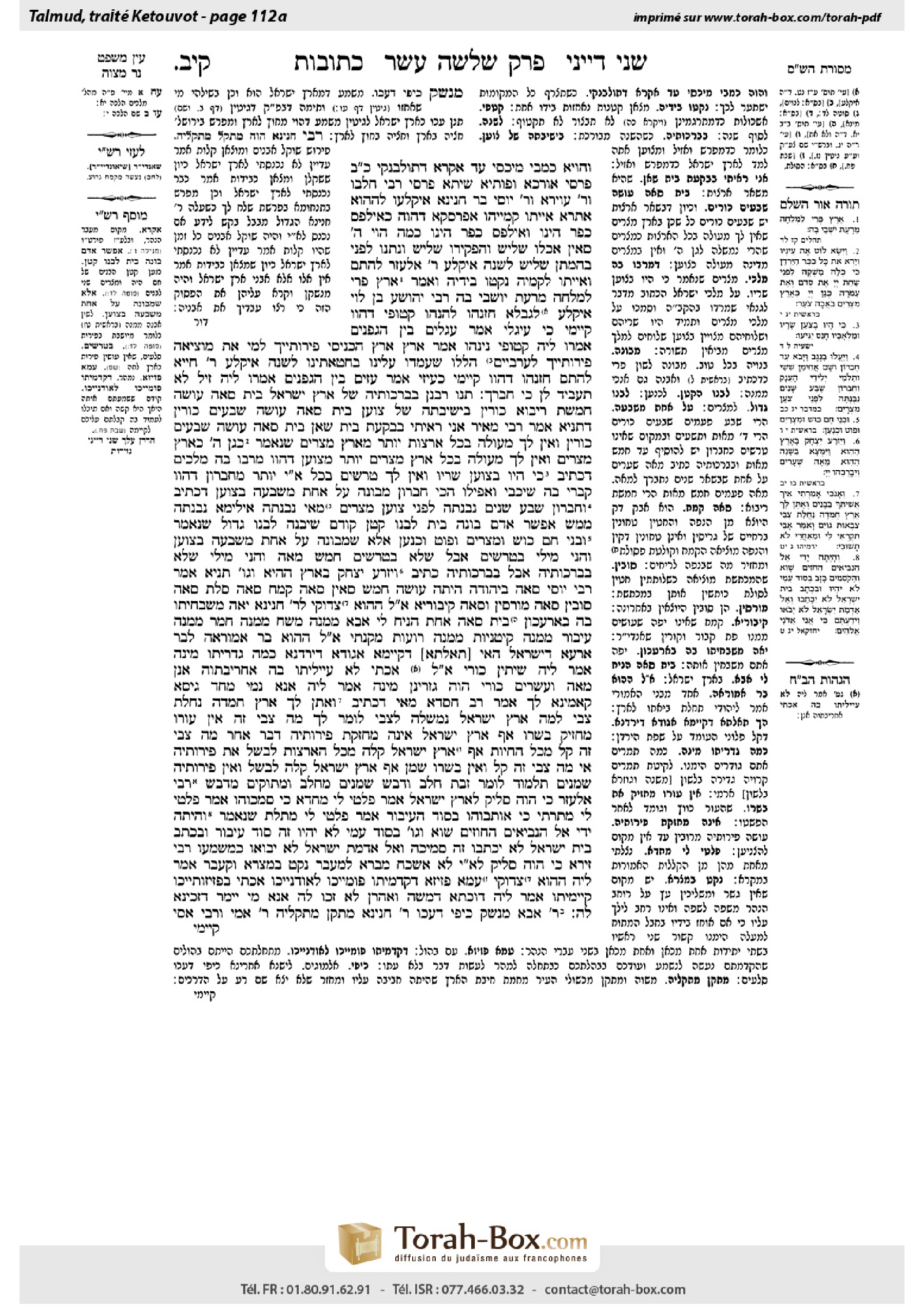
כתובות קי״ב א · Aramaic and Hebrew text
וְהָוְיָא כְּמִבֵּי מִיכְסֵי עַד אַקְרָא דְתוּלְבַּנְקֵי, עֶשְׂרִין וְתַרְתֵּין פַּרְסֵי אוּרְכָּא וּפוּתְיָא שִׁיתָּא פַּרְסֵי.
רַבִּי חֶלְבּוֹ וְרַבִּי עַוִּירָא וְרַבִּי יוֹסֵי בַּר חֲנִינָא אִיקְּלַעוּ לְהָהוּא אַתְרָא. אַיְיתוֹ קַמַּיְיהוּ אֲפַרְסְקָא דַּהֲוָה כְּאִילְפַּס כְּפַר הִינוֹ. וְאִילְפַּס כְּפַר הִינוֹ כַּמָּה הָוֵי — חָמֵשׁ סְאִין. אָכְלוּ שְׁלִישׁ, וְהִפְקִירוּ שְׁלִישׁ, וְנָתְנוּ לִפְנֵי בְּהֶמְתָּן שְׁלִישׁ.
לְשָׁנָה אִיקְּלַע רַבִּי אֶלְעָזָר לְהָתָם וְאַיְיתוֹ לְקַמֵּיהּ (נְקַטוּ) [נַקְטֵיהּ] בִּידֵיהּ, וְאָמַר: ״אֶרֶץ פְּרִי לִמְלֵחָה מֵרָעַת יוֹשְׁבֵי בָהּ״.
רַבִּי יְהוֹשֻׁעַ בֶּן לֵוִי אִיקְּלַע לְגַבְלָא, חֲזַנְהוּ לְהָנְהוּ קִטּוּפֵי דַּהֲווֹ קָיְימִי כִּי עִיגְלֵי, אָמַר: עֲגָלִים בֵּין הַגְּפָנִים? אֲמַרוּ לֵיהּ: קִטּוּפֵי נִינְהוּ. אָמַר: אֶרֶץ אֶרֶץ, הַכְנִיסִי פֵּירוֹתַיִיךְ, לְמִי אַתְּ מוֹצִיאָה פֵּירוֹתַיִיךְ, לְגוֹיִם הַלָּלוּ שֶׁעָמְדוּ עָלֵינוּ בְּחַטֹּאתֵינוּ?
לְשָׁנָה אִיקְּלַע רַבִּי חִיָּיא לְהָתָם, חֲזַנְהוּ דַּהֲווֹ קָיְימִי כְּעִיזֵּי, אָמַר: עִזִּים בֵּין הַגְּפָנִים? אֲמַרוּ לֵיהּ: זִיל, לָא תַּעֲבֵיד לַן כִּי חַבְרָךְ.
תָּנוּ רַבָּנַן: בְּבִרְכוֹתֶיהָ שֶׁל אֶרֶץ יִשְׂרָאֵל — בֵּית סְאָה עוֹשָׂה חֲמֵשֶׁת רִיבּוֹא כּוֹרִין, בִּישִׁיבָתָהּ שֶׁל צוֹעַן — בֵּית סְאָה עוֹשָׂה שִׁבְעִים כּוֹרִין. דְּתַנְיָא, אָמַר רַבִּי מֵאִיר: אֲנִי רָאִיתִי בְּבִקְעַת בֵּית שְׁאָן בֵּית סְאָה עוֹשָׂה שִׁבְעִים כּוֹרִין.
וְאֵין לְךָ מְעוּלָּה בְּכׇל אֲרָצוֹת יוֹתֵר מֵאֶרֶץ מִצְרַיִם, שֶׁנֶּאֱמַר: ״כְּגַן ה׳ כְּאֶרֶץ מִצְרַיִם״. וְאֵין לְךָ מְעוּלָּה בְּכׇל אֶרֶץ מִצְרַיִם יוֹתֵר מִצּוֹעַן — דַּהֲווֹ מְרַבּוּ בַּהּ מְלָכִים, דִּכְתִיב: ״כִּי הָיוּ בְצוֹעַן שָׂרָיו״. וְאֵין לְךָ טְרָשִׁים בְּכׇל אֶרֶץ יִשְׂרָאֵל יוֹתֵר מֵחֶבְרוֹן, דַּהֲווֹ קָבְרִי בָּהּ שָׁיכְבֵי.
וַאֲפִילּוּ הָכִי, חֶבְרוֹן מְבוּנָּה עַל אַחַת מִשִּׁבְעָה בְּצוֹעַן, דִּכְתִיב: ״וְחֶבְרוֹן שֶׁבַע שָׁנִים נִבְנְתָה לִפְנֵי צוֹעַן מִצְרָיִם״, מַאי ״נִבְנְתָה״? אִילֵימָא נִבְנְתָה מַמָּשׁ, אֶפְשָׁר אָדָם בּוֹנֶה בַּיִת לִבְנוֹ קָטָן קוֹדֶם שֶׁיִּבְנֶה לִבְנוֹ גָּדוֹל? שֶׁנֶּאֱמַר: ״וּבְנֵי חָם כּוּשׁ וּמִצְרַיִם וּפוּט וּכְנָעַן״!
אֶלָּא שֶׁמְּבוּנָּה עַל אַחַת מִשִּׁבְעָה בְּצוֹעֵן. וְהָנֵי מִילֵּי בִּטְרָשִׁים, אֲבָל שֶׁלֹּא בִּטְרָשִׁים — חֲמֵשׁ מְאָה.
וְהָנֵי מִילֵּי שֶׁלֹּא בְּבִרְכוֹתֶיהָ, אֲבָל בְּבִרְכוֹתֶיהָ, כְּתִיב: ״וַיִּזְרַע יִצְחָק בָּאָרֶץ הַהִיא וְגוֹ׳״.
תַּנְיָא, אָמַר רַבִּי יוֹסֵי: סְאָה בִּיהוּדָה הָיְתָה עוֹשָׂה חָמֵשׁ סְאִין: סְאָה קֶמַח, סְאָה סֹלֶת, סְאָה סוּבִּין, סְאָה מוּרְסִין, וּסְאָה קִיבּוֹרְיָא. אֲמַר לֵיהּ הָהוּא צַדּוּקִי לְרַבִּי חֲנִינָא: יָאֵה מְשַׁבְּחִיתוּ בַּהּ בְּאַרְעֲכוֹן. בֵּית סְאָה אַחַת הִנִּיחַ לִי אַבָּא, מִמֶּנָּה מְשַׁח, מִמֶּנָּה חֲמַר, מִמֶּנָּה עִיבוּר, מִמֶּנָּה קִיטְנִיּוֹת, מִמֶּנָּה רוֹעוֹת מִקְנָתִי.
אֲמַר לֵיהּ הָהוּא בַּר אֱמוֹרָאָה לְבַר אַרְעָא דְיִשְׂרָאֵל: הַאי [תָּאלְתָּא] דְּקָיְימָא אַגּוּדָּא דְיַרְדְּנָא כַּמָּה גָּדְרִיתוּ מִינַּהּ? אֲמַר לֵיהּ: שִׁיתִּין כּוֹרֵי. אֲמַר לֵיהּ: אַכַּתִּי לָא עָיְילִיתוּ בָּהּ אַחְרֵיבְתּוּהָ, אֲנַן מְאָה וְעֶשְׂרִים כּוֹרֵי הֲוָה גָּזְרִינַן מִינַּהּ. אֲמַר לֵיהּ: אֲנָא נָמֵי מֵחַד גִּיסָא קָאָמֵינָא לָךְ.
אָמַר רַב חִסְדָּא, מַאי דִּכְתִיב: ״וְאֶתֶּן לָךְ אֶרֶץ חֶמְדָּה נַחֲלַת צְבִי״, לָמָּה אֶרֶץ יִשְׂרָאֵל נִמְשְׁלָה לִצְבִי? לוֹמַר לְךָ: מָה צְבִי זֶה אֵין עוֹרוֹ מַחֲזִיק בְּשָׂרוֹ, אַף אֶרֶץ יִשְׂרָאֵל אֵינָהּ מַחְזֶקֶת פֵּירוֹתֶיהָ. דָּבָר אַחֵר: מָה צְבִי זֶה קַל מִכׇּל הַחַיּוֹת, אַף אֶרֶץ יִשְׂרָאֵל קַלָּה מִכׇּל הָאֲרָצוֹת לְבַשֵּׁל אֶת פֵּירוֹתֶיהָ.
אִי מָה צְבִי זֶה קַל וְאֵין בְּשָׂרוֹ שָׁמֵן — אַף אֶרֶץ יִשְׂרָאֵל קַלָּה לְבַשֵּׁל וְאֵין פֵּירוֹתֶיהָ שְׁמֵנִים, תַּלְמוּד לוֹמַר: ״זָבַת חָלָב וּדְבָשׁ״, שְׁמֵנִים מֵחָלָב וּמְתוּקִים מִדְּבַשׁ.
רַבִּי אֶלְעָזָר כִּי הֲוָה סָלֵיק לְאֶרֶץ יִשְׂרָאֵל, אָמַר: פְּלַטִי לִי מֵחֲדָא. כִּי סַמְכוּהוּ, אֲמַר: פְּלַטִי לִי מִתַּרְתֵּי. כִּי אוֹתְבוּהוּ בְּסוֹד הָעִיבּוּר, אֲמַר: פְּלַטִי לִי מִתְּלָת,
שֶׁנֶּאֱמַר: ״וְהָיְתָה יָדִי אֶל הַנְּבִיאִים הַחוֹזִים שָׁוְא וְגוֹ׳״. ״בְּסוֹד עַמִּי לֹא יִהְיוּ״ — זֶה סוֹד עִיבּוּר. ״וּבִכְתָב בֵּית יִשְׂרָאֵל לֹא יִכָּתֵבוּ״ — זֶה סְמִיכָה. ״וְאֶל אַדְמַת יִשְׂרָאֵל לֹא יָבוֹאוּ״ — כְּמַשְׁמָעוֹ.
רַבִּי זֵירָא כִּי הֲוָה סָלֵיק לְאֶרֶץ יִשְׂרָאֵל לָא אַשְׁכַּח מַבָּרָא לְמֶעְבַּר, נְקַט בְּמִצְרָא וְקָעָבַר. אֲמַר לֵיהּ הָהוּא צַדּוּקִי: עַמָּא פְּזִיזָא, דְּקַדְּמִיתוּ פּוּמַּיְיכוּ לְאוּדְנַיְיכוּ, אַכַּתִּי בִּפְזִיזוּתַיְיכוּ קָיְימִיתוּ? אֲמַר לֵיהּ: דּוּכְתָּא דְּמֹשֶׁה וְאַהֲרֹן לָא זְכוֹ לַהּ, אֲנָא מִי יֵימַר דְּזָכֵינָא לַהּ.
רַבִּי אַבָּא מְנַשֵּׁק כֵּיפֵי דְעַכּוֹ. רַבִּי חֲנִינָא מְתַקֵּן מַתְקָלַיָּה. רַבִּי אַמֵּי וְרַבִּי אַסִּי
Ketubot 112a · English translation
and it was the same in area as that which stretches from the city of Bei Mikhsei until the fortress of Tulbanki: Its length twenty-two parasangs and its width six parasangs, 132 square parasangs, which is 2,112 square mil.
§ The Gemara relates that Rabbi Ḥelbo, Rabbi Avira, and Rabbi Yosei bar Ḥanina happened to come on one occasion to a certain place. The locals brought before these Sages a peach [afarseka] that was as large as a stewpot [ilpas] of Kefar Hino. The Gemara asks: And how big is a stewpot of Kefar Hino? The Gemara answers: It has a capacity of five se’a. They ate one-third of it, they declared ownerless one-third of it, and they placed before their animals one-third of it.
In the following year, Rabbi Elazar happened to come to that same place, and they brought a peach before him. He held it in his hand, as the peach was small enough for him to grasp in one hand, and he said, in reference to the change in size of the fruit from the previous year: “A fruitful land into a salt waste, from the wickedness of they who dwell there” (Psalms 107:34), i.e., their sins caused the drastic change in the yield of the produce.
§ Once Rabbi Yehoshua ben Levi happened to come to Gavla, in the Golan, and he saw those clusters of vines that were standing as large as calves. He said to the locals: Calves are standing between the grapevines and you are not concerned that they will cause damage? They said to him: They are clusters. Rabbi Yehoshua ben Levi said: O earth, O earth! Gather in your fruit. For whom do you produce your fruit? For these gentiles who stand over us in our sins? It would be preferable if you did not produce such large fruit.
The following year, Rabbi Ḥiyya happened to come to that same place, and he saw clusters that were standing as large as goats. He said: Goats are standing between the grapevines. They said to him: Go away; do not do to us what your colleague has done. Rabbi Yehoshua ben Levi’s curse was already fulfilled, as the fruit had shrunk from the previous year.
§ The Sages taught: In years of blessings of Eretz Yisrael, an area of land measuring one beit se’a produces fifty thousand kor. By way of comparison, when Zoan, a fertile region in Egypt, was settled, one beit se’a there would produce only seventy kor. As it is taught in a baraita that Rabbi Meir said: I saw in the valley of Beit She’an that one beit se’a produced seventy kor, which teaches that the soil of a good-quality and irrigated stretch of land outside the borders of Eretz Yisrael will naturally yield this quantity of produce.
And you have no more outstanding earth among all the lands other than the land of Egypt, as it is stated: “Like the garden of the Lord, like the land of Egypt” (Genesis 13:10). And you have no more outstanding region in all of the land of Egypt than Zoan. The superior quality of Zoan is derived from the fact that they would raise kings there, as it is written: “For his princes are at Zoan” (Isaiah 30:4). And you have no rockier terrain in all of Eretz Yisrael than Hebron, as people would bury their dead there, e.g., the Patriarchs in the Cave of Machpelah, because the land was not arable.
And even so, Hebron was more developed, i.e., more fertile, than Zoan by sevenfold, as it is written: “Now Hebron was built [nivneta] seven years before Zoan in Egypt” (Numbers 13:22). What is the meaning of the term: Nivneta, in this verse? If we say it means literally that Hebron was built before Zoan, would a person build a house for his younger son before building one for his older son? As it is stated: “And the sons of Ham: Cush, and Mizraim, and Put, and Canaan” (Genesis 10:6), which indicates that Egypt, Mizraim, was older than Canaan, in whose territory Hebron was located.
Rather, the meaning of the verse is that Hebron was more developed and more fertile than Zoan by sevenfold, which means that Hebron produced 490 kor, seven times more than the seventy kor of regular fertile land, as stated above. And this applies only to the rocky terrain of Eretz Yisrael, e.g., Hebron, whereas those parts of Eretz Yisrael that were not rocky produced even more, up to five hundred kor.
And this applies only to a year when Eretz Yisrael is not blessed. However, with regard to a year when it was blessed, it is written: “And Isaac sowed in that land, and found in the same year a hundredfold” (Genesis 26:12). Isaac’s field produced one hundred times the normal yield, which according to the above calculations is fifty thousand kor, as stated in the baraita.
§ It is taught in a baraita that Rabbi Yosei said: A se’a of wheat in Judea would produce five se’a. How so? It would yield a se’a of flour; a se’a of fine flour; a se’a of bran fiber, from the outer layer of the grain; a se’a of coarse bran, i.e., flour mixed with bran fiber; and a se’a of cibarium [kiburaya], inferior flour. A certain Sadducee said to Rabbi Ḥanina: You have done well in praising your land; my father left me one beit se’a of land in Eretz Yisrael and from it I am able to produce oil, from it I produce wine, from it I grow produce, from it I grow legumes, and with it I provide pasture from which my sheep graze.
A certain Amorite once said to a resident of Eretz Yisrael: That palm tree which stands on the banks of the Jordan, how many dates are you able to pick from it? He said to him: Sixty kor. The Amorite said to him: You have not yet fully entered Eretz Yisrael and yet you have already succeeded in destroying it. We would pick off that tree 120 kor. The resident said to him: I too am speaking to you about only one side of the tree, as I have not yet picked the fruit off the other side.
§ Rav Ḥisda said: What is the meaning of that which is written: “And give you a pleasant land, the goodliest [tzvi] heritage” (Jeremiah 3:19)? Why is Eretz Yisrael likened to a deer [tzvi]? This comparison comes to tell you that just as with regard to this deer, its skin cannot contain its meat once it has been skinned, so too, Eretz Yisrael cannot contain its fruit once it has been picked, due to the great quantity of the produce. Alternatively, just as this deer is swifter than all the other beasts, so too Eretz Yisrael is swifter to ripen its fruit than all the other countries.
The Gemara asks: If so, one can suggest the following comparison: Just as this deer is swift and its meat is not fatty, so too, Eretz Yisrael is swift to ripen its fruit but its fruit is not fat and juicy. The Gemara explains: For this reason the verse states: “Flowing with milk and honey” (Exodus 3:8), to say that its fruit is fat and juicier than milk and sweeter than honey.
§ The Gemara relates that when Rabbi Elazar ascended to Eretz Yisrael he said: I have been spared one curse. When they ordained him and awarded him the title of Rabbi, he said: I have been spared two. When they appointed him to sit in the council of Sages who dealt with the intercalation of the calendar, he said: I have been spared three.
As it is stated: “And My hand shall be against the prophets that see vanity, and that divine lies; they shall not be in the council of My people, neither shall they be written in the register of the house of Israel, neither shall they enter into the land of Israel; and you shall know that I am the Lord God” (Ezekiel 13:9). “They shall not be in the council of My people,” this is referring to the council of the intercalation of the calendar; “neither shall they be written in the register of the house of Israel,” this is referring to ordination; “neither shall they enter into the land of Israel,” this is understood as per its plain meaning. Rabbi Elazar merited that these three curses were not fulfilled in him.
§ When Rabbi Zeira ascended to Eretz Yisrael he could not find a ferry to cross the Jordan River. He took hold of a rope that was strung across as a makeshift bridge and crossed the Jordan. A certain Sadducee said to him: Hasty people who put your mouths before your ears, when you said at the time of the giving of the Torah: “We will do” before “we will hear” (Exodus 24:7), you remain hasty to this day. Why couldn’t you wait a little longer to cross the river on a ferry? Rabbi Zeira said to him: This is a place where Moses and Aaron did not merit entering; who is to say that I will merit seeing this land? I hurried across before anything might occur to prevent my entrance into Eretz Yisrael.
§ Rabbi Abba would kiss the rocks of Akko, which was on the coast of Eretz Yisrael. Rabbi Ḥanina would repair its stumbling blocks, i.e., any potholes in the land, so that travelers would not fall and consequently speak ill of Eretz Yisrael. Rabbi Ammi and Rabbi Asi
Ketubot 112a · Traduction française (IA)
et sa superficie était égale à celle de la région qui s’étend de la ville de Bei Mikhsei jusqu’à la forteresse de Tulbanki : vingt-deux parasanges de long et six parasanges de large, soit 132 parasanges carrées, ce qui équivaut à 2 112 mil carrés.
§ La Guemara rapporte que Rabbi Ḥelbo, Rabbi Avira et Rabbi Yosei bar Ḥanina arrivèrent un jour par hasard dans un certain endroit. Les habitants apportèrent à ces Sages une pêche [afarseka] aussi grosse qu’une marmite [ilpas] de Kefar Hino. La Guemara demande : quelle est la contenance d’une marmite de Kefar Hino ? La Guemara répond : cinq séa. Ils en mangèrent un tiers, déclarèrent un tiers sans propriétaire et donnèrent un tiers à leurs animaux.
L’année suivante, Rabbi Elazar arriva par hasard au même endroit, et on lui apporta une pêche. Il la prit dans sa main, car elle était assez petite pour tenir dans une seule main, et dit, faisant référence au changement de taille du fruit depuis l’année précédente : « Une terre fertile changée en désert salé, à cause de la méchanceté de ses habitants » (Psaumes 107:34). Autrement dit, leurs péchés avaient entraîné une diminution drastique du rendement des récoltes.
§ Un jour, Rabbi Yehoshua ben Levi arriva par hasard à Gavla, dans le Golan, et vit des grappes de raisin qui étaient aussi grosses que des veaux. Il dit aux habitants : « Des veaux se tiennent entre les vignes, et vous ne craignez pas qu’ils causent des dégâts ? » Ils lui répondirent : « Ce sont des grappes. » Rabbi Yehoshua ben Levi dit : « Ô terre, ô terre ! Retiens tes fruits ! Pour qui produis-tu tes fruits ? Pour ces non-Juifs qui nous dominent à cause de nos péchés ? Il vaudrait mieux que tu ne produises pas de fruits aussi gros. »
L’année suivante, Rabbi Ḥiyya arriva par hasard au même endroit et vit des grappes aussi grosses que des chèvres. Il dit : « Des chèvres se tiennent entre les vignes. » Ils lui répondirent : « Va-t’en ; ne nous fais pas subir ce que ton collègue nous a fait. » La malédiction de Rabbi Yehoshua ben Levi s’était déjà réalisée, car les fruits avaient diminué depuis l’année précédente.
§ Les Sages ont enseigné : durant les années où Eretz Yisrael est bénie, une parcelle d’une superficie d’un beit séa produit cinquante mille kor. À titre de comparaison, lorsque Zoan, une région fertile d’Égypte, était habitée, un beit séa y produisait seulement soixante-dix kor. En effet, il est enseigné dans une baraïta que Rabbi Meir a dit : « J’ai vu, dans la vallée de Beit She’an, qu’un beit séa produisait soixante-dix kor. » Cela nous enseigne que le sol d’une parcelle de bonne qualité, irriguée et située hors des frontières d’Eretz Yisrael, produit naturellement cette quantité de récoltes.
Et parmi toutes les terres, aucune n’est plus remarquable que la terre d’Égypte, comme il est dit : « Comme le jardin de l’Éternel, comme le pays d’Égypte » (Genèse 13:10). Et, dans tout le pays d’Égypte, aucune région n’est plus remarquable que Zoan. La qualité supérieure de Zoan ressort du fait qu’on y élevait des rois, comme il est écrit : « Car ses princes sont à Zoan » (Isaïe 30:4). Et, dans tout Eretz Yisrael, aucun terrain n’est plus rocailleux que celui d’Hébron. On y enterrait les morts, comme les Patriarches dans la grotte de Makhpéla, parce que cette terre n’était pas cultivable.
Et pourtant, Hébron était sept fois plus développée, c’est-à-dire plus fertile, que Zoan, comme il est écrit : « Hébron fut bâtie [nivneta] sept ans avant Zoan, en Égypte » (Nombres 13:22). Que signifie ici le terme « nivneta » ? Si l’on dit qu’il signifie littéralement qu’Hébron fut bâtie avant Zoan, un homme bâtirait-il une maison pour son fils cadet avant d’en bâtir une pour son fils aîné ? En effet, il est dit : « Les fils de Ḥam : Koush, Mitsraïm, Pout et Canaan » (Genèse 10:6), ce qui indique que l’Égypte, Mitsraïm, était plus ancienne que Canaan, dont le territoire comprenait Hébron.
Le sens du verset est plutôt qu’Hébron était sept fois plus développée et plus fertile que Zoan, ce qui signifie qu’elle produisait 490 kor, soit sept fois plus que les soixante-dix kor d’une terre fertile ordinaire, comme indiqué plus haut. Cela ne s’applique qu’aux terrains rocailleux d’Eretz Yisrael, comme celui d’Hébron, tandis que les régions d’Eretz Yisrael qui n’étaient pas rocailleuses produisaient encore davantage, jusqu’à cinq cents kor.
Cela ne s’applique qu’à une année où Eretz Yisrael n’est pas bénie. En revanche, à propos d’une année où elle fut bénie, il est écrit : « Isaac sema dans ce pays et recueillit cette année-là au centuple » (Genèse 26:12). Le champ d’Isaac produisit cent fois le rendement normal, soit, selon les calculs précédents, cinquante mille kor, comme l’enseigne la baraïta.
§ Il est enseigné dans une baraïta que Rabbi Yosei a dit : « Un séa de blé en Judée produisait cinq séa. » Comment cela ? Il donnait un séa de farine, un séa de farine fine, un séa de son provenant de l’enveloppe extérieure du grain, un séa de son grossier, c’est-à-dire de farine mêlée à du son, et un séa de farine de qualité inférieure [kiburaya]. Un certain Sadducéen dit à Rabbi Ḥanina : « Vous avez bien fait de louer votre pays. Mon père m’a laissé un beit séa de terre en Eretz Yisrael ; j’en tire de l’huile, j’y produis du vin, j’y cultive des récoltes et des légumineuses, et j’y trouve des pâturages où paissent mes moutons. »
Un jour, un certain Amoréen dit à un habitant d’Eretz Yisrael : « Ce palmier qui se trouve sur les rives du Jourdain, combien de dattes peux-tu en cueillir ? » Il lui répondit : « Soixante kor. » L’Amoréen lui dit : « Tu n’as pas encore pénétré bien loin en Eretz Yisrael que tu as déjà réussi à l’épuiser. Nous cueillions cent vingt kor sur cet arbre. » L’habitant lui répondit : « Moi aussi, je ne te parle que d’un seul côté de l’arbre, car je n’ai pas encore cueilli les fruits de l’autre côté. »
§ Rav Ḥisda dit : « Quel est le sens de ce qui est écrit : “Je vous donnerai un pays agréable, le plus beau des héritages [tzvi]” (Jérémie 3:19) ? Pourquoi Eretz Yisrael est-elle comparée à une biche [tzvi] ? Cette comparaison vient t’enseigner que, de même que la peau de la biche ne peut contenir sa chair une fois qu’elle a été dépouillée, de même Eretz Yisrael ne peut contenir ses fruits une fois qu’ils ont été cueillis, tant la récolte est abondante. Autre explication : de même que cette biche est plus rapide que toutes les autres bêtes, de même Eretz Yisrael fait mûrir ses fruits plus rapidement que tous les autres pays. »
La Guemara demande : Si tel est le cas, on pourrait proposer la comparaison suivante : de même que cette biche est rapide et que sa chair n’est pas grasse, de même Eretz Yisrael fait mûrir rapidement ses fruits, mais ceux-ci ne sont ni gras ni juteux. La Guemara explique : C’est pourquoi le verset dit : « Ruisselant de lait et de miel » (Exode 3:8), pour enseigner que ses fruits sont gras et plus juteux que le lait, et plus doux que le miel.
§ La Guemara rapporte que, lorsque Rabbi Elazar monta en Eretz Yisrael, il dit : « J’ai échappé à une malédiction. » Lorsqu’on lui conféra l’ordination et le titre de Rabbi, il dit : « J’ai échappé à deux malédictions. » Lorsqu’on le nomma pour siéger au conseil des Sages chargé de l’intercalation du calendrier, il dit : « J’ai échappé à trois malédictions. »
Comme il est écrit : « Ma main s’élèvera contre les prophètes qui ont des visions de néant et profèrent des mensonges ; ils ne feront pas partie du conseil de mon peuple, ils ne seront pas inscrits dans le registre de la maison d’Israël et ils n’entreront pas dans la terre d’Israël ; et vous saurez que je suis le Seigneur Dieu » (Ézéchiel 13:9). « Ils ne feront pas partie du conseil de mon peuple » fait référence au conseil chargé de l’intercalation du calendrier ; « ils ne seront pas inscrits dans le registre de la maison d’Israël » fait référence à l’ordination ; « ils n’entreront pas dans la terre d’Israël » s’entend dans son sens littéral. Rabbi Elazar mérita que ces trois malédictions ne se réalisent pas pour lui.
§ Lorsque Rabbi Zeira monta en Eretz Yisrael, il ne trouva pas de bac pour traverser le Jourdain. Il s’agrippa à une corde tendue en guise de pont de fortune et traversa le Jourdain. Un certain Sadducéen lui dit : « Gens pressés, qui mettez votre bouche avant vos oreilles ! Lorsque vous avez dit, au moment du don de la Torah, “Nous ferons” avant “nous écouterons” (Exode 24:7), vous êtes encore pressés à ce jour. Pourquoi ne pouvais-tu pas attendre un peu plus longtemps et traverser le fleuve en bac ? » Rabbi Zeira lui répondit : « C’est un lieu où Moïse et Aaron n’ont pas mérité d’entrer ; qui peut dire que, moi, je mériterai de voir ce pays ? J’ai traversé à la hâte, avant qu’il ne se produise quoi que ce soit qui puisse m’empêcher d’entrer en Eretz Yisrael. »
§ Rabbi Abba embrassait les rochers d’Akko, située sur la côte d’Eretz Yisrael. Rabbi Ḥanina réparait les obstacles sur les routes, c’est-à-dire les nids-de-poule, afin que les voyageurs ne tombent pas et ne parlent pas ensuite en mal d’Eretz Yisrael. Rabbi Ammi et Rabbi Asi
Traduction française générée par IA à partir de l’édition anglaise de Sefaria. Vérifie toujours un passage avec le texte source.
Text from Sefaria: William Davidson Edition - Vocalized Aramaic (CC BY NC); William Davidson Edition - English (CC BY NC).