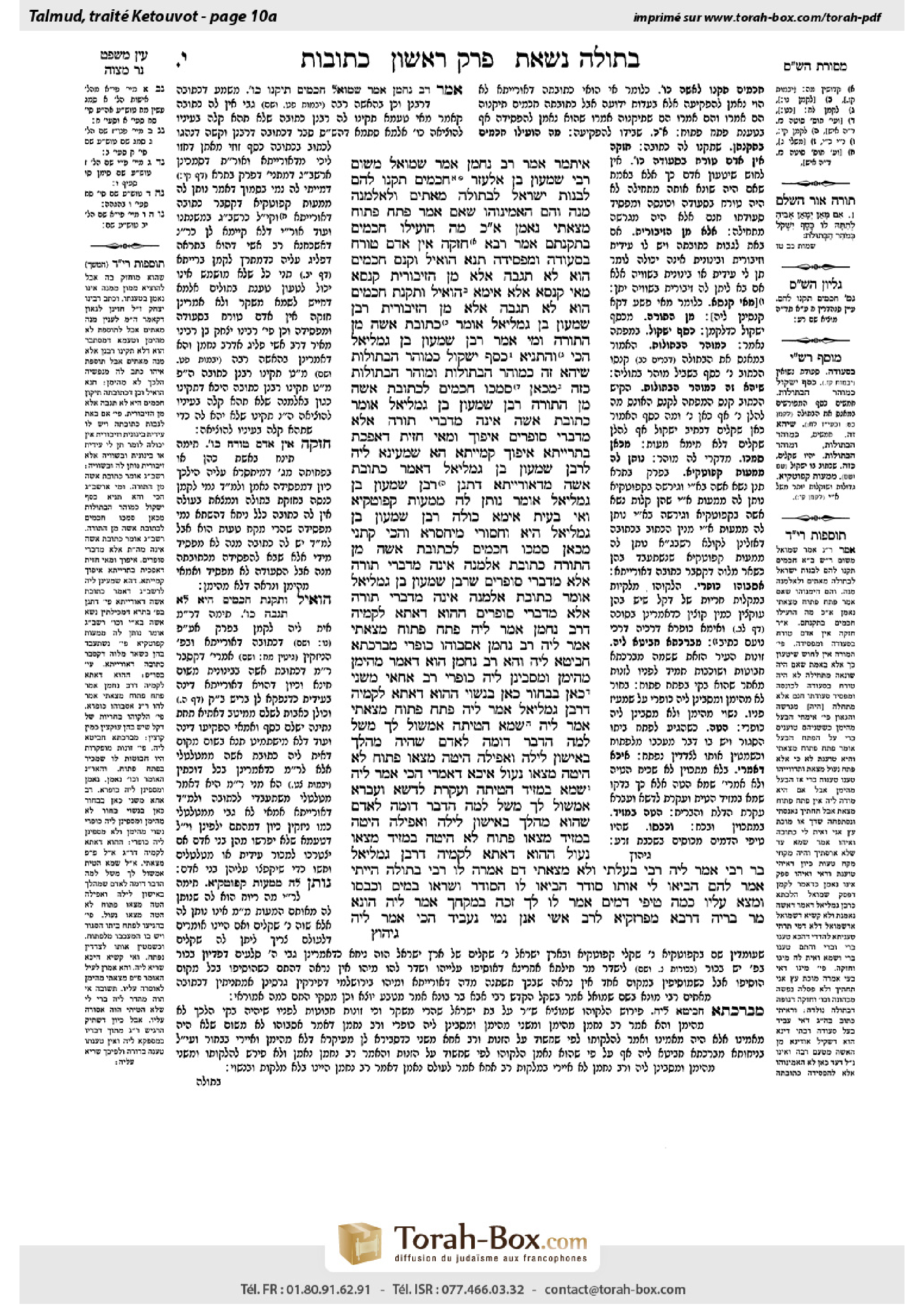
Ketubot 10a: Talmud study for Daf Yomi
Daf Yomi is the daily study of one Talmud folio. Explore 37 tractates with scans, Hebrew text, Sefaria English and AI-generated French translations where annotated.
Passage selection and English or AI-generated French translation are available where the scan has annotations. Daf Study is independent of Torah-Box and Sefaria.
Browse Ketubot · כתובות · All tractatesKetubot 10a text and translations
This page of Ketubot includes the Aramaic text, an English translation and an AI-generated French translation, alongside the scan above.
כתובות י׳ א · Aramaic and Hebrew text
אִיתְּמַר, אָמַר רַב נַחְמָן אָמַר שְׁמוּאֵל מִשּׁוּם רַבִּי שִׁמְעוֹן בֶּן אֶלְעָזָר: חֲכָמִים תִּקְּנוּ לָהֶם לִבְנוֹת יִשְׂרָאֵל, לִבְתוּלָה מָאתַיִם, וּלְאַלְמָנָה מָנֶה. וְהֵם הֶאֱמִינוּהוּ, שֶׁאִם אָמַר ״פֶּתַח פָּתוּחַ מָצָאתִי״ — נֶאֱמָן. אִם כֵּן — מָה הוֹעִילוּ חֲכָמִים בְּתַקָּנָתָם?
אָמַר רָבָא: חֲזָקָה, אֵין אָדָם טוֹרֵחַ בַּסְּעוּדָה וּמַפְסִידָהּ.
תָּנָא: הוֹאִיל וּקְנַס חֲכָמִים הוּא — לֹא תִּגְבֶּה אֶלָּא מִן הַזִּיבּוּרִית. קְנָסָא? מַאי קְנָסָא?! אֶלָּא אֵימָא: הוֹאִיל וְתַקָּנַת חֲכָמִים הוּא — לֹא תִּגְבֶּה אֶלָּא מִן הַזִּיבּוּרִית. רַבָּן שִׁמְעוֹן בֶּן גַּמְלִיאֵל אוֹמֵר: כְּתוּבַּת אִשָּׁה מִן הַתּוֹרָה.
וּמִי אָמַר רַבָּן שִׁמְעוֹן בֶּן גַּמְלִיאֵל הָכִי? וְהָתַנְיָא: ״כֶּסֶף יִשְׁקֹל כְּמֹהַר הַבְּתוּלוֹת״: שֶׁיְּהֵא זֶה, כְּמוֹהַר הַבְּתוּלוֹת, וּמוֹהַר הַבְּתוּלוֹת כָּזֶה. מִכָּאן סָמְכוּ חֲכָמִים לִכְתוּבַּת אִשָּׁה מִן הַתּוֹרָה. רַבָּן שִׁמְעוֹן בֶּן גַּמְלִיאֵל אוֹמֵר: כְּתוּבַּת אִשָּׁה אֵינָהּ מִדִּבְרֵי תוֹרָה, אֶלָּא מִדִּבְרֵי סוֹפְרִים!
אֵיפוֹךְ. וּמַאי חָזֵית דְּאָפְכַתְּ בָּתְרָיְיתָא, אֵיפוֹךְ קַמַּיְיתָא?
הָא שָׁמְעִינַן לֵיהּ לְרַבָּן שִׁמְעוֹן בֶּן גַּמְלִיאֵל דְּאָמַר כְּתוּבַּת אִשָּׁה מִדְּאוֹרָיְיתָא. דִּתְנַן, רַבָּן שִׁמְעוֹן בֶּן גַּמְלִיאֵל אוֹמֵר — נוֹתֵן לָהּ מִמְּעוֹת קַפּוֹטְקְיָא.
וְאִי בָּעֵית אֵימָא: כּוּלָּהּ רַבָּן שִׁמְעוֹן בֶּן גַּמְלִיאֵל הִיא, וְחַסּוֹרֵי מִיחַסְּרָא, וְהָכִי קָתָנֵי: מִכָּאן סָמְכוּ חֲכָמִים לִכְתוּבַּת אִשָּׁה מִן הַתּוֹרָה. כְּתוּבַּת אַלְמָנָה אֵינָהּ מִדִּבְרֵי תוֹרָה, אֶלָּא מִדִּבְרֵי סוֹפְרִים, שֶׁרַבָּן שִׁמְעוֹן בֶּן גַּמְלִיאֵל אוֹמֵר: כְּתוּבַּת אַלְמָנָה אֵינָהּ מִדִּבְרֵי תוֹרָה, אֶלָּא מִדִּבְרֵי סוֹפְרִים.
הַהוּא דַּאֲתָא לְקַמֵּיהּ דְּרַב נַחְמָן, אֲמַר לֵיהּ: פֶּתַח פָּתוּחַ מָצָאתִי. אֲמַר לֵיהּ רַב נַחְמָן: אַסְּבוּהוּ כּוּפְרֵי, מְבָרַכְתָּא חֲבִיטָא לֵיהּ?
וְהָא רַב נַחְמָן הוּא דְּאָמַר מְהֵימַן! מְהֵימַן, וּמַסְּבִינַן לֵיהּ כּוּפְרֵי. רַב אַחַאי מְשַׁנֵּי: כָּאן בְּבָחוּר, כָּאן בְּנָשׂוּי.
הַהוּא דַּאֲתָא לְקַמֵּיהּ דְּרַבָּן גַּמְלִיאֵל, אֲמַר לֵיהּ: פֶּתַח פָּתוּחַ מָצָאתִי. אֲמַר לֵיהּ: שֶׁמָּא הִטֵּיתָהּ? אֶמְשׁוֹל לְךָ מָשָׁל: לְמָה הַדָּבָר דּוֹמֶה? לְאָדָם שֶׁהָיָה מְהַלֵּךְ בְּאִישׁוֹן לַיְלָה וַאֲפֵילָה, הִיטָּה — מְצָאוֹ פָּתוּחַ, לֹא הִיטָּה — מְצָאוֹ נָעוּל.
אִיכָּא דְּאָמְרִי, הָכִי אֲמַר לֵיהּ: שֶׁמָּא בְּמֵזִיד הִטֵּיתָהּ, וַעֲקַרְתְּ לְדַשָּׁא וְעָבְרָא? אֶמְשׁוֹל לְךָ מָשָׁל: לְמָה הַדָּבָר דּוֹמֶה? לְאָדָם שֶׁהוּא מְהַלֵּךְ בְּאִישׁוֹן לַיְלָה וַאֲפֵילָה, הִיטָּה בְּמֵזִיד — מְצָאוֹ פָּתוּחַ, לֹא הִיטָּה בְּמֵזִיד — מְצָאוֹ נָעוּל.
הַהוּא דַּאֲתָא לְקַמֵּיהּ דְּרַבָּן גַּמְלִיאֵל בַּר רַבִּי, אֲמַר לֵיהּ: רַבִּי, בָּעַלְתִּי וְלֹא מָצָאתִי דָּם. אָמְרָה לוֹ: רַבִּי, בְּתוּלָה הָיִיתִי. אָמַר לָהֶם: הָבִיאוּ לִי אוֹתוֹ סוּדָר. הֵבִיאוּ לוֹ הַסּוּדָר, וּשְׁרָאוֹ בְּמַיִם וְכִבְּסוֹ, וּמָצָא עָלָיו כַּמָּה טִיפֵּי דָמִים. אָמַר לוֹ: לֵךְ זְכֵה בְּמִקָּחֶךָ.
אֲמַר לֵיהּ הוּנָא מָר בְּרֵיהּ דְּרָבָא מִפַּרְזִקְיָא לְרַב אָשֵׁי: אֲנַן נָמֵי נַעֲבֵיד הָכִי. אֲמַר לֵיהּ:
Ketubot 10a · English translation
§ It was stated: Rav Naḥman said that Shmuel said in the name of Rabbi Shimon ben Elazar: The Sages instituted the marriage contract for Jewish women: For a virgin two hundred dinars and for a widow one hundred dinars. And they deemed the groom credible in that if he says with regard to his virgin bride: I encountered an unobstructed orifice and she is not a virgin, he is deemed credible, causing her to lose her marriage contract. The Gemara asks: If so, and the Sages deemed him credible, what did the Sages accomplish in their ordinance that the marriage contract of a virgin is two hundred dinars, if his claim that she is not a virgin is effective?
Rava said: The ordinance is effective due to the presumption that a person does not exert himself to prepare a wedding feast and then cause it to be lost. Investing in the wedding preparations clearly indicates that the groom’s intention is to marry the bride and rejoice with her. If, nevertheless, he claims that she is not a virgin, apparently he is telling the truth.
§ A Sage taught in a baraita: Since payment of the marriage contract is a penalty instituted by the Sages, she may collect only from the husband’s land of the most inferior quality. The Gemara asks: A penalty? What penalty is there in a marriage contract? Rather, emend the baraita and say: Since it is a rabbinic ordinance and not a Torah obligation, she may collect only from the husband’s land of the most inferior quality. Rabban Shimon ben Gamliel says: The marriage contract of a woman is an obligation by Torah law.
The Gemara asks: And did Rabban Shimon ben Gamliel say that? But isn’t it taught in a baraita that it is written with regard to a seducer: “He shall pay money according to the dowry of virgins” (Exodus 22:16)? The Torah establishes that this fine will be like the dowry of a virgin, and that the dowry of a virgin will be like this fine, i.e., fifty silver sela, or two hundred dinars. From here the Sages based their determination that a woman’s marriage contract is an obligation by Torah law. Rabban Shimon ben Gamliel says: The marriage contract of a woman is not an obligation by Torah law, but is by rabbinic law.
The Gemara resolves the contradiction between the statements of Rabban Shimon ben Gamliel: Reverse the attribution of opinions in this baraita. The Gemara asks: And what did you see that led you to reverse the attribution of opinions in the latter baraita? Reverse the attribution of opinions in the former, in the baraita, and say that Rabban Shimon ben Gamliel is the one who holds that the marriage contract is a rabbinic ordinance.
The Gemara answers: The reason is that we learned that it is Rabban Shimon ben Gamliel who said elsewhere that the marriage contract of a woman is an obligation by Torah law, as we learned in a mishna (110b) that Rabban Shimon ben Gamliel says that if a man marries a woman in Cappadocia, where the currency is more valuable, and he divorces her in Eretz Yisrael, he gives her payment for the marriage contract from the money of Cappadocia. From the fact that he is obligated to pay the marriage contract in the currency of the place where he undertook the obligation, apparently the marriage contract of a woman is an obligation by Torah law.
And if you wish, say instead that the entire latter baraita is in accordance with the opinion of Rabban Shimon ben Gamliel, but the baraita is incomplete and it is teaching the following: From here, the Sages based their determination that a woman’s marriage contract in the case of a virgin is an obligation by Torah law. However, the marriage contract of a widow is not an obligation by Torah law but is an ordinance by rabbinic law, as Rabban Shimon ben Gamliel says: The marriage contract of a widow is not an obligation by Torah law but is an ordinance by rabbinic law.
§ The Gemara relates: A certain man who had never been married came before Rav Naḥman and said to him: I encountered an unobstructed orifice when I consummated the marriage. Rav Naḥman said in his regard: Flog him with palm branches [kufrei]; prostitutes [mevarakhta] are common around him. As he was never previously married, how was he able to determine whether or not the orifice was unobstructed, if he did not gain experience with prostitutes?
The Gemara asks: But isn’t Rav Naḥman he who said that he is deemed credible when he claims that he encountered an unobstructed orifice? The Gemara answers: Yes, he is deemed credible, and nevertheless, we flog him with palm branches. Rav Aḥai answered: Here, in the case where he is flogged, it is with regard to a bachelor, who is not accorded credibility, because he lacks experience. There, in the case where he is accorded credibility, it is with regard to one who has been married.
The Gemara relates a similar incident from an earlier era: A certain man who came before Rabban Gamliel said to him: I encountered an unobstructed orifice. Rabban Gamliel said to him: Perhaps you diverted your approach and therefore, you encountered no obstruction? I will tell you a parable to which this is similar. It is similar to a man who was walking in the blackness of night and darkness and he arrived at the entrance to the house; if he diverts the object preventing the door from opening, he finds it open; if he does not divert it, he finds it locked. Perhaps you too diverted your approach and entered from a different angle and that is why you did not encounter an obstruction.
Some say this is what Rabban Gamliel said to him: Maybe you diverted your approach intentionally and you displaced the door and the bolt. I will tell you a parable to which this is similar. It is similar to a man who is walking in the blackness of night and darkness and he arrives at his entrance. If he diverts intentionally, he finds it open; if he does not divert intentionally, he finds it locked.
The Gemara relates: A certain man who came before Rabban Gamliel bar Rabbi Yehuda HaNasi said to him: My teacher, I engaged in intercourse and did not find blood. The bride said to him: My teacher, I was a virgin. Rabban Gamliel bar Rabbi Yehuda HaNasi said to them: Bring me that cloth [sudar] on which you consummated the marriage. They brought him the cloth, and he soaked it in water and laundered it and found upon it several drops of blood from the rupture of the hymen. Rabban Gamliel bar Rabbi Yehuda HaNasi said to the groom: Go take possession of your acquisition, as she was a virgin and there is no need for concern.
Huna Mar, son of Rava, from Parzakya, said to Rav Ashi: Let us do so as well in similar cases and examine whether there is blood that is obscured by semen or another substance. Rav Ashi said to him:
Ketubot 10a · Traduction française (IA)
§ Il a été dit : Rav Naḥman a dit que Shmuel a dit au nom de Rabbi Shimon ben Elazar : Les Sages ont institué la ketouba pour les femmes juives : deux cents dinars pour une vierge et cent dinars pour une veuve. Ils ont aussi jugé que le marié était digne de foi si, au sujet de sa jeune épouse, il déclarait : « J’ai rencontré un orifice sans obstruction ; elle n’est pas vierge. » On le croyait, ce qui la privait de sa ketouba. La Guemara demande : Si c’est ainsi et que les Sages le tiennent pour digne de foi, qu’ont-ils accompli en décrétant que la ketouba d’une vierge est de deux cents dinars, si son affirmation qu’elle n’est pas vierge produit son effet ?
Rava a dit : Le décret est efficace en raison de la présomption qu’un homme ne se donne pas tant de peine pour préparer un festin de noces pour ensuite le faire échouer. Le fait qu’il investisse dans les préparatifs du mariage indique clairement que le marié a l’intention d’épouser la jeune femme et de se réjouir avec elle. Si, malgré cela, il affirme qu’elle n’est pas vierge, il semble donc dire la vérité.
§ Un Sage a enseigné dans une baraïta : Puisque le paiement de la ketouba est une pénalité instituée par les Sages, elle ne peut recouvrer la somme que sur les terres de moindre qualité de son mari. La Guemara demande : Une pénalité ? Quelle pénalité y a-t-il dans une ketouba ? Il faut plutôt corriger la baraïta et dire : Puisqu’il s’agit d’un décret rabbinique et non d’une obligation de la Torah, elle ne peut recouvrer la somme que sur les terres de moindre qualité de son mari. Rabban Shimon ben Gamliel dit : La ketouba d’une femme est une obligation imposée par la Torah.
La Guemara demande : Rabban Shimon ben Gamliel a-t-il vraiment dit cela ? Pourtant, n’est-il pas enseigné dans une baraïta, à propos du séducteur, qu’il est écrit : « Il devra payer une somme correspondant à la dot des vierges » (Exode 22, 16) ? La Torah établit que cette amende sera équivalente à la dot d’une vierge, et que la dot d’une vierge sera équivalente à cette amende, soit cinquante sélas d’argent, ou deux cents dinars. C’est de là que les Sages ont fondé leur décision selon laquelle la ketouba d’une femme est une obligation imposée par la Torah. Rabban Shimon ben Gamliel dit : La ketouba d’une femme n’est pas une obligation imposée par la Torah, mais une obligation rabbinique.
La Guemara résout la contradiction entre les propos de Rabban Shimon ben Gamliel : inversez l’attribution des opinions dans cette baraïta. La Guemara demande : Qu’est-ce qui vous a conduit à inverser l’attribution des opinions dans la baraïta ultérieure ? Inversez plutôt l’attribution des opinions dans la baraïta précédente et dites que Rabban Shimon ben Gamliel est celui qui soutient que la ketouba est un décret rabbinique.
La Guemara répond : La raison est que nous avons appris que c’est Rabban Shimon ben Gamliel qui a dit ailleurs que la ketouba d’une femme est une obligation imposée par la Torah. En effet, nous avons appris dans une Michna (110b) que Rabban Shimon ben Gamliel dit que si un homme épouse une femme en Cappadoce, où la monnaie a une valeur supérieure, puis divorce d’elle en terre d’Israël, il lui verse le montant de la ketouba dans la monnaie de Cappadoce. Puisqu’il est tenu de payer la ketouba dans la monnaie du lieu où il a contracté l’obligation, il semble que la ketouba d’une femme soit une obligation imposée par la Torah.
Et si tu le souhaites, dis plutôt que toute la baraïta ultérieure suit l’opinion de Rabban Shimon ben Gamliel, mais qu’elle est incomplète et enseigne ce qui suit : C’est de là que les Sages ont fondé leur décision selon laquelle la ketouba d’une vierge est une obligation imposée par la Torah. Toutefois, la ketouba d’une veuve n’est pas une obligation imposée par la Torah, mais un décret rabbinique, comme le dit Rabban Shimon ben Gamliel : La ketouba d’une veuve n’est pas une obligation imposée par la Torah, mais un décret rabbinique.
§ La Guemara rapporte : Un certain homme qui n’avait jamais été marié se présenta devant Rav Naḥman et lui dit : « J’ai rencontré un orifice sans obstruction lorsque j’ai consommé le mariage. » Rav Naḥman dit à son sujet : « Frappez-le avec des branches de palmier [kufrei] ; les prostituées [mevarakhta] sont fréquentes dans son entourage. » Puisqu’il n’avait jamais été marié auparavant, comment pouvait-il déterminer si l’orifice était ou non sans obstruction, s’il n’avait pas acquis d’expérience auprès de prostituées ?
La Guemara demande : Pourtant, n’est-ce pas Rav Naḥman qui a dit qu’on le tient pour digne de foi lorsqu’il affirme avoir rencontré un orifice sans obstruction ? La Guemara répond : Oui, on le tient pour digne de foi, et pourtant on le frappe avec des branches de palmier. Rav Aḥai répondit : Ici, dans le cas où il est frappé, il s’agit d’un célibataire, auquel on ne reconnaît pas de crédibilité parce qu’il manque d’expérience. Là, dans le cas où on lui reconnaît de la crédibilité, il s’agit d’un homme qui a déjà été marié.
La Guemara rapporte un incident semblable datant d’une époque antérieure : Un certain homme se présenta devant Rabban Gamliel et lui dit : « J’ai rencontré un orifice sans obstruction. » Rabban Gamliel lui dit : « Peut-être as-tu dévié de ta trajectoire et n’as-tu donc rencontré aucun obstacle ? Je vais te raconter une parabole à laquelle cela ressemble. C’est comme un homme qui marche dans l’obscurité de la nuit et arrive à l’entrée d’une maison : s’il écarte l’objet qui empêche la porte de s’ouvrir, il la trouve ouverte ; s’il ne l’écarte pas, il la trouve verrouillée. Peut-être as-tu, toi aussi, dévié de ta trajectoire et es-tu entré sous un autre angle ; c’est pourquoi tu n’as rencontré aucun obstacle. »
Selon certains, voici ce que Rabban Gamliel lui a dit : « Peut-être as-tu dévié intentionnellement de ta trajectoire et déplacé la porte ainsi que le verrou. Je vais te raconter une parabole à laquelle cela ressemble. C’est comme un homme qui marche dans l’obscurité de la nuit et arrive à son entrée. S’il dévie intentionnellement, il la trouve ouverte ; s’il ne dévie pas intentionnellement, il la trouve verrouillée. »
La Guemara rapporte : Un certain homme se présenta devant Rabban Gamliel, fils de Rabbi Yehuda HaNasi, et lui dit : « Mon maître, j’ai eu des rapports et je n’ai pas trouvé de sang. » La jeune épouse lui dit : « Mon maître, j’étais vierge. » Rabban Gamliel, fils de Rabbi Yehuda HaNasi, leur dit : « Apportez-moi ce linge [sudar] sur lequel vous avez consommé le mariage. » Ils lui apportèrent le linge ; il le trempa dans l’eau et le lava, puis y trouva plusieurs gouttes de sang provenant de la rupture de l’hymen. Rabban Gamliel, fils de Rabbi Yehuda HaNasi, dit au marié : « Va prendre possession de ton acquisition, car elle était vierge et il n’y a pas lieu de s’inquiéter. »
Huna Mar, fils de Rava, de Parzakya, dit à Rav Ashi : « Faisons de même, nous aussi, dans des cas semblables, et examinons s’il y a du sang masqué par du sperme ou une autre substance. » Rav Ashi lui dit :
Traduction française générée par IA à partir de l’édition anglaise de Sefaria. Vérifie toujours un passage avec le texte source.
Text from Sefaria: William Davidson Edition - Vocalized Aramaic (CC BY NC); William Davidson Edition - English (CC BY NC).