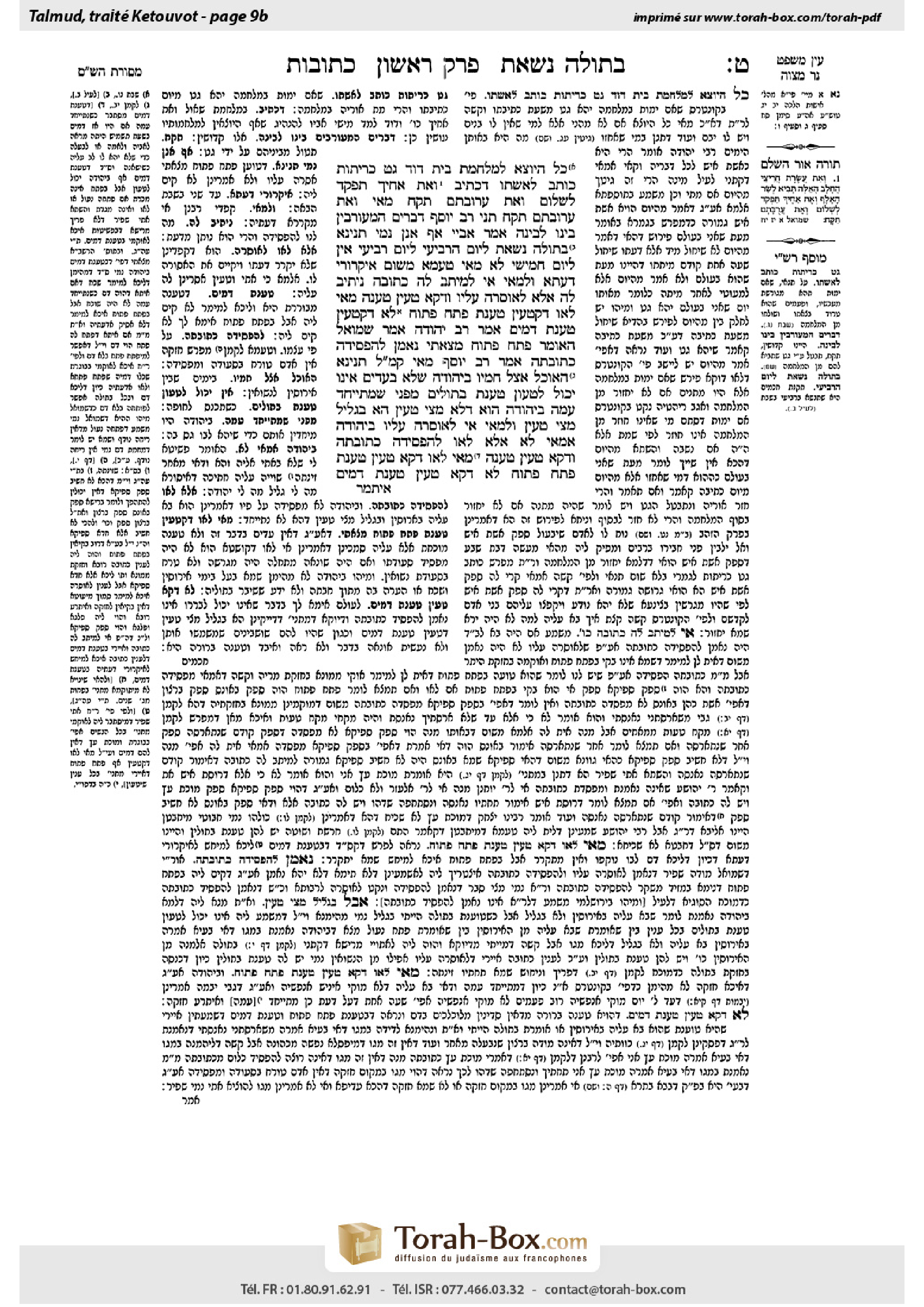
Ketubot 9b: Talmud study for Daf Yomi
Daf Yomi is the daily study of one Talmud folio. Explore 37 tractates with scans, Hebrew text, Sefaria English and AI-generated French translations where annotated.
Passage selection and English or AI-generated French translation are available where the scan has annotations. Daf Study is independent of Torah-Box and Sefaria.
Browse Ketubot · כתובות · All tractatesKetubot 9b text and translations
This page of Ketubot includes the Aramaic text, an English translation and an AI-generated French translation, alongside the scan above.
כתובות ט׳ ב · Aramaic and Hebrew text
כׇּל הַיּוֹצֵא לְמִלְחֶמֶת בֵּית דָּוִד, גֵּט כְּרִיתוּת כּוֹתֵב לְאִשְׁתּוֹ. דִּכְתִיב: ״וְאֶת אַחֶיךָ תִּפְקֹד לְשָׁלוֹם וְאֶת עֲרֻבָּתָם תִּקָּח״, מַאי ״וְאֶת עֲרֻבָּתָם תִּקָּח״? תָּנֵי רַב יוֹסֵף: דְּבָרִים הַמְעוֹרָבִין בֵּינוֹ לְבֵינָהּ.
אָמַר אַבָּיֵי, אַף אֲנַן נָמֵי תְּנֵינָא: בְּתוּלָה נִשֵּׂאת לַיּוֹם הָרְבִיעִי. לְיוֹם רְבִיעִי — אִין, לְיוֹם חֲמִישִׁי — לָא. מַאי טַעְמָא — מִשּׁוּם אִיקָּרוֹרֵי דַעְתָּא.
וּלְמַאי? אִי לְמִיתַּב לָהּ כְּתוּבָּה, נִיתֵּיב לַהּ! אֶלָּא לְאוֹסְרָהּ עָלָיו, וּדְקָא טָעֵין טַעֲנָה.
מַאי לָאו, דְּקָטָעֵין טַעֲנַת ״פֶּתַח פָּתוּחַ״! לָא, דְּקָטָעֵין טַעֲנַת דָּמִים.
אָמַר רַב יְהוּדָה אָמַר שְׁמוּאֵל: הָאוֹמֵר ״פֶּתַח פָּתוּחַ מָצָאתִי״, נֶאֱמָן לְהַפְסִידָהּ כְּתוּבָּתָהּ. אָמַר רַב יוֹסֵף: מַאי קָא מַשְׁמַע לַן? תְּנֵינָא: הָאוֹכֵל אֵצֶל חָמִיו בִּיהוּדָה שֶׁלֹּא בְּעֵדִים — אֵינוֹ יָכוֹל לִטְעוֹן טַעֲנַת בְּתוּלִים, מִפְּנֵי שֶׁמִּתְיַיחֵד עִמָּהּ. בִּיהוּדָה הוּא דְּלָא מָצֵי טָעֵין, הָא בַּגָּלִיל מָצֵי טָעֵין.
וּלְמַאי, אִי לְאוֹסְרָהּ עָלָיו, בִּיהוּדָה אַמַּאי לָא? אֶלָּא לָאו, לְהַפְסִידָהּ כְּתוּבָּתָהּ, וּדְקָא טָעֵין טַעֲנָה. מַאי לָאו, דְּקָא טָעֵין טַעֲנַת ״פֶּתַח פָּתוּחַ״! לָא, דְּקָא טָעֵין טַעֲנַת דָּמִים.
Ketubot 9b · English translation
Anyone who goes to a war waged by the royal house of David writes a conditional bill of divorce to his wife. This was done to prevent a situation in which the wife of the soldier would be unable to remarry because her husband did not return from battle and there were no witnesses with regard to his fate. The conditional bill of divorce accorded the wife the status of a divorcée and freed her to remarry, as it is written: “And to your brothers bring greetings and take their pledge [arubatam]” (I Samuel 17:18). What is the meaning of: And take arubatam? Rav Yosef taught: It is referring to matters that are shared [hame’oravin] between the husband and his wife, i.e., marriage. Since apparently it was customary for men at war to send their wives a conditional divorce, and since Uriah later died, Bathsheba assumed divorced status retroactively from the time that he set out to war. Therefore, she was not forbidden to David.
§ Apropos the credibility of the claim: I encountered an unobstructed orifice, Abaye said: We, too, learn in the mishna proof for the opinion of Rabbi Elazar: A virgin is married on Wednesday. Abaye infers: On Wednesday, yes, a virgin is married; on Thursday, no, she is not married. What is the reason for this ruling? It is due to the fact that if the marriage were to be held on Thursday, several days would elapse before the court would next convene, and in the interim his resolve will cool and his anger subside. The concern is that consequently he will fail to claim before the court that his bride was not a virgin.
The Gemara asks: And for what matter is that a source of concern? If the concern is with regard to giving her payment for her marriage contract, i.e., if he fails to go to court, her legal status at the time of marriage will remain that of a virgin, and when the time comes she will receive payment for her marriage contract to which she is not entitled; then let him give it to her if he wishes. Why is that a concern? Rather, it is with regard to rendering her forbidden to him, and that would result in a case where he makes a claim.
What, is it not referring to a case where he makes the claim: I encountered an unobstructed orifice, after engaging in intercourse with his bride, and his claim is accorded credibility to render her forbidden to him in accordance with the opinion of Rabbi Elazar? The Gemara rejects that proof: No, it can be explained that it is a case where he makes the claim that there was no blood, which would have resulted from rupture of the hymen had she been a virgin. That is a claim based on objective, verifiable evidence and not merely dependent on his subjective sensation.
§ Rav Yehuda said that Shmuel said that a groom who says: I encountered an unobstructed orifice, is deemed credible with regard to causing her to lose her marriage contract. Rav Yosef said: What is he teaching us? We already learned explicitly in a mishna (12a): A man who eats at the house of his father-in-law in Judea after betrothal, without witnesses to attest to the fact that he was not alone with her, cannot make a claim about his bride’s virginity after marriage, because in accordance with the custom in Judea, the assumption is that he secluded himself with her and it was he who engaged in intercourse with her. The Gemara infers: It is in Judea that he cannot claim that she is not a virgin, but in the Galilee, he can claim that this is the case.
The Gemara asks: And for what matter is this claim directed? If it is to render her forbidden to him, then in Judea why is the claim not credible? If he is certain that he did not engage in intercourse with her, and finds that she is not a virgin, apparently she committed adultery and that claim should render her forbidden. Rather, is it not that he is seeking to cause her to lose her marriage contract in a case where he makes a claim? And what, is it not referring to a case where he makes the claim: I encountered an unobstructed orifice, and apparently he is accorded credibility? The Gemara rejects that proof: No, it can be explained that it is a case where he makes the claim that there was no blood.
Ketubot 9b · Traduction française (IA)
Quiconque part à une guerre menée par la maison royale de David rédige pour sa femme un acte de divorce conditionnel. On faisait cela afin d’éviter que la femme du soldat ne puisse se remarier si son mari ne revenait pas de la bataille et qu’il n’y ait aucun témoin de son sort. L’acte de divorce conditionnel conférait à la femme le statut de divorcée et lui permettait de se remarier, comme il est écrit : « Et porte ces provisions à tes frères, et prends leur gage [arubatam] » (I Samuel 17, 18). Que signifie « prends leur arubatam » ? Rav Yossef enseigna que cela désigne ce qui est partagé [hame’oravin] entre le mari et sa femme, c’est-à-dire le mariage. Puisqu’il semble que les hommes partant à la guerre avaient coutume d’envoyer à leurs femmes un acte de divorce conditionnel, et qu’Ouriya mourut par la suite, Batcheva fut considérée rétroactivement comme divorcée à compter du moment où il était parti à la guerre. Elle n’était donc pas interdite à David.
§ À propos de la crédibilité de l’affirmation : « J’ai trouvé un orifice ouvert », Abayé dit : Nous aussi, nous apprenons dans la Michna une preuve en faveur de l’opinion de Rabbi Elazar : une vierge se marie le mercredi. Abayé en déduit que le mercredi, oui, une vierge se marie, mais que le jeudi, non, elle ne se marie pas. Quelle est la raison de cette règle ? Si le mariage avait lieu le jeudi, plusieurs jours s’écouleraient avant que le tribunal ne siège de nouveau et, entre-temps, sa résolution se serait affaiblie et sa colère serait retombée. On craint qu’il ne manque alors de prétendre devant le tribunal que sa mariée n’était pas vierge.
La Guemara demande : En quoi cela pose-t-il problème ? S’il s’agit de lui faire verser le montant de sa ketouba, c’est-à-dire que, s’il ne se rend pas au tribunal, son statut juridique au moment du mariage restera celui d’une vierge et, le moment venu, elle percevra le montant de sa ketouba auquel elle n’a pas droit, qu’il le lui verse donc s’il le souhaite. Pourquoi cela pose-t-il problème ? Il s’agit plutôt de la rendre interdite à son mari ; cela aboutirait donc à un cas où il formule une affirmation.
N’est-ce pas un cas où, après avoir eu des relations avec sa mariée, il affirme : « J’ai trouvé un orifice ouvert », et où son affirmation est jugée crédible pour la rendre interdite à son mari, conformément à l’opinion de Rabbi Elazar ? La Guemara rejette cette preuve : Non, on peut expliquer qu’il s’agit d’un cas où il affirme qu’il n’y avait pas de sang, lequel aurait dû apparaître si l’hymen s’était déchiré alors qu’elle était vierge. Cette affirmation repose sur des éléments objectifs et vérifiables, et non pas seulement sur sa sensation subjective.
§ Rav Yehouda dit au nom de Chmouel qu’un marié qui affirme : « J’ai trouvé un orifice ouvert », est jugé crédible lorsqu’il s’agit de lui faire perdre sa ketouba. Rav Yossef dit : Que nous apprend-il ? Nous l’avons déjà appris explicitement dans une Michna (12a) : un homme qui prend ses repas dans la maison de son beau-père en Judée après les fiançailles, sans témoins pouvant attester qu’il n’a pas été seul avec elle, ne peut pas, après le mariage, formuler une affirmation au sujet de la virginité de sa mariée, car, conformément à la coutume en Judée, on présume qu’il s’est isolé avec elle et qu’il a eu des relations avec elle. La Guemara en déduit que c’est en Judée qu’il ne peut pas prétendre qu’elle n’est pas vierge, mais qu’en Galilée, il peut le prétendre.
La Guemara demande : Dans quel but cette affirmation est-elle formulée ? S’il s’agit de la rendre interdite à son mari, pourquoi son affirmation n’est-elle pas jugée crédible en Judée ? S’il est certain de ne pas avoir eu de relations avec elle et qu’il découvre qu’elle n’est pas vierge, il semble qu’elle ait commis un adultère, et cette affirmation devrait la rendre interdite. Ne s’agit-il pas plutôt de lui faire perdre sa ketouba dans un cas où il formule une affirmation ? Et n’est-ce pas un cas où il affirme : « J’ai trouvé un orifice ouvert », et où il est apparemment jugé crédible ? La Guemara rejette cette preuve : Non, on peut expliquer qu’il s’agit d’un cas où il affirme qu’il n’y avait pas de sang.
Traduction française générée par IA à partir de l’édition anglaise de Sefaria. Vérifie toujours un passage avec le texte source.
Text from Sefaria: William Davidson Edition - Vocalized Aramaic (CC BY NC); William Davidson Edition - English (CC BY NC).