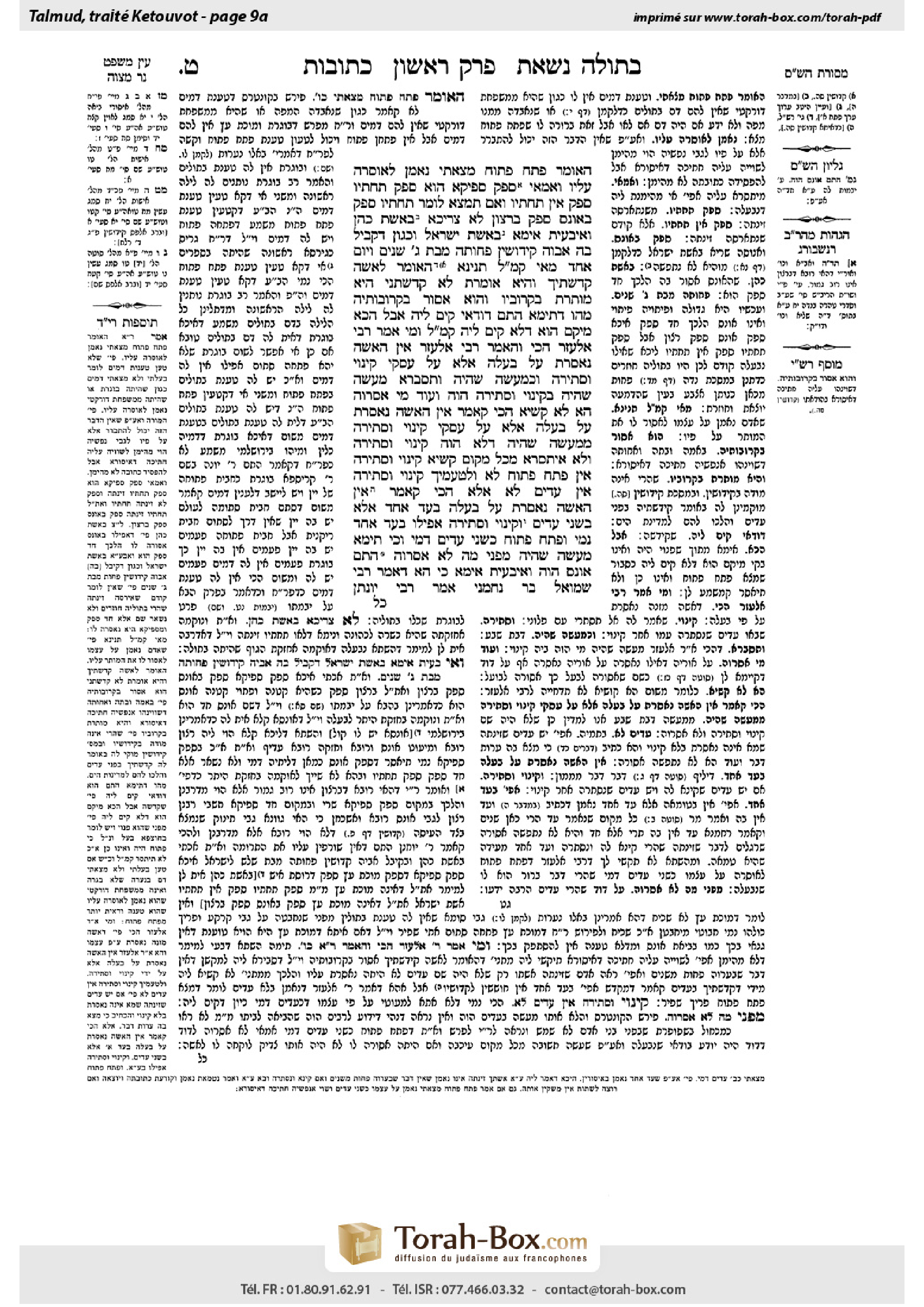
Ketubot 9a: Talmud study for Daf Yomi
Daf Yomi is the daily study of one Talmud folio. Explore 37 tractates with scans, Hebrew text, Sefaria English and AI-generated French translations where annotated.
Passage selection and English or AI-generated French translation are available where the scan has annotations. Daf Study is independent of Torah-Box and Sefaria.
Browse Ketubot · כתובות · All tractatesKetubot 9a text and translations
This page of Ketubot includes the Aramaic text, an English translation and an AI-generated French translation, alongside the scan above.
כתובות ט׳ א · Aramaic and Hebrew text
הָאוֹמֵר ״פֶּתַח פָּתוּחַ מָצָאתִי״ — נֶאֱמָן לְאוֹסְרָהּ עָלָיו.
וְאַמַּאי? סְפֵק סְפֵיקָא הוּא: סָפֵק תַּחְתָּיו, סָפֵק אֵין תַּחְתָּיו. וְאִם תִּמְצָא לוֹמַר תַּחְתָּיו: סָפֵק בְּאוֹנֶס, סָפֵק בְּרָצוֹן!
לָא צְרִיכָא, בְּאֵשֶׁת כֹּהֵן. וְאִיבָּעֵית אֵימָא: בְּאֵשֶׁת יִשְׂרָאֵל, וּכְגוֹן דְּקַבֵּיל בַּהּ אֲבוּהּ קִידּוּשִׁין פְּחוּתָה מִבַּת שָׁלֹשׁ שָׁנִים וְיוֹם אֶחָד.
מַאי קָא מַשְׁמַע לַן? תְּנֵינָא: הָאוֹמֵר לְאִשָּׁה ״קִדַּשְׁתִּיךְ״, וְהִיא אוֹמֶרֶת ״לֹא קִדַּשְׁתַּנִי״ — הִיא מוּתֶּרֶת בִּקְרוֹבָיו, וְהוּא אָסוּר בִּקְרוֹבוֹתֶיהָ.
מַהוּ דְּתֵימָא: הָתָם דְּוַדַּאי קִים לֵיהּ, אֲבָל הָכָא מֵיקָם הוּא דְּלָא קִים לֵיהּ, קָא מַשְׁמַע לַן.
וּמִי אָמַר רַבִּי אֶלְעָזָר הָכִי? וְהָאָמַר רַבִּי אֶלְעָזָר: אֵין הָאִשָּׁה נֶאֱסֶרֶת עַל בַּעְלָהּ אֶלָּא עַל עִסְקֵי קִינּוּי וּסְתִירָה, וּכְמַעֲשֶׂה שֶׁהָיָה!
וְתִסְבְּרָא מַעֲשֶׂה שֶׁהָיָה, בְּקִינּוּי וּסְתִירָה הֲוָה? וְעוֹד, מִי אַסְרוּהָ?
הָא לָא קַשְׁיָא, הָכִי קָאָמַר: אֵין הָאִשָּׁה נֶאֱסֶרֶת עַל בַּעְלָהּ אֶלָּא עַל עִסְקֵי קִינּוּי וּסְתִירָה, מִמַּעֲשֶׂה שֶׁהָיָה, דְּלָא הֲוָה קִינּוּי וּסְתִירָה וְלָא אִיתַּסְרָא. מִכׇּל מָקוֹם קַשְׁיָא: קִינּוּי וּסְתִירָה — אִין, ״פֶּתַח פָּתוּחַ״ — לָא!
וּלְטַעְמָיךְ: קִינּוּי וּסְתִירָה — אִין, עֵדִים — לָא?!
אֶלָּא הָכִי קָאָמַר: אֵין הָאִשָּׁה נֶאֱסֶרֶת עַל בַּעְלָהּ בְּעֵד אֶחָד, אֶלָּא בִּשְׁנֵי עֵדִים. וְקִינּוּי וּסְתִירָה — אֲפִילּוּ בְּעֵד אֶחָד נָמֵי. וּפֶתַח פָּתוּחַ — כִּשְׁנֵי עֵדִים דָּמֵי.
וְכִי תֵּימָא מַעֲשֶׂה שֶׁהָיָה, מִפְּנֵי מָה לֹא אֲסָרוּהָ? הָתָם אוֹנֶס הֲוָה. וְאִיבָּעֵית אֵימָא: כִּי הָא דְּאָמַר רַבִּי שְׁמוּאֵל בַּר נַחְמָנִי אָמַר רַבִּי יוֹנָתָן:
Ketubot 9a · English translation
A groom who says: I encountered an unobstructed orifice, claiming that when he consummated the marriage he discovered that his bride was not a virgin, is credible to render her forbidden to himself. Although it is not always possible to corroborate his claim with testimony that his wife committed adultery after betrothal, he is credible to render her forbidden to him as though she had in fact committed adultery.
The Gemara asks: But why is she forbidden to him? It is a case of compound uncertainty. It is uncertain whether she engaged in intercourse while under his jurisdiction, after betrothal, in which case she would be forbidden to him, and it is uncertain whether she engaged in intercourse while not under his jurisdiction, in which case she would not be forbidden to him. And if you say that she engaged in intercourse while under his jurisdiction, it is uncertain whether she engaged in intercourse by coercion, in which case she would not be forbidden to him, and it is uncertain whether she engaged in intercourse willingly, in which case she would be forbidden to him. In cases of compound uncertainty, the ruling is lenient. Why, then, is his claim deemed credible?
No, it is necessary to teach this ruling only in the case of the wife of a priest, who is rendered forbidden to her husband even if she engaged in intercourse by coercion. In that case, there is a single uncertainty. And if you wish, say instead that this ruling is relevant even to the wife of an Israelite, and it is in a case where her father accepted her betrothal when she was less than three years and one day old. Intercourse with a girl less than three years old does not permanently rupture the hymen, and therefore there is no uncertainty whether she engaged in intercourse before or after betrothal. Clearly, it took place after betrothal, and there is only one uncertainty: Did she engage in intercourse by coercion or willingly?
The Gemara asks: If this is a case where there is only one uncertainty, what is it teaching us? We already learned this explicitly: With regard to a man who says to a woman: I betrothed you, and she says: You did not betroth me, and there are no witnesses to corroborate either claim, she is permitted to marry any of his relatives, e.g., his brother, because based on her claim they are not related. And it is prohibited for him to marry her relatives, as based on his claim she is his betrothed. Apparently, one is capable of creating a prohibition for himself without corroborating witnesses.
The Gemara says that it was necessary to teach the case of the claim of virginity, lest you say: There, where certainly it is clear to him that he betrothed her, it is prohibited for him to marry her relatives. However, here, perhaps it is not clear to him that she was not a virgin, as he is not experienced in these matters and is mistaken. Therefore, Rabbi Elazar teaches us that his claim is nevertheless credible and she is forbidden to him.
And did Rabbi Elazar say that? But didn’t Rabbi Elazar say: A woman is forbidden to her husband due to adultery, only over matters of jealous warning and seclusion, and as it was in the incident that transpired involving David and Bathsheba? A wife is forbidden to her husband only in a case where he warns her not to seclude herself with a certain man and witnesses testify that she subsequently entered into seclusion with him.
And how can you understand it in that manner? Was the incident that transpired with jealous warning and seclusion? Furthermore, did the Sages render Bathsheba forbidden to her husband? Had she been forbidden to her husband, she would have also been forbidden to David, based on the following principle: Just as an adulteress is forbidden to her husband, she is also forbidden to her paramour.
That is not difficult, as this is what Rabbi Elazar is saying: The fact that a woman is forbidden to her husband due to adultery only over matters of jealous warning and seclusion is derived from the incident that transpired involving David and Bathsheba, as there was no jealous warning and seclusion, and therefore she was not forbidden to her husband. In any case, it is difficult, as the statements of Rabbi Elazar are contradictory. It may be inferred: By means of jealous warning and seclusion, yes, a man renders his wife forbidden to him; by means of the claim that he encountered an unobstructed orifice, no, he does not render her forbidden.
The Gemara rejects that inference: And according to your reasoning, that the statement of Rabbi Elazar restricts to jealous warning and seclusion the manner in which a husband can render his wife forbidden, infer: By means of jealous warning and seclusion, yes, a man renders his wife forbidden to him; by means of the testimony of two witnesses that she engaged in adulterous relations, no, he does not render her forbidden. That cannot be so, as clearly two witnesses establish her as one who committed adultery and render her forbidden to her husband.
The Gemara explains: Rather, this is what Rabbi Elazar is saying: A woman is not rendered forbidden to her husband through the testimony of one witness. Rather, she is rendered forbidden only by means of the testimony of two witnesses who testify that she engaged in adulterous relations. And if there was jealous warning and seclusion, she is rendered forbidden even by means of the testimony of one witness as well, if he comes after the husband warned his wife and testifies that she engaged in adulterous relations. And the legal status of the claim: I encountered an unobstructed orifice, is like that of two witnesses, and it renders her forbidden even without jealous warning and seclusion.
And if you would say with regard to the incident that transpired involving David and Bathsheba: For what reason did the Sages not deem her forbidden, when clearly David committed adultery with a married woman? The Gemara answers: There it was rape, and she did not engage in intercourse willingly. And if you wish, say instead that the Sages did not deem her forbidden, as that which Rabbi Shmuel bar Naḥmani said that Rabbi Yonatan said:
Ketubot 9a · Traduction française (IA)
Un marié qui affirme : « J’ai trouvé un orifice ouvert », prétendant qu’au moment de consommer le mariage, il a découvert que sa nouvelle épouse n’était pas vierge, est cru lorsqu’il s’agit de la lui interdire. Même s’il n’est pas toujours possible de corroborer son affirmation par le témoignage établissant que son épouse a commis un adultère après les fiançailles, il est cru et peut la tenir pour interdite à lui, comme si elle avait effectivement commis un adultère.
La Guemara demande : Mais pourquoi lui est-elle interdite ? Il s’agit d’un cas de double incertitude. On ne sait pas si elle a eu des rapports alors qu’elle relevait de son autorité, après les fiançailles, auquel cas elle lui serait interdite, ou si elle a eu des rapports alors qu’elle ne relevait pas de son autorité, auquel cas elle ne lui serait pas interdite. Et si tu dis qu’elle a eu des rapports alors qu’elle relevait de son autorité, on ne sait pas si ces rapports ont eu lieu sous la contrainte, auquel cas elle ne lui serait pas interdite, ou de son plein gré, auquel cas elle lui serait interdite. Dans les cas de double incertitude, la décision est indulgente. Pourquoi, dès lors, son affirmation est-elle tenue pour crédible ?
Non, cette règle devait être enseignée uniquement dans le cas de l’épouse d’un prêtre, qui est interdite à son mari même si elle a eu des rapports sous la contrainte. Dans ce cas, il n’y a qu’une seule incertitude. Et si tu préfères, dis plutôt que cette règle concerne également l’épouse d’un Israélite, lorsque son père a accepté ses fiançailles alors qu’elle avait moins de trois ans et un jour. Des rapports avec une fillette de moins de trois ans ne rompent pas définitivement l’hymen ; il n’y a donc aucune incertitude quant à savoir si elle a eu des rapports avant ou après les fiançailles. Ils ont manifestement eu lieu après les fiançailles, et il ne reste qu’une seule incertitude : a-t-elle eu des rapports sous la contrainte ou de son plein gré ?
La Guemara demande : S’il s’agit d’un cas où il n’y a qu’une seule incertitude, que nous apprend-on ? Nous l’avons déjà appris explicitement : un homme dit à une femme : « Je t’ai fiancée », et elle répond : « Tu ne m’as pas fiancée » ; aucun témoin ne vient corroborer l’une ou l’autre affirmation. Elle peut épouser n’importe lequel des proches de cet homme, par exemple son frère, puisqu’à l’en croire, ils ne sont pas parents. En revanche, il lui est interdit d’épouser les proches de cette femme, puisqu’à l’en croire, elle est sa fiancée. Il apparaît donc qu’un homme peut créer pour lui-même une interdiction sans témoins à l’appui.
La Guemara explique qu’il fallait enseigner le cas de l’affirmation concernant la virginité, de peur que tu ne dises : là, où il sait assurément qu’il l’a fiancée, il lui est interdit d’épouser ses proches. Mais ici, peut-être ne sait-il pas avec certitude qu’elle n’était pas vierge, car il manque d’expérience en la matière et se trompe. Rabbi Elazar nous enseigne donc que son affirmation est néanmoins crédible et qu’elle lui est interdite.
Rabbi Elazar a-t-il vraiment dit cela ? N’a-t-il pas dit : une femme n’est interdite à son mari pour adultère que dans les cas d’avertissement de jalousie et d’isolement, comme dans l’épisode de David et Bethsabée ? Une épouse n’est interdite à son mari que si celui-ci l’avertit de ne pas s’isoler avec un homme en particulier et que des témoins attestent qu’elle s’est ensuite isolée avec lui.
Et comment peut-on comprendre cela ainsi ? L’épisode en question comportait-il un avertissement de jalousie et un isolement ? De plus, les Sages ont-ils déclaré Bethsabée interdite à son mari ? Si elle lui avait été interdite, elle l’aurait également été à David, selon le principe suivant : de même qu’une femme adultère est interdite à son mari, elle est aussi interdite à son amant.
Il n’y a pas de difficulté : voici ce que dit Rabbi Elazar. On déduit de l’épisode de David et Bethsabée qu’une femme n’est interdite à son mari pour adultère que dans les cas d’avertissement de jalousie et d’isolement : il n’y avait eu ni avertissement de jalousie ni isolement, et elle n’était donc pas interdite à son mari. Quoi qu’il en soit, une difficulté demeure, car les propos de Rabbi Elazar sont contradictoires. On peut en déduire que par l’avertissement de jalousie et l’isolement, oui, un homme rend son épouse interdite à lui ; mais par l’affirmation « J’ai trouvé un orifice ouvert », non, il ne la rend pas interdite.
La Guemara rejette cette déduction : si l’on suit ton raisonnement, selon lequel Rabbi Elazar limite aux cas d’avertissement de jalousie et d’isolement les moyens par lesquels un mari peut rendre son épouse interdite, déduis-en que par l’avertissement de jalousie et l’isolement, oui, un homme rend son épouse interdite à lui, mais que par le témoignage de deux témoins établissant qu’elle a eu des relations adultères, non, il ne la rend pas interdite. Cela ne peut pas être le cas, car il est évident que deux témoins établissent qu’elle a commis un adultère et la rendent interdite à son mari.
La Guemara explique : voici plutôt ce que dit Rabbi Elazar. Une femme n’est pas rendue interdite à son mari par le témoignage d’un seul témoin ; elle ne l’est que par le témoignage de deux témoins attestant qu’elle a eu des relations adultères. Toutefois, en cas d’avertissement de jalousie et d’isolement, elle est aussi rendue interdite par le témoignage d’un seul témoin, si celui-ci se présente après que le mari a averti son épouse et atteste qu’elle a eu des relations adultères. L’affirmation « J’ai trouvé un orifice ouvert » a le même statut que le témoignage de deux témoins et la rend interdite même en l’absence d’avertissement de jalousie et d’isolement.
Et si tu demandes, au sujet de l’épisode de David et Bethsabée : pourquoi les Sages ne l’ont-ils pas déclarée interdite, alors que David a manifestement commis un adultère avec une femme mariée ? La Guemara répond : il s’agissait d’un viol et elle n’a pas eu de rapports de son plein gré. Et si tu préfères, dis plutôt que les Sages ne l’ont pas déclarée interdite, en raison de ce que Rabbi Shmuel bar Naḥmani a dit au nom de Rabbi Yonatan :
Traduction française générée par IA à partir de l’édition anglaise de Sefaria. Vérifie toujours un passage avec le texte source.
Text from Sefaria: William Davidson Edition - Vocalized Aramaic (CC BY NC); William Davidson Edition - English (CC BY NC).