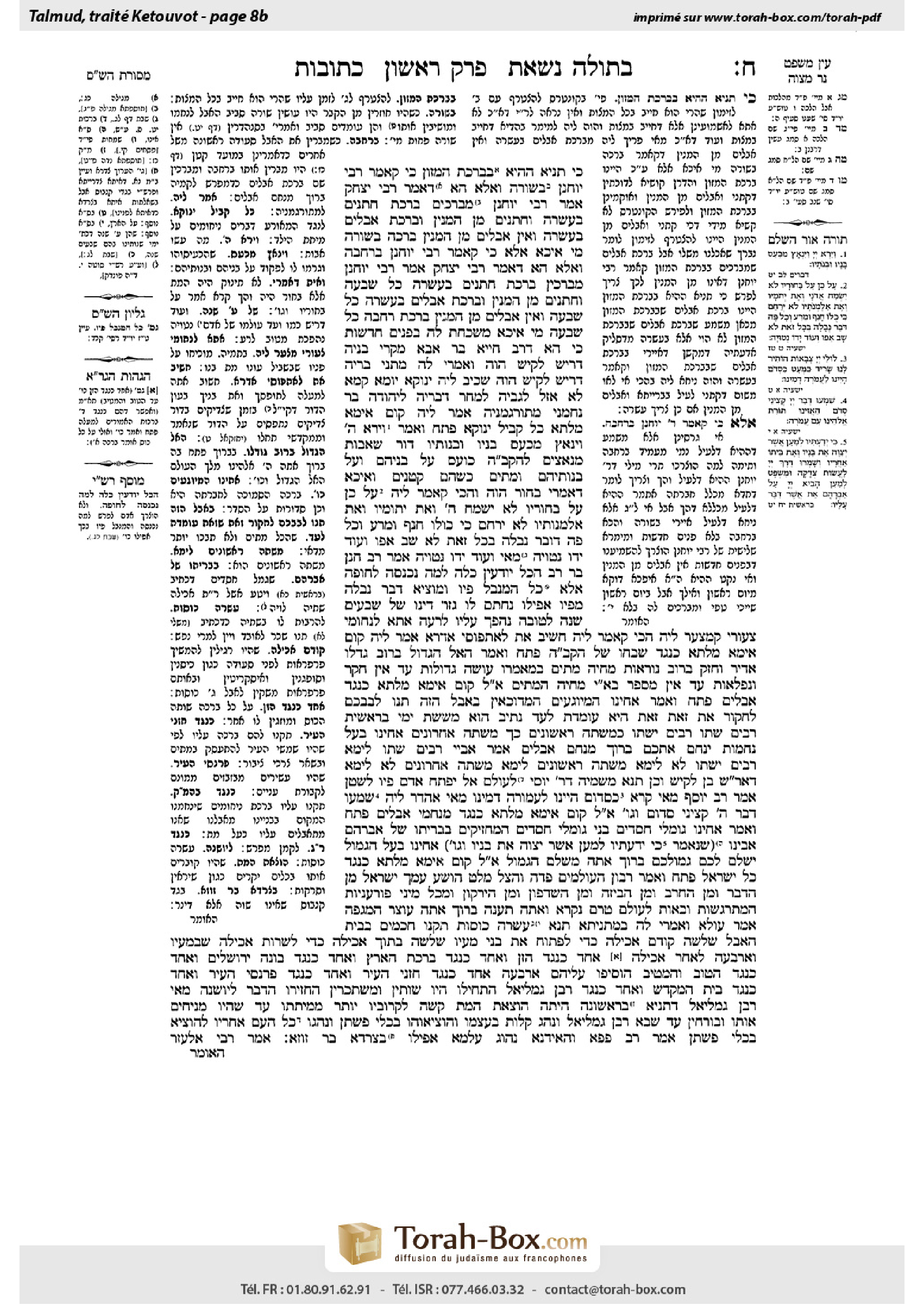
Ketubot 8b: Talmud study for Daf Yomi
Daf Yomi is the daily study of one Talmud folio. Explore 37 tractates with scans, Hebrew text, Sefaria English and AI-generated French translations where annotated.
Passage selection and English or AI-generated French translation are available where the scan has annotations. Daf Study is independent of Torah-Box and Sefaria.
Browse Ketubot · כתובות · All tractatesKetubot 8b text and translations
This page of Ketubot includes the Aramaic text, an English translation and an AI-generated French translation, alongside the scan above.
כתובות ח׳ ב · Aramaic and Hebrew text
כִּי תַּנְיָא הָהִיא — בְּבִרְכַּת הַמָּזוֹן, כִּי קָאָמַר רַבִּי יוֹחָנָן — בְּשׁוּרָה.
וְאֶלָּא הָא דְּאָמַר רַבִּי יִצְחָק אָמַר רַבִּי יוֹחָנָן: מְבָרְכִים בִּרְכַּת חֲתָנִים בַּעֲשָׂרָה, וַחֲתָנִים מִן הַמִּנְיָן. וּבִרְכַּת אֲבֵלִים בַּעֲשָׂרָה, וְאֵין אֲבֵלִים מִן הַמִּנְיָן. בְּרָכָה בְּשׁוּרָה מִי אִיכָּא? אֶלָּא כִּי קָאָמַר רַבִּי יוֹחָנָן בִּרְחָבָה.
וְאֶלָּא הָא דְּאָמַר רַבִּי יִצְחָק אָמַר רַבִּי יוֹחָנָן: מְבָרְכִין בִּרְכַּת חֲתָנִים בַּעֲשָׂרָה כׇּל שִׁבְעָה, וַחֲתָנִים מִן הַמִּנְיָן. וּבִרְכַּת אֲבֵלִים בַּעֲשָׂרָה כׇּל שִׁבְעָה, וְאֵין אֲבֵלִים מִן הַמִּנְיָן. בִּרְכַּת רְחָבָה כׇּל שִׁבְעָה מִי אִיכָּא? מַשְׁכַּחַתְּ לַהּ בְּפָנִים חֲדָשׁוֹת.
כִּי הָא דְּרַב חִיָּיא בַּר אַבָּא מַקְרֵי בְּנֵיהּ דְּרֵישׁ לָקִישׁ הֲוָה, וְאָמְרִי לַהּ מַתְנִי בְּרֵיהּ דְּרֵישׁ לָקִישׁ הֲוָה. שְׁכֵיב לֵיהּ יָנוֹקָא. יוֹמָא קַמָּא לָא אֲזַל לְגַבֵּיהּ. לִמְחַר דַּבְרֵיהּ לִיהוּדָה בַּר נַחְמָנִי מְתוּרְגְּמָנֵיהּ. אֲמַר לֵיהּ: קוּם אֵימָא מִלְּתָא כׇּל קֳבֵיל יָנוֹקָא. פְּתַח וַאֲמַר: ״וַיַּרְא ה׳ וַיִּנְאָץ מִכַּעַס בָּנָיו וּבְנוֹתָיו״, דּוֹר שֶׁאָבוֹת מְנָאֲצִים לְהַקָּדוֹשׁ בָּרוּךְ הוּא — כּוֹעֵס עַל בְּנֵיהֶם וְעַל בְּנוֹתֵיהֶם, וּמֵתִים כְּשֶׁהֵם קְטַנִּים.
וְאִיכָּא דְּאָמְרִי בָּחוּר הֲוָה. וְהָכִי קָאָמַר לֵיהּ: ״עַל כֵּן עַל בַּחוּרָיו לֹא יִשְׂמַח ה׳ וְאֶת יְתוֹמָיו וְאֶת אַלְמְנוֹתָיו לֹא יְרַחֵם כִּי כֻלּוֹ חָנֵף וּמֵרַע וְכׇל פֶּה דֹּבֵר נְבָלָה בְּכׇל זֹאת לֹא שָׁב אַפּוֹ וְעוֹד יָדוֹ נְטוּיָה״. מַאי ״וְעוֹד יָדוֹ נְטוּיָה״? אָמַר רַב חָנָן בַּר רַב: הַכֹּל יוֹדְעִין כַּלָּה לָמָּה נִכְנְסָה לַחוּפָּה. אֶלָּא, כׇּל הַמְנַבֵּל פִּיו, וּמוֹצִיא דְּבַר נְבָלָה מִפִּיו, אֲפִלּוּ נֶחְתַּם לוֹ גְּזַר דִּינוֹ שֶׁל שִׁבְעִים שָׁנָה לְטוֹבָה — נֶהְפָּךְ עָלָיו לְרָעָה.
אֲתָא לְנַחוֹמֵי — צַעוֹרֵי קָמְצַעַר לֵיהּ! הָכִי קָאָמַר לֵיהּ: חֲשִׁיב אַתְּ לְאִתְּפוֹסֵי אַדָּרָא.
אֲמַר לֵיהּ: קוּם אֵימָא מִלְּתָא כְּנֶגֶד שְׁבָחוֹ שֶׁל הַקָּדוֹשׁ בָּרוּךְ הוּא. פָּתַח וְאָמַר: ״הָאֵל הַגָּדוֹל בְּרוֹב גׇּדְלוֹ, אַדִּיר וְחָזָק בְּרוֹב נוֹרָאוֹת, מְחַיֵּה מֵתִים בְּמַאֲמָרוֹ, עוֹשֶׂה גְדוֹלוֹת עַד אֵין חֵקֶר וְנִפְלָאוֹת עַד אֵין מִסְפָּר. בָּרוּךְ אַתָּה ה׳ מְחַיֵּה הַמֵּתִים״.
אֲמַר לֵיהּ: קוּם אֵימָא מִלְּתָא כְּנֶגֶד אֲבֵלִים, פָּתַח וְאָמַר: ״אַחֵינוּ הַמְיוּגָּעִים, הַמְדוּכָּאִין בָּאֵבֶל הַזֶּה, תְּנוּ לְבַבְכֶם לַחְקוֹר אֶת זֹאת. זֹאת הִיא עוֹמֶדֶת לָעַד, נָתִיב הוּא מִשֵּׁשֶׁת יְמֵי בְרֵאשִׁית. רַבִּים שָׁתוּ, רַבִּים יִשְׁתּוּ. כְּמִשְׁתֵּה רִאשׁוֹנִים כָּךְ מִשְׁתֵּה אַחֲרוֹנִים. אַחֵינוּ, בַּעַל נֶחָמוֹת יְנַחֵם אֶתְכֶם. בָּרוּךְ מְנַחֵם אֲבֵלִים״.
אָמַר אַבָּיֵי: ״רַבִּים שָׁתוּ״ — לֵימָא. ״רַבִּים יִשְׁתּוּ״ — לָא לֵימָא. ״מִשְׁתֵּה רִאשׁוֹנִים״ — לֵימָא. ״מִשְׁתֵּה אַחֲרוֹנִים״ — לָא לֵימָא. דְּאָמַר רַבִּי שִׁמְעוֹן בֶּן לָקִישׁ, וְכֵן תָּנָא מִשְּׁמֵיהּ דְּרַבִּי יוֹסֵי: לְעוֹלָם אַל יִפְתַּח אָדָם פִּיו לַשָּׂטָן. אָמַר רַב יוֹסֵף, מַאי קְרָא: ״כִּסְדוֹם הָיִינוּ לַעֲמוֹרָה דָּמִינוּ״. מַאי אַהְדַּר לֵיהּ — ״שִׁמְעוּ דְבַר ה׳ קְצִינֵי סְדוֹם וְגוֹ׳״.
אֲמַר לֵיהּ: קוּם אֵימָא מִלְּתָא כְּנֶגֶד מְנַחֲמֵי אֲבֵלִים. פָּתַח וְאָמַר: ״אַחֵינוּ גּוֹמְלֵי חֲסָדִים בְּנֵי גּוֹמְלֵי חֲסָדִים, הַמַּחְזִיקִים בִּבְרִיתוֹ שֶׁל אַבְרָהָם אָבִינוּ (שֶׁנֶּאֱמַר: ׳כִּי יְדַעְתִּיו לְמַעַן אֲשֶׁר יְצַוֶּה אֶת בָּנָיו וְגוֹ׳׳). אַחֵינוּ, בַּעַל הַגְּמוּל יְשַׁלֵּם לָכֶם גְּמוּלְכֶם. בָּרוּךְ אַתָּה, מְשַׁלֵּם הַגְּמוּל״.
אֲמַר לֵיהּ: קוּם אֵימָא מִלְּתָא כְּנֶגֶד כׇּל יִשְׂרָאֵל. פָּתַח וְאָמַר: ״רִבּוֹן הָעוֹלָמִים, פְּדֵה וְהַצֵּל, מַלֵּט, הוֹשַׁע עַמְּךָ יִשְׂרָאֵל מִן הַדֶּבֶר וּמִן הַחֶרֶב וּמִן הַבִּיזָּה וּמִן הַשִּׁדָּפוֹן וּמִן הַיֵּרָקוֹן וּמִכׇּל מִינֵי פּוּרְעָנִיּוֹת הַמִּתְרַגְּשׁוֹת וּבָאוֹת לָעוֹלָם, טֶרֶם נִקְרָא וְאַתָּה תַּעֲנֶה. בָּרוּךְ אַתָּה, עוֹצֵר הַמַּגֵּפָה״.
אֲמַר עוּלָּא, וְאָמְרִי לַהּ בְּמַתְנִיתָא תָּנָא: עֲשָׂרָה כּוֹסוֹת תִּקְּנוּ חֲכָמִים בְּבֵית הָאֵבֶל: שְׁלֹשָׁה קוֹדֶם אֲכִילָה, כְּדֵי לִפְתּוֹחַ אֶת בְּנֵי מֵעָיו. שְׁלֹשָׁה בְּתוֹךְ אֲכִילָה, כְּדֵי לִשְׁרוֹת אֲכִילָה שֶׁבְּמֵעָיו. וְאַרְבָּעָה לְאַחַר אֲכִילָה, אֶחָד כְּנֶגֶד ״הַזָּן״, וְאֶחָד כְּנֶגֶד בִּרְכַּת הָאָרֶץ, וְאֶחָד כְּנֶגֶד ״בּוֹנֵה יְרוּשָׁלָיִם״, וְאֶחָד כְּנֶגֶד ״הַטּוֹב וְהַמֵּטִיב״.
הוֹסִיפוּ עֲלֵיהֶם אַרְבָּעָה: אֶחָד כְּנֶגֶד חַזָּנֵי הָעִיר, וְאֶחָד כְּנֶגֶד פַּרְנָסֵי הָעִיר, וְאֶחָד כְּנֶגֶד בֵּית הַמִּקְדָּשׁ, וְאֶחָד כְּנֶגֶד רַבָּן גַּמְלִיאֵל. הִתְחִילוּ (הָיוּ) שׁוֹתִין וּמִשְׁתַּכְּרִין, הֶחְזִירוּ הַדָּבָר לְיוֹשְׁנָהּ.
מַאי רַבָּן גַּמְלִיאֵל? דְּתַנְיָא: בָּרִאשׁוֹנָה הָיְתָה הוֹצָאַת הַמֵּת קָשָׁה לִקְרוֹבָיו יוֹתֵר מִמִּיתָתוֹ, עַד שֶׁהָיוּ מַנִּיחִים אוֹתוֹ וּבוֹרְחִין. עַד שֶׁבָּא רַבָּן גַּמְלִיאֵל וְנָהַג קַלּוּת בְּעַצְמוֹ, וְהוֹצִיאוּהוּ בִּכְלֵי פִשְׁתָּן. וְנָהֲגוּ כׇּל הָעָם אַחֲרָיו לְהוֹצִיא בִּכְלֵי פִשְׁתָּן. אֲמַר רַב פָּפָּא: וְהָאִידָּנָא נְהוּג עָלְמָא אֲפִילּוּ בְּצַרְדָּא בַּר זוּזָא.
אֲמַר רַבִּי אֶלְעָזָר:
Ketubot 8b · English translation
The Gemara answers: When that baraita is taught, it is with regard to combining with others to form a quorum of three to recite Grace after Meals, as a mourner is obligated to recite Grace after Meals. However, when Rabbi Yoḥanan says that mourners are not included in the tally, it is with regard to the quorum of ten men required to form a line to comfort the mourners following the burial.
And the Gemara raises an objection: However, that which Rabbi Yitzḥak said that Rabbi Yoḥanan said: One recites the blessing of the grooms in a quorum of ten, and the grooms are included in the tally, and one recites the blessing of the mourners in a quorum of ten, and the mourners are not included in the tally. Is there a blessing recited in the line formed to comfort the mourners? Clearly, this statement of Rabbi Yoḥanan cannot be explained as referring to the line. Rather, when Rabbi Yoḥanan said that mourners are not included in the tally, it was with regard to the blessing recited in the square adjacent to the cemetery, where the meal of comfort takes place and various blessings are recited to comfort the mourners. Mourners are not included in the requisite quorum of ten.
The Gemara asks: However, with regard to that which Rabbi Yitzḥak said that Rabbi Yoḥanan said: One recites the blessing of the grooms in a quorum of ten all seven days of celebration, and the grooms are included in the tally; and one recites the blessing of the mourners all seven days of mourning in a quorum of ten, and the mourners are not included in the tally, is there a blessing recited in the square all seven days? The meal of comfort and the associated blessings take place directly after the burial, not throughout the seven days of mourning. The Gemara answers: You find blessings recited throughout the seven-day mourning period in a case where new faces who did not attend the burial are present. In that case, eulogies and words of comfort are repeated, and the blessing of the mourners is recited again.
§ This is similar to that incident involving Rav Ḥiyya bar Abba, who was the Bible teacher of the sons of Reish Lakish, and some say that he was the Mishna teacher of the son of Reish Lakish. His child died. On the first day, Reish Lakish did not go to comfort him. The next day, he took Yehuda bar Naḥmani, his disseminator, with him to comfort Rav Ḥiyya bar Abba. Reish Lakish said to his disseminator: Stand and say a matter of comfort with regard to the death of the child. He began and said: “And the Lord saw it and He abhorred them, due to the provocation of His sons and His daughters” (Deuteronomy 32:19). A generation in which the fathers abhor the Holy One, Blessed be He, He is angered at their sons and their daughters, and they die when they are small.
And there are those who say that the child who died was not a small child, but a youth, and this is what the disseminator said to him: “Therefore the Lord shall have no joy in their young men, nor shall He have compassion on their orphans and widows, for everyone is a flatterer and an evildoer, and every mouth speaks obscenity. For all this His anger is not turned away, and His hand is still outstretched” (Isaiah 9:16). What is the meaning of the phrase “And His hand is still outstretched”? Rav Ḥanan bar Rav said: Everyone knows why a bride enters the wedding canopy. It is the step before consummation of the marriage. However, one should not speak about it unnecessarily, as anyone who profanes his mouth and issues a matter of profanity from his mouth, even if a positive decree of seventy years was sealed for him, nevertheless, it is transformed for him into an evil decree.
The Gemara asks about this incident: He came at the behest of Reish Lakish to comfort Rav Ḥiyya bar Abba and instead he upset him by attributing the death of his son to his transgressions! The Gemara answers: It was not his intention to upset Rav Ḥiyya bar Abba and to attribute the death of his son to his actions. Rather, this is what he is saying to him: You are sufficiently significant to be seized, i.e., to die or suffer, for the sins of the generation, as it is specifically the righteous few who are punished for the transgressions of a sinful generation.
Reish Lakish said to his disseminator: Stand and say a statement with regard to the praiseworthiness of the Holy One, Blessed be He. He began and said: God, Who is great in the abundance of His greatness, mighty and strong in the abundance of His awesome deeds, Who revives the dead in fulfillment of His statement, Who does great deeds beyond comprehension, wondrous deeds without number. Blessed are You, Lord, Who revives the dead.
Reish Lakish said to him: Stand and say a statement with regard to the mourners. He began and said: Our brothers, who are exhausted, who are overwhelmed by this mourning, set your heart to examine this: This is what stands forever. It is a path from the six days of Creation, i.e., death exists since Creation, and it is well known that this is the fate of man. Many have drunk from the poisonous cup of death, and many will drink. As was the consequence of the drink of the first who have drunk, so too will be the consequence of the drink of the last who will drink. Our brothers, may the Master of solace comfort you. Blessed are You, Lord, Who comforts the mourners.
Abaye said with regard to the statement concerning the mourners: Let him say: Many have drunk; let him not say: Many will drink. Let him say: The drink of the first; let him not say: The drink of the last. This is as Rabbi Shimon ben Lakish said, and likewise it was taught in the name of Rabbi Yosei: A person should never open his mouth to Satan and speculate about potential disasters. Rav Yosef said: What is the verse from which it is derived? “We should have almost been as Sodom, we should have been like unto Gomorrah” (Isaiah 1:9), after which, what did the prophet reply to them? “Hear the word of the Lord, rulers of Sodom; give ear unto the law of our God, people of Gomorrah” (Isaiah 1:10). Isaiah drew the analogy and immediately it was realized.
Reish Lakish said to the disseminator: Stand and say a statement with regard to those who comfort the mourners. He began and said: Our brothers, bestowers of loving-kindness, sons of bestowers of loving-kindness, who embrace the covenant of Abraham our Patriarch, as it is stated: “For I know him, that he will command his children…to do righteousness and justice” (Genesis 18:19). Our brothers, may the Master of reward pay you your just deserts. Blessed are You, Lord, Who pays the just deserts.
Reish Lakish said to the disseminator: Stand and say a statement with regard to the entire Jewish people. He began and said: Master of the worlds, redeem and save, rescue and deliver Your people, Israel, from the pestilence and from the sword, and from spoil, and from the blight, and from the mildew, and from all types of afflictions that suddenly erupt and come to the world. Before we call and You will respond. Blessed are You, Lord, Who halts the plague. Apparently, several blessings are recited on the days following the burial.
§ In connection with comforting mourners, Ulla said, and some say that it was taught in a baraita: The Sages instituted ten cups of wine to be drunk in the house of the mourner: Three cups prior to the meal, in order to open his intestines, i.e., whet his appetite; three during the meal, to soak the food in his intestines in order to facilitate digestion; and four cups after the meal, each corresponding to a blessing in the Grace after Meals. One corresponds to the first blessing: Who feeds all; one corresponds to the second blessing, the blessing of the land; one corresponding to the third blessing: Who builds Jerusalem; and one corresponding to the fourth blessing: Who is good and does good.
Later, the Sages added to those four additional blessings: One, noting the actions of the attendants of the city [ḥazzanei ha’ir], who tend to burials and other communal needs; one, noting the actions of the leaders of the city, who would provide funding for the burial of the poor; one, noting the Temple, commemorating its destruction; and one, noting the actions of Rabban Gamliel. The people began observing this ordinance instituted by the Sages, and they would drink and become intoxicated. Therefore, the Sages restored the matter to its previous status and established that they drink no more than ten cups.
What is the connection between Rabban Gamliel and a house of mourning? It is as it is taught in a baraita: Initially, the funeral expenditures for the deceased were more taxing for his relatives than his death, as the burials were opulent, until it reached a point where people would abandon the deceased and flee. This continued until Rabbi Gamliel came and conducted himself in a self-deprecatory manner, instructing the people that they were to take him for burial in plain linen garments. And all the people conducted themselves following his example, and instructed their families to take them for burial in plain linen garments. Rav Pappa said: And today, everyone is accustomed to bury the dead in plain garments, even in rough cloth [tzerada] worth one zuz.
Rabbi Elazar said:
Ketubot 8b · Traduction française (IA)
La Guemara répond : Lorsque cette baraïta est enseignée, il s’agit de s’associer à d’autres pour former un quorum de trois personnes afin de réciter le Birkat Hamazon, car un endeuillé est tenu de réciter le Birkat Hamazon. En revanche, lorsque Rabbi Yoḥanan dit que les endeuillés ne sont pas comptés, il s’agit du quorum de dix hommes nécessaire pour former un rang afin de réconforter les endeuillés après l’inhumation.
La Guemara soulève une objection : Que dire alors de ce que Rabbi Yitzḥak a dit au nom de Rabbi Yoḥanan : « On récite la bénédiction des mariés en présence d’un quorum de dix, et les mariés sont comptés ; on récite la bénédiction des endeuillés en présence d’un quorum de dix, et les endeuillés ne sont pas comptés » ? Une bénédiction est-elle récitée dans le rang formé pour réconforter les endeuillés ? Il est clair que cette déclaration de Rabbi Yoḥanan ne peut pas se rapporter au rang. Lorsque Rabbi Yoḥanan dit que les endeuillés ne sont pas comptés, il s’agit donc de la bénédiction récitée sur la place jouxtant le cimetière, où a lieu le repas de consolation et où diverses bénédictions sont récitées pour réconforter les endeuillés. Les endeuillés ne sont pas comptés dans le quorum requis de dix personnes.
La Guemara demande : Que dire toutefois de ce que Rabbi Yitzḥak a dit au nom de Rabbi Yoḥanan : « On récite la bénédiction des mariés en présence d’un quorum de dix durant les sept jours de réjouissance, et les mariés sont comptés ; on récite la bénédiction des endeuillés en présence d’un quorum de dix durant les sept jours de deuil, et les endeuillés ne sont pas comptés » ? Une bénédiction est-elle récitée sur la place pendant les sept jours ? Le repas de consolation et les bénédictions qui l’accompagnent ont lieu juste après l’inhumation, et non pendant toute la période des sept jours de deuil. La Guemara répond : Des bénédictions peuvent être récitées tout au long des sept jours de deuil lorsqu’assistent des personnes qui n’étaient pas présentes à l’inhumation. Dans ce cas, les éloges funèbres et les paroles de consolation sont répétés, et la bénédiction des endeuillés est récitée de nouveau.
§ Un épisode semblable concerne Rav Ḥiyya bar Abba, qui enseignait la Bible aux fils de Reish Lakish ; certains disent qu’il enseignait la Michna au fils de Reish Lakish. Son enfant mourut. Le premier jour, Reish Lakish ne vint pas le réconforter. Le lendemain, il emmena Yehuda bar Naḥmani, son orateur, pour réconforter Rav Ḥiyya bar Abba. Reish Lakish dit à son orateur : « Lève-toi et prononce une parole de consolation au sujet de la mort de l’enfant. » Il commença par dire : « Le Seigneur le vit et les prit en aversion, à cause de la provocation de ses fils et de ses filles » (Deutéronome 32,19). Dans une génération où les pères prennent en aversion le Saint, béni soit-Il, Il se met en colère contre leurs fils et leurs filles, et ceux-ci meurent en bas âge.
D’autres disent que l’enfant qui mourut n’était pas en bas âge, mais qu’il était jeune. Voici ce que l’orateur lui dit alors : « C’est pourquoi le Seigneur ne prendra pas plaisir à leurs jeunes gens et n’aura pas compassion de leurs orphelins et de leurs veuves, car tous sont hypocrites et malfaisants, et toute bouche profère des obscénités. Malgré tout cela, sa colère ne s’est pas détournée, et sa main reste étendue » (Isaïe 9,16). Quel est le sens de l’expression « sa main reste étendue » ? Rav Ḥanan bar Rav dit : Tout le monde sait pourquoi une mariée entre sous la houppa : c’est l’étape qui précède la consommation du mariage. Toutefois, il ne faut pas en parler inutilement, car quiconque profane sa bouche et en fait sortir des propos obscènes, même si un décret favorable de soixante-dix ans a été scellé à son égard, ce décret se transforme néanmoins en décret funeste.
La Guemara interroge au sujet de cet épisode : Il est venu, à la demande de Reish Lakish, réconforter Rav Ḥiyya bar Abba, mais il l’a au contraire bouleversé en attribuant la mort de son fils à ses transgressions ! La Guemara répond : Il n’avait pas l’intention de bouleverser Rav Ḥiyya bar Abba ni d’attribuer la mort de son fils à ses actes. Voici plutôt ce qu’il lui disait : Tu es assez important pour être frappé, c’est-à-dire pour mourir ou souffrir, à cause des péchés de la génération ; en effet, ce sont précisément les quelques justes qui sont punis pour les transgressions d’une génération pécheresse.
Reish Lakish dit à son orateur : « Lève-toi et prononce une parole à la louange du Saint, béni soit-Il. » Il commença par dire : « Dieu, grand par l’abondance de Sa grandeur, puissant et fort par l’abondance de Ses actes redoutables, qui ressuscite les morts conformément à Sa parole, qui accomplit des œuvres immenses et incompréhensibles, des merveilles sans nombre. Béni sois-Tu, Seigneur, qui ressuscites les morts. »
Reish Lakish lui dit : « Lève-toi et prononce une parole à l’adresse des endeuillés. » Il commença par dire : « Nos frères, épuisés, accablés par ce deuil, prenez à cœur de réfléchir à ceci : c’est là ce qui demeure éternellement. C’est une voie qui remonte aux six jours de la Création — autrement dit, la mort existe depuis la Création — et il est bien connu que tel est le destin de l’homme. Nombreux sont ceux qui ont bu à la coupe empoisonnée de la mort, et nombreux seront ceux qui y boiront. Ce qui est arrivé à ceux qui ont bu les premiers arrivera aussi à ceux qui boiront les derniers. Nos frères, que le Maître de la consolation vous console. Béni sois-Tu, Seigneur, qui consoles les endeuillés. »
Abaye dit au sujet de la déclaration adressée aux endeuillés : Qu’il dise : « Nombreux sont ceux qui ont bu » ; qu’il ne dise pas : « Nombreux seront ceux qui boiront ». Qu’il dise : « Ceux qui ont bu les premiers » ; qu’il ne dise pas : « Ceux qui boiront les derniers ». C’est ce qu’a dit Rabbi Shimon ben Lakish, et il a également été enseigné au nom de Rabbi Yosei : Une personne ne doit jamais ouvrir la bouche à Satan en spéculant sur d’éventuels malheurs. Rav Yosef dit : Quel est le verset dont on déduit cela ? « Nous aurions presque été comme Sodome, nous aurions été semblables à Gomorrhe » (Isaïe 1,9). Que répondit alors le prophète ? « Écoutez la parole du Seigneur, chefs de Sodome ; prêtez l’oreille à l’enseignement de notre Dieu, peuple de Gomorrhe » (Isaïe 1,10). Isaïe établit cette comparaison, et elle se réalisa aussitôt.
Reish Lakish dit à son orateur : « Lève-toi et prononce une parole à l’adresse de ceux qui réconfortent les endeuillés. » Il commença par dire : « Nos frères, dispensateurs de bonté, fils de dispensateurs de bonté, vous qui observez l’alliance d’Abraham notre patriarche, comme il est dit : “Car Je l’ai choisi afin qu’il ordonne à ses enfants […] de pratiquer la justice et le droit” (Genèse 18,19). Nos frères, que le Maître de la récompense vous accorde ce qui vous revient. Béni sois-Tu, Seigneur, qui accorde ce qui revient à chacun. »
Reish Lakish dit à son orateur : « Lève-toi et prononce une parole à l’adresse de tout le peuple juif. » Il commença par dire : « Maître des mondes, rachète et sauve, délivre et arrache Ton peuple, Israël, à la peste, à l’épée, au pillage, à la calamité, à la moisissure et à toutes sortes de fléaux qui éclatent soudainement et s’abattent sur le monde, avant même que nous appelions et que Tu répondes. Béni sois-Tu, Seigneur, qui arrêtes l’épidémie. » Il apparaît donc que plusieurs bénédictions sont récitées dans les jours qui suivent l’inhumation.
§ À propos de la consolation des endeuillés, Ulla dit — certains disent que cela fut enseigné dans une baraïta : Les Sages instituèrent dix coupes de vin à boire dans la maison de l’endeuillé : trois coupes avant le repas, afin de lui ouvrir les intestins, c’est-à-dire de lui aiguiser l’appétit ; trois pendant le repas, afin d’imbiber les aliments dans ses intestins et de faciliter la digestion ; et quatre coupes après le repas, chacune correspondant à une bénédiction du Birkat Hamazon. L’une correspond à la première bénédiction : « Qui nourrit tous les êtres » ; l’une à la deuxième bénédiction, celle de la terre ; l’une à la troisième bénédiction : « Qui rebâtit Jérusalem » ; et l’une à la quatrième bénédiction : « Qui est bon et fait le bien ».
Par la suite, les Sages ajoutèrent à ces quatre bénédictions quatre bénédictions supplémentaires : l’une évoquant les actions des préposés de la ville [ḥazzanei ha’ir], qui s’occupent des inhumations et d’autres besoins de la communauté ; l’une évoquant les actions des dirigeants de la ville, qui finançaient l’inhumation des pauvres ; l’une évoquant le Temple et commémorant sa destruction ; et l’une évoquant les actions de Rabban Gamliel. Le peuple se mit à observer cette ordonnance instituée par les Sages, et les gens buvaient jusqu’à s’enivrer. Les Sages rétablirent donc la situation antérieure et décrétèrent qu’on ne boirait pas plus de dix coupes.
Quel est le lien entre Rabban Gamliel et une maison de deuil ? Comme il est enseigné dans une baraïta : À l’origine, les dépenses funéraires du défunt pesaient davantage sur ses proches que sa mort, car les inhumations étaient somptueuses, au point que les gens abandonnaient le défunt et s’enfuyaient. Cela continua jusqu’à ce que Rabbi Gamliel vienne et se conduise avec humilité, en demandant qu’on l’inhume vêtu de simples habits de lin. Tous les gens suivirent son exemple et demandèrent à leurs familles de les faire inhumer vêtus de simples habits de lin. Rav Pappa dit : Aujourd’hui, tout le monde a l’habitude d’inhumer les morts dans des vêtements simples, même dans une étoffe grossière [tzerada] qui vaut un zouz.
Rabbi Elazar dit :
Traduction française générée par IA à partir de l’édition anglaise de Sefaria. Vérifie toujours un passage avec le texte source.
Text from Sefaria: William Davidson Edition - Vocalized Aramaic (CC BY NC); William Davidson Edition - English (CC BY NC).