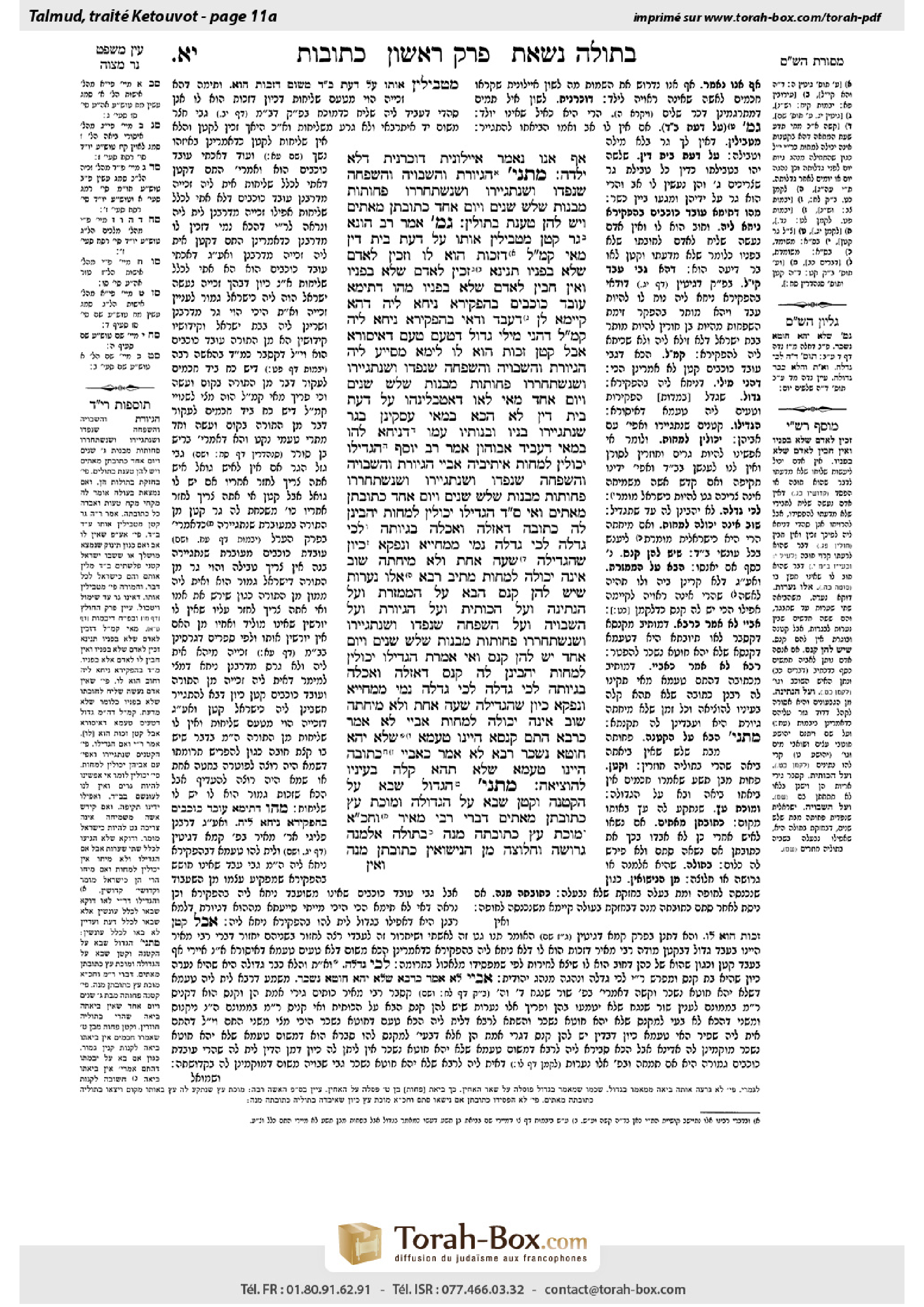
Ketubot 11a: Talmud study for Daf Yomi
Daf Yomi is the daily study of one Talmud folio. Explore 37 tractates with scans, Hebrew text, Sefaria English and AI-generated French translations where annotated.
Passage selection and English or AI-generated French translation are available where the scan has annotations. Daf Study is independent of Torah-Box and Sefaria.
Browse Ketubot · כתובות · All tractatesKetubot 11a text and translations
This page of Ketubot includes the Aramaic text, an English translation and an AI-generated French translation, alongside the scan above.
כתובות י״א א · Aramaic and Hebrew text
אַף אָנוּ נֹאמַר: ״אַיְילוֹנִית״ — דּוּכְרָנִית, דְּלָא יָלְדָה.
מַתְנִי׳ הַגִּיּוֹרֶת וְהַשְּׁבוּיָה וְהַשִּׁפְחָה שֶׁנִּפְדּוּ וְשֶׁנִּתְגַּיְּירוּ וְשֶׁנִּשְׁתַּחְרְרוּ, פְּחוּתוֹת מִבְּנוֹת שָׁלֹשׁ שָׁנִים וְיוֹם אֶחָד — כְּתוּבָּתָן מָאתַיִם. וְיֵשׁ לָהֶן טַעֲנַת בְּתוּלִין.
גְּמָ׳ אָמַר רַב הוּנָא: גֵּר קָטָן — מַטְבִּילִין אוֹתוֹ עַל דַּעַת בֵּית דִּין.
מַאי קָא מַשְׁמַע לַן — דִּזְכוּת הוּא לוֹ, וְזָכִין לָאָדָם שֶׁלֹּא בְּפָנָיו? תְּנֵינָא: זָכִין לְאָדָם שֶׁלֹּא בְּפָנָיו, וְאֵין חָבִין לָאָדָם שֶׁלֹּא בְּפָנָיו!
מַהוּ דְּתֵימָא: גּוֹי בְּהֶפְקֵירָא נִיחָא לֵיהּ, דְּהָא קַיְימָא לַן דְּעֶבֶד וַדַּאי בְּהֶפְקֵירָא נִיחָא לֵיהּ,
קָא מַשְׁמַע לַן: דְּהָנֵי מִילֵּי גָּדוֹל, דִּטְעַם טַעַם דְּאִיסּוּרָא, אֲבָל קָטָן — זְכוּת הוּא לוֹ.
לֵימָא מְסַיַּיע לֵיהּ: הַגִּיּוֹרֶת וְהַשְּׁבוּיָה וְהַשִּׁפְחָה שֶׁנִּפְדּוּ וְשֶׁנִּתְגַּיְּירוּ וְשֶׁנִּשְׁתַּחְרְרוּ, פְּחוּתוֹת מִבְּנוֹת שָׁלֹשׁ שָׁנִים וְיוֹם אֶחָד. מַאי לָאו, דְּאַטְבְּלִינְהוּ עַל דַּעַת בֵּית דִּין?
לָא, הָכָא בְּמַאי עָסְקִינַן: בְּגֵר שֶׁנִּתְגַּיְּירוּ בָּנָיו וּבְנוֹתָיו עִמּוֹ, דְּנִיחָא לְהוּ בְּמַאי דְּעָבֵיד אֲבוּהוֹן.
אָמַר רַב יוֹסֵף: הִגְדִּילוּ — יְכוֹלִין לְמַחוֹת. אֵיתִיבֵיהּ אַבָּיֵי: הַגִּיּוֹרֶת וְהַשְּׁבוּיָה וְהַשִּׁפְחָה שֶׁנִּפְדּוּ וְשֶׁנִּתְגַּיְּירוּ וְשֶׁנִּשְׁתַּחְרְרוּ, פְּחוּתוֹת מִבְּנוֹת שָׁלֹשׁ שָׁנִים וְיוֹם אֶחָד — כְּתוּבָּתָן מָאתַיִם. וְאִי סָלְקָא דַעְתָּךְ הִגְדִּילוּ יְכוֹלִין לְמַחוֹת — יָהֲבִינַן לַהּ כְּתוּבָה דְּאָזְלָה וְאָכְלָה בְּגַּיּוּתַהּ?
לְכִי גָדְלָה. לְכִי גָדְלָה נָמֵי מְמַחֲיָיא וְנָפְקָא! כֵּיוָן שֶׁהִגְדִּילָה שָׁעָה אַחַת וְלֹא מִיחֲתָה — שׁוּב אֵינָהּ יְכוֹלָה לְמַחוֹת.
מֵתִיב רָבָא, אֵלּוּ נְעָרוֹת שֶׁיֵּשׁ לָהֶן קְנָס: הַבָּא עַל הַמַּמְזֶרֶת וְעַל הַנְּתִינָה וְעַל הַכּוּתִית וְעַל הַגִּיּוֹרֶת וְעַל הַשְּׁבוּיָה וְעַל הַשִּׁפְחָה שֶׁנִּפְדּוּ וְשֶׁנִּתְגַּיְּירוּ וְשֶׁנִּשְׁתַּחְרְרוּ, פְּחוּתוֹת מִבְּנוֹת שָׁלֹשׁ שָׁנִים וְיוֹם אֶחָד, יֵשׁ לָהֶן קְנָס. וְאִי אָמְרַתְּ הִגְדִּילוּ יְכוֹלִין לְמַחוֹת — יָהֲבִינַן לַהּ קְנָס דְּאָזְלָה וְאָכְלָה בְּגֵיוּתַהּ?
לְכִי גָדְלָה. לְכִי גָדְלָה נָמֵי מְמַחֲיָיא וְנָפְקָא! כֵּיוָן שֶׁהִגְדִּילָה שָׁעָה אַחַת וְלֹא מִיחֲתָה — שׁוּב אֵינָהּ יְכוֹלָה לְמַחוֹת.
אַבָּיֵי לָא אָמַר כְּרָבָא: הָתָם קְנָסָא הַיְינוּ טַעְמָא — שֶׁלֹּא יְהֵא חוֹטֵא נִשְׂכָּר.
רָבָא לָא אָמַר כְּאַבַּיֵּי: כְּתוּבָּה הַיְינוּ טַעְמָא — שֶׁלֹּא תְּהֵא קַלָּה בְּעֵינָיו לְהוֹצִיאָהּ.
מַתְנִי׳ הַגָּדוֹל שֶׁבָּא עַל הַקְּטַנָּה וְקָטָן שֶׁבָּא עַל הַגְּדוֹלָה וּמוּכַּת עֵץ — כְּתוּבָּתָן מָאתַיִם, דִּבְרֵי רַבִּי מֵאִיר. וַחֲכָמִים אוֹמְרִים: מוּכַּת עֵץ כְּתוּבָּתָהּ מָנֶה.
בְּתוּלָה, אַלְמָנָה, גְּרוּשָׁה וַחֲלוּצָה מִן הַנִּישּׂוּאִין — כְּתוּבָּתָן מָנֶה.
Ketubot 11a · English translation
We too will say: Ailonit, a sexually underdeveloped woman, is a term meaning: Like a ram [dukhranit], because like a male sheep [ayyil] she does not bear children.
MISHNA: With regard to a female convert, or a captive woman, or a maidservant, who were ransomed with regard to the captive, or who converted with regard to the convert, or who was freed with regard to the maidservant, when she was less than three years and one day old, for all of these, their marriage contract is two hundred dinars, as their presumptive status is that of a virgin. Even if they were subject to intercourse when they were younger than that age, the hymen remains restored. And they are subject to a claim concerning their virginity.
GEMARA: Rav Huna said: With regard to a convert who is a minor, one immerses him in a ritual bath with the consent of the court. As a minor lacks the capacity to make halakhic decisions, the court is authorized to make those decisions in his stead.
What is Rav Huna coming to teach us? Is he teaching that it is a privilege for the minor to convert, and one may act in a person’s interests even in his absence? We already learned that explicitly in a mishna (Eiruvin 81b): One may act in a person’s interests in his absence, but one may not act against a person’s interests in his absence.
Rav Huna’s statement was necessary lest you say: With regard to a gentile, licentiousness is preferable for him, so conversion is contrary to his interests, just as we maintain that with regard to a slave, licentiousness is certainly preferable. Just as a slave has no interest in assuming the restrictions that come with freedom, in that a freed Canaanite slave is a convert to Judaism, a gentile would have the same attitude toward conversion.
Therefore, Rav Huna teaches us: That applies only with regard to an adult, who has experienced a taste of prohibition. Therefore, presumably he prefers to remain a slave and indulge in licentiousness. However, with regard to a minor, who did not yet engage in those activities, it is a privilege for him to convert.
The Gemara suggests: Let us say that the mishna supports Rav Huna’s statement: With regard to a female convert, or a captive woman, or a maidservant, who were ransomed with regard to the captive, or who converted with regard to the convert, or who were freed with regard to the maidservant, when she was less than three years and one day old; what, is it not referring to a case where they immersed the minor converts and the maidservants with the consent of the court? Apparently, a conversion of that sort is valid.
The Gemara rejects that proof: No, with what are we dealing here? It is with a convert whose minor sons and daughters converted with him, as they are content with whatever their father does in their regard. However, that does not apply to a child who is converting on his own.
Rav Yosef said: In any case where minors convert, when they reach majority they can protest and annul their conversion. Abaye raised an objection to his opinion from the mishna: With regard to a female convert, or a captive woman, or a maidservant who were ransomed, or who converted, or who were freed when they were less than three years and one day old, their marriage contract is two hundred dinars. And if it enters your mind to say that when they reach majority they can protest and annul their conversion, do we give her the payment of the marriage contract that she will go and consume in her gentile state?
The Gemara answers: She receives payment of her marriage contract once she has reached majority and does not protest, but not while still a minor. The Gemara asks: When she reaches majority too, is there not the same concern that she will protest and abandon Judaism? The Gemara answers: Once she reached majority for even one moment and did not protest, she may no longer protest. This mishna poses no difficulty to the opinion of Rav Yosef.
Rava raised an objection from a mishna (29a): These are the cases of young women for whom there is a fine paid to their fathers by one who rapes them: One who engages in intercourse with a mamzeret; or with a Gibeonite woman [netina], who are given [netunim] to the service of the people and the altar (see Joshua 9:27); or with a Samaritan woman [kutit]. In addition, the same applies to one who engages in intercourse with a female convert, or with a captive woman, or with a maidservant, provided that the captives were ransomed or that the converts converted, or that the maidservants were freed when they were less than three years and one day old, as only in that case do they maintain the presumptive status of a virgin. In all of these cases, there is a fine paid to their fathers if they are raped. And if you say that when they reach majority they can protest and annul their conversion, do we give her payment of the fine that she will go and consume in her gentile state?
The Gemara answers: She receives payment of the fine once she has reached majority and does not protest, but not while she is still a minor. The Gemara asks: When she reaches majority too, is there not the same concern that she will protest and abandon Judaism? The Gemara answers: Once she reached majority for even one moment and did not protest, she may no longer protest.
Abaye did not state his objection from the same source as did Rava, because there, in the mishna cited by Rava, it is referring to a fine, and in that case this is the reason: So that the sinner will not profit. The Sages did not absolve the rapist from payment of the fine merely due to the concern that the woman he raped may ultimately negate the conversion.
Rava did not state his objection from the same source as did Abaye, as with regard to a marriage contract, this is the reason that the Sages instituted it: So that his wife will not be inconsequential in his eyes, enabling him to easily divorce her. As long as this woman does not negate her conversion, she is a Jewish woman and the Sages saw to her interests.
MISHNA: With regard to an adult man who engaged in intercourse with a minor girl less than three years old; or a minor boy less than nine years old who engaged in intercourse with an adult woman; or a woman who had her hymen ruptured by wood or any other foreign object, for all these women their marriage contract is two hundred dinars, as their legal status is that of a virgin. This is the statement of Rabbi Meir. And the Rabbis say: The marriage contract of a woman whose hymen was ruptured by wood is one hundred dinars, as physically, since her hymen is not intact, she is no longer a virgin.
With regard to a virgin who is either a widow, a divorcée, or a ḥalutza who achieved that status from a state of marriage, for all these women their marriage contract is one hundred dinars,
Ketubot 11a · Traduction française (IA)
Nous dirons également : Ailonit, une femme sexuellement sous-développée, est un terme qui signifie : Comme un bélier [dukhranit], car, tout comme un bélier [ayyil], elle ne porte pas d'enfants.
Michna : En ce qui concerne une femme convertie, ou une femme captive, ou une servante, qui ont été rachetées en ce qui concerne la captive, ou qui se sont converties en ce qui concerne la convertie, ou qui ont été affranchies en ce qui concerne la servante, alors qu'elles avaient moins de trois ans et un jour, pour toutes celles-ci, leur contrat de mariage est de deux cents dinars, car leur statut présumé est celui d'une vierge. Même si elles ont été sujettes à des rapports sexuels alors qu'elles étaient plus jeunes que cet âge, l'hymen reste restauré. Et elles sont sujettes à une réclamation concernant leur virginité.
Guemara : Rav Huna a dit : En ce qui concerne un converti mineur, on l'immerse dans un bain rituel avec le consentement du tribunal. Comme un mineur n'a pas la capacité de prendre des décisions halakhiques, le tribunal est autorisé à prendre ces décisions à sa place.
Que Rav Huna vient-il nous enseigner ? Enseigne-t-il que la conversion est un privilège pour le mineur, et qu'on peut agir dans l'intérêt d'une personne même en son absence ? Nous avons déjà appris cela explicitement dans une Michna (Erouvin 81b) : On peut agir dans l'intérêt d'une personne en son absence, mais on ne peut pas agir contre l'intérêt d'une personne en son absence.
La déclaration de Rav Huna était nécessaire de peur que vous ne disiez : En ce qui concerne un non-Juif, la débauche est préférable pour lui, donc la conversion est contraire à ses intérêts, tout comme nous soutenons qu'en ce qui concerne un esclave, la débauche est certainement préférable. Tout comme un esclave n'a aucun intérêt à assumer les restrictions qui accompagnent la liberté, de même, un esclave cananéen affranchi étant un converti au judaïsme, un non-Juif aurait la même attitude envers la conversion.
Par conséquent, Rav Huna nous enseigne : Cela ne s'applique qu'en ce qui concerne un adulte, qui a goûté à l'interdit. Par conséquent, il préfère probablement rester esclave et se livrer à la débauche. Cependant, en ce qui concerne un mineur, qui ne s'est pas encore livré à ces activités, la conversion est un privilège pour lui.
La Guemara suggère : Disons que la Michna soutient l'enseignement de Rav Huna : En ce qui concerne une femme convertie, ou une femme captive, ou une servante, qui ont été rachetées — dans le cas de la captive —, ou qui se sont converties — dans le cas de la convertie —, ou qui ont été affranchies — dans le cas de la servante —, alors qu'elles avaient moins de trois ans et un jour ; n'est-ce pas là un cas où l'on a immergé les converties mineures et les servantes avec le consentement du tribunal ? Apparemment, une conversion de ce type est valide.
La Guemara rejette cette preuve : Non, avec quoi avons-nous affaire ici ? Il s'agit d'un converti dont les fils et les filles mineurs se sont convertis avec lui, car ils se contentent de tout ce que leur père fait à leur égard. Cependant, cela ne s'applique pas à un enfant qui se convertit par lui-même.
Rav Yosef a dit : Dans tout cas où des mineurs se convertissent, lorsqu'ils atteignent la majorité, ils peuvent protester et annuler leur conversion. Abaye a soulevé une objection à son avis à partir de la Michna : En ce qui concerne une femme convertie, ou une femme captive, ou une servante qui ont été rachetées, ou qui se sont converties, ou qui ont été affranchies alors qu'elles avaient moins de trois ans et un jour, leur contrat de mariage est de deux cents dinars. Et si vous avez l'idée de dire que lorsqu'elles atteignent la majorité, elles peuvent protester et annuler leur conversion, leur donnons-nous le paiement du contrat de mariage pour qu'elles aillent le consommer dans leur état de non-Juives ?
La Guemara répond : Elle reçoit le paiement de son contrat de mariage une fois qu'elle a atteint la majorité et qu'elle ne proteste pas, mais pas alors qu'elle est encore mineure. La Guemara demande : Lorsqu'elle atteint la majorité, n'y a-t-il pas la même inquiétude qu'elle protestera et abandonnera le judaïsme ? La Guemara répond : Une fois qu'elle a atteint la majorité, même pour un instant, et qu'elle n'a pas protesté, elle ne peut plus protester. Cette Michna ne pose aucune difficulté à l'avis de Rav Yosef.
Rava a soulevé une objection à partir d'une Michna (29a) : Voici les cas de jeunes femmes pour lesquelles une amende est payée à leurs pères par celui qui les viole : Celui qui a des rapports sexuels avec une mamzeret ; ou avec une femme gibéonite [netina], qui sont données [netunim] au service du peuple et de l'autel (voir Josué 9:27) ; ou avec une femme samaritaine [kutit]. En outre, la même chose s'applique à celui qui a des rapports sexuels avec une femme convertie, ou avec une femme captive, ou avec une servante, à condition que les captives aient été rachetées ou que les converties se soient converties, ou que les servantes aient été affranchies alors qu'elles avaient moins de trois ans et un jour, car c'est seulement dans ce cas qu'elles maintiennent le statut présumé de vierge. Dans tous ces cas, une amende est payée à leurs pères si elles sont violées. Et si vous dites que lorsqu'elles atteignent la majorité, elles peuvent protester et annuler leur conversion, leur donnons-nous le paiement de l'amende pour qu'elles aillent le consommer dans leur état de non-Juives ?
La Guemara répond : Elle reçoit le paiement de l'amende une fois qu'elle a atteint la majorité et qu'elle ne proteste pas, mais pas alors qu'elle est encore mineure. La Guemara demande : Lorsqu'elle atteint la majorité, n'y a-t-il pas la même inquiétude qu'elle protestera et abandonnera le judaïsme ? La Guemara répond : Une fois qu'elle a atteint la majorité, même pour un instant, et qu'elle n'a pas protesté, elle ne peut plus protester.
Abaye n'a pas formulé son objection à partir de la même source que Rava, car là, dans la Michna citée par Rava, il est fait référence à une amende, et dans ce cas, voici la raison : afin que le coupable ne tire aucun profit. Les Sages n'ont pas exonéré le violeur du paiement de l'amende simplement par crainte que la femme qu'il a violée ne finisse par renier sa conversion.
Rava n'a pas formulé son objection à partir de la même source qu'Abaye, car en ce qui concerne le contrat de mariage, la raison pour laquelle les Sages l'ont institué est la suivante : afin que sa femme ne soit pas sans importance à ses yeux, ce qui lui permettrait de la répudier facilement. Tant que cette femme ne renie pas sa conversion, elle est une femme juive et les Sages veillent à ses intérêts.
MICHNA : S'agissant d'un homme adulte qui a eu des rapports sexuels avec une jeune fille mineure de moins de trois ans ; ou d'un garçon mineur de moins de neuf ans qui a eu des rapports sexuels avec une femme adulte ; ou d'une femme dont l'hymen a été rompu par du bois ou tout autre objet étranger, pour toutes ces femmes, leur contrat de mariage est de deux cents dinars, car leur statut juridique est celui d'une vierge. C'est l'avis de Rabbi Meïr. Et les Rabbins disent : Le contrat de mariage d'une femme dont l'hymen a été rompu par du bois est de cent dinars, car, physiquement, son hymen n'étant plus intact, elle n'est plus vierge.
S'agissant d'une vierge qui est veuve, divorcée ou ḥalutza, ayant acquis ce statut à partir d'un état de mariage, pour toutes ces femmes, leur contrat de mariage est de cent dinars,
Traduction française générée par IA à partir de l’édition anglaise de Sefaria. Vérifie toujours un passage avec le texte source.
Text from Sefaria: William Davidson Edition - Vocalized Aramaic (CC BY NC); William Davidson Edition - English (CC BY NC).