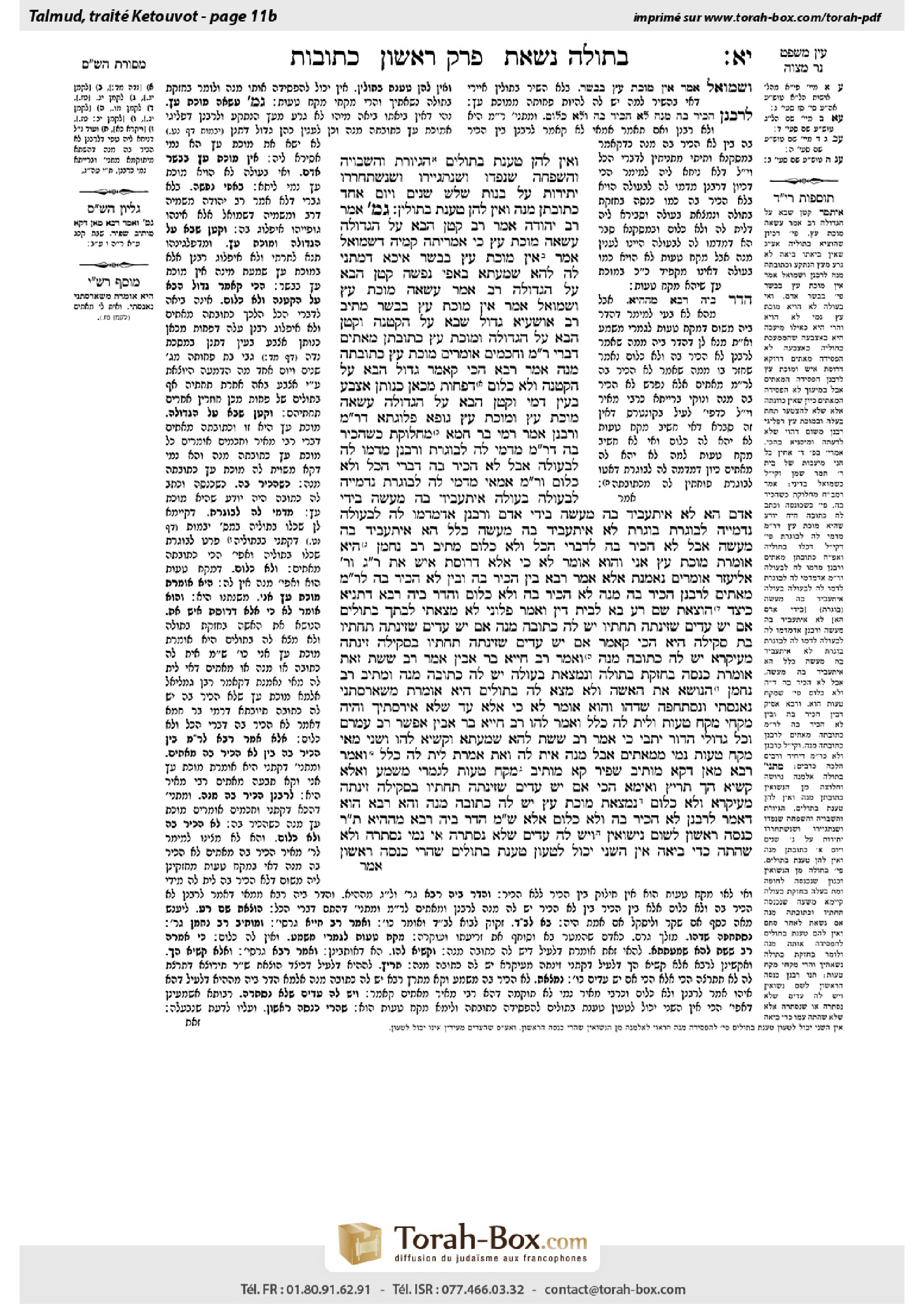
Ketubot 11b: Talmud study for Daf Yomi
Daf Yomi is the daily study of one Talmud folio. Explore 37 tractates with scans, Hebrew text, Sefaria English and AI-generated French translations where annotated.
Passage selection and English or AI-generated French translation are available where the scan has annotations. Daf Study is independent of Torah-Box and Sefaria.
Browse Ketubot · כתובות · All tractatesKetubot 11b text and translations
This page of Ketubot includes the Aramaic text, an English translation and an AI-generated French translation, alongside the scan above.
כתובות י״א ב · Aramaic and Hebrew text
וְאֵין לָהֶן טַעֲנַת בְּתוּלִים.
הַגִּיּוֹרֶת וְהַשְּׁבוּיָה וְהַשִּׁפְחָה שֶׁנִּפְדּוּ וְשֶׁנִּתְגַּיְּירוּ וְשֶׁנִּשְׁתַּחְרְרוּ, יְתֵירוֹת עַל בְּנוֹת שָׁלֹשׁ שָׁנִים וְיוֹם אֶחָד — כְּתוּבָּתָן מָנֶה, וְאֵין לָהֶן טַעֲנַת בְּתוּלִין.
גְּמָ׳ אָמַר רַב יְהוּדָה אָמַר רַב: קָטָן הַבָּא עַל הַגְּדוֹלָה — עֲשָׂאָהּ מוּכַּת עֵץ. כִּי אַמְרִיתַהּ קַמֵּיהּ דִּשְׁמוּאֵל, אָמַר: אֵין מוּכַּת עֵץ בְּבָשָׂר.
אִיכָּא דְּמַתְנֵי לַהּ לְהָא שְׁמַעְתָּא בְּאַפֵּי נַפְשַׁהּ: קָטָן הַבָּא עַל הַגְּדוֹלָה, רַב אָמַר: עֲשָׂאָהּ מוּכַּת עֵץ, וּשְׁמוּאֵל אָמַר: אֵין מוּכַּת עֵץ בְּבָשָׂר.
מֵתִיב רַב אוֹשַׁעְיָא: גָּדוֹל שֶׁבָּא עַל הַקְּטַנָּה, וְקָטָן הַבָּא עַל הַגְּדוֹלָה, וּמוּכַּת עֵץ — כְּתוּבָּתָן מָאתַיִם, דִּבְרֵי רַבִּי מֵאִיר. וַחֲכָמִים אוֹמְרִים: מוּכַּת עֵץ כְּתוּבָּתָהּ מָנֶה.
אָמַר רָבָא, הָכִי קָאָמַר: גָּדוֹל הַבָּא עַל הַקְּטַנָּה — וְלֹא כְּלוּם, דְּפָחוֹת מִכָּאן כְּנוֹתֵן אֶצְבַּע בָּעַיִן דָּמֵי. וְקָטָן הַבָּא עַל הַגְּדוֹלָה — עֲשָׂאָהּ מוּכַּת עֵץ. וּמוּכַּת עֵץ גּוּפָא פְּלוּגְתָּא דְּרַבִּי מֵאִיר וְרַבָּנַן.
אָמַר רָמֵי בַּר חָמָא: מַחֲלוֹקֶת כְּשֶׁהִכִּיר בָּהּ, דְּרַבִּי מֵאִיר מְדַמֵּי לַהּ לְבוֹגֶרֶת. וְרַבָּנַן מְדַמּוּ לַהּ לִבְעוּלָה, אֲבָל לֹא הִכִּיר בָּהּ — דִּבְרֵי הַכֹּל וְלֹא כְּלוּם.
וְרַבִּי מֵאִיר, אַמַּאי מְדַמֵּי לַהּ לְבוֹגֶרֶת? נְדַמְּיַיהּ לִבְעוּלָה! בְּעוּלָה — אִיתְעֲבִיד בַּהּ מַעֲשֶׂה בִּידֵי אָדָם, הָא — לָא אִיתְעֲבִיד בַּהּ מַעֲשֶׂה בִּידֵי אָדָם. וְרַבָּנַן, אַדִּמְדַמּוּ לַהּ לִבְעוּלָה, נְדַמְּיוּהָ לְבוֹגֶרֶת? בּוֹגֶרֶת — לָא אִיתְעֲבִיד בַּהּ מַעֲשֶׂה כְּלָל, הָא — אִיתְעֲבִיד בַּהּ מַעֲשֶׂה.
אֲבָל לֹא הִכִּיר בָּהּ — לְדִבְרֵי הַכֹּל וְלֹא כְּלוּם. מֵתִיב רַב נַחְמָן, הִיא אוֹמֶרֶת: מוּכַּת עֵץ אֲנִי, וְהוּא אוֹמֵר: לֹא כִּי, אֶלָּא דְּרוּסַת אִישׁ אַתְּ — רַבָּן גַּמְלִיאֵל וְרַבִּי אֱלִיעֶזֶר אוֹמְרִים: נֶאֱמֶנֶת.
אֶלָּא אָמַר רָבָא: בֵּין הִכִּיר בָּהּ וּבֵין לֹא הִכִּיר בָּהּ — לְרַבִּי מֵאִיר מָאתַיִם. לְרַבָּנַן, הִכִּיר בָּהּ — מָנֶה, לֹא הִכִּיר בָּהּ — וְלֹא כְּלוּם.
וַהֲדַר בֵּיהּ רָבָא, דְּתַנְיָא: כֵּיצַד הוֹצָאַת שֵׁם רַע? בָּא לְבֵית דִּין וְאָמַר: פְּלוֹנִי, לֹא מָצָאתִי לְבִתְּךָ בְּתוּלִים. אִם יֵשׁ עֵדִים שֶׁזִּינְּתָה תַּחְתָּיו — יֵשׁ לָהּ כְּתוּבָּה מָנֶה. אִם יֵשׁ עֵדִים שֶׁזִּינְּתָה תַּחְתָּיו — בַּת סְקִילָה הִיא! הָכִי קָאָמַר: אִם יֵשׁ עֵדִים שֶׁזִּינְּתָה תַּחְתָּיו — בִּסְקִילָה. זִינְּתָה מֵעִיקָּרָא — יֵשׁ לָהּ כְּתוּבָּה מָנֶה.
וְאָמַר רַב חִיָּיא בַּר אָבִין אָמַר רַב שֵׁשֶׁת: זֹאת אוֹמֶרֶת, כְּנָסָהּ בְּחֶזְקַת בְּתוּלָה וְנִמְצֵאת בְּעוּלָה — יֵשׁ לָהּ כְּתוּבָּה מָנֶה. וּמֵתִיב רַב נַחְמָן: הַנּוֹשֵׂא אֶת הָאִשָּׁה וְלֹא מָצָא לָהּ בְּתוּלִים, הִיא אוֹמֶרֶת: מִשֶּׁאֵרַסְתַּנִי נֶאֱנַסְתִּי וְנִסְתַּחֲפָה שָׂדֵהוּ. וְהוּא אוֹמֵר: לֹא כִי, אֶלָּא עַד שֶׁלֹּא אֵירַסְתִּיךְ, וְהָיָה מִקָּחִי מִקָּח טָעוּת. וְלֵית לַהּ כְּלָל?
וַאֲמַר לְהוּ רַב חִיָּיא בַּר אָבִין: אֶפְשָׁר רַב עַמְרָם וְכׇל גְּדוֹלֵי הַדּוֹר יָתְבִי כִּי אָמַר רַב שֵׁשֶׁת לְהָא שְׁמַעְתָּא וְקַשְׁיָא לְהוּ, וְשַׁנִּי: מַאי ״מִקָּח טָעוּת״ נָמֵי, מִמָּאתַיִם. אֲבָל מָנֶה אִית לַהּ, וְאַתּ אָמְרַתְּ לֵית לַהּ כְּלָל!
וְאָמַר רָבָא: מַאן דְּקָא מוֹתֵיב — שַׁפִּיר קָא מוֹתֵיב: מִקָּח טָעוּת לִגְמָרֵי מַשְׁמַע. וְאֶלָּא קַשְׁיָא הָךְ? תָּרֵיץ וְאֵימָא הָכִי: אִם יֵשׁ עֵדִים שֶׁזִּינְּתָה תַּחְתָּיו — בִּסְקִילָה. זִינְּתָה מֵעִיקָּרָא — וְלֹא כְּלוּם. נִמְצֵאת מוּכַּת עֵץ יֵשׁ לָהּ כְּתוּבָּה מָנֶה.
וְהָא רָבָא הוּא דְּאָמַר לְרַבָּנַן לֹא הִכִּיר בָּהּ — וְלֹא כְּלוּם! אֶלָּא שְׁמַע מִינַּהּ הֲדַר בֵּיהּ רָבָא מֵהַהִיא.
תָּנוּ רַבָּנַן: כְּנָסָהּ רִאשׁוֹן לְשׁוּם נִישּׂוּאִין, וְיֵשׁ לָהּ עֵדִים שֶׁלֹּא נִסְתְּרָה, אִי נָמֵי נִסְתְּרָה, וְלֹא שָׁהֲתָה כְּדֵי בִיאָה — אֵין הַשֵּׁנִי יָכוֹל לִטְעוֹן טַעֲנַת בְּתוּלִים. שֶׁהֲרֵי כְּנָסָהּ רִאשׁוֹן.
Ketubot 11b · English translation
and they are not subject to a claim concerning their virginity. Since they were married, even if they did not engage in intercourse with their husband, their presumptive status is that of non-virgins, and the second husband cannot claim that he was misled with regard to their status as virgins.
And similarly, with regard to a female convert, or a captive woman, or a maidservant, who were ransomed with regard to the captive, or who converted with regard to the convert, or who were freed with regard to the maidservant, when she was more than three years and one day old, for all of these, their marriage contract is one hundred dinars and they are not subject to a claim concerning their virginity. When they married, their presumptive status was that of a non-virgin.
GEMARA: Rav Yehuda said that Rav said: A minor boy who engaged in intercourse with an adult woman renders her as one whose hymen was ruptured by wood, as the act is not considered full-fledged intercourse. Rav Yehuda continues: When I said this statement before Shmuel, he said to me: A woman does not achieve the status of one whose hymen was ruptured by wood by means of flesh, i.e., intercourse.
Some teach this halakha independent of Rav Yehuda: With regard to a minor boy who engaged in intercourse with an adult woman, Rav said: He renders her as one whose hymen was ruptured by wood. And Shmuel said: A woman does not achieve the status of one whose hymen was ruptured by wood by means of flesh.
Rav Oshaya raised an objection to the opinion of Rav from the mishna: With regard to an adult man who engaged in intercourse with a minor girl less than three years old, or a minor boy less than nine years old who engaged in intercourse with an adult woman, or a woman who had her hymen ruptured by wood or any other foreign object, the marriage contract for each of these women is two hundred dinars. This is the statement of Rabbi Meir. And the Rabbis say: The marriage contract of a woman whose hymen was ruptured by wood is one hundred dinars. Contrary to Rav’s opinion, the Rabbis distinguish between the halakha in the case of the intercourse of a minor boy and the halakha in the case of a woman whose hymen was ruptured by wood.
Rava said that this is what the mishna is saying: An adult man who engaged in intercourse with a minor girl less than three years old has done nothing, as intercourse with a girl less than three years old is tantamount to poking a finger into the eye. In the case of an eye, after a tear falls from it another tear forms to replace it. Similarly, the ruptured hymen of the girl younger than three is restored. And a young boy who engaged in intercourse with an adult woman renders her as one whose hymen was ruptured by wood. And with regard to the case of a woman whose hymen was ruptured by wood itself, there is a dispute between Rabbi Meir and the Rabbis. Rabbi Meir maintains that her marriage contract is two hundred dinars, and the Rabbis maintain that it is one hundred dinars.
Rami bar Ḥama said: This dispute is specifically in a case where the husband was aware that her hymen was ruptured by wood, as in that case Rabbi Meir likens her to a grown woman, whose hymen does not completely obstruct the orifice as a result of the maturation process. Nevertheless, her marriage contract is that of a virgin, two hundred dinars. And the Rabbis liken her to a non-virgin who engaged in intercourse in the past. Her marriage contract is one hundred dinars. However, if he was not aware that her hymen was ruptured by wood and was under the impression that she was a full-fledged virgin, everyone agrees that she receives no marriage contract at all when he becomes aware of her condition, as the marriage was a mistaken transaction.
The Gemara asks: And why does Rabbi Meir liken her to a grown woman? Let him liken her to a non-virgin, who engaged in intercourse in the past. The Gemara answers: In the case of a non-virgin, an action was performed on her by a person; but with regard to this woman, whose hymen was ruptured by wood, an action was not performed on her by a person. The Gemara asks: And with regard to the Rabbis, rather than likening her to a non-virgin, let them liken her to a grown woman. The Gemara answers: In the case of a grown woman, no action was performed on her; but with regard to this woman, whose hymen was ruptured by wood, an action was performed on her.
Rami bar Ḥama concluded his statement: However, if he was not aware that her hymen was ruptured by wood, everyone agrees that she receives no marriage contract at all. Rav Naḥman raised an objection from a mishna (13a): In a case where she says: I am one whose hymen was ruptured by wood, i.e., she admits that her hymen is not intact but claims that it was not ruptured through intercourse, and the groom says: No; rather, you are one who was violated by a man and you are no longer a virgin, Rabban Gamliel and Rabbi Eliezer say: She is deemed credible and her claim is accepted. In that case, she is claiming that she is entitled to a marriage contract. Despite the fact that the groom had no prior awareness of her condition, Rabban Gamliel and Rabbi Eliezer maintain that she is deemed credible and receives a marriage contract of at least one hundred dinars. Apparently, not everyone agrees that in that case she receives nothing at all.
Rather, Rava said: This is what the mishna is saying: Whether the husband was aware that her hymen was ruptured by wood and whether he was not aware of her condition, according to Rabbi Meir she receives a marriage contract of two hundred dinars and it is not a mistaken transaction. According to the Rabbis, if he was aware of her condition she receives a marriage contract of one hundred dinars like a non-virgin; if he was not aware of her condition she receives no marriage contract at all, since it is a mistaken transaction, as when he married her he believed that her hymen was intact. According to this explanation, the mishna cited by Rav Naḥman is in accordance with the opinion of Rabbi Meir.
And Rava retracted his opinion, as it is taught in a baraita: How does the slander described in the Torah come about? If the groom comes to court and says: So-and-so, father of the bride, I did not find in your daughter an intact hymen. If there are witnesses that she committed adultery while under the husband’s jurisdiction after betrothal, she receives a marriage contract of one hundred dinars. The Gemara asks: If there are witnesses that she committed adultery while under his jurisdiction after betrothal, she is subject to execution by stoning. Obviously, she is in no position to receive a marriage contract. The Gemara answers that this is what the mishna is saying: If there are witnesses that she committed adultery while under his jurisdiction after betrothal, she is subject to execution by stoning. However, if she engaged in intercourse initially, prior to betrothal, she receives a marriage contract of one hundred dinars, like any non-virgin.
And Rav Ḥiyya bar Avin said that Rav Sheshet said: That is to say, if the groom married a woman with the presumptive status of a virgin and she is found to be a non-virgin, she receives a marriage contract of one hundred dinars. And Rav Naḥman raised an objection to the statement of Rav Sheshet from a mishna (12b): There is a case of one who marries a woman and did not find her hymen intact, and she says: After you betrothed me I was raped, and his, i.e., her husband’s, field was inundated, meaning that it is his misfortune that she is not a virgin, as she was raped after betrothal. And he says: No; rather, you were raped before I betrothed you, and my transaction was a mistaken transaction. The betrothal was predicated on your presumptive status as a virgin and in fact, you were not a virgin then. In that case, she does not receive any marriage contract at all.
And Rav Ḥiyya bar Avin said to those present: Is it possible that Rav Amram and all the prominent Sages of the generation were sitting when Rav Sheshet said this halakha, and Rav Naḥman’s question was difficult for them, and they answered: What is the meaning of mistaken transaction in this context? It too means that he is absolved from his commitment to pay the marriage contract of a virgin, two hundred dinars, because she is not entitled to that sum. However, she is entitled to one hundred dinars. And, contrary to that consensus, you say that she does not receive any marriage contract at all?
And Rava said: The one who raised the objection, Rav Naḥman, raises the objection well, as the term: Mistaken transaction, indicates that the betrothal is dissolved totally. The Gemara asks: But that baraita with regard to slander remains difficult, as in that case, if he discovered that she was not a virgin, she receives a marriage contract of one hundred dinars. The Gemara answers: Resolve the apparent contradiction and say this in the text of the baraita: If there are witnesses that she committed adultery while under his jurisdiction after betrothal, she is subject to execution by stoning. If she engaged in intercourse initially, prior to betrothal, she receives nothing at all. If she was discovered to be one whose hymen was ruptured by wood, she is entitled to a marriage contract of one hundred dinars.
But isn’t it Rava himself who said that according to the Rabbis, in the case of a woman whose hymen was ruptured by wood, if he was not aware of her condition she receives no marriage contract at all? Rather, conclude from it that Rava retracted that statement, and he holds that even according to the Rabbis, even if he was unaware of her condition she receives a marriage contract of one hundred dinars.
§ The Sages taught: If her first husband brought her into his home for the purpose of marriage, and she has witnesses who testified that she did not seclude herself with him, or alternatively, they testified that she secluded herself with him and did not stay in seclusion with him for a period equivalent to the time required to engage in intercourse, if the first husband dies or divorces her and she remarries, despite the testimony of the witnesses, the second husband cannot make a claim concerning virginity, and say the betrothal was predicated on the assumption that she was a virgin and she should lose her marriage contract. Since the first husband brought her into his home, the second husband should have considered that a woman who entered her husband’s home is no longer a virgin.
Ketubot 11b · Traduction française (IA)
et elles ne peuvent faire l’objet d’une contestation concernant leur virginité. Puisqu’elles ont été mariées, même si elles n’ont pas eu de rapports avec leur mari, elles sont présumées ne plus être vierges, et le second mari ne peut prétendre avoir été induit en erreur quant à leur statut de vierges.
De même, s’agissant d’une convertie, d’une femme captive ou d’une servante, qui ont été respectivement rachetées, converties ou affranchies, lorsqu’elles avaient plus de trois ans et un jour, leur contrat de mariage est de cent dinars et elles ne peuvent faire l’objet d’une contestation concernant leur virginité. Au moment de leur mariage, elles étaient présumées ne plus être vierges.
GUEMARA : Rav Yehouda a dit au nom de Rav : Un garçon mineur qui a un rapport avec une femme adulte la rend semblable à une femme dont l’hymen a été déchiré par un morceau de bois, car cet acte n’est pas considéré comme un rapport sexuel à part entière. Rav Yehouda poursuit : Lorsque j’ai rapporté cette déclaration devant Shmuel, il m’a dit : Une femme ne peut acquérir le statut de celle dont l’hymen a été déchiré par un morceau de bois au moyen de la chair, c’est-à-dire par un rapport sexuel.
Certains enseignent cette halakha indépendamment de Rav Yehouda : Au sujet d’un garçon mineur qui a un rapport avec une femme adulte, Rav a dit : Il la rend semblable à une femme dont l’hymen a été déchiré par un morceau de bois. Et Shmuel a dit : Une femme ne peut acquérir le statut de celle dont l’hymen a été déchiré par un morceau de bois au moyen de la chair.
Rav Oshaya soulève une objection à l’opinion de Rav à partir de la Michna : Dans le cas d’un homme adulte qui a un rapport avec une fillette de moins de trois ans, d’un garçon mineur de moins de neuf ans qui a un rapport avec une femme adulte, ou d’une femme dont l’hymen a été déchiré par un morceau de bois ou par tout autre objet étranger, le contrat de mariage de chacune de ces femmes est de deux cents dinars. Telle est la déclaration de Rabbi Meïr. Les Sages disent : Le contrat de mariage d’une femme dont l’hymen a été déchiré par un morceau de bois est de cent dinars. Contrairement à l’opinion de Rav, les Sages distinguent la halakha relative au rapport avec un garçon mineur de celle qui concerne une femme dont l’hymen a été déchiré par un morceau de bois.
Rava dit que voici ce qu’enseigne la Michna : Un homme adulte qui a un rapport avec une fillette de moins de trois ans n’a rien fait, car avoir un rapport avec une fillette de moins de trois ans revient à enfoncer un doigt dans l’œil. Dans le cas de l’œil, après qu’une larme en est tombée, une autre se forme pour la remplacer. De même, l’hymen déchiré de la fillette de moins de trois ans se reconstitue. Un jeune garçon qui a un rapport avec une femme adulte la rend semblable à une femme dont l’hymen a été déchiré par un morceau de bois. Quant au cas d’une femme dont l’hymen a été déchiré par un morceau de bois proprement dit, Rabbi Meïr et les Sages sont en désaccord. Rabbi Meïr estime que son contrat de mariage est de deux cents dinars, tandis que les Sages estiment qu’il est de cent dinars.
Rami bar Ḥama dit : Ce désaccord porte précisément sur le cas où le mari savait que son hymen avait été déchiré par un morceau de bois, car, dans ce cas, Rabbi Meïr l’assimile à une femme adulte, dont l’hymen, en raison du processus de maturation, n’obstrue pas complètement l’orifice. Néanmoins, son contrat de mariage est celui d’une vierge, soit deux cents dinars. Les Sages, eux, l’assimilent à une non-vierge qui a eu des rapports par le passé. Son contrat de mariage est de cent dinars. Cependant, s’il ignorait que son hymen avait été déchiré par un morceau de bois et croyait qu’elle était vierge à part entière, tous conviennent qu’elle ne reçoit aucun contrat de mariage lorsqu’il découvre son état, car le mariage était une transaction fondée sur une erreur.
La Guemara demande : Pourquoi Rabbi Meïr l’assimile-t-il à une femme adulte ? Qu’il l’assimile à une non-vierge qui a eu des rapports par le passé. La Guemara répond : Dans le cas d’une non-vierge, une personne a accompli un acte sur elle ; mais, s’agissant de cette femme dont l’hymen a été déchiré par un morceau de bois, personne n’a accompli d’acte sur elle. La Guemara demande : Et s’agissant des Sages, au lieu de l’assimiler à une non-vierge, qu’ils l’assimilent à une femme adulte. La Guemara répond : Dans le cas d’une femme adulte, aucun acte n’a été accompli sur elle ; mais, s’agissant de cette femme dont l’hymen a été déchiré par un morceau de bois, un acte a été accompli sur elle.
Rami bar Ḥama conclut sa déclaration : Cependant, s’il ignorait que son hymen avait été déchiré par un morceau de bois, tous conviennent qu’elle ne reçoit aucun contrat de mariage. Rav Naḥman soulève une objection à partir d’une Michna (13a) : Dans le cas où elle dit : « Je suis une femme dont l’hymen a été déchiré par un morceau de bois », c’est-à-dire qu’elle reconnaît que son hymen n’est pas intact, mais affirme qu’il n’a pas été déchiré lors d’un rapport sexuel, et où le marié répond : « Non, tu as été violée par un homme et tu n’es plus vierge », Rabban Gamliel et Rabbi Eliezer disent : Elle est jugée digne de foi et sa déclaration est acceptée. Dans ce cas, elle affirme avoir droit à un contrat de mariage. Bien que le marié n’ait pas eu connaissance au préalable de son état, Rabban Gamliel et Rabbi Eliezer estiment qu’elle est digne de foi et qu’elle reçoit un contrat de mariage d’au moins cent dinars. Apparemment, tous ne conviennent pas que, dans ce cas, elle ne reçoit absolument rien.
Rava dit plutôt : Voici ce qu’enseigne la Michna : Que le mari ait su ou non que son hymen avait été déchiré par un morceau de bois, selon Rabbi Meïr, elle reçoit un contrat de mariage de deux cents dinars et il ne s’agit pas d’une transaction fondée sur une erreur. Selon les Sages, s’il connaissait son état, elle reçoit un contrat de mariage de cent dinars, comme une non-vierge ; s’il l’ignorait, elle ne reçoit aucun contrat de mariage, puisqu’il s’agit d’une transaction fondée sur une erreur : lorsqu’il l’a épousée, il croyait que son hymen était intact. Selon cette explication, la Michna citée par Rav Naḥman suit l’opinion de Rabbi Meïr.
Rava est revenu sur son opinion, car une baraïta enseigne : Comment se produit la calomnie décrite dans la Torah ? Le marié se présente au tribunal et dit : « Untel, père de la mariée, je n’ai pas trouvé l’hymen de ta fille intact. » S’il y a des témoins attestant qu’elle a commis un adultère alors qu’elle relevait de l’autorité de son mari, après les fiançailles, elle reçoit un contrat de mariage de cent dinars. La Guemara demande : S’il y a des témoins attestant qu’elle a commis un adultère alors qu’elle relevait de son autorité, après les fiançailles, elle est passible de lapidation. Évidemment, elle n’est pas en mesure de recevoir un contrat de mariage. La Guemara répond que voici ce qu’enseigne la Michna : S’il y a des témoins attestant qu’elle a commis un adultère alors qu’elle relevait de son autorité, après les fiançailles, elle est passible de lapidation. Mais si elle a eu des rapports auparavant, avant les fiançailles, elle reçoit un contrat de mariage de cent dinars, comme toute non-vierge.
Rav Ḥiyya bar Avin a dit au nom de Rav Sheshet : Cela signifie que si le marié a épousé une femme présumée vierge et qu’on découvre qu’elle ne l’est pas, elle reçoit un contrat de mariage de cent dinars. Rav Naḥman soulève une objection à la déclaration de Rav Sheshet à partir d’une Michna (12b) : Il y a le cas d’un homme qui épouse une femme et ne trouve pas son hymen intact. Elle dit : « Après que tu m’as fiancée, j’ai été violée », et le champ de celui-ci, c’est-à-dire de son mari, a été inondé, ce qui signifie que c’est son malheur à lui qu’elle ne soit pas vierge, puisqu’elle a été violée après les fiançailles. Lui dit : « Non, tu as été violée avant que je te fiance, et notre transaction était fondée sur une erreur. » Les fiançailles reposaient sur ta présomption de virginité, alors qu’en réalité tu ne l’étais pas à ce moment-là. Dans ce cas, elle ne reçoit aucun contrat de mariage.
Rav Ḥiyya bar Avin dit aux personnes présentes : Est-il possible que Rav Amram et tous les Sages éminents de la génération aient été assis lorsque Rav Sheshet a énoncé cette halakha, que la question de Rav Naḥman leur ait posé problème et qu’ils aient répondu : Que signifie ici l’expression « transaction fondée sur une erreur » ? Elle signifie aussi qu’il est libéré de son obligation de payer le contrat de mariage d’une vierge, soit deux cents dinars, car elle n’a pas droit à cette somme. Elle a toutefois droit à cent dinars. Et, contrairement à ce consensus, vous dites qu’elle ne reçoit aucun contrat de mariage ?
Rava dit : Celui qui a soulevé l’objection, Rav Naḥman, a bien fait de la soulever, car l’expression « transaction fondée sur une erreur » indique que les fiançailles sont entièrement annulées. La Guemara demande : Mais la baraïta concernant la calomnie reste problématique, car dans ce cas, s’il découvre qu’elle n’est pas vierge, elle reçoit un contrat de mariage de cent dinars. La Guemara répond : Résolvez cette contradiction apparente et formulez ainsi le texte de la baraïta : S’il y a des témoins attestant qu’elle a commis un adultère alors qu’elle relevait de son autorité, après les fiançailles, elle est passible de lapidation. Si elle a eu des rapports auparavant, avant les fiançailles, elle ne reçoit rien du tout. Si l’on découvre que son hymen a été déchiré par un morceau de bois, elle a droit à un contrat de mariage de cent dinars.
Mais n’est-ce pas Rava lui-même qui a dit que, selon les Sages, dans le cas d’une femme dont l’hymen a été déchiré par un morceau de bois, si le mari ignorait son état, elle ne reçoit aucun contrat de mariage ? Il faut plutôt en conclure que Rava est revenu sur cette déclaration et qu’il estime que même selon les Sages, même s’il ignorait son état, elle reçoit un contrat de mariage de cent dinars.
§ Les Sages ont enseigné : Si son premier mari l’a fait entrer dans sa maison en vue du mariage et qu’elle a des témoins attestant qu’elle ne s’est pas isolée avec lui, ou des témoins attestant qu’elle s’est isolée avec lui, mais pas pendant une durée équivalant au temps nécessaire pour avoir un rapport, si le premier mari meurt ou divorce d’elle et qu’elle se remarie, le second mari ne peut, malgré le témoignage des témoins, contester sa virginité ni dire que les fiançailles reposaient sur la présomption qu’elle était vierge et qu’elle doit donc perdre son contrat de mariage. Puisque le premier mari l’a fait entrer dans sa maison, le second mari aurait dû tenir compte du fait qu’une femme entrée dans la maison de son mari n’est plus vierge.
Traduction française générée par IA à partir de l’édition anglaise de Sefaria. Vérifie toujours un passage avec le texte source.
Text from Sefaria: William Davidson Edition - Vocalized Aramaic (CC BY NC); William Davidson Edition - English (CC BY NC).