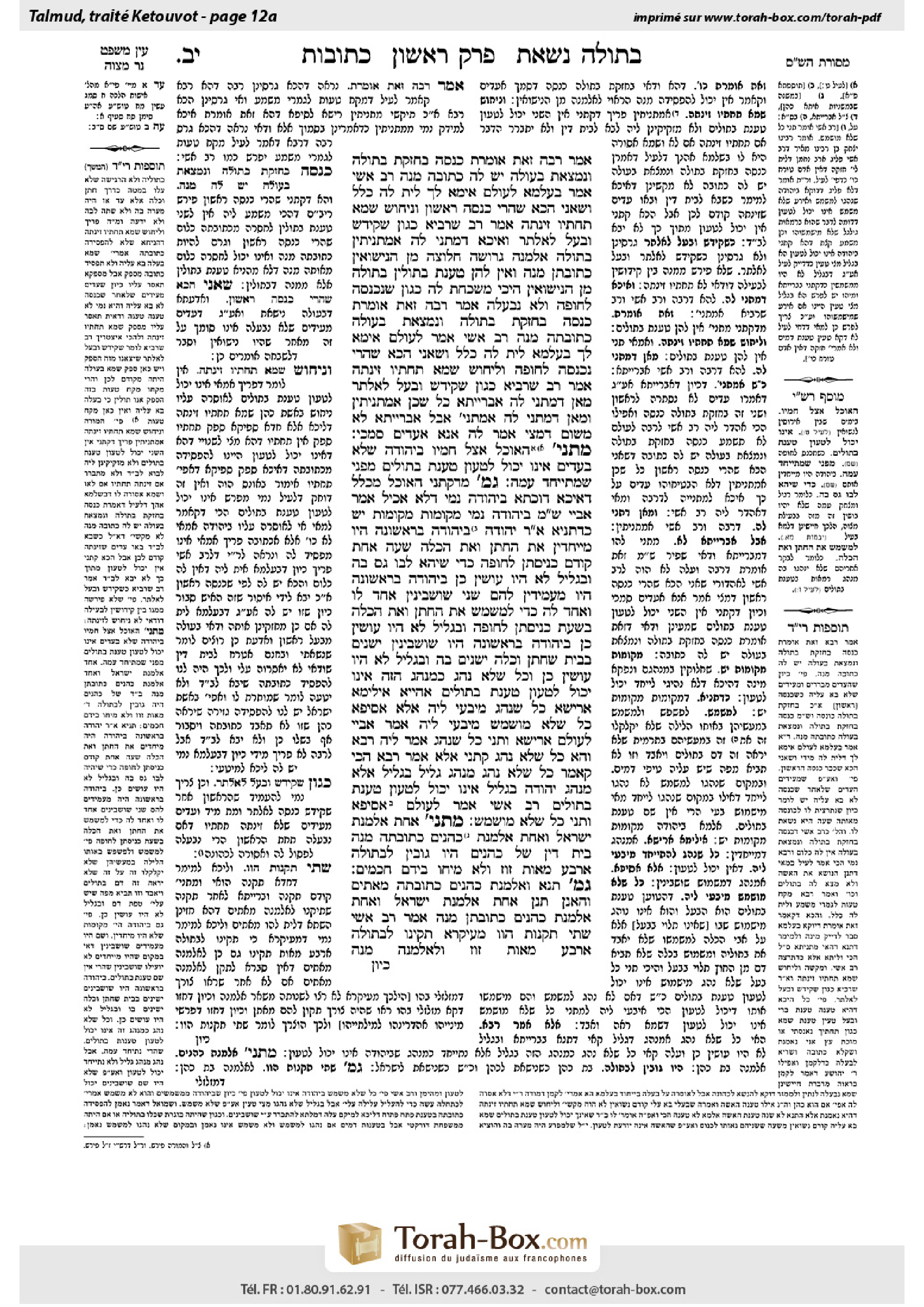
Ketubot 12a: Talmud study for Daf Yomi
Daf Yomi is the daily study of one Talmud folio. Explore 37 tractates with scans, Hebrew text, Sefaria English and AI-generated French translations where annotated.
Passage selection and English or AI-generated French translation are available where the scan has annotations. Daf Study is independent of Torah-Box and Sefaria.
Browse Ketubot · כתובות · All tractatesKetubot 12a text and translations
This page of Ketubot includes the Aramaic text, an English translation and an AI-generated French translation, alongside the scan above.
כתובות י״ב א · Aramaic and Hebrew text
אָמַר רַבָּה: זֹאת אוֹמֶרֶת, כְּנָסָהּ בְּחֶזְקַת בְּתוּלָה, וְנִמְצֵאת בְּעוּלָה — יֵשׁ לָהּ כְּתוּבָּה מָנֶה. רַב אָשֵׁי אָמַר: בְּעָלְמָא לְעוֹלָם אֵימָא לָךְ לֵית לַהּ כְּלָל, וְשָׁאנֵי הָכָא, שֶׁהֲרֵי כְּנָסָהּ רִאשׁוֹן.
וְנֵיחוּשׁ שֶׁמָּא תַּחְתָּיו זִינְּתָה! אָמַר רַב שֵׁרֵבְיָא: כְּגוֹן שֶׁקִּידֵּשׁ וּבָעַל לְאַלְתַּר.
וְאִיכָּא דְּמַתְנֵי לַהּ אַמַּתְנִיתִין: בְּתוּלָה, אַלְמָנָה, גְּרוּשָׁה חֲלוּצָה מִן הַנִּישּׂוּאִין — כְּתוּבָּתָן מָנֶה, וְאֵין לָהֶן טַעֲנַת בְּתוּלִין. בְּתוּלָה מִן הַנִּישּׂוּאִין הֵיכִי מַשְׁכַּחַתְּ לַהּ? כְּגוֹן שֶׁנִּכְנְסָה לְחוּפָּה וְלֹא נִבְעֲלָה.
אָמַר רַבָּה: זֹאת אוֹמֶרֶת, כְּנָסָהּ בְּחֶזְקַת בְּתוּלָה וְנִמְצֵאת בְּעוּלָה — כְּתוּבָּתָהּ מָנֶה. רַב אָשֵׁי אָמַר: לְעוֹלָם אֵימָא לָךְ בְּעָלְמָא לֵית לַהּ כְּלָל, וְשָׁאנֵי הָכָא שֶׁהֲרֵי נִכְנְסָה לְחוּפָּה.
וְנֵיחוּשׁ שֶׁמָּא תַּחְתָּיו זִינְּתָה! אָמַר רַב שֵׁרֵבְיָא: כְּגוֹן שֶׁקִּידֵּשׁ וּבָעַל לְאַלְתַּר.
מַאן דְּמַתְנֵי לַהּ אַבָּרַיְיתָא — כׇּל שֶׁכֵּן אַמַּתְנִיתִין, וּמַאן דְּמַתְנֵי לַהּ אַמַּתְנִיתִין — אֲבָל אַבָּרַיְיתָא לָא, מִשּׁוּם דְּמָצֵי אָמַר לַהּ: אֲנָא אַעֵדִים סְמַכִי.
מַתְנִי׳ הָאוֹכֵל אֵצֶל חָמִיו בִּיהוּדָה שֶׁלֹּא בְּעֵדִים — אֵינוֹ יָכוֹל לִטְעוֹן טַעֲנַת בְּתוּלִים, מִפְּנֵי שֶׁמִּתְיַיחֵד עִמָּהּ.
גְּמָ׳ מִדְּקָתָנֵי ״הָאוֹכֵל״, מִכְּלָל דְּאִיכָּא דּוּכְתָּא בִּיהוּדָה נָמֵי דְּלָא אָכֵיל. אָמַר אַבָּיֵי: שְׁמַע מִינַּהּ בִּיהוּדָה נָמֵי מְקוֹמוֹת מְקוֹמוֹת יֵשׁ. כִּדְתַנְיָא, אָמַר רַבִּי יְהוּדָה: בִּיהוּדָה, בָּרִאשׁוֹנָה הָיוּ מְיַיחֲדִין אֶת הֶחָתָן וְאֶת הַכַּלָּה שָׁעָה אַחַת קוֹדֶם כְּנִיסָתָן לַחוּפָּה, כְּדֵי שֶׁיְּהֵא לִבּוֹ גַּס בָּהּ, וּבַגָּלִיל לֹא הָיוּ עוֹשִׂין כֵּן.
בִּיהוּדָה, בָּרִאשׁוֹנָה הָיוּ מַעֲמִידִין לָהֶם שְׁנֵי שׁוֹשְׁבִינִין, אֶחָד לוֹ וְאֶחָד לָהּ, כְּדֵי לְמַשְׁמֵשׁ אֶת הֶחָתָן וְאֶת הַכַּלָּה בִּשְׁעַת כְּנִיסָתָן לַחוּפָּה, וּבַגָּלִיל לֹא הָיוּ עוֹשִׂין כֵּן.
בִּיהוּדָה, בָּרִאשׁוֹנָה הָיוּ שׁוֹשְׁבִינִין יְשֵׁנִים בַּבַּיִת שֶׁחָתָן וְכַלָּה יְשֵׁנִים בָּהּ, וּבַגָּלִיל לֹא הָיוּ עוֹשִׂין כֵּן.
וְכֹל שֶׁלֹּא נָהַג כַּמִּנְהָג הַזֶּה — אֵינוֹ יָכוֹל לִטְעוֹן טַעֲנַת בְּתוּלִים. אַהֵיָיא? אִילֵּימָא אַרֵישָׁא, ״כֹּל שֶׁנָּהַג״ מִיבְּעֵי לֵיהּ!
אֶלָּא אַסֵּיפָא, ״כֹּל שֶׁלֹּא מוּשְׁמַשׁ״ מִיבְּעֵי לֵיהּ!
אָמַר אַבָּיֵי: לְעוֹלָם אַרֵישָׁא, וּתְנִי: ״כֹּל שֶׁנָּהַג״. אֲמַר לֵיהּ רָבָא: וְהָא ״כֹּל שֶׁלֹּא נָהַג״ קָתָנֵי. אֶלָּא אָמַר רָבָא, הָכִי קָאָמַר: כׇּל שֶׁלֹּא נָהַג מִנְהַג גָּלִיל בַּגָּלִיל, אֶלָּא מִנְהַג יְהוּדָה בַּגָּלִיל — אֵינוֹ יָכוֹל לִטְעוֹן טַעֲנַת בְּתוּלִים. רַב אָשֵׁי אָמַר: לְעוֹלָם אַסֵּיפָא, וּתְנִי: ״כֹּל שֶׁלֹּא מוּשְׁמַשׁ״.
מַתְנִי׳ אַחַת אַלְמְנַת יִשְׂרָאֵל וְאַחַת אַלְמְנַת כֹּהֲנִים — כְּתוּבָּתָהּ מָנֶה. בֵּית דִּין שֶׁל כֹּהֲנִים הָיוּ גּוֹבִין לִבְתוּלָה אַרְבַּע מֵאוֹת זוּז, וְלֹא מִיחוּ בְּיָדָם חֲכָמִים.
גְּמָ׳ תָּנָא: וְאַלְמְנַת כֹּהֲנִים — כְּתוּבָּתָהּ מָאתַיִם. וְהָאֲנַן תְּנַן: אַחַת אַלְמְנַת יִשְׂרָאֵל וְאַחַת אַלְמְנַת כֹּהֲנִים כְּתוּבָּתָן מָנֶה!
אָמַר רַב אָשֵׁי: שְׁתֵּי תַּקָּנוֹת הֲווֹ, מֵעִיקָּרָא תַּקִּינוּ לִבְתוּלָה אַרְבַּע מֵאוֹת זוּז, וּלְאַלְמָנָה מָנֶה.
Ketubot 12a · English translation
Rabba said: That is to say, if one married a woman with the presumptive status of a virgin, as there were witnesses that she did not engage in intercourse, and she was found to be a non-virgin, she is entitled to a marriage contract of one hundred dinars. The Gemara rejects the proof. Rav Ashi said: In general, actually, I would say to you that in that case she does not receive a marriage contract at all, as it is a mistaken transaction. But here it is different, and she does not totally lose her marriage contract, because the first husband brought her into his house. Therefore, the second husband should have considered that a woman who entered her husband’s home is no longer a virgin.
The Gemara asks: And since there are witnesses that she did not engage in intercourse with the first husband, let us be concerned that perhaps she committed adultery after betrothal, while under the jurisdiction of the second husband, and rule that she is forbidden to him due to suspicion of adultery and is not entitled to a marriage contract at all. Rav Sherevya said: The baraita is referring to a case where he betrothed her and engaged in intercourse immediately. Therefore, there was no opportunity to engage in adultery between her betrothal and her marriage to the second husband.
Others taught this statement of Rabba with regard to the mishna: Concerning a virgin who is a widow, a divorcée, or a ḥalutza who achieved that status from a state of marriage, for all these women their marriage contract is one hundred dinars, and they are not subject to a claim concerning their virginity. The Gemara asks: How can you find a virgin from a state of marriage? It is in a case where she entered the wedding canopy and did not engage in intercourse.
Rabba said: That is to say, if one married a woman with the presumptive status of a virgin and she was found to be a non-virgin, her marriage contract is one hundred dinars. The Gemara rejects the proof. Rav Ashi said: In general, actually, I would say to you that in general, she does not receive a marriage contract at all, as it is a mistaken transaction. But here it is different, and she does not totally lose her marriage contract, because she entered the wedding canopy. Therefore, the second husband should have considered that a woman who entered her husband’s home is no longer a virgin.
The Gemara asks: And let us be concerned that perhaps she committed adultery after betrothal, while under the jurisdiction of the second husband. Rav Sherevya said: The baraita is referring to a case where he betrothed her and engaged in intercourse immediately. Therefore, there was no opportunity to engage in adultery between her betrothal and her marriage to the second husband.
The Gemara notes: The one who taught the exchange between Rabba and Rav Ashi with regard to the baraita, where there is explicit testimony that she did not engage in intercourse with the first husband and nevertheless no proof can be brought that if he discovers that she is not a virgin she receives a marriage contract of one hundred dinars, all the more so would he say that the same is true with regard to the mishna. And the one who taught the exchange with regard to the mishna, however, would not say the same with regard to the baraita, due to the fact that the husband could say to her: I relied on witnesses. Therefore, proof can be brought from the baraita that if he discovered that she is not a virgin, she receives a marriage contract of one hundred dinars.
MISHNA: A man who eats at the house of his father-in-law in Judea after betrothal and without witnesses to attest to the fact that he was not alone with his betrothed is unable to make a claim concerning virginity after marriage because in accordance with the custom in Judea, the assumption is that he secluded himself with her, and the concern is that it was he who engaged in intercourse with her.
GEMARA: The Gemara infers: From the fact that the mishna teaches the halakha employing the phrase: A man who eats, by inference one may conclude that there is also a place in Judea where the groom does not eat at the house of his father-in-law, and does not enter into seclusion with his betrothed. Abaye said: Conclude from it that in Judea too there are different places with different customs, as it is taught in a baraita that Rabbi Yehuda said: In Judea, at first they would seclude the groom and bride together for a brief period before their entry into the wedding canopy, so that he would grow accustomed to her companionship in order to ease the awkwardness when they would consummate the marriage. And in the Galilee they did not do so.
The baraita continues. In Judea, at first they would appoint for them two groomsmen [shushvinin], one for him and one for her, in order to examine the groom and the bride at the time of their entry into the wedding canopy and thereafter, to ensure that neither would engage in deception with regard to the presence or absence of blood from the rupture of the hymen. And in the Galilee they would not do so. As the custom of appointing groomsmen would be relevant only in a case where the groom and the bride had not been together in seclusion prior to marriage, this is apparently a custom in Judea different from the first custom cited in the mishna, where they would enter into seclusion prior to marriage.
The baraita continues. In Judea, at first the groomsmen would sleep in the house in which the groom and bride sleep, in order to examine the sheet on which the marriage was consummated immediately following intercourse. This was in order to ensure that the groom would not attempt to obscure the blood of the rupture of the hymen and claim that the bride was not a virgin. And in the Galilee they would not do so.
The baraita concludes: And anyone who did not conduct himself in accordance with this custom cannot make a claim concerning virginity against the bride. The Gemara asks: Concerning which case in the baraita was this principle stated? If we say it is concerning the first clause of the baraita, regarding the custom to seclude the couple prior to marriage, in that case, the phrase: Anyone who conducted himself in accordance with this custom cannot make a claim concerning virginity, is what it needed to say, due to the concern that perhaps they had sexual relations before the marriage.
Rather, it is concerning the latter clause of the baraita: They would appoint for them two groomsmen to examine them, that the principle was stated. In that case, the phrase: Anyone who was not examined by the groomsmen, is what it needed to say, as it is dependent on the family of the bride, and not the phrase: Anyone who did not conduct himself in accordance with this custom, which indicates that it depends on him.
Abaye said: Actually, the principle is stated concerning the first clause; and emend the baraita and teach: Anyone who conducted himself in accordance with this custom. Rava said to him: But isn’t it teaching explicitly: Anyone who did not conduct himself in accordance with this custom? One should not corrupt a baraita due to a difficulty that arose in understanding it. Rather, Rava said that this is what the baraita is saying: Anyone who did not practice the custom of the Galilee in the Galilee, but instead observed the custom of Judea in the Galilee, cannot make a claim concerning virginity against the bride. Rav Ashi said: Actually, this principle could be applied concerning the latter clause, and teach: Anyone who was not examined. When it said in the baraita: Anyone who did not conduct himself in accordance with this custom, it is referring to the custom of being examined.
MISHNA: For both a widow who is an Israelite woman and a widow who is the daughter of priests, her marriage contract is one hundred dinars. A court of priests would collect a marriage contract of four hundred dinars for a virgin daughter of a priest, twice the sum of the standard marriage contract for a virgin, and the Sages did not reprimand them.
GEMARA: A Sage taught in a baraita: And for a widow who is the daughter of priests, her marriage contract is two hundred dinars. The Gemara asks: But didn’t we learn in the mishna: For both a widow who is an Israelite woman and a widow who is the daughter of priests, their marriage contract is one hundred dinars?
Rav Ashi said: There were two ordinances instituted: Initially, the court of priests instituted for a virgin daughter of a priest a marriage contract of four hundred dinars, and for a widow, a marriage contract of one hundred dinars.
Ketubot 12a · Traduction française (IA)
Rabba dit : Cela signifie que si un homme a épousé une femme présumée vierge — des témoins attestant qu’elle n’avait pas eu de relations sexuelles — et qu’elle s’est révélée ne pas être vierge, elle a droit à une ketouba de cent dinars. La Guemara rejette cette preuve. Rav Achi dit : En règle générale, je te dirais qu’elle ne reçoit aucune ketouba dans ce cas, car il s’agit d’une transaction fondée sur une erreur. Mais ici, c’est différent : elle ne perd pas entièrement sa ketouba, puisque son premier mari l’a fait entrer dans sa maison. Le second mari aurait donc dû prendre en considération le fait qu’une femme entrée dans la maison de son mari n’est plus vierge.
La Guemara demande : Puisqu’il y a des témoins attestant qu’elle n’a pas eu de relations sexuelles avec son premier mari, ne devons-nous pas craindre qu’elle ait commis un adultère après les fiançailles, alors qu’elle relevait de l’autorité du second mari, et statuer qu’elle lui est interdite en raison du soupçon d’adultère et qu’elle n’a droit à aucune ketouba ? Rav Chérévya dit : La baraïta parle d’un cas où il l’a fiancée puis a eu des relations sexuelles avec elle immédiatement. Elle n’a donc pas eu l’occasion de commettre un adultère entre ses fiançailles et son mariage avec le second mari.
D’autres ont rapporté cette déclaration de Rabba à propos de la Michna : pour une vierge devenue veuve, divorcée ou ḥaloutsa alors qu’elle était mariée, la ketouba est de cent dinars, et aucune réclamation au sujet de sa virginité ne peut être présentée. La Guemara demande : Comment peut-on trouver une vierge devenue veuve, divorcée ou ḥaloutsa alors qu’elle était mariée ? Il s’agit d’un cas où elle est entrée sous la houppa sans avoir eu de relations sexuelles.
Rabba dit : Cela signifie que si un homme a épousé une femme présumée vierge et qu’elle s’est révélée ne pas être vierge, sa ketouba est de cent dinars. La Guemara rejette cette preuve. Rav Achi dit : En règle générale, je te dirais qu’elle ne reçoit aucune ketouba, car il s’agit d’une transaction fondée sur une erreur. Mais ici, c’est différent : elle ne perd pas entièrement sa ketouba, puisqu’elle est entrée sous la houppa. Le second mari aurait donc dû prendre en considération le fait qu’une femme entrée dans la maison de son mari n’est plus vierge.
La Guemara demande : Ne devons-nous pas craindre qu’elle ait commis un adultère après les fiançailles, alors qu’elle relevait de l’autorité du second mari ? Rav Chérévya dit : La baraïta parle d’un cas où il l’a fiancée puis a eu des relations sexuelles avec elle immédiatement. Elle n’a donc pas eu l’occasion de commettre un adultère entre ses fiançailles et son mariage avec le second mari.
La Guemara fait remarquer : Celui qui a rapporté l’échange entre Rabba et Rav Achi à propos de la baraïta — où des témoins attestent explicitement qu’elle n’a pas eu de relations sexuelles avec son premier mari et où, néanmoins, on ne peut pas prouver que, si le mari découvre qu’elle n’est pas vierge, elle reçoit une ketouba de cent dinars — dirait à plus forte raison la même chose à propos de la Michna. En revanche, celui qui a rapporté cet échange à propos de la Michna ne dirait pas la même chose à propos de la baraïta, car le mari pourrait lui dire : « Je me suis fié aux témoins. » On peut donc tirer de la baraïta la preuve que, s’il découvre qu’elle n’est pas vierge, elle reçoit une ketouba de cent dinars.
MICHNA : Un homme qui prend ses repas dans la maison de son beau-père en Judée, après les fiançailles et sans témoins attestant qu’il n’est pas resté seul avec sa fiancée, ne peut présenter aucune réclamation au sujet de sa virginité après le mariage, car, conformément à la coutume en Judée, on présume qu’il s’est isolé avec elle et l’on craint que ce soit lui qui ait eu des relations sexuelles avec elle.
GUEMARA : La Guemara déduit de la formulation de la Michna — « un homme qui prend ses repas » — qu’il existe aussi en Judée un endroit où le marié ne prend pas ses repas dans la maison de son beau-père et ne s’isole pas avec sa fiancée. Abayé dit : On peut en conclure qu’en Judée aussi, les coutumes varient selon les endroits, car une baraïta enseigne que Rabbi Yehouda a dit : En Judée, autrefois, on laissait le marié et la mariée s’isoler ensemble brièvement avant leur entrée sous la houppa, afin qu’il s’habitue à sa compagnie et que la gêne soit moindre au moment où ils consommeraient le mariage. En Galilée, on ne faisait pas ainsi.
La baraïta poursuit : En Judée, autrefois, on leur désignait deux garçons d’honneur [shushvinin], un pour le marié et un pour la mariée, afin de les examiner au moment de leur entrée sous la houppa et par la suite, pour s’assurer qu’aucun des deux ne chercherait à tromper l’autre quant à la présence ou à l’absence du sang provoqué par la rupture de l’hymen. En Galilée, on ne faisait pas ainsi. Puisque la coutume de désigner des garçons d’honneur n’était pertinente que si le marié et la mariée ne s’étaient pas isolés ensemble avant le mariage, il semble que cette coutume de Judée diffère de la première coutume mentionnée dans la Michna, selon laquelle ils s’isolaient avant le mariage.
La baraïta poursuit : En Judée, autrefois, les garçons d’honneur dormaient dans la maison où le marié et la mariée dormaient, afin d’examiner le drap sur lequel le mariage avait été consommé, immédiatement après les relations sexuelles. Il s’agissait de s’assurer que le marié ne chercherait pas à dissimuler le sang provoqué par la rupture de l’hymen et à prétendre que la mariée n’était pas vierge. En Galilée, on ne faisait pas ainsi.
La baraïta conclut : Quiconque ne s’est pas conformé à cette coutume ne peut présenter aucune réclamation au sujet de la virginité de la mariée. La Guemara demande : À quel cas de la baraïta ce principe se rapporte-t-il ? S’il concerne la première partie de la baraïta, à savoir la coutume consistant à isoler le couple avant le mariage, il aurait fallu dire : « Quiconque s’est conformé à cette coutume ne peut présenter aucune réclamation au sujet de la virginité », car on craint qu’ils aient eu des relations sexuelles avant le mariage.
Il faut plutôt dire que ce principe se rapporte à la dernière partie de la baraïta : on leur désignait deux garçons d’honneur pour les examiner. Dans ce cas, il aurait fallu dire : « Quiconque n’a pas été examiné par les garçons d’honneur », car cela dépend de la famille de la mariée, et non : « Quiconque ne s’est pas conformé à cette coutume », formulation qui indique que cela dépend de lui.
Abayé dit : En réalité, le principe se rapporte à la première partie ; il faut corriger la baraïta et enseigner : « Quiconque s’est conformé à cette coutume. » Rava lui dit : Mais n’enseigne-t-elle pas explicitement : « Quiconque ne s’est pas conformé à cette coutume » ? Il ne faut pas altérer une baraïta en raison d’une difficulté de compréhension. Rava dit plutôt que voici ce que la baraïta enseigne : Quiconque n’a pas suivi la coutume de Galilée en Galilée, mais y a observé la coutume de Judée, ne peut présenter aucune réclamation au sujet de la virginité de la mariée. Rav Achi dit : En réalité, ce principe peut se rapporter à la dernière partie ; il faut enseigner : « Quiconque n’a pas été examiné. » Lorsque la baraïta dit : « Quiconque ne s’est pas conformé à cette coutume », elle fait référence à la coutume de l’examen.
MICHNA : Pour une veuve israélite comme pour une veuve fille de prêtres, la ketouba est de cent dinars. Un tribunal de prêtres percevait une ketouba de quatre cents dinars pour une vierge fille de prêtre, soit le double du montant de la ketouba habituelle d’une vierge, et les Sages ne les réprimandaient pas.
GUEMARA : Un Sage a enseigné dans une baraïta : Pour une veuve fille de prêtres, la ketouba est de deux cents dinars. La Guemara demande : Mais n’avons-nous pas appris dans la Michna : Pour une veuve israélite comme pour une veuve fille de prêtres, la ketouba est de cent dinars ?
Rav Achi dit : Deux règlements furent institués. Au début, le tribunal de prêtres institua une ketouba de quatre cents dinars pour une vierge fille de prêtre et une ketouba de cent dinars pour une veuve.
Traduction française générée par IA à partir de l’édition anglaise de Sefaria. Vérifie toujours un passage avec le texte source.
Text from Sefaria: William Davidson Edition - Vocalized Aramaic (CC BY NC); William Davidson Edition - English (CC BY NC).