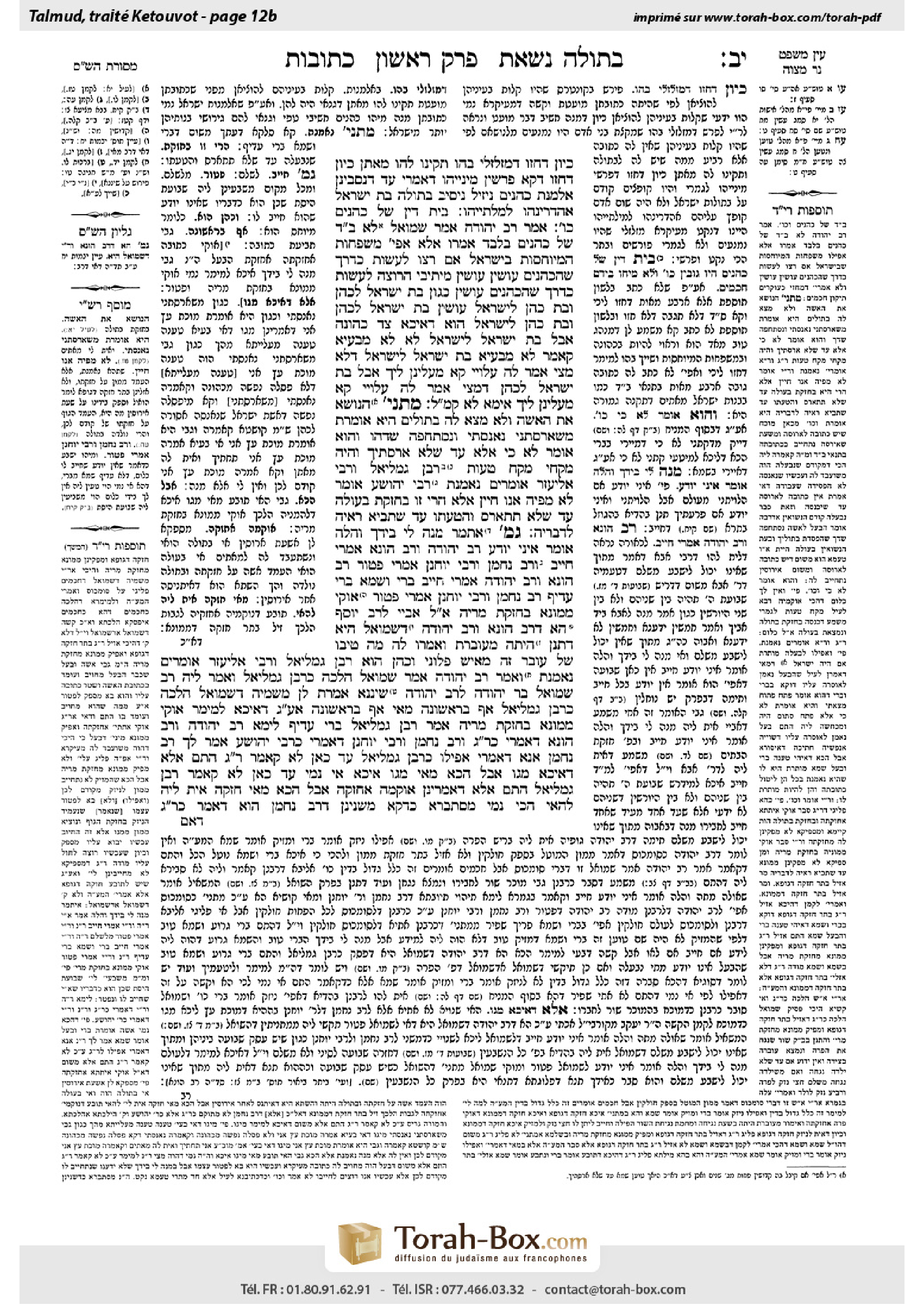
Ketubot 12b: Talmud study for Daf Yomi
Daf Yomi is the daily study of one Talmud folio. Explore 37 tractates with scans, Hebrew text, Sefaria English and AI-generated French translations where annotated.
Passage selection and English or AI-generated French translation are available where the scan has annotations. Daf Study is independent of Torah-Box and Sefaria.
Browse Ketubot · כתובות · All tractatesKetubot 12b text and translations
This page of Ketubot includes the Aramaic text, an English translation and an AI-generated French translation, alongside the scan above.
כתובות י״ב ב · Aramaic and Hebrew text
כֵּיוָן דַּחֲזוֹ דִּמְזַלְזְלִי בְּהוּ, תַּקִּינוּ לְהוּ מָאתַן. כֵּיוָן דַּחֲזוֹ דְּקָא פָּרְשִׁין מִינַּיְיהוּ, דְּאָמְרִי: עַד דְּנָסְבִינַן אַלְמְנַת כֹּהֲנִים — נֵיזִיל נִיסֵּיב בְּתוּלָה בַּת יִשְׂרָאֵל, אַהְדְּרִינְהוּ לְמִלְּתַיְיהוּ.
בֵּית דִּין שֶׁל כֹּהֲנִים כּוּ׳. אָמַר רַב יְהוּדָה אָמַר שְׁמוּאֵל: לֹא בֵּית דִּין שֶׁל כֹּהֲנִים בִּלְבַד אָמְרוּ, אֶלָּא אֲפִילּוּ מִשְׁפָּחוֹת הַמְיוּחָסוֹת בְּיִשְׂרָאֵל, אִם רָצוּ לַעֲשׂוֹת כְּדֶרֶךְ שֶׁהַכֹּהֲנִים עוֹשִׂין — עוֹשִׂין.
מֵיתִיבִי: הָרוֹצֶה לַעֲשׂוֹת כְּדֶרֶךְ שֶׁהַכֹּהֲנִים עוֹשִׂין, כְּגוֹן בַּת יִשְׂרָאֵל לְכֹהֵן, וּבַת כֹּהֵן לְיִשְׂרָאֵל — עוֹשִׂין. בַּת יִשְׂרָאֵל לְכֹהֵן וּבַת כֹּהֵן לְיִשְׂרָאֵל הוּא דְּאִיכָּא צַד כְּהוּנָּה. אֲבָל בַּת יִשְׂרָאֵל לְיִשְׂרָאֵל — לָא!
לָא מִבַּעְיָא קָאָמַר: לָא מִבַּעְיָא בַּת יִשְׂרָאֵל לְיִשְׂרָאֵל, דְּלָא מָצֵי אָמַר לַהּ עַלּוֹיֵי קָא מְעַלֵּינָא לִיךְ, אֲבָל בַּת יִשְׂרָאֵל לְכֹהֵן, דְּמָצֵי אָמַר לַהּ עַלּוֹיֵי קָא מְעַלֵּינָא לִיךְ — אֵימָא לָא, קָא מַשְׁמַע לַן.
מַתְנִי׳ הַנּוֹשֵׂא אֶת הָאִשָּׁה וְלֹא מָצָא לָהּ בְּתוּלִים. הִיא אוֹמֶרֶת: מִשֶּׁאֵרַסְתַּנִי נֶאֱנַסְתִּי, וְנִסְתַּחֲפָה שָׂדֵהוּ. וְהוּא אוֹמֵר: לֹא כִּי, אֶלָּא עַד שֶׁלֹּא אֵרַסְתִּיךָ, וְהָיָה מִקָּחִי מִקָּח טָעוּת — רַבָּן גַּמְלִיאֵל וְרַבִּי אֱלִיעֶזֶר אוֹמְרִים: נֶאֱמֶנֶת. רַבִּי יְהוֹשֻׁעַ אוֹמֵר: לֹא מִפִּיהָ אָנוּ חַיִּין, אֶלָּא הֲרֵי זוֹ בְּחֶזְקַת בְּעוּלָה עַד שֶׁלֹּא תִּתְאָרֵס, וְהִטְעַתּוּ, עַד שֶׁתָּבִיא רְאָיָה לִדְבָרֶיהָ.
גְּמָ׳ אִתְּמַר: ״מָנֶה לִי בְּיָדְךָ״, וְהַלָּה אוֹמֵר: אֵינִי יוֹדֵעַ — רַב יְהוּדָה וְרַב הוּנָא אָמְרִי: חַיָּיב, וְרַב נַחְמָן וְרַבִּי יוֹחָנָן אָמְרִי: פָּטוּר. רַב הוּנָא וְרַב יְהוּדָה אָמְרִי חַיָּיב — בָּרִי וְשֶׁמָּא בָּרִי עָדִיף. רַב נַחְמָן וְרַבִּי יוֹחָנָן אָמְרִי פָּטוּר — אוֹקִי מָמוֹנָא בְּחֶזְקַת מָרֵיהּ.
אֲמַר לֵיהּ אַבָּיֵי לְרַב יוֹסֵף: הָא דְּרַב הוּנָא וְרַב יְהוּדָה — דִּשְׁמוּאֵל הִיא. דִּתְנַן: הָיְתָה מְעוּבֶּרֶת, וְאָמְרוּ לָהּ: מָה טִיבוֹ שֶׁל עוּבָּר זֶה? מֵאִישׁ פְּלוֹנִי, וְכֹהֵן הוּא — רַבָּן גַּמְלִיאֵל וְרַבִּי אֱלִיעֶזֶר אוֹמְרִים: נֶאֱמֶנֶת. וְאָמַר רַב יְהוּדָה אָמַר שְׁמוּאֵל: הֲלָכָה כְּרַבָּן גַּמְלִיאֵל.
וַאֲמַר לֵיהּ רַב שְׁמוּאֵל בַּר יְהוּדָה לְרַב יְהוּדָה: שִׁינָּנָא, אֲמַרְתְּ לַן מִשְּׁמֵיהּ דִּשְׁמוּאֵל: הֲלָכָה כְּרַבָּן גַּמְלִיאֵל אַף בָּרִאשׁוֹנָה. מַאי אַף בָּרִאשׁוֹנָה? אַף עַל גַּב דְּאִיכָּא לְמֵימַר אוֹקֵי מָמוֹנָא בְּחֶזְקַת מָרֵיהּ — אָמַר רַבָּן גַּמְלִיאֵל: בָּרִי עָדִיף.
לֵימָא רַב יְהוּדָה וְרַב הוּנָא דְּאָמְרִי כְּרַבָּן גַּמְלִיאֵל, וְרַב נַחְמָן וְרַבִּי יוֹחָנָן דְּאָמְרִי כְּרַבִּי יְהוֹשֻׁעַ?
אָמַר לְךָ רַב נַחְמָן: אֲנָא דַּאֲמַרִי, אֲפִילּוּ כְּרַבָּן גַּמְלִיאֵל — עַד כָּאן לָא קָאָמַר רַבָּן גַּמְלִיאֵל הָתָם, אֶלָּא דְּאִיכָּא מִגּוֹ. אֲבָל הָכָא, מַאי מִגּוֹ אִיכָּא?
אִי נָמֵי: עַד כָּאן לָא קָאָמַר רַבָּן גַּמְלִיאֵל הָתָם אֶלָּא דְּאָמְרִינַן אוֹקְמַהּ אַחֲזָקָה, אֲבָל הָכָא, מַאי חֲזָקָה אִית לֵיהּ לְהַאי?
הָכִי נָמֵי מִסְתַּבְּרָא כִּדְקָא מְשַׁנֵּינַן, דְּרַב נַחְמָן הוּא דְּאָמַר כְּרַבָּן גַּמְלִיאֵל,
Ketubot 12b · English translation
Once the members of the court saw that the priests were demeaning the widows, they instituted for them a marriage contract of two hundred dinars, so that they would treat them with greater esteem. Once they saw that the grooms were distancing themselves from them, as they said: Instead of marrying a widow who is the daughter of priests and paying a marriage contract of two hundred, let us go marry a virgin Israelite woman for the same price. Since men would no longer marry widows from priestly families, they restored matters to their original status. This indicates that the mishna and the baraita are addressing different time periods and different ordinances.
§ It is stated in the mishna that a court of priests would collect a marriage contract of four hundred dinars for a virgin daughter of a priest. Rav Yehuda said that Shmuel said: Not only with regard to a court of priests did the Sages say that they could collect a greater sum for the marriage contract of their daughters, but even families of distinguished lineage in Israel. If they wanted to act as the priests do, they may act in that manner.
The Gemara raises an objection from a baraita: One who sought to act as the priests do, as in cases where an Israelite woman is married to a priest, or the daughter of a priest is married to an Israelite, may act in that manner. The Gemara infers: This allowance is specifically in cases where an Israelite woman is married to a priest, or the daughter of a priest is married to an Israelite, where there is an aspect of priesthood involved. However, apparently, in a case where the daughter of an Israelite is married to an Israelite, no, it is not allowed.
The Gemara rejects that inference. The baraita is stated employing the style of: It is not necessary. It is not necessary to state a case where the daughter of an Israelite is married to an Israelite, as in that case the groom cannot say to her: By marrying you, I am raising your social status, and it is clear that women from distinguished families would demand a marriage contract with a greater sum. However, in a case where an Israelite woman is married to a priest, where he can say to her: I am raising your social status, as you are marrying into the priesthood, you might think to say no, the woman cannot demand a marriage contract with a greater sum. Therefore, the baraita teaches us that even in the case of a woman from a distinguished family of Israelites marrying a priest, she may demand a marriage contract with a greater sum.
MISHNA: There is a case of one who marries a woman and did not find her hymen intact, and she says: After you betrothed me I was raped, and his, i.e., her husband’s, field was inundated, meaning that it is his misfortune that she is not a virgin, as she was raped after betrothal. And he says: No; rather, you were raped before I betrothed you, and my transaction was a mistaken transaction. Rabban Gamliel and Rabbi Eliezer say: She is deemed credible. Rabbi Yehoshua says: It is not based on the statement emerging from her mouth that we conduct our lives; rather, this woman assumes the presumptive status of one who engaged in intercourse when she was not yet betrothed and she misled him, until she brings proof supporting her statement.
GEMARA: It was stated: With regard to one who approaches another and says: I have one hundred dinars in your possession, and the other says: I don’t know, Rav Yehuda and Rav Huna say: The respondent is obligated to pay, because he did not deny the claim, and Rav Naḥman and Rabbi Yoḥanan say: He is exempt from payment. The Gemara elaborates. Rav Huna and Rav Yehuda say that the respondent is obligated to pay based on the principle: When there is a certain claim, e.g., that of the claimant, and an uncertain claim, e.g., that of the respondent, the certain claim prevails. Rav Naḥman and Rabbi Yoḥanan say: The respondent is exempt based on the principle: Establish the money in the possession of its owner, and the burden of proof rests upon the claimant. Since the claimant does not support his claim with proof, the money remains in the possession of the respondent.
Abaye said to Rav Yosef: This ruling of Rav Huna and Rav Yehuda is essentially the statement of Shmuel, as we learned in a mishna (13a): In the case of an unmarried woman who was pregnant, and the Sages said to her: What is the nature of this fetus, i.e., who is the father. And she says: It is from a man called so-and-so and he is a priest and is certainly of valid lineage. Rabban Gamliel and Rabbi Eliezer say: She is deemed credible, and the fetus is deemed to be of valid lineage. Rav Yehuda said that Shmuel said: The halakha is in accordance with the opinion of Rabban Gamliel.
And Rav Shmuel bar Yehuda said to Rav Yehuda: Big-toothed one [shinnana], you said to us in the name of Shmuel that the halakha is in accordance with the opinion of Rabban Gamliel even in the first dispute, the dispute cited in the mishna, which is the first in a series of disputes with regard to conflicting claims. The Gemara asks: What is the meaning of even the first? What is unique about that dispute relative to the others? The Gemara answers: The novel element in the first dispute is that the claim of the bride is accepted despite the fact that although there is room to say: Establish the money in the possession of its owner, and since the money is in the possession of the husband and the woman is the claimant, Rabban Gamliel said that the certain claim of the bride prevails over the uncertain claim of the groom, who can only speculate about when she was raped.
The Gemara suggests: Let us say that it is Rav Yehuda and Rav Huna who say their ruling in accordance with the opinion of Rabban Gamliel, who says that a certain claim prevails over an uncertain one even to collect money from the possession of the respondent. And it is Rav Naḥman and Rabbi Yoḥanan who say their ruling in accordance with the opinion of Rabbi Yehoshua, that one does not collect money based merely on a claim.
The Gemara rejects that suggestion. Rav Naḥman could have said to you: That which I said, is even in accordance with the opinion of Rabban Gamliel. Rabban Gamliel says his ruling only there, with regard to claims of a groom and a bride, where there is a miggo, a halakhic argument that the ability to make a more advantageous claim grants credibility to the claim one actually makes, that bolsters the bride’s claim. She could have claimed that she wasn’t raped at all, but rather that her hymen was ruptured by wood. That is a more advantageous claim because she is not disgraced in the eyes of the groom. Therefore, her claim that she was raped is accorded credibility. However here, where one claims that another owes him money, what miggo is there bolstering his claim and according it credibility?
Alternatively, Rav Naḥman could have said to you: Rabban Gamliel says his ruling only there, where we say: Establish her legal status according to her presumptive status as a virgin, and the husband’s claim seeks to undermine that presumptive status. However here, what presumptive status does this claimant have supporting the claim that another owes him money? Therefore, even Rabban Gamliel would concede that his certain claim does not prevail.
The Gemara notes: Indeed, it is also reasonable to explain as we are teaching, that it is Rav Naḥman who said his ruling in accordance with the opinion of Rabban Gamliel.
Ketubot 12b · Traduction française (IA)
Lorsque les membres du tribunal virent que les prêtres méprisaient les veuves, ils instituèrent pour elles une ketouba de deux cents dinars, afin qu’elles soient traitées avec davantage d’égards. Lorsqu’ils virent ensuite que les prétendants s’en détournaient, en disant : « Plutôt que d’épouser une veuve, fille de prêtres, et de payer une ketouba de deux cents dinars, marions-nous avec une vierge israélite pour le même prix », ils rétablirent la situation initiale, puisque les hommes n’épousaient plus les veuves issues de familles sacerdotales. Cela indique que la Michna et la baraïta portent sur des périodes et des décrets différents.
§ La Michna enseigne qu’un tribunal de prêtres pouvait exiger une ketouba de quatre cents dinars pour une vierge, fille d’un prêtre. Rav Yehouda a dit au nom de Chmouel : Les Sages n’ont pas seulement dit qu’un tribunal de prêtres pouvait exiger une somme plus élevée pour la ketouba de leurs filles ; les familles israélites de lignée prestigieuse le peuvent également. Si elles souhaitent agir comme les prêtres, elles peuvent le faire.
La Guemara soulève une objection à partir d’une baraïta : Celui qui souhaite agir comme les prêtres peut le faire dans les cas où une Israélite épouse un prêtre ou où la fille d’un prêtre épouse un Israélite. La Guemara en déduit que cette permission concerne précisément les cas où une Israélite épouse un prêtre ou où la fille d’un prêtre épouse un Israélite, c’est-à-dire lorsqu’un aspect sacerdotal est en jeu. Mais il semblerait que, dans le cas où la fille d’un Israélite épouse un Israélite, cela ne soit pas permis.
La Guemara rejette cette déduction. La baraïta est formulée selon le principe : « Il n’est pas nécessaire de préciser… » Il n’est pas nécessaire de préciser le cas où la fille d’un Israélite épouse un Israélite, car, dans ce cas, le marié ne peut pas lui dire : « En t’épousant, j’élève ton statut social » ; il est donc évident que les femmes de familles prestigieuses réclameraient une ketouba d’un montant supérieur. En revanche, dans le cas où une Israélite épouse un prêtre, celui-ci peut lui dire : « J’élève ton statut social, puisque tu entres dans la prêtrise » ; on aurait pu penser que la femme ne peut pas réclamer une ketouba d’un montant supérieur. La baraïta nous enseigne donc que même une femme issue d’une famille israélite prestigieuse qui épouse un prêtre peut réclamer une ketouba d’un montant supérieur.
MICHNA : Il s’agit du cas d’un homme qui épouse une femme et constate que son hymen n’est pas intact. Elle dit : « Après que tu m’as fiancée, j’ai été violée », et le champ de son mari a été inondé, c’est-à-dire qu’il subit lui-même le malheur qu’elle ne soit pas vierge, puisqu’elle a été violée après les fiançailles. Lui répond : « Non, tu as été violée avant que je ne te fiance, et notre transaction reposait sur une erreur. » Rabban Gamliel et Rabbi Eliezer disent : Elle est considérée comme crédible. Rabbi Yehoshoua dit : Nous ne réglons pas notre conduite sur la seule déclaration qui sort de sa bouche ; cette femme est présumée avoir eu des rapports avant d’être fiancée et l’avoir trompé, jusqu’à ce qu’elle apporte une preuve à l’appui de ses propos.
GUEMARA : Il a été enseigné : Si quelqu’un s’adresse à un autre et lui dit : « Tu détiens cent dinars qui m’appartiennent », et que l’autre répond : « Je ne sais pas », Rav Yehouda et Rav Houna disent : Le défendeur est tenu de payer, puisqu’il n’a pas nié la réclamation. Rav Naḥman et Rabbi Yoḥanan disent qu’il est exempté de paiement. La Guemara développe. Rav Houna et Rav Yehouda disent que le défendeur est tenu de payer en vertu du principe suivant : lorsqu’il y a une réclamation certaine, celle du demandeur par exemple, et une réclamation incertaine, celle du défendeur par exemple, la réclamation certaine l’emporte. Rav Naḥman et Rabbi Yoḥanan disent que le défendeur est exempté en vertu du principe suivant : on laisse l’argent en possession de son propriétaire, et la charge de la preuve incombe au demandeur. Puisque celui-ci n’étaye pas sa réclamation par une preuve, l’argent reste en possession du défendeur.
Abayé dit à Rav Yossef : Cette décision de Rav Houna et de Rav Yehouda revient essentiellement à l’opinion de Chmouel, comme nous l’avons appris dans une Michna (13a) : Dans le cas d’une femme célibataire enceinte, les Sages lui demandèrent : « Quelle est l’origine de ce fœtus ? », c’est-à-dire : qui est son père ? Elle répond : « Il est de tel homme, qui est prêtre et dont la lignée est certainement valide. » Rabban Gamliel et Rabbi Eliezer disent : Elle est considérée comme crédible, et le fœtus est considéré comme issu d’une lignée valide. Rav Yehouda a dit au nom de Chmouel : La halakha suit l’opinion de Rabban Gamliel.
Et Rav Chmouel bar Yehouda dit à Rav Yehouda : « Toi qui as de grandes dents [shinnana], tu nous as dit au nom de Chmouel que la halakha suit l’opinion de Rabban Gamliel même dans la première controverse, celle qui est citée dans la Michna et qui est la première d’une série de controverses portant sur des réclamations contradictoires. » La Guemara demande : Que signifie « même dans la première » ? En quoi cette controverse se distingue-t-elle des autres ? La Guemara répond : L’élément novateur de la première controverse est que la réclamation de la mariée est acceptée, bien qu’on puisse dire : « Laisse l’argent en possession de son propriétaire » ; puisque l’argent est en possession du mari et que la femme est la demanderesse, Rabban Gamliel affirme que la réclamation certaine de la mariée l’emporte sur la réclamation incertaine du marié, qui ne peut que supposer à quel moment elle a été violée.
La Guemara propose : Ne pourrait-on pas dire que Rav Yehouda et Rav Houna ont formulé leur décision conformément à l’opinion de Rabban Gamliel, qui affirme qu’une réclamation certaine l’emporte sur une réclamation incertaine, même lorsqu’il s’agit de recouvrer de l’argent détenu par le défendeur ? Et que Rav Naḥman et Rabbi Yoḥanan ont formulé la leur conformément à l’opinion de Rabbi Yehoshoua, selon laquelle on ne recouvre pas d’argent sur la seule base d’une réclamation ?
La Guemara rejette cette proposition. Rav Naḥman aurait pu te répondre : « Ce que j’ai dit est également conforme à l’opinion de Rabban Gamliel. » Rabban Gamliel ne tranche ainsi que dans ce cas, celui des réclamations du marié et de la mariée, où intervient un miggo, argument halakhique selon lequel la possibilité de formuler une réclamation plus avantageuse confère de la crédibilité à celle qui a effectivement été formulée, ce qui renforce la réclamation de la mariée. Elle aurait pu prétendre qu’elle n’avait pas été violée du tout, mais que son hymen avait été rompu par un morceau de bois. Cette réclamation est plus avantageuse, car elle n’est pas déshonorée aux yeux du marié. C’est pourquoi sa déclaration selon laquelle elle a été violée est jugée crédible. Mais ici, lorsqu’une personne prétend qu’une autre lui doit de l’argent, quel miggo vient renforcer sa réclamation et lui conférer de la crédibilité ?
Rav Naḥman aurait aussi pu te répondre : « Rabban Gamliel ne tranche ainsi que dans ce cas, où nous disons : “Établissons son statut juridique selon sa présomption de virginité”, et où la réclamation du mari vise à remettre en cause cette présomption. Mais ici, de quelle présomption le demandeur dispose-t-il pour étayer son affirmation qu’un autre lui doit de l’argent ? » Par conséquent, même Rabban Gamliel reconnaîtrait que sa réclamation certaine ne l’emporte pas.
La Guemara note : En effet, il est également raisonnable d’expliquer, comme nous l’enseignons, que c’est Rav Naḥman qui a formulé sa décision conformément à l’opinion de Rabban Gamliel.
Traduction française générée par IA à partir de l’édition anglaise de Sefaria. Vérifie toujours un passage avec le texte source.
Text from Sefaria: William Davidson Edition - Vocalized Aramaic (CC BY NC); William Davidson Edition - English (CC BY NC).