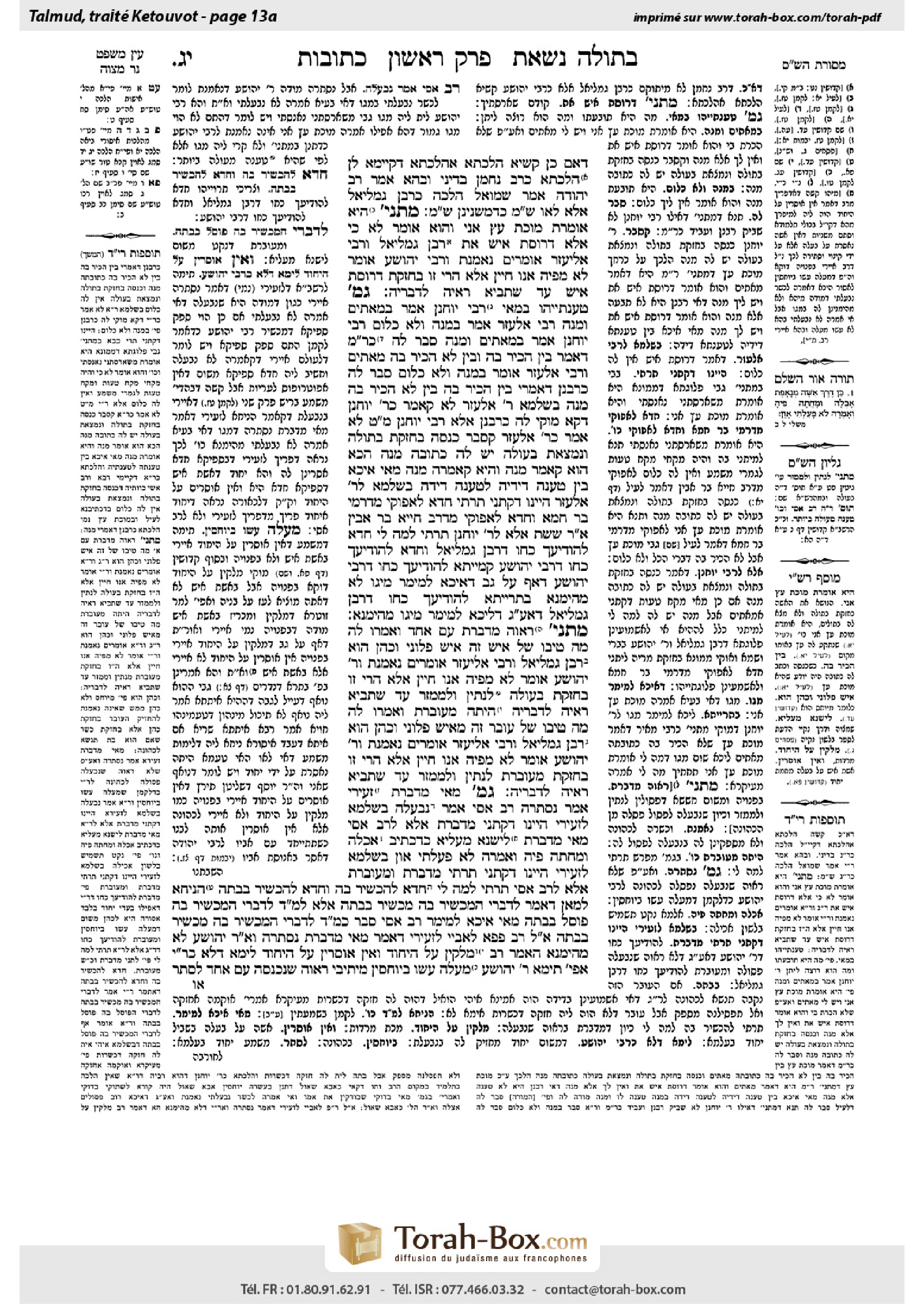
Ketubot 13a: Talmud study for Daf Yomi
Daf Yomi is the daily study of one Talmud folio. Explore 37 tractates with scans, Hebrew text, Sefaria English and AI-generated French translations where annotated.
Passage selection and English or AI-generated French translation are available where the scan has annotations. Daf Study is independent of Torah-Box and Sefaria.
Browse Ketubot · כתובות · All tractatesKetubot 13a text and translations
This page of Ketubot includes the Aramaic text, an English translation and an AI-generated French translation, alongside the scan above.
כתובות י״ג א · Aramaic and Hebrew text
דְּאִם כֵּן, קַשְׁיָא הִלְכְתָא אַהִלְכְתָא. דְּקַיְימָא לַן הִלְכְתָא כְּרַב נַחְמָן בְּדִינֵי, וּבְהָא אָמַר רַב יְהוּדָה אָמַר שְׁמוּאֵל: הֲלָכָה כְּרַבָּן גַּמְלִיאֵל. אֶלָּא לָאו שְׁמַע מִינַּהּ כִּדְמִשְּׁנֵינַן. שְׁמַע מִינַּהּ.
מַתְנִי׳ הִיא אוֹמֶרֶת: מוּכַּת עֵץ אֲנִי. וְהוּא אוֹמֵר: לֹא כִי, אֶלָּא דְּרוּסַת אִישׁ אַתְּ. רַבָּן גַּמְלִיאֵל וְרַבִּי אֱלִיעֶזֶר אוֹמְרִים: נֶאֱמֶנֶת. וְרַבִּי יְהוֹשֻׁעַ אוֹמֵר: לֹא מִפִּיהָ אָנוּ חַיִּין, אֶלָּא הֲרֵי זוֹ בְּחֶזְקַת דְּרוּסַת אִישׁ, עַד שֶׁתָּבִיא רְאָיָה לִדְבָרֶיהָ.
גְּמָ׳ טַעֲנָתַיְיהוּ בְּמַאי? רַבִּי יוֹחָנָן אָמַר: בְּמָאתַיִם וּמָנֶה. רַבִּי אֶלְעָזָר אָמַר: בְּמָנֶה וְלֹא כְּלוּם.
רַבִּי יוֹחָנָן אָמַר: בְּמָאתַיִם וּמָנֶה, סָבַר לַהּ כְּרַבִּי מֵאִיר, דְּאָמַר: בֵּין הִכִּיר בָּהּ, וּבֵין לֹא הִכִּיר בָּהּ — מָאתַיִם. וְרַבִּי אֶלְעָזָר אוֹמֵר: בְּמָנֶה וְלֹא כְּלוּם — סָבַר לַהּ כְּרַבָּנַן, דְּאָמְרִי: בֵּין הִכִּיר בָּהּ, בֵּין לֹא הִכִּיר בָּהּ — מָנֶה.
בִּשְׁלָמָא רַבִּי אֶלְעָזָר לֹא קָאָמַר כְּרַבִּי יוֹחָנָן — דְּקָא מוֹקֵי לַהּ כְּרַבָּנַן. אֶלָּא רַבִּי יוֹחָנָן מַאי טַעְמָא לָא אָמַר כְּרַבִּי אֶלְעָזָר?
קָסָבַר: כְּנָסָהּ בְּחֶזְקַת בְּתוּלָה וְנִמְצֵאת בְּעוּלָה — יֵשׁ לָהּ כְּתוּבָּה מָנֶה. הָכָא, הוּא קָאָמַר מָנֶה, וְהִיא קָאָמְרָה מָנֶה, מַאי אִיכָּא בֵּין טַעֲנָה דִידֵיהּ לְטַעֲנָה דִידַהּ?
בִּשְׁלָמָא לְרַבִּי אֶלְעָזָר — הַיְינוּ דְּקָתָנֵי תַּרְתֵּי: חֲדָא לְאַפּוֹקֵי מִדְּרָמֵי בַּר חָמָא,
וַחֲדָא לְאַפּוֹקֵי מִדְּרַב חִיָּיא בַּר אָבִין אָמַר רַב שֵׁשֶׁת. אֶלָּא לְרַבִּי יוֹחָנָן תַּרְתֵּי לְמָה לִי?
חֲדָא לְהוֹדִיעֲךָ כֹּחוֹ דְּרַבָּן גַּמְלִיאֵל, וַחֲדָא לְהוֹדִיעֲךָ כֹּחוֹ דְּרַבִּי יְהוֹשֻׁעַ. קַמַּיְיתָא — לְהוֹדִיעֲךָ כֹּחוֹ דְּרַבִּי יְהוֹשֻׁעַ, דְּאַף עַל גַּב דְּאִיכָּא לְמֵימַר מִיגּוֹ — לָא מְהֵימְנָא. בָּתְרָיְיתָא — לְהוֹדִיעֲךָ כֹּחוֹ דְּרַבָּן גַּמְלִיאֵל, דְּאַף עַל גַּב דְּלֵיכָּא לְמֵימַר מִיגּוֹ, מְהֵימְנָא.
מַתְנִי׳ רָאוּהָ מְדַבֶּרֶת עִם אֶחָד, וְאָמְרוּ לָהּ: מָה טִיבוֹ שֶׁל אִישׁ זֶה? אִישׁ פְּלוֹנִי, וְכֹהֵן הוּא. רַבָּן גַּמְלִיאֵל וְרַבִּי אֱלִיעֶזֶר אוֹמְרִים: נֶאֱמֶנֶת, וְרַבִּי יְהוֹשֻׁעַ אוֹמֵר: לֹא מִפִּיהָ אָנוּ חַיִּין, אֶלָּא הֲרֵי זוֹ בְּחֶזְקַת בְּעוּלָה לְנָתִין וּלְמַמְזֵר, עַד שֶׁתָּבִיא רְאָיָה לִדְבָרֶיהָ.
הָיְתָה מְעוּבֶּרֶת, וְאָמְרוּ לָהּ: מָה טִיבוֹ שֶׁל עוּבָּר זֶה? מֵאִישׁ פְּלוֹנִי, וְכֹהֵן הוּא. רַבָּן גַּמְלִיאֵל וְרַבִּי אֱלִיעֶזֶר אוֹמְרִים: נֶאֱמֶנֶת, וְרַבִּי יְהוֹשֻׁעַ אוֹמֵר: לֹא מִפִּיהָ אָנוּ חַיִּין, אֶלָּא הֲרֵי זוֹ בְּחֶזְקַת מְעוּבֶּרֶת לְנָתִין וּלְמַמְזֵר, עַד שֶׁתָּבִיא רְאָיָה לִדְבָרֶיהָ.
גְּמָ׳ מַאי מְדַבֶּרֶת? זְעֵירִי אָמַר: נִסְתְּרָה, רַב אַסִּי אָמַר: נִבְעֲלָה. בִּשְׁלָמָא לִזְעֵירִי, הַיְינוּ דְּקָתָנֵי מְדַבֶּרֶת. אֶלָּא לְרַב אַסִּי, מַאי מְדַבֶּרֶת? לִישָּׁנָא מְעַלְּיָא, כְּדִכְתִיב: ״אָכְלָה וּמָחֲתָה פִיהָ וְאָמְרָה לֹא פָעַלְתִּי אָוֶן״.
בִּשְׁלָמָא לִזְעֵירִי — הַיְינוּ דְּקָתָנֵי תַּרְתֵּי: ״מְדַבֶּרֶת״, וּ״מְעוּבֶּרֶת״. אֶלָּא לְרַב אַסִּי — תַּרְתֵּי לְמָה לִי?
חֲדָא, לְהַכְשִׁיר בָּהּ. וַחֲדָא, לְהַכְשִׁיר בְּבִתָּהּ.
הָנִיחָא לְמַאן דְּאָמַר: לְדִבְרֵי הַמַּכְשִׁיר בָּהּ — מַכְשִׁיר בְּבִתָּהּ. אֶלָּא לְמַאן דְּאָמַר: לְדִבְרֵי הַמַּכְשִׁיר בָּהּ — פּוֹסֵל בְּבִתָּהּ, מַאי אִיכָּא לְמֵימַר? רַב אַסִּי סָבַר כְּמַאן דְּאָמַר לְדִבְרֵי הַמַּכְשִׁיר בָּהּ — מַכְשִׁיר בְּבִתָּהּ.
אֲמַר לֵיהּ רַב פָּפָּא לְאַבָּיֵי: לִזְעֵירִי דְּאָמַר מַאי ״מְדַבֶּרֶת״ — נִסְתְּרָה, וְאָמַר רַבִּי יְהוֹשֻׁעַ לָא מְהֵימְנָא, הָאָמַר רַב: מַלְקִין עַל הַיִּחוּד — וְאֵין אוֹסְרִין עַל הַיִּחוּד!
לֵימָא דְּלָא כְּרַבִּי יְהוֹשֻׁעַ? אֲפִילּוּ תֵּימָא רַבִּי יְהוֹשֻׁעַ — מַעֲלָה עָשׂוּ בְּיוּחֲסִין.
מֵיתִיבִי: רָאוּהָ שֶׁנִּכְנְסָה עִם אֶחָד לְסֵתֶר,
Ketubot 13a · English translation
Because if that were not so, it is difficult, as there would be a contradiction between one halakha and another halakha. Since, on the one hand, we maintain a principle in halakhic ruling that the halakha is in accordance with the opinion of Rav Naḥman in civil law; and, on the other hand, in that case involving the claims of the bride and the groom Rav Yehuda said that Shmuel said: The halakha is in accordance with the opinion of Rabban Gamliel. Rather, can we not conclude from this apparent contradiction that the matter must be understood as we are teaching, that the opinion of Rav Naḥman can be reconciled with the opinion of Rabban Gamliel? The Gemara affirms: Indeed, conclude from it that this is the case.
MISHNA: In a case where she says: I am one whose hymen was ruptured by wood, i.e., she admits that her hymen is not intact but claims that it was not ruptured through intercourse, and the groom says: No; rather, you are one who was trampled by a man, and your hymen was ruptured through intercourse, Rabban Gamliel and Rabbi Eliezer say: She is deemed credible and her claim is accepted because she certainly knows what actually happened. Rabbi Yehoshua says: It is not based on the statement emerging from her mouth that we conduct our lives; rather, she retains the presumptive status of one who was trampled by a man, until she brings proof supporting her statement that her hymen was ruptured by wood.
GEMARA: The Gemara asks: What are their respective financial claims? Rabbi Yoḥanan said: The bride claims that since her hymen was ruptured by wood, her legal status is that of a virgin and she is entitled to a marriage contract of two hundred dinars; and the groom claims that she engaged in intercourse and is entitled to a marriage contract of one hundred dinars. Rabbi Elazar said: The bride claims that although her hymen is not intact she did not completely deceive him, as she never engaged in intercourse, and therefore she is entitled to a marriage contract of one hundred dinars; and the groom claims that she engaged in intercourse, rendering the betrothal a mistaken transaction, and therefore she is entitled to nothing at all.
The Gemara elaborates. Rabbi Yoḥanan said: The dispute between the bride and groom is whether the marriage contract is two hundred dinars or one hundred dinars, because the tanna of the mishna holds in accordance with the opinion of Rabbi Meir, who said: Whether the husband was aware that her hymen was ruptured by wood or whether he was not aware of her condition, she receives payment of her marriage contract of two hundred dinars and it is not a mistaken transaction. And Rabbi Elazar says: The dispute between the bride and groom is whether the marriage contract is one hundred dinars or whether she is entitled to nothing at all, because the tanna of the mishna holds in accordance with the opinion of the Rabbis, who said: Whether the husband was aware that her hymen was ruptured by wood or whether he was not aware of her condition, she receives payment of her marriage contract of one hundred dinars.
The Gemara asks: Granted, Rabbi Elazar did not state his explanation of the mishna in accordance with the explanation of Rabbi Yoḥanan because he preferred to establish the mishna in accordance with the opinion of the Rabbis, according to which the halakha is ruled, and not the opinion of Rabbi Meir. However, what is the reason that Rabbi Yoḥanan did not state his explanation of the mishna in accordance with the explanation of Rabbi Elazar?
The Gemara answers: The reason that Rabbi Yoḥanan explained the mishna in that manner is that he holds: If the groom married a woman with the presumptive status of a virgin, and she is found to be a non-virgin, she receives payment of her marriage contract of one hundred dinars. Therefore, here, according to the explanation of Rabbi Elazar, who explains the mishna according to the opinion of the Rabbis, he is saying that she engaged in intercourse and is entitled to a marriage contract of one hundred dinars; and she is saying that her hymen was ruptured by wood and she is entitled to a marriage contract of one hundred dinars. What difference is there between his claim and her claim? Therefore, Rabbi Yoḥanan explains the mishna in accordance with the opinion of Rabbi Meir, who holds that the dispute between the bride and the groom is whether she is entitled to a marriage contract of two hundred dinars or a marriage contract of one hundred dinars.
Again we question: Granted, according to Rabbi Elazar, who explains that the dispute between the bride and the groom is with regard to whether she is entitled to a marriage contract of one hundred dinars because her hymen was ruptured by wood, or whether she is entitled to nothing because she engaged in intercourse, that is why the tanna teaches two similar disputes, in this mishna and in the previous one. One dispute, in this mishna, comes to exclude the opinion of Rami bar Ḥama, who said: If he was not aware that her hymen was ruptured by wood, everyone agrees that she receives no marriage contract at all, as the marriage was a mistaken transaction. From this mishna it is clear that according to her claim that her hymen was ruptured by wood, she is entitled to one hundred dinars.
And one dispute, in the previous mishna, is brought in order to exclude that which Rav Ḥiyya bar Avin said that Rav Sheshet said: If the groom married a woman with the presumptive status of a virgin and she is found to be a non-virgin, she receives payment of her marriage contract of one hundred dinars. In the previous mishna he claims: Before I betrothed you, you were raped and my transaction was a mistaken transaction, indicating that she is entitled to nothing. However, according to Rabbi Yoḥanan, why do I need the tanna to teach two similar disputes? In his opinion, the previous mishna could not have been taught to exclude that which Rav Ḥiyya bar Avin said that Rav Sheshet said. It has already been established that Rabbi Yoḥanan agrees with the opinion that if she is found to be a non-virgin, she receives payment of her marriage contract of one hundred dinars.
The Gemara answers: The two similar disputes were necessary. One is to convey to you the far-reaching nature of the opinion of Rabban Gamliel and the extent of the credibility that he accords to her claim; and one is to convey to you the far-reaching nature of the opinion of Rabbi Yehoshua and the extent to which he does not accord credibility to her claim. The Gemara elaborates: The first mishna, where she admits she was raped but claims that it was after betrothal, conveys to you the far-reaching nature of the opinion of Rabbi Yehoshua: That even though there is room to say that her claim is bolstered by a miggo, she is not deemed credible. The second mishna, where she claims that her hymen was ruptured by wood and he claims that she engaged in intercourse, conveys to you the far-reaching nature of the opinion of Rabban Gamliel: That even though there is no room to say that her claim is bolstered by a miggo, in his opinion she is deemed credible.
MISHNA: If people saw a woman speaking to one man, but they did not recognize him, and they said to her: What is the nature [tivo] of this man? And she said to them: He is a man called so-and-so and he is a priest; Rabban Gamliel and Rabbi Eliezer say: She is deemed credible, and Rabbi Yehoshua says: It is not based on the statement emerging from her mouth that we conduct our lives. Rather, she assumes the presumptive status of one who engaged in intercourse with a Gibeonite or with a mamzer, men of flawed lineage who disqualify her from marrying a priest, until she brings proof supporting her statement.
Similarly, if a single woman was pregnant, and people said to her: What is the nature of this fetus? And she says to them: It is from a man called so-and-so and he is a priest; Rabban Gamliel and Rabbi Eliezer say: She is deemed credible, and Rabbi Yehoshua says: It is not based on the statement emerging from her mouth that we conduct our lives. Rather, she assumes the presumptive status of one who conceived from a Gibeonite or a mamzer, until she brings proof supporting her statement.
GEMARA: The Gemara asks: What is the meaning of speaking mentioned in the mishna? Ze’eiri said: It means that she secluded herself with a man and it is unknown whether she engaged in intercourse. Rav Asi said: It means that she engaged in intercourse. Granted, according to Ze’eiri, that is why the mishna teaches the case employing the term speaking, as it is certain only that they were in seclusion. Perhaps all they did was speak. However, according to Rav Asi, what is the reason the mishna employed the term speaking if the reference is to intercourse? The Gemara answers: The mishna employed a euphemism, as it is written with regard to licentious women: “She eats and wipes her mouth and says: I have done no wickedness” (Proverbs 30:20). The verse euphemistically ascribes the act of intercourse to the mouth instead of to the appropriate body part.
The Gemara asks: Granted, according to Ze’eiri, who said that speaking means that she secluded herself with him, that is the reason that the tanna teaches two cases in the mishna: A woman speaking to a man and a woman who is pregnant. However, according to Rav Asi, if speaking means that she engaged in intercourse, why do I need two cases addressing the same issue?
The Gemara answers: The tanna teaches one case, the case of speaking to a man, to deem her fit to marry a priest, because although she engaged in intercourse, Rabbi Eliezer and Rabban Gamliel rule that she is deemed credible and is not considered to have engaged in intercourse with a man of flawed lineage. And the tanna teaches one case, the case of the single woman who is pregnant, in order to deem her daughter born from that pregnancy fit to marry a priest, as Rabbi Eliezer and Rabban Gamliel rule the mother is deemed credible.
The Gemara asks: This works out well according to the one who says: With regard to the statement of the one who deems her fit to marry a priest, he deems her daughter fit to do so as well. However, according to the one who says: With regard to the statement of the one who deems her fit to marry a priest, he nevertheless deems her daughter unfit, what is there to say? Why did the mishna cite two cases addressing the same issue? The Gemara answers: Rav Asi holds in accordance with the opinion of the one who said: With regard to the statement of the one who deems her fit to marry a priest, he deems her daughter fit to do so as well.
Rav Pappa said to Abaye: According to Ze’eiri, who said: What is the meaning of the term speaking? It means that she secluded herself, and Rabbi Yehoshua said that she is not deemed credible to say that she engaged in intercourse with a man of proper lineage, but the assumption is that she engaged in intercourse with a man of flawed lineage. Didn’t Rav say: One flogs a man and a woman for entering into seclusion, for violating rabbinic law, but one does not render a woman forbidden to her husband for entering into seclusion? Only if it is established as a certainty that she engaged in intercourse with a man other than her husband, is she forbidden to her husband.
Let us say that this statement of Rav is not in accordance with the opinion of Rabbi Yehoshua, as Rabbi Yehoshua rules that she assumes the presumptive status of one who engaged in intercourse with a Gibeonite or with a mamzer, and she is forbidden to marry a priest even for entering into seclusion. The Gemara rejects that conclusion. Even if you say that Rav’s statement is in accordance with the opinion of Rabbi Yehoshua, the Sages established a higher standard with regard to matters of lineage. Although she is not forbidden to her husband for entering into seclusion, she is deemed unfit to marry a priest.
The Gemara raises an objection: If people saw that a woman entered with one man into seclusion,
Ketubot 13a · Traduction française (IA)
Car, s’il n’en était pas ainsi, une difficulté se poserait : une halakha contredirait une autre halakha. En effet, d’une part, nous posons comme principe de décision halakhique que la halakha suit l’opinion de Rav Naḥman en matière de droit civil ; d’autre part, dans le cas des prétentions de la mariée et du marié, Rav Yehuda a dit au nom de Shmuel : la halakha suit l’opinion de Rabban Gamliel. Ne faut-il donc pas conclure de cette contradiction apparente qu’il faut comprendre les choses comme nous l’enseignons, à savoir que l’opinion de Rav Naḥman peut être conciliée avec celle de Rabban Gamliel ? La Guemara confirme : en effet, conclus-en ainsi.
MICHNA : Dans le cas où elle dit : « Mon hymen a été rompu par un morceau de bois », c’est-à-dire qu’elle reconnaît que son hymen n’est pas intact, mais affirme qu’il n’a pas été rompu lors d’un rapport sexuel, et où le marié dit : « Non, tu as plutôt été foulée par un homme et ton hymen a été rompu lors d’un rapport sexuel », Rabban Gamliel et Rabbi Eliezer disent : Elle est jugée crédible et sa déclaration est acceptée, car elle sait certainement ce qui s’est réellement passé. Rabbi Yehoshua dit : Nous ne réglons pas notre conduite d’après la déclaration qui sort de sa bouche ; elle conserve plutôt le statut présumé d’une femme qui a été foulée par un homme, jusqu’à ce qu’elle apporte une preuve à l’appui de sa déclaration selon laquelle son hymen a été rompu par un morceau de bois.
GUEMARA : La Guemara demande : Quelles sont leurs prétentions financières respectives ? Rabbi Yoḥanan dit : La mariée prétend que, puisque son hymen a été rompu par un morceau de bois, elle a le statut juridique d’une vierge et a droit à une ketouba de deux cents dinars ; le marié prétend qu’elle a eu un rapport sexuel et n’a droit qu’à une ketouba de cent dinars. Rabbi Elazar dit : La mariée prétend que, bien que son hymen ne soit pas intact, elle ne l’a pas complètement trompé, puisqu’elle n’a jamais eu de rapport sexuel, et qu’elle a donc droit à une ketouba de cent dinars ; le marié prétend qu’elle a eu un rapport sexuel, ce qui fait des fiançailles une transaction conclue par erreur, et qu’elle n’a donc droit à rien du tout.
La Guemara développe : Rabbi Yoḥanan dit que le désaccord entre la mariée et le marié porte sur le montant de la ketouba : deux cents ou cent dinars. En effet, le tanna de la Michna suit l’opinion de Rabbi Meir, qui dit que, que le mari ait su que son hymen avait été rompu par un morceau de bois ou qu’il l’ait ignoré, elle reçoit les deux cents dinars de sa ketouba et il ne s’agit pas d’une transaction conclue par erreur. Rabbi Elazar dit que le désaccord entre la mariée et le marié porte sur la question de savoir si elle a droit à une ketouba de cent dinars ou à rien du tout. En effet, le tanna de la Michna suit l’opinion des Rabbins, qui disent que, que le mari ait su que son hymen avait été rompu par un morceau de bois ou qu’il l’ait ignoré, elle reçoit les cent dinars de sa ketouba.
La Guemara demande : Certes, Rabbi Elazar n’a pas expliqué la Michna comme Rabbi Yoḥanan, car il préférait établir la Michna conformément à l’opinion des Rabbins, selon laquelle la halakha est tranchée, et non à celle de Rabbi Meir. Mais pourquoi Rabbi Yoḥanan n’a-t-il pas expliqué la Michna comme Rabbi Elazar ?
La Guemara répond : Si Rabbi Yoḥanan explique la Michna de cette manière, c’est parce qu’il considère que, si un homme épouse une femme ayant le statut présumé de vierge et qu’elle se révèle ne pas être vierge, elle reçoit les cent dinars de sa ketouba. Par conséquent, selon l’explication de Rabbi Elazar, qui interprète la Michna conformément à l’opinion des Rabbins, le mari dit qu’elle a eu un rapport sexuel et qu’elle a droit à une ketouba de cent dinars ; elle dit que son hymen a été rompu par un morceau de bois et qu’elle a droit à une ketouba de cent dinars. Quelle différence y a-t-il entre leurs prétentions ? C’est pourquoi Rabbi Yoḥanan explique la Michna conformément à l’opinion de Rabbi Meir, selon laquelle le désaccord entre la mariée et le marié porte sur la question de savoir si elle a droit à une ketouba de deux cents dinars ou à une ketouba de cent dinars.
Nous posons de nouveau la question : Certes, selon Rabbi Elazar, qui explique que le désaccord entre la mariée et le marié porte sur la question de savoir si elle a droit à une ketouba de cent dinars parce que son hymen a été rompu par un morceau de bois, ou si elle n’a droit à rien parce qu’elle a eu un rapport sexuel, on comprend pourquoi le tanna enseigne deux différends semblables, dans cette Michna et dans la précédente. Le différend de cette Michna vient exclure l’opinion de Rami bar Ḥama, qui a dit : Si le mari ignorait que son hymen avait été rompu par un morceau de bois, tous conviennent qu’elle ne reçoit aucune ketouba, car le mariage constituait une transaction conclue par erreur. Cette Michna montre que, selon sa prétention, à savoir que son hymen a été rompu par un morceau de bois, elle a droit à cent dinars.
Et le différend de la Michna précédente vient exclure ce qu’a dit Rav Ḥiyya bar Avin au nom de Rav Sheshet : Si un homme épouse une femme ayant le statut présumé de vierge et qu’elle se révèle ne pas être vierge, elle reçoit les cent dinars de sa ketouba. Dans la Michna précédente, il prétend : « Avant que je ne te fiance, tu as été violée », et que son mariage constituait une transaction conclue par erreur, ce qui indique qu’elle n’a droit à rien. Mais, selon Rabbi Yoḥanan, pourquoi le tanna doit-il enseigner deux différends semblables ? Selon lui, la Michna précédente ne pouvait pas avoir été enseignée pour exclure ce qu’a dit Rav Ḥiyya bar Avin au nom de Rav Sheshet. Il a déjà été établi que Rabbi Yoḥanan partage l’opinion selon laquelle, si elle se révèle ne pas être vierge, elle reçoit les cent dinars de sa ketouba.
La Guemara répond : Les deux différends semblables étaient nécessaires. L’un vise à faire connaître la portée extrême de l’opinion de Rabban Gamliel et l’étendue de la crédibilité qu’il accorde à sa déclaration ; l’autre vise à faire connaître la portée extrême de l’opinion de Rabbi Yehoshua et la mesure dans laquelle il ne la croit pas. La Guemara développe : La première Michna, où elle reconnaît avoir été violée mais prétend que cela s’est produit après les fiançailles, fait connaître la portée extrême de l’opinion de Rabbi Yehoshua : même s’il serait possible de dire que sa déclaration est renforcée par un miggo, elle n’est pas jugée crédible. La deuxième Michna, où elle prétend que son hymen a été rompu par un morceau de bois et où il prétend qu’elle a eu un rapport sexuel, fait connaître la portée extrême de l’opinion de Rabban Gamliel : même s’il n’est pas possible de dire que sa déclaration est renforcée par un miggo, selon lui, elle est jugée crédible.
MICHNA : Si des gens ont vu une femme parler à un homme sans l’avoir reconnu et lui ont demandé : « Quelle est la nature [tivo] de cet homme ? », et qu’elle leur a répondu : « C’est un homme appelé Untel, et il est prêtre », Rabban Gamliel et Rabbi Eliezer disent : Elle est jugée crédible ; Rabbi Yehoshua dit : Nous ne réglons pas notre conduite d’après la déclaration qui sort de sa bouche. Elle a plutôt le statut présumé d’une femme ayant eu un rapport sexuel avec un Gabaonite ou avec un mamzer, des hommes de lignage défectueux qui la rendent impropre à épouser un prêtre, jusqu’à ce qu’elle apporte une preuve à l’appui de sa déclaration.
De même, si une femme célibataire était enceinte et que des gens lui demandaient : « Quelle est la nature de ce fœtus ? », et qu’elle leur disait : « Il est d’un homme appelé Untel, et il est prêtre », Rabban Gamliel et Rabbi Eliezer disent : Elle est jugée crédible ; Rabbi Yehoshua dit : Nous ne réglons pas notre conduite d’après la déclaration qui sort de sa bouche. Elle a plutôt le statut présumé d’une femme ayant conçu d’un Gabaonite ou d’un mamzer, jusqu’à ce qu’elle apporte une preuve à l’appui de sa déclaration.
GUEMARA : La Guemara demande : Que signifie le fait de « parler » mentionné dans la Michna ? Ze’eiri dit : Cela signifie qu’elle s’est isolée avec un homme, sans que l’on sache si elle a eu un rapport sexuel. Rav Asi dit : Cela signifie qu’elle a eu un rapport sexuel. Selon Ze’eiri, on comprend pourquoi la Michna emploie le terme « parler », puisque l’on sait seulement qu’ils se sont isolés. Peut-être n’ont-ils fait que parler. Mais, selon Rav Asi, pourquoi la Michna emploie-t-elle le terme « parler » si elle fait référence à un rapport sexuel ? La Guemara répond : La Michna a employé un euphémisme, comme il est écrit au sujet des femmes débauchées : « Elle mange, s’essuie la bouche et dit : Je n’ai commis aucune faute » (Proverbes 30, 20). Le verset attribue par euphémisme l’acte sexuel à la bouche plutôt qu’à la partie du corps appropriée.
La Guemara demande : Selon Ze’eiri, qui dit que « parler » signifie qu’elle s’est isolée avec lui, on comprend pourquoi le tanna enseigne deux cas dans la Michna : une femme qui parle à un homme et une femme enceinte. Mais, selon Rav Asi, si « parler » signifie qu’elle a eu un rapport sexuel, pourquoi faut-il deux cas portant sur la même question ?
La Guemara répond : Le tanna enseigne un cas, celui de la femme qui parle à un homme, afin de la déclarer apte à épouser un prêtre ; en effet, bien qu’elle ait eu un rapport sexuel, Rabbi Eliezer et Rabban Gamliel tranchent qu’elle est jugée crédible et qu’on ne considère pas qu’elle a eu un rapport sexuel avec un homme de lignage défectueux. Le tanna enseigne un autre cas, celui de la femme célibataire enceinte, afin de déclarer apte à épouser un prêtre la fille née de cette grossesse, puisque Rabbi Eliezer et Rabban Gamliel tranchent que la mère est jugée crédible.
La Guemara demande : Cela s’explique bien selon celui qui dit que, lorsqu’on déclare une femme apte à épouser un prêtre, on déclare également sa fille apte à le faire. Mais que peut-on dire selon celui qui affirme que, lorsqu’on déclare une femme apte à épouser un prêtre, on juge néanmoins sa fille inapte ? Pourquoi la Michna cite-t-elle deux cas portant sur la même question ? La Guemara répond : Rav Asi suit l’opinion de celui qui dit que, lorsqu’on déclare une femme apte à épouser un prêtre, on déclare également sa fille apte à le faire.
Rav Pappa dit à Abaye : Selon Ze’eiri, qui explique que le terme « parler » signifie qu’elle s’est isolée, Rabbi Yehoshua dit qu’elle n’est pas jugée crédible lorsqu’elle affirme avoir eu un rapport sexuel avec un homme de lignage convenable, et qu’on suppose plutôt qu’elle a eu un rapport sexuel avec un homme de lignage défectueux. Rav n’a-t-il pas dit : On administre des coups à un homme et à une femme qui se sont isolés, parce qu’ils ont enfreint une loi rabbinique, mais on ne rend pas une femme interdite à son mari parce qu’elle s’est isolée ? Ce n’est que s’il est établi avec certitude qu’elle a eu un rapport sexuel avec un homme autre que son mari qu’elle lui est interdite.
Faut-il en conclure que cette déclaration de Rav ne suit pas l’opinion de Rabbi Yehoshua, puisque celui-ci tranche qu’elle a le statut présumé d’une femme ayant eu un rapport sexuel avec un Gabaonite ou un mamzer, et qu’elle est interdite à un prêtre même pour s’être isolée ? La Guemara rejette cette conclusion. Même si l’on dit que la déclaration de Rav suit l’opinion de Rabbi Yehoshua, les Sages ont fixé une exigence plus stricte en matière de lignage. Bien qu’elle ne soit pas interdite à son mari pour s’être isolée, elle est jugée inapte à épouser un prêtre.
La Guemara soulève une objection : Si des gens ont vu une femme entrer avec un homme dans un lieu où ils se trouvaient seuls,
Traduction française générée par IA à partir de l’édition anglaise de Sefaria. Vérifie toujours un passage avec le texte source.
Text from Sefaria: William Davidson Edition - Vocalized Aramaic (CC BY NC); William Davidson Edition - English (CC BY NC).