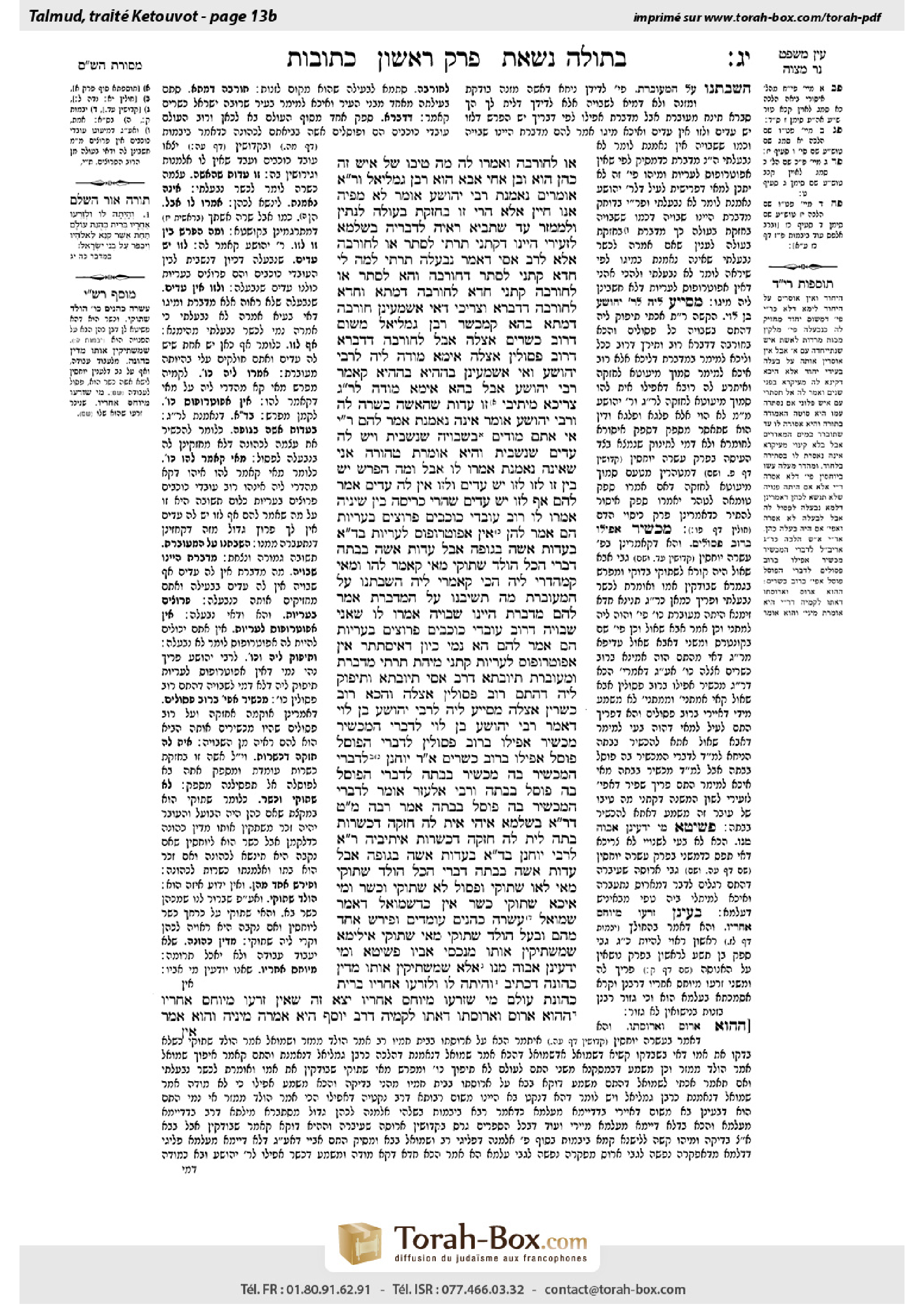
Ketubot 13b: Talmud study for Daf Yomi
Daf Yomi is the daily study of one Talmud folio. Explore 37 tractates with scans, Hebrew text, Sefaria English and AI-generated French translations where annotated.
Passage selection and English or AI-generated French translation are available where the scan has annotations. Daf Study is independent of Torah-Box and Sefaria.
Browse Ketubot · כתובות · All tractatesKetubot 13b text and translations
This page of Ketubot includes the Aramaic text, an English translation and an AI-generated French translation, alongside the scan above.
כתובות י״ג ב · Aramaic and Hebrew text
אוֹ לְחוּרְבָּה — וְאָמְרוּ לָהּ: מָה טִיבוֹ שֶׁל אִישׁ זֶה? כֹּהֵן הוּא, וּבֶן אֲחִי אַבָּא הוּא. רַבָּן גַּמְלִיאֵל וְרַבִּי אֱלִיעֶזֶר אוֹמְרִים: נֶאֱמֶנֶת, רַבִּי יְהוֹשֻׁעַ אוֹמֵר: לֹא מִפִּיהָ אָנוּ חַיִּין, אֶלָּא הֲרֵי זוֹ בְּחֶזְקַת בְּעוּלָה לְנָתִין וּלְמַמְזֵר, עַד שֶׁתָּבִיא רְאָיָה לִדְבָרֶיהָ.
בִּשְׁלָמָא לִזְעֵירִי — הַיְינוּ דְּקָתָנֵי תַּרְתֵּי: לְסֵתֶר אוֹ לְחוּרְבָּה. אֶלָּא לְרַב אַסִּי דְּאָמַר נִבְעֲלָה, תַּרְתֵּי לְמָה לִי? חֲדָא קָתָנֵי: לְסֵתֶר דְּחוּרְבָּה.
וְהָא לְסֵתֶר אוֹ לְחוּרְבָּה קָתָנֵי! חֲדָא לְחוּרְבָּה דְמָתָא, וַחֲדָא לְחוּרְבָּה דְּדַבְרָא. וּצְרִיכִי, דְּאִי אַשְׁמְעִינַן חוּרְבָּה דְמָתָא — בְּהָא קָמַכְשַׁר רַבָּן גַּמְלִיאֵל, מִשּׁוּם דְּרוֹב כְּשֵׁרִים אֶצְלָהּ. אֲבָל לְחוּרְבָּה דְּדַבְרָא, דְּרוֹב פְּסוּלִין אֶצְלָהּ — אֵימָא מוֹדֶה לֵיהּ לְרַבִּי יְהוֹשֻׁעַ.
וְאִי אַשְׁמְעִינַן בְּהָהִיא — בְּהָהִיא קָאָמַר רַבִּי יְהוֹשֻׁעַ, אֲבָל בְּהָא — אֵימָא מוֹדֶה לְרַבָּן גַּמְלִיאֵל, צְרִיכָא.
מֵיתִיבִי: זוֹ עֵדוּת שֶׁהָאִשָּׁה כְּשֵׁרָה לָהּ, וְרַבִּי יְהוֹשֻׁעַ אוֹמֵר: אֵינָהּ נֶאֱמֶנֶת. אָמַר לָהֶם רַבִּי יְהוֹשֻׁעַ: אִי אַתֶּם מוֹדִים בִּשְׁבוּיָה שֶׁנִּשְׁבֵּית וְיֵשׁ לָהּ עֵדִים שֶׁנִּשְׁבֵּית, וְהִיא אוֹמֶרֶת טְהוֹרָה אֲנִי, שֶׁאֵינָהּ נֶאֱמֶנֶת?
אָמְרוּ לוֹ: אֲבָל. וּמָה הֶפְרֵשׁ יֵשׁ בֵּין זוֹ לָזוֹ? לָזוֹ — יֵשׁ עֵדִים, ולָזוֹ — אֵין לָהּ עֵדִים.
אָמַר לָהֶם: אַף לָזוֹ יֵשׁ עֵדִים, שֶׁהֲרֵי כְּרֵיסָהּ בֵּין שִׁינֶּיהָ. אָמְרוּ לוֹ: רוֹב גּוֹיִם פְּרוּצִים בַּעֲרָיוֹת הֵם. אָמַר לָהֶן: אֵין אַפּוֹטְרוֹפּוֹס לַעֲרָיוֹת.
בַּמֶּה דְּבָרִים אֲמוּרִים — בְּעֵדוּת אִשָּׁה בְּגוּפָהּ, אֲבָל עֵדוּת אִשָּׁה בְּבִתָּהּ — דִּבְרֵי הַכֹּל הַוָּלָד שְׁתוּקִי.
מַאי קָאָמַר לְהוּ וּמַאי קָמַהְדְּרִי לֵיהּ? הָכִי קָאָמְרִי לֵיהּ: הֲשַׁבְתָּנוּ עַל הַמְעוּבֶּרֶת. מָה תְּשִׁיבֵנוּ עַל הַמְדַבֶּרֶת? אָמַר לָהֶם: מְדַבֶּרֶת הַיְינוּ שְׁבוּיָה. אָמְרוּ לוֹ: שָׁאנֵי שְׁבוּיָה, דְּרוֹב גּוֹיִם פְּרוּצִים בַּעֲרָיוֹת הֵם. אָמַר לָהֶם: הָא נָמֵי, כֵּיוָן דְּאִיסְתַּתַּר, אֵין אַפּוֹטְרוֹפּוֹס לַעֲרָיוֹת.
קָתָנֵי מִיהַת תַּרְתֵּי — מְדַבֶּרֶת וּמְעוּבֶּרֶת. תְּיוּבְתָּא דְּרַב אַסִּי תְּיוּבְתָּא.
וְתִיפּוֹק לֵיהּ דְּהָתָם רוֹב פְּסוּלִין אֶצְלָהּ, וְהָכָא רוֹב כְּשֵׁרִין אֶצְלָהּ. מְסַיַּיע לֵיהּ לְרַבִּי יְהוֹשֻׁעַ בֶּן לֵוִי. דְּאָמַר רַבִּי יְהוֹשֻׁעַ בֶּן לֵוִי: לְדִבְרֵי הַמַּכְשִׁיר — מַכְשִׁיר אֲפִילּוּ בְּרוֹב פְּסוּלִין, לְדִבְרֵי הַפּוֹסֵל — פּוֹסֵל אֲפִילּוּ בְּרוֹב כְּשֵׁרִים.
אָמַר רַבִּי יוֹחָנָן: לְדִבְרֵי הַמַּכְשִׁיר בָּהּ — מַכְשִׁיר בְּבִתָּהּ. לְדִבְרֵי הַפּוֹסֵל בָּהּ — פּוֹסֵל בְּבִתָּהּ. וְרַבִּי אֶלְעָזָר אוֹמֵר: לְדִבְרֵי הַמַּכְשִׁיר בָּהּ — פּוֹסֵל בְּבִתָּהּ.
אָמַר רַבָּה, מַאי טַעְמָא דְּרַבִּי אֶלְעָזָר: בִּשְׁלָמָא אִיהִי אִית לַהּ חֲזָקָה דְכַשְׁרוּת. בִּתָּהּ, לֵית לַהּ חֲזָקָה דְכַשְׁרוּת.
אֵיתִיבֵיהּ רַבִּי אֶלְעָזָר לְרַבִּי יוֹחָנָן: בַּמֶּה דְּבָרִים אֲמוּרִים — בְּעֵדוּת אִשָּׁה בְּגוּפָהּ, אֲבָל עֵדוּת אִשָּׁה בְּבִתָּהּ —דִּבְרֵי הַכֹּל הַוָּלָד שְׁתוּקִי. מַאי לָאו שְׁתוּקִי, וּפָסוּל. לָא: שְׁתוּקִי, וְכָשֵׁר.
וּמִי אִיכָּא שְׁתוּקִי כָּשֵׁר? אִין, כְּדִשְׁמוּאֵל. דְּאָמַר שְׁמוּאֵל: עֲשָׂרָה כֹּהֲנִים עוֹמְדִים, וּפֵירַשׁ אֶחָד מֵהֶם וּבָעַל — הַוָּלָד שְׁתוּקִי.
מַאי ״שְׁתוּקִי״? אִילֵימָא שֶׁמַּשְׁתִּיקִין אוֹתוֹ מִנִּכְסֵי אָבִיו — פְּשִׁיטָא, וּמִי יָדְעִינַן אֲבוּהּ מַנּוּ? אֶלָּא שֶׁמַּשְׁתִּיקִין אוֹתוֹ מִדִּין כְּהוּנָּה, דִּכְתִיב: ״וְהָיְתָה לּוֹ וּלְזַרְעוֹ אַחֲרָיו בְּרִית כְּהֻנַּת עוֹלָם״, מִי שֶׁזַּרְעוֹ מְיוּחָס אַחֲרָיו, יָצָא זֶה שֶׁאֵין זַרְעוֹ מְיוּחָס אַחֲרָיו.
הָהוּא אָרוּס וַאֲרוּסָתוֹ דַּאֲתוֹ לְקַמֵּיהּ דְּרַב יוֹסֵף, הִיא אָמְרָה: מִינֵּיהּ, וְהוּא אָמַר:
Ketubot 13b · English translation
or into a ruin, which is typically located outside the city, and if a man and woman meet there it is presumably in order to engage in sexual relations, and people said to her: What is the nature of this man with whom you secluded? She said to them: He is a priest, and he is the son of my father’s brother, a respectable person of impeccable lineage. Rabban Gamliel and Rabbi Eliezer say: She is deemed credible. Rabbi Yehoshua says: It is not based on the statement emerging from her mouth that we conduct our lives; rather, she assumes the presumptive status of one who engaged in intercourse with a Gibeonite or with a mamzer, men of flawed lineage who disqualify her from marrying a priest, until she brings proof supporting her statement.
Granted, according to Ze’eiri, who said that speaking means that she secluded herself, that is the reason that the tanna teaches two cases where there is merely concern: The case of: Into seclusion, where there is lesser concern that she engaged in intercourse, and the case of: Into a ruin, where there is greater concern. However, according to Rav Asi, who said that speaking means that she had intercourse, and only in that case is she not deemed credible according to Rabbi Yehoshua, why do I need two cases? The Gemara answers: According to Rav Asi, the tanna is teaching one case: If people saw a woman enter with one man into the seclusion of a ruin, where the likelihood is that that they entered to engage in relations.
The Gemara asks: But isn’t the mishna teaching two different cases: Into seclusion or into a ruin? The Gemara suggests a different explanation. According to Rav Asi, two cases are necessary, one with regard to a ruin in the city and one with regard to a ruin in the field, distant from the city. And both cases are necessary, because if the tanna taught us only the case of a ruin in the city, one might have concluded that in that case Rabban Gamliel deems her fit to marry a priest due to the fact that the majority of the people in its proximity are honorable and of impeccable lineage. However, with regard to a ruin in the field, where the majority of the people in its proximity are unfit and of flawed lineage, as people from all over the world pass the ruin in the field and the majority of the people in the world are of flawed lineage, say that Rabban Gamliel concedes to Rabbi Yehoshua and deems her unfit to marry a priest.
And if the tanna taught us only that case of a ruin in the field, one might have concluded that in that case Rabbi Yehoshua said she is not deemed credible, because the majority of the people there are of flawed lineage. However here, in the case of a ruin in the city, where the majority of the people are of impeccable lineage, say that Rabbi Yehoshua concedes to Rabban Gamliel that she is deemed credible. Therefore, both cases were necessary.
The Gemara raises an objection from the Tosefta: This, i.e., that she engaged in intercourse with a man of impeccable lineage, is testimony that a woman is fit to testify. And Rabbi Yehoshua says: She is not deemed credible. Rabbi Yehoshua said to the Sages: Do you not agree in the case of a woman who was taken captive, and she has witnesses testifying that she was taken captive, and she says: I am pure, i.e., I was not violated by my captors, that she is not deemed credible? The assumption in that case is that most captive women are violated by their captors.
The Sages said to him: But there is a difference between the cases. And what difference is there between this case of a captive, where the woman is not accorded credibility, and that case of a woman who secluded herself with a man? For this captive, there are witnesses that she was taken captive, and due to the prevalent immorality in that situation, she loses the presumptive status of virtue and is considered to have certainly engaged in intercourse. But for this woman who secluded herself with a man, she does not have witnesses that she engaged in intercourse. Since she could have claimed that she did not engage in intercourse and instead admitted that she engaged in intercourse and claimed that it was with a man of impeccable lineage, she should be accorded credibility.
Rabbi Yehoshua said to them: Even for that woman, the one who secluded herself, there are witnesses, because her belly is between her teeth, i.e., her pregnancy is conspicuous and therefore she does not have the option of claiming that she did not engage in intercourse. The Sages said to him: There remains a difference between the cases, as most gentiles are steeped in sexual immorality. Therefore, presumably, they engaged in intercourse with the captive woman. However, in the case of the woman in seclusion there is no presumption that she engaged in intercourse specifically with a man with flawed lineage. Rabbi Yehoshua said to them: There is no steward for restraining sexual immorality, and therefore, everyone is suspect in that regard. Therefore, this woman, since she engaged in intercourse, lost her presumptive status of virtue, and there is no basis to trust her that it was with a person of impeccable lineage.
The baraita continues: In what case are these divergent statements of Rabban Gamliel and Rabbi Yehoshua said? It is in the case of the testimony of a woman with regard to herself, to render her fit to marry a priest. However, in the case of testimony of a woman with regard to the fact that the father of her daughter is a man of unflawed lineage, everyone agrees that her testimony is not deemed credible, and the legal status of the child is that of a shetuki, the identity of whose father is unknown and to whom all the stringencies that apply to a mamzer apply, due the uncertainty of his lineage.
The Gemara seeks to understand the exchange between Rabbi Yehoshua and the Sages. What did he say to them and what did they reply to him? It appears that they were not discussing the same case. This is what the Sages are saying to him: You answered us concerning the pregnant woman, asserting that there is testimony in the case of the pregnant woman comparable to the testimony in the case of the captive. However, what will you answer us concerning the woman who was seen speaking to a man? In that case, there is no testimony that she had intercourse. Rabbi Yehoshua said to them: The case of speaking is the same as the case of the captive, as there is reason to believe that she engaged in intercourse. The Sages said to him: The case of a captive is different, as most gentiles are steeped in sexual immorality, and presumably they engaged in intercourse with the captive woman. Rabbi Yehoshua said to them: In this case too, since she secluded herself with a man, based on the principle: There is no steward for restraining sexual immorality, presumably she engaged in intercourse with him.
With regard to the dispute over the meaning of the term: Speaking, the Gemara says: In any event, from this discussion it is clear that the tanna is teaching two different cases, one case of speaking, where there is uncertainty whether she engaged in intercourse, and one case where she is pregnant, and there is no uncertainty in that regard. The Gemara suggests: This is a conclusive refutation of the opinion of Rav Asi, who explained that speaking in the mishna means that she engaged in intercourse. The Gemara concludes: Indeed, this is a conclusive refutation of his opinion.
The Gemara asks with regard to the baraita: And let the tanna derive this distinction between a captive woman and a woman who secluded herself with a man from the fact that there, in the case of the captive, the majority of the men in her proximity are unfit and of flawed lineage, but here, where she was secluded, the majority of the men in her proximity are honorable and of impeccable lineage. Since she is unmarried, most men are not unfit for her. The Gemara notes: The fact that the tanna did not derive the distinction from that source supports the opinion of Rabbi Yehoshua ben Levi, as Rabbi Yehoshua ben Levi said: According to the statement of Rabban Gamliel, the one who deems her fit to marry a priest, he deems her fit even in a case where the majority of the men in her proximity are unfit. According to the statement of Rabbi Yehoshua, the one who deems her unfit to marry a priest, he deems her unfit even in a case where the majority of the men in her proximity are fit.
Rabbi Yoḥanan said: According to the statement of the one who deems her fit to marry a priest and accepts her claim that she engaged in intercourse with a man of unflawed lineage, he deems her daughter fit as well. According to the statement of the one who deems her unfit, he deems her daughter unfit as well. But Rabbi Elazar says: According to the statement of the one who deems her fit, he deems her daughter unfit.
Rabba said: What is the reason for the opinion of Rabbi Elazar, who distinguishes between the effectiveness of the woman’s claim in determining her own status and its effectiveness in determining the status of her daughter? The reason is that granted, her claim is effective with regard to her status because she has the presumptive status of fitness. Therefore, until proven otherwise, she retains that status. Her daughter, the identity of whose father is unknown, does not have the presumptive status of fitness. Therefore, a full-fledged proof is required to establish her fitness.
Rabbi Elazar raised an objection to the opinion of Rabbi Yoḥanan from the baraita: In what case are these disputing statements of Rabban Gamliel and Rabbi Yehoshua said? It is in the case of a woman’s testimony with regard to herself. However, in the case of testimony of a woman with regard to her daughter, everyone agrees that her testimony is not credible, and the legal status of the child is that of a shetuki. What, is it not that contrary to the opinion of Rabbi Yoḥanan, the baraita means that the child is a shetuki and unfit until proof can be brought that the lineage of the father is unflawed? The Gemara rejects that objection: No, the baraita means that the child is a shetuki, as her lineage is unclear, but she is nevertheless fit.
The Gemara asks: And is there a case of a shetuki who is nevertheless fit? The Gemara answers: Yes, as in the statement of Shmuel. As Shmuel said: If ten priests were standing and one of them left and engaged in intercourse, the child is a shetuki, literally one who is silenced, because the identity of the father is unclear. In that case it is clear that the child is fit, because it is known that the father is a priest of flawless lineage.
The Gemara asks: In what sense is this child a shetuki? If we say that it means that one silences him from a claim to his father’s assets and he does not inherit his estate, that is obvious. Do we know who his father is? It could be any one of the ten. Rather, it means that one silences him from a claim to the status of priesthood. Although there is no doubt that his father is a priest, the son is not a priest, as it is written: “And it shall be for him and for his offspring after him an everlasting covenant of priesthood” (Numbers 25:13). From this it is derived: In the case of a priest whose offspring are attributed to him, his offspring are priests; to the exclusion of this priest, whose offspring are not attributed to him, and whose offspring are not priests. This child, therefore, is a shetuki only in the sense that he may not perform the Temple service as a priest. However, he is permitted to marry a Jewish woman.
Apropos paternity, the Gemara relates: There was a certain betrothed man and his betrothed, who was pregnant, who came before Rav Yosef. She said that she conceived from relations with him, and he said:
Ketubot 13b · Traduction française (IA)
ou dans une ruine, qui se trouve généralement en dehors de la ville, et si un homme et une femme s'y rencontrent, c'est vraisemblablement pour avoir des relations sexuelles. Les gens lui ont dit : Quelle est la nature de cet homme avec qui tu t'es isolée ? Elle leur a répondu : C'est un prêtre, et il est le fils de mon oncle paternel, une personne respectable de lignée irréprochable. Rabban Gamliel et Rabbi Eliezer disent : Elle est considérée comme crédible. Rabbi Yehoshua dit : Ce n'est pas sur la base de la déclaration émanant de sa bouche que nous menons notre vie ; plutôt, elle assume le statut présumé de celle qui a eu des rapports avec un Gibeonite ou avec un mamzer, des hommes de lignée défectueuse qui la disqualifient du mariage avec un prêtre, jusqu'à ce qu'elle apporte une preuve étayant sa déclaration.
Admettons, selon Ze'eiri, qui a dit que « parler » signifie qu'elle s'est isolée, que c'est la raison pour laquelle le tanna enseigne deux cas où il n'y a qu'une simple crainte : le cas de « dans l'isolement », où la crainte qu'elle ait eu des rapports est moindre, et le cas de « dans une ruine », où la crainte est plus grande. Cependant, selon Rav Asi, qui a dit que « parler » signifie qu'elle a eu des rapports, et que c'est seulement dans ce cas qu'elle n'est pas considérée comme crédible selon Rabbi Yehoshua, pourquoi ai-je besoin de deux cas ? La Guemara répond : Selon Rav Asi, le tanna enseigne un seul cas : Si des gens ont vu une femme entrer avec un homme dans l'isolement d'une ruine, où la probabilité est qu'ils soient entrés pour avoir des relations.
La Guemara demande : Mais la Michna n'enseigne-t-elle pas deux cas différents : dans un lieu isolé ou dans une ruine ? La Guemara propose une explication différente. Selon Rav Asi, deux cas sont nécessaires, l'un concernant une ruine dans la ville et l'autre concernant une ruine dans les champs, éloignée de la ville. Et les deux cas sont nécessaires, car si le tanna ne nous avait enseigné que le cas d'une ruine dans la ville, on aurait pu conclure que dans ce cas Rabban Gamliel la considère comme apte à épouser un prêtre, en raison du fait que la majorité des gens à proximité sont honorables et de lignée irréprochable. Cependant, concernant une ruine dans les champs, où la majorité des gens à proximité sont inaptes et de lignée défectueuse, car des gens du monde entier passent par la ruine dans les champs et la majorité des gens dans le monde sont de lignée défectueuse, on pourrait dire que Rabban Gamliel concède à Rabbi Yehoshua et la considère comme inapte à épouser un prêtre.
Et si le tanna ne nous avait enseigné que le cas d'une ruine dans les champs, on aurait pu conclure que dans ce cas Rabbi Yehoshua a dit qu'elle n'est pas considérée comme crédible, parce que la majorité des gens là-bas sont de lignée défectueuse. Cependant, ici, dans le cas d'une ruine dans la ville, où la majorité des gens sont de lignée irréprochable, on pourrait dire que Rabbi Yehoshua concède à Rabban Gamliel qu'elle est considérée comme crédible. Par conséquent, les deux cas étaient nécessaires.
La Guemara soulève une objection à partir de la Tosefta : Ceci, c'est-à-dire qu'elle a eu des rapports avec un homme de lignée irréprochable, est un témoignage selon lequel une femme est apte à témoigner. Et Rabbi Yehoshua dit : Elle n'est pas considérée comme crédible. Rabbi Yehoshua a dit aux Sages : N'êtes-vous pas d'accord dans le cas d'une femme qui a été capturée, et il y a des témoins attestant qu'elle a été capturée, et elle dit : Je suis pure, c'est-à-dire que je n'ai pas été violée par mes ravisseurs, qu'elle n'est pas considérée comme crédible ? L'hypothèse dans ce cas est que la plupart des femmes capturées sont violées par leurs ravisseurs.
Les Sages lui dirent : Mais il y a une différence entre les cas. Et quelle différence y a-t-il entre ce cas d'une captive, où la femme ne bénéficie pas de la présomption de crédibilité, et le cas d'une femme qui s'est isolée avec un homme ? Pour cette captive, il y a des témoins qu'elle a été capturée, et en raison de l'immoralité prévalente dans cette situation, elle perd la présomption de vertu et est considérée comme ayant certainement eu des rapports. Mais pour cette femme qui s'est isolée avec un homme, il n'y a pas de témoins qu'elle a eu des rapports. Puisqu'elle aurait pu affirmer qu'elle n'a pas eu de rapports, et qu'elle a au contraire admis avoir eu des rapports en affirmant que c'était avec un homme de lignée irréprochable, elle devrait bénéficier de la présomption de crédibilité.
Rabbi Yehoshua leur dit : Même pour cette femme, celle qui s'est isolée, il y a des témoins, car son ventre est entre ses dents, c'est-à-dire que sa grossesse est manifeste, et par conséquent elle n'a pas la possibilité d'affirmer qu'elle n'a pas eu de rapports. Les Sages lui dirent : Il reste une différence entre les cas, car la plupart des non-Juifs sont enfoncés dans l'immoralité sexuelle. Par conséquent, on présume qu'ils ont eu des rapports avec la femme captive. Cependant, dans le cas de la femme qui s'est isolée, il n'y a pas de présomption qu'elle a eu des rapports spécifiquement avec un homme de lignée défectueuse. Rabbi Yehoshua leur dit : Il n'y a pas de gardien pour restreindre l'immoralité sexuelle, et par conséquent, tout le monde est suspect à cet égard. Par conséquent, cette femme, puisqu'elle a eu des rapports, a perdu la présomption de vertu, et il n'y a pas de fondement pour lui faire confiance quant au fait que c'était avec une personne de lignée irréprochable.
La baraïta continue : Dans quel cas ces déclarations divergentes de Rabban Gamliel et de Rabbi Yehoshua sont-elles formulées ? C'est dans le cas du témoignage d'une femme concernant elle-même, pour la rendre apte à épouser un prêtre. Cependant, dans le cas du témoignage d'une femme attestant que le père de sa fille est un homme de lignée irréprochable, tous conviennent que son témoignage n'est pas considéré comme crédible, et le statut juridique de l'enfant est celui d'un shetuki, dont l'identité du père est inconnue et auquel s'appliquent toutes les rigueurs applicables à un mamzer, en raison de l'incertitude de sa lignée.
La Guemara cherche à comprendre l'échange entre Rabbi Yehoshua et les Sages. Que lui a-t-il dit et que lui ont-ils répondu ? Il semble qu'ils ne discutaient pas du même cas. Voici ce que les Sages lui disent : Tu nous as répondu au sujet de la femme enceinte, en affirmant qu'il existe dans le cas de la femme enceinte un témoignage comparable au témoignage dans le cas de la captive. Cependant, que nous répondras-tu au sujet de la femme vue en train de parler à un homme ? Dans ce cas, il n'y a pas de témoignage qu'elle a eu des rapports sexuels. Rabbi Yehoshua leur a dit : Le cas de la conversation est le même que le cas de la captive, car il y a raison de croire qu'elle a eu des rapports sexuels. Les Sages lui ont dit : Le cas de la captive est différent, car la plupart des non-Juifs sont enfoncés dans l'immoralité sexuelle, et il est présumé qu'ils ont eu des rapports sexuels avec la femme captive. Rabbi Yehoshua leur a dit : Dans ce cas aussi, puisqu'elle s'est isolée avec un homme, en vertu du principe : Il n'y a pas de gardien pour restreindre l'immoralité sexuelle, il est présumé qu'elle a eu des rapports sexuels avec lui.
Concernant la controverse sur le sens du terme « parler », la Guemara dit : En tout état de cause, il ressort clairement de cette discussion que le tanna enseigne deux cas distincts : un cas de « parler », où il y a incertitude quant au fait qu'elle ait eu des rapports sexuels, et un cas où elle est enceinte, sans qu'il y ait d'incertitude à cet égard. La Guemara suggère : C'est une réfutation définitive de l'opinion de Rav Asi, qui expliquait que « parler » dans la Michna signifie qu'elle a eu des rapports sexuels. La Guemara conclut : En effet, c'est une réfutation définitive de son opinion.
La Guemara demande au sujet de la baraïta : Et que le tanna déduise cette distinction entre une femme captive et une femme qui s'est isolée avec un homme du fait que, dans le cas de la captive, la majorité des hommes à sa proximité sont inaptes et de lignée défectueuse, mais ici, où elle s'est isolée, la majorité des hommes à sa proximité sont honorables et de lignée irréprochable. Puisqu'elle est célibataire, la plupart des hommes ne sont pas inaptes pour elle. La Guemara note : Le fait que le tanna n'ait pas déduit cette distinction de cette source soutient l'opinion de Rabbi Yehoshua ben Levi, car Rabbi Yehoshua ben Levi a dit : Selon l'énoncé de Rabban Gamliel, celui qui la juge apte à épouser un prêtre la juge apte même dans un cas où la majorité des hommes à sa proximité sont inaptes. Selon l'énoncé de Rabbi Yehoshua, celui qui la juge inapte à épouser un prêtre la juge inapte même dans un cas où la majorité des hommes à sa proximité sont aptes.
Rabbi Yoḥanan a dit : Selon l'avis de celui qui la juge apte à épouser un prêtre et qui accepte son affirmation qu'elle a eu des rapports sexuels avec un homme de lignée irréprochable, il juge sa fille apte également. Selon l'avis de celui qui la juge inapte, il juge sa fille inapte également. Mais Rabbi Elazar dit : Selon l'avis de celui qui la juge apte, il juge sa fille inapte.
Rabba a dit : Quelle est la raison de l'opinion de Rabbi Elazar, qui distingue entre l'efficacité de l'affirmation de la femme pour déterminer son propre statut et son efficacité pour déterminer le statut de sa fille ? La raison est que, certes, son affirmation est efficace quant à son statut parce qu'elle bénéficie du statut présumé d'aptitude. Par conséquent, jusqu'à preuve du contraire, elle conserve ce statut. Sa fille, dont l'identité du père est inconnue, ne bénéficie pas du statut présumé d'aptitude. Par conséquent, une preuve complète est requise pour établir son aptitude.
Rabbi Elazar a soulevé une objection à l'opinion de Rabbi Yoḥanan à partir de la baraïta : Dans quel cas ces énoncés contradictoires de Rabban Gamliel et de Rabbi Yehoshua sont-ils formulés ? C'est dans le cas du témoignage d'une femme à son propre sujet. Cependant, dans le cas du témoignage d'une femme à propos de sa fille, tout le monde est d'accord que son témoignage n'est pas crédible, et le statut juridique de l'enfant est celui d'un shetuki. Quoi, n'est-ce pas que, contrairement à l'opinion de Rabbi Yoḥanan, la baraïta signifie que l'enfant est un shetuki et inapte jusqu'à ce qu'une preuve soit apportée que la lignée du père est irréprochable ? La Guemara rejette cette objection : Non, la baraïta signifie que l'enfant est un shetuki, car sa lignée est incertaine, mais elle est néanmoins apte.
La Guemara demande : Y a-t-il un cas de shetuki qui est néanmoins apte ? La Guemara répond : Oui, comme dans l'énoncé de Shmuel. Car Shmuel a dit : Si dix prêtres étaient debout et que l'un d'eux est parti et a eu des rapports sexuels, l'enfant est un shetuki, littéralement celui qui est tu, parce que l'identité du père est incertaine. Dans ce cas, il est clair que l'enfant est apte, car il est connu que le père est un prêtre de lignée irréprochable.
La Guemara demande : En quel sens cet enfant est-il un shetuki ? Si nous disons que cela signifie qu'on le fait taire quant à une réclamation sur les biens de son père et qu'il n'hérite pas de son patrimoine, c'est évident. Savons-nous qui est son père ? Cela pourrait être n'importe lequel des dix. Plutôt, cela signifie qu'on le fait taire quant à une réclamation sur le statut de prêtre. Bien qu'il n'y ait aucun doute que son père est un prêtre, le fils n'est pas un prêtre, car il est écrit : « Et cela sera pour lui et pour sa descendance après lui une alliance éternelle de sacerdoce » (Nombres 25:13). De là, il est déduit : Dans le cas d'un prêtre dont la descendance lui est attribuée, sa descendance est prêtre ; à l'exclusion de ce prêtre, dont la descendance ne lui est pas attribuée, et dont la descendance n'est pas prêtre. Cet enfant, donc, est un shetuki seulement dans le sens qu'il ne peut pas effectuer le service du Temple en tant que prêtre. Cependant, il lui est permis d'épouser une femme juive.
À propos de la paternité, la Guemara rapporte : Il y avait un certain fiancé et sa fiancée, qui était enceinte, qui sont venus devant Rav Yosef. Elle a dit qu'elle avait conçu de rapports avec lui, et il a dit :
Traduction française générée par IA à partir de l’édition anglaise de Sefaria. Vérifie toujours un passage avec le texte source.
Text from Sefaria: William Davidson Edition - Vocalized Aramaic (CC BY NC); William Davidson Edition - English (CC BY NC).