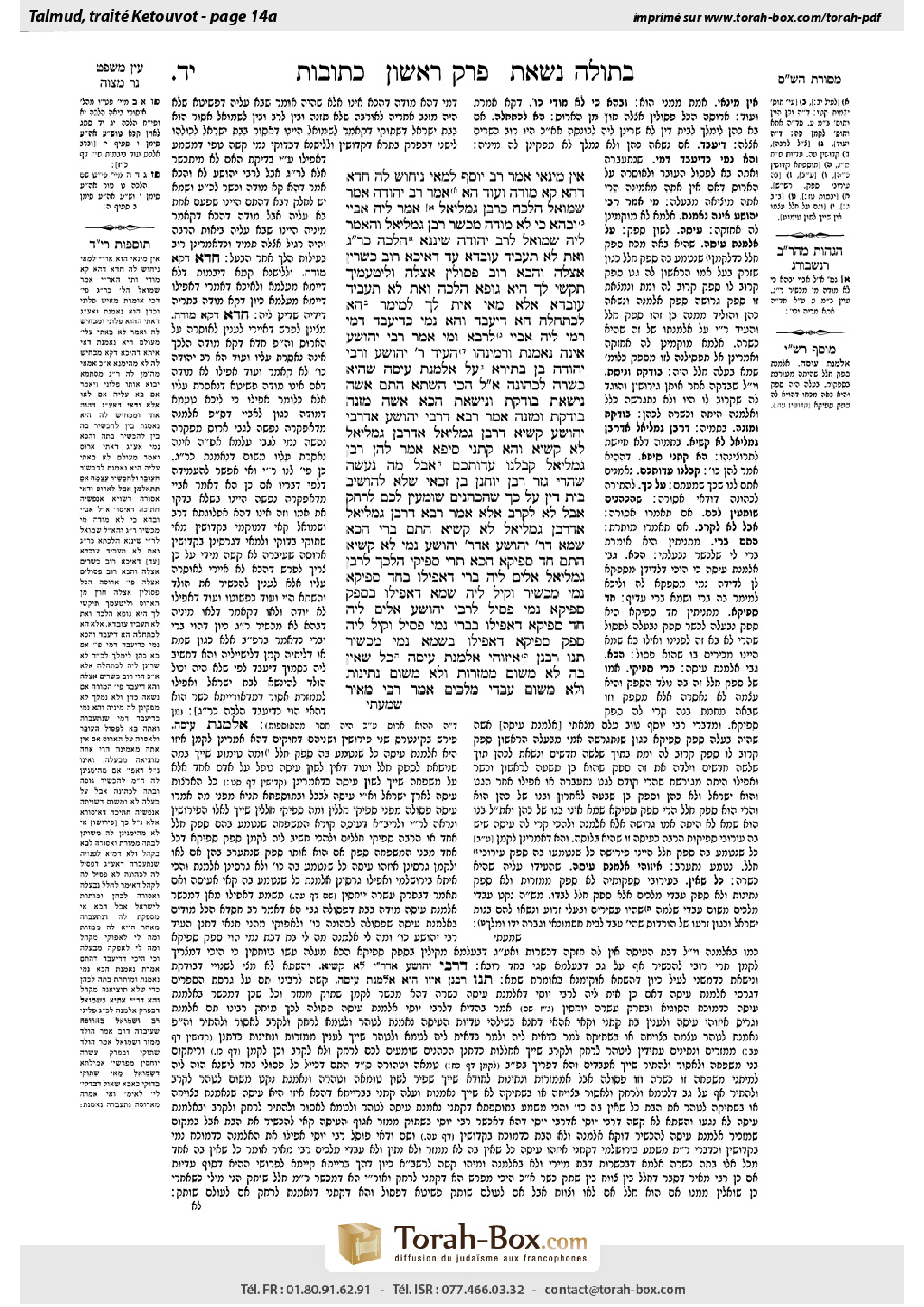
Ketubot 14a: Talmud study for Daf Yomi
Daf Yomi is the daily study of one Talmud folio. Explore 37 tractates with scans, Hebrew text, Sefaria English and AI-generated French translations where annotated.
Passage selection and English or AI-generated French translation are available where the scan has annotations. Daf Study is independent of Torah-Box and Sefaria.
Browse Ketubot · כתובות · All tractatesKetubot 14a text and translations
This page of Ketubot includes the Aramaic text, an English translation and an AI-generated French translation, alongside the scan above.
כתובות י״ד א · Aramaic and Hebrew text
אִין, מִינַּאי. אָמַר רַב יוֹסֵף: לְמַאי נֵיחוּשׁ לַהּ? חֲדָא, דְּהָא קָא מוֹדֵה. וְעוֹד, הָא אָמַר רַב יְהוּדָה אָמַר שְׁמוּאֵל: הֲלָכָה כְּרַבָּן גַּמְלִיאֵל.
אֲמַר לֵיהּ אַבָּיֵי: וּבְהָא, כִּי לָא מוֹדֵה מַכְשַׁר רַבָּן גַּמְלִיאֵל? וְהָאָמַר לֵיהּ שְׁמוּאֵל לְרַב יְהוּדָה: שִׁינָּנָא, הֲלָכָה כְּרַבָּן גַּמְלִיאֵל, וְאַתְּ לָא תַּעֲבֵיד עוֹבָדָא עַד דְּאִיכָּא רוֹב כְּשֵׁרִין אֶצְלָהּ. וְהָכָא — רוֹב פְּסוּלִין אֶצְלָהּ!
וְלִיטַעְמָיךְ תִּקְשֵׁי לָךְ הִיא גּוּפַהּ: הֲלָכָה, וְאַתְּ לָא תַּעֲבֵיד עוֹבָדָא?! אֶלָּא מַאי אִית לָךְ לְמֵימַר: הָא — לְכַתְּחִלָּה, הָא — דִּיעֲבַד. וְהָא נָמֵי, כְּדִיעֲבַד דָּמֵי.
רָמֵי לֵיהּ אַבָּיֵי לְרָבָא: וּמִי אָמַר רַבִּי יְהוֹשֻׁעַ אֵינָהּ נֶאֱמֶנֶת? וּרְמִינְהוּ: הֵעִיד רַבִּי יְהוֹשֻׁעַ וְרַבִּי יְהוּדָה בֶּן בְּתֵירָא עַל אַלְמְנַת עִיסָּה, שֶׁהִיא כְּשֵׁרָה לַכְּהוּנָּה.
אֲמַר לֵיהּ: הָכִי הַשְׁתָּא?! הָתָם: אִשָּׁה נִישֵּׂאת, בּוֹדֶקֶת וְנִישֵּׂאת. הָכָא, אִשָּׁה מְזַנָּה בּוֹדֶקֶת וּמְזַנָּה?!
אָמַר רָבָא: דְּרַבִּי יְהוֹשֻׁעַ אַדְּרַבִּי יְהוֹשֻׁעַ קַשְׁיָא, דְּרַבָּן גַּמְלִיאֵל אַדְּרַבָּן גַּמְלִיאֵל לָא קַשְׁיָא? וְהָא קָתָנֵי סֵיפָא: אָמַר לָהֶן רַבָּן גַּמְלִיאֵל: קִבַּלְנוּ עֵדוּתְכֶם, אֲבָל מָה נַעֲשֶׂה שֶׁהֲרֵי גָּזַר רַבָּן יוֹחָנָן בֶּן זַכַּאי שֶׁלֹּא לְהוֹשִׁיב בֵּית דִּין עַל כָּךְ, שֶׁהַכֹּהֲנִים שׁוֹמְעִין לָכֶם לְרַחֵק אֲבָל לֹא לְקָרֵב.
אֶלָּא אָמַר רָבָא: דְּרַבָּן גַּמְלִיאֵל אַדְּרַבָּן גַּמְלִיאֵל לָא קַשְׁיָא: הָתָם — בָּרִי, הָכָא — שֶׁמָּא.
דְּרַבִּי יְהוֹשֻׁעַ אַדְּרַבִּי יְהוֹשֻׁעַ נָמֵי לָא קַשְׁיָא: הָתָם — חַד סְפֵיקָא, הָכָא — תְּרֵי סְפֵיקֵי.
הִלְכָּךְ, לְרַבָּן גַּמְלִיאֵל: אַלִּים לֵיהּ בָּרִי, דַּאֲפִילּוּ בְּחַד סְפֵיקָא נָמֵי מַכְשִׁיר. וְקִיל לֵיהּ שֶׁמָּא, דַּאֲפִילּוּ בִּסְפֵק סְפֵיקָא נָמֵי פָּסֵיל. לְרַבִּי יְהוֹשֻׁעַ: אַלִּים לֵיהּ חַד סְפֵיקָא, דַּאֲפִילּוּ בְּבָרִי נָמֵי פָּסֵיל, וְקִיל לֵיהּ סְפֵק סְפֵיקָא, דַּאֲפִילּוּ בִּשְׁמָא נָמֵי מַכְשִׁיר.
תָּנוּ רַבָּנַן: אֵיזוֹהִי אַלְמְנַת עִיסָּה? כֹּל שֶׁאֵין בָּהּ לֹא מִשּׁוּם מַמְזֵרוּת, וְלֹא מִשּׁוּם נְתִינוּת, וְלֹא מִשּׁוּם עַבְדֵי מְלָכִים. אָמַר רַבִּי מֵאִיר:
Ketubot 14a · English translation
Yes, she conceived from relations with me. Rav Yosef said: The ruling here is clear, as with regard to what suspicion need we be concerned? First, he concedes that he is the father. And furthermore, didn’t Rav Yehuda say that Shmuel said: The halakha is in accordance with the opinion of Rabban Gamliel, and even if he didn’t admit that the child was his, the woman’s claim is accorded credibility?
Abaye said to him: And in this case, based on the fact that you cited two reasons to deem the child fit, is that to say when he does not admit that he is the father Rabban Gamliel deems the child fit? But didn’t Shmuel say to Rav Yehuda: Big-toothed one, the halakha is in accordance with the opinion of Rabban Gamliel, i.e., that she is accorded credibility, but you should not perform an action based on this ruling unless the majority of the men in her proximity are honorable and of impeccable lineage, corroborating her claim. And here, since she is betrothed, the majority of the men in her proximity are unfit, as a child fathered by any man other than her betrothed is a mamzer. Shmuel should not have ruled that the halakha was in accordance with the opinion of Rabban Gamliel.
Rav Yosef said to Abaye: And according to your reasoning, the halakha itself should pose a difficulty for you, as on the one hand Shmuel rules that it is the halakha and on the other hand he adds: But you should not perform an action based on this ruling. Rather, what have you to say to explain this contradiction? This statement that one relies on the woman’s claim only if a majority of men in her proximity are of unflawed lineage is ab initio. That statement that one may rely on the woman’s claim regardless of the status of the men in her proximity is after the fact. And this case of the betrothed woman, too, is like a case after the fact, as failure to rely on her claim will render her child a mamzer. Therefore, in this case, Shmuel would rule that the halakha is in accordance with the opinion of Rabban Gamliel.
§ Abaye raised a contradiction before Rava from a mishna (Eduyyot 8:3): Did Rabbi Yehoshua say that the woman is not deemed credible and her claim is not accepted? And the Gemara raises a contradiction: Rabbi Yehoshua and Rabbi Yehuda ben Beteira testified concerning the widow whose late husband was a member of a priestly family of questionable lineage [issa], that she is fit to marry into the priesthood. Since the matter is uncertain, the woman retains her presumptive status of fitness and her late husband is presumed to be of unflawed lineage.
Rava said to him: How can these cases be compared? There, in the case of the widow, one could say: A woman who marries investigates the lineage of her prospective husband before the wedding and only then marries. Therefore, one may rely on her presumptive status of fitness and deem her fit to marry a priest. Here, can it be said that a woman who engages in licentious intercourse investigates the lineage of her partner and only then engages in licentious intercourse?
Rava said with regard to the contradiction that was raised: Is the contradiction between one statement of Rabbi Yehoshua and another statement of Rabbi Yehoshua difficult, and the contradiction between one statement of Rabban Gamliel and another statement of Rabban Gamliel not difficult? But isn’t it taught in the latter clause of that mishna with regard to the widow whose late husband was from a priestly family of questionable lineage that Rabban Gamliel said to them: We accept your testimony that this is the halakha, but what can we do, as Rabban Yoḥanan ben Zakkai decreed not to convene a court for this purpose of ruling the woman fit, because the priests obey you when your ruling calls to distance a woman of questionable lineage from marrying them, but not when your ruling calls to bring her near and deem her fit to marry them. Apparently, Rabban Gamliel did not accept the lenient ruling in the case of the widow, contrary to his statement here that she is accorded credibility.
Rather, Rava said: The contradiction between one statement of Rabban Gamliel and another statement of Rabban Gamliel is not difficult. There, in the case of the woman who engaged in intercourse with an unidentified man, her claim that the lineage of the man is unflawed is a certain claim. Here, in the case of the widow, her claim that his lineage is unflawed is an uncertain claim, because there is objective uncertainty with regard to his lineage.
The contradiction between one statement of Rabbi Yehoshua and another statement of Rabbi Yehoshua is similarly not difficult. There, in the case of the woman who engaged in intercourse with an unidentified man, there is only one uncertainty: Is the lineage of the man with whom she engaged in intercourse flawed or unflawed? In the case of one uncertainty, the ruling is stringent. Here, in the case of the widow, there are two uncertainties with regard to the objective situation. It is established that there is uncertainty with regard to one of the members of the family whether or not he is a ḥalal. The first uncertainty is whether her late husband is the member of that family with regard to whom the uncertainty exists. Even if it is established that her late husband is indeed the one with regard to whom the uncertainty exists, there remains an uncertainty whether he is in fact a ḥalal.
Therefore, according to Rabban Gamliel, a certain claim is so powerful for him that even in a case where there is one uncertainty, he also deems her fit to marry a priest. And an uncertain claim is so insignificant for him that even in a case where there is a compound uncertainty, he also deems her unfit to marry a priest. According to Rabbi Yehoshua, a case where there is one uncertainty is so powerful for him that even in a case where she makes a certain claim, he also deems her unfit. And the case of a compound uncertainty is so insignificant for him that even if she makes an uncertain claim, he also deems her fit.
§ Apropos the widow, the Rabbis taught: Who is the widow whose late husband was a member of a priestly family of questionable lineage and is fit to marry a priest? It is one who married into any family that does not have the status of being unfit, neither due to uncertain mamzer status, nor due to uncertain Gibeonite status, nor due to uncertain status as slaves of kings, who would force Jewish women, even daughters of priests, to marry them. Rabbi Meir said:
Ketubot 14a · Traduction française (IA)
Oui, elle a conçu à la suite de relations avec moi. Rav Yossef dit : La décision est ici évidente : de quel soupçon faudrait-il se préoccuper ? Tout d’abord, il reconnaît être le père. De plus, Rav Yehouda n’a-t-il pas dit que Shmuel a dit : « La halakha est conforme à l’avis de Rabban Gamliel », et cela même s’il n’a pas reconnu que l’enfant était le sien, car la déclaration de la femme est jugée crédible ?
Abayé lui dit : Dans ce cas, puisque tu as cité deux raisons de déclarer l’enfant apte, cela signifie-t-il que, même s’il ne reconnaît pas être le père, Rabban Gamliel déclare l’enfant apte ? Pourtant, Shmuel n’a-t-il pas dit à Rav Yehouda : « Grande-Dent, la halakha est conforme à l’avis de Rabban Gamliel, c’est-à-dire qu’on la juge crédible, mais tu ne dois pas agir sur la base de cette décision, à moins que la majorité des hommes qui se trouvent dans son entourage soient de bonne réputation et de lignage irréprochable, ce qui corrobore sa déclaration » ? Or ici, puisqu’elle est fiancée, la majorité des hommes qui se trouvent dans son entourage sont inaptes, car tout enfant engendré par un homme autre que son fiancé serait un mamzer. Shmuel n’aurait donc pas dû décider que la halakha est conforme à l’avis de Rabban Gamliel.
Rav Yossef dit à Abayé : Selon ton raisonnement, la halakha elle-même devrait te poser problème, car, d’une part, Shmuel décide que telle est la halakha et, d’autre part, il ajoute : « Mais tu ne dois pas agir sur la base de cette décision. » Que répondrais-tu pour expliquer cette contradiction ? Cette déclaration — selon laquelle on ne se fie à la parole de la femme que si la majorité des hommes qui se trouvent dans son entourage sont de lignage irréprochable — concerne le cas a priori. Cette autre déclaration — selon laquelle on peut se fier à la parole de la femme quel que soit le statut des hommes qui se trouvent dans son entourage — concerne le cas a posteriori. Le cas de cette femme fiancée est lui aussi un cas a posteriori, car ne pas se fier à sa déclaration rendrait son enfant mamzer. Par conséquent, dans ce cas, Shmuel déciderait que la halakha est conforme à l’avis de Rabban Gamliel.
§ Abayé souleva devant Rava une contradiction à partir d’une Michna (Eduyyot 8:3) : Rabbi Yehoshoua a-t-il dit que la femme n’est pas jugée crédible et que sa déclaration n’est pas acceptée ? La Guemara soulève une contradiction : Rabbi Yehoshoua et Rabbi Yehouda ben Beteira ont témoigné au sujet de la veuve dont le défunt mari appartenait à une famille sacerdotale de lignage douteux [issa], qu’elle est apte à épouser un prêtre. Puisque la situation est incertaine, la femme conserve son statut présumé d’aptitude et son défunt mari est présumé de lignage irréprochable.
Rava lui dit : Comment peut-on comparer ces cas ? Dans le cas de la veuve, on peut dire qu’une femme qui se marie enquête sur le lignage de son futur mari avant les noces et ne se marie qu’ensuite. On peut donc se fier à son statut présumé d’aptitude et la déclarer apte à épouser un prêtre. Ici, peut-on dire qu’une femme qui a des relations illicites enquête sur le lignage de son partenaire avant d’avoir ces relations ?
Rava dit au sujet de la contradiction soulevée : La contradiction entre une déclaration de Rabbi Yehoshoua et une autre déclaration de Rabbi Yehoshoua te pose-t-elle problème, tandis que celle entre une déclaration de Rabban Gamliel et une autre déclaration de Rabban Gamliel ne t’en pose-t-elle pas ? Pourtant, il est enseigné dans la dernière partie de cette Michna, au sujet de la veuve dont le défunt mari appartenait à une famille sacerdotale de lignage douteux, que Rabban Gamliel leur dit : « Nous acceptons votre témoignage selon lequel telle est la halakha, mais que pouvons-nous faire ? Rabban Yoḥanan ben Zakkaï a décrété qu’on ne réunisse pas de tribunal dans le but de déclarer la femme apte, car les prêtres vous obéissent lorsque votre décision leur demande d’éloigner d’eux une femme de lignage douteux, mais pas lorsqu’elle leur demande de la rapprocher et de la déclarer apte à les épouser. » Il apparaît donc que Rabban Gamliel n’a pas accepté la décision indulgente dans le cas de la veuve, contrairement à ce qu’il affirme ici, à savoir qu’on la juge crédible.
Rava dit plutôt : La contradiction entre une déclaration de Rabban Gamliel et une autre déclaration de Rabban Gamliel ne pose pas problème. Dans le cas de la femme qui a eu des relations avec un homme non identifié, sa déclaration selon laquelle le lignage de l’homme est irréprochable est certaine. En revanche, dans le cas de la veuve, sa déclaration selon laquelle le lignage de son mari est irréprochable est incertaine, car il existe une incertitude objective quant à son lignage.
De même, la contradiction entre une déclaration de Rabbi Yehoshoua et une autre déclaration de Rabbi Yehoshoua ne pose pas problème. Dans le cas de la femme qui a eu des relations avec un homme non identifié, il n’y a qu’une seule incertitude : le lignage de l’homme avec lequel elle a eu des relations est-il entaché ou irréprochable ? En cas d’incertitude unique, la décision est rigoureuse. En revanche, dans le cas de la veuve, il existe deux incertitudes quant à la situation objective. Il est établi qu’il existe une incertitude concernant l’un des membres de la famille : est-il ou non un ḥalal ? La première incertitude consiste à savoir si son défunt mari est le membre de cette famille au sujet duquel il existe une incertitude. Même s’il est établi que son défunt mari est bien celui qui est concerné par cette incertitude, il reste à savoir s’il est effectivement un ḥalal.
Par conséquent, pour Rabban Gamliel, une déclaration certaine a tant de poids que, même dans un cas où il n’y a qu’une seule incertitude, il la déclare apte à épouser un prêtre. En revanche, une déclaration incertaine a si peu de poids à ses yeux que, même dans un cas d’incertitude composée, il la déclare inapte à épouser un prêtre. Pour Rabbi Yehoshoua, un cas comportant une seule incertitude a tant de poids que, même lorsqu’elle fait une déclaration certaine, il la déclare inapte. Et un cas d’incertitude composée a si peu de poids à ses yeux que, même si elle fait une déclaration incertaine, il la déclare apte.
§ À propos de la veuve, les rabbins enseignèrent : Quelle est la veuve dont le défunt mari appartenait à une famille sacerdotale de lignage douteux et qui est apte à épouser un prêtre ? C’est celle qui s’est mariée dans une famille qui n’a pas le statut d’inapte, ni en raison d’un statut incertain de mamzer, ni en raison d’un statut incertain de Gabaonite, ni en raison d’un statut incertain d’esclave du roi — des esclaves qui contraignaient les femmes juives, même les filles de prêtres, à les épouser. Rabbi Meïr dit :
Traduction française générée par IA à partir de l’édition anglaise de Sefaria. Vérifie toujours un passage avec le texte source.
Text from Sefaria: William Davidson Edition - Vocalized Aramaic (CC BY NC); William Davidson Edition - English (CC BY NC).