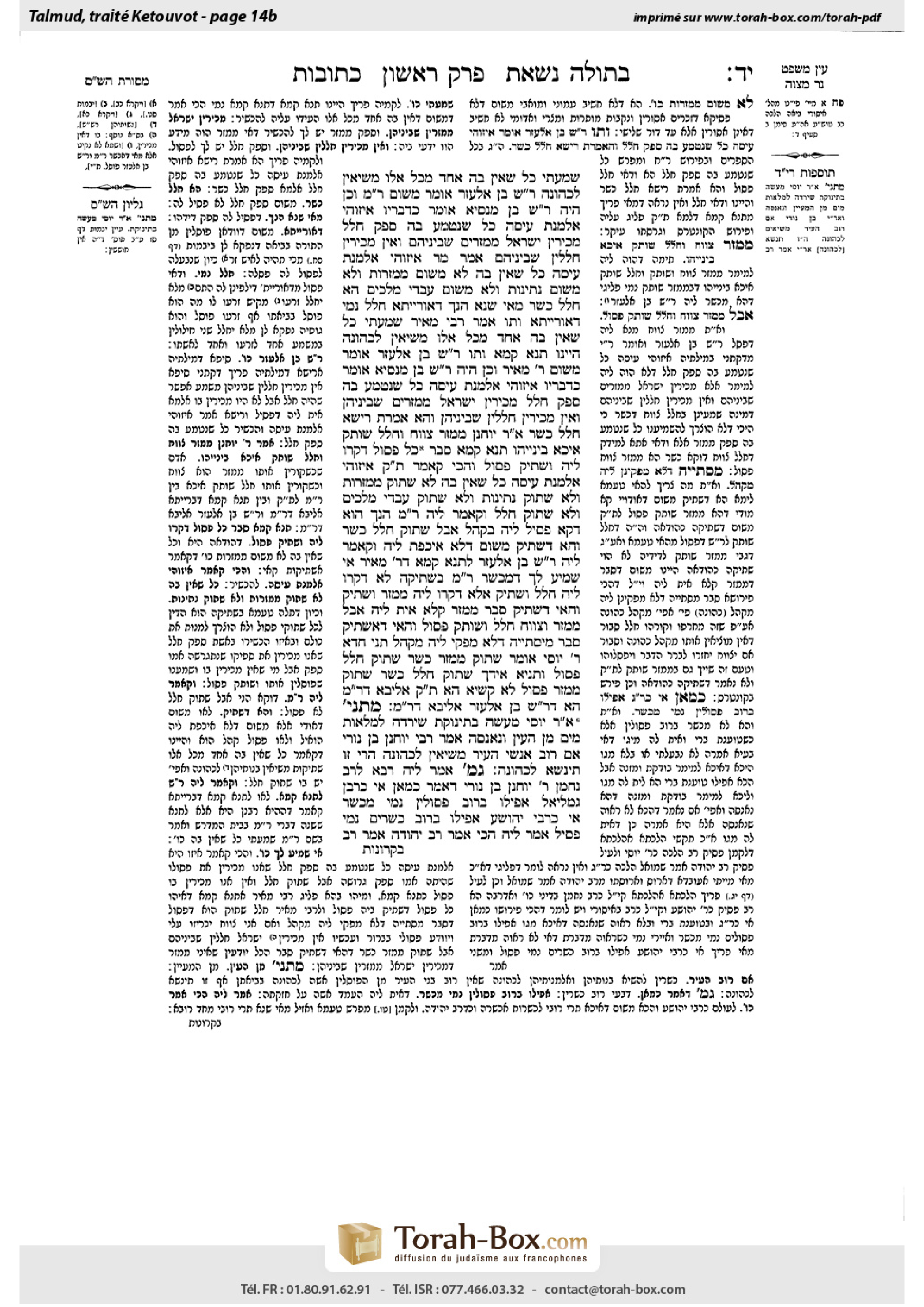
Ketubot 14b: Talmud study for Daf Yomi
Daf Yomi is the daily study of one Talmud folio. Explore 37 tractates with scans, Hebrew text, Sefaria English and AI-generated French translations where annotated.
Passage selection and English or AI-generated French translation are available where the scan has annotations. Daf Study is independent of Torah-Box and Sefaria.
Browse Ketubot · כתובות · All tractatesKetubot 14b text and translations
This page of Ketubot includes the Aramaic text, an English translation and an AI-generated French translation, alongside the scan above.
כתובות י״ד ב · Aramaic and Hebrew text
שָׁמַעְתִּי, כֹּל שֶׁאֵין בָּהּ אֶחָד מִכׇּל אֵלּוּ — מַשִּׂיאִין לַכְּהוּנָּה.
רַבִּי שִׁמְעוֹן בֶּן אֶלְעָזָר אוֹמֵר מִשּׁוּם רַבִּי מֵאִיר, וְכֵן הָיָה רַבִּי שִׁמְעוֹן בֶּן מְנַסְיָא אוֹמֵר כִּדְבָרָיו: אֵיזוֹהִי אַלְמְנַת עִיסָּה — כֹּל שֶׁנִּטְמַע בָּהּ סְפֵק חָלָל.
מַכִּירִין יִשְׂרָאֵל מַמְזֵרִים שֶׁבֵּינֵיהֶם, וְאֵין מַכִּירִין חֲלָלִין שֶׁבֵּינֵיהֶם.
אָמַר מָר: אֵיזוֹהִי אַלְמְנַת עִיסָּה — כֹּל שֶׁאֵין בָּהּ לֹא מִשּׁוּם מַמְזֵרוּת, וְלֹא מִשּׁוּם נְתִינוּת, וְלֹא מִשּׁוּם עַבְדֵי מְלָכִים. הָא חָלָל — כָּשֵׁר.
מַאי שְׁנָא הָנָךְ — דְּאוֹרָיְיתָא, חָלָל נָמֵי דְּאוֹרָיְיתָא! וְתוּ, אָמַר רַבִּי מֵאִיר: שָׁמַעְתִּי, כֹּל שֶׁאֵין בָּהּ אֶחָד מִכׇּל אֵלּוּ מַשִּׂיאִין לַכְּהוּנָּה, הַיְינוּ תַּנָּא קַמָּא?!
וְתוּ: רַבִּי שִׁמְעוֹן בֶּן אֶלְעָזָר אוֹמֵר מִשּׁוּם רַבִּי מֵאִיר, וְכֵן הָיָה רַבִּי שִׁמְעוֹן בֶּן מְנַסְיָא אוֹמֵר כִּדְבָרָיו: אֵיזוֹהִי אַלְמְנַת עִיסָּה — כֹּל שֶׁנִּטְמַע בָּהּ סְפֵק חָלָל, מַכִּירִין יִשְׂרָאֵל מַמְזֵרִים שֶׁבֵּינֵיהֶן וְאֵין מַכִּירִין חֲלָלִין שֶׁבֵּינֵיהֶן. וְהָא אָמְרַתְּ רֵישָׁא, חָלָל כָּשֵׁר!
אָמַר רַבִּי יוֹחָנָן: מַמְזֵר צוֹוֵחַ וְחָלָל שׁוֹתֵק אִיכָּא בֵּינַיְיהוּ: תַּנָּא קַמָּא סָבַר: כֹּל פְּסוּל דְּקָרוּ לֵיהּ וְשָׁתֵיק — פָּסוּל. וְהָכִי קָאָמַר תַּנָּא קַמָּא: אֵיזוֹהִי אַלְמְנַת עִיסָּה — כֹּל שֶׁאֵין בָּהּ לֹא שְׁתוּק מַמְזֵרוּת, וְלֹא שְׁתוּק נְתִינוּת, וְלֹא שְׁתוּק עַבְדֵי מְלָכִים, וְלֹא שְׁתוּק חָלָל.
וְקָאָמַר לֵיהּ רַבִּי מֵאִיר: הָנָךְ הוּא דְּקָא פָּסֵיל לֵיהּ בְּקָהָל, אֲבָל שְׁתוּק חָלָל — כָּשֵׁר. וְהָא דְּשָׁתֵיק — מִשּׁוּם דְּלָא אִיכְפַּת לֵיהּ.
וְקָאָמַר לֵיהּ רַבִּי שִׁמְעוֹן בֶּן אֶלְעָזָר לְתַנָּא קַמָּא דְּרַבִּי מֵאִיר: אִי שְׁמִיעַ לָךְ דְּמַכְשַׁר רַבִּי מֵאִיר בִּשְׁתִיקָה — לָא דְּקָרוּ לֵיהּ ״חָלָל״ וְשָׁתֵיק, אֶלָּא דְּקָרוּ לֵיהּ ״מַמְזֵר״ וְשָׁתֵיק. וְהַאי דְּשָׁתֵיק, סָבַר מַמְזֵר קָלָא אִית לֵיהּ. אֲבָל מַמְזֵר וְצוֹוֵחַ, חָלָל וְשׁוֹתֵק — פָּסוּל. וְהַאי דְּאִשְׁתִּיק, סָבַר מִיסָּתְיֵיהּ דְּלָא מַפְּקִי לֵיהּ מִקָּהָל.
תָּנֵי חֲדָא, רַבִּי יוֹסֵי אוֹמֵר: שְׁתוּק מַמְזֵר — כָּשֵׁר, שְׁתוּק חָלָל — פָּסוּל. וְתַנְיָא אִידַּךְ: שְׁתוּק חָלָל — כָּשֵׁר, שְׁתוּק מַמְזֵר — פָּסוּל.
לָא קַשְׁיָא: הָא תַּנָּא קַמָּא אַלִּיבָּא דְּרַבִּי מֵאִיר, הָא דְּרַבִּי שִׁמְעוֹן בֶּן אֶלְעָזָר אַלִּיבָּא דְּרַבִּי מֵאִיר.
מַתְנִי׳ אָמַר רַבִּי יוֹסֵי: מַעֲשֶׂה בְּתִינוֹקֶת שֶׁיָּרְדָה לְמַלּאוֹת מַיִם מִן הָעַיִן, וְנֶאֱנָסָה. אָמַר רַבִּי יוֹחָנָן בֶּן נוּרִי: אִם רוֹב אַנְשֵׁי הָעִיר מַשִּׂיאִין לִכְהוּנָּה, הֲרֵי זוֹ תִּינָּשֵׂא לִכְהוּנָּה.
גְּמָ׳ אֲמַר לֵיהּ רָבָא לְרַב נַחְמָן: רַבִּי יוֹחָנָן בֶּן נוּרִי דְּאָמַר כְּמַאן? אִי כְּרַבָּן גַּמְלִיאֵל — אֲפִילּוּ בְּרוֹב פְּסוּלִין נָמֵי מַכְשַׁר. אִי כְּרַבִּי יְהוֹשֻׁעַ — אֲפִילּוּ בְּרוֹב כְּשֵׁרִים נָמֵי פָּסֵיל! אֲמַר לֵיהּ, הָכִי אָמַר רַב יְהוּדָה אָמַר רַב:
Ketubot 14b · English translation
I heard that with regard to the widow of any family that has none of these uncertainties associated with it, one allows her to marry members of the priesthood. The only uncertainty where this ruling applies is in the case of uncertain ḥalal status.
Rabbi Shimon ben Elazar says in the name of Rabbi Meir, and likewise Rabbi Shimon ben Menasya would say in accordance with his statement: Who is the widow whose late husband was a member of a priestly family of questionable lineage? It is a widow who marries into any family in which a person with regard to whom there is uncertainty whether or not he is a ḥalal was assimilated among its members. Therefore, she is referred to as a widow of dough [issa]. Just as dough is the result of a mixture of several ingredients, this family too has a person with regard to whom there is uncertainty whether he is a ḥalal mixed within it.
The reason for the distinction between uncertain ḥalal status and uncertain mamzer status is that Jews identify the mamzerim that are among them, and there is no concern lest they assimilate into families of unflawed lineage. But they do not identify the ḥalalin among them. Therefore, there is concern lest a ḥalal assimilate into the family.
The Gemara analyzes the baraita. The Master said in the baraita: Who is the widow whose late husband was a member of a priestly family of questionable lineage? It is one who married into any family that does not have the status of being unfit, neither due to uncertain mamzer status, nor due to uncertain Gibeonite status, nor due to uncertain status as slaves of kings. The Gemara infers: However, if it is due to uncertain ḥalal status, her marriage to a priest is deemed fit.
The Gemara asks: What is different about these flaws in lineage, uncertain mamzer status and Gibeonite status, which render her unfit to marry a priest by Torah law? A ḥalal also renders her unfit by Torah law. And furthermore, the baraita continues: Rabbi Meir said: I heard that with regard to the widow of any family that has none of these uncertainties associated with it, one marries her to members of the priesthood. That is identical to the opinion of the first tanna. If there is uncertainty with regard to one in the late husband’s family that he is a mamzer or a Gibeonite, she is unfit to marry a priest; if the uncertainty is with regard to ḥalal status, she is fit to marry a priest. What novel element does Rabbi Meir introduce?
The baraita continues: And furthermore, Rabbi Shimon ben Elazar says in the name of Rabbi Meir, and likewise, Rabbi Shimon ben Menasya would say in accordance with his statement: Who is the widow whose late husband was a member of a priestly family of questionable lineage? It is a widow who marries into any family in which a person with regard to whom there is uncertainty whether or not he is a ḥalal was assimilated. Because Jews identify the mamzerim that are among them there is no concern that they will assimilate into families of unflawed lineage, but Jews do not identify the ḥalalin among them. Due to the concern that a ḥalal assimilated into the family, the widow is unfit to marry a priest. The Gemara asks: But didn’t you say in the first clause of the baraita that if there is uncertainty whether or not a ḥalal was assimilated among its members, her marriage to a priest is deemed fit?
Rabbi Yoḥanan said: The case of one who when called mamzer screams and protests that he is being slandered, and when called ḥalal is silent, is the subject of the dispute between the tanna’im in the baraita. The first tanna holds: Anyone who when others call him unfit and he is silent, is unfit, as his silence confirms the allegation. And this is what the first tanna is saying: Who is the widow whose late husband was a member of a priestly family of questionable lineage, who is fit to marry a priest? It is one who married into any family that has neither unfitness due to silence in response to allegations of mamzer status, nor silence in response to allegations of Gibeonite status, nor silence in response to allegations that they are slaves of kings, nor silence in response to allegations of ḥalal status. Only a woman who was married into a family that protested in response to all these allegations is fit to marry a priest.
And Rabbi Meir is saying to him: Specifically, each of those silent in response to allegations of mamzer or Gibeonite status or allegations that they are slaves of kings are rendered unfit because these allegations render him unfit to marry into the congregation of Israel. However, despite silence in response to allegations of ḥalal status, her marriage to a priest is deemed fit. And the fact that he is silent is due to his indifference, as even were he deemed a ḥalal the only restriction would be with regard to marriage to priests.
And Rabbi Shimon ben Elazar is saying to the first tanna who quoted Rabbi Meir as saying: I heard, etc. If you heard that Rabbi Meir deems her marriage to a priest fit, in a case of silence in response to allegations, it is not in a case where they called him ḥalal and he is silent; rather, it is in a case where they call him mamzer and he is silent. In that case, the reason he is silent is that he holds: The fact that one is a mamzer generates publicity, and since he is not reputed to be a mamzer, he is indifferent to the allegation. However, in a case where he is called mamzer and he screams in protest, or where he is called ḥalal and he is silent, he is unfit. And the fact that he is silent and does not protest is because he holds: It is sufficient for him that they do not expel him from the congregation of Israel.
The Gemara notes: It is taught in one baraita that Rabbi Yosei says: Despite the fact that with silence in response to allegations of mamzer one is fit; silence in response to allegations of ḥalal renders one unfit. It is taught in another baraita: Despite the fact that with silence in response to allegations of ḥalal one is fit; silence in response to allegations of mamzer renders one unfit.
The Gemara explains: The contradiction between the baraitot is not difficult. This second baraita is the opinion of the first tanna in accordance with the opinion of Rabbi Meir, who holds that silence in response to allegations of ḥalal does not render one unfit. And this first baraita is the opinion of Rabbi Shimon ben Elazar in accordance with the opinion of Rabbi Meir, who holds that silence in response to allegations of mamzer is motivated by indifference and does not render him unfit; however, silence in response to allegations of ḥalal is an indication that the allegations are true and he is unfit.
MISHNA: Rabbi Yosei said: There was an incident involving a young girl who descended to fill her jug with water from the spring, and she was raped, and the identity of the rapist was unknown. Rabbi Yoḥanan ben Nuri said: If the majority of the people of the city marry their daughters to members of the priesthood, this young girl may be married to a member of the priesthood.
GEMARA: Rava said to Rav Naḥman: In accordance with whose opinion is it that Rabbi Yoḥanan ben Nuri stated his opinion? If it is in accordance with the opinion of Rabban Gamliel, even in a case where the majority of the people are of flawed lineage as well, he deems her fit to marry into the priesthood. If it is in accordance with the opinion of Rabbi Yehoshua, even in a case where the majority of the people are of unflawed lineage, he deems her unfit to marry into the priesthood. Rav Naḥman said to Rava that this is what Rav Yehuda said that Rav said:
Ketubot 14b · Traduction française (IA)
J’ai entendu que, s’agissant de la veuve d’une famille à laquelle n’est associée aucune de ces incertitudes, on l’autorise à épouser un membre de la classe sacerdotale. La seule incertitude à laquelle cette décision s’applique est celle du statut de ḥalal.
Rabbi Shimon ben Elazar dit au nom de Rabbi Meir, et Rabbi Shimon ben Menasya disait de même, conformément à son avis : Qui est la veuve dont le défunt mari était membre d’une famille sacerdotale de lignée incertaine ? C’est une veuve qui s’est mariée dans une famille au sein de laquelle s’est intégré un homme dont on ne sait pas s’il est ou non ḥalal. C’est pourquoi on la qualifie de veuve de pâte [issa]. De même que la pâte résulte du mélange de plusieurs ingrédients, cette famille compte elle aussi parmi ses membres un homme dont le statut de ḥalal est incertain.
La raison de la distinction entre l’incertitude concernant le statut de ḥalal et celle concernant le statut de mamzer est que les Juifs identifient les mamzerim qui se trouvent parmi eux ; on ne craint donc pas qu’ils s’intègrent dans des familles de lignée sans défaut. En revanche, ils n’identifient pas les ḥalalim parmi eux. On craint donc qu’un ḥalal ne s’intègre dans la famille.
La Guemara analyse la baraïta. Le Maître a dit dans la baraïta : Qui est la veuve dont le défunt mari était membre d’une famille sacerdotale de lignée incertaine ? C’est une femme qui s’est mariée dans une famille dont la lignée n’est pas entachée d’inaptitude, ni en raison d’un statut incertain de mamzer, ni d’un statut incertain de Gabaonite, ni d’un statut incertain d’esclave des rois. La Guemara en déduit : en revanche, si l’incertitude porte sur un statut de ḥalal, son mariage avec un prêtre est considéré comme permis.
La Guemara demande : En quoi ces défauts de lignée — le statut incertain de mamzer et celui de Gabaonite — qui la rendent inapte à épouser un prêtre selon la Torah, diffèrent-ils ? Un ḥalal la rend lui aussi inapte selon la Torah. De plus, la baraïta poursuit : Rabbi Meir a dit : « J’ai entendu que, s’agissant de la veuve d’une famille à laquelle n’est associée aucune de ces incertitudes, on la marie à un membre de la classe sacerdotale. » Cela revient à l’avis du premier tanna. Si l’on doute qu’un membre de la famille de son défunt mari soit un mamzer ou un Gabaonite, elle est inapte à épouser un prêtre ; si le doute porte sur le statut de ḥalal, elle est apte à épouser un prêtre. Quel élément nouveau Rabbi Meir apporte-t-il ?
La baraïta poursuit : De plus, Rabbi Shimon ben Elazar dit au nom de Rabbi Meir, et Rabbi Shimon ben Menasya disait de même, conformément à son avis : Qui est la veuve dont le défunt mari était membre d’une famille sacerdotale de lignée incertaine ? C’est une veuve qui s’est mariée dans une famille au sein de laquelle s’est intégré un homme dont on ne sait pas s’il est ou non ḥalal. Puisque les Juifs identifient les mamzerim qui se trouvent parmi eux, on ne craint pas qu’ils s’intègrent dans des familles de lignée sans défaut ; mais les Juifs n’identifient pas les ḥalalim parmi eux. Comme on craint qu’un ḥalal se soit intégré dans la famille, la veuve est inapte à épouser un prêtre. La Guemara demande : Mais n’as-tu pas dit dans la première partie de la baraïta que, si l’on doute qu’un ḥalal se soit intégré parmi ses membres, son mariage avec un prêtre est considéré comme permis ?
Rabbi Yoḥanan dit : Le cas d’un homme qui, lorsqu’on le traite de mamzer, crie et proteste qu’on le calomnie, mais qui garde le silence lorsqu’on le traite de ḥalal, fait l’objet du désaccord entre les tannaïm dans la baraïta. Le premier tanna considère que quiconque garde le silence lorsque les autres le déclarent inapte est inapte, car son silence confirme l’accusation. Voici ce que dit le premier tanna : Qui est la veuve dont le défunt mari était membre d’une famille sacerdotale de lignée incertaine, mais qui est apte à épouser un prêtre ? C’est une femme qui s’est mariée dans une famille où personne n’a été déclaré inapte en gardant le silence face à des accusations de statut de mamzer, de Gabaonite, d’esclave des rois ou de ḥalal. Seule une femme mariée dans une famille qui a protesté contre toutes ces accusations est apte à épouser un prêtre.
Et Rabbi Meir lui répond : précisément, ceux qui gardent le silence face à des accusations de statut de mamzer ou de Gabaonite, ou face à l’accusation d’être esclave des rois, sont déclarés inaptes, car ces accusations les rendent inaptes à entrer dans l’assemblée d’Israël. En revanche, même si l’on garde le silence face à une accusation de statut de ḥalal, son mariage avec un prêtre est considéré comme permis. S’il garde le silence, c’est par indifférence : même s’il était déclaré ḥalal, la seule restriction concernerait le mariage avec des prêtres.
Et Rabbi Shimon ben Elazar s’adresse ainsi au premier tanna, qui a rapporté les paroles de Rabbi Meir : « J’ai entendu, etc. » Si tu as entendu que Rabbi Meir considère son mariage avec un prêtre comme permis dans un cas où l’on garde le silence face à des accusations, il ne s’agit pas du cas où l’on traite l’homme de ḥalal et où il garde le silence ; il s’agit du cas où on le traite de mamzer et où il garde le silence. Dans ce cas, il garde le silence parce qu’il estime que le statut de mamzer fait l’objet d’une publicité ; puisqu’il n’a pas la réputation d’être mamzer, il est indifférent à l’accusation. En revanche, s’il est traité de mamzer et proteste, ou s’il est traité de ḥalal et garde le silence, il est inapte. S’il garde le silence sans protester, c’est parce qu’il estime qu’il lui suffit de ne pas être exclu de l’assemblée d’Israël.
La Guemara note : Dans une baraïta, on enseigne que Rabbi Yosei dit : bien que celui qui garde le silence face à une accusation de statut de mamzer soit apte, celui qui garde le silence face à une accusation de statut de ḥalal est inapte. Dans une autre baraïta, on enseigne : bien que celui qui garde le silence face à une accusation de statut de ḥalal soit apte, celui qui garde le silence face à une accusation de statut de mamzer est inapte.
La Guemara explique : La contradiction entre les baraïtot n’est pas difficile à résoudre. Cette seconde baraïta exprime l’avis du premier tanna, conformément à celui de Rabbi Meir, qui estime que garder le silence face à une accusation de statut de ḥalal ne rend pas inapte. Cette première baraïta exprime l’avis de Rabbi Shimon ben Elazar, conformément à celui de Rabbi Meir, qui estime que garder le silence face à une accusation de statut de mamzer est dû à l’indifférence et ne rend pas inapte ; en revanche, garder le silence face à une accusation de statut de ḥalal indique que l’accusation est fondée, et l’homme est inapte.
Michna : Rabbi Yosei a dit : Il est arrivé qu’une jeune fille descende remplir sa cruche d’eau à la source ; elle fut violée, et l’identité du violeur était inconnue. Rabbi Yoḥanan ben Nuri a dit : Si la majorité des habitants de la ville marient leurs filles à des membres de la classe sacerdotale, cette jeune fille peut épouser un membre de la classe sacerdotale.
Guemara : Rava dit à Rav Naḥman : De l’avis de qui Rabbi Yoḥanan ben Nuri a-t-il formulé cette opinion ? Si c’est de l’avis de Rabban Gamliel, même si la majorité des habitants sont de lignée imparfaite, il la déclare apte à épouser un membre de la classe sacerdotale. Si c’est de l’avis de Rabbi Yehoshua, même si la majorité des habitants sont de lignée sans défaut, il la déclare inapte à épouser un membre de la classe sacerdotale. Rav Naḥman dit à Rava que voici ce que Rav Yehuda a dit au nom de Rav :
Traduction française générée par IA à partir de l’édition anglaise de Sefaria. Vérifie toujours un passage avec le texte source.
Text from Sefaria: William Davidson Edition - Vocalized Aramaic (CC BY NC); William Davidson Edition - English (CC BY NC).