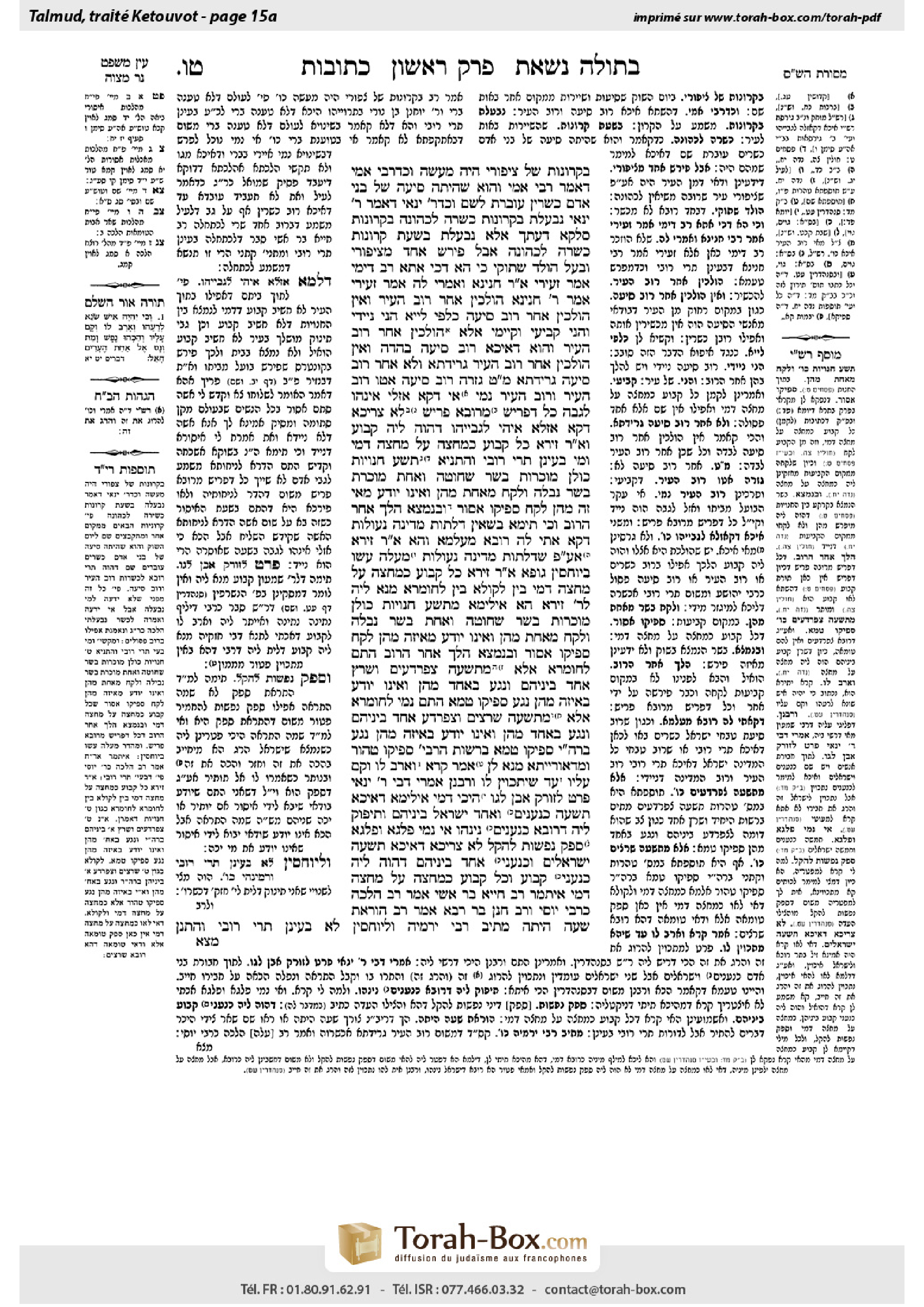
Ketubot 15a: Talmud study for Daf Yomi
Daf Yomi is the daily study of one Talmud folio. Explore 37 tractates with scans, Hebrew text, Sefaria English and AI-generated French translations where annotated.
Passage selection and English or AI-generated French translation are available where the scan has annotations. Daf Study is independent of Torah-Box and Sefaria.
Browse Ketubot · כתובות · All tractatesKetubot 15a text and translations
This page of Ketubot includes the Aramaic text, an English translation and an AI-generated French translation, alongside the scan above.
כתובות י״ה א · Aramaic and Hebrew text
בִּקְרוֹנוֹת שֶׁל צִיפּוֹרִי הָיָה מַעֲשֶׂה, וְכִדְרַבִּי אַמֵּי. דְּאָמַר רַבִּי אַמֵּי: וְהוּא שֶׁהָיְתָה סִיעָה שֶׁל בְּנֵי אָדָם כְּשֵׁרִין עוֹבֶרֶת לְשָׁם, וְכִדְרַבִּי יַנַּאי. דְּאָמַר רַבִּי יַנַּאי: נִבְעֶלֶת בִּקְרוֹנוֹת כְּשֵׁרָה לַכְּהוּנָּה.
בִּקְרוֹנוֹת סָלְקָא דַּעְתָּךְ? אֶלָּא נִבְעֶלֶת בִּשְׁעַת קְרוֹנוֹת, כְּשֵׁרָה לַכְּהוּנָּה. אֲבָל פֵּירַשׁ אֶחָד מִצִּיפּוֹרִי וּבָעַל — הַוָּלָד שְׁתוּקִי.
כִּי הָא דְּכִי אֲתָא רַב דִּימִי, אָמַר זְעֵירִי, אָמַר רַבִּי חֲנִינָא, וְאָמְרִי לַהּ, אָמַר זְעֵירִי אָמַר רַבִּי חֲנִינָא: הוֹלְכִין אַחַר רוֹב הָעִיר, וְאֵין הוֹלְכִין אַחַר רוֹב סִיעָה.
כְּלַפֵּי לְיָיא?! הָנֵי נָיְידִי, וְהָנֵי קְבִיעִי וְקָיְימִי!
אֶלָּא: הוֹלְכִין אַחַר רוֹב הָעִיר, וְהוּא דְּאִיכָּא רוֹב סִיעָה בַּהֲדַהּ, וְאֵין הוֹלְכִין אַחַר רוֹב הָעִיר גְּרֵידְתָּא, וְלֹא אַחַר רוֹב סִיעָה גְּרֵידְתָּא. מַאי טַעְמָא? גְּזֵרָה רוֹב סִיעָה אַטּוּ רוֹב הָעִיר.
וְרוֹב הָעִיר נָמֵי, אִי דְּקָא אָזְלִי אִינְהוּ לְגַבַּהּ: כֹּל דְּפָרֵישׁ — מֵרוּבָּא פָּרֵישׁ! לָא צְרִיכָא, דְּקָא אָזְלָא אִיהִי לְגַבַּיְיהוּ, דְּהָוֵה לֵיהּ קָבוּעַ, וְאָמַר רַבִּי זֵירָא: כׇּל קָבוּעַ כְּמֶחֱצָה עַל מֶחֱצָה דָּמֵי.
וּמִי בָּעֵינַן תְּרֵי רוּבֵּי? וְהָתַנְיָא: תֵּשַׁע חֲנוּיוֹת כּוּלָּן מוֹכְרוֹת בְּשַׂר שְׁחוּטָה, וְאַחַת מוֹכֶרֶת בְּשַׂר נְבֵלָה, וְלָקַח מֵאַחַת מֵהֶן וְאֵינוֹ יוֹדֵעַ מֵאֵי זֶה מֵהֶן לָקַח — סְפֵיקוֹ אָסוּר. וּבַנִּמְצָא — הַלֵּךְ אַחַר הָרוֹב.
וְכִי תֵּימָא בְּשֶׁאֵין דַּלְתוֹת מְדִינָה נְעוּלוֹת, דְּקָא אָתֵי לַהּ רוּבָּא מֵעָלְמָא — וְהָא אָמַר רַבִּי זֵירָא: אַף עַל פִּי שֶׁדַּלְתוֹת מְדִינָה נְעוּלוֹת! מַעֲלָה עָשׂוּ בְּיוּחֲסִין.
גּוּפָא, אָמַר רַבִּי זֵירָא: כׇּל קָבוּעַ — כְּמֶחֱצָה עַל מֶחֱצָה דָּמֵי, בֵּין לְקוּלָּא בֵּין לְחוּמְרָא.
מְנָא לֵיהּ לְרַבִּי זֵירָא הָא? אִילֵּימָא מִתֵּשַׁע חֲנוּיוֹת, כּוּלָּן מוֹכְרוֹת בְּשַׂר שְׁחוּטָה, וְאַחַת בְּשַׂר נְבֵלָה, וְלָקַח מֵאַחַת מֵהֶן וְאֵינוֹ יוֹדֵעַ מֵאֵיזֶה מֵהֶן לָקַח — סְפֵיקוֹ אָסוּר, וּבַנִּמְצָא — הַלֵּךְ אַחַר הָרוֹב; הָתָם לְחוּמְרָא!
אֶלָּא מִתִּשְׁעָה צְפַרְדְּעִים וְשֶׁרֶץ אֶחָד בֵּינֵיהֶם, וְנָגַע בְּאֶחָד מֵהֶן, וְאֵינוֹ יוֹדֵעַ בְּאֵיזֶה מֵהֶן נָגַע — סְפֵיקוֹ טָמֵא. הָתָם נָמֵי לְחוּמְרָא!
אֶלָּא מִתִּשְׁעָה שְׁרָצִים וּצְפַרְדֵּעַ אֶחָד בֵּינֵיהֶם, וְנָגַע בְּאֶחָד מֵהֶן, וְאֵינוֹ יוֹדֵעַ בְּאֵיזֶה מֵהֶן נָגַע. בִּרְשׁוּת הַיָּחִיד — סְפֵיקוֹ טָמֵא. בִּרְשׁוּת הָרַבִּים — סְפֵיקוֹ טָהוֹר.
וּמִדְּאוֹרָיְיתָא מְנָא לַן? אָמַר קְרָא: ״וְאָרַב לוֹ וְקָם עָלָיו״, עַד שֶׁיִּתְכַּוֵּין לוֹ. וְרַבָּנַן? אָמְרִי דְּבֵי רַבִּי יַנַּאי: פְּרָט לְזוֹרֵק אֶבֶן לְגָו.
הֵיכִי דָמֵי? אִילֵּימָא דְּאִיכָּא תִּשְׁעָה גּוֹיִם וְאֶחָד יִשְׂרָאֵל בֵּינֵיהֶם — תִּיפּוֹק לִיה דְּרוּבָּא גּוֹיִם נִינְהוּ. אִי נָמֵי, פַּלְגָא וּפַלְגָא — סְפֵק נְפָשׁוֹת לְהָקֵל.
לָא צְרִיכָא: דְּאִיכָּא תִּשְׁעָה יִשְׂרְאֵלִים וְגוֹי אֶחָד בֵּינֵיהֶם, דְּהָוֵה לֵיהּ גּוֹי קָבוּעַ, וְכׇל קָבוּעַ — כְּמֶחֱצָה עַל מֶחֱצָה דָּמֵי.
אִיתְּמַר, רַב חִיָּיא בַּר אָשֵׁי אָמַר רַב: הֲלָכָה כְּרַבִּי יוֹסֵי. וְרַב חָנָן בַּר רָבָא אָמַר רַב: הוֹרָאַת שָׁעָה הָיְתָה.
מֵתִיב רַבִּי יִרְמְיָה: וּלְיוּחֲסִין לָא בָּעֵינַן תְּרֵי רוּבֵּי? וְהָתְנַן:
Ketubot 15a · English translation
The incident transpired among the wagons [keronot] in the marketplace of Tzippori on the market day, and this halakha is in accordance with the statement of Rabbi Ami, as Rabbi Ami said: And this is the ruling only in a case where there was a contingent of men of unflawed lineage passing there. Due to the fact that both the lineage of the majority of the people of the city where the girl was raped and the lineage of the majority of the passersby is unflawed, the rape is attributed to a man of unflawed lineage. And this ruling is in accordance with the statement of Rabbi Yannai, as Rabbi Yannai said: If she engaged in intercourse in the wagons, she is fit to marry a member of the priesthood.
The Gemara asks: Does it enter your mind to say that the woman was raped in the wagons, in the crowded area of the marketplace where business is conducted? Rather, Rabbi Yannai is saying that if she was forced to engage in intercourse at the time of the wagons, i.e., when the convoys pass, she is fit to marry a member of the priesthood. However, if one individual, whose lineage is unknown, left Tzippori and engaged in intercourse with a woman, the child is a shetuki and deemed unfit to marry into the priesthood even though the majority of the inhabitants of city are of unflawed lineage.
The Gemara notes: That is similar to this statement that when Rav Dimi came from Eretz Yisrael to Babylonia, Ze’eiri said that Rabbi Ḥanina said, and some say directly that Ze’eiri said that Rabbi Ḥanina said: One follows the flawed lineage of the majority of the people in the city and one does not follow the unflawed lineage of the majority of the traveling contingent, and the woman who engaged in intercourse with a member of the itinerant contingent is deemed unfit to marry into the priesthood.
The Gemara asks: On the contrary [kelapei layya], the opposite is logical. These members of the contingent are moving, and in that case the principle is that one follows the majority. And these people of the city are fixed and standing in one place, and in that case the principle is that even if the lineage of the majority is unflawed, the uncertainty is treated as if it were equally balanced.
Rather, this is what Rabbi Yannai is saying: One follows the lineage of the majority of the city, and that is specifically in a case where there is a majority of men of unflawed lineage in the passing contingent together with the city’s unflawed majority. In that case, from both perspectives the intercourse can be attributed to a man of unflawed lineage. However, neither does one follow the unflawed lineage of the majority of the city alone, nor does he follow the unflawed lineage of the majority of the contingent alone. What is the reason that one does not follow the lineage of the majority of the moving contingent? It is because the Sages issued a decree not to follow the majority of the contingent due to the majority of the city, where one does not follow the majority.
The Gemara asks: But aren’t there cases where one follows the majority of the city as well, as, if one of the residents of the city goes out of the city to her and rapes her, the principle is: The legal status of any item that is separated from the group is that of one separated from the majority? Therefore, there is no reason to issue a decree. The Gemara answers: The decree is necessary only due to a case where she went into the city to them, in which case the rapist is an indistinguishable member of a fixed set, and Rabbi Zeira said: The legal status of uncertainty with regard to any item fixed in its place is that of an uncertainty that is equally balanced, and one does not follow the majority.
The Gemara questions the statement of Rabbi Ami: And do we require two majorities to overcome the minority? Isn’t it taught in a baraita: With regard to nine stores in a city, all of which sell kosher meat from a slaughtered animal, and one other store that sells meat from unslaughtered animal carcasses, and a person bought meat from one of the stores and he does not know from which store he bought the meat, in this case of uncertainty, the meat is prohibited. The legal status of uncertainty with regard to any item fixed in its place is that of an uncertainty that is equally balanced, and one does not follow the majority. This baraita continues: And in the case of meat found in the street, outside the stores, follow the majority of stores that sell kosher meat. In other words, the meat is kosher.
And if you would say that one follows the majority only in a case where the gates of the city are unlocked, where the meat could have come to the city from the majority of kosher meat outside the city and only by combining that majority with the majority of kosher meat stores inside the city, creating two majorities, is the meat ruled kosher; but didn’t Rabbi Zeira say: Even if the city gates are locked, one follows the majority and the meat is kosher even without a double majority? The Gemara answers: The Sages require two majorities only in cases such as establishing the identity of the child’s father, because they established a higher standard with regard to matters of lineage. However, in other cases, e.g., concerning kosher meat, a single majority is sufficient.
§ In terms of the matter itself, Rabbi Zeira said: The legal status of uncertainty with regard to any item fixed in its place is that of an uncertainty that is equally balanced, both when it leads to leniency, e.g., in a case where, were one to follow the majority, the ruling would be stringent, and when it leads to stringency, e.g., in a case where, were one to follow the majority, the ruling would be lenient.
The Gemara asks: From where does Rabbi Zeira learn that the legal status of uncertainty with regard to any item fixed in its place is that of an uncertainty that is equally balanced, both when it leads to leniency and when it leads to stringency? If we say that it is derived from the case of nine stores in a city, all of which sell kosher meat from a slaughtered animal, and one other store that sells meat from unslaughtered animal carcasses, and a person bought meat from one of the stores and he does not know from which store he bought the meat, in this case of uncertainty the meat is prohibited. And in the case of meat found in the street, outside the stores, follow the majority of stores that sell kosher meat, and therefore the meat would be kosher. There, in the first case, ruling it an equally balanced uncertainty is a stringency, as there is a majority of kosher stores.
Rather, Rabbi Zeira learns that halakha from a different baraita. If there were nine frogs, which is a creeping animal that does not impart ritual impurity while alive or when dead, and one ritually impure creeping animal, whose carcass imparts ritual impurity, among them, and a person touched one of the ten creatures, and he does not know which of them he touched, in this case of uncertainty the person is ritually impure. There too, ruling it an equally balanced uncertainty is a stringency, as the majority of the creeping animals do not impart impurity.
Rather, Rabbi Zeira learns that halakha from the continuation of that baraita. If there are nine creeping animals, whose carcasses impart ritual impurity, and one frog among them, and a person touched one of them, and he does not know which of them he touched, if it was in the private domain, in this case of uncertainty the person is ritually impure, as all cases of uncertainty with regard to ritual impurity are ruled impure in the private domain. This is derived from the case of sota. However, in the public domain, in that case of uncertainty the person is ritually pure. Although contact with a creeping animal from the majority would render him ritually impure, since the uncertainty is with regard to a fixed group, its legal status is that of an equally balanced uncertainty, and in the public domain he is ritually pure. Rabbi Zeira learns that halakha from this case of leniency.
After citing a tannaitic source for Rabbi Zeira’s opinion, the Gemara asks: And from where in the Torah do we derive that the legal status of any item fixed in its place is like that of an uncertainty that is equally balanced, both when it leads to leniency and when it leads to stringency? It is derived from the verse that states with regard to a murderer: “And lie in wait for him, and rise up against him” (Deuteronomy 19:11), indicating that one is liable only in a case where he intends to kill him. One who intended to kill one person and inadvertently killed another is exempt from punishment. And how do the Rabbis, who hold that one is liable in that case, interpret that verse? The Sages of the school of Rabbi Yannai say: It excludes the case of one who throws a stone into a crowd and did not intend to kill a specific person.
The Gemara asks: What are the circumstances of the case where he threw the stone and is exempt? If we say that there are nine gentiles in the crowd and one Jew among them, even without the verse, let him derive the exemption from the fact that they are a majority of gentiles. Alternatively, even if we say that half of the ten people are considered gentiles and half are considered Jews, let him derive the exemption from the principle: In a case of uncertainty concerning a life-threatening situation, the halakha is lenient.
The Gemara answers: No, the verse is necessary only in a case where there are nine Jews and one gentile among them. Were the ruling to follow the majority the one who threw the stone would be liable. But in that case, because the gentile is fixed among them, and the legal status of any item fixed in its place is like that of an uncertainty that is equally balanced, he is exempt, based on the principle: In a case of uncertainty concerning a life-threatening situation, the halakha is lenient. Apparently, even in cases of Torah law in which the result would be a leniency, i.e., exemption from the death penalty for murder, the legal status of any item fixed in its place is like that of an uncertainty that is equally balanced.
§ With regard to the matter of following the majority in cases of lineage, it was stated that there is an amoraic dispute: Rav Ḥiyya bar Ashi said that Rav said: The halakha is in accordance with the opinion of Rabbi Yosei in the mishna, and it is permitted for the young girl who was raped to marry a priest. And Rav Ḥanan bar Rava said that Rav said: That was a provisional edict issued in exigent circumstances. However, typically, with regard to matters of lineage two majorities are required.
Rav Yirmeya raised an objection to the ruling of Rav Ḥiyya bar Ashi, who apparently ruled that even in cases where there is one majority the halakha is in accordance with the opinion of Rabbi Yosei: And in matters of lineage, do we not require two majorities, a majority of the city’s inhabitants and a majority of the passing contingent? But didn’t we learn in a mishna (Makhshirin 2:7):
Ketubot 15a · Traduction française (IA)
L’incident eut lieu parmi les chariots [keronot], sur la place du marché de Tsippori, un jour de marché. Cette halakha est conforme à l’avis de Rabbi Ami, car Rabbi Ami a dit : Cette décision ne s’applique que lorsqu’un groupe d’hommes de lignée irréprochable passait par là. Puisque la lignée de la majorité des habitants de la ville où la jeune fille a été violée et celle de la majorité des passants sont irréprochables, le viol est attribué à un homme de lignée irréprochable. Cette décision est également conforme à l’avis de Rabbi Yannai, car Rabbi Yannai a dit : Si elle a eu des rapports sexuels dans les chariots, elle peut épouser un membre de la prêtrise.
La Guemara demande : Peut-on imaginer que la femme ait été violée parmi les chariots, dans la zone bondée du marché où se déroulent les transactions ? Rabbi Yannai veut plutôt dire que si elle a été contrainte d’avoir des rapports sexuels au moment du passage des chariots, c’est-à-dire lorsque les convois passent, elle peut épouser un membre de la prêtrise. En revanche, si un individu de lignée inconnue a quitté Tsippori et a eu des rapports sexuels avec une femme, l’enfant est un shetuki et est considéré comme inapte à épouser un membre de la prêtrise, bien que la majorité des habitants de la ville soit de lignée irréprochable.
La Guemara relève que cela ressemble à cet enseignement : lorsque Rav Dimi vint d’Eretz Israël en Babylonie, Ze’eiri rapporta que Rabbi Ḥanina avait dit — et certains disent que Ze’eiri rapporta directement que Rabbi Ḥanina avait dit — qu’on suit la lignée déficiente de la majorité des habitants de la ville et qu’on ne suit pas la lignée irréprochable de la majorité du groupe de voyageurs ; la femme qui a eu des rapports sexuels avec un membre du groupe itinérant est donc considérée comme inapte à épouser un membre de la prêtrise.
La Guemara demande : Au contraire [kelapei layya], c’est le raisonnement inverse qui s’impose. Les membres de ce groupe sont en déplacement, et dans ce cas, le principe veut que l’on suive la majorité. Quant aux habitants de la ville, ils sont fixes et demeurent au même endroit ; dans ce cas, même si la lignée de la majorité est irréprochable, l’incertitude est considérée comme si les deux possibilités étaient à égalité.
Voici plutôt ce que veut dire Rabbi Yannai : on suit la lignée de la majorité des habitants de la ville, mais uniquement lorsqu’une majorité d’hommes de lignée irréprochable dans le groupe de passage s’ajoute à la majorité irréprochable de la ville. Dans ce cas, sous ces deux aspects, les rapports sexuels peuvent être attribués à un homme de lignée irréprochable. En revanche, on ne suit ni la lignée irréprochable de la seule majorité des habitants de la ville, ni celle de la seule majorité du groupe. Pourquoi ne suit-on pas la lignée de la majorité du groupe en déplacement ? Parce que les Sages ont décrété qu’on ne suivrait pas la majorité du groupe en raison de la majorité de la ville, dans un cas où l’on ne suit pas la majorité.
La Guemara demande : Pourtant, il existe aussi des cas où l’on suit la majorité de la ville : si l’un de ses habitants sort de la ville, se rend auprès d’elle et la viole, le principe veut que tout élément séparé du groupe soit considéré comme provenant de la majorité. Il n’y a donc aucune raison de prendre un décret. La Guemara répond : Le décret est nécessaire uniquement dans le cas où elle est entrée dans la ville pour les rejoindre. Le violeur est alors un membre indiscernable d’un groupe fixe, et Rabbi Zeira a dit : L’incertitude concernant tout élément fixe à sa place est considérée comme une incertitude où les possibilités sont à égalité ; on ne suit pas la majorité.
La Guemara met en doute l’enseignement de Rabbi Ami : faut-il donc deux majorités pour l’emporter sur la minorité ? N’est-il pas enseigné dans une baraïta : dans une ville, il y a neuf magasins qui vendent tous de la viande cachère provenant d’animaux abattus rituellement, et un autre magasin qui vend de la viande provenant de carcasses d’animaux non abattus rituellement. Une personne achète de la viande dans l’un des magasins sans savoir lequel ; dans ce cas d’incertitude, la viande est interdite. L’incertitude concernant tout élément fixe à sa place est considérée comme une incertitude où les possibilités sont à égalité, et l’on ne suit pas la majorité. La baraïta poursuit : si de la viande est trouvée dans la rue, à l’extérieur des magasins, on suit la majorité des magasins qui vendent de la viande cachère. Autrement dit, la viande est cachère.
Et si tu disais qu’on ne suit la majorité que lorsque les portes de la ville sont ouvertes — car la viande aurait alors pu venir en ville de la majorité de viande cachère située hors de la ville, et ce n’est qu’en combinant cette majorité avec celle des magasins de viande cachère à l’intérieur de la ville, ce qui donne deux majorités, qu’on déclare la viande cachère — Rabbi Zeira n’a-t-il pas dit que même si les portes de la ville sont fermées, on suit la majorité et la viande est cachère, sans qu’il faille une double majorité ? La Guemara répond : les Sages exigent deux majorités uniquement dans des cas tels que l’établissement de l’identité du père d’un enfant, car ils ont fixé une norme plus stricte en matière de lignée. Dans les autres cas, par exemple pour la viande cachère, une seule majorité suffit.
§ À propos de la question elle-même, Rabbi Zeira a dit : L’incertitude concernant tout élément fixe à sa place est considérée comme une incertitude où les possibilités sont à égalité, qu’elle conduise à une indulgence — par exemple, lorsque suivre la majorité rendrait la décision plus stricte — ou à une rigueur, par exemple lorsque suivre la majorité rendrait la décision plus indulgente.
La Guemara demande : D’où Rabbi Zeira déduit-il que l’incertitude concernant tout élément fixe à sa place est considérée comme une incertitude où les possibilités sont à égalité, qu’elle conduise à une indulgence ou à une rigueur ? Si l’on disait qu’il le déduit du cas des neuf magasins d’une ville qui vendent tous de la viande cachère provenant d’animaux abattus rituellement, et d’un autre magasin qui vend de la viande provenant de carcasses d’animaux non abattus rituellement : lorsqu’une personne a acheté de la viande dans l’un des magasins sans savoir lequel, la viande est interdite en raison de cette incertitude ; tandis que, dans le cas de viande trouvée dans la rue, à l’extérieur des magasins, on suit la majorité des magasins qui vendent de la viande cachère, de sorte que la viande serait cachère. Dans le premier cas, considérer qu’il s’agit d’une incertitude où les possibilités sont à égalité constitue une rigueur, puisqu’il y a une majorité de magasins cachères.
Rabbi Zeira déduit plutôt cette halakha d’une autre baraïta : s’il y a neuf grenouilles — des animaux rampants qui ne transmettent pas l’impureté rituelle, qu’elles soient vivantes ou mortes — et un animal rampant impur, dont la carcasse transmet l’impureté rituelle, parmi elles, et qu’une personne touche l’une des dix créatures sans savoir laquelle, elle est rituellement impure en raison de cette incertitude. Là aussi, considérer qu’il s’agit d’une incertitude où les possibilités sont à égalité constitue une rigueur, puisque la majorité des animaux rampants ne transmettent pas l’impureté.
Rabbi Zeira déduit plutôt cette halakha de la suite de cette baraïta : s’il y a neuf animaux rampants dont les carcasses transmettent l’impureté rituelle, et une grenouille parmi eux, et qu’une personne touche l’un d’eux sans savoir lequel, si cela se produit dans le domaine privé, elle est rituellement impure en raison de cette incertitude, car tous les cas d’incertitude concernant l’impureté rituelle sont tranchés en faveur de l’impureté dans le domaine privé. Cela se déduit du cas de la sota. En revanche, dans le domaine public, elle est rituellement pure en raison de cette incertitude. Bien que le contact avec un animal rampant issu de la majorité la rendrait rituellement impure, puisqu’il s’agit d’une incertitude portant sur un groupe fixe, elle est considérée comme une incertitude où les possibilités sont à égalité ; dans le domaine public, elle est donc rituellement pure. Rabbi Zeira déduit cette halakha de ce cas d’indulgence.
Après avoir cité une source tannaïtique à l’appui de l’opinion de Rabbi Zeira, la Guemara demande : Et d’où déduit-on de la Torah que l’incertitude concernant tout élément fixe à sa place est considérée comme une incertitude où les possibilités sont à égalité, qu’elle conduise à une indulgence ou à une rigueur ? On le déduit du verset relatif à un meurtrier : « Il se met en embuscade contre lui et se dresse contre lui » (Deutéronome 19, 11), ce qui indique qu’il n’est passible que s’il avait l’intention de le tuer. Celui qui avait l’intention de tuer une personne mais en a tué une autre par inadvertance est exempt de peine. Et comment les Sages, qui estiment qu’il est passible dans ce cas, interprètent-ils ce verset ? Les Sages de l’école de Rabbi Yannai disent : il exclut le cas de celui qui lance une pierre dans une foule sans avoir l’intention de tuer une personne précise.
La Guemara demande : Dans quelles circonstances celui qui a lancé la pierre est-il exempt ? Si l’on dit que la foule compte neuf non-Juifs et un Juif, même sans le verset, qu’il déduise son exemption du fait que les non-Juifs sont majoritaires. Ou bien, même si l’on dit que la moitié des dix personnes sont considérées comme des non-Juifs et l’autre moitié comme des Juifs, qu’il déduise son exemption du principe suivant : en cas d’incertitude concernant une situation mettant des vies en danger, la halakha est indulgente.
La Guemara répond : Non, le verset n’est nécessaire que dans un cas où il y a neuf Juifs et un non-Juif parmi eux. Si l’on suivait la majorité, celui qui a lancé la pierre serait passible. Mais dans ce cas, puisque le non-Juif est fixe parmi eux, l’incertitude concernant tout élément fixe à sa place est considérée comme une incertitude où les possibilités sont à égalité ; il est donc exempt en vertu du principe selon lequel, en cas d’incertitude concernant une situation mettant des vies en danger, la halakha est indulgente. Il apparaît donc que même dans les cas relevant de la Torah où l’issue est une indulgence — c’est-à-dire l’exemption de la peine capitale pour meurtre —, l’incertitude concernant tout élément fixe à sa place est considérée comme une incertitude où les possibilités sont à égalité.
§ Au sujet de la question de savoir si l’on suit la majorité dans les affaires de lignée, un différend entre amoraïm a été rapporté : Rav Ḥiyya bar Ashi a dit au nom de Rav : la halakha suit l’opinion de Rabbi Yosei dans la Michna, et la jeune fille qui a été violée est autorisée à épouser un prêtre. Rav Ḥanan bar Rava a dit au nom de Rav : il s’agissait d’un décret provisoire émis dans une situation d’urgence. En règle générale, toutefois, deux majorités sont requises en matière de lignée.
Rav Yirmeya souleva une objection contre la décision de Rav Ḥiyya bar Ashi, qui semblait avoir statué que la halakha suit l’opinion de Rabbi Yosei même dans les cas où il n’y a qu’une seule majorité : dans les affaires de lignée, n’exige-t-on pas deux majorités, celle des habitants de la ville et celle du groupe de passage ? Pourtant, n’avons-nous pas appris dans une Michna (Makhshirin 2:7) :
Traduction française générée par IA à partir de l’édition anglaise de Sefaria. Vérifie toujours un passage avec le texte source.
Text from Sefaria: William Davidson Edition - Vocalized Aramaic (CC BY NC); William Davidson Edition - English (CC BY NC).