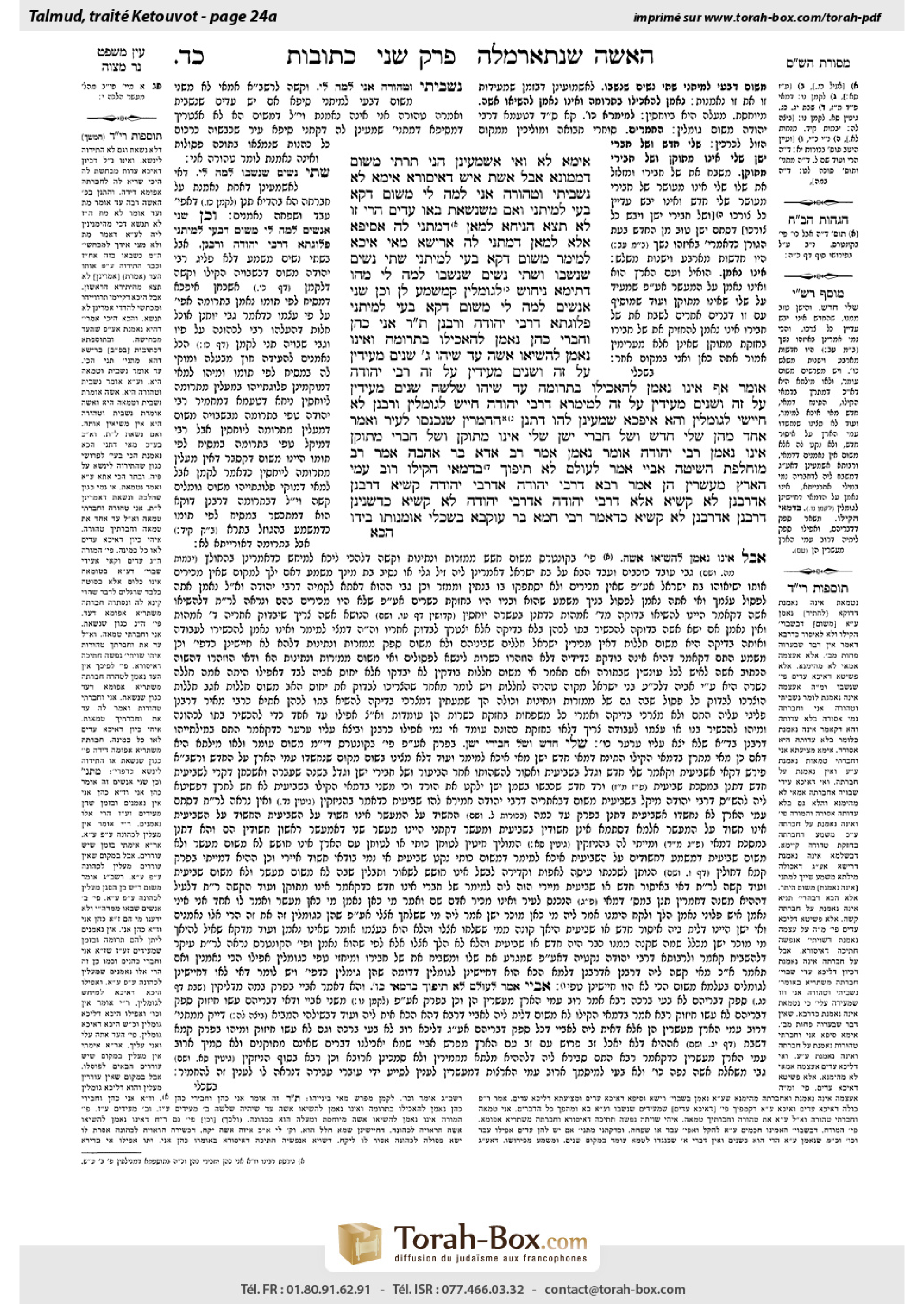
Ketubot 24a: Talmud study for Daf Yomi
Daf Yomi is the daily study of one Talmud folio. Explore 37 tractates with scans, Hebrew text, Sefaria English and AI-generated French translations where annotated.
Passage selection and English or AI-generated French translation are available where the scan has annotations. Daf Study is independent of Torah-Box and Sefaria.
Browse Ketubot · כתובות · All tractatesKetubot 24a text and translations
This page of Ketubot includes the Aramaic text, an English translation and an AI-generated French translation, alongside the scan above.
כתובות כ״ד א · Aramaic and Hebrew text
אֵימָא לָא.
וְאִי אַשְׁמְעִינַן הָנֵי תַּרְתֵּי, מִשּׁוּם דְּמָמוֹנָא, אֲבָל אֵשֶׁת אִישׁ, דְּאִיסּוּרָא — אֵימָא לָא.
״נִשְׁבֵּיתִי וּטְהוֹרָה אֲנִי״ לְמָה לִי? מִשּׁוּם דְּקָא בָּעֵי לְמִיתְנֵי: ״וְאִם מִשֶּׁנִּשֵּׂאת בָּאוּ עֵדִים — הֲרֵי זוֹ לֹא תֵּצֵא״.
הָנִיחָא לְמַאן דְּמַתְנֵי לַהּ אַסֵּיפָא, אֶלָּא לְמַאן דְּמַתְנֵי לַהּ אַרֵישָׁא — מַאי אִיכָּא לְמֵימַר? מִשּׁוּם דְּקָא בָּעֵי לְמִיתְנֵי: ״שְׁתֵּי נָשִׁים שֶׁנִּשְׁבּוּ״.
וּ״שְׁתֵּי נָשִׁים שֶׁנִּשְׁבּוּ״ לְמָה לִי? מַהוּ דְּתֵימָא נֵיחוּשׁ לְגוֹמְלִין, קָמַשְׁמַע לַן.
״וְכֵן שְׁנֵי אֲנָשִׁים״ לְמָה לִי? מִשּׁוּם דְּקָא בָּעֵי לְמִיתְנֵי פְּלוּגְתָּא דְּרַבִּי יְהוּדָה וְרַבָּנַן.
תָּנוּ רַבָּנַן: ״אֲנִי כֹּהֵן וַחֲבֵרִי כֹּהֵן״ — נֶאֱמָן לְהַאֲכִילוֹ בִּתְרוּמָה, וְאֵינוֹ נֶאֱמָן לְהַשִּׂיאוֹ אִשָּׁה עַד שֶׁיְּהוּ שְׁלֹשָׁה: שְׁנַיִם מְעִידִין עַל זֶה, וּשְׁנַיִם מְעִידִין עַל זֶה. רַבִּי יְהוּדָה אוֹמֵר: אַף אֵינוֹ נֶאֱמָן לְהַאֲכִילוֹ בִּתְרוּמָה עַד שֶׁיְּהוּ שְׁלֹשָׁה, שְׁנַיִם מְעִידִין עַל זֶה וּשְׁנַיִם מְעִידִין עַל זֶה.
לְמֵימְרָא דְּרַבִּי יְהוּדָה חָיֵישׁ לְגוֹמְלִין, וְרַבָּנַן לָא חָיְישִׁי לְגוֹמְלִין? וְהָא אִיפְּכָא שָׁמְעִינַן לְהוּ, דִּתְנַן: הַחַמָּרִין שֶׁנִּכְנְסוּ לָעִיר, וְאָמַר אֶחָד מֵהֶן: שֶׁלִּי חָדָשׁ, וְשֶׁל חֲבֵרִי יָשָׁן: שֶׁלִּי אֵינוֹ מְתוּקָּן, וְשֶׁל חֲבֵרִי מְתוּקָּן — אֵינוֹ נֶאֱמָן. רַבִּי יְהוּדָה אוֹמֵר: נֶאֱמָן.
אָמַר רַב אַדָּא בַּר אַהֲבָה אָמַר רַב: מוּחְלֶפֶת הַשִּׁיטָה. אַבָּיֵי אָמַר: לְעוֹלָם לָא תֵּיפוֹךְ. בִּדְמַאי הֵקֵילּוּ, רוֹב עַמֵּי הָאָרֶץ מְעַשְּׂרִין הֵן.
אָמַר רָבָא: דְּרַבִּי יְהוּדָה אַדְּרַבִּי יְהוּדָה קַשְׁיָא, דְּרַבָּנַן אַדְּרַבָּנַן לָא קַשְׁיָא? אֶלָּא: דְּרַבִּי יְהוּדָה אַדְּרַבִּי יְהוּדָה לָא קַשְׁיָא, כִּדְשַׁנֵּינַן. דְּרַבָּנַן אַדְּרַבָּנַן לָא קַשְׁיָא, כִּדְאָמַר רַבִּי חָמָא בַּר עוּקְבָא, בְּשֶׁכְּלֵי אוּמָּנוּתוֹ בְּיָדוֹ,
Ketubot 24a · English translation
say no, his claim is not accepted.
And if the tanna taught us these two cases, one might have thought that the claim is deemed credible due to the fact that the cases involve monetary matters; however, in the case of a married woman who claims that she was divorced, which is a ritual matter, say no, she is not deemed credible. Therefore, it was necessary for the tanna to teach us all three cases.
The Gemara asks: With regard to the case where one says: I was taken captive and I am pure, why do I need the tanna to teach that case? There is no novel element in that ruling, as it is merely another application of the same principle. The Gemara answers: The tanna taught that case due to the fact that the tanna sought to teach based on it: And if the witnesses came after she married, this woman need not leave her husband.
The Gemara asks: This works out well according to the one who teaches this halakha in reference to the latter clause of the mishna with regard to a woman taken captive. However, according to the one who taught this halakha in reference to the first clause of the mishna, with regard to a woman who claimed that she was married and divorced, what is there to say? According to that opinion, the ruling with regard to a woman taken captive who claims that she remained pure is superfluous. If a woman is deemed credible in the case where the concern is that she is a married woman, she is all the more so deemed credible when the concern pertains to a less severe prohibition, that of a woman who was violated in captivity marrying a priest. The Gemara answers: The tanna taught the superfluous halakha that a woman claiming that she was taken captive and remained pure is deemed credible as an introduction, due to the fact that he sought to subsequently teach the case of two women who were taken captive.
The Gemara asks: And why do I need the tanna to teach the case of two women who were taken captive? What novel element is introduced in that case that did not exist in the case of one woman? The Gemara answers: Lest you say: Let us be concerned for collusion between the women, that each would testify for the benefit of the other, the tanna therefore teaches us that this is not a concern.
The Gemara asks: And why do I need the tanna to teach the following case: And likewise two men, each testifying that the other is a priest? He already taught that if two women each testify that the other is pure, they are deemed credible. The Gemara answers: The tanna taught the superfluous halakha with regard to two men as an introduction, due to the fact that he sought to subsequently teach the dispute between Rabbi Yehuda and the Rabbis, concerning whether or not the testimony of a single witness is deemed credible to establish another’s presumptive status as a priest.
§ The Gemara elaborates: The Rabbis taught in a baraita: In the case of two men, each of whom says: I am a priest and my counterpart is a priest, each is deemed credible with regard to enabling his counterpart to partake of teruma. But he is not deemed credible with regard to establishing his presumptive status as a priest of unflawed lineage for the purpose of his marrying a woman until there are three people, the two claiming to be priests and an additional witness, so that there are two witnesses testifying with regard to the status of this person and two witnesses testifying with regard to the status of that person. Rabbi Yehuda says: Each is not deemed credible even with regard to enabling his counterpart to partake of teruma until there are three men, so that there are two witnesses testifying with regard to this person and two witnesses testifying with regard to that person.
The Gemara asks: Is that to say that Rabbi Yehuda is concerned for collusion between them, and the Rabbis are not concerned for collusion? But didn’t we learn that they said the opposite? As we learned in a mishna: In a case where there were donkey drivers who entered a city, and one of them said: My produce is new from this year’s crop, and it is not yet completely dry and therefore of lower quality, and the produce of my counterpart is old and dry and therefore more durable; or if he said: My produce is not tithed and the produce of my counterpart is tithed, he is not deemed credible. Presumably, there is collusion between the two merchants. In this city, one denigrates the quality of his own produce, enhancing his credibility, while praising the quality of the produce of his counterpart; and his counterpart says the same in the next city that they enter. And Rabbi Yehuda says: He is deemed credible, as apparently he is not concerned for collusion between the merchants.
Rav Adda bar Ahava said that Rav said: The attribution of the opinions is reversed in one of the mishnayot, so that the opinions of the tanna’im are consistent in both the case of the priests and the case of the donkey drivers. Abaye said: Actually, do not reverse the attribution, and the fact that Rabbi Yehuda accepts the claim of the donkey driver is because with regard to doubtfully tithed produce [demai] the Sages were lenient, because most amei ha’aretz tithe their produce. The ordinance of the Sages classifying produce purchased from an am ha’aretz as doubtfully tithed produce and requiring its tithing is based on a far-fetched concern. Therefore, testimony of any sort is sufficient to permit its consumption. However, as a rule, Rabbi Yehuda is concerned about collusion.
Rava said: Is that to say that the contradiction between one statement of Rabbi Yehuda and another statement of Rabbi Yehuda is difficult, but the contradiction between one statement of the Rabbis and another statement of the Rabbis is not difficult? Clearly, the contradiction between the rulings of the Rabbis in the respective mishnayot is difficult. Rather, the contradiction between one statement of Rabbi Yehuda and another statement of Rabbi Yehuda is not difficult, as we explained above that Rabbi Yehuda was lenient with regard to doubtfully tithed produce. The contradiction between one statement of the Rabbis and another statement of the Rabbis is also not difficult. Fundamentally, the Rabbis are not concerned for collusion between the two parties. However, in the case of donkey drivers they are concerned, as Rabbi Ḥama bar Ukva said in another context that it is referring to a case where one has the tools of his trade in his hand.
Ketubot 24a · Traduction française (IA)
Dis : non, sa déclaration n’est pas acceptée.
Et si le tanna nous avait enseigné ces deux cas, on aurait pu penser que la déclaration est jugée crédible parce qu’il s’agit de questions pécuniaires. Mais, dans le cas d’une femme mariée qui affirme avoir été divorcée, qui relève d’une question rituelle, dis : non, elle n’est pas jugée crédible. Il était donc nécessaire que le tanna nous enseigne les trois cas.
La Guemara demande : Dans le cas où une femme dit : « J’ai été captive et je suis pure », pourquoi le tanna doit-il enseigner ce cas ? Cette décision ne comporte aucun élément nouveau, puisqu’elle ne fait qu’appliquer une nouvelle fois le même principe. La Guemara répond : Le tanna a enseigné ce cas parce qu’il voulait ensuite enseigner : « Et si les témoins se présentent après qu’elle s’est mariée, cette femme n’a pas à quitter son mari. »
La Guemara demande : Cela s’explique bien selon celui qui enseigne cette halakha à propos de la dernière clause de la Michna, concernant une femme captive. Mais que dire selon celui qui enseigne cette halakha à propos de la première clause de la Michna, concernant une femme qui affirme avoir été mariée puis divorcée ? Selon cette opinion, la décision concernant une femme captive qui affirme être restée pure est superflue. Si une femme est jugée crédible lorsque l’on craint qu’elle soit encore mariée, elle l’est à plus forte raison lorsque la préoccupation concerne une interdiction moins grave : celle pour une femme violée pendant sa captivité d’épouser un prêtre. La Guemara répond : Le tanna a enseigné à titre d’introduction la halakha superflue selon laquelle une femme qui affirme avoir été captive et être restée pure est jugée crédible, parce qu’il voulait ensuite enseigner le cas de deux femmes captives.
La Guemara demande : Et pourquoi le tanna doit-il enseigner le cas de deux femmes captives ? Quel élément nouveau ce cas présente-t-il par rapport à celui d’une seule femme ? La Guemara répond : De peur que tu ne dises : « Il faut craindre une entente entre les femmes, chacune témoignant en faveur de l’autre », le tanna nous enseigne que cette crainte n’est pas fondée.
La Guemara demande : Et pourquoi le tanna doit-il enseigner le cas suivant : « De même, deux hommes, chacun témoignant que l’autre est prêtre » ? Il a déjà enseigné que si deux femmes témoignent chacune que l’autre est pure, elles sont jugées crédibles. La Guemara répond : Le tanna a enseigné à titre d’introduction la halakha superflue concernant deux hommes, parce qu’il voulait ensuite enseigner le désaccord entre Rabbi Yehouda et les Sages sur la question de savoir si le témoignage d’un seul témoin est jugé crédible pour établir le statut présumé de prêtre d’une autre personne.
§ La Guemara développe : Les Sages ont enseigné dans une baraïta : Dans le cas de deux hommes dont chacun dit : « Je suis prêtre et mon compagnon est prêtre », chacun est jugé crédible pour permettre à son compagnon de consommer de la terouma. Mais il n’est pas jugé crédible pour établir le statut présumé de prêtre de lignée irréprochable de son compagnon, afin que celui-ci puisse épouser une femme, tant qu’il n’y a pas trois personnes : les deux hommes qui affirment être prêtres et un témoin supplémentaire, de sorte que deux témoins attestent du statut de cet homme et deux témoins du statut de l’autre. Rabbi Yehouda dit : Chacun n’est pas jugé crédible, même pour permettre à son compagnon de consommer de la terouma, tant qu’il n’y a pas trois hommes, de sorte que deux témoins attestent du statut de l’un et deux témoins du statut de l’autre.
La Guemara demande : Cela signifie-t-il que Rabbi Yehouda craint une entente entre eux, tandis que les Sages ne la craignent pas ? Mais n’avons-nous pas appris qu’ils ont dit le contraire ? En effet, nous avons appris dans une Michna : Dans le cas où des conducteurs d’ânes entrent dans une ville et que l’un d’eux dit : « Mes produits sont nouveaux, de la récolte de cette année, et ne sont pas encore complètement secs, donc de qualité inférieure ; ceux de mon compagnon sont vieux et secs, donc plus durables », ou s’il dit : « Mes produits n’ont pas été soumis à la dîme, tandis que ceux de mon compagnon l’ont été », il n’est pas jugé crédible. De toute évidence, les deux marchands se sont entendus : dans une ville, l’un déprécie ses propres produits, ce qui renforce sa crédibilité, tout en vantant ceux de son compagnon ; puis, dans la ville suivante où ils se rendent, son compagnon fait de même. Or Rabbi Yehouda dit : Il est jugé crédible, ce qui montre apparemment qu’il ne craint pas une entente entre les marchands.
Rav Adda bar Ahava a dit au nom de Rav : L’attribution des opinions est inversée dans l’une des Michnayot, afin que les opinions des tannaïm soient cohérentes dans les deux cas, celui des prêtres et celui des conducteurs d’ânes. Abayé a dit : En réalité, n’inverse pas l’attribution ; si Rabbi Yehouda accepte la déclaration du conducteur d’ânes, c’est parce que les Sages se sont montrés indulgents à l’égard des produits dont le statut au regard de la dîme est incertain [demai], car la plupart des amei ha’aretz prélèvent la dîme sur leurs produits. Le décret des Sages qui classe parmi les produits dont le statut au regard de la dîme est incertain ceux qui sont achetés à un am ha’aretz et impose de les soumettre à la dîme repose sur une crainte peu plausible. C’est pourquoi un témoignage de quelque nature que ce soit suffit à en permettre la consommation. Toutefois, en règle générale, Rabbi Yehouda craint les ententes.
Rava a dit : Cela signifie-t-il que la contradiction entre une déclaration de Rabbi Yehouda et une autre déclaration de Rabbi Yehouda pose problème, mais pas celle entre une déclaration des Sages et une autre déclaration des Sages ? Il est clair que la contradiction entre les décisions des Sages dans les deux Michnayot pose problème. Il faut plutôt dire que la contradiction entre une déclaration de Rabbi Yehouda et une autre n’en est pas une, puisque nous avons expliqué plus haut que Rabbi Yehouda s’est montré indulgent à l’égard des produits dont le statut au regard de la dîme est incertain. La contradiction entre une déclaration des Sages et une autre n’en est pas une non plus. En principe, les Sages ne craignent pas une entente entre les deux parties. Cependant, ils la craignent dans le cas des conducteurs d’ânes, car, comme l’a dit Rabbi Ḥama bar Ukva dans un autre contexte, il s’agit d’un cas où l’un d’eux tient ses outils de travail à la main.
Traduction française générée par IA à partir de l’édition anglaise de Sefaria. Vérifie toujours un passage avec le texte source.
Text from Sefaria: William Davidson Edition - Vocalized Aramaic (CC BY NC); William Davidson Edition - English (CC BY NC).