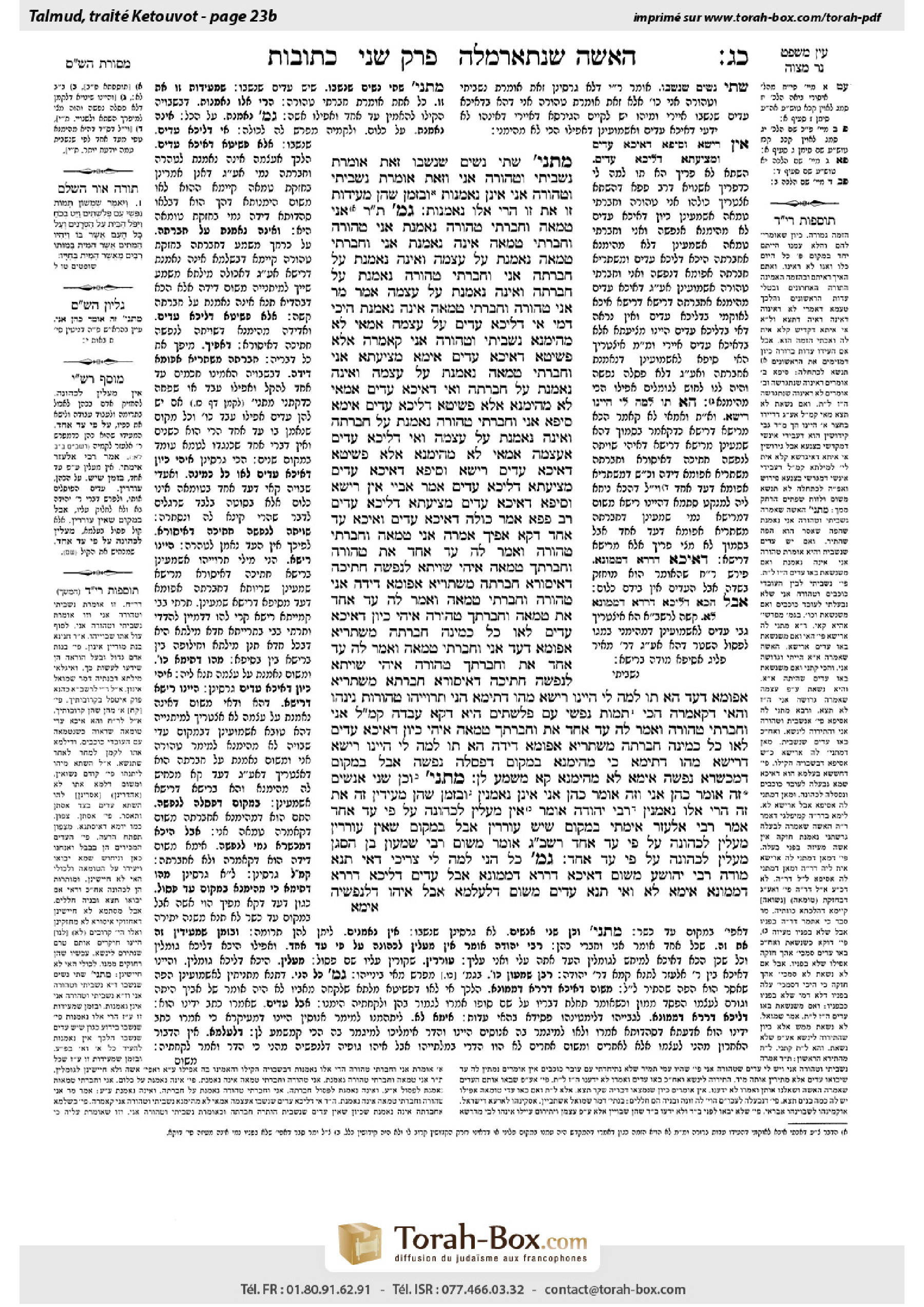
Ketubot 23b: Talmud study for Daf Yomi
Daf Yomi is the daily study of one Talmud folio. Explore 37 tractates with scans, Hebrew text, Sefaria English and AI-generated French translations where annotated.
Passage selection and English or AI-generated French translation are available where the scan has annotations. Daf Study is independent of Torah-Box and Sefaria.
Browse Ketubot · כתובות · All tractatesKetubot 23b text and translations
This page of Ketubot includes the Aramaic text, an English translation and an AI-generated French translation, alongside the scan above.
כתובות כ״ג ב · Aramaic and Hebrew text
מַתְנִי׳ שְׁתֵּי נָשִׁים שֶׁנִּשְׁבּוּ, זֹאת אוֹמֶרֶת ״נִשְׁבֵּיתִי וּטְהוֹרָה אֲנִי״, וְזֹאת אוֹמֶרֶת ״נִשְׁבֵּיתִי וּטְהוֹרָה אֲנִי״ — אֵינָן נֶאֱמָנוֹת. וּבִזְמַן שֶׁהֵן מְעִידוֹת זוֹ אֶת זוֹ — הֲרֵי אֵלּוּ נֶאֱמָנוֹת.
גְּמָ׳ תָּנוּ רַבָּנַן: ״אֲנִי טְמֵאָה וַחֲבֶרְתִּי טְהוֹרָה״ — נֶאֱמֶנֶת. ״אֲנִי טְהוֹרָה וַחֲבֶרְתִּי טְמֵאָה״ — אֵינָהּ נֶאֱמֶנֶת. ״אֲנִי וַחֲבֶרְתִּי טְמֵאָה״ — נֶאֱמֶנֶת עַל עַצְמָהּ, וְאֵינָהּ נֶאֱמֶנֶת עַל חֲבֶרְתָּהּ. ״אֲנִי וַחֲבֶרְתִּי טְהוֹרָה״ — נֶאֱמֶנֶת עַל חֲבֶרְתָּהּ, וְאֵינָהּ נֶאֱמֶנֶת עַל עַצְמָהּ.
אָמַר מָר: ״אֲנִי טְהוֹרָה וַחֲבֶרְתִּי טְמֵאָה״ — אֵינָהּ נֶאֱמֶנֶת. הֵיכִי דָמֵי? אִי דְּלֵיכָּא עֵדִים, עַל עַצְמָהּ אַמַּאי לָא מְהֵימְנָא? ״נִשְׁבֵּיתִי וּטְהוֹרָה אֲנִי״ קָאָמְרָה! אֶלָּא פְּשִׁיטָא דְּאִיכָּא עֵדִים.
אֵימָא מְצִיעֲתָא: ״אֲנִי וַחֲבֶרְתִּי טְמֵאָה״ — נֶאֱמֶנֶת עַל עַצְמָהּ, וְאֵינָהּ נֶאֱמֶנֶת עַל חֲבֶרְתָּהּ. וְאִי דְּאִיכָּא עֵדִים — אַמַּאי לָא מְהֵימְנָא? אֶלָּא פְּשִׁיטָא דְּלֵיכָּא עֵדִים.
אֵימָא סֵיפָא: ״אֲנִי וַחֲבֶרְתִּי טְהוֹרָה״ — נֶאֱמֶנֶת עַל חֲבֶרְתָּהּ, וְאֵינָהּ נֶאֱמֶנֶת עַל עַצְמָהּ. וְאִי דְּלֵיכָּא עֵדִים — אַעַצְמָהּ אַמַּאי לָא מְהֵימְנָא? אֶלָּא פְּשִׁיטָא דְּאִיכָּא עֵדִים.
רֵישָׁא וְסֵיפָא דְּאִיכָּא עֵדִים, מְצִיעֲתָא דְּלֵיכָּא עֵדִים! אָמַר אַבָּיֵי: אִין. רֵישָׁא וְסֵיפָא — דְּאִיכָּא עֵדִים, מְצִיעֲתָא — דְּלֵיכָּא עֵדִים.
רַב פָּפָּא אָמַר: כּוּלָּהּ דְּאִיכָּא עֵדִים, וְאִיכָּא עֵד אֶחָד דְּקָא אָפֵיךְ. אָמְרָה: ״אֲנִי טְמֵאָה וַחֲבֶרְתִּי טְהוֹרָה״, וְאָמַר לַהּ עֵד אֶחָד: ״אַתְּ טְהוֹרָה וַחֲבֶרְתֵּךְ טְמֵאָה״. אִיהִי שַׁוִּיתַהּ לְנַפְשַׁהּ חֲתִיכָה דְּאִיסּוּרָא, חֲבֶרְתָּהּ מִשְׁתַּרְיָא אַפּוּמָּא דִידַהּ.
״אֲנִי טְהוֹרָה וַחֲבֶרְתִּי טְמֵאָה״, וְאָמַר לָהּ עֵד אֶחָד: ״אַתְּ טְמֵאָה וַחֲבֶרְתְּךָ טְהוֹרָה״. אִיהִי, כֵּיוָן דְּאִיכָּא עֵדִים — לָאו כָּל כְּמִינַהּ, חֲבֶרְתַּהּ — מִשְׁתַּרְיָא אַפּוּמָּא דְעֵד.
״אֲנִי וַחֲבֶרְתִּי טְמֵאָה״, וְאָמַר לַהּ עֵד אֶחָד: ״אַתְּ וַחֲבֶרְתֵּךְ טְהוֹרָה״ — אִיהִי שַׁוִּיתַהּ לְנַפְשַׁהּ חֲתִיכָה דְּאִיסּוּרָא, חֲבֶרְתַּהּ מִשְׁתַּרְיָא אַפּוּמָּא דְעֵד. הָא תּוּ לְמָה לִי? הַיְינוּ רֵישָׁא!
מַהוּ דְּתֵימָא: הָנֵי תַּרְוַיְיהוּ טְהוֹרוֹת נִינְהוּ, וְהַאי דְּקָאָמְרָה הָכִי, ״תָּמוֹת נַפְשִׁי עִם פְּלִשְׁתִּים״ הִיא דְּקָא עָבְדָה — קָא מַשְׁמַע לַן.
״אֲנִי וַחֲבֶרְתִּי טְהוֹרָה״, וְאָמַר לָהּ עֵד אֶחָד: ״אַתְּ וַחֲבֶרְתֵּךְ טְמֵאָה״, אִיהִי כֵּיוָן דְּאִיכָּא עֵדִים — לָאו כָּל כְּמִינַּהּ. חֲבֶרְתַּהּ מִשְׁתַּרְיָא אַפּוּמָּא דִידַהּ. הָא תּוּ לְמָה לִי? הַיְינוּ רֵישָׁא דְרֵישָׁא!
מַהוּ דְּתֵימָא: כִּי מְהֵימְנָא — בְּמָקוֹם דְּפָסְלָה נַפְשַׁהּ, אֲבָל בְּמָקוֹם דְּמַכְשְׁרָא נַפְשַׁהּ — אֵימָא לָא מְהֵימְנָא, קָא מַשְׁמַע לַן.
מַתְנִי׳ וְכֵן שְׁנֵי אֲנָשִׁים, זֶה אוֹמֵר ״כֹּהֵן אֲנִי״, וְזֶה אוֹמֵר ״כֹּהֵן אֲנִי״ — אֵינָן נֶאֱמָנִין. וּבִזְמַן שֶׁהֵן מְעִידִין זֶה אֶת זֶה — הֲרֵי אֵלּוּ נֶאֱמָנִין. רַבִּי יְהוּדָה אוֹמֵר: אֵין מַעֲלִין לִכְהוּנָּה עַל פִּי עֵד אֶחָד. אָמַר רַבִּי אֶלְעָזָר: אֵימָתַי — בִּמְקוֹם שֶׁיֵּשׁ עוֹרְרִין. אֲבָל בִּמְקוֹם שֶׁאֵין עוֹרְרִין — מַעֲלִין לִכְהוּנָּה עַל פִּי עֵד אֶחָד. רַבָּן שִׁמְעוֹן בֶּן גַּמְלִיאֵל אוֹמֵר מִשּׁוּם רַבִּי שִׁמְעוֹן בֶּן הַסְּגָן: מַעֲלִין לִכְהוּנָּה עַל פִּי עֵד אֶחָד.
גְּמָ׳ כֹּל הָנֵי לְמָה לִי! צְרִיכִי, דְּאִי תְּנָא מוֹדֶה רַבִּי יְהוֹשֻׁעַ, מִשּׁוּם דְּאִיכָּא דְּרָרָא דְמָמוֹנָא. אֲבָל עֵדִים, דְּלֵיכָּא דְּרָרָא דְמָמוֹנָא — אֵימָא לָא.
וְאִי תְּנָא עֵדִים, מִשּׁוּם דִּלְעָלְמָא, אֲבָל אִיהוּ, דִּלְנַפְשֵׁיהּ,
Ketubot 23b · English translation
MISHNA: In a case where witnesses testify that there are two women who were taken captive, and this woman says: I was taken captive but I am pure, and that woman says: I was taken captive but I am pure, they are not deemed credible. And when this woman testifies about that woman that she is pure and vice versa, they are deemed credible.
GEMARA: The Sages taught in the Tosefta (2:2): If one of the women says: I am tainted and my counterpart is pure, she is deemed credible on both counts. If she says: I am pure and my counterpart is tainted, she is not deemed credible with regard to herself nor with regard to her counterpart. If she says: I and my counterpart are both tainted, she is deemed credible with regard to herself but she is not deemed credible with regard to her counterpart. If she says: I and my counterpart are both pure, she is deemed credible with regard to her counterpart but she is not deemed credible with regard to herself.
The Master said in the baraita that if she says: I am pure and my counterpart is tainted, she is not deemed credible. The Gemara asks: What are the circumstances? If there are no witnesses that she was taken captive, why is she not deemed credible with regard to herself? If she is saying: I was taken captive and I am pure, she is deemed credible based on the principle that the mouth that prohibited is the mouth that permitted. Rather, it is obvious that there are witnesses that she was taken captive.
The Gemara asks: If so, say the middle clause of the baraita: If she says: I and my counterpart are both tainted, she is deemed credible with regard to herself but she is not deemed credible with regard to her counterpart. And if there are witnesses, why is she not deemed credible with regard to her counterpart? Once there is testimony that she was taken captive, she no longer has the presumptive status of purity. Rather, it is obvious that there are no witnesses that she was taken captive, and therefore her presumptive status of purity is intact.
The Gemara asks: If so, say the last clause of the baraita: If she says: I and my counterpart are both pure, she is deemed credible with regard to her counterpart but she is not deemed credible with regard to herself. And if there are no witnesses that they were taken captive, why is she not deemed credible with regard to herself? Rather, it is obvious that there are witnesses.
The Gemara asks: Is that to say that the baraita is formulated in an unusual fashion, with the first clause and the last clause pertaining to cases where there are witnesses, and the middle clause pertaining to a case where there are no witnesses? Abaye said: Yes, the first clause and the last clause pertain to cases where there are witnesses, and the middle clause pertains to a case where there are no witnesses.
Rav Pappa said: The baraita in its entirety can be explained in a case where there are witnesses, and there is one witness who is testifying to the reverse of the woman’s claim. If the woman said: I am tainted and my counterpart is pure, and one witness said to her: You are pure and your counterpart is tainted, although the witness testified that she was pure, because she admitted that she was tainted she rendered herself an entity of prohibition. Her counterpart is permitted on the basis of her claim, which is accepted despite being contradicted by the witness.
If the woman said: I am pure and my counterpart is tainted, and one witness said to her: You are tainted and your counterpart is pure, then with regard to her, since there are witnesses testifying that she was taken captive, it is not in her power to permit herself on the basis of her claim. However, her counterpart is permitted on the basis of the testimony of the witness.
If the woman said: I and my counterpart are both tainted, and one witness said to her: You and your friend are both pure, she rendered herself an entity of prohibition. However, her counterpart is permitted on the basis of the testimony of the witness. The Gemara asks: Why do I need this additional case? This is identical to that which was taught in the in the first clause. The principles governing the first two cases, i.e., she claims that she is tainted and thereby renders herself as an entity of prohibition, and her counterpart is permitted by the testimony of one witness even if that testimony is contradicted, also apply in this case.
The Gemara answers: Lest you say that in this case, both of them are deemed untainted in accordance with the testimony of the witness, and the fact that she said that they are both tainted was because she was acting with the intention termed: “Let me die with the Philistines” (Judges 16:30), i.e., she was willing to implicate herself in order to bolster her credibility so that her testimony against her counterpart would be accepted, the tanna therefore teaches us that this is not a consideration.
If the woman said: I and my counterpart are both pure, and one witness said to her: You and your counterpart are both tainted, with regard to her, since there are witnesses testifying that she was taken captive, it is not in her power to permit herself on the basis of her claim. However, her counterpart is permitted on the basis of her claim. The Gemara asks: Why do I need this additional case? This is identical to that which was taught in the first part of the first clause. The principles governing the first two cases, i.e., her claim that she is pure is not accepted when the fact that she was taken captive was established by witnesses, and her counterpart is permitted on the basis of her claim even if that claim is contradicted, also apply in this case.
The Gemara answers: Lest you say that when is she deemed credible to permit her counterpart, it is only in a case where she rendered herself unfit to marry a priest, but in a case where she rendered herself fit, say that she is not deemed credible with regard to her counterpart; the tanna therefore teaches us that each segment of the testimony is assessed independently, based on the criteria taught in the first clause.
MISHNA: And likewise, with regard to two men whose lineage is unknown, and this man says: I am a priest, and that man says: I am a priest, they are not deemed credible. And when this man testifies about that man that he is a priest and vice versa, they are deemed credible. Rabbi Yehuda says: One does not elevate a man to priesthood on the basis of one witness. Two witnesses are required for that purpose. Rabbi Elazar says: When is that the ruling? In a case where there are challengers to his claim that he is a priest. However, in a case where there are no challengers, one elevates a man to priesthood on the basis of one witness. Rabban Shimon ben Gamliel says in the name of Rabbi Shimon, son of the deputy High Priest: One elevates a man to priesthood on the basis of one witness.
GEMARA: The Gemara asks: Why do I need all these different cases cited in the mishnayot in this chapter? Aren’t they all based on the principle: The mouth that prohibited is the mouth that permitted? The Gemara answers: These cases are all necessary, as, if the tanna had taught only the case where Rabbi Yehoshua concedes, in a case where one says to another: This field, which is currently in my possession, belonged to your father, and I purchased it from him, then one might have thought that his claim is deemed credible due to the fact that there is financial significance [derara] in his contention that it belonged to the other’s father, and he would not have made that claim if it were not true. However, in the case of witnesses authenticating their signatures, where there is no financial significance for them in their testimony, say no, their claim is not accepted.
And if the tanna taught only the case of witnesses, one might have thought that their claim is deemed credible due to the fact that their testimony is relevant to others. However, with regard to him, whose testimony is relevant to himself, as he claims that he purchased the field from the other’s father,
Ketubot 23b · Traduction française (IA)
MICHNA : Dans le cas où des témoins attestent que deux femmes ont été faites prisonnières, et que cette femme dit : « J’ai été faite prisonnière, mais je suis pure », tandis que l’autre dit : « J’ai été faite prisonnière, mais je suis pure », elles ne sont pas jugées crédibles. Mais lorsque chacune témoigne que l’autre est pure, elles sont jugées crédibles.
GUEMARA : Les Sages ont enseigné dans la Tosefta (2:2) : Si l’une des femmes dit : « Je suis disqualifiée et mon homologue est pure », elle est jugée crédible sur les deux points. Si elle dit : « Je suis pure et mon homologue est disqualifiée », elle n’est jugée crédible ni à son propre sujet ni au sujet de son homologue. Si elle dit : « Mon homologue et moi sommes toutes deux disqualifiées », elle est jugée crédible à son propre sujet, mais pas au sujet de son homologue. Si elle dit : « Mon homologue et moi sommes toutes deux pures », elle est jugée crédible au sujet de son homologue, mais pas à son propre sujet.
Le maître a dit dans la baraïta que si elle dit : « Je suis pure et mon homologue est disqualifiée », elle n’est pas jugée crédible. La Guemara demande : Dans quelles circonstances ? S’il n’y a pas de témoins attestant qu’elle a été faite prisonnière, pourquoi ne serait-elle pas jugée crédible à son propre sujet ? Si elle dit : « J’ai été faite prisonnière et je suis pure », elle est jugée crédible selon le principe : « La bouche qui a interdit est la bouche qui a permis. » Il est donc évident qu’il y a des témoins attestant qu’elle a été faite prisonnière.
La Guemara demande : Si tel est le cas, examinons la clause médiane de la baraïta : si elle dit : « Mon homologue et moi sommes toutes deux disqualifiées », elle est jugée crédible à son propre sujet, mais pas au sujet de son homologue. Or, s’il y a des témoins, pourquoi ne serait-elle pas jugée crédible au sujet de son homologue ? Dès lors qu’il existe des témoins attestant qu’elle a été faite prisonnière, elle n’a plus de présomption de pureté. Il est donc évident qu’il n’y a pas de témoins attestant qu’elle a été faite prisonnière, et que sa présomption de pureté demeure intacte.
La Guemara demande : Si tel est le cas, examinons la dernière clause de la baraïta : si elle dit : « Mon homologue et moi sommes toutes deux pures », elle est jugée crédible au sujet de son homologue, mais pas à son propre sujet. Or, s’il n’y a pas de témoins attestant qu’elles ont été faites prisonnières, pourquoi ne serait-elle pas jugée crédible à son propre sujet ? Il est donc évident qu’il y a des témoins.
La Guemara demande : Faut-il en conclure que la baraïta est formulée de manière inhabituelle, sa première et sa dernière clauses concernant des cas où il y a des témoins, et sa clause médiane un cas où il n’y en a pas ? Abayé dit : Oui, la première et la dernière clauses concernent des cas où il y a des témoins, et la clause médiane un cas où il n’y en a pas.
Rav Pappa dit : Toute la baraïta peut s’expliquer dans un cas où il y a des témoins, ainsi qu’un témoin qui dépose en sens contraire de l’affirmation de la femme. Si la femme dit : « Je suis disqualifiée et mon homologue est pure », et qu’un témoin lui dit : « Tu es pure et ton homologue est disqualifiée », bien que le témoin ait attesté qu’elle était pure, puisqu’elle a reconnu être disqualifiée, elle s’est elle-même rendue interdite. Son homologue est permise sur la base de sa déclaration, qui est acceptée bien que le témoin la contredise.
Si la femme dit : « Je suis pure et mon homologue est disqualifiée », et qu’un témoin lui dit : « Tu es disqualifiée et ton homologue est pure », en ce qui la concerne, puisqu’il y a des témoins attestant qu’elle a été faite prisonnière, elle ne peut pas se rendre permise sur la base de sa déclaration. Cependant, son homologue est permise sur la base du témoignage du témoin.
Si la femme dit : « Mon homologue et moi sommes toutes deux disqualifiées », et qu’un témoin lui dit : « Toi et ton amie êtes toutes deux pures », elle s’est elle-même rendue interdite. Cependant, son homologue est permise sur la base du témoignage du témoin. La Guemara demande : Pourquoi faut-il enseigner ce cas supplémentaire ? Il est identique à celui qui a été enseigné dans la première clause. Les principes régissant les deux premiers cas — à savoir qu’elle affirme être disqualifiée et se rend ainsi interdite, tandis que son homologue est permise grâce au témoignage d’un seul témoin, même si ce témoignage est contredit — s’appliquent également à ce cas.
La Guemara répond : De peur que tu ne dises que, dans ce cas, toutes deux sont jugées non disqualifiées conformément au témoignage du témoin, et qu’elle a dit qu’elles étaient toutes deux disqualifiées parce qu’elle agissait selon l’intention exprimée par les mots : « Que je meure avec les Philistins » (Juges 16:30), c’est-à-dire qu’elle était prête à s’incriminer afin de renforcer sa crédibilité et de faire accepter son témoignage contre son homologue, le tanna nous enseigne que cela n’entre pas en considération.
Si la femme dit : « Mon homologue et moi sommes toutes deux pures », et qu’un témoin lui dit : « Toi et ton homologue êtes toutes deux disqualifiées », en ce qui la concerne, puisqu’il y a des témoins attestant qu’elle a été faite prisonnière, elle ne peut pas se rendre permise sur la base de sa déclaration. Cependant, son homologue est permise sur la base de sa déclaration. La Guemara demande : Pourquoi faut-il enseigner ce cas supplémentaire ? Il est identique à celui qui a été enseigné dans la première partie de la première clause. Les principes régissant les deux premiers cas — à savoir que sa déclaration de pureté n’est pas acceptée lorsque des témoins ont établi qu’elle a été faite prisonnière, tandis que son homologue est permise sur la base de sa déclaration, même si celle-ci est contredite — s’appliquent également à ce cas.
La Guemara répond : De peur que tu ne dises : elle n’est jugée crédible pour rendre son homologue permise que dans le cas où elle s’est déclarée inapte à épouser un prêtre ; mais si elle s’est déclarée apte, disons qu’elle n’est pas jugée crédible au sujet de son homologue. Le tanna nous enseigne donc que chaque partie du témoignage est évaluée indépendamment, selon les critères enseignés dans la première clause.
MICHNA : De même, au sujet de deux hommes dont la lignée est inconnue, si cet homme dit : « Je suis prêtre », et que l’autre dit : « Je suis prêtre », ils ne sont pas jugés crédibles. Mais lorsque chacun témoigne que l’autre est prêtre, ils sont jugés crédibles. Rabbi Yehouda dit : On ne confère pas à un homme le statut de prêtre sur la base du témoignage d’un seul témoin. Deux témoins sont requis à cette fin. Rabbi Elazar dit : Quand cette règle s’applique-t-elle ? Lorsqu’il y a des contestataires qui mettent en doute son affirmation selon laquelle il est prêtre. Mais s’il n’y a pas de contestataires, on confère à un homme le statut de prêtre sur la base du témoignage d’un seul témoin. Rabban Chimon ben Gamliel dit au nom de Rabbi Chimon, fils du grand prêtre adjoint : On confère à un homme le statut de prêtre sur la base du témoignage d’un seul témoin.
GUEMARA : La Guemara demande : Pourquoi faut-il tous les différents cas cités dans les michnayot de ce chapitre ? Ne reposent-ils pas tous sur le principe : « La bouche qui a interdit est la bouche qui a permis » ? La Guemara répond : Tous ces cas sont nécessaires. En effet, si le tanna avait enseigné uniquement le cas dans lequel Rabbi Yehoshua concède — celui où quelqu’un dit à un autre : « Ce champ, qui est actuellement en ma possession, appartenait à ton père, et je le lui ai acheté » — on aurait pu penser que son affirmation est jugée crédible parce qu’il y a un enjeu financier [derara] dans son argument selon lequel le champ appartenait au père de l’autre, et qu’il n’aurait pas avancé cet argument s’il n’était pas vrai. Mais dans le cas de témoins qui authentifient leurs signatures, puisqu’il n’y a aucun enjeu financier pour eux dans leur témoignage, on aurait pu dire que leur affirmation n’est pas acceptée.
Et si le tanna avait enseigné uniquement le cas des témoins, on aurait pu penser que leur affirmation est jugée crédible parce que leur témoignage concerne d’autres personnes. Mais en ce qui le concerne, lui, dont le témoignage le concerne personnellement, puisqu’il affirme avoir acheté le champ au père de l’autre,
Traduction française générée par IA à partir de l’édition anglaise de Sefaria. Vérifie toujours un passage avec le texte source.
Text from Sefaria: William Davidson Edition - Vocalized Aramaic (CC BY NC); William Davidson Edition - English (CC BY NC).