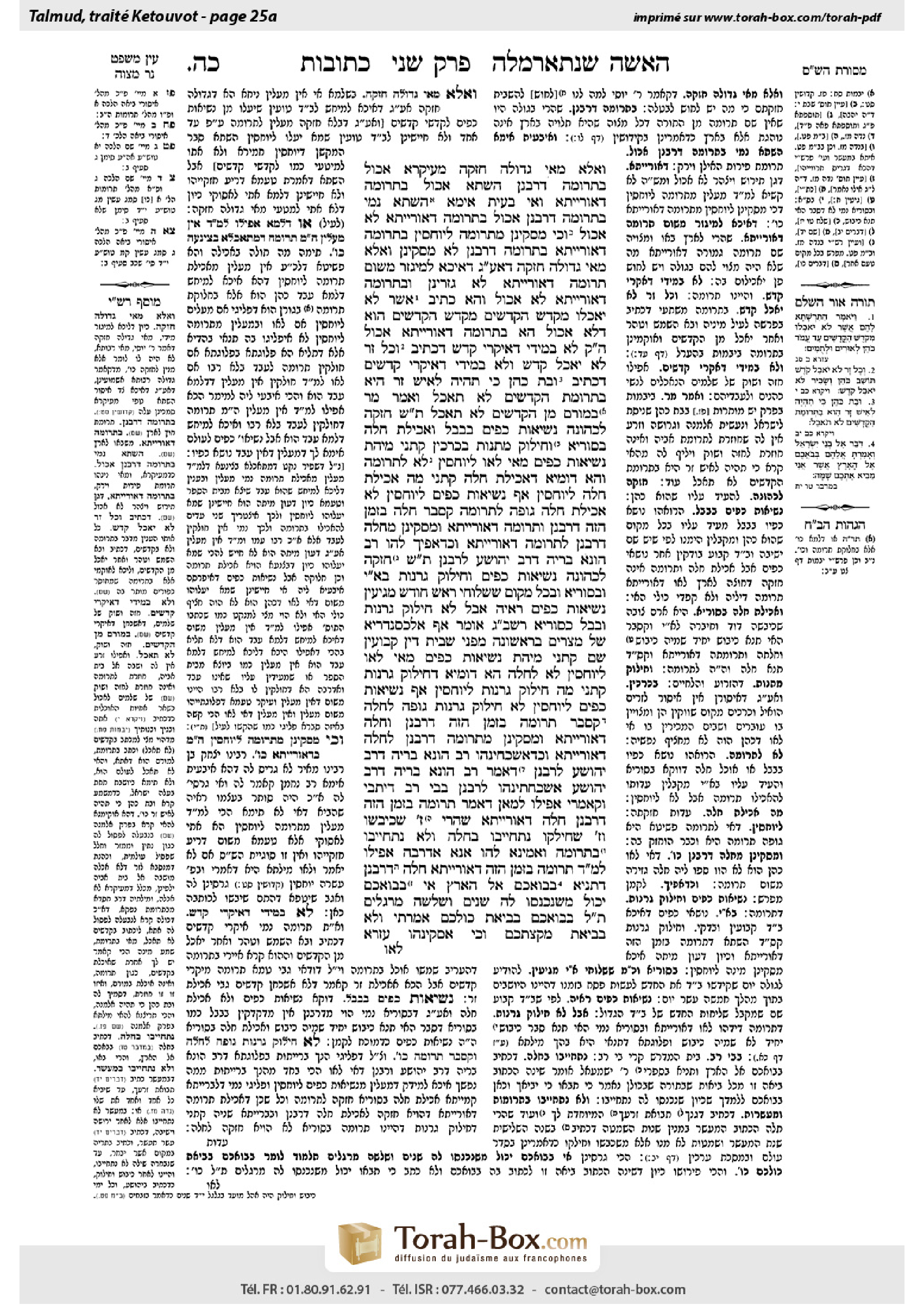
Ketubot 25a: Talmud study for Daf Yomi
Daf Yomi is the daily study of one Talmud folio. Explore 37 tractates with scans, Hebrew text, Sefaria English and AI-generated French translations where annotated.
Passage selection and English or AI-generated French translation are available where the scan has annotations. Daf Study is independent of Torah-Box and Sefaria.
Browse Ketubot · כתובות · All tractatesKetubot 25a text and translations
This page of Ketubot includes the Aramaic text, an English translation and an AI-generated French translation, alongside the scan above.
כתובות כ״ה א · Aramaic and Hebrew text
וְאֶלָּא, מַאי גְּדוֹלָה חֲזָקָה? מֵעִיקָּרָא אֲכוּל בִּתְרוּמָה דְּרַבָּנַן, הַשְׁתָּא אֲכוּל בִּתְרוּמָה דְּאוֹרָיְיתָא.
וְאִי בָּעֵית אֵימָא: הַשְׁתָּא נָמֵי בִּתְרוּמָה דְּרַבָּנַן אֲכוּל, בִּתְרוּמָה דְּאוֹרָיְיתָא לָא אֲכוּל. וְכִי מַסְּקִינַן מִתְּרוּמָה לְיוּחֲסִין — בִּתְרוּמָה דְּאוֹרָיְיתָא, בִּתְרוּמָה דְּרַבָּנַן — לָא מַסְּקִינַן. וְאֶלָּא, מַאי גְּדוֹלָה חֲזָקָה? דְּאַף עַל גַּב דְּאִיכָּא לְמִיגְזַר מִשּׁוּם תְּרוּמָה דְּאוֹרָיְיתָא — לָא גָּזְרִינַן.
וּבַתְּרוּמָה דְּאוֹרָיְיתָא לָא אֲכוּל? וְהָא כְּתִיב: ״אֲשֶׁר לֹא יֹאכְלוּ מִקֹּדֶשׁ הַקֳּדָשִׁים״. מִקֹּדֶשׁ הַקֳּדָשִׁים הוּא דְּלָא אֲכוּל, הָא בִּתְרוּמָה דְּאוֹרָיְיתָא אֲכוּל!
הָכִי קָאָמַר: לָא בְּמִידֵּי דְּאִיקְּרִי ״קֹדֶשׁ״, דִּכְתִיב: ״וְכׇל זָר לֹא יֹאכַל קֹדֶשׁ״, וְלָא בְּמִידֵּי דְּאִיקְּרִי ״קָדָשִׁים״, דִּכְתִיב: ״וּבַת כֹּהֵן כִּי תִהְיֶה לְאִישׁ זָר הִיא בִּתְרוּמַת הַקֳּדָשִׁים לֹא תֹאכֵל״, וְאָמַר מָר: בְּמוּרָם מִן הַקֳּדָשִׁים — לֹא תֹאכֵל.
תָּא שְׁמַע: חֲזָקָה לִכְהוּנָּה — נְשִׂיאוּת כַּפַּיִם בְּבָבֶל, וַאֲכִילַת חַלָּה בְּסוּרְיָא, וְחִילּוּק מַתָּנוֹת בִּכְרַכִּין. קָתָנֵי מִיהַת נְשִׂיאוּת כַּפַּיִם, מַאי לָאו לְיוּחֲסִין? לָא, לִתְרוּמָה.
וְהָא דּוּמְיָא דַּאֲכִילַת חַלָּה קָתָנֵי, מָה אֲכִילַת חַלָּה לְיוּחֲסִין — אַף נְשִׂיאוּת כַּפַּיִם לְיוּחֲסִין! לָא, אֲכִילַת חַלָּה גּוּפַהּ לִתְרוּמָה. קָסָבַר חַלָּה בִּזְמַן הַזֶּה דְּרַבָּנַן, וּתְרוּמָה דְּאוֹרָיְיתָא. וּמַסְּקִינַן מֵחַלָּה דְּרַבָּנַן לִתְרוּמָה דְּאוֹרָיְיתָא. וְכִדְאָפֵיךְ לְהוּ רַב הוּנָא בְּרֵיהּ דְּרַב יְהוֹשֻׁעַ לְרַבָּנַן.
תָּא שְׁמַע: חֲזָקָה לִכְהוּנָּה — נְשִׂיאוּת כַּפַּיִם וְחִילּוּק גֳּרָנוֹת בְּאֶרֶץ יִשְׂרָאֵל. וּבְסוּרְיָא, וּבְכׇל מָקוֹם שֶׁשְּׁלוּחֵי רֹאשׁ חוֹדֶשׁ מַגִּיעִין — נְשִׂיאוּת כַּפַּיִם רְאָיָה, אֲבָל לֹא חִילּוּק גֳּרָנוֹת.
וּבָבֶל כְּסוּרְיָא. רַבָּן שִׁמְעוֹן בֶּן גַּמְלִיאֵל אוֹמֵר: אַף אֲלֶכְּסַנְדְּרִיָּא שֶׁל מִצְרַיִם בָּרִאשׁוֹנָה, מִפְּנֵי שֶׁבֵּית דִּין קְבוּעִין שָׁם.
קָתָנֵי מִיהַת נְשִׂיאוּת כַּפַּיִם, מַאי לָאו לְיוּחֲסִין? לָא, לְחַלָּה. הָא דּוּמְיָא דְּחִילּוּק גֳּרָנוֹת קָתָנֵי: מָה חִילּוּק גֳּרָנוֹת לְיוּחֲסִין, אַף נְשִׂיאוּת כַּפַּיִם לְיוּחֲסִין! לָא, חִילּוּק גֳּרָנוֹת גּוּפֵהּ לְחַלָּה. קָסָבַר תְּרוּמָה בַּזְּמַן הַזֶּה דְּרַבָּנַן, וְחַלָּה דְּאוֹרָיְיתָא. וּמַסְּקִינַן מִתְּרוּמָה דְּרַבָּנַן לְחַלָּה דְּאוֹרָיְיתָא.
וְכִדְאַשְׁכְּחִינְהוּ רַב הוּנָא בְּרֵיהּ דְּרַב יְהוֹשֻׁעַ לְרַבָּנַן. דְּאָמַר רַב הוּנָא בְּרֵיהּ דְּרַב יְהוֹשֻׁעַ: אַשְׁכַּחְתִּינְהוּ לְרַבָּנַן בְּבֵי רַב, דְּיָתְבִי וְקָאָמְרִי: אֲפִילּוּ לְמַאן דְּאָמַר תְּרוּמָה בַּזְּמַן הַזֶּה דְּרַבָּנַן, חַלָּה דְּאוֹרָיְיתָא. שֶׁהֲרֵי שֶׁבַע שֶׁכִּיבְּשׁוּ וְשֶׁבַע שֶׁחִילְּקוּ — נִתְחַיְּיבוּ בְּחַלָּה, וְלֹא נִתְחַיְּיבוּ בִּתְרוּמָה.
וְאָמֵינָא לְהוּ אֲנָא: אַדְּרַבָּה, אֲפִילּוּ לְמַאן דְּאָמַר תְּרוּמָה בִּזְמַן הַזֶּה דְּאוֹרָיְיתָא — חַלָּה דְּרַבָּנַן. דְּתַנְיָא: ״בְּבוֹאֲכֶם אֶל הָאָרֶץ״. אִי ״בְּבוֹאֲכֶם״, יָכוֹל מִשֶּׁנִּכְנְסוּ לָהּ שְׁנַיִם וּשְׁלֹשָׁה מְרַגְּלִים — תַּלְמוּד לוֹמַר: ״בְּבוֹאֲכֶם״. בְּבִיאַת כּוּלְּכֶם אָמַרְתִּי, וְלֹא בְּבִיאַת מִקְצַתְכֶם. וְכִי אַסְּקִינְהוּ עֶזְרָא,
Ketubot 25a · English translation
The Gemara asks: And what, then, is the meaning of: Great is the legal authority of presumptive status? This is a standard case of presumptive status, as the practice of the priests remained as it was. There is nothing novel in the application of the principle of presumptive status in this case. The Gemara answers: Initially, in the Babylonian exile, they would partake of teruma taken from produce obligated by rabbinic law. Now, upon their return to Eretz Yisrael, they partake of teruma taken from produce obligated by Torah law: Grain, wine, and oil, based on their presumptive status.
And if you wish, say instead: Now too, upon their return to Eretz Yisrael, they partake of teruma taken from produce obligated by rabbinic law. However, of teruma taken from produce obligated by Torah law they may not partake. And when we elevate from teruma to lineage, this is only with regard to one who partakes of teruma by Torah law. However, in the case of one who partakes of teruma by rabbinic law, we do not elevate him to priestly lineage. The Gemara asks: And what, then, is the meaning of: Great is the legal authority of presumptive status? The Gemara answers: It means that although there is reason to issue a decree in Eretz Yisrael prohibiting consumption of teruma by rabbinic law, due to teruma that is forbidden by Torah law, we do not issue that decree because: Great is the legal authority of presumptive status.
The Gemara asks: And did they in fact not partake of teruma by Torah law? But isn’t it written: “That they should not partake of the most sacred items [kodesh hakodashim]” (Ezra 2:63), from which it may be inferred: It is of the most sacred items, i.e., offerings, that they did not partake; of teruma by Torah law, they did partake.
The Gemara answers that this is what the verse is saying: Neither did they partake of items called kodesh, as it is written: “And no common man may eat of kodesh” (Leviticus 22:10), referring to teruma, nor did they partake of items called kodashim, as it is written: “And if a priest’s daughter be married to a common man, she shall not eat of terumat hakodashim” (Leviticus 22:12). The Master said that this means: Of that which is set aside from the offerings [kodashim] to the priests, i.e., the loaves of the thanks-offering and the breast and the shoulder, they may not partake. According to neither explanation can any proof be cited from the baraita as to whether or not one elevates from teruma or from the Priestly Benediction to lineage.
The Gemara suggests: Come and hear proof from a baraita: Presumptive status for priesthood is established by the lifting of hands in Babylonia; by partaking of ḥalla in Syria; and by distributing priestly gifts, i.e., the foreleg, the jaw, and the maw, in the cities. In any event, the tanna teaches that the lifting of hands establishes the presumptive status of priesthood. The Gemara asks: What, does it not establish presumptive status for lineage? The Gemara answers: No, it establishes presumptive status for teruma.
The Gemara asks: But isn’t lifting of hands taught parallel to partaking of ḥalla? Just as with regard to partaking of ḥalla the tanna teaches that it establishes presumptive status for lineage, so too with regard to the lifting of hands the tanna teaches that it establishes presumptive status for lineage. The Gemara answers: No, partaking of ḥalla itself establishes presumptive status only for teruma and not for lineage. This tanna holds that today the obligation to separate ḥalla from dough is by rabbinic law and the obligation to separate teruma is by Torah law. The tanna teaches that we elevate from ḥalla, which is an obligation by rabbinic law, to teruma, which is by Torah law. And this explanation is in accordance with the opinion of Rav Huna, son of Rav Yehoshua, cited below, who reversed the opinion of the Rabbis and posited that ḥalla today is an obligation by rabbinic law.
The Gemara suggests: Come and hear proof from a baraita: Presumptive status for priesthood is established in Eretz Yisrael by the lifting of hands and distribution of teruma at the threshing floors. And in Syria and everyplace outside Eretz Yisrael that emissaries informing residents of the Diaspora of sanctification of the New Moon arrive, the lifting of hands constitutes proof of presumptive status for priesthood, as the court would investigate the lineage of everyone who recited the Priestly Benediction. But distribution of teruma at the threshing floors does not constitute proof of that status. Since there is no obligation of teruma by Torah law, the courts were not as resolute in examining the lineage of those to whom teruma was distributed.
And the status in Babylonia is like that in Syria, as there, too, there are permanent courts that examine the lineage of those reciting the Priestly Benediction. Rabban Shimon ben Gamliel says: Even Alexandria of Egypt initially had the same status as Syria, due to the fact that there was a permanent court there ensuring that the lifting of hands was performed only by a priest.
In any event, the tanna teaches that the lifting of hands establishes the presumptive status of priesthood. The Gemara asks: What, does it not establish presumptive status for lineage? The Gemara answers: No, the lifting of hands establishes presumptive status for ḥalla. The Gemara asks: But isn’t the halakha of lifting of hands taught parallel to the halakha of distribution of teruma at the threshing floors? Just as distribution of teruma at the threshing floors in Eretz Yisrael establishes presumptive status for lineage, so too, the lifting of hands establishes presumptive status for lineage. The Gemara answers: No, distribution of teruma at the threshing floors establishes presumptive status only for ḥalla but not for lineage. This tanna holds that today the obligation to separate teruma is by rabbinic law, and ḥalla is by Torah law. The tanna teaches that we elevate from teruma, which is an obligation by rabbinic law, to ḥalla, which is by Torah law.
And the dispute with regard to the legal status of teruma and ḥalla today is as in the incident where Rav Huna, son of Rav Yehoshua, found that this is the opinion of the Rabbis, as Rav Huna, son of Rav Yehoshua, said: I found the Sages in the study hall of Rav, who were sitting and saying: Even according to the one who said that teruma today is an obligation by rabbinic law, the obligation to separate ḥalla is by Torah law, as during the seven years that the Israelites conquered the land of Canaan led by Joshua and during the seven years that they divided the land, they were obligated in ḥalla but were not obligated in teruma. Today, too, although there is no obligation to take teruma in Eretz Yisrael by Torah law, the obligation to separate ḥalla is by Torah law.
And I said to them: On the contrary, even according to the one who said that teruma today is an obligation by Torah law, the obligation to separate ḥalla is by rabbinic law, as it is taught in a baraita with regard to the verse concerning ḥalla: “When you come into the land…from the first of your dough you should separate teruma” (Numbers 15:18–19). If the obligation is when you come, one might have thought that it took effect from the moment that two or three spies entered the land, therefore the verse states: “When you come,” from which it is derived that God is saying: I said that the obligation takes effect with the coming of all of you and not with the coming of some of you. Separating ḥalla is an obligation by Torah law only when the entire Jewish people comes to Eretz Yisrael, and when Ezra took them up to Eretz Yisrael at the beginning of the Second Temple period,
Ketubot 25a · Traduction française (IA)
La Guemara demande : Que signifie donc l’affirmation : « Grande est la force juridique du statut présumé » ? Il s’agit d’un cas ordinaire de statut présumé, puisque la pratique des prêtres est restée inchangée. L’application du principe du statut présumé dans ce cas n’a rien de nouveau. La Guemara répond : Au départ, pendant l’exil à Babylone, ils consommaient de la terouma prélevée sur des produits soumis à une obligation rabbinique. À présent, à leur retour en Eretz Israël, ils consomment, sur la foi de leur statut présumé, de la terouma prélevée sur des produits soumis à une obligation de la Torah : les céréales, le vin et l’huile.
Et si tu préfères, dis plutôt : À présent aussi, à leur retour en Eretz Israël, ils consomment de la terouma prélevée sur des produits soumis à une obligation rabbinique. En revanche, ils ne peuvent pas consommer de terouma prélevée sur des produits soumis à une obligation de la Torah. Et lorsque nous déduisons le lignage de la consommation de terouma, cela ne concerne que celui qui consomme de la terouma soumise à une obligation de la Torah. Mais dans le cas de celui qui en consomme en vertu d’une obligation rabbinique, nous ne lui attribuons pas un lignage sacerdotal. La Guemara demande : Que signifie donc l’affirmation : « Grande est la force juridique du statut présumé » ? La Guemara répond : Cela signifie que, bien qu’il y ait lieu de prendre en Eretz Israël un décret interdisant la consommation de terouma soumise à une obligation rabbinique, par crainte de la terouma interdite par la Torah, nous ne prenons pas ce décret, car « grande est la force juridique du statut présumé ».
La Guemara demande : En réalité, ne consommaient-ils donc pas de terouma soumise à une obligation de la Torah ? N’est-il pas écrit : « afin qu’ils ne mangent pas des choses très saintes [kodesh hakodashim] » (Esdras 2, 63), ce dont on peut déduire que c’est des choses très saintes, c’est-à-dire des offrandes, qu’ils ne mangeaient pas, mais qu’ils consommaient de la terouma soumise à une obligation de la Torah.
La Guemara répond que voici ce que dit le verset : ils ne mangeaient ni des choses appelées kodesh, comme il est écrit : « Aucun profane ne mangera de kodesh » (Lévitique 22, 10), ce qui désigne la terouma, ni des choses appelées kodashim, comme il est écrit : « Si la fille d’un prêtre épouse un profane, elle ne mangera pas de la teroumat hakodashim » (Lévitique 22, 12). Le Maître a dit que cela signifie qu’ils ne peuvent pas manger ce qui est prélevé sur les offrandes [kodashim] pour les prêtres, c’est-à-dire les pains de l’offrande de remerciement, ainsi que la poitrine et l’épaule. Selon l’une ou l’autre explication, on ne peut tirer de la baraïta aucune preuve permettant de savoir si l’on déduit le lignage de la terouma ou de la bénédiction sacerdotale.
La Guemara propose : Viens et entends une preuve tirée d’une baraïta : le statut présumé de prêtre est établi par l’élévation des mains en Babylonie, par la consommation de ḥalla en Syrie et par la distribution des dons sacerdotaux — la patte avant, les mâchoires et la caillette — dans les villes. Quoi qu’il en soit, le tanna enseigne que l’élévation des mains établit le statut présumé de prêtre. La Guemara demande : N’établit-elle pas un statut présumé de lignage ? La Guemara répond : Non, elle établit un statut présumé permettant de consommer de la terouma.
La Guemara demande : Mais l’élévation des mains n’est-elle pas enseignée en parallèle de la consommation de ḥalla ? De même que, concernant la consommation de ḥalla, le tanna enseigne qu’elle établit un statut présumé de lignage, de même, concernant l’élévation des mains, le tanna enseigne qu’elle établit un statut présumé de lignage. La Guemara répond : Non, la consommation de ḥalla elle-même n’établit un statut présumé que pour la terouma, et non pour le lignage. Selon ce tanna, aujourd’hui, l’obligation de prélever la ḥalla de la pâte relève du droit rabbinique, tandis que l’obligation de prélever la terouma relève de la Torah. Le tanna enseigne que l’on déduit le statut relatif à la terouma de celui relatif à la ḥalla, dont l’obligation est rabbinique, alors que la terouma est soumise à une obligation de la Torah. Cette explication suit l’opinion de Rav Huna, fils de Rav Yehoshua, citée plus loin, qui a inversé l’opinion des Rabbins et soutenu qu’aujourd’hui la ḥalla relève d’une obligation rabbinique.
La Guemara propose : Viens et entends une preuve tirée d’une baraïta : le statut présumé de prêtre est établi en Eretz Israël par l’élévation des mains et par la distribution de terouma sur les aires de battage. En Syrie et dans tous les lieux hors d’Eretz Israël où arrivent les émissaires chargés d’informer les habitants de la Diaspora de la sanctification de la nouvelle lune, l’élévation des mains constitue une preuve du statut présumé de prêtre, car le tribunal vérifiait le lignage de tous ceux qui récitaient la bénédiction sacerdotale. En revanche, la distribution de terouma sur les aires de battage ne constitue pas une preuve de ce statut. Puisqu’il n’y a pas d’obligation de terouma en vertu de la Torah, les tribunaux n’étaient pas aussi rigoureux dans la vérification du lignage de ceux à qui la terouma était distribuée.
La situation en Babylonie est la même qu’en Syrie, car là aussi se trouvent des tribunaux permanents qui vérifient le lignage de ceux qui récitent la bénédiction sacerdotale. Rabban Shimon ben Gamliel dit : Même Alexandrie d’Égypte avait initialement le même statut que la Syrie, car un tribunal permanent s’y trouvait pour veiller à ce que seuls des prêtres procèdent à l’élévation des mains.
Quoi qu’il en soit, le tanna enseigne que l’élévation des mains établit le statut présumé de prêtre. La Guemara demande : N’établit-elle pas un statut présumé de lignage ? La Guemara répond : Non, l’élévation des mains établit un statut présumé permettant de consommer de la ḥalla. La Guemara demande : Mais la halakha de l’élévation des mains n’est-elle pas enseignée en parallèle de la halakha de la distribution de terouma sur les aires de battage ? De même que la distribution de terouma sur les aires de battage en Eretz Israël établit un statut présumé de lignage, de même l’élévation des mains établit un statut présumé de lignage. La Guemara répond : Non, la distribution de terouma sur les aires de battage établit un statut présumé uniquement pour la ḥalla, mais pas pour le lignage. Selon ce tanna, aujourd’hui, l’obligation de prélever la terouma relève du droit rabbinique, tandis que celle de prélever la ḥalla relève de la Torah. Le tanna enseigne que l’on déduit le statut relatif à la ḥalla de celui relatif à la terouma, dont l’obligation est rabbinique, alors que la ḥalla est soumise à une obligation de la Torah.
La controverse sur le statut juridique de la terouma et de la ḥalla aujourd’hui est illustrée par l’incident où Rav Huna, fils de Rav Yehoshua, découvrit que telle était l’opinion des Rabbins. En effet, Rav Huna, fils de Rav Yehoshua, a dit : « J’ai trouvé les Sages dans la maison d’étude de Rav, assis et disant : Même selon celui qui dit qu’aujourd’hui la terouma relève d’une obligation rabbinique, l’obligation de prélever la ḥalla relève de la Torah, car, pendant les sept années où les Israélites, conduits par Josué, conquirent le pays de Canaan, et pendant les sept années où ils se le partagèrent, ils étaient soumis à l’obligation de prélever la ḥalla, mais pas à celle de prélever la terouma. Aujourd’hui aussi, bien qu’il n’y ait pas en Eretz Israël d’obligation de prélever la terouma en vertu de la Torah, l’obligation de prélever la ḥalla relève de la Torah. »
Et je leur ai dit : Au contraire, même selon celui qui dit qu’aujourd’hui la terouma relève d’une obligation de la Torah, l’obligation de prélever la ḥalla relève du droit rabbinique, comme l’enseigne une baraïta à propos du verset concernant la ḥalla : « Lorsque vous entrerez dans le pays… vous prélèverez une terouma sur les prémices de votre pâte » (Nombres 15, 18-19). Si l’obligation prend effet lorsque vous entrez, on aurait pu penser qu’elle s’appliquait dès l’entrée dans le pays de deux ou trois espions. C’est pourquoi le verset dit : « Lorsque vous entrerez », d’où l’on déduit que Dieu dit : « J’ai dit que l’obligation prend effet lorsque vous entrez tous, et non lorsque certains d’entre vous entrent. » Le prélèvement de la ḥalla est une obligation de la Torah uniquement lorsque tout le peuple juif entre en Eretz Israël. Or, lorsqu’Ezra les conduisit en Eretz Israël au début de la période du Second Temple,
Traduction française générée par IA à partir de l’édition anglaise de Sefaria. Vérifie toujours un passage avec le texte source.
Text from Sefaria: William Davidson Edition - Vocalized Aramaic (CC BY NC); William Davidson Edition - English (CC BY NC).