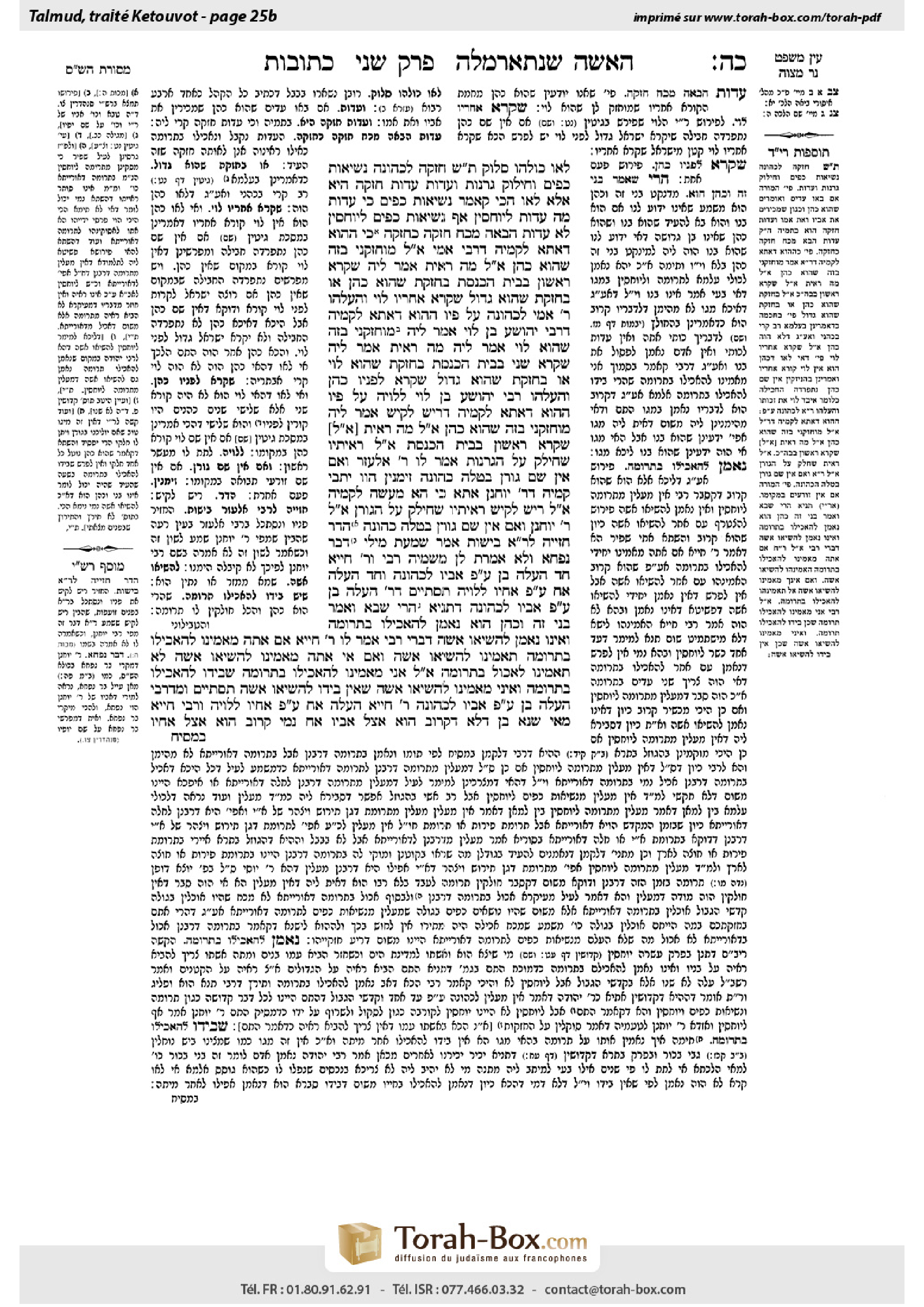
Ketubot 25b: Talmud study for Daf Yomi
Daf Yomi is the daily study of one Talmud folio. Explore 37 tractates with scans, Hebrew text, Sefaria English and AI-generated French translations where annotated.
Passage selection and English or AI-generated French translation are available where the scan has annotations. Daf Study is independent of Torah-Box and Sefaria.
Browse Ketubot · כתובות · All tractatesKetubot 25b text and translations
This page of Ketubot includes the Aramaic text, an English translation and an AI-generated French translation, alongside the scan above.
כתובות כ״ה ב · Aramaic and Hebrew text
לָאו כּוּלְּהוּ סְלוּק.
תָּא שְׁמַע: חֲזָקָה לִכְהוּנָּה — נְשִׂיאוּת כַּפַּיִם וְחִילּוּק גֳּרָנוֹת וְעֵדוּת. עֵדוּת חֲזָקָה הִיא? אֶלָּא לָאו, הָכִי קָאָמַר: נְשִׂיאוּת כַּפַּיִם כִּי עֵדוּת: מָה עֵדוּת לְיוּחֲסִין, אַף נְשִׂיאוּת כַּפַּיִם לְיוּחֲסִין! לָא: עֵדוּת הַבָּאָה מִכֹּחַ חֲזָקָה — כַּחֲזָקָהּ.
כִּי הָהוּא דַּאֲתָא לְקַמֵּיהּ דְּרַבִּי אַמֵּי, אֲמַר לֵיהּ: מוּחְזְקַנִי בָּזֶה שֶׁהוּא כֹּהֵן. אֲמַר לֵיהּ: מָה רָאִיתָ? אֲמַר לֵיהּ: שֶׁקָּרָא רִאשׁוֹן בְּבֵית הַכְּנֶסֶת. בְּחֶזְקַת שֶׁהוּא כֹּהֵן, אוֹ בְּחֶזְקַת שֶׁהוּא גָּדוֹל? שֶׁקָּרָא אַחֲרָיו לֵוִי. וְהֶעֱלָהוּ רַבִּי אַמֵּי לִכְהוּנָּה עַל פִּיו.
הָהוּא דַּאֲתָא לְקַמֵּיהּ דְּרַבִּי יְהוֹשֻׁעַ בֶּן לֵוִי, אֲמַר לֵיהּ: מוּחְזְקַנִי בָּזֶה שֶׁהוּא לֵוִי. אֲמַר לֵיהּ: מָה רָאִיתָ? אֲמַר לֵיהּ: שֶׁקָּרָא שֵׁנִי בְּבֵית הַכְּנֶסֶת. בְּחֶזְקַת שֶׁהוּא לֵוִי, אוֹ בְּחֶזְקַת שֶׁהוּא גָּדוֹל? שֶׁקָּרָא לְפָנָיו כֹּהֵן. וְהַעֲלֵהוּ רַבִּי יְהוֹשֻׁעַ בֶּן לֵוִי לִלְוִיָּה עַל פִּיו.
הַהוּא דַּאֲתָא לְקַמֵּיהּ דְּרֵישׁ לָקִישׁ, אֲמַר לֵיהּ: מוּחְזְקַנִי בָּזֶה שֶׁהוּא כֹּהֵן. אֲמַר לֵיהּ: מָה רָאִיתָ? [אֲמַר לֵיהּ] שֶׁקָּרָא רִאשׁוֹן בְּבֵית הַכְּנֶסֶת. אֲמַר לֵיהּ: רְאִיתִיו שֶׁחִילֵּק עַל הַגֳּרָנוֹת? אָמַר לוֹ רַבִּי אֶלְעָזָר: וְאִם אֵין שָׁם גּוֹרֶן, בָּטְלָה כְּהוּנָּה?
זִימְנִין הָווּ יָתְבִי קַמֵּיהּ דְּרַבִּי יוֹחָנָן, אֲתָא כִּי הָא מַעֲשֶׂה לְקַמֵּיהּ. אֲמַר לֵיהּ רֵישׁ לָקִישׁ: רְאִיתִיו שֶׁחִילֵּק עַל הַגּוֹרֶן? אֲמַר לֵיהּ רַבִּי יוֹחָנָן: וְאִם אֵין שָׁם גּוֹרֶן, בָּטְלָה כְּהוּנָּה? הֲדַר חַזְיֵיהּ לְרַבִּי אֶלְעָזָר בִּישׁוּת, אֲמַר: שָׁמְעַתְּ מִילֵּי דְּבַר נַפָּחָא, וְלָא אֲמַרְתְּ לַן מִשְּׁמֵיהּ?
רַבִּי וְרַבִּי חִיָּיא, חַד הֶעֱלָה בֵּן עַל פִּי אָבִיו לִכְהוּנָּה, וְחַד הֶעֱלָה אָח עַל פִּי אָחִיו לִלְוִיָּה.
תִּסְתַּיֵּים דְּרַבִּי הֶעֱלָה בֵּן עַל פִּי אָבִיו לִכְהוּנָּה, דְּתַנְיָא: הֲרֵי שֶׁבָּא וְאָמַר: בְּנִי זֶה, וְכֹהֵן הוּא — נֶאֱמָן לְהַאֲכִילוֹ בִּתְרוּמָה, וְאֵינוֹ נֶאֱמָן לְהַשִּׂיאוֹ אִשָּׁה, דִּבְרֵי רַבִּי. אָמַר לוֹ רַבִּי חִיָּיא: אִם אַתָּה מַאֲמִינוֹ לְהַאֲכִילוֹ בִּתְרוּמָה — תַּאֲמִינוֹ לְהַשִּׂיאוֹ אִשָּׁה. וְאִם אִי אַתָּה מַאֲמִינוֹ לְהַשִּׂיאוֹ אִשָּׁה — לֹא תַּאֲמִינוֹ לֶאֱכוֹל בִּתְרוּמָה!
אָמַר לוֹ: אֲנִי מַאֲמִינוֹ לְהַאֲכִילוֹ בִּתְרוּמָה — שֶׁבְּיָדוֹ לְהַאֲכִילוֹ בִּתְרוּמָה, וְאֵינִי מַאֲמִינוֹ לְהַשִּׂיאוֹ אִשָּׁה — שֶׁאֵין בְּיָדוֹ לְהַשִּׂיאוֹ אִשָּׁה. תִּסְתַּיֵּים. וּמִדְּרַבִּי הֶעֱלָה בֵּן עַל פִּי אָבִיו לִכְהוּנָּה — רַבִּי חִיָּיא הֶעֱלָה אָח עַל פִּי אָחִיו לִלְוִיָּה.
וְרַבִּי חִיָּיא, מַאי שְׁנָא בֵּן דְּלָא, דְּקָרוֹב הוּא אֵצֶל אָבִיו — אָח נָמֵי קָרוֹב הוּא אֵצֶל אָחִיו?!
Ketubot 25b · English translation
not all of them ascended. Since the majority of the people did not come to the land, separating ḥalla was not restored to the status of an obligation by Torah law.
The Gemara cites proof from another baraita to resolve the dilemma. Come and hear: The presumptive status for priesthood is established by Lifting of the Hands for the Priestly Benediction, and by distribution of teruma at the threshing floors, and by testimony. The Gemara asks: Does testimony merely establish presumptive status? Testimony provides absolute proof of his status, not merely a presumption. Rather is it not that this is what the tanna is saying: Lifting of the Hands is like testimony, just as testimony that one is a priest elevates him to the priesthood for lineage, so too Lifting of the Hands establishes presumptive status for lineage. The Gemara answers: No, when the tanna is referring to testimony, he is stating that the legal status of testimony that is based on presumptive status is like that of presumptive status itself.
As in the incident involving a certain man who came before Rabbi Ami and said to him: That man established presumptive status before me that he is a priest. Rabbi Ami said to him: What did you see that led you to that conclusion? He said to Rabbi Ami: I saw that he was called to the Torah and read first in the synagogue. Rabbi Ami asked him: Did he read first based on the presumptive status that he is a priest, or was it based on the presumptive status that he is a great man? The custom was that a priest would be called to the Torah first, unless there was a prominent Torah scholar among the worshippers. He said to Rabbi Ami: He read the Torah as a priest, as after him a Levite read the Torah. A Levite is called to the Torah second only when a priest is called first. And Rabbi Ami elevated him to the priesthood, on the basis of his statement.
The Gemara relates an incident involving a certain man who came before Rabbi Yehoshua ben Levi and said to Rabbi Yehoshua ben Levi: That man established the presumptive status before me that he is a Levite. Rabbi Yehoshua ben Levi said to him: What did you see that led you to that conclusion? He said to Rabbi Yehoshua ben Levi: I saw that he was called to the Torah and that he read second in the synagogue. Rabbi Yehoshua ben Levi asked him: Did he read second based on the presumptive status that he is a Levite, or was it based on the presumptive status that he is a great man? When there is no priest in the synagogue, people in the synagogue are called to the Torah in order of their prominence. Perhaps he was the second most prominent man in the synagogue. He said to Rabbi Yehoshua ben Levi: I am certain that he is a Levite, as a priest read the Torah before him. And Rabbi Yehoshua ben Levi elevated him to Levite status, based on his statement.
The Gemara relates another incident involving a certain man who came before Reish Lakish and said to Reish Lakish: That man established the presumptive status before me that he is a priest. Reish Lakish said to him: What did you see that led you to that conclusion? He said to Reish Lakish: I saw that he was called to the Torah and read first in the synagogue. Reish Lakish, based on his opinion that one’s presumptive status as a priest can be established only on the basis of his receiving teruma, said to him: Did you see that he received a share of teruma at the threshing floor? Rabbi Elazar said to Reish Lakish: And if there is no threshing floor there, does the priesthood cease to exist? The testimony that he read from the Torah first is sufficient.
On another occasion Rabbi Elazar and Reish Lakish sat before Rabbi Yoḥanan. A matter similar to that incident, where one testified that another is a priest based on his reading the Torah first, came before Rabbi Yoḥanan. Reish Lakish said to the person who testified: Did you see that he received a share of teruma at the threshing floor? Rabbi Yoḥanan said to Reish Lakish: And if there is no threshing floor there, does the priesthood cease to exist? The Gemara relates that Reish Lakish turned and looked at Rabbi Elazar harshly, as he understood that on the previous occasion, Rabbi Elazar was citing verbatim a ruling that he heard from Rabbi Yoḥanan. Reish Lakish said to Rabbi Elazar: You heard a statement of bar Nappaḥa, the son of a blacksmith, an epithet for Rabbi Yoḥanan, and you did not say it to us in his name? Had you done so, I would have accepted it from you then.
The Gemara relates with regard to Rabbi Yehuda HaNasi and Rabbi Ḥiyya that one elevated a son to priesthood on the basis of the statement of his father, and one elevated a brother to the Levite status on the basis of the statement of his brother. It is unclear which of the Sages ruled in which case.
The Gemara notes: It may be concluded that Rabbi Yehuda HaNasi is the one who elevated a son to priesthood on the basis of the statement of his father, as it is taught in a baraita that if one came and said: This is my son and he is a priest, his statement is deemed credible to enable his son to partake of teruma, but it is not deemed credible to marry a woman of superior lineage to him, as his testimony is not deemed credible for the purposes of lineage; this is the statement of Rabbi Yehuda HaNasi. Rabbi Ḥiyya said to him: If you deem the father credible to enable his son to partake of teruma, deem him credible to marry a woman to his son. And if you do not deem him credible to marry a woman to him, do not deem him credible to enable his son to partake of teruma.
Rabbi Yehuda HaNasi said to him: I deem him credible to enable his son to partake of teruma, as it is within his purview to feed his son teruma, and one is deemed credible with regard to matters that are within his purview. But I do not deem him credible to marry a woman to his son, as it is not within his purview to marry a woman to his son, and therefore his testimony is not accepted. The Gemara determines: Indeed, it may be concluded that it is Rabbi Yehuda HaNasi who elevated a son to priesthood on the basis of the statement of his father. And from the fact that it is Rabbi Yehuda HaNasi who elevated a son to priesthood on the basis of the statement of his father, clearly it is Rabbi Ḥiyya who elevated a brother to Levite status on the basis of the statement of his brother.
The Gemara asks: And according to Rabbi Ḥiyya, what is different in the case of a son, where a father is not deemed credible because the son is a relative of his father, and therefore the father is disqualified from testifying about his son? A brother is also a relative of his brother, and therefore the brother should have been disqualified from testifying about his brother. Rabbi Ḥiyya should accept the testimony in both cases or reject the testimony in both cases.
Ketubot 25b · Traduction française (IA)
Tous ne montèrent pas. Puisque la majorité du peuple n’était pas venue dans le pays, le prélèvement de la ‘hala ne retrouva pas le statut d’obligation imposée par la Torah.
La Guemara cite une preuve tirée d’une autre baraïta afin de résoudre la question. Viens et entends : la présomption de prêtrise s’établit par la bénédiction sacerdotale prononcée les mains levées, par la distribution de terouma sur les aires de battage et par témoignage. La Guemara demande : le témoignage ne sert-il qu’à établir une présomption ? Le témoignage apporte une preuve absolue de son statut, et non une simple présomption. Ne faut-il pas plutôt comprendre que le tanna dit ceci : la bénédiction sacerdotale prononcée les mains levées vaut témoignage ; de même qu’un témoignage attestant qu’un homme est prêtre l’établit comme prêtre pour ce qui est de sa filiation, de même la bénédiction sacerdotale prononcée les mains levées établit une présomption de prêtrise pour ce qui est de sa filiation. La Guemara répond : Non ; en parlant de témoignage, le tanna indique que la valeur juridique d’un témoignage fondé sur une présomption équivaut à celle de la présomption elle-même.
C’est comme dans le cas d’un certain homme qui se présenta devant Rabbi Ami et lui dit : « Cet homme a établi devant moi une présomption de prêtrise. » Rabbi Ami lui demanda : « Qu’as-tu vu qui t’a amené à cette conclusion ? » Il répondit à Rabbi Ami : « Je l’ai vu être appelé à la Torah et lire en premier à la synagogue. » Rabbi Ami lui demanda : « A-t-il lu en premier en raison de la présomption qu’il était prêtre, ou en raison de la présomption qu’il était un homme éminent ? » La coutume voulait qu’un prêtre soit appelé à la Torah en premier, sauf si un éminent érudit en Torah se trouvait parmi les fidèles. Il répondit à Rabbi Ami : « Il a lu la Torah en tant que prêtre, car un lévite a lu après lui. Un lévite n’est appelé à la Torah en deuxième position que lorsqu’un prêtre a été appelé en premier. » Rabbi Ami l’établit comme prêtre sur la foi de sa déclaration.
La Guemara rapporte le cas d’un certain homme qui se présenta devant Rabbi Yehoshua ben Levi et lui dit : « Cet homme a établi devant moi une présomption de statut lévitique. » Rabbi Yehoshua ben Levi lui demanda : « Qu’as-tu vu qui t’a amené à cette conclusion ? » Il répondit à Rabbi Yehoshua ben Levi : « Je l’ai vu être appelé à la Torah et lire en deuxième à la synagogue. » Rabbi Yehoshua ben Levi lui demanda : « A-t-il lu en deuxième en raison de la présomption qu’il était lévite, ou en raison de la présomption qu’il était un homme éminent ? » Lorsqu’il n’y a pas de prêtre à la synagogue, les fidèles sont appelés à la Torah selon leur rang. Peut-être était-il le deuxième homme le plus éminent de la synagogue. Il répondit à Rabbi Yehoshua ben Levi : « Je suis certain qu’il est lévite, car un prêtre a lu la Torah avant lui. » Rabbi Yehoshua ben Levi l’établit comme lévite sur la foi de sa déclaration.
La Guemara rapporte un autre cas : un certain homme se présenta devant Reish Lakish et lui dit : « Cet homme a établi devant moi une présomption de prêtrise. » Reish Lakish lui demanda : « Qu’as-tu vu qui t’a amené à cette conclusion ? » Il répondit à Reish Lakish : « Je l’ai vu être appelé à la Torah et lire en premier à la synagogue. » Reish Lakish, conformément à son opinion selon laquelle la présomption de prêtrise ne peut être établie que sur la base de la réception de terouma, lui demanda : « L’as-tu vu recevoir une part de terouma sur l’aire de battage ? » Rabbi Elazar dit à Reish Lakish : « Et s’il n’y a pas d’aire de battage là-bas, la prêtrise cesse-t-elle d’exister ? » Le témoignage selon lequel il a lu la Torah en premier suffit.
Une autre fois, Rabbi Elazar et Reish Lakish étaient assis devant Rabbi Yoḥanan. Une affaire semblable à celle où quelqu’un avait attesté qu’un autre était prêtre parce qu’il avait lu la Torah en premier fut soumise à Rabbi Yoḥanan. Reish Lakish demanda au témoin : « L’as-tu vu recevoir une part de terouma sur l’aire de battage ? » Rabbi Yoḥanan dit à Reish Lakish : « Et s’il n’y a pas d’aire de battage là-bas, la prêtrise cesse-t-elle d’exister ? » La Guemara rapporte que Reish Lakish se retourna et lança un regard sévère à Rabbi Elazar, car il comprit que, lors de l’occasion précédente, Rabbi Elazar citait mot pour mot une décision qu’il avait entendue de Rabbi Yoḥanan. Reish Lakish dit à Rabbi Elazar : « Tu as entendu une déclaration de bar Nappaḥa, le fils du forgeron — surnom de Rabbi Yoḥanan — et tu ne nous l’as pas rapportée en son nom ? Si tu l’avais fait, je l’aurais acceptée de toi à l’époque. »
La Guemara rapporte qu’au sujet de Rabbi Yehuda HaNasi et de Rabbi Ḥiyya, l’un établit un fils comme prêtre sur la foi de la déclaration de son père, et l’autre établit un frère comme lévite sur la foi de la déclaration de son frère. On ne sait pas lequel des Sages statua dans chaque cas.
La Guemara fait remarquer qu’on peut en conclure que c’est Rabbi Yehuda HaNasi qui établit un fils comme prêtre sur la foi de la déclaration de son père. En effet, il est enseigné dans une baraïta que si quelqu’un vient et dit : « Celui-ci est mon fils et il est prêtre », sa déclaration est jugée digne de foi pour permettre à son fils de consommer de la terouma, mais elle n’est pas jugée digne de foi pour lui faire épouser une femme de lignage supérieur, car son témoignage n’est pas jugé fiable aux fins de la filiation. Telle est la déclaration de Rabbi Yehuda HaNasi. Rabbi Ḥiyya lui dit : « Si tu juges le père digne de foi pour permettre à son fils de consommer de la terouma, juge-le digne de foi pour faire épouser une femme à son fils. Et si tu ne le juges pas digne de foi pour lui faire épouser une femme, ne le juge pas digne de foi pour permettre à son fils de consommer de la terouma. »
Rabbi Yehuda HaNasi lui dit : « Je le juge digne de foi pour permettre à son fils de consommer de la terouma, car il est en son pouvoir de nourrir son fils de terouma, et une personne est jugée digne de foi au sujet des choses qui sont en son pouvoir. Mais je ne le juge pas digne de foi pour faire épouser une femme à son fils, car il n’est pas en son pouvoir de marier son fils ; son témoignage n’est donc pas accepté. » La Guemara conclut : En effet, on peut en déduire que c’est Rabbi Yehuda HaNasi qui établit un fils comme prêtre sur la foi de la déclaration de son père. Et puisque c’est Rabbi Yehuda HaNasi qui établit un fils comme prêtre sur la foi de la déclaration de son père, il est clair que c’est Rabbi Ḥiyya qui établit un frère comme lévite sur la foi de la déclaration de son frère.
La Guemara demande : Et, selon Rabbi Ḥiyya, quelle différence y a-t-il dans le cas du fils, où le père n’est pas jugé digne de foi parce que son fils est son proche parent et que le père est donc disqualifié pour témoigner à son sujet ? Un frère est également un proche parent de son frère ; il aurait donc dû être disqualifié pour témoigner à son sujet. Rabbi Ḥiyya devrait accepter le témoignage dans les deux cas ou le rejeter dans les deux cas.
Traduction française générée par IA à partir de l’édition anglaise de Sefaria. Vérifie toujours un passage avec le texte source.
Text from Sefaria: William Davidson Edition - Vocalized Aramaic (CC BY NC); William Davidson Edition - English (CC BY NC).