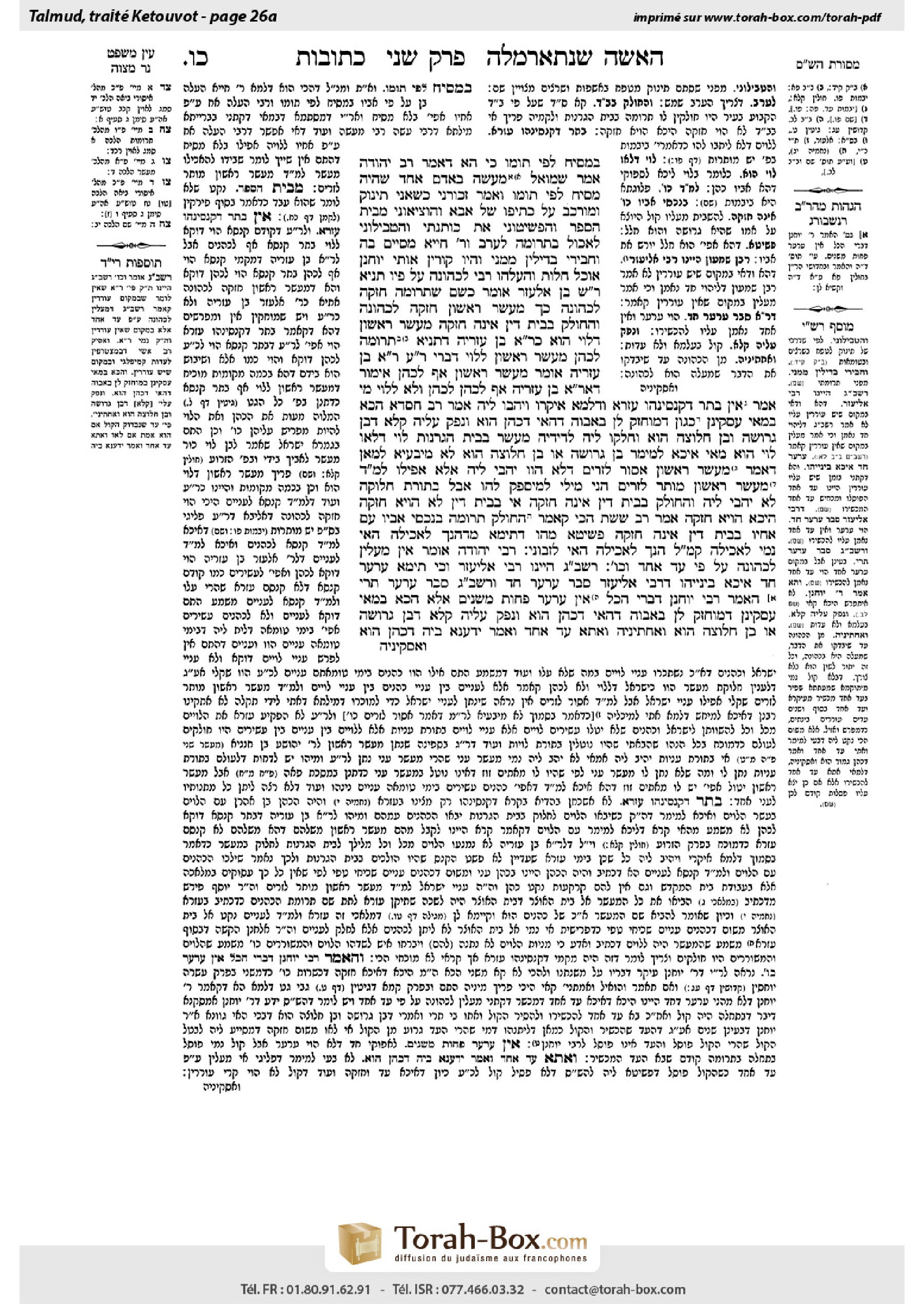
Ketubot 26a: Talmud study for Daf Yomi
Daf Yomi is the daily study of one Talmud folio. Explore 37 tractates with scans, Hebrew text, Sefaria English and AI-generated French translations where annotated.
Passage selection and English or AI-generated French translation are available where the scan has annotations. Daf Study is independent of Torah-Box and Sefaria.
Browse Ketubot · כתובות · All tractatesKetubot 26a text and translations
This page of Ketubot includes the Aramaic text, an English translation and an AI-generated French translation, alongside the scan above.
כתובות כ״ו א · Aramaic and Hebrew text
בְּמֵסִיחַ לְפִי תּוּמּוֹ. כִּי הָא דְּאָמַר רַב יְהוּדָה אָמַר שְׁמוּאֵל: מַעֲשֶׂה בְּאָדָם אֶחָד שֶׁהָיָה מֵסִיחַ לְפִי תּוּמּוֹ, וְאָמַר: זְכוּרַנִי כְּשֶׁאֲנִי תִּינוֹק וּמוּרְכָּב עַל כְּתֵיפוֹ שֶׁל אַבָּא, וְהוֹצִיאוּנִי מִבֵּית הַסֵּפֶר, וְהִפְשִׁיטוּנִי אֶת כּוּתׇּנְתִּי, וְהַטְבִּילוּנִי לֶאֱכוֹל בִּתְרוּמָה לָעֶרֶב.
וְרַבִּי חִיָּיא מְסַיֵּים בַּהּ: וַחֲבֵירַי בְּדֵילִין מִמֶּנִּי, וְהָיוּ קוֹרִין אוֹתִי ״יוֹחָנָן אוֹכֵל חַלּוֹת״. וְהֶעֱלָהוּ רַבִּי לִכְהוּנָּה עַל פִּיו.
תַּנְיָא, רַבִּי שִׁמְעוֹן בֶּן אֶלְעָזָר אוֹמֵר: כְּשֵׁם שֶׁתְּרוּמָה חֲזָקָה לִכְהוּנָּה — כָּךְ מַעֲשֵׂר רִאשׁוֹן חֲזָקָה לִכְהוּנָּה, וְהַחוֹלֵק בְּבֵית דִּין אֵינָהּ חֲזָקָה.
מַעֲשֵׂר רִאשׁוֹן דְּלֵוִי הוּא! כְּרַבִּי אֶלְעָזָר בֶּן עֲזַרְיָה. דְּתַנְיָא: תְּרוּמָה לְכֹהֵן, מַעֲשֵׂר רִאשׁוֹן לְלֵוִי, דִּבְרֵי רַבִּי עֲקִיבָא. רַבִּי אֶלְעָזָר בֶּן עֲזַרְיָה אוֹמֵר: מַעֲשֵׂר רִאשׁוֹן אַף לְכֹהֵן. אֵימוֹר דְּאָמַר רַבִּי אֶלְעָזָר בֶּן עֲזַרְיָה ״אַף לְכֹהֵן״, לְכֹהֵן וְלֹא לְלֵוִי מִי אָמַר?
אִין, בָּתַר דְּקַנְסִינְהוּ עֶזְרָא. וְדִלְמָא אִיקְּרוּ וְיָהֲבוּ לֵיהּ! אָמַר רַב חִסְדָּא: הָכָא בְּמַאי עָסְקִינַן — כְּגוֹן דְּמוּחְזָק לַן בַּאֲבוּהּ דְּהַאי דְּכֹהֵן הוּא, וּנְפַק עֲלֵיהּ קָלָא דְּבֶן גְּרוּשָׁה וּבֶן חֲלוּצָה הוּא, וַחֲלַקוּ לֵיהּ לְדִידֵיהּ מַעֲשֵׂר בְּבֵית הַגֳּרָנוֹת.
לֵוִי, דְּלָאו לֵוִי הוּא, מַאי אִיכָּא לְמֵימַר — בֶּן גְּרוּשָׁה אוֹ בֶּן חֲלוּצָה הוּא. לָא מִיבַּעְיָא לְמַאן דְּאָמַר מַעֲשֵׂר רִאשׁוֹן אָסוּר לְזָרִים, דְּלָא הֲווֹ יָהֲבִי לֵיהּ. אֶלָּא אֲפִילּוּ לְמַאן דְּאָמַר מַעֲשֵׂר רִאשׁוֹן מוּתָּר לְזָרִים, הָנֵי מִילֵּי לְמִיסְפָּא לְהוּ, אֲבָל בְּתוֹרַת חֲלוּקָּה לָא יָהֲבִי לֵיהּ.
וְהַחוֹלֵק בְּבֵית דִּין אֵינָהּ חֲזָקָה. אִי בְּבֵית דִּין לָא הָוְיָא חֲזָקָה, הֵיכָא הָוְיָא חֲזָקָה?! אָמַר רַב שֵׁשֶׁת, הָכִי קָאָמַר: הַחוֹלֵק תְּרוּמָה בְּנִכְסֵי אָבִיו עִם אֶחָיו בְּבֵית דִּין — אֵינָהּ חֲזָקָה.
פְּשִׁיטָא! מַהוּ דְּתֵימָא: מִדְּהָנָךְ לַאֲכִילָה, הַאי נָמֵי לַאֲכִילָה, קָא מַשְׁמַע לַן: הָנָךְ לַאֲכִילָה, הַאי לְזַבּוֹנֵי.
רַבִּי יְהוּדָה אוֹמֵר: אֵין מַעֲלִין לִכְהוּנָּה עַל פִּי עֵד אֶחָד וְכוּ׳. רַבָּן שִׁמְעוֹן בֶּן גַּמְלִיאֵל הַיְינוּ רַבִּי אֱלִיעֶזֶר! וְכִי תֵּימָא עַרְעָר חַד אִיכָּא בֵּינַיְיהוּ, דְּרַבִּי אֱלִיעֶזֶר סָבַר עַרְעָר חַד, וְרַבָּן שִׁמְעוֹן בֶּן גַּמְלִיאֵל סָבַר: עַרְעָר תְּרֵי. הָאָמַר רַבִּי יוֹחָנָן: דִּבְרֵי הַכֹּל, אֵין עַרְעָר פָּחוֹת מִשְּׁנַיִם!
אֶלָּא: הָכָא בְּמַאי עָסְקִינַן — דְּמוּחְזָק לַן בַּאֲבוּהּ דְּהַאי דְּכֹהֵן הוּא, וּנְפַק עֲלֵיהּ קָלָא דְּבֶן גְּרוּשָׁה אוֹ בֶּן חֲלוּצָה הוּא, וְאַחֲתִינֵּיהּ. וַאֲתָא עֵד אֶחָד וְאָמַר: יָדַעְנָא בֵּיהּ דְּכֹהֵן הוּא,
Ketubot 26a · English translation
The Gemara answers: Rabbi Ḥiyya is speaking of a case where the brother speaks offhandedly in the context of a conversation about a different topic. It was understood from this that his brother is a Levite. This is similar to that which Rav Yehuda said that Shmuel said: There was an incident involving a person who was speaking offhandedly and said: I remember when I was a child and still young enough to be carried on my father’s shoulder, and they took me out of school, and removed my cloak, and immersed me to purify me from any possible ritual impurity, so that I would be able to partake of teruma that evening.
And Rabbi Ḥiyya, who related that incident, concluded the story and related that the man said: And my friends distanced themselves from me, and would call me: Yoḥanan who partakes of ḥallot, as it was prohibited for his friends, who were non-priests, to eat ḥalla and teruma. And Rabbi Yehuda HaNasi elevated him to priesthood based on his statement. Just as one’s offhanded statement is reliable, so too, is the offhanded statement of one’s brother.
§ It is taught in a baraita that Rabbi Shimon ben Elazar says: Just as teruma establishes the presumptive status for priesthood, so too the first tithe establishes the presumptive status for priesthood. And one who receives a share of teruma in court does not establish the presumptive status of priesthood.
The Gemara asks: First tithe is given to a Levite. How does it establish the presumptive status of priesthood? The Gemara answers: This is in accordance with the opinion of Rabbi Elazar ben Azarya, as it is taught in a baraita: Teruma is given to a priest, first tithe is given to a Levite; this is the statement of Rabbi Akiva. Rabbi Elazar ben Azarya says: First tithe is given to a priest as well. The Gemara asks: Say that Rabbi Elazar ben Azarya said: To a priest as well. Did he actually say to a priest and not to a Levite? Since it is given to both a Levite and a priest, first tithe cannot establish the presumptive status of priesthood.
The Gemara answers: Yes, first tithe can establish the presumptive status of priesthood. After Ezra penalized the Levites for failure to return to Eretz Yisrael from Babylonia, he decreed that the people should not give them first tithe. Although by Torah law first tithe may be given to both Levites and priests, after that decree, it was given only to priests. The Gemara asks: How can the presumptive status of priesthood be established? But perhaps in this case he was actually a Levite, and by happenstance they gave him first tithe. Rav Ḥisda said: With what are we dealing here? It is a case where the father of that man established the presumptive status of priesthood before us, and a rumor emerged about the son that he is the son of a divorced woman or the son of a ḥalutza. As a ḥalal, who is disqualified from the priesthood, his legal status is that of an Israelite. And it was seen that the son himself received a share of first tithe at the threshing floor.
Therefore, with regard to Levite status, it is clear that he is not a Levite, as his father is a priest. The Gemara asks: What then is there to say? Is it that he is the son of a divorced woman or the son of a ḥalutza? It is not necessary to say that according to the one who says that first tithe is forbidden to non-priests, they would not have given first tithe to the son of the divorcée, as his legal status is that of a non-priest. However, even according to the one who says that first tithe is permitted for non-priests, and therefore the fact that he received first tithe proves nothing, that halakha applies only to the fact that it is permitted for one to whom first tithe produce was distributed to provide it to non-priests. However, in the form of a share of first tithe at the threshing floor, one does not give it to a non-priest. Therefore, according to Rabbi Elazar ben Azarya, the fact that one receives a share at the threshing floor proves that he is a priest of unflawed lineage.
It is taught in the same baraita: And one who receives a share of teruma in court does not establish the presumptive status of priesthood. The Gemara asks: If in court it does not establish the presumptive status, where does it establish the presumptive status? Isn’t court the place where matters are optimally clarified? Rav Sheshet said that this is what the tanna is saying: One who receives a share of teruma from his father’s property with his brothers in court as his portion of the inheritance, in doing so does not establish presumptive status of priesthood. Even if he is a ḥalal and therefore a non-priest, it could be that he owns the teruma as part of his inheritance.
The Gemara asks: It is obvious that receiving teruma in court does not establish the presumptive status. The Gemara answers: Lest you say that from the fact that these brothers receive the teruma to partake of it, it can be deduced that that brother also receives the teruma to partake of it, the tanna therefore teaches us that these brothers receive the teruma to partake of it and that brother receives it to sell it. The fact that he may not eat the teruma does not prevent him from selling it.
§ We learned in the mishna that Rabbi Yehuda says: One does not elevate a man to priesthood on the basis of one witness. Rabbi Elazar says: In a case where there are no challengers, one elevates a man to priesthood on the basis of one witness. Rabban Shimon ben Gamliel says: One elevates a man to priesthood on the basis of one witness. The Gemara asks: The opinion of Rabban Shimon ben Gamliel is identical to the opinion of Rabbi Eliezer, as they agree that one elevates a man to priesthood on the basis of one witness when there are no challengers. And if you would say that there is a difference between them in a case where there is a challenge posed by one witness, as Rabbi Eliezer holds: A challenge posed by one witness is sufficient to undermine one’s presumptive status of priesthood and two witnesses are required to overcome that challenge, and Rabban Shimon ben Gamliel holds: An effective challenge requires two witnesses, didn’t Rabbi Yoḥanan say: Everyone agrees that there is no effective challenge with fewer than two witnesses?
Rather, with what case are we dealing here? It is in a case where the father of that man established his presumptive status of priesthood before us, and a rumor emerged about the son that he is the son of a divorced woman or the son of a ḥalutza, and therefore we downgraded him from the presumptive status of priesthood. And one witness came and said: I know that he is a priest of unflawed lineage,
Ketubot 26a · Traduction française (IA)
La Guemara répond : Rabbi Ḥiyya parle d’un cas où le frère s’exprime incidemment, au cours d’une conversation portant sur un autre sujet. On a compris de ses propos que son frère est lévite. Cela ressemble à ce que Rav Yehuda a dit au nom de Shmuel : il y eut un incident concernant un homme qui parlait incidemment et dit : « Je me souviens que, lorsque j’étais enfant et encore assez jeune pour être porté sur l’épaule de mon père, on m’a sorti de l’école, on m’a enlevé mon manteau et on m’a immergé afin de me purifier de toute impureté rituelle éventuelle, pour que je puisse manger de la terouma ce soir-là. »
Et Rabbi Ḥiyya, qui rapporta cet incident, conclut le récit en racontant que l’homme avait ajouté : « Mes amis s’écartaient de moi et m’appelaient : “Yoḥanan, celui qui mange des ḥallot”, car il était interdit à ses amis, qui n’étaient pas prêtres, de manger de la ḥalla et de la terouma. » Rabbi Yehuda HaNasi lui attribua le statut de prêtre sur la base de ses propos. De même que la déclaration incidente d’un homme est fiable, celle de son frère l’est également.
§ Il est enseigné dans une baraïta que Rabbi Shimon ben Elazar dit : de même que la terouma établit une présomption de statut sacerdotal, la première dîme établit elle aussi cette présomption. En revanche, celui qui reçoit une part de terouma au tribunal n’établit pas de présomption de statut sacerdotal.
La Guemara demande : la première dîme est donnée à un lévite ; comment peut-elle établir une présomption de statut sacerdotal ? La Guemara répond : cela correspond à l’opinion de Rabbi Elazar ben Azarya, comme il est enseigné dans une baraïta : « La terouma est donnée à un prêtre, la première dîme à un lévite » ; telle est l’opinion de Rabbi Akiva. Rabbi Elazar ben Azarya dit : « La première dîme est également donnée à un prêtre. » La Guemara demande : Il a dit qu’elle était également donnée à un prêtre. A-t-il réellement dit qu’elle était donnée à un prêtre et non à un lévite ? Puisqu’elle est donnée à la fois à un lévite et à un prêtre, la première dîme ne peut pas établir une présomption de statut sacerdotal.
La Guemara répond : si, la première dîme peut établir une présomption de statut sacerdotal. Après qu’Ezra eut sanctionné les lévites parce qu’ils n’étaient pas revenus en Eretz Yisrael depuis la Babylonie, il décréta que le peuple ne leur donnerait pas la première dîme. Bien que, selon la Torah, la première dîme puisse être donnée aussi bien aux lévites qu’aux prêtres, après ce décret, elle n’était donnée qu’aux prêtres. La Guemara demande : comment peut-on établir une présomption de statut sacerdotal ? Peut-être était-il en réalité lévite et lui a-t-on donné la première dîme par hasard. Rav Ḥisda dit : de quel cas s’agit-il ici ? Du cas où le père de cet homme avait établi devant nous sa présomption de statut sacerdotal, puis une rumeur avait circulé au sujet du fils, selon laquelle il serait le fils d’une femme divorcée ou d’une ḥaloutza. En tant que ḥalal, disqualifié du sacerdoce, son statut juridique est celui d’un Israélite. Or, on a vu le fils lui-même recevoir une part de première dîme à l’aire de battage.
Par conséquent, pour ce qui est du statut de lévite, il est clair qu’il n’est pas lévite, puisque son père est prêtre. La Guemara demande : que faut-il donc conclure ? Qu’il est le fils d’une femme divorcée ou d’une ḥaloutza ? Il n’est pas nécessaire de dire que, selon celui qui affirme que la première dîme est interdite aux non-prêtres, on n’aurait pas donné la première dîme au fils de la femme divorcée, puisque son statut juridique est celui d’un non-prêtre. Cependant, même selon celui qui affirme que la première dîme est autorisée aux non-prêtres, de sorte que le fait qu’il l’ait reçue ne prouve rien, cette halakha signifie seulement qu’il est permis à celui à qui les produits de la première dîme ont été distribués de les donner à des non-prêtres. En revanche, sous la forme d’une part de première dîme à l’aire de battage, on ne la donne pas à un non-prêtre. Par conséquent, selon Rabbi Elazar ben Azarya, le fait qu’il reçoive une part à l’aire de battage prouve qu’il est un prêtre de filiation irréprochable.
Il est enseigné dans la même baraïta : celui qui reçoit une part de terouma au tribunal n’établit pas de présomption de statut sacerdotal. La Guemara demande : si cela n’établit pas cette présomption au tribunal, où l’établit-on ? Le tribunal n’est-il pas précisément le lieu où les faits sont établis de la manière la plus rigoureuse ? Rav Sheshet dit que voici ce que veut dire le tanna : celui qui reçoit au tribunal une part de terouma provenant des biens de son père, avec ses frères, à titre de part d’héritage, n’établit pas ainsi de présomption de statut sacerdotal. Même s’il est ḥalal et donc non-prêtre, il se peut qu’il possède la terouma dans le cadre de son héritage.
La Guemara demande : il est évident que recevoir de la terouma au tribunal n’établit pas de présomption de statut sacerdotal. La Guemara répond : de crainte que tu ne dises qu’on peut déduire du fait que ces frères reçoivent la terouma pour la manger que cet autre frère la reçoit lui aussi pour la manger, le tanna nous enseigne donc que ces frères reçoivent la terouma pour la manger, tandis que cet autre frère la reçoit pour la vendre. Le fait qu’il ne puisse pas manger la terouma ne l’empêche pas de la vendre.
§ Nous avons appris dans la Michna que Rabbi Yehuda dit : on ne confère pas le statut de prêtre à un homme sur la foi d’un seul témoin. Rabbi Elazar dit : lorsqu’il n’y a pas de contestation, on confère le statut de prêtre à un homme sur la foi d’un seul témoin. Rabban Shimon ben Gamliel dit : on confère le statut de prêtre à un homme sur la foi d’un seul témoin. La Guemara demande : l’opinion de Rabban Shimon ben Gamliel est identique à celle de Rabbi Eliezer, puisqu’ils conviennent tous deux qu’on confère le statut de prêtre à un homme sur la foi d’un seul témoin lorsqu’il n’y a pas de contestation. Et si tu dis qu’ils diffèrent dans le cas où un seul témoin conteste ce statut, Rabbi Eliezer considérant qu’une contestation portée par un seul témoin suffit à remettre en cause la présomption de statut sacerdotal et qu’il faut deux témoins pour la réfuter, tandis que Rabban Shimon ben Gamliel considère qu’une contestation valable exige deux témoins, Rabbi Yoḥanan n’a-t-il pas dit : tous conviennent qu’une contestation n’est valable que si elle est soutenue par au moins deux témoins ?
Mais de quel cas s’agit-il ici ? Du cas où le père de cet homme avait établi devant nous sa présomption de statut sacerdotal, puis une rumeur avait circulé au sujet du fils, selon laquelle il serait le fils d’une femme divorcée ou d’une ḥaloutza ; nous l’avons donc déchu de sa présomption de statut sacerdotal. Un témoin est alors venu et a dit : « Je sais qu’il est un prêtre de filiation irréprochable, »
Traduction française générée par IA à partir de l’édition anglaise de Sefaria. Vérifie toujours un passage avec le texte source.
Text from Sefaria: William Davidson Edition - Vocalized Aramaic (CC BY NC); William Davidson Edition - English (CC BY NC).