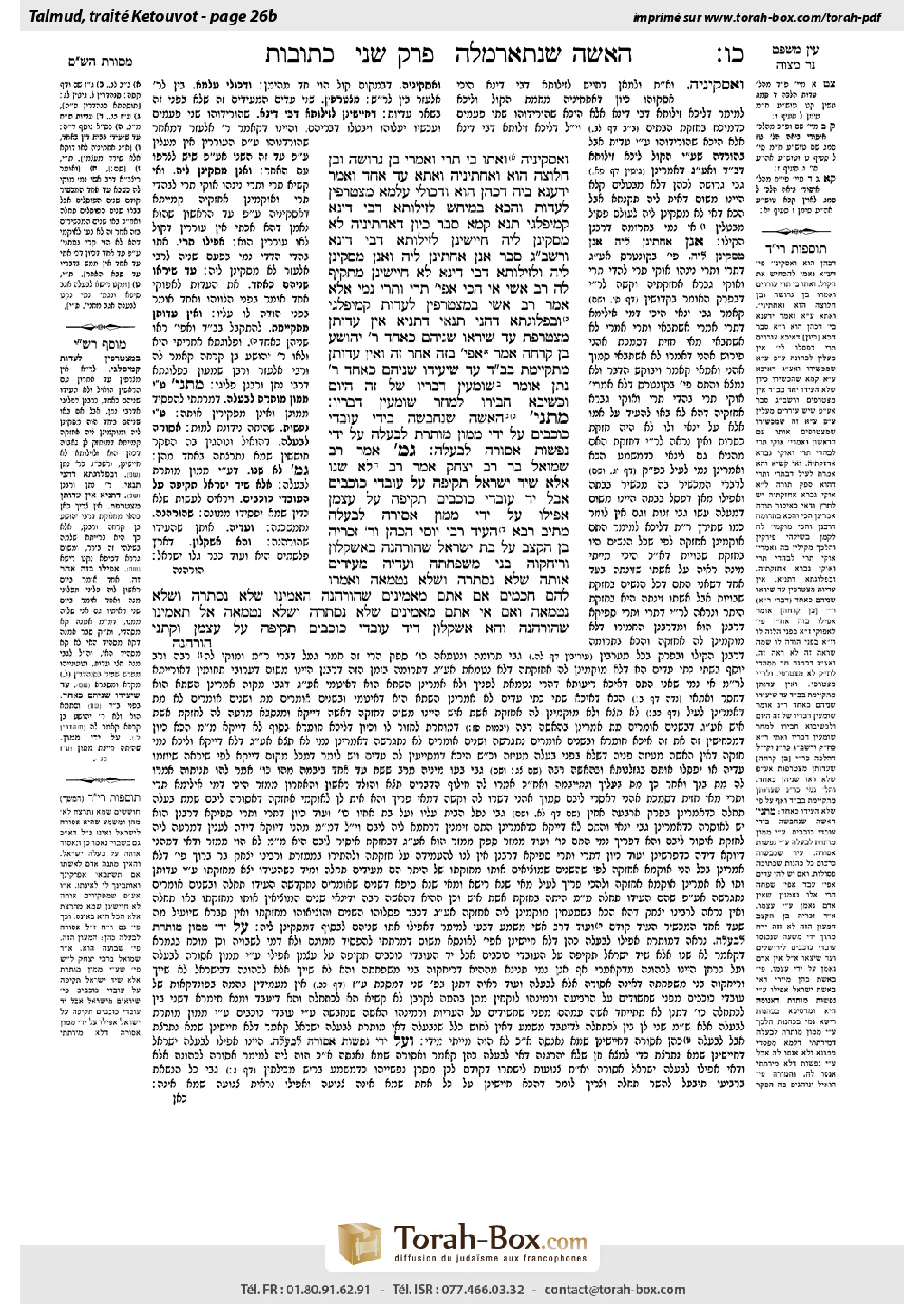
Ketubot 26b: Talmud study for Daf Yomi
Daf Yomi is the daily study of one Talmud folio. Explore 37 tractates with scans, Hebrew text, Sefaria English and AI-generated French translations where annotated.
Passage selection and English or AI-generated French translation are available where the scan has annotations. Daf Study is independent of Torah-Box and Sefaria.
Browse Ketubot · כתובות · All tractatesKetubot 26b text and translations
This page of Ketubot includes the Aramaic text, an English translation and an AI-generated French translation, alongside the scan above.
כתובות כ״ו ב · Aramaic and Hebrew text
וְאַסְּקִינֵּיהּ. וַאֲתוֹ בֵּי תְרֵי וְאָמְרִי: בֶּן גְּרוּשָׁה וּבֶן חֲלוּצָה הוּא, וְאַחֲתִינֵּיהּ. וַאֲתָא עֵד אֶחָד וְאָמַר: יָדַעְנָא בֵּיהּ דְּכֹהֵן הוּא. וּדְכוּלֵּי עָלְמָא מִצְטָרְפִין לְעֵדוּת.
וְהָכָא בְּמֵיחַשׁ לְזִילוּתָא דְבֵי דִינָא קָמִיפַּלְגִי. תַּנָּא קַמָּא סָבַר: כֵּיוָן דְּאַחֲתִינֵּיהּ, לָא מַסְּקִינַן לֵיהּ, חָיְישִׁינַן לְזִילוּתָא דְּבֵי דִינָא. וְרַבָּן שִׁמְעוֹן בֶּן גַּמְלִיאֵל סָבַר: אֲנַן אַחֲתִינַן לֵיהּ וַאֲנַן מַסְּקִינַן לֵיהּ, וּלְזִילוּתָא דְּבֵי דִינָא לָא חָיְישִׁינַן.
מַתְקֵיף לַהּ רַב אָשֵׁי: אִי הָכִי, אֲפִילּוּ תְּרֵי וּתְרֵי נָמֵי!
אֶלָּא אָמַר רַב אָשֵׁי: בְּמִצְטָרְפִין לְעֵדוּת קָמִיפַּלְגִי, וּבִפְלוּגְתָּא דְּהָנֵי תַנָּאֵי. דְּתַנְיָא: אֵין עֵדוּתָן מִצְטָרֶפֶת עַד שֶׁיִּרְאוּ שְׁנֵיהֶם כְּאֶחָד. רַבִּי יְהוֹשֻׁעַ בֶּן קׇרְחָה אוֹמֵר: אֲפִילּוּ בָּזֶה אַחַר זֶה. וְאֵין עֵדוּתָן מִתְקַיֶּימֶת בְּבֵית דִּין עַד שֶׁיָּעִידוּ שְׁנֵיהֶם כְּאֶחָד.
רַבִּי נָתָן אוֹמֵר: שׁוֹמְעִין דְּבָרָיו שֶׁל זֶה הַיּוֹם, וּכְשֶׁיָּבֹא חֲבֵירוֹ לְמָחָר שׁוֹמְעִין דְּבָרָיו.
מַתְנִי׳ הָאִשָּׁה שֶׁנֶּחְבְּשָׁה בִּידֵי גוֹיִם, עַל יְדֵי מָמוֹן — מוּתֶּרֶת לְבַעְלָהּ. עַל יְדֵי נְפָשׁוֹת — אֲסוּרָה לְבַעְלָהּ.
גְּמָ׳ אָמַר רַב שְׁמוּאֵל בַּר רַב יִצְחָק אָמַר רַב: לֹא שָׁנוּ אֶלָּא שֶׁיַּד יִשְׂרָאֵל תַּקִּיפָה עַל אוּמּוֹת הָעוֹלָם, אֲבָל יַד אוּמּוֹת הָעוֹלָם תַּקִּיפָה עַל עַצְמָן, אֲפִילּוּ עַל יְדֵי מָמוֹן — אֲסוּרָה לְבַעְלָהּ.
מֵתִיב רָבָא: הֵעִיד רַבִּי יוֹסֵי הַכֹּהֵן וְרַבִּי זְכַרְיָה בֶּן הַקַּצָּב עַל בַּת יִשְׂרָאֵל שֶׁהוּרְהֲנָה בְּאַשְׁקְלוֹן, וְרִיחֲקוּהָ בְּנֵי מִשְׁפַּחְתָּהּ, וְעֵדֶיהָ מְעִידִים אוֹתָהּ שֶׁלֹּא נִסְתְּרָה וְשֶׁלֹּא נִטְמָאָה. וְאָמְרוּ לָהֶם חֲכָמִים: אִם אַתֶּם מַאֲמִינִים שֶׁהוּרְהֲנָה — הַאֲמִינוּ שֶׁלֹּא נִסְתְּרָה וְשֶׁלֹּא נִטְמָאָה, וְאִם אִי אַתֶּם מַאֲמִינִים שֶׁלֹּא נִסְתְּרָה וְשֶׁלֹּא נִטְמָאָה — אַל תַּאֲמִינוּ שֶׁהוּרְהֲנָה.
וְהָא אַשְׁקְלוֹן, דְּיַד אוּמּוֹת הָעוֹלָם תַּקִּיפָה עַל עַצְמָן, וְקָתָנֵי:
Ketubot 26b · English translation
and therefore we elevated him back to the priesthood, as one witness is sufficient to negate the rumor. And then two witnesses came and said: He is the son of a divorced woman or the son of a ḥalutza, and then we downgraded him from the priesthood, as two witnesses negated the testimony of one witness. Then one witness came and said: I know that he is a priest of unflawed lineage. And everyone agrees that the two single witnesses join together and constitute two witnesses for the purpose of testimony that he is a priest of unflawed lineage, and fundamentally his presumptive status of priesthood should be restored.
And here it is with regard to concern that it will lead to contempt for the court that they disagree. The first tanna, Rabbi Eliezer, holds: Once we downgraded him from the priesthood, we do not then elevate him. We are concerned that it will lead to contempt for the court, as the reversal in the court decisions create the impression that the court does not know what it is doing. And Rabban Shimon ben Gamliel holds: We downgrade him from the priesthood and we then elevate him, and as for the possibility that it will lead to contempt for the court, we are not concerned about it. The primary concern is that the matter be determined based on the relevant testimonies.
Rav Ashi strongly objects: If so, if they disagree with regard to contempt for the court, why is it necessary to establish the dispute in a case where the witnesses who testified that he is a priest of unflawed lineage came individually? If so, then even if two witnesses testify together that he is unfit for the priesthood, and the court downgraded him, and two witnesses testify together that he is fit for the priesthood, and the court elevated him, the tanna’im would also disagree, as the same concern for contempt of court applies.
Rather, Rav Ashi said: It is with regard to whether two single witnesses join together and constitute two witnesses for the purpose of testimony that they disagree, and it is in the dispute between these tanna’im that they disagree, as it is taught in a baraita: The testimony of individual witnesses merges into the testimony of two witnesses only if the two of them saw the incident transpire together, as one. Rabbi Yehoshua ben Korḥa says: Their testimony merges even in a case where this witness saw the incident after that witness; however, the testimony of witnesses is validated in court only if the two of them testify together as one.
Rabbi Natan says: They need not even testify together, but even if the court hears the statement of this witness today, and when his fellow witness comes tomorrow the court hears his statement, their testimonies merge. Rabbi Eliezer holds in accordance with the opinion of Rabbi Yehoshua ben Korḥa, and therefore the testimony of the second witness cannot be merged with the testimony of the first witness and the person remains a ḥalal. Rabban Shimon ben Gamliel holds that the testimony of the two witnesses that he is a priest of unflawed lineage is merged, and his presumptive status of priesthood is restored, as it was already established that his father is a priest.
MISHNA: In the case of a woman who was imprisoned by gentiles due to a monetary offense committed by her husband, once she is released after he pays his debt, she is permitted to her husband, even if he is a priest. There is no concern that they violated her because their objective is to coerce the husband to pay his debt in exchange for her release. Were they to abuse her, it is possible that he would be unwilling to pay. However, if a woman was imprisoned due to a capital offense and sentenced to death, once she is released she is forbidden to her husband even if he is not a priest due to the concern that perhaps her captors violated her, and she acquiesced to one of them.
GEMARA: Rav Shmuel bar Rav Yitzḥak said that Rav said: They taught this mishna only in a case where the authority of the Jewish people is dominant over the nations of the world, and the gentiles are law-abiding citizens. However, when the authority of the nations of the world is dominant over themselves, a euphemism for dominance over the Jewish people, even a woman who was imprisoned due to a monetary offense is forbidden to her husband, as there is nothing preventing her jailers from violating her.
Rava raised an objection from a mishna (Eduyyot 8:2): Rabbi Yosei the priest and Rabbi Zekharya ben HaKatzav testified about a Jewish woman about whom witnesses testified that she was taken as collateral for a debt in Ashkelon. And the members of her family, who suspected that she engaged in intercourse there, distanced themselves from her, but her witnesses testified about her that she neither entered into seclusion nor was violated. And the Sages said to the members of the family: If you deem the witnesses credible to testify that she was taken as collateral, deem the witnesses credible to testify that she neither entered into seclusion nor was violated. And if you do not deem the witnesses credible to testify that she neither entered into seclusion nor was violated, do not deem the witnesses credible to testify that she was taken as collateral at all. In either case, she is permitted to her husband.
Rava asks: But this took place in Ashkelon, which is a place where the authority of the nations of the world is dominant over themselves, as it was a city of gentiles, and it is taught:
Ketubot 26b · Traduction française (IA)
et par conséquent, nous l'avons rétabli dans le sacerdoce, car un seul témoin suffit pour contredire le bruit. Puis deux témoins sont venus et ont dit : Il est le fils d'une femme divorcée ou le fils d'une ḥalutza, et alors nous l'avons déchu du sacerdoce, car deux témoins ont contredit le témoignage d'un seul témoin. Ensuite, un témoin est venu et a dit : Je sais qu'il est un prêtre de lignée irréprochable. Et tout le monde est d'accord pour dire que les deux témoins isolés se combinent et constituent deux témoins aux fins de témoigner qu'il est un prêtre de lignée irréprochable, et fondamentalement, son statut présumé de prêtre devrait être rétabli.
Et ici, il s'agit de la crainte que cela ne conduise au mépris du tribunal, sur ce point ils sont en désaccord. Le premier tanna, Rabbi Eliezer, soutient : Une fois que nous l'avons déchu du sacerdoce, nous ne le rétablissons pas ensuite. Nous craignons que cela ne conduise au mépris du tribunal, car le renversement des décisions du tribunal crée l'impression que le tribunal ne sait pas ce qu'il fait. Et Rabban Shimon ben Gamliel soutient : Nous le déchuons du sacerdoce et nous le rétablissons ensuite, et quant à la possibilité que cela ne conduise au mépris du tribunal, nous n'en tenons pas compte. La préoccupation principale est que l'affaire soit tranchée sur la base des témoignages pertinents.
Rav Ashi objecte vigoureusement : Si c'est ainsi, s'ils sont en désaccord quant au mépris du tribunal, pourquoi est-il nécessaire d'établir le désaccord dans un cas où les témoins qui ont témoigné qu'il est un prêtre de lignée irréprochable sont venus individuellement ? Si c'est ainsi, alors même si deux témoins témoignent ensemble qu'il n'est pas apte au sacerdoce, et que le tribunal l'a déchu, et que deux témoins témoignent ensemble qu'il est apte au sacerdoce, et que le tribunal l'a rétabli, les tanna'im seraient également en désaccord, car la même crainte du mépris du tribunal s'applique.
Plutôt, Rav Ashi a dit : C'est quant à savoir si deux témoins isolés se combinent pour constituer deux témoins aux fins de témoignage qu'ils sont en désaccord, et c'est dans le désaccord entre ces tanna'im qu'ils sont en désaccord, car il est enseigné dans une baraïta : Le témoignage de témoins isolés ne se combine au témoignage de deux témoins que si les deux ont vu l'incident se produire ensemble, comme un seul. Rabbi Yehoshua ben Korḥa dit : Leur témoignage se combine même dans un cas où ce témoin a vu l'incident après l'autre témoin ; cependant, le témoignage des témoins n'est validé en tribunal que si les deux témoignent ensemble comme un seul.
Rabbi Natan dit : Ils n'ont même pas besoin de témoigner ensemble, mais même si le tribunal entend la déclaration de ce témoin aujourd'hui, et lorsque son co-témoin vient demain, le tribunal entend sa déclaration, leurs témoignages se combinent. Rabbi Eliezer soutient conformément à l'opinion de Rabbi Yehoshua ben Korḥa, et par conséquent, le témoignage du second témoin ne peut pas se combiner au témoignage du premier témoin et la personne reste un ḥalal. Rabban Shimon ben Gamliel soutient que le témoignage des deux témoins qu'il est un prêtre de lignée irréprochable se combine, et son statut présumé de prêtre est rétabli, car il a déjà été établi que son père est un prêtre.
MICHNA : Dans le cas d'une femme emprisonnée par des non-Juifs en raison d'une infraction monétaire commise par son mari, une fois qu'elle est libérée après qu'il a payé sa dette, elle est permise à son mari, même s'il est un Cohen. Il n'y a pas de crainte qu'ils l'aient violée, car leur objectif est de contraindre le mari à payer sa dette en échange de sa libération. S'ils l'abusaient, il est possible qu'il ne soit pas disposé à payer. Cependant, si une femme a été emprisonnée en raison d'une infraction capitale et condamnée à mort, une fois qu'elle est libérée, elle est interdite à son mari, même s'il n'est pas un Cohen, en raison de la crainte que peut-être ses geôliers l'aient violée, et qu'elle ait consenti à l'un d'entre eux.
GUEMARA : Rav Shmuel bar Rav Yitzḥak a dit que Rav a dit : Ils ont enseigné cette Michna seulement dans un cas où l'autorité du peuple juif est dominante sur les nations du monde, et les non-Juifs sont des citoyens respectueux de la loi. Cependant, lorsque l'autorité des nations du monde est dominante sur elles-mêmes, euphémisme pour la domination sur le peuple juif, même une femme emprisonnée en raison d'une infraction monétaire est interdite à son mari, car rien n'empêche ses geôliers de la violer.
Rava a soulevé une objection à partir d'une Michna (Eduyyot 8:2) : Rabbi Yosei le prêtre et Rabbi Zekharya ben HaKatzav ont témoigné au sujet d'une femme juive, au sujet de laquelle des témoins avaient attesté qu'elle avait été prise en garantie d'une dette à Ashkelon. Les membres de sa famille, qui soupçonnaient qu'elle avait eu des rapports sexuels là-bas, se sont distancés d'elle, mais ses témoins ont attesté qu'elle n'avait ni été mise en situation de seclusion, ni violée. Les Sages ont dit aux membres de la famille : Si vous estimez les témoins crédibles pour attester qu'elle a été prise en garantie, estimez-les également crédibles pour attester qu'elle n'a ni été mise en situation de seclusion, ni violée. Et si vous n'estimez pas les témoins crédibles pour attester qu'elle n'a ni été mise en situation de seclusion, ni violée, n'estimez-les pas non plus crédibles pour attester qu'elle a été prise en garantie. Dans les deux cas, elle est permise à son mari.
Rava demande : Mais cela s'est produit à Ashkelon, un lieu où l'autorité des nations du monde est prépondérante, car c'était une ville de non-Juifs, et il est enseigné :
Traduction française générée par IA à partir de l’édition anglaise de Sefaria. Vérifie toujours un passage avec le texte source.
Text from Sefaria: William Davidson Edition - Vocalized Aramaic (CC BY NC); William Davidson Edition - English (CC BY NC).