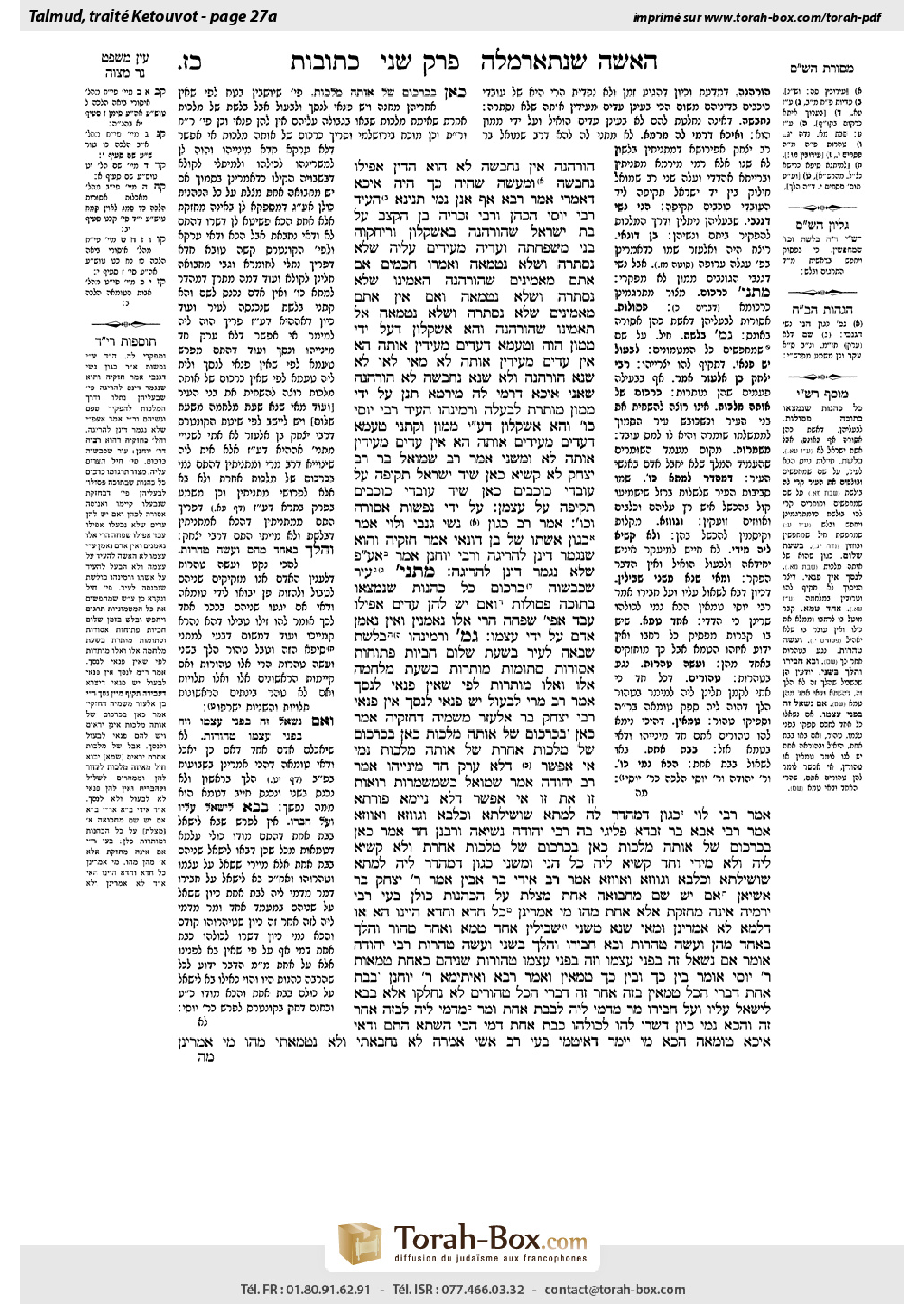
Ketubot 27a: Talmud study for Daf Yomi
Daf Yomi is the daily study of one Talmud folio. Explore 37 tractates with scans, Hebrew text, Sefaria English and AI-generated French translations where annotated.
Passage selection and English or AI-generated French translation are available where the scan has annotations. Daf Study is independent of Torah-Box and Sefaria.
Browse Ketubot · כתובות · All tractatesKetubot 27a text and translations
This page of Ketubot includes the Aramaic text, an English translation and an AI-generated French translation, alongside the scan above.
כתובות כ״ז א · Aramaic and Hebrew text
הוּרְהֲנָה — אִין, נֶחְבְּשָׁה — לָא. הוּא הַדִּין אֲפִילּוּ נֶחְבְּשָׁה. וּמַעֲשֶׂה שֶׁהָיָה, כָּךְ הָיָה.
אִיכָּא דְּאָמְרִי, אָמַר רָבָא: אַף אֲנַן נָמֵי תְּנֵינָא: הֵעִיד רַבִּי יוֹסֵי הַכֹּהֵן וְרַבִּי זְכַרְיָה בֶּן הַקַּצָּב עַל בַּת יִשְׂרָאֵל שֶׁהוּרְהֲנָה בְּאַשְׁקְלוֹן, וְרִיחֲקוּהָ בְּנֵי מִשְׁפַּחְתָּהּ, וְעֵדֶיהָ מְעִידִים עָלֶיהָ שֶׁלֹּא נִסְתְּרָה וְשֶׁלֹּא נִטְמָאָה, וְאָמְרוּ חֲכָמִים: אִם אַתֶּם מַאֲמִינִים שֶׁהוּרְהֲנָה — הַאֲמִינוּ שֶׁלֹּא נִסְתְּרָה וְשֶׁלֹּא נִטְמָאָה, וְאִם אֵין אַתֶּם מַאֲמִינִים שֶׁלֹּא נִסְתְּרָה וְשֶׁלֹּא נִטְמָאָה — אַל תַּאֲמִינוּ שֶׁהוּרְהֲנָה.
וְהָא אַשְׁקְלוֹן, דְּעַל יְדֵי מָמוֹן הֲוָה, וְטַעְמָא דְּעֵדִים מְעִידִין אוֹתָהּ, הָא אֵין עֵדִים מְעִידִין אוֹתָהּ — לָא. מַאי לָאו: לָא שְׁנָא הוּרְהֲנָה, וְלָא שְׁנָא נֶחְבְּשָׁה! לָא, הוּרְהֲנָה שָׁאנֵי.
אִיכָּא דְּרָמֵי לַהּ מִירְמָא, תְּנַן: עַל יְדֵי מָמוֹן מוּתֶּרֶת לְבַעְלָהּ, וּרְמִינְהוּ: הֵעִיד רַבִּי יוֹסֵי כּוּ׳. וְהָא אַשְׁקְלוֹן, דְּעַל יְדֵי מָמוֹן, וְקָתָנֵי: טַעְמָא דְּעֵדִים מְעִידִים אוֹתָהּ, הָא אֵין עֵדִים מְעִידִין אוֹתָהּ לָא!
וּמְשַׁנֵּי, אָמַר רַב שְׁמוּאֵל בַּר רַב יִצְחָק, לָא קַשְׁיָא: כָּאן שֶׁיַּד יִשְׂרָאֵל תַּקִּיפָה עַל אוּמּוֹת הָעוֹלָם, כָּאן שֶׁיַּד אוּמּוֹת הָעוֹלָם תַּקִּיפָה עַל עַצְמָן.
עַל יְדֵי נְפָשׁוֹת אֲסוּרָה וְכוּ׳. אָמַר רַב: כְּגוֹן נְשֵׁי גַנָּבֵי. וְלֵוִי אָמַר: כְּגוֹן אִשְׁתּוֹ שֶׁל בֶּן דּוֹנַאי. אָמַר חִזְקִיָּה: וְהוּא שֶׁנִּגְמַר דִּינָן לַהֲרִיגָה, וְרַבִּי יוֹחָנָן אָמַר: אַף עַל פִּי שֶׁלֹּא נִגְמַר דִּינָן לַהֲרִיגָה.
מַתְנִי׳ עִיר שֶׁכְּבָשׁוּהָ כַּרְכּוֹם — כׇּל כֹּהֲנוֹת שֶׁנִּמְצְאוּ בְּתוֹכָהּ פְּסוּלוֹת. וְאִם יֵשׁ לָהֶן עֵדִים, אֲפִילּוּ עֶבֶד, אֲפִילּוּ שִׁפְחָה — הֲרֵי אֵלּוּ נֶאֱמָנִין. וְאֵין נֶאֱמָן אָדָם עַל יְדֵי עַצְמוֹ.
גְּמָ׳ וּרְמִינְהוּ: בַּלֶּשֶׁת שֶׁבָּאָה לָעִיר, בִּשְׁעַת שָׁלוֹם — חָבִיּוֹת פְּתוּחוֹת אֲסוּרוֹת, סְתוּמוֹת מוּתָּרוֹת. בִּשְׁעַת מִלְחָמָה — אֵלּוּ וְאֵלּוּ מוּתָּרוֹת, לְפִי שֶׁאֵין פְּנַאי לְנַסֵּךְ.
אָמַר רַב מָרִי: לִבְעוֹל יֵשׁ פְּנַאי, לְנַסֵּךְ אֵין פְּנַאי. רַבִּי יִצְחָק בַּר אֶלְעָזָר מִשְּׁמֵיהּ דְּחִזְקִיָּה אָמַר: כָּאן בְּכַרְכּוֹם שֶׁל אוֹתָהּ מַלְכוּת, כָּאן בְּכַרְכּוֹם שֶׁל מַלְכוּת אַחֶרֶת.
שֶׁל אוֹתָהּ מַלְכוּת נָמֵי, אִי אֶפְשָׁר דְּלָא עָרַק חַד מִינַּיְיהוּ. אָמַר רַב יְהוּדָה אָמַר שְׁמוּאֵל: כְּשֶׁמִּשְׁמָרוֹת רוֹאוֹת זוֹ אֶת זוֹ. אִי אֶפְשָׁר דְּלָא נָיְימָא פּוּרְתָּא! אָמַר רַבִּי לֵוִי: כְּגוֹן דִּמְהַדַּר לַהּ לְמָתָא שׁוּשִׁילְתָּא וְכַלְבָּא וּגְווֹזָא וַאֲווֹזָא.
אָמַר רַבִּי אַבָּא בַּר זַבְדָּא: פְּלִיגִי בַּהּ רַבִּי יְהוּדָה נְשִׂיאָה וְרַבָּנַן. חַד אָמַר: כָּאן בְּכַרְכּוֹם שֶׁל אוֹתָהּ מַלְכוּת, כָּאן בְּכַרְכּוֹם שֶׁל מַלְכוּת אַחֶרֶת, וְלָא קַשְׁיָא לֵיהּ וְלָא מִידֵּי. וְחַד קַשְׁיָא לֵיהּ כֹּל הָנֵי, וּמְשַׁנֵּי: כְּגוֹן דִּמְהַדַּר לֵיהּ לְמָתָא שׁוּשִׁילְתָּא וְכַלְבָּא וּגְווֹזָא וַאֲווֹזָא.
אָמַר רַב אִידִי בַּר אָבִין אָמַר רַבִּי יִצְחָק בַּר אַשְׁיָאן: אִם יֵשׁ שָׁם מַחְבּוֹאָה אַחַת — מַצֶּלֶת עַל הַכֹּהֲנוֹת כּוּלָּן.
בָּעֵי רַבִּי יִרְמְיָה: אֵינָהּ מַחְזֶקֶת אֶלָּא אַחַת מַהוּ? מִי אָמְרִינַן כֹּל חֲדָא וַחֲדָא הַיְינוּ הָא, אוֹ דִלְמָא לָא אָמְרִינַן?
וּמַאי שְׁנָא מִשְּׁנֵי שְׁבִילִין, אֶחָד טָמֵא וְאֶחָד טָהוֹר. וְהָלַךְ בְּאֶחָד מֵהֶן וְעָשָׂה טְהָרוֹת, וּבָא חֲבֵירוֹ וְהָלַךְ בַּשֵּׁנִי וְעָשָׂה טְהָרוֹת,
רַבִּי יְהוּדָה אוֹמֵר: אִם נִשְׁאַל זֶה בִּפְנֵי עַצְמוֹ וְזֶה בִּפְנֵי עַצְמוֹ — טְהוֹרוֹת. שְׁנֵיהֶם כְּאַחַת — טְמֵאוֹת. רַבִּי יוֹסִי אוֹמֵר: בֵּין כָּךְ וּבֵין כָּךְ טְמֵאִין.
וְאָמַר רָבָא, וְאִיתֵּימָא רַבִּי יוֹחָנָן: בְּבַת אַחַת — דִּבְרֵי הַכֹּל: טְמֵאִין. בְּזֶה אַחַר זֶה — דִּבְרֵי הַכֹּל: טְהוֹרִים. לֹא נֶחְלְקוּ אֶלָּא בְּבָא לִישָּׁאֵל עָלָיו וְעַל חֲבֵירוֹ: מָר מְדַמֵּי לֵיהּ לִבְבַת אַחַת, וּמָר מְדַמֵּי לֵיהּ לְבָזֶה אַחַר זֶה. וְהָכָא נָמֵי, כֵּיוָן דְּשָׁרֵי לְהוּ לְכוּלְּהוּ — כְּבַת אַחַת דָּמֵי!
הָכִי הַשְׁתָּא?! הָתָם וַדַּאי אִיכָּא טוּמְאָה, הָכָא מִי יֵימַר דְּאִיטַּמַּי.
בָּעֵי רַב אָשֵׁי, אָמְרָה: לֹא נֶחְבֵּאתִי וְלֹא נִטְמֵאתִי, מַהוּ? מִי אָמְרִינַן:
Ketubot 27a · English translation
If she was taken as security, in a case where her husband stipulated that if he fails to pay a debt the gentiles may take his wife and do with her as they please, yes, she requires witnesses to testify that she was not violated. However, if she was imprisoned by the authorities, no, she is deemed untainted even without witnesses. Apparently, the distinction is not based on the dominance of the Jewish people. Rather, it is based on the manner in which she was apprehended. The Gemara answers: The same is true that she is forbidden to her husband even if she was imprisoned, and the reason that the tanna’im testified about a case where she was taken as security is because the incident that transpired, transpired in that manner.
Some say a different version of this tradition. Rava said that we too learn a proof from a mishna for the statement that Rav Shmuel bar Rav Yitzḥak said that Rav said: Rabbi Yosei the priest and Rabbi Zekharya ben HaKatzav testified about a Jewish woman about whom witnesses testified that she was taken as security for a debt in Ashkelon. And the members of her family, who suspected that she engaged in intercourse there, distanced themselves from her, and her witnesses testified about her that she neither entered into seclusion nor was violated. And the Sages said to the members of the family: If you believe the witnesses that she was taken as collateral, believe the witnesses who say that she neither entered into seclusion nor was violated. And if you do not believe the witnesses that she neither entered into seclusion nor was violated, do not believe the witnesses that she was taken as collateral at all.
Rava asks: But in the case in Ashkelon that was due to a monetary offense, the reason that she was permitted is that witnesses testified about her that she was untainted. However, if witnesses did not testify about her, no, she would not be permitted to her husband, although she was taken due to a monetary offense. What, is it not that it is no different if she was taken as collateral and it is no different if she was imprisoned? Apparently, if the authority of the gentiles is dominant, even if she was imprisoned for the sake of money there is concern that she was violated. The Gemara rejects the proof: No, the case where the woman is taken as collateral is different, and only in that case, where her husband stipulated that the gentiles could take her, would the gentiles allow themselves to violate her. However, in a case where she is imprisoned there is no concern of that sort.
Some raise it as a contradiction between the sources. We learned in the mishna: A woman who was taken hostage due to a monetary offense is permitted to her husband. And they raise a contradiction from the mishna in Eduyyot: Rabbi Yosei the priest and Rabbi Zekharya ben HaKatzav testified about a Jewish woman about whom witnesses testified that she was taken as collateral for a debt in Ashkelon. But this is not the case in Ashkelon, which was due to a monetary offense, and it is taught that the reason that the woman was permitted is that witnesses testified about her that she was untainted. However, if witnesses did not testify about her, no, she would not be permitted, although she was taken for the sake of money.
And he answers that Rav Shmuel bar Rav Yitzḥak said: This is not difficult. Here, the mishna is referring to a period when the authority of the Jewish people is dominant over the nations of the world. Then, a woman taken hostage for the sake of money is permitted. There it is referring to a period when the authority of the nations of the world is dominant over themselves and over the Jewish people. Therefore, even a woman taken because of a monetary offense is forbidden unless witnesses testify that she is untainted.
§ We learned in the mishna: A woman who was imprisoned because of a capital offense is forbidden to her husband. Rav said: The mishna is referring to a case where the wives of thieves are involved, as when thieves were apprehended and hanged, their wives were abandoned and made available to all, and they were not protected from potential rapists. And Levi said: The mishna is referring to a case where the wife of ben Donai, a murderer, is involved, as in that case the government abandons his wife and makes her available to all, which is not the case when one is condemned for theft. Ḥizkiyya said: And this abandonment is only in a case where the husbands were sentenced to death. And Rabbi Yoḥanan said: Although their husbands were not sentenced to death, if the imprisonment is because of a capital offense, the women are abandoned and available to all.
MISHNA: With regard to a city that was conquered by an army laying siege, all the women married to priests located in the city are unfit and forbidden to their husbands, due to the concern that they were raped. And if they have witnesses, even if the witness is a slave, even if the witness is a maidservant, both of whom are generally disqualified as witnesses, they are deemed credible. And a person is not deemed credible to establish his status by his own testimony. Therefore, a woman is not deemed credible to claim that she was not violated.
GEMARA: The Gemara raises a contradiction from a mishna (Avoda Zara 70b): If there is a gentile military unit that entered a city, if it entered during peacetime, after the soldiers leave, the open barrels of wine are forbidden and the wine in them may not be drunk, due to suspicion that the gentile soldiers may have poured this wine as a libation for idolatry. The sealed barrels are permitted. However, if the unit entered in wartime, both these and those are permitted because in wartime there is no respite to pour wine for idolatry. One can be certain that the soldiers did not do so because the soldiers were preoccupied with preparations for a potential attack by the enemy. Why, then, is the mishna concerned that perhaps the soldiers laying siege to the city rape the women?
Rav Mari said: To engage in intercourse there is respite; to pour wine for idolatry there is no respite. Rabbi Yitzḥak bar Elazar said in the name of Ḥizkiyya: There is a different distinction between the cases. There, the mishna is referring to the siege of a city under the rule of the same monarchy. In that case, the soldiers, acting as the enforcement body of the monarchy, seek to minimize unnecessary damage to the city and will refrain from ruining the wine and raping the women. Here, the mishna is referring to the siege of a city under the rule of a different monarchy. Therefore, there are no restraints with regard to ruining the wine or raping the women.
The Gemara asks: Even in the siege of a city under the rule of the same monarchy, it is impossible that one of the soldiers did not wander off and rape a woman. Rav Yehuda said that Shmuel said: This is referring to a case where the sentries see each other and do not allow the soldiers to plunder the city. The Gemara asks: It is impossible that the sentries would not doze a bit, enabling some soldiers to enter and plunder the city. Rabbi Levi said: It is referring to a case where they surround the city with chains, and dogs, and branches [gavza], and geese, as obstacles preventing unauthorized entry.
Rabbi Abba bar Zavda said: Rabbi Yehuda Nesia, grandson of Rabbi Yehuda HaNasi, redactor of the mishna, and the Rabbis dispute this matter. One said: There, the mishna is referring to the siege of a city under the rule of the same monarchy. Here, the mishna is referring to the siege of a city under the rule of a different monarchy, and it was not difficult for him at all, as in that case there is no concern that perhaps an individual soldier would enter the city. And for the other one, all these questions were difficult, and he answers: It is referring to a case where they surround the city with chains, and dogs, and branches, and geese.
§ With regard to the ruling in the mishna, Rav Idi bar Avin said that Rabbi Yitzḥak bar Ashyan said: If there is a single hideaway there in the city, where the women could hide from the soldiers, it saves all the women married to priests. Due to the uncertainty, the presumption is that each of the women found the hideaway, and therefore they are not forbidden to their husbands.
Rabbi Yirmeya raises a dilemma: If the hideaway holds only one woman, what is the ruling? Do we say that with regard to each woman who appears before us, this is the one who hid there, and each is permitted to her husband? Or, perhaps we do not say that.
The Gemara asks: And in what way is this different from the case of two paths? As we learned in a mishna: There were two paths, one that was ritually impure due to a corpse buried there and one that was ritually pure. And one walked on one of them, but he does not remember which, and afterward engaged in handling items of ritual purity, e.g., teruma or consecrated items. And another person came and walked on the second path, and he too does not remember which path it was, and he also engaged in handling items of ritual purity.
Rabbi Yehuda says: If this one asked a Sage in and of himself, and that one asked a Sage in and of himself, they are both pure. When considered separately, each person retains his presumptive status of ritual purity. However, if they both came to ask at the same time, they are both ritually impure. Since one of the two certainly passed on the impure path, although it is uncertain which, both are deemed impure due to that uncertainty. Rabbi Yosei says: One way or another they are both ritually impure.
And Rava said, and some say it was Rabbi Yoḥanan who elaborates: If they came at the same time, everyone agrees that they are ritually impure, as even Rabbi Yehuda concedes that this is the halakha. If they came independently, this one after that one, everyone agrees that they are ritually pure. They disagree only with regard to a case where one comes to ask about himself and about the other. One Sage, Rabbi Yosei, likens it to a case where they come to ask at the same time, and Rabbi Yehuda likens it to a case where this one comes after that one. The Gemara concludes the analogy: And here too, where there was room in the hideout for only one woman, although they came and asked individually, since they seek to render all the women married to priests permitted to their husbands based on that hideout, it is tantamount to asking about them all at the same time, and they should be deemed forbidden to their husbands.
The Gemara asks: How can these cases be compared? There, in the case of the two paths, there is certainly ritual impurity in one of the paths, and therefore there is certainly one man who is impure. Here, who says any of the women was violated? Since there is uncertainty whether any woman was violated at all, one is more likely to rule that each woman was the one who hid than it is to rule that each of the men walked on the ritually pure path.
Rav Ashi raises a dilemma: If there was a hideaway in the city and a woman married to a priest says: Neither did I hide nor was I violated, what is the ruling? Do we say the principle:
Ketubot 27a · Traduction française (IA)
Si elle a été prise en garantie — dans le cas où son mari a stipulé que, s’il ne remboursait pas une dette, les non-Juifs pourraient prendre sa femme et en faire ce qu’ils voudraient —, elle doit effectivement produire des témoins attestant qu’elle n’a pas été violée. En revanche, si elle a été emprisonnée par les autorités, elle est réputée n’avoir subi aucune atteinte, même sans témoins. Apparemment, la distinction ne dépend pas de la prépondérance du pouvoir juif, mais de la manière dont elle a été appréhendée. La Guemara répond : Il est vrai qu’elle est interdite à son mari même si elle a été emprisonnée ; si les tannaïm ont témoigné au sujet d’un cas où elle avait été prise en garantie, c’est parce que l’incident s’est produit de cette manière.
Certains transmettent cette tradition sous une autre forme. Rava a dit : Nous aussi, nous pouvons tirer la preuve d’une Michna à l’appui de ce que Rav Shmuel bar Rav Yitzḥak a dit au nom de Rav : Rabbi Yosei le prêtre et Rabbi Zekharya ben HaKatzav ont témoigné au sujet d’une femme juive dont des témoins avaient attesté qu’elle avait été prise en garantie d’une dette à Ashkelon. Les membres de sa famille, qui soupçonnaient qu’elle y avait eu des rapports sexuels, prirent leurs distances avec elle ; ses témoins attestèrent qu’elle n’avait été ni isolée avec un homme ni violée. Les Sages dirent aux membres de la famille : Si vous croyez les témoins qui disent qu’elle a été prise en garantie, croyez aussi ceux qui disent qu’elle n’a été ni isolée avec un homme ni violée. Et si vous ne croyez pas les témoins qui disent qu’elle n’a été ni isolée avec un homme ni violée, ne croyez pas non plus ceux qui disent qu’elle a été prise en garantie.
Rava objecte : Mais, dans le cas d’Ashkelon, qui relevait d’une infraction pécuniaire, la raison pour laquelle elle a été autorisée à son mari est que des témoins ont attesté qu’elle n’avait subi aucune atteinte. Cependant, si aucun témoin n’avait déposé à son sujet, elle n’aurait pas été autorisée à son mari, bien qu’elle ait été prise à la suite d’une infraction pécuniaire. N’est-ce pas que cela s’applique de la même façon, qu’elle ait été prise en garantie ou emprisonnée ? Apparemment, lorsque le pouvoir des non-Juifs prédomine, même si elle a été emprisonnée pour une affaire d’argent, on craint qu’elle ait été violée. La Guemara rejette cette preuve : Non, le cas où la femme est prise en garantie est différent : c’est seulement dans ce cas, où son mari a stipulé que les non-Juifs pouvaient la prendre, que ceux-ci se permettraient de la violer. En revanche, lorsqu’elle est emprisonnée, il n’y a pas lieu de craindre cela.
Certains soulèvent une contradiction entre les sources. Nous avons appris dans la Michna : Une femme prise en otage à la suite d’une infraction pécuniaire est autorisée à son mari. On oppose à cela la Michna d’Eduyyot : Rabbi Yosei le prêtre et Rabbi Zekharya ben HaKatzav ont témoigné au sujet d’une femme juive dont des témoins avaient attesté qu’elle avait été prise en garantie d’une dette à Ashkelon. Or, le cas d’Ashkelon ne relevait-il pas d’une infraction pécuniaire ? Pourtant, il est enseigné que la femme a été autorisée parce que des témoins avaient attesté qu’elle n’avait subi aucune atteinte. Mais si aucun témoin n’avait déposé à son sujet, elle n’aurait pas été autorisée, bien qu’elle ait été prise pour une affaire d’argent.
Il répond que Rav Shmuel bar Rav Yitzḥak a dit : Il n’y a pas de difficulté. Ici, la Michna parle d’une époque où le pouvoir du peuple juif prédomine sur les nations du monde. Dans ce cas, une femme prise en otage à la suite d’une infraction pécuniaire est autorisée à son mari. Là, il s’agit d’une époque où le pouvoir des nations du monde prédomine sur elles-mêmes et sur le peuple juif. Par conséquent, même une femme prise à la suite d’une infraction pécuniaire est interdite à son mari, à moins que des témoins n’attestent qu’elle n’a subi aucune atteinte.
§ Nous avons appris dans la Michna : Une femme emprisonnée à cause d’une infraction passible de la peine capitale est interdite à son mari. Rav a dit : La Michna parle des femmes de voleurs ; lorsque des voleurs étaient arrêtés et pendus, leurs femmes étaient abandonnées et livrées à tous, sans protection contre d’éventuels violeurs. Levi a dit : La Michna parle du cas de la femme de ben Donai, un meurtrier. Dans ce cas, le gouvernement abandonne sa femme et la livre à tous, contrairement au cas d’un homme condamné pour vol. Ḥizkiyya a dit : Cet abandon ne se produit que lorsque les maris ont été condamnés à mort. Rabbi Yoḥanan a dit : Même si leurs maris n’ont pas été condamnés à mort, lorsque l’emprisonnement est dû à une infraction passible de la peine capitale, les femmes sont abandonnées et livrées à tous.
MICHNA : Dans le cas d’une ville conquise par une armée qui en faisait le siège, toutes les femmes mariées à des prêtres qui se trouvaient dans la ville sont disqualifiées et interdites à leurs maris, car on craint qu’elles aient été violées. Si elles ont des témoins — même si le témoin est un esclave, même si c’est une servante, alors que ces deux catégories sont généralement disqualifiées comme témoins —, ceux-ci sont considérés comme dignes de foi. Nul n’est considéré comme digne de foi pour établir son propre statut par son propre témoignage. Par conséquent, une femme n’est pas considérée comme digne de foi lorsqu’elle affirme ne pas avoir été violée.
GUEMARA : La Guemara soulève une contradiction à partir d’une Michna (Avoda Zara 70b) : Si une troupe militaire non juive entre dans une ville en temps de paix, après le départ des soldats, les tonneaux de vin ouverts sont interdits et le vin qu’ils contiennent ne peut être bu, car on soupçonne que les soldats non juifs l’aient versé en libation pour l’idolâtrie. Les tonneaux scellés sont autorisés. En revanche, si la troupe entre en temps de guerre, les uns comme les autres sont autorisés, car, en temps de guerre, les soldats n’ont pas de répit pour verser du vin en libation pour l’idolâtrie. On peut être certain qu’ils ne l’ont pas fait, car ils étaient occupés à se préparer à une éventuelle attaque ennemie. Pourquoi, dès lors, la Michna craint-elle que les soldats assiégeant la ville ne violent les femmes ?
Rav Mari a dit : Pour avoir des rapports sexuels, il y a du répit ; pour verser du vin en libation pour l’idolâtrie, il n’y en a pas. Rabbi Yitzḥak bar Elazar a dit au nom de Ḥizkiyya : Il existe une autre distinction entre ces cas. Là, la Michna parle du siège d’une ville soumise à la même monarchie. Dans ce cas, les soldats, qui agissent comme les forces de l’ordre de la monarchie, cherchent à limiter les dégâts inutiles dans la ville et s’abstiennent de gâcher le vin et de violer les femmes. Ici, la Michna parle du siège d’une ville soumise à une autre monarchie. Par conséquent, rien ne les retient de gâcher le vin ou de violer les femmes.
La Guemara demande : Même lors du siège d’une ville soumise à la même monarchie, il est impossible qu’aucun soldat ne se soit éloigné et n’ait violé une femme. Rav Yehuda a dit au nom de Shmuel : Il s’agit d’un cas où les sentinelles se voient les unes les autres et empêchent les soldats de piller la ville. La Guemara demande : Il est impossible que les sentinelles ne somnolent jamais, permettant ainsi à certains soldats d’entrer et de piller la ville. Rabbi Levi a dit : Il s’agit d’un cas où ils entourent la ville de chaînes, de chiens, de branches [gavza] et d’oies, afin d’empêcher toute entrée non autorisée.
Rabbi Abba bar Zavda a dit : Rabbi Yehuda Nesia, petit-fils de Rabbi Yehuda HaNasi, rédacteur de la Michna, et les Rabbins sont en désaccord sur ce point. Selon l’un, là, la Michna parle du siège d’une ville soumise à la même monarchie ; ici, elle parle du siège d’une ville soumise à une autre monarchie. Celui-ci n’avait alors aucune difficulté, car, dans ce cas, on ne craint pas qu’un soldat isolé entre dans la ville. Pour l’autre, toutes ces questions se posaient ; il répond qu’il s’agit d’un cas où ils entourent la ville de chaînes, de chiens, de branches et d’oies.
§ À propos de la décision de la Michna, Rav Idi bar Avin a dit au nom de Rabbi Yitzḥak bar Ashyan : S’il y a dans la ville une seule cachette où les femmes pourraient se dissimuler aux soldats, cela met à l’abri toutes les femmes mariées à des prêtres. En raison de l’incertitude, on présume que chacune des femmes a trouvé la cachette ; elles ne sont donc pas interdites à leurs maris.
Rabbi Yirmeya soulève une difficulté : Si la cachette ne peut accueillir qu’une seule femme, quelle est la halakha ? Faut-il dire que, pour chacune des femmes qui se présente devant nous, c’est elle qui s’y est cachée, de sorte que chacune est autorisée à son mari ? Ou bien ne faut-il pas dire cela ?
La Guemara demande : En quoi ce cas diffère-t-il de celui des deux chemins ? En effet, nous avons appris dans une Michna : Il y avait deux chemins, l’un rituellement impur parce qu’un cadavre y était enterré, l’autre rituellement pur. Un homme a emprunté l’un d’eux, mais ne se rappelle pas lequel, puis il a manipulé des objets relevant de la pureté rituelle, par exemple de la terouma ou des objets consacrés. Un autre homme est venu et a emprunté le second chemin ; lui non plus ne se rappelle pas lequel, et il a également manipulé des objets relevant de la pureté rituelle.
Rabbi Yehuda dit : Si chacun a interrogé un Sage séparément, tous deux sont purs. Considéré séparément, chacun conserve son statut présumé de pureté rituelle. Toutefois, s’ils sont venus poser leur question en même temps, tous deux sont rituellement impurs. Puisque l’un des deux a certainement emprunté le chemin impur, même si l’on ignore lequel, tous deux sont considérés comme impurs en raison de cette incertitude. Rabbi Yosei dit : Dans tous les cas, tous deux sont rituellement impurs.
Rava a dit — et certains disent que c’est Rabbi Yoḥanan qui développe le raisonnement : S’ils sont venus en même temps, tous conviennent qu’ils sont rituellement impurs, car même Rabbi Yehuda reconnaît que telle est la halakha. S’ils sont venus séparément, l’un après l’autre, tous conviennent qu’ils sont rituellement purs. Leur désaccord porte uniquement sur le cas où l’un vient interroger au sujet de lui-même et de l’autre. Rabbi Yosei assimile ce cas à celui où ils viennent interroger en même temps, tandis que Rabbi Yehuda l’assimile à celui où l’un vient après l’autre. La Guemara conclut l’analogie : De même ici, lorsqu’il n’y avait de place dans la cachette que pour une seule femme, même si elles sont venues poser leur question séparément, puisqu’elles cherchent à faire autoriser auprès de leurs maris toutes les femmes mariées à des prêtres en se fondant sur cette cachette, c’est comme si elles les faisaient toutes examiner en même temps ; elles devraient donc être considérées comme interdites à leurs maris.
La Guemara demande : Comment comparer ces cas ? Là, dans le cas des deux chemins, l’un d’eux est certainement rituellement impur, et il y a donc nécessairement un homme impur. Ici, qui affirme qu’une des femmes a été violée ? Puisqu’on ignore si une femme a été violée, il est plus vraisemblable de décider que chacune des femmes est celle qui s’est cachée que de décider que chacun des hommes a emprunté le chemin rituellement pur.
Rav Ashi soulève une difficulté : S’il y avait une cachette dans la ville et qu’une femme mariée à un prêtre affirme : « Je ne me suis pas cachée et je n’ai pas été violée », quelle est la halakha ? Faut-il dire que le principe
Traduction française générée par IA à partir de l’édition anglaise de Sefaria. Vérifie toujours un passage avec le texte source.
Text from Sefaria: William Davidson Edition - Vocalized Aramaic (CC BY NC); William Davidson Edition - English (CC BY NC).