Ketubot 28a: Talmud study for Daf Yomi
Daf Yomi is the daily study of one Talmud folio. Explore 37 tractates with scans, Hebrew text, Sefaria English and AI-generated French translations where annotated.
Passage selection and English or AI-generated French translation are available where the scan has annotations. Daf Study is independent of Torah-Box and Sefaria.
Browse Ketubot · כתובות · All tractatesKetubot 28a text and translations
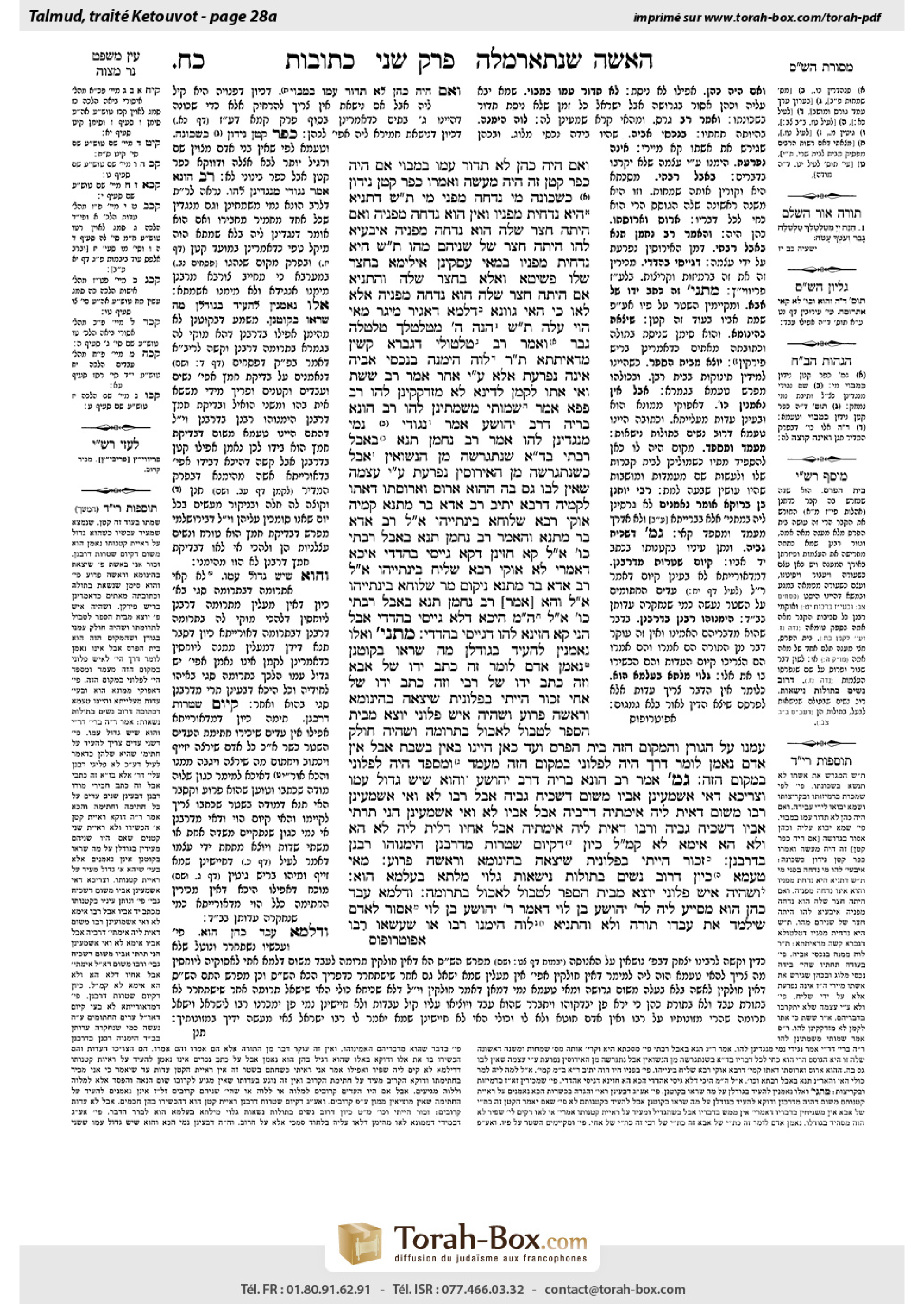
This page of Ketubot includes the Aramaic text, an English translation and an AI-generated French translation, alongside the scan above.
כתובות כ״ח א · Aramaic and Hebrew text
וְאִם הָיָה כֹּהֵן — לֹא תָּדוּר עִמּוֹ בְּמָבוֹי. אִם הָיָה כְּפָר קָטָן — זֶה הָיָה מַעֲשֶׂה וְאָמְרוּ: כְּפָר קָטָן נִידּוֹן כִּשְׁכוּנָה.
מִי נִדְחֶה מִפְּנֵי מִי? תָּא שְׁמַע, דְּתַנְיָא: הִיא נִדְחֵית מִפָּנָיו, וְאֵין הוּא נִדְחֶה מִפָּנֶיהָ. וְאִם הָיְתָה חָצֵר שֶׁלָּהּ — הוּא נִדְחֶה מִפָּנֶיהָ.
אִיבַּעְיָא לְהוּ: הָיְתָה חָצֵר שֶׁל שְׁנֵיהֶם, מַהוּ? תָּא שְׁמַע: הִיא נִדְחֵית מִפָּנָיו. בְּמַאי עָסְקִינַן? אִילֵימָא בְּחָצֵר שֶׁלּוֹ, פְּשִׁיטָא! וְאֶלָּא בְּחָצֵר שֶׁלָּהּ, וְהָתַנְיָא: אִם הָיְתָה חָצֵר שֶׁלָּהּ — הוּא נִדְחֶה מִפָּנֶיהָ. אֶלָּא לָאו כִּי הַאי גַוְונָא, דִּלְמָא דַּאֲגִיר מֵיגָר.
מַאי הָוֵי עֲלַהּ? תָּא שְׁמַע: ״הִנֵּה ה׳ מְטַלְטֶלְךָ טַלְטֵלָה גָּבֶר״, וְאָמַר רַב: טִלְטוּלָא דְגַבְרָא קָשֵׁי מִדְּאִיתְּתָא.
תָּנוּ רַבָּנַן: לָוָה הֵימֶנָּה בְּנִכְסֵי אָבִיהָ — אֵינָהּ נִפְרַעַת אֶלָּא עַל יְדֵי אַחֵר. אָמַר רַב שֵׁשֶׁת: וְאִי אָתוּ לְקַמַּן לְדִינָא, לָא מִזְדַּקְקִינַן לְהוּ. רַב פָּפָּא אָמַר: שַׁמּוֹתֵי מְשַׁמְּתִינַן לְהוּ. רַב הוּנָא בְּרֵיהּ דְּרַב יְהוֹשֻׁעַ אָמַר: נַגּוֹדֵי נָמֵי מְנַגְּדִינַן לְהוּ. אָמַר רַב נַחְמָן: תָּנָא בְּאֵבֶל רַבָּתִי: בַּמֶּה דְּבָרִים אֲמוּרִים — שֶׁנִּתְגָּרְשָׁה מִן הַנִּשּׂוּאִין, אֲבָל כְּשֶׁנִּתְגָּרְשָׁה מִן הָאֵירוּסִין, נִפְרַעַת עַל יְדֵי עַצְמָהּ — שֶׁאֵין לִבּוֹ גַּס בָּהּ.
הָהוּא אָרוּס וַאֲרוּסָתוֹ דַּאֲתוֹ לְקַמֵּיהּ דְּרָבָא. יְתֵיב רַב אַדָּא בַּר מַתְנָא קַמֵּיהּ. אוֹקִי רָבָא שְׁלוּחָא בֵּינְתַיְיהוּ. אֲמַר לֵיהּ רַב אַדָּא בַּר מַתְנָא, וְהָאָמַר רַב נַחְמָן: תָּנָא בְּאֵבֶל רַבָּתִי כּוּ׳. אֲמַר לֵיהּ: קָא חָזֵינָא דְּ(קָא) גָּיְיסִי בַּהֲדָדֵי.
אִיכָּא דְאָמְרִי: לָא אוֹקִי רָבָא שָׁלִיחַ בֵּינְתַיְיהוּ. אֲמַר לֵיהּ רַב אַדָּא בַּר מַתְנָא: נֹיקֵום מָר שְׁלוּחָא בֵּינְתַיְיהוּ, אֲמַר לֵיהּ: וְהָא [אָמַר] רַב נַחְמָן תָּנָא בְּאֵבֶל רַבָּתִי כּוּ׳. אֲמַר לֵיהּ: הָנֵי מִילֵּי, הֵיכָא דְּלָא גָּיְיסִי בַּהֲדָדֵי, אֲבָל הָנֵי — קָא חָזֵינָא לְהוּ דְּגָיְיסִי בַּהֲדָדֵי.
מַתְנִי׳ וְאֵלּוּ נֶאֱמָנִין לְהָעִיד בְּגוֹדְלָן מַה שֶּׁרָאוּ בְּקוֹטְנָן. נֶאֱמָן אָדָם לוֹמַר: ״זֶה כְּתַב יָדוֹ שֶׁל אַבָּא״, וְ״זֶה כְּתַב יָדוֹ שֶׁל רַבִּי״, וְ״זֶה כְּתַב יָדוֹ שֶׁל אָחִי״.
״זָכוּר הָיִיתִי בִּפְלוֹנִית שֶׁיָּצְאָה בְּהִינוּמָא וְרֹאשָׁהּ פָּרוּעַ״, וְ״שֶׁהָיָה אִישׁ פְּלוֹנִי יוֹצֵא מִבֵּית הַסֵּפֶר לִטְבּוֹל, לֶאֱכוֹל בִּתְרוּמָה״. וְ״שֶׁהָיָה חוֹלֵק עִמָּנוּ עַל הַגּוֹרֶן״. וְ״הַמָּקוֹם הַזֶּה בֵּית הַפְּרָס״. וְ״עַד כָּאן הָיִינוּ בָּאִין בַּשַּׁבָּת״.
אֲבָל אֵין אָדָם נֶאֱמָן לוֹמַר ״דֶּרֶךְ הָיָה לִפְלוֹנִי בַּמָּקוֹם הַזֶּה״, ״מַעֲמָד וּמִסְפֵּד הָיָה לִפְלוֹנִי בַּמָּקוֹם הַזֶּה״.
גְּמָ׳ אָמַר רַב הוּנָא בְּרֵיהּ דְּרַב יְהוֹשֻׁעַ: וְהוּא שֶׁיֵּשׁ גָּדוֹל עִמּוֹ.
וּצְרִיכָא. דְּאִי אַשְׁמְעִינַן אָבִיו — מִשּׁוּם דִּשְׁכִיחַ גַּבֵּיהּ, אֲבָל רַבּוֹ — לָא. וְאִי אַשְׁמְעִינַן רַבּוֹ, מִשּׁוּם דְּאִית לֵיהּ אֵימְתֵיהּ דְּרַבֵּיהּ, אֲבָל אָבִיו — לָא.
וְאִי אַשְׁמְעִינַן הָנֵי תַּרְתֵּי: אָבִיו — דִּשְׁכִיחַ גַּבֵּיהּ, וְרַבּוֹ — דְּאִית לֵיהּ אֵימְתֵיהּ, אֲבָל אָחִיו דְּלֵית לֵיהּ לָא הָא וְלָא הָא — אֵימָא לָא, קָא מַשְׁמַע לַן: כֵּיוָן דְּקִיּוּם שְׁטָרוֹת מִדְּרַבָּנַן, הֵימְנוּהוּ רַבָּנַן בִּדְרַבָּנַן.
״זָכוּר הָיִיתִי בִּפְלוֹנִית שֶׁיָּצְאָה בְּהִינוּמָא וְרֹאשָׁהּ פָּרוּעַ״. מַאי טַעְמָא — כֵּיוָן דְּרוֹב נָשִׁים בְּתוּלוֹת נִישָּׂאוֹת, גִּלּוּי מִלְּתָא בְּעָלְמָא הוּא.
וְ״שֶׁהָיָה אִישׁ פְּלוֹנִי יוֹצֵא מִבֵּית הַסֵּפֶר לִטְבּוֹל, לֶאֱכוֹל בִּתְרוּמָה״. וְדִלְמָא עֶבֶד כֹּהֵן הוּא? מְסַיַּיע לֵיהּ לְרַבִּי יְהוֹשֻׁעַ בֶּן לֵוִי. דְּאָמַר רַבִּי יְהוֹשֻׁעַ בֶּן לֵוִי: אָסוּר לְאָדָם שֶׁיְּלַמֵּד אֶת עַבְדּוֹ תּוֹרָה.
וְלָא? וְהָתַנְיָא: לָוָה הֵימֶנּוּ רַבּוֹ, אוֹ שֶׁעֲשָׂאוֹ רַבּוֹ
Ketubot 28a · English translation
And if he was a priest she may not live with him even in one alleyway that opens into several courtyards, even if she did not remarry, as she is forbidden to him forever. What is the ruling if it was a small village? May she live with her ex-husband in the same village? The Gemara relates that this case of his divorcée and a small village was an incident that transpired and the Sages said: A small village is judged as his immediate proximity.
The Gemara asks: In cases where they may not reside in the same courtyard or alleyway, who is ousted in favor of whom? Which of them must leave? The Gemara suggests: Come and hear proof as it is taught in a baraita: She is ousted in favor of him, and leaves, and he is not ousted in favor of her. But if it was her courtyard, he is ousted in favor of her.
A dilemma was raised before the Sages: If it was a courtyard belonging to both of them, what is the halakha; who is ousted in favor of whom? The Gemara suggests: Come and hear proof as it is taught in a baraita: She is ousted in favor of him. The Gemara elaborates: With what circumstances are we dealing? If we say that the subject of the baraita is with regard to his courtyard, it is obvious that she is ousted. But rather, is it with regard to her courtyard? Isn’t it taught in a baraita: If it was her courtyard, he is ousted in favor of her? Rather, is it not that the baraita is dealing with a case like this, where it was a courtyard belonging to both of them? The Gemara rejects this proof: Perhaps the baraita is teaching that even in a case where he rented the courtyard she is ousted in his favor. Therefore, the dilemma with regard to a courtyard belonging to both of them is unresolved.
The Gemara asks: What halakhic conclusion was reached about this matter? The Gemara suggests: Come and hear proof from the verse: “The Lord will dislocate you the dislocation of a man” (Isaiah 22:17), and Rav said: This indicates that the dislocation of a man is more difficult for him than the dislocation of a woman is for her. Therefore, the woman is ousted.
The Sages taught: With regard to a priest who borrowed from his wife from usufruct property that she inherited from her father and then he divorced her, she is repaid only by means of another person and not directly from her husband, to prevent them from engaging in business dealings. Rav Sheshet said: And if after engaging in business dealings they came before us for judgment, we do not attend to them because by engaging in those dealings they were in violation of a transgression. Rav Pappa said: We excommunicate them for violating that transgression. Rav Huna, the son of Rav Yehoshua, said: We also flog them with lashes. Rav Naḥman said: The tanna taught in Evel Rabbati, one of the minor tractates that deals primarily with the halakhot of mourning: In what case is this statement said? It is in a case where she was divorced from marriage. However, when she was divorced from betrothal, she is repaid even directly by means of receiving the money herself, because, in that case, he is not yet accustomed to her. Since they never shared intimacy, there is no concern that it will lead to transgression.
The Gemara relates: There was an incident concerning this divorced, betrothed man and his betrothed who came before Rava for judgment, and Rav Adda bar Mattana was sitting before him at the time. Rava placed an intermediary to separate between them. Rav Adda bar Mattana said to Rava: But didn’t Rav Naḥman say: The tanna taught in Evel Rabbati that if she was divorced from betrothal she is paid directly? Rava said to him: This applies only in a case where they are not accustomed to each other. However, with regard to these people, we see that they are accustomed to each other, and therefore they must be separated.
Some say that Rava did not place an intermediary to separate between them. Rav Adda bar Mattana said to Rava: Let the Master place an intermediary to separate between them. Rava said to Rav Adda bar Mattana: But didn’t Rav Naḥman say: The tanna taught in Evel Rabbati that if she was divorced from betrothal she is paid directly? Rav Adda bar Mattana said to Rava: This applies only in a case where they are not accustomed to each other. However, with regard to these people, we see that they are accustomed to each other, and therefore they must be separated.
MISHNA: And these are deemed credible to testify in their majority with regard to what they saw in their minority. A person is deemed credible to say: This is my father’s handwriting, and to say: This is my teacher’s handwriting; and to say: This is my brother’s handwriting, even though he never saw their handwriting after reaching majority.
§ Similarly, one is deemed credible to say: I was reminded of the wedding of so-and-so, who went out with a hinnuma, or with her hair uncovered in a manner typical of virgins, and therefore, her marriage contract is two hundred dinars; and to say that so-and-so would leave school to immerse in order to partake of teruma, and that he would share teruma with us at the threshing floor and therefore he is a priest. Similarly, one is deemed credible to say: This place is a beit haperas, a field with a grave that was plowed, scattering the bones, and rendering the field a place of uncertain ritual impurity; and to say: Until here we would come on Shabbat and thereby determine the Shabbat boundary.
However, a person is neither deemed credible to say: So-and-so had a path in this place; nor to say: So-and-so had a tract of land where they would perform the ritual of standing and sitting and deliver a eulogy in that place, thereby attesting that the land belongs to that person. The reason he is not deemed credible in those cases is that full-fledged testimony is required to remove property from the possession of its presumptive owner.
GEMARA: Rav Huna, son of Rav Yehoshua, said: And the mishna said that one is deemed credible to testify about handwriting he saw as a minor only when there is a witness who saw the handwriting as an adult testifying with him.
And all of these cases are necessary, as one could not have been derived from the other. As, if the tanna had taught us the case of his father’s handwriting, one might have thought that he is deemed credible due to the fact that he is often found with his father and is familiar with his handwriting; but with regard to his teacher’s handwriting, no, he is not deemed credible. And if the tanna had taught us the case of his teacher’s handwriting, one might have thought that he is deemed credible due to the fact that he has a sense of awe of his teacher and therefore pays attention to his handwriting; but with regard to his father’s handwriting, no, he is not deemed credible.
And if the tanna had taught us these two cases, one might have thought that he is deemed credible with regard to his father’s handwriting due to the fact that he is often found with him, and his teacher’s handwriting due to the fact that he has a sense of awe of him. But with regard to his brother’s handwriting, which has neither this factor nor that factor, say no, he is not deemed credible. Therefore, the tanna teaches us: Since ratification of documents is required by rabbinic law, as by Torah law, the signatories are sufficient proof of a document’s validity; the Sages deemed him credible to testify in cases that he witnessed as a minor in matters that are by rabbinic law, including the case of his brother.
And the mishna states that one is deemed credible to say: I was reminded of the wedding of so-and-so, who went out with a hinnuma, or with her hair uncovered. What is the reason that he is deemed credible? Since most women are married as virgins, her presumptive status is that of a virgin even without his testimony. His testimony with regard to what he saw as a minor is merely revealing of a matter already presumed true, not actual testimony.
And the mishna states that one is deemed credible to say that so-and-so would leave school to immerse in order to partake of teruma, and therefore he is a priest. The Gemara asks: And perhaps he is the slave of a priest, who is also eligible to partake of teruma. The Gemara notes: This mishna provides support for the opinion of Rabbi Yehoshua ben Levi, as Rabbi Yehoshua ben Levi said: It is prohibited for a person to teach his slave Torah. Since the testimony is that he was in school, apparently he is not a slave. Therefore, the fact that he partook of teruma indicates that he is a priest.
The Gemara asks: And may one not teach his slave Torah? But isn’t it taught in a baraita: A slave whose master borrowed from him, or whose master made him
Ketubot 28a · Traduction française (IA)
Et s’il était prêtre, elle ne peut pas habiter avec lui, même dans une ruelle donnant sur plusieurs cours, même si elle ne s’est pas remariée, car elle lui est interdite à jamais. Que se passe-t-il si c’est un petit village ? Peut-elle habiter dans le même village que son ex-mari ? La Guemara rapporte que le cas d’un homme et de son ex-femme dans un petit village s’est effectivement présenté, et les Sages ont dit : Un petit village est considéré comme étant à proximité immédiate de lui.
La Guemara demande : Dans les cas où ils ne peuvent pas habiter dans la même cour ou la même ruelle, qui doit céder la place à l’autre ? Lequel des deux doit partir ? La Guemara propose : Viens et entends une preuve, car il est enseigné dans une baraïta : Elle doit céder la place à lui et partir, tandis que lui n’a pas à céder la place à elle. Mais si la cour lui appartenait, c’est lui qui doit céder la place à elle.
Un dilemme fut soumis aux Sages : si la cour leur appartenait à tous les deux, quelle est la halakha ? Qui doit céder la place à l’autre ? La Guemara propose : Viens et entends une preuve, car il est enseigné dans une baraïta : Elle doit céder la place à lui. La Guemara précise : De quelles circonstances s’agit-il ? Si nous disons que la baraïta parle de sa cour à lui, il est évident qu’elle doit céder la place. Mais alors, s’agit-il de sa cour à elle ? N’est-il pas enseigné dans une baraïta que, si la cour lui appartenait, c’est lui qui doit céder la place à elle ? Ne s’agit-il donc pas d’un cas comme celui-ci, où la cour leur appartenait à tous les deux ? La Guemara rejette cette preuve : peut-être la baraïta enseigne-t-elle que, même dans le cas où il a loué la cour, elle doit céder la place à lui. Le dilemme concernant une cour qui leur appartient à tous les deux reste donc sans réponse.
La Guemara demande : Quelle conclusion halakhique a-t-on tirée à ce sujet ? La Guemara propose : Viens et entends une preuve tirée du verset : « Le Seigneur te fera rouler comme un homme roule » (Isaïe 22,17). Rav a dit que cela indique que le déplacement d’un homme est plus difficile pour lui que celui d’une femme pour elle. Par conséquent, c’est la femme qui doit partir.
Les Sages ont enseigné : Lorsqu’un prêtre a emprunté à sa femme de l’argent provenant de biens dont elle avait hérité de son père et dont elle percevait les revenus, puis qu’il a divorcé d’elle, elle ne peut être remboursée que par l’intermédiaire d’une autre personne, et non directement par son mari, afin d’éviter qu’ils ne fassent des affaires ensemble. Rav Sheshet a dit : Si, après avoir fait des affaires ensemble, ils se présentent devant nous pour être jugés, nous ne nous occupons pas de leur cas, car ils ont transgressé une interdiction en faisant ces affaires. Rav Pappa a dit : Nous les mettons au ban pour cette transgression. Rav Huna, fils de Rav Yehoshua, a dit : Nous les faisons aussi flageller. Rav Naḥman a dit : Le tanna a enseigné dans Evel Rabbati, l’un des traités mineurs qui traite principalement des halakhot du deuil : Dans quel cas cette règle s’applique-t-elle ? Lorsqu’elle a été divorcée après le mariage. En revanche, lorsqu’elle a été divorcée après les fiançailles, elle peut être remboursée directement, en recevant elle-même l’argent, car, dans ce cas, il n’a pas encore pris l’habitude d’être avec elle. Puisqu’ils n’ont jamais eu de relations intimes, on ne craint pas que cela les conduise à transgresser.
La Guemara rapporte : Un cas concernant cet homme divorcé de sa fiancée et celle-ci fut soumis à Rava, qui devait le juger ; Rav Adda bar Mattana était alors assis devant lui. Rava plaça un intermédiaire entre eux pour les séparer. Rav Adda bar Mattana dit à Rava : Mais Rav Naḥman n’a-t-il pas dit que le tanna a enseigné dans Evel Rabbati que, si elle a été divorcée après les fiançailles, elle est remboursée directement ? Rava lui répondit : Cela ne s’applique que lorsqu’ils n’ont pas l’habitude d’être ensemble. Mais, dans le cas de ces personnes, nous voyons qu’elles en ont l’habitude ; il faut donc les séparer.
Selon certains, Rava ne plaça pas d’intermédiaire entre eux pour les séparer. Rav Adda bar Mattana dit à Rava : Que le Maître place un intermédiaire entre eux pour les séparer. Rava dit à Rav Adda bar Mattana : Mais Rav Naḥman n’a-t-il pas dit que le tanna a enseigné dans Evel Rabbati que, si elle a été divorcée après les fiançailles, elle est remboursée directement ? Rav Adda bar Mattana dit à Rava : Cela ne s’applique que lorsqu’ils n’ont pas l’habitude d’être ensemble. Mais, dans le cas de ces personnes, nous voyons qu’elles en ont l’habitude ; il faut donc les séparer.
MICHNA : Voici les personnes dont on accepte le témoignage, une fois adultes, au sujet de ce qu’elles ont vu lorsqu’elles étaient mineures. Une personne est crue lorsqu’elle dit : « C’est l’écriture de mon père », « C’est l’écriture de mon maître » ou « C’est l’écriture de mon frère », même si elle n’a jamais vu leur écriture après avoir atteint l’âge adulte.
§ De même, une personne est crue lorsqu’elle dit : « Je me suis souvenu du mariage d’untel, qui est sortie avec une hinnuma ou les cheveux découverts, comme il est d’usage chez les vierges », et que son contrat de mariage s’élève donc à deux cents dinars ; ou lorsqu’elle dit qu’untel quittait l’école pour s’immerger afin de consommer de la terouma et qu’il partageait de la terouma avec nous à l’aire de battage, ce qui indique qu’il est prêtre. De même, une personne est crue lorsqu’elle dit : « Cet endroit est un beit haperas », c’est-à-dire un champ où se trouvait une tombe qui a été labourée, dispersant les ossements et rendant le champ sujet à une incertitude quant à son impureté rituelle ; ou lorsqu’elle dit : « Nous venions jusqu’ici le Chabbat », indiquant ainsi la limite du Chabbat.
En revanche, une personne n’est pas crue lorsqu’elle dit : « Untel avait un chemin à cet endroit », ni lorsqu’elle dit : « Untel possédait une parcelle de terre où l’on accomplissait le rite consistant à se tenir debout puis à s’asseoir et à prononcer une oraison funèbre », attestant ainsi que cette terre lui appartient. Dans ces cas, son témoignage n’est pas accepté, car un témoignage en bonne et due forme est nécessaire pour retirer un bien de la possession de celui qui est présumé en être le propriétaire.
GUEMARA : Rav Huna, fils de Rav Yehoshua, a dit : La Michna enseigne qu’une personne est crue lorsqu’elle témoigne au sujet d’une écriture qu’elle a vue étant mineure uniquement si un témoin qui l’a vue à l’âge adulte témoigne avec elle.
Tous ces cas sont nécessaires, car aucun ne pouvait être déduit des autres. En effet, si le tanna nous avait enseigné le cas de l’écriture de son père, on aurait pu penser qu’il est cru parce qu’il se trouve souvent auprès de son père et connaît son écriture ; mais, pour l’écriture de son maître, non, il ne serait pas cru. Et si le tanna nous avait enseigné le cas de l’écriture de son maître, on aurait pu penser qu’il est cru parce qu’il éprouve de la crainte révérencielle envers son maître et prête donc attention à son écriture ; mais, pour l’écriture de son père, non, il ne serait pas cru.
Et si le tanna nous avait enseigné ces deux cas, on aurait pu penser qu’il est cru pour l’écriture de son père parce qu’il se trouve souvent auprès de lui, et pour celle de son maître parce qu’il éprouve de la crainte révérencielle envers lui. Mais, pour l’écriture de son frère, qui ne présente ni l’un ni l’autre de ces facteurs, on aurait pu penser qu’il n’est pas cru. Le tanna nous enseigne donc ceci : puisque la validation des actes est exigée par la loi rabbinique, alors qu’en vertu de la Torah écrite les signatures suffisent à prouver la validité d’un acte, les Sages l’ont jugé digne de foi pour témoigner, dans des affaires relevant de la loi rabbinique, au sujet de ce qu’il a vu étant mineur, y compris dans le cas de l’écriture de son frère.
Et la Michna enseigne qu’une personne est crue lorsqu’elle dit : « Je me suis souvenu du mariage d’untel, qui est sortie avec une hinnuma ou les cheveux découverts. » Pourquoi son témoignage est-il accepté ? Puisque la plupart des femmes se marient vierges, elle est présumée vierge même sans son témoignage. Son témoignage au sujet de ce qu’elle a vu étant mineure ne fait que révéler une chose déjà présumée vraie ; il ne constitue donc pas un véritable témoignage.
Et la Michna enseigne qu’une personne est crue lorsqu’elle dit qu’untel quittait l’école pour s’immerger afin de consommer de la terouma, ce qui indique qu’il est prêtre. La Guemara demande : Peut-être est-il l’esclave d’un prêtre, qui est lui aussi autorisé à consommer de la terouma ? La Guemara relève que cette Michna vient à l’appui de l’opinion de Rabbi Yehoshua ben Levi, car Rabbi Yehoshua ben Levi a dit : Il est interdit d’enseigner la Torah à son esclave. Puisque le témoignage indique qu’il se trouvait à l’école, il n’est apparemment pas un esclave. Par conséquent, le fait qu’il consommait de la terouma indique qu’il est prêtre.
La Guemara demande : Ne peut-on donc pas enseigner la Torah à son esclave ? N’est-il pas enseigné dans une baraïta : Un esclave dont le maître a emprunté auprès de lui, ou dont le maître l’a fait
Traduction française générée par IA à partir de l’édition anglaise de Sefaria. Vérifie toujours un passage avec le texte source.
Text from Sefaria: William Davidson Edition - Vocalized Aramaic (CC BY NC); William Davidson Edition - English (CC BY NC).