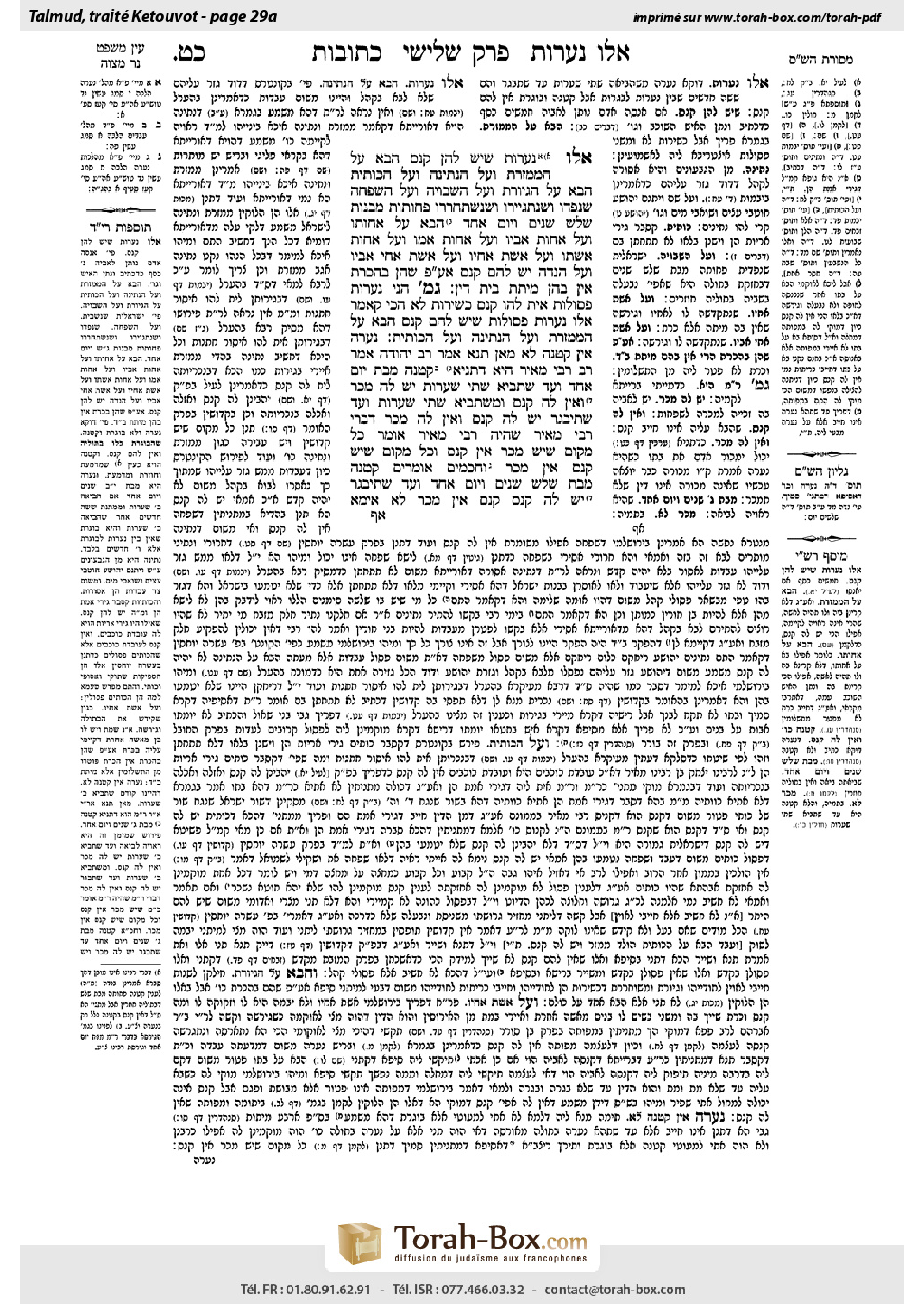
Ketubot 29a: Talmud study for Daf Yomi
Daf Yomi is the daily study of one Talmud folio. Explore 37 tractates with scans, Hebrew text, Sefaria English and AI-generated French translations where annotated.
Passage selection and English or AI-generated French translation are available where the scan has annotations. Daf Study is independent of Torah-Box and Sefaria.
Browse Ketubot · כתובות · All tractatesKetubot 29a text and translations
This page of Ketubot includes the Aramaic text, an English translation and an AI-generated French translation, alongside the scan above.
כתובות כ״ט א · Aramaic and Hebrew text
אֵלּוּ נְעָרוֹת שֶׁיֵּשׁ לָהֶן קְנָס: הַבָּא עַל הַמַּמְזֶרֶת וְעַל הַנְּתִינָה וְעַל הַכּוּתִית, הַבָּא עַל הַגִּיּוֹרֶת וְעַל הַשְּׁבוּיָה וְעַל הַשִּׁפְחָה שֶׁנִּפְדּוּ וְשֶׁנִּתְגַּיְּירוּ וְשֶׁנִּשְׁתַּחְרְרוּ, פְּחוּתוֹת מִבְּנוֹת שָׁלֹשׁ שָׁנִים וְיוֹם אֶחָד.
הַבָּא עַל אֲחוֹתוֹ, וְעַל אֲחוֹת אָבִיו, וְעַל אֲחוֹת אִמּוֹ, וְעַל אֲחוֹת אִשְׁתּוֹ, וְעַל אֵשֶׁת אָחִיו, וְעַל אֵשֶׁת אֲחִי אָבִיו, וְעַל הַנִּדָּה — יֵשׁ לָהֶם קְנָס, אַף עַל פִּי שֶׁהֵן בְּהִכָּרֵת — אֵין בָּהֶן מִיתַת בֵּית דִּין.
גְּמָ׳ הָנֵי נְעָרוֹת, פְּסוּלוֹת אִית לְהוּ קְנָס, כְּשֵׁירוֹת לָא?! הָכִי קָאָמַר: אֵלּוּ נְעָרוֹת פְּסוּלוֹת שֶׁיֵּשׁ לָהֶם קְנָס — הַבָּא עַל הַמַּמְזֶרֶת וְעַל הַנְּתִינָה וְעַל הַכּוּתִית.
נַעֲרָה אִין, קְטַנָּה לָא. מַאן תַּנָּא?
אָמַר רַב יְהוּדָה אָמַר רַב: רַבִּי מֵאִיר הִיא. דְּתַנְיָא: קְטַנָּה מִבַּת יוֹם אֶחָד וְעַד שֶׁתָּבִיא שְׁתֵּי שְׂעָרוֹת — יֵשׁ לָהּ מֶכֶר וְאֵין לָהּ קְנָס. וּמִשֶּׁתָּבִיא שְׁתֵּי שְׂעָרוֹת וְעַד שֶׁתִּיבְגַּר — יֵשׁ לָהּ קְנָס וְאֵין לָהּ מֶכֶר. דִּבְרֵי רַבִּי מֵאִיר. שֶׁהָיָה רַבִּי מֵאִיר אוֹמֵר: כׇּל מָקוֹם שֶׁיֵּשׁ מֶכֶר — אֵין קְנָס, וְכׇל מָקוֹם שֶׁיֵּשׁ קְנָס — אֵין מֶכֶר.
וַחֲכָמִים אוֹמְרִים: קְטַנָּה מִבַּת שָׁלֹשׁ שָׁנִים וְיוֹם אֶחָד וְעַד שֶׁתִּיבְגַּר — יֵשׁ לָהּ קְנָס. קְנָס אִין, מֶכֶר לָא?! אֵימָא:
Ketubot 29a · English translation
MISHNA: These are the cases of young women for whom there is a fine paid to their fathers by one who rapes them: One who engages in intercourse with a mamzeret, or with a Gibeonite woman [netina], who are given [netunim] to the service of the people and the altar (see Joshua 9:27), or with a Samaritan woman [kutit]. In addition, the same applies to one who engages in intercourse with a female convert, or with a captive woman, or with a maidservant, provided that the captives were ransomed, or that the converts converted, or that the maidservants were liberated when they were less than three years and one day old, as only in that case do they maintain the presumptive status of a virgin.
Similarly, one who engages in intercourse with his sister, i.e., he rapes her, or with his father’s sister, or with his mother’s sister, or with his wife’s sister, or with his brother’s wife, or with his father’s brother’s wife after they divorced, or with a menstruating woman, there is a fine paid. Although there is karet for engaging in relations with any of the women enumerated in this list, one is liable to pay the fine because there is no court-imposed capital punishment. In cases where there is a court-imposed death penalty, the rapist would be exempt from paying the fine.
GEMARA: The Gemara wonders: Is it these young women with flawed lineage listed in the mishna, for whom there is a fine paid if they are raped, while for young women with unflawed lineage, no, there is no fine? The Gemara explains that this is what the tanna is saying: These are the young women with flawed lineage for whom there is a fine paid if they are raped. This is not a comprehensive list; rather, the tanna enumerates those young women for whom a fine is paid despite their flawed lineage: One who has relations with a mamzeret, or with a Gibeonite woman, or with a Samaritan woman.
The mishna teaches the halakha with regard to a young woman, from which the Gemara infers: With regard to a young woman, yes, one is liable to pay the fine if he rapes her, but with regard to a minor, no, one is not liable to pay the fine. Who is the tanna who maintains that one is liable for raping a young woman but not a minor?
Rav Yehuda said that Rav said: The tanna is Rabbi Meir, as it is taught in a baraita: With regard to a minor from the age of one day old until she grows two pubic hairs, there is the possibility of sale for her, as her father may sell her as a Hebrew maidservant, but there is no fine paid for her if she is raped. And once she grows two pubic hairs, from that point until she matures into a grown woman there is a fine for her, as during that period she is a young woman, with regard to whom the Torah law of a rapist and a seducer applies, but there is no possibility of sale for her. Once she grows two hairs she is no longer under her father’s control and can no longer be sold. This is the statement of Rabbi Meir, as Rabbi Meir would state a principle: Any place where there is a sale, there is no fine; and any place where there is a fine, there is no sale.
And the Rabbis say: With regard to a minor from the age of three years and one day old until she matures into a grown woman, there is a fine for her. The Gemara asks: Is that to say that a fine, yes, there is, but a sale, no, there is not? Do the Rabbis maintain that the father has no right to sell his minor daughter? The Gemara emends the text: Say:
Ketubot 29a · Traduction française (IA)
Michna : Voici les cas de jeunes filles pour lesquelles une amende est versée à leurs pères par celui qui les viole : celui qui a des rapports avec une mamzèret, ou avec une femme gibeonite [netina], qui sont données [netunim] au service du peuple et de l'autel (voir Josué 9:27), ou avec une femme samaritaine [kutit]. De plus, la même règle s'applique à celui qui a des rapports avec une femme convertie, ou avec une femme captive, ou avec une servante, à condition que les captives aient été rachetées, ou que les converties aient effectué leur conversion, ou que les servantes aient été libérées alors qu'elles avaient moins de trois ans et un jour, car c'est seulement dans ce cas qu'elles conservent le statut présumé de vierge.
De même, celui qui a des rapports avec sa sœur, c'est-à-dire qu'il la viole, ou avec la sœur de son père, ou avec la sœur de sa mère, ou avec la sœur de sa femme, ou avec la femme de son frère, ou avec la femme du frère de son père après leur divorce, ou avec une femme en période menstruelle, une amende est versée. Bien qu'il y ait une peine de karet pour avoir des rapports avec l'une des femmes énumérées dans cette liste, on est tenu de payer l'amende car il n'y a pas de peine capitale imposée par le tribunal. Dans les cas où il y a une peine de mort imposée par le tribunal, le violeur serait exempté du paiement de l'amende.
Guemara : La Guemara s'étonne : S'agit-il de ces jeunes filles de lignée défectueuse énumérées dans la Michna, pour lesquelles une amende est versée si elles sont violées, tandis que pour les jeunes filles de lignée irréprochable, non, il n'y a pas d'amende ? La Guemara explique que c'est ce que le tanna dit : Voici les jeunes filles de lignée défectueuse pour lesquelles une amende est versée si elles sont violées. Ce n'est pas une liste exhaustive ; plutôt, le tanna énumère ces jeunes filles pour lesquelles une amende est versée malgré leur lignée défectueuse : celui qui a des rapports avec une mamzèret, ou avec une femme gibeonite, ou avec une femme samaritaine.
La Michna enseigne la halakha concernant une jeune fille, d'où la Guemara infère : Concernant une jeune fille, oui, on est tenu de payer l'amende s'il la viole, mais concernant une mineure, non, on n'est pas tenu de payer l'amende. Qui est le tanna qui soutient qu'on est tenu de payer l'amende pour le viol d'une jeune fille, mais pas pour celui d'une mineure ?
Rav Yehouda a dit que Rav a dit : Le tanna est Rabbi Meïr, car il est enseigné dans une baraïta : Concernant une mineure, de l'âge d'un jour jusqu'à ce qu'elle fasse pousser deux poils pubiens, il y a la possibilité de vente pour elle, car son père peut la vendre comme servante hébraïque, mais il n'y a pas d'amende à payer pour elle si elle est violée. Et dès qu'elle fait pousser deux poils pubiens, de ce moment jusqu'à ce qu'elle devienne une femme adulte, il y a une amende pour elle, car pendant cette période elle est une jeune fille, à qui s'applique la loi de la Torah concernant le violeur et le séducteur, mais il n'y a pas de possibilité de vente pour elle. Dès qu'elle fait pousser deux poils, elle n'est plus sous le contrôle de son père et ne peut plus être vendue. C'est l'opinion de Rabbi Meïr, car Rabbi Meïr énonce un principe : En tout lieu où il y a une vente, il n'y a pas d'amende ; et en tout lieu où il y a une amende, il n'y a pas de vente.
Et les Sages disent : Concernant une mineure, de l'âge de trois ans et un jour jusqu'à ce qu'elle devienne une femme adulte, il y a une amende pour elle. La Guemara demande : Est-ce à dire qu'une amende, oui, il y en a, mais une vente, non, il n'y en a pas ? Les Sages soutiennent-ils que le père n'a pas le droit de vendre sa fille mineure ? La Guemara corrige le texte : Dites :
Traduction française générée par IA à partir de l’édition anglaise de Sefaria. Vérifie toujours un passage avec le texte source.
Text from Sefaria: William Davidson Edition - Vocalized Aramaic (CC BY NC); William Davidson Edition - English (CC BY NC).