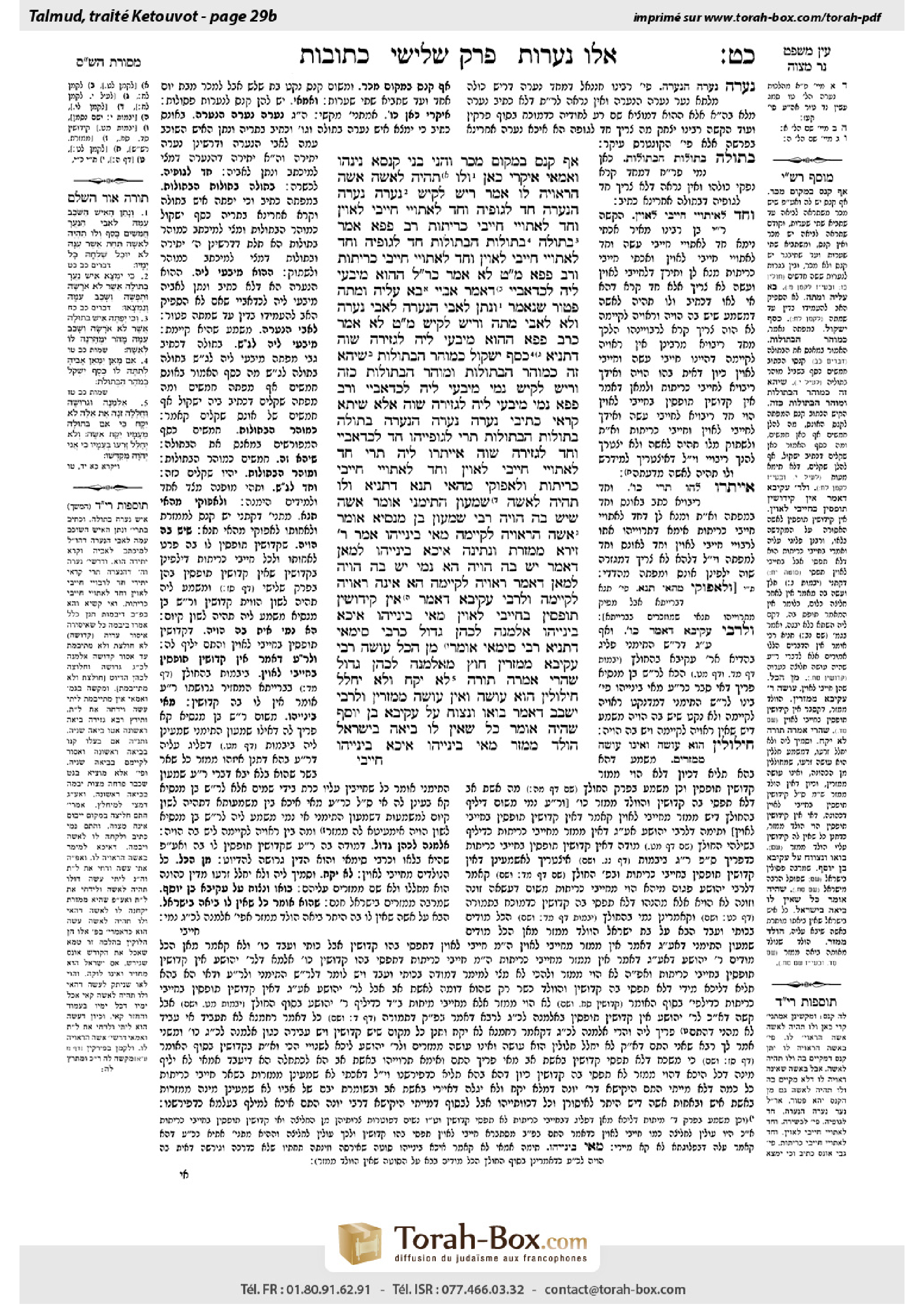
Ketubot 29b: Talmud study for Daf Yomi
Daf Yomi is the daily study of one Talmud folio. Explore 37 tractates with scans, Hebrew text, Sefaria English and AI-generated French translations where annotated.
Passage selection and English or AI-generated French translation are available where the scan has annotations. Daf Study is independent of Torah-Box and Sefaria.
Browse Ketubot · כתובות · All tractatesKetubot 29b text and translations
This page of Ketubot includes the Aramaic text, an English translation and an AI-generated French translation, alongside the scan above.
כתובות כ״ט ב · Aramaic and Hebrew text
אַף קְנָס בִּמְקוֹם מֶכֶר.
וְהָנֵי בְּנֵי קְנָסָא נִינְהוּ? וְאַמַּאי? אִיקְּרִי כָּאן: ״וְלוֹ תִּהְיֶה לְאִשָּׁה״, אִשָּׁה הָרְאוּיָה לוֹ! אָמַר רֵישׁ לָקִישׁ: ״נַעֲרָה״, ״נַעֲרָה״, ״הַנַּעֲרָה״. חַד לְגוּפֵיהּ, וְחַד לְאֵתוֹיֵי חַיָּיבֵי לָאוִין, וְחַד לְאֵתוֹיֵי חַיָּיבֵי כָרֵיתוֹת.
רַב פָּפָּא אָמַר: ״בְּתוּלָה״, ״בְּתוּלוֹת״, ״הַבְּתוּלוֹת״. חַד לְגוּפֵיהּ, וְחַד לְאֵתוֹיֵי חַיָּיבֵי לָאוִין, וְחַד לְאֵתוֹיֵי חַיָּיבֵי כָרֵיתוֹת.
וְרַב פָּפָּא מַאי טַעְמָא לָא אָמַר כְּרֵישׁ לָקִישׁ? הָהוּא מִיבְּעֵי לֵיהּ לְכִדְאַבָּיֵי. דְּאָמַר אַבָּיֵי: בָּא עָלֶיהָ וּמֵתָה — פָּטוּר, שֶׁנֶּאֱמַר: ״וְנָתַן לַאֲבִי הַנַּעֲרָה״. לַאֲבִי נַעֲרָה, וְלֹא לַאֲבִי מֵתָה.
וְרֵישׁ לָקִישׁ מַאי טַעְמָא לָא אָמַר כְּרַב פָּפָּא? הָהוּא מִיבְּעֵי לֵיהּ לִגְזֵירָה שָׁוָה. דְּתַנְיָא: ״כֶּסֶף יִשְׁקוֹל כְּמוֹהַר הַבְּתוּלוֹת״, שֶׁיְּהֵא זֶה כְּמוֹהַר הַבְּתוּלוֹת, וּמוֹהַר הַבְּתוּלוֹת כָּזֶה. וְרֵישׁ לָקִישׁ נָמֵי, מִיבְּעֵי לֵיהּ לְכִדְאַבָּיֵי. וְרַב פָּפָּא נָמֵי, מִיבְּעֵי לֵיהּ לִגְזֵירָה שָׁוָה!
אֶלָּא: שִׁיתָּא קְרָאֵי כְּתִיבִי? ״נַעֲרָה״ ״נַעֲרָה״ ״הַנַּעֲרָה״. ״בְּתוּלָה״ ״בְּתוּלוֹת״ ״הַבְּתוּלוֹת״, תְּרֵי לְגוּפַיְיהוּ, חַד לְכִדְאַבָּיֵי, וְחַד לִגְזֵירָה שָׁוָה. אִיַּיתַּרוּ לֵיהּ תְּרֵי. חַד — לְאֵתוֹיֵי חַיָּיבֵי לָאוִין, וְחַד — לְאֵתוֹיֵי חַיָּיבֵי כָרֵיתוֹת.
וּלְאַפּוֹקֵי מֵהַאי תַּנָּא, דְּתַנְיָא: ״וְלוֹ תִּהְיֶה לְאִשָּׁה״, שִׁמְעוֹן הַתִּימְנִי אוֹמֵר: אִשָּׁה שֶׁיֵּשׁ בָּהּ הֲוָיָה. רַבִּי שִׁמְעוֹן בֶּן מְנַסְיָא אוֹמֵר: אִשָּׁה הָרְאוּיָה לְקַיְּימָהּ.
מַאי בֵּינַיְיהוּ? אָמַר רַבִּי זֵירָא: מַמְזֶרֶת וּנְתִינָה אִיכָּא בֵּינַיְיהוּ. לְמַאן דְּאָמַר יֵשׁ בָּהּ הֲוָיָה, הָא נָמֵי יֵשׁ בָּהּ הֲוָיָה. לְמַאן דְּאָמַר רְאוּיָה לְקַיְּימָהּ, הָא אֵינָהּ רְאוּיָה לְקַיְּימָהּ.
וּלְרַבִּי עֲקִיבָא דְּאָמַר: אֵין קִידּוּשִׁין תּוֹפְסִין בְּחַיָּיבֵי לָאוִין, מַאי בֵּינַיְיהוּ! אִיכָּא בֵּינַיְיהוּ אַלְמָנָה לְכֹהֵן גָּדוֹל, כְּרַבִּי סִימַאי, דְּתַנְיָא: רַבִּי סִימַאי אוֹמֵר: מִן הַכֹּל עוֹשֶׂה רַבִּי עֲקִיבָא מַמְזֵרִין, חוּץ מֵאַלְמָנָה לְכֹהֵן גָּדוֹל. שֶׁהֲרֵי אָמְרָה תּוֹרָה: ״לֹא יִקַּח ... וְלֹא יְחַלֵּל״ — חִילּוּלִין הוּא עוֹשֶׂה, וְאֵין עוֹשֶׂה מַמְזֵרִין.
וּלְרַבִּי יְשֵׁבָב, דְּאָמַר: בּוֹאוּ וְנִצְוַח עַל עֲקִיבָא בֶּן יוֹסֵף, שֶׁהָיָה אוֹמֵר: כֹּל שֶׁאֵין לוֹ בִּיאָה בְּיִשְׂרָאֵל — הַוָּלָד מַמְזֵר. מַאי בֵּינַיְיהוּ? אִיכָּא בֵּינַיְיהוּ
Ketubot 29b · English translation
There is a fine even in a place where there is sale. That is, not only can a minor girl from the age of three be sold until she matures, but she also receives payment of the fine.
§ The Gemara questions the basic halakha that one who rapes young women of flawed lineage is liable to pay the fine: And are these young women entitled to the fine? But why? I read here with regard to a rapist: “And to him she shall be as a wife” (Deuteronomy 22:29), from which the Sages derived that only a wife who is suitable for him is eligible to receive payment of a fine from a rapist. Reish Lakish said that one verse states: “If a man finds a young woman” (Deuteronomy 22:28), and another states: “And he shall give to the father of the young woman” (Deuteronomy 22:29). This is tantamount to three mentions: Young woman, young woman, the young woman, as the superfluous definite article is interpreted as a third mention of the term. One mention is required to teach the matter itself, that one who rapes a young woman is liable to pay a fine; and one is to include payment of a fine to those young women for whose rape one is liable for violating prohibitions; and one is to include payment of a fine to those young women for whose rape one is liable to receive karet.
Rav Pappa said: This is derived from the halakha of the seducer, as the verses state: “And if a man seduce a virgin…he shall weigh money like the dowry of the virgins” (Exodus 22:15–16). This is tantamount to three mentions: Virgin, virgins, the virgins. One mention is required to teach the matter itself; and one is to include those young women for whose rape one is liable for violating prohibitions; and one is to include those young women for whom one who rapes them is liable to receive karet.
The Gemara asks: And Rav Pappa, what is the reason that he did not cite the source as Reish Lakish did? The Gemara answers: That derivation from the three instances of the term young woman is required by him to teach in accordance with that which Abaye said, as Abaye said: If one engaged in forced intercourse with a young woman and she died before he stood trial, he is exempt from paying the fine, as it is stated: “And he shall give to the father of the young woman” (Deuteronomy 22:29). From the fact that the verse does not simply say: To her father, it is inferred: To the father of the young woman and not to the father of a dead woman. He is liable only if the young woman is still alive.
The Gemara asks: And Reish Lakish, what is the reason that he did not cite the source as Rav Pappa did? The Gemara answers: That derivation from the three instances of the term virgin is required by him to derive a verbal analogy, as it is taught in a baraita that it is written with regard to a seducer: “He shall weigh [yishkol] money like the dowry of the virgins” (Exodus 22:16), from which it is derived that this fine of a seducer should be a sum of fifty sela like the dowry of the virgins specified in the case of a rapist; and the dowry of the virgins must be paid in sela like this fine of the seducer. Therefore, Reish Lakish holds that no additional matters may be derived from the term virgins. The Gemara asks: And for Reish Lakish too, isn’t it required by him to teach in accordance with that which Abaye said? And similarly, for Rav Pappa, isn’t it required by him to derive a verbal analogy?
Rather, there are six verses written, and both Reish Lakish and Rav Pappa derive matters from all of them. In the two passages discussing the rapist and the seducer, it is written: Young woman, young woman, the young woman; virgin, virgins, the virgins. Two mentions are required to teach the matters themselves, the basic halakhot of a rapist and a seducer; one mention is needed to teach in accordance with that which Abaye said; and one mention is necessary to derive a verbal analogy with regard to the dowry of virgins. Two mentions of the term remain for him; one is to include those young women for whose rape one is liable for violating prohibitions, and one is to include those young women for whom one who rapes them is liable to receive karet. Reish Lakish and Rav Pappa do not disagree; the derivation of each complements that of the other.
§ The Gemara comments: And the mishna comes to exclude the opinion of this tanna, as it is taught in a baraita that it is written: “And to him she shall be [tihye] as a wife” (Deuteronomy 22:29). Shimon HaTimni says: This is referring to a woman for whom there is betrothal [havaya]. If one betroths a woman with whom relations are punishable by karet, the betrothal does not take effect. Rabbi Shimon ben Menasya says: This is referring to a woman who is suitable for him to sustain, whom he need not divorce due to her flawed lineage.
The Gemara begins its analysis of the baraita with the question: What is the practical difference between the statements of Shimon HaTimni and Rabbi Shimon ben Menasya? The Gemara explains that Rabbi Zeira said: The difference between their opinions is with regard to a mamzeret or a Gibeonite woman, or any other woman who is forbidden but for whom betrothal takes effect. According to the one who said that the criterion is whether there is betrothal, for this woman there is also betrothal. If a Jewish man betroths a mamzeret or a Gibeonite woman, although it is prohibited to do so, the betrothal takes effect. However, according to the one who said that the criterion is whether the woman is suitable for him to sustain, this woman is not suitable for him to sustain, since due to the prohibition he is obligated to divorce her.
The Gemara asks: And according to Rabbi Akiva, who said: Betrothal does not take effect for women for whose rape one is liable for violating prohibitions, what is the difference between them? According to his opinion, betrothal of a mamzeret does not take effect either. The Gemara answers: The difference between their statements is the case of a widow raped by a High Priest, in accordance with the opinion of Rabbi Simai, as it is taught in a baraita that Rabbi Simai says: Rabbi Akiva deems children from all illicit relations mamzerim, except for a child born from a widow to a High Priest, as the Torah said: “A widow and a divorcée he shall not take…and he shall not profane [yeḥallel] his seed among his people” (Leviticus 21:14–15), from which it is derived: If he has a child with a widow he creates ḥillulin, i.e., the male offspring of those relations is a ḥalal, disqualified from the priesthood, and the female offspring is a ḥalala, unfit to marry a priest, but he does not create mamzerim. Apparently, in that case, the betrothal does take effect.
The Gemara asks: And according to Rabbi Yeshevav, who said: Come, let us scream at Akiva ben Yosef, who is proliferating mamzerim, as he would say: With regard to anyone who does not have the possibility of permitted relations in the Jewish people, including a widow with a High Priest, the offspring is a mamzer, what is the difference between their opinions, between the one who said that a fine is paid to women with whom the betrothal takes effect and the one who said that a fine is paid to women suitable for one to sustain? Rabbi Yeshevav maintains that betrothal does not take effect even in the case of a widow to a High Priest. The Gemara answers: There is a difference between them with regard to
Ketubot 29b · Traduction française (IA)
Il y a une amende même dans un cas où la vente est possible. Autrement dit, non seulement une fillette mineure peut être vendue à partir de l’âge de trois ans et jusqu’à sa puberté, mais elle reçoit également le paiement de l’amende.
§ La Guemara remet en question la halakha fondamentale selon laquelle celui qui viole de jeunes femmes de filiation irrégulière est tenu de payer l’amende : ces jeunes femmes ont-elles donc droit à l’amende ? Mais pourquoi ? Je lis ici, à propos du violeur : « Elle sera pour lui une épouse » (Deutéronome 22,29), d’où les Sages ont déduit que seule une femme qui peut légitimement devenir son épouse a droit au paiement de l’amende due par un violeur. Reish Lakish dit qu’un verset énonce : « Si un homme trouve une jeune femme » (Deutéronome 22,28), et un autre : « Il donnera au père de la jeune femme » (Deutéronome 22,29). Cela équivaut à trois occurrences : « jeune femme », « jeune femme », « la jeune femme », l’article défini superflu étant interprété comme une troisième occurrence du terme. Une occurrence est nécessaire pour enseigner la règle elle-même, à savoir que celui qui viole une jeune femme est tenu de payer une amende ; une autre sert à inclure les jeunes femmes dont le viol rend le violeur passible pour la transgression d’interdits ; et une autre encore sert à inclure les jeunes femmes dont le violeur est passible de karet.
Rav Pappa dit : cela se déduit de la halakha concernant le séducteur, car les versets énoncent : « Si un homme séduit une vierge… il pèsera de l’argent selon la dot des vierges » (Exode 22,15-16). Cela équivaut à trois occurrences : « vierge », « vierges », « les vierges ». Une occurrence est nécessaire pour enseigner la règle elle-même ; une autre sert à inclure les jeunes femmes dont le viol rend le violeur passible pour la transgression d’interdits ; et une autre encore sert à inclure les jeunes femmes dont le violeur est passible de karet.
La Guemara demande : Et Rav Pappa, pourquoi ne cite-t-il pas la source comme l’a fait Reish Lakish ? La Guemara répond : il a besoin de la déduction tirée des trois occurrences du terme « jeune femme » pour enseigner conformément à ce qu’a dit Abaye. En effet, Abaye a dit : si un homme a eu de force une relation avec une jeune femme et qu’elle meurt avant qu’il ne comparaisse en jugement, il est dispensé de payer l’amende, comme il est dit : « Il donnera au père de la jeune femme » (Deutéronome 22,29). Puisque le verset ne dit pas simplement « à son père », on en déduit : au père de la jeune femme, et non au père d’une femme morte. Il n’est passible de l’amende que si la jeune femme est encore vivante.
La Guemara demande : Et Reish Lakish, pourquoi ne cite-t-il pas la source comme l’a fait Rav Pappa ? La Guemara répond : il a besoin de la déduction tirée des trois occurrences du terme « vierge » pour établir une analogie verbale, comme l’enseigne une baraïta : à propos du séducteur, il est écrit : « Il pèsera [yishkol] de l’argent selon la dot des vierges » (Exode 22,16). On en déduit que l’amende du séducteur doit s’élever à cinquante séla, comme la dot des vierges fixée dans le cas du violeur, et que la dot des vierges doit être versée en séla, comme cette amende du séducteur. Reish Lakish estime donc qu’on ne peut rien déduire de plus du terme « vierges ». La Guemara demande : Mais Reish Lakish aussi n’a-t-il pas besoin de cette déduction pour enseigner conformément à ce qu’a dit Abaye ? Et, de même, Rav Pappa n’a-t-il pas besoin de cette déduction pour établir une analogie verbale ?
En réalité, six versets sont écrits, et Reish Lakish comme Rav Pappa tirent des enseignements de chacun d’eux. Dans les deux passages traitant du violeur et du séducteur, on trouve les termes : « jeune femme, jeune femme, la jeune femme ; vierge, vierges, les vierges ». Deux occurrences sont nécessaires pour enseigner les règles elles-mêmes, les halakhot fondamentales concernant le violeur et le séducteur ; une occurrence est nécessaire pour enseigner conformément à ce qu’a dit Abaye ; et une occurrence est nécessaire pour établir une analogie verbale concernant la dot des vierges. Il lui reste deux occurrences du terme : l’une sert à inclure les jeunes femmes dont le viol rend le violeur passible pour la transgression d’interdits, et l’autre sert à inclure les jeunes femmes dont le violeur est passible de karet. Reish Lakish et Rav Pappa ne sont pas en désaccord ; la déduction de chacun complète celle de l’autre.
§ La Guemara fait remarquer que la Michna vient exclure l’opinion de ce tanna, car il est enseigné dans une baraïta : il est écrit : « Elle sera [tihye] pour lui une épouse » (Deutéronome 22,29). Shimon HaTimni dit : cela concerne une femme avec laquelle les kidouchin [havaya] prennent effet. Si un homme contracte des kidouchin avec une femme avec laquelle les relations sont passibles de karet, les kidouchin ne prennent pas effet. Rabbi Shimon ben Menasya dit : cela concerne une femme qu’il peut légitimement entretenir et qu’il n’a pas à répudier en raison de sa filiation irrégulière.
La Guemara commence son analyse de la baraïta par la question suivante : quelle différence pratique y a-t-il entre les propos de Shimon HaTimni et ceux de Rabbi Shimon ben Menasya ? La Guemara explique que Rabbi Zeira a dit : leurs opinions diffèrent au sujet d’une mamzérète, d’une femme guibonite ou de toute autre femme interdite avec laquelle les kidouchin prennent néanmoins effet. Selon celui qui dit que le critère est la prise d’effet des kidouchin, ceux-ci prennent également effet avec cette femme. Si un homme juif contracte des kidouchin avec une mamzérète ou une femme guibonite, les kidouchin prennent effet, bien que cela soit interdit. En revanche, selon celui qui dit que le critère est que la femme puisse légitimement être entretenue par lui, cette femme ne peut pas l’être, puisqu’en raison de l’interdit, il est tenu de la répudier.
La Guemara demande : Et selon Rabbi Akiva, qui dit que les kidouchin ne prennent pas effet avec les femmes dont le viol rend le violeur passible pour la transgression d’interdits, quelle différence y a-t-il entre eux ? Selon son opinion, les kidouchin d’une mamzérète ne prennent pas effet non plus. La Guemara répond : leurs propos diffèrent dans le cas d’une veuve violée par un grand prêtre, conformément à l’opinion de Rabbi Simai. Car il est enseigné dans une baraïta que Rabbi Simai dit : Rabbi Akiva considère comme mamzerim les enfants issus de toutes les relations illicites, à l’exception de l’enfant né d’une veuve et d’un grand prêtre, puisque la Torah dit : « Une veuve et une divorcée, il ne prendra pas… et il ne profanera pas [yeḥallel] sa descendance parmi son peuple » (Lévitique 21,14-15). On en déduit que s’il a un enfant avec une veuve, il crée des ḥillulin, c’est-à-dire que le fils issu de cette union est un ḥalal, exclu du sacerdoce, et que la fille est une ḥalala, inapte à épouser un prêtre ; mais il ne crée pas de mamzerim. Il apparaît donc que, dans ce cas, les kidouchin prennent effet.
La Guemara demande : Et selon Rabbi Yeshevav, qui a dit : « Venez, crions contre Akiva ben Yosef, qui multiplie les mamzerim », car il disait : « Quiconque n’a aucune possibilité d’avoir des relations permises au sein du peuple juif, y compris une veuve avec un grand prêtre, a un enfant mamzer », quelle différence y a-t-il entre leurs opinions, entre celui qui dit qu’une amende est versée pour les femmes avec lesquelles les kidouchin prennent effet et celui qui dit qu’elle est versée pour les femmes qu’un homme peut légitimement entretenir ? Rabbi Yeshevav estime que les kidouchin ne prennent pas effet même dans le cas d’une veuve et d’un grand prêtre. La Guemara répond : ils diffèrent au sujet de
Traduction française générée par IA à partir de l’édition anglaise de Sefaria. Vérifie toujours un passage avec le texte source.
Text from Sefaria: William Davidson Edition - Vocalized Aramaic (CC BY NC); William Davidson Edition - English (CC BY NC).