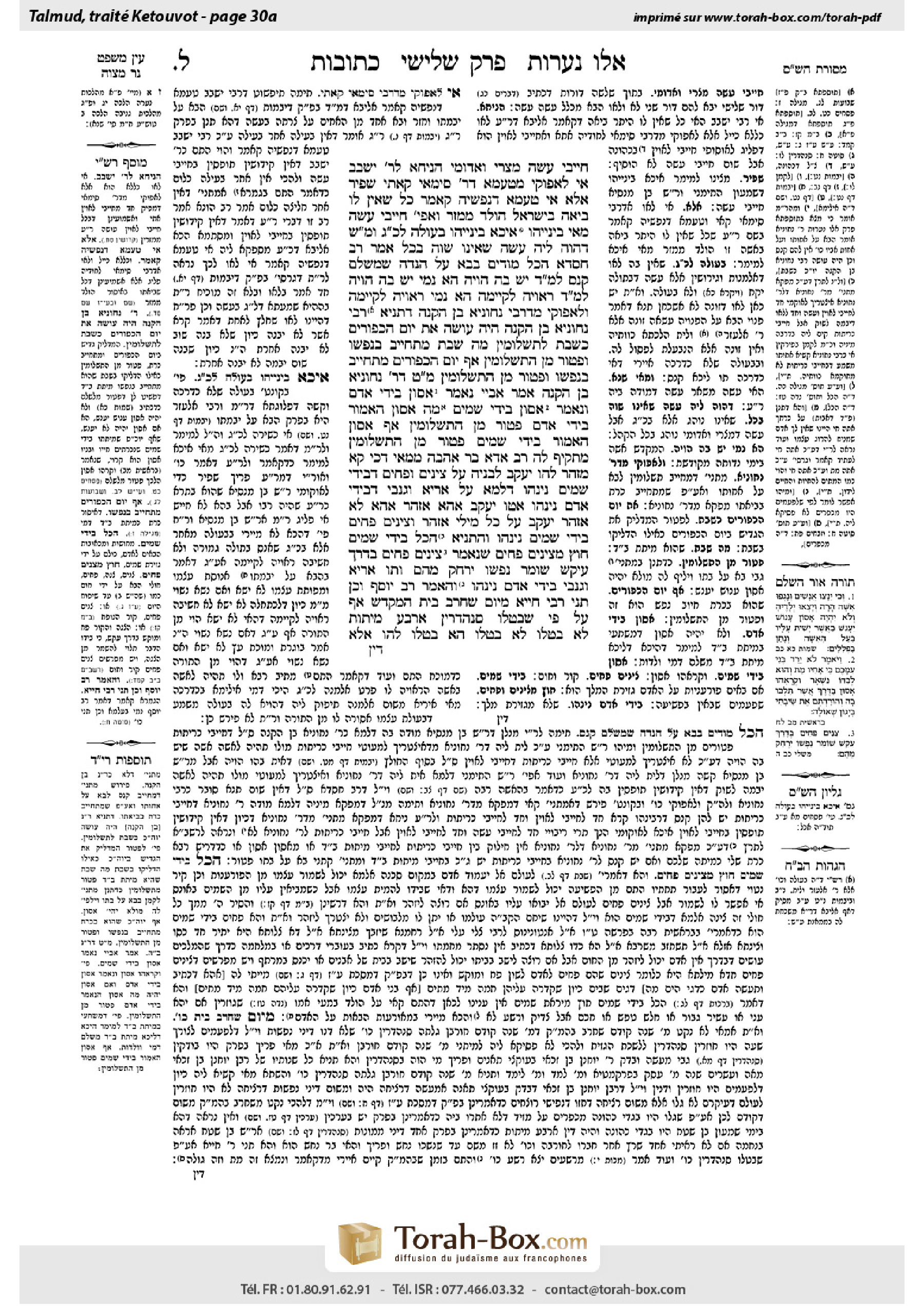
Ketubot 30a: Talmud study for Daf Yomi
Daf Yomi is the daily study of one Talmud folio. Explore 37 tractates with scans, Hebrew text, Sefaria English and AI-generated French translations where annotated.
Passage selection and English or AI-generated French translation are available where the scan has annotations. Daf Study is independent of Torah-Box and Sefaria.
Browse Ketubot · כתובות · All tractatesKetubot 30a text and translations
This page of Ketubot includes the Aramaic text, an English translation and an AI-generated French translation, alongside the scan above.
כתובות ל׳ א · Aramaic and Hebrew text
חַיָּיבֵי עֲשֵׂה, מִצְרִי וַאֲדוֹמִי.
הָנִיחָא לְרַבִּי יְשֵׁבָב, אִי לְאַפּוֹקֵי מִטַּעְמָא דְּרַבִּי סִימַאי קָאָתֵי — שַׁפִּיר. אֶלָּא אִי טַעְמָא דְנַפְשֵׁיהּ קָאָמַר, כֹּל שֶׁאֵין לוֹ בִּיאָה בְּיִשְׂרָאֵל הַוָּלָד מַמְזֵר — וַאֲפִילּוּ חַיָּיבֵי עֲשֵׂה! מַאי בֵּינַיְיהוּ?
אִיכָּא בֵּינַיְיהוּ בְּעוּלָה לְכֹהֵן גָּדוֹל. וּמַאי שְׁנָא? דְּהָוֵה לֵיהּ עֲשֵׂה שֶׁאֵינוֹ שָׁוֶה בַּכֹּל.
אָמַר רַב חִסְדָּא: הַכֹּל מוֹדִים בְּבָא עַל הַנִּדָּה שֶׁמְּשַׁלֵּם קְנָס. לְמַאן דְּאָמַר יֵשׁ בָּהּ הֲוָיָה — הָא נָמֵי יֵשׁ בָּהּ הֲוָיָה. לְמַאן דְּאָמַר רְאוּיָה לְקַיְּימָהּ — הָא נָמֵי רְאוּיָה לְקַיְּימָהּ.
וּלְאַפּוֹקֵי מִדְּרַבִּי נְחוּנְיָא בֶּן הַקָּנָה. דְּתַנְיָא: רַבִּי נְחוּנְיָא בֶּן הַקָּנָה הָיָה עוֹשֶׂה אֶת יוֹם הַכִּפּוּרִים כַּשַּׁבָּת לְתַשְׁלוּמִין. מָה שַׁבָּת — מִתְחַיֵּיב בְּנַפְשׁוֹ וּפָטוּר מִן הַתַּשְׁלוּמִין, אַף יוֹם הַכִּפּוּרִים — מִתְחַיֵּיב בְּנַפְשׁוֹ וּפָטוּר מִן הַתַּשְׁלוּמִין.
מַאי טַעְמָא דְּרַבִּי נְחוּנְיָא בֶּן הַקָּנָה? אָמַר אַבָּיֵי: נֶאֱמַר ״אָסוֹן״ בִּידֵי אָדָם. וְנֶאֱמַר ״אָסוֹן״ בִּידֵי שָׁמַיִם. מָה ״אָסוֹן״ הָאָמוּר בִּידֵי אָדָם — פָּטוּר מִן הַתַּשְׁלוּמִין, אַף ״אָסוֹן״ הָאָמוּר בִּידֵי שָׁמַיִם — פָּטוּר מִן הַתַּשְׁלוּמִין.
מַתְקֵיף לַהּ רַב אַדָּא בַּר אַהֲבָה: מִמַּאי דְּכִי קָא מַזְהַר לְהוּ יַעֲקֹב לִבְנֵיהּ, עַל צִינִּים וּפַחִים דְּבִידֵי שָׁמַיִם נִינְהוּ? דִּלְמָא עַל אַרְיָא וְגַנָּבֵי דְּבִידֵי אָדָם נִינְהוּ?! אַטּוּ יַעֲקֹב אַהָא אַזְהַר, אַהָא לָא אַזְהַר? יַעֲקֹב עַל כֹּל מִילֵּי אַזְהַר.
וְצִינִּים פַּחִים בִּידֵי שָׁמַיִם נִינְהוּ? וְהָתַנְיָא: הַכֹּל בִּידֵי שָׁמַיִם חוּץ מִצִּינִּים פַּחִים, שֶׁנֶּאֱמַר: ״צִינִּים פַּחִים בְּדֶרֶךְ עִיקֵּשׁ שׁוֹמֵר נַפְשׁוֹ יִרְחַק מֵהֶם״! וְתוּ אַרְיָא וְגַנָּבֵי בִּידֵי אָדָם נִינְהוּ? וְהָאָמַר רַב יוֹסֵף וְכֵן תָּנֵי רַבִּי חִיָּיא: מִיּוֹם שֶׁחָרַב בֵּית הַמִּקְדָּשׁ, אַף עַל פִּי שֶׁבָּטְלוּ סַנְהֶדְרִין, אַרְבַּע מִיתוֹת לֹא בָּטְלוּ. לֹא בָּטְלוּ?! הָא בָּטְלוּ לְהוּ! אֶלָּא:
Ketubot 30a · English translation
intercourse with women for which one is liable for violating a positive mitzva, e.g., an Egyptian convert and an Edomite convert (see Deuteronomy 23:8–9). If he raped a first- or second-generation Egyptian or Edomite convert, even Rabbi Yeshevav agrees that the child is not a mamzer, as the betrothal takes effect. On the other hand, it is prohibited for him to sustain her as a wife.
The Gemara asks: This works out well according to Rabbi Yeshevav if he is coming to reject the opinion of Rabbi Simai. If Rabbi Yeshevav merely takes issue with Rabbi Simai, who said that all offspring of forbidden relations are mamzerim according to Rabbi Akiva except for those resulting from relations between a widow and a High Priest, then it may well be explained that Rabbi Yeshevav holds that Rabbi Akiva rules that betrothal does not take effect and that there is mamzerut when one violates the prohibitions of the priesthood. However, if he is stating his own opinion, independent of Rabbi Simai’s statement, his ruling is more comprehensive and leads to the conclusion that in the case of relations with anyone who does not have the possibility of permitted relations among the Jewish people, the child is a mamzer, and this is true even of women for relations with whom one is liable for violating positive mitzvot, e.g., Egyptian or Edomite converts. In that case, what is the difference between the opinions of Shimon HaTimni and Rabbi Shimon ben Menasya?
The Gemara answers: There is a difference between them in the case of a non-virgin raped by a High Priest. And the Gemara asks: Here, too, she is a woman for relations with whom one is liable for violating a positive mitzva, as the High Priest fails to fulfill the mitzva “But a virgin of his own people shall he take to wife” (Leviticus 21:14). If Rabbi Akiva rules that betrothal does not take effect when a positive mitzva is violated, what is different about this case? The Gemara answers: It is different because it is a positive mitzva whose application is not equal for all. There are two lenient aspects to this mitzva: It is a positive mitzva and not a prohibition, and it applies only to the High Priest and not to all Jews. Even Rabbi Yeshevav would agree that according to Rabbi Akiva, a child born from relations between a High Priest and a non-virgin is not a mamzer. However, the High Priest may not sustain the woman as his wife. Therefore, this case is the practical difference between the statements of Shimon HaTimni and Rabbi Shimon ben Menasya.
§ Rav Ḥisda said: Everyone agrees with regard to one who engaged in forced intercourse with a menstruating woman that he pays the fine. He elaborates: According to the one who says that the criterion is whether there is betrothal, for this woman too there is betrothal. According to the one who says that the criterion is whether the woman is suitable for him to sustain, this woman is suitable for him to sustain.
§ The Gemara comments: And the mishna’s ruling that one who has relations with his sister is liable to pay the fine comes to exclude the opinion of Rabbi Neḥunya ben HaKana, as it is taught in a baraita: Rabbi Neḥunya ben HaKana would render Yom Kippur like Shabbat with regard to payment for damages. Just as one who intentionally desecrates Shabbat is liable to receive the death penalty and is therefore exempt from the obligation of payment for damages caused while desecrating Shabbat, so too, one who intentionally desecrates Yom Kippur is liable to receive the death penalty and is therefore exempt from the obligation of payment for damages caused while desecrating Yom Kippur.
The Gemara asks: What is the rationale for the opinion of Rabbi Neḥunya ben HaKana? Abaye said: It states the word harm at the hands of man, in the verse “But if any harm follow, then you shall give a soul for a soul” (Exodus 21:23) and it states the word harm at the hand of Heaven, in the verse in which Jacob states: “My son shall not descend with you…and harm befalls him on the way” (Genesis 42:38). Just as with regard to harm that is stated at the hands of man, e.g., one who kills and is liable to be executed, one is exempt from the associated payment, so too, with regard to harm that is stated at the hand of Heaven, one is exempt from the associated payment.
Rav Adda bar Ahava strongly objects to this: From where is it derived that when Jacob is warning his sons he is warning them about cold and heat [tzinim paḥim], which are at the hand of Heaven? Perhaps he was warning them about a lion and thieves, which are harm at the hands of man, meaning that unlike heat and cold, these dangers are not calibrated by God. The Gemara refutes this: Is that to say that Jacob warned them about this harm at the hand of man, but about that harm at the hand of Heaven he did not warn them? Jacob warned them about all potentially harmful matters that might befall Benjamin, not merely one particular form of catastrophe.
The Gemara asks: And are cold and heat at the hand of Heaven? Isn’t it taught in a baraita: All matters are at the hand of Heaven except for cold and heat, as it is stated: “Cold and heat are on the path of the crooked, he who guards his soul shall keep far from them” (Proverbs 22:5)? This indicates that cold and heat are forms of harm caused by man, from which one can protect himself. And furthermore, are a lion and thieves forms of harm at the hands of man? But didn’t Rav Yosef say, and similarly, didn’t Rabbi Ḥiyya teach a baraita: From the day that the Temple was destroyed, although the Sanhedrin was abolished the four death penalties were not abolished? The Gemara asks: Were they not abolished? It is clear that they were abolished, as today there is neither Sanhedrin nor capital punishment. Rather, it means that although there are no court-imposed executions,
Ketubot 30a · Traduction française (IA)
des relations avec des femmes pour lesquelles on est passible d’avoir transgressé une mitsva positive, par exemple une convertie égyptienne ou édomite (voir Deutéronome 23, 8-9). S’il a violé une convertie égyptienne ou édomite de première ou de deuxième génération, même Rabbi Yeshevav convient que l’enfant n’est pas un mamzer, car les kiddouchin prennent effet. En revanche, il lui est interdit de la garder comme épouse.
La Guemara demande : Cela s’explique bien selon Rabbi Yeshevav, s’il entend réfuter l’opinion de Rabbi Simai. Mais si Rabbi Yeshevav ne fait que contester Rabbi Simai, qui a dit que, selon Rabbi Akiva, tous les enfants issus de relations interdites sont des mamzerim, à l’exception de ceux issus d’une relation entre une veuve et un Grand Prêtre, on peut fort bien expliquer que Rabbi Yeshevav considère que, selon Rabbi Akiva, les kiddouchin ne prennent pas effet et qu’il y a mamzerout lorsque sont transgressées les interdictions propres à la prêtrise. En revanche, s’il énonce sa propre opinion, indépendamment de celle de Rabbi Simai, sa décision est plus générale et conduit à conclure que, dans le cas de relations avec toute personne avec laquelle il n’existe aucune possibilité de relations permises au sein du peuple juif, l’enfant est un mamzer. Cela vaut même pour les femmes avec lesquelles des relations exposent à transgresser des mitsvot positives, par exemple les converties égyptiennes ou édomites. Dans ce cas, quelle différence y a-t-il entre les opinions de Shimon HaTimni et de Rabbi Shimon ben Menasya ?
La Guemara répond : Ils divergent dans le cas d’une femme non vierge violée par un Grand Prêtre. La Guemara demande alors : Ici aussi, il s’agit d’une femme avec laquelle des relations exposent à transgresser une mitsva positive, puisque le Grand Prêtre n’accomplit pas la mitsva : « Mais c’est une vierge de son peuple qu’il prendra pour femme » (Lévitique 21, 14). Si Rabbi Akiva décide que les kiddouchin ne prennent pas effet lorsqu’une mitsva positive est transgressée, en quoi ce cas est-il différent ? La Guemara répond : Il est différent, car il s’agit d’une mitsva positive dont l’application n’est pas la même pour tous. Cette mitsva comporte deux aspects atténuants : c’est une mitsva positive et non une interdiction, et elle ne s’applique qu’au Grand Prêtre, et non à tous les Juifs. Même Rabbi Yeshevav conviendrait que, selon Rabbi Akiva, l’enfant né de relations entre un Grand Prêtre et une femme non vierge n’est pas un mamzer. Toutefois, le Grand Prêtre ne peut pas garder cette femme comme épouse. Ce cas constitue donc la différence pratique entre les propos de Shimon HaTimni et ceux de Rabbi Shimon ben Menasya.
§ Rav Ḥisda a dit : Tout le monde convient que celui qui a eu de force des relations avec une femme en période de niddah doit payer l’amende. Il explique : selon celui qui dit que le critère est l’existence des kiddouchin, ceux-ci prennent également effet avec cette femme. Selon celui qui dit que le critère est de savoir si l’homme peut la garder comme épouse, cette femme convient pour être gardée par lui comme épouse.
§ La Guemara fait remarquer : La décision de la Michna selon laquelle celui qui a des relations avec sa sœur doit payer l’amende vient exclure l’opinion de Rabbi Neḥunya ben HaKana, comme l’enseigne une baraïta : Rabbi Neḥunya ben HaKana assimilait Yom Kippour au Chabbat en matière d’indemnisation des dommages. De même que celui qui profane intentionnellement le Chabbat est passible de la peine de mort et est donc dispensé d’indemniser les dommages causés en le profanant, celui qui profane intentionnellement Yom Kippour est lui aussi passible de la peine de mort et est donc dispensé d’indemniser les dommages causés en profanant Yom Kippour.
La Guemara demande : Quel est le fondement de l’opinion de Rabbi Neḥunya ben HaKana ? Abaye a dit : Le verset emploie le mot « dommage » à propos de ce qui relève de l’homme, dans la phrase « Mais s’il s’ensuit un dommage, tu donneras une vie pour une vie » (Exode 21, 23), et le même mot à propos de ce qui relève du Ciel, dans la phrase où Jacob dit : « Mon fils ne descendra pas avec vous… et un malheur pourrait lui arriver en chemin » (Genèse 42, 38). De même que, pour un dommage imputable à l’homme — par exemple lorsqu’une personne tue et est passible d’exécution —, on est dispensé du paiement correspondant, de même, pour un dommage imputable au Ciel, on est dispensé du paiement correspondant.
Rav Adda bar Ahava s’y oppose vivement : D’où sait-on que, lorsqu’il avertit ses fils, Jacob les met en garde contre le froid et la chaleur [tzinim paḥim], qui relèvent du Ciel ? Peut-être les mettait-il en garde contre un lion et des voleurs, des dangers imputables à l’homme, c’est-à-dire des dangers qui, contrairement au froid et à la chaleur, ne sont pas régis par Dieu. La Guemara réfute cette objection : Faut-il dire que Jacob les a mis en garde contre ce danger imputable à l’homme, mais pas contre ce danger imputable au Ciel ? Jacob les a mis en garde contre toutes les choses susceptibles de nuire à Benjamin, et non contre une seule forme de catastrophe.
La Guemara demande : Le froid et la chaleur relèvent-ils du Ciel ? N’enseigne-t-on pas dans une baraïta : Toutes les choses relèvent du Ciel, à l’exception du froid et de la chaleur, comme il est dit : « Le froid et la chaleur sont sur le chemin du tortueux ; celui qui garde son âme s’en tiendra éloigné » (Proverbes 22, 5) ? Cela indique que le froid et la chaleur sont des formes de dommage causées par l’homme, dont on peut se protéger. En outre, un lion et des voleurs sont-ils des formes de dommage imputables à l’homme ? Rav Yossef n’a-t-il pas dit, et Rabbi Ḥiyya n’a-t-il pas, de même, enseigné une baraïta : Depuis le jour où le Temple a été détruit, bien que le Sanhédrin ait été aboli, les quatre peines de mort n’ont pas été abolies ? La Guemara demande : N’ont-elles donc pas été abolies ? Il est clair qu’elles l’ont été, puisqu’aujourd’hui il n’y a ni Sanhédrin ni peine capitale. Il faut plutôt comprendre que, bien qu’il n’y ait pas d’exécutions ordonnées par les tribunaux,
Traduction française générée par IA à partir de l’édition anglaise de Sefaria. Vérifie toujours un passage avec le texte source.
Text from Sefaria: William Davidson Edition - Vocalized Aramaic (CC BY NC); William Davidson Edition - English (CC BY NC).