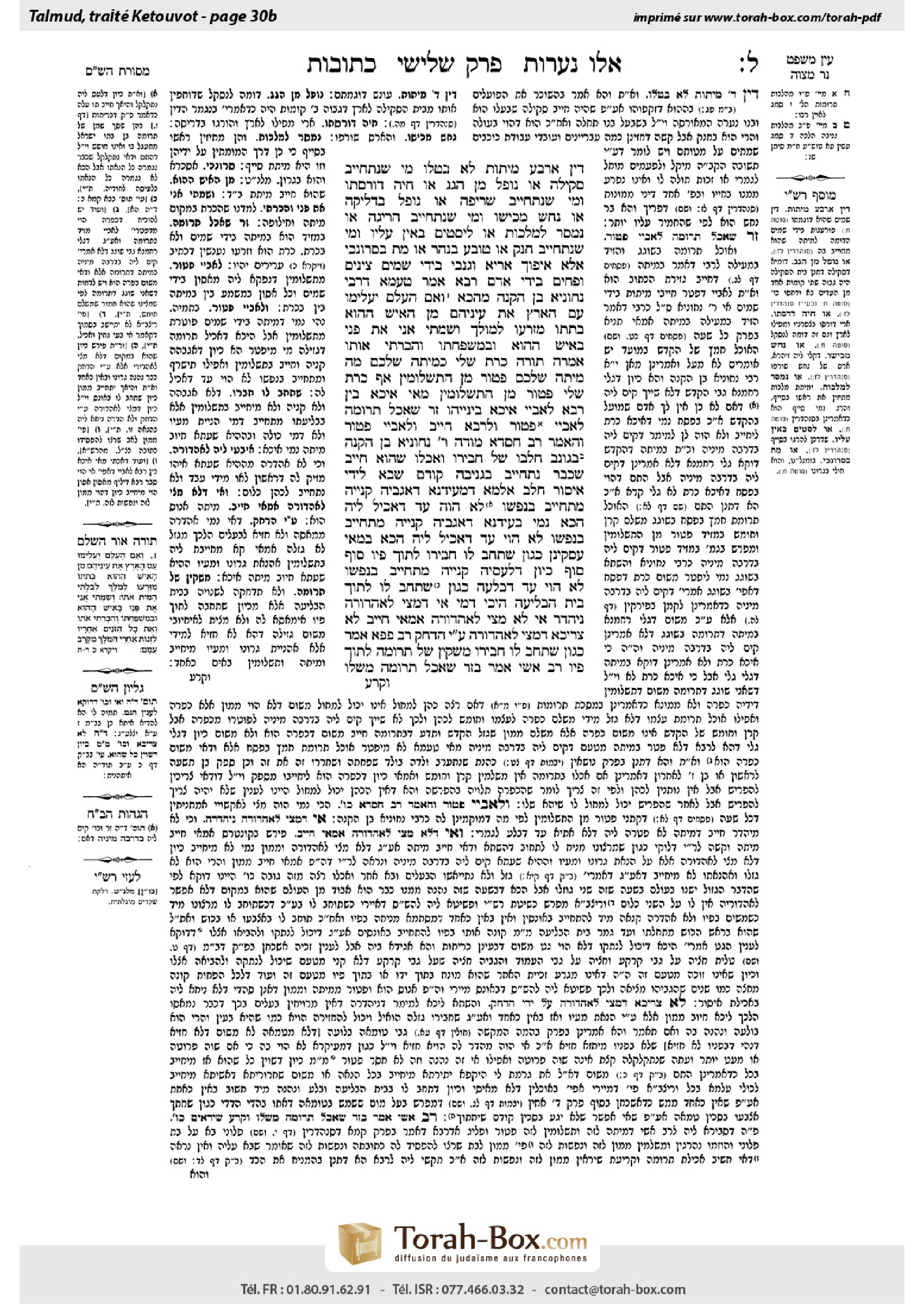
Ketubot 30b: Talmud study for Daf Yomi
Daf Yomi is the daily study of one Talmud folio. Explore 37 tractates with scans, Hebrew text, Sefaria English and AI-generated French translations where annotated.
Passage selection and English or AI-generated French translation are available where the scan has annotations. Daf Study is independent of Torah-Box and Sefaria.
Browse Ketubot · כתובות · All tractatesKetubot 30b text and translations
This page of Ketubot includes the Aramaic text, an English translation and an AI-generated French translation, alongside the scan above.
כתובות ל׳ ב · Aramaic and Hebrew text
דִּין אַרְבַּע מִיתוֹת לֹא בָּטְלוּ. מִי שֶׁנִּתְחַיֵּיב סְקִילָה — אוֹ נוֹפֵל מִן הַגָּג, אוֹ חַיָּה דּוֹרַסְתּוֹ. וּמִי שֶׁנִּתְחַיֵּיב שְׂרֵיפָה — אוֹ נוֹפֵל בִּדְלֵיקָה, אוֹ נָחָשׁ מַכִּישׁוֹ. וּמִי שֶׁנִּתְחַיֵּיב הֲרִיגָה — אוֹ נִמְסָר לַמַּלְכוּת, אוֹ לִיסְטִים בָּאִין עָלָיו. וּמִי שֶׁנִּתְחַיֵּיב חֶנֶק — אוֹ טוֹבֵעַ בַּנָּהָר, אוֹ מֵת בִּסְרוֹנְכֵי?! אֶלָּא, אֵיפוֹךְ: אַרְיָא וְגַנָּבֵי בִּידֵי שָׁמַיִם, צִינִּים וּפַחִים בִּידֵי אָדָם.
רָבָא אָמַר, טַעְמָא דְּרַבִּי נְחוּנְיָא בֶּן הַקָּנָה מֵהָכָא: ״וְאִם הַעְלֵם יַעְלִימוּ עַם הָאָרֶץ אֶת עֵינֵיהֶם מִן הָאִישׁ הַהוּא בְּתִתּוֹ מִזַּרְעוֹ לַמּוֹלֶךְ. וְשַׂמְתִּי אֲנִי אֶת פָּנַי בָּאִישׁ הַהוּא וּבְמִשְׁפַּחְתּוֹ וְהִכְרַתִּי אוֹתוֹ״, אָמְרָה תּוֹרָה: כָּרֵת שֶׁלִּי כְּמִיתָה שֶׁלָּכֶם, מָה מִיתָה שֶׁלָּכֶם — פָּטוּר מִן הַתַּשְׁלוּמִין. אַף כָּרֵת שֶׁלִּי — פָּטוּר מִן הַתַּשְׁלוּמִין.
מַאי אִיכָּא בֵּין רָבָא לְאַבָּיֵי? אִיכָּא בֵּינַיְיהוּ זָר שֶׁאָכַל תְּרוּמָה — לְאַבָּיֵי פָּטוּר, וּלְרָבָא חַיָּיב.
וּלְאַבָּיֵי פָּטוּר?! וְהָאָמַר רַב חִסְדָּא: מוֹדֶה רַבִּי נְחוּנְיָא בֶּן הַקָּנָה בְּגוֹנֵב חֶלְבּוֹ שֶׁל חֲבֵירוֹ וַאֲכָלוֹ, שֶׁהוּא חַיָּיב — שֶׁכְּבָר נִתְחַיֵּיב בִּגְנֵיבָה קוֹדֶם שֶׁבָּא לִידֵי אִיסּוּר חֵלֶב. אַלְמָא דְּמֵעִידָּנָא דְּאַגְבְּהֵיהּ קַנְיֵיהּ, מִתְחַיֵּיב בְּנַפְשׁוֹ לָא הֲוָה עַד דְּאָכֵיל לֵיהּ. הָכָא נָמֵי, בְּעִידָּנָא דְּאַגְבְּהֵיהּ — קַנְיֵיהּ, מִתְחַיֵּיב בְּנַפְשׁוֹ לָא הָוֵי עַד דְּאָכֵיל לֵיהּ! הָכָא בְּמַאי עָסְקִינַן — כְּגוֹן שֶׁתָּחַב לוֹ חֲבֵירוֹ לְתוֹךְ פִּיו.
סוֹף סוֹף כֵּיוָן דְּלַעֲסֵיהּ קַנְיֵיהּ, מִתְחַיֵּיב בְּנַפְשׁוֹ לָא הָוֵי עַד דְּבַלְעַהּ! כְּגוֹן שֶׁתָּחַב לוֹ לְתוֹךְ בֵּית הַבְּלִיעָה. הֵיכִי דָמֵי? אִי דְּמָצֵי לְאַהְדּוֹרַהּ — נֶיהְדַּר. אִי לָא מָצֵי לְאַהְדּוֹרַהּ — אַמַּאי חַיָּיב? לָא צְרִיכָא, דְּמָצֵי לְאַהְדּוֹרַהּ עַל יְדֵי הַדְּחָק.
רַב פָּפָּא אָמַר: כְּגוֹן שֶׁתָּחַב לוֹ חֲבֵירוֹ מַשְׁקִין שֶׁל תְּרוּמָה לְתוֹךְ פִּיו. רַב אָשֵׁי אָמַר: בְּזָר שֶׁאָכַל תְּרוּמָה מִשֶּׁלּוֹ,
Ketubot 30b · English translation
the punishment of the four death penalties was not abolished. How so? One who was liable to be executed by stoning either falls from the roof or a beast tramples him. That is similar to stoning, which involves being pushed off an elevated place and then stoned. And one who was liable to be executed by burning either falls into a conflagration or a snake bites him, which creates a burning sensation. And one who was liable to be executed by decapitation is either handed over to the ruling monarchy for execution by sword, or bandits attack and kill him. And one who was liable to be executed by strangulation either drowns in a river, or dies of diphtheria [serunki]. Rather, reverse the order of the previous statement: A lion and thieves are cases of harm at the hand of Heaven, while cold and heat are cases of harm at the hands of man.
Rava said an additional explanation: The rationale for the opinion of Rabbi Neḥunya ben HaKana is from here. It is written that one who gives his children to Molech is liable to be executed by stoning: “And if the people of the land do at all hide their eyes from that man, when he gives of his seed to Molech, and do not put him to death; then I will set My face against that man and against his family, and will cut him off [vehikhrati]” (Leviticus 20:4–5). Through the juxtaposition in this verse the Torah said: My karet is like your death penalty; just as one who is liable to receive your death penalty is exempt from the associated payments, so too, one who is liable to receive My karet is exempt from the associated payments.
The Gemara asks: What practical difference is there between the opinions of Rava and Abaye with regard to the rationale for the opinion of Rabbi Neḥunya ben HaKana? The Gemara answers: There is a difference between them with regard to a non-priest who intentionally ate teruma. According to Abaye he is exempt from paying the priest the value of the teruma, as a non-priest who ate teruma is liable to receive death at the hand of Heaven. Abaye maintains that the legal status of all forms of death at the hand of Heaven is equivalent to that of death at the hands of man, and therefore, one is exempt from payment. And according to Rava, who derives the rationale from the juxtaposition between karet and death at the hands of man, since a non-priest who ate teruma is not liable to receive karet, he is liable to pay the priest for the teruma that he ate.
The Gemara asks: And according to Abaye, is a non-priest actually exempt from payment for the teruma? But didn’t Rav Ḥisda say that Rabbi Neḥunya ben HaKana concedes with regard to one who steals another’s forbidden fat and eats it that he is obligated to pay for the fat, even though he is liable to receive karet, as he was already liable for theft before he came to violate the prohibition against eating forbidden fat? Apparently, from the moment he lifts the fat to steal it he acquired it, and he bears responsibility to repay it, but he is liable to receive the death penalty only when he eats it. Here, too, with regard to a non-priest who ate teruma, at the moment he lifts the teruma he acquired it and is responsible to repay it, and he is liable to receive the death penalty only when he eats it. The Gemara answers: With what are we dealing here? It is a case where another inserted the teruma into his mouth. In that case, acquisition and liability to receive the death penalty are simultaneous.
The Gemara asks: Ultimately, once he chewed the teruma he acquired it and is liable to pay, and he is liable to receive the death penalty only when he swallows it. Since the two are not simultaneous, he should be liable to pay. The Gemara answers: It is a case where another inserted it into the pharynx, so the liability for payment and liability for the death penalty were both achieved through swallowing. The Gemara asks: What are the circumstances? If it is possible to retrieve the teruma by removing it without ruining it, let him retrieve it. If one does so, he would not be liable to pay. If he fails to do so, liability or payment precedes liability for the death penalty. If it is not possible to retrieve the teruma, why is he liable? He did nothing; another person inserted the food in his throat. The Gemara answers: It is necessary only in a situation where it is possible to retrieve the teruma under duress, with great effort.
Rav Pappa said: It is referring to a case where another inserted liquids of teruma into his mouth. As soon as the liquid enters his mouth, it is ruined. Therefore, the acquisition and his enjoyment are simultaneous. Rav Ashi said: It is referring to a non-priest who partook of his own teruma, e.g., if the non-priest inherited teruma from a priest, or acquired ownership from a priest. In that case, he did not steal the teruma and there is no payment for it, but he is liable to receive the death penalty for eating teruma,
Ketubot 30b · Traduction française (IA)
La peine correspondant aux quatre peines capitales n’a pas été abolie. Comment cela se manifeste-t-il ? Celui qui était passible de lapidation tombe du toit ou est piétiné par une bête. Cela ressemble à la lapidation, qui consiste à être précipité d’un endroit élevé, puis lapidé. Celui qui était passible du bûcher tombe dans un incendie ou est mordu par un serpent, ce qui provoque une sensation de brûlure. Celui qui était passible de décapitation est livré à la monarchie régnante pour être exécuté par l’épée, ou bien des brigands l’attaquent et le tuent. Celui qui était passible d’étranglement se noie dans un fleuve ou meurt de diphtérie [serunki]. Il faut plutôt inverser l’ordre de la déclaration précédente : le lion et les voleurs sont des cas de dommages infligés par la main du Ciel, tandis que le froid et la chaleur sont des cas de dommages infligés par la main de l’homme.
Rava donne une explication supplémentaire : le fondement de l’opinion de Rabbi Neḥunya ben HaKana se trouve ici. Il est écrit que celui qui livre ses enfants à Molekh est passible de lapidation : « Et si les gens du pays ferment les yeux sur cet homme, lorsqu’il donne de sa descendance à Molekh, et ne le mettent pas à mort, alors je tournerai ma face contre cet homme et contre sa famille, et je le retrancherai [vehikhrati] » (Lévitique 20, 4-5). Par le rapprochement opéré dans ce verset, la Torah dit : « Mon retranchement équivaut à votre peine de mort » ; de même que celui qui est passible de votre peine de mort est exempt des paiements correspondants, de même celui qui est passible de mon retranchement est exempt des paiements correspondants.
La Guemara demande : Quelle différence pratique y a-t-il entre les opinions de Rava et d’Abaye quant au fondement de l’opinion de Rabbi Neḥunya ben HaKana ? La Guemara répond : Il y a une différence dans le cas d’un non-prêtre qui a mangé intentionnellement de la terouma. Selon Abaye, il est exempt de payer au prêtre la valeur de la terouma, car un non-prêtre qui a mangé de la terouma est passible de mort par la main du Ciel. Abaye considère que le statut juridique de toutes les formes de mort par la main du Ciel équivaut à celui de la mort par la main de l’homme ; par conséquent, il est exempt de paiement. Selon Rava, qui déduit le fondement de l’opinion du rapprochement entre le retranchement et la mort par la main de l’homme, le non-prêtre qui a mangé de la terouma n’étant pas passible de retranchement, il doit payer au prêtre la terouma qu’il a mangée.
La Guemara demande : Mais selon Abaye, un non-prêtre est-il réellement exempt de payer la terouma ? Rav Ḥisda n’a-t-il pas dit que Rabbi Neḥunya ben HaKana reconnaît que celui qui vole la graisse interdite d’autrui et la mange est tenu de payer cette graisse, bien qu’il soit passible de retranchement, car il était déjà passible pour le vol avant de transgresser l’interdiction de manger de la graisse interdite ? Apparemment, dès qu’il soulève la graisse pour la voler, il en acquiert la propriété et devient tenu de la rembourser ; mais il n’est passible de la peine de mort que lorsqu’il la mange. De même ici, pour un non-prêtre qui a mangé de la terouma, dès qu’il la soulève, il en acquiert la propriété et devient tenu de la rembourser, mais il n’est passible de la peine de mort que lorsqu’il la mange. La Guemara répond : De quel cas parlons-nous ici ? D’un cas où quelqu’un d’autre lui a introduit la terouma dans la bouche. Dans ce cas, l’acquisition et la responsabilité passible de la peine de mort sont simultanées.
La Guemara demande : En définitive, une fois qu’il a mâché la terouma, il en a acquis la propriété et est tenu de la payer, tandis qu’il n’est passible de la peine de mort que lorsqu’il l’avale. Puisque les deux ne sont pas simultanées, il devrait être tenu de payer. La Guemara répond : Il s’agit d’un cas où quelqu’un d’autre a introduit la terouma dans son pharynx ; ainsi, l’obligation de paiement et la responsabilité passible de la peine de mort ont toutes deux été engagées au moment de l’ingestion. La Guemara demande : Quelles sont les circonstances ? S’il est possible de récupérer la terouma en la retirant sans l’abîmer, qu’il la récupère. S’il le fait, il ne sera pas tenu de payer. S’il ne le fait pas, l’obligation de paiement précède la responsabilité passible de la peine de mort. S’il est impossible de récupérer la terouma, pourquoi est-il passible ? Il n’a rien fait ; une autre personne lui a introduit la nourriture dans la gorge. La Guemara répond : Cela est nécessaire uniquement dans une situation où il est possible de récupérer la terouma sous la contrainte, au prix d’un grand effort.
Rav Pappa dit : Il s’agit d’un cas où quelqu’un d’autre lui a introduit dans la bouche des liquides de terouma. Dès que le liquide entre dans sa bouche, il est altéré. Par conséquent, l’acquisition et la jouissance sont simultanées. Rav Ashi dit : Il s’agit d’un non-prêtre qui a consommé sa propre terouma, par exemple s’il en a hérité d’un prêtre ou en a acquis la propriété auprès d’un prêtre. Dans ce cas, il n’a pas volé la terouma et n’a pas à la payer, mais il est passible de la peine de mort pour avoir mangé de la terouma,
Traduction française générée par IA à partir de l’édition anglaise de Sefaria. Vérifie toujours un passage avec le texte source.
Text from Sefaria: William Davidson Edition - Vocalized Aramaic (CC BY NC); William Davidson Edition - English (CC BY NC).