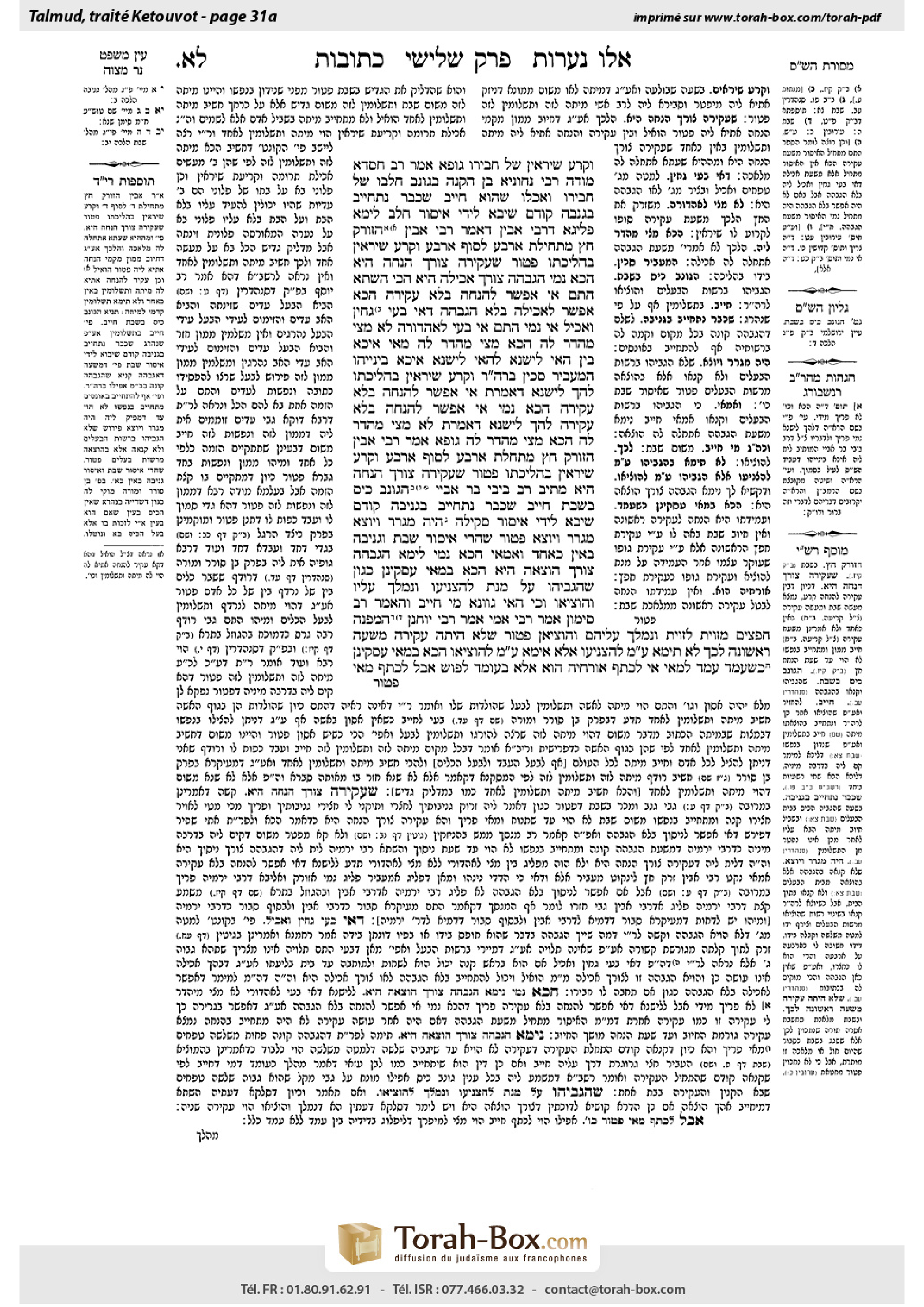
Ketubot 31a: Talmud study for Daf Yomi
Daf Yomi is the daily study of one Talmud folio. Explore 37 tractates with scans, Hebrew text, Sefaria English and AI-generated French translations where annotated.
Passage selection and English or AI-generated French translation are available where the scan has annotations. Daf Study is independent of Torah-Box and Sefaria.
Browse Ketubot · כתובות · All tractatesKetubot 31a text and translations
This page of Ketubot includes the Aramaic text, an English translation and an AI-generated French translation, alongside the scan above.
כתובות ל״א א · Aramaic and Hebrew text
וְקָרַע שִׁירָאִין שֶׁל חֲבֵירוֹ.
גּוּפָא, אָמַר רַב חִסְדָּא: מוֹדֶה רַבִּי נְחוּנְיָא בֶּן הַקָּנָה בְּגוֹנֵב חֶלְבּוֹ שֶׁל חֲבֵירוֹ וַאֲכָלוֹ שֶׁהוּא חַיָּיב, שֶׁכְּבָר נִתְחַיֵּיב בִּגְנֵבָה קוֹדֶם שֶׁיָּבֹא לִידֵי אִיסּוּר חֵלֶב. לֵימָא פְּלִיגָא דְּרַבִּי אָבִין. דְּאָמַר רַבִּי אָבִין: הַזּוֹרֵק חֵץ מִתְּחִילַּת אַרְבַּע לְסוֹף אַרְבַּע, וְקָרַע שִׁירָאִין בַּהֲלִיכָתוֹ — פָּטוּר. שֶׁעֲקִירָה צוֹרֶךְ הַנָּחָה הִיא. הָכָא נָמֵי: הַגְבָּהָה צוֹרֶךְ אֲכִילָה הִיא!
הָכִי הַשְׁתָּא?! הָתָם, אִי אֶפְשָׁר לְהַנָּחָה בְּלֹא עֲקִירָה. הָכָא, אֶפְשָׁר לַאֲכִילָה בְּלֹא הַגְבָּהָה, דְּאִי בָּעֵי, גָּחֵין וְאָכֵיל. אִי נָמֵי: הָתָם אִי בָּעֵי לְאַהְדּוֹרַהּ — לָא מָצֵי מַהְדַּר לַהּ. הָכָא — מָצֵי מַהְדַּר לַהּ.
מַאי אִיכָּא בֵּין הַאי לִישָּׁנָא לְהַאי לִישָּׁנָא? אִיכָּא בֵּינַיְיהוּ הַמַּעֲבִיר סַכִּין בִּרְשׁוּת הָרַבִּים וְקָרַע שִׁירָאִין בַּהֲלִיכָתוֹ. לְהָךְ לִישָּׁנָא דְּאָמְרַתְּ אִי אֶפְשָׁר לְהַנָּחָה בְּלֹא עֲקִירָה — הָכָא נָמֵי אִי אֶפְשָׁר לְהַנָּחָה בְּלֹא עֲקִירָה. לְהָךְ לִישָּׁנָא דְּאָמְרַתְּ לָא מָצֵי מַהְדַּר לַהּ — הָכָא מָצֵי מַהְדַּר לַהּ.
גּוּפָא, אָמַר רַבִּי אָבִין: הַזּוֹרֵק חֵץ מִתְּחִלַּת אַרְבַּע לְסוֹף אַרְבַּע וְקָרַע שִׁירָאִין בַּהֲלִיכָתוֹ — פָּטוּר, שֶׁעֲקִירָה צוֹרֶךְ הַנָּחָה הִיא. מֵתִיב רַב בִּיבִי בַּר אַבָּיֵי: הַגּוֹנֵב כִּיס בְּשַׁבָּת — חַיָּיב, שֶׁכְּבָר נִתְחַיֵּיב בִּגְנֵיבָה קוֹדֶם שֶׁיָּבֹא לִידֵי אִיסּוּר סְקִילָה. הָיָה מְגָרֵר וְיוֹצֵא, מְגָרֵר וְיוֹצֵא — פָּטוּר, שֶׁהֲרֵי אִיסּוּר שַׁבָּת וּגְנֵיבָה בָּאִין כְּאֶחָד.
וְאַמַּאי? הָכָא נָמֵי, לֵימָא: הַגְבָּהָה צוֹרֶךְ הוֹצָאָה הִיא! הָכָא בְּמַאי עָסְקִינַן — כְּגוֹן שֶׁהִגְבִּיהוֹ עַל מְנָת לְהַצְנִיעוֹ, וְנִמְלַךְ עָלָיו וְהוֹצִיאוֹ.
וְכִי הַאי גַּוְונָא מִי חַיָּיב? וְהָאָמַר רַב סִימוֹן אָמַר רַבִּי אַמֵּי אָמַר רַבִּי יוֹחָנָן: הַמְפַנֶּה חֲפָצִים מִזָּוִית לְזָוִית, וְנִמְלַךְ עֲלֵיהֶם וְהוֹצִיאָן — פָּטוּר, שֶׁלֹּא הָיְתָה עֲקִירָה מִשָּׁעָה רִאשׁוֹנָה לְכָךְ!
לָא תֵּימָא עַל מְנָת לְהַצְנִיעוֹ, אֶלָּא אֵימָא עַל מְנָת לְהוֹצִיאוֹ, הָכָא בְּמַאי עָסְקִינַן — כְּשֶׁעָמַד.
עָמַד לְמַאי? אִי לְכַתֵּף — אוֹרְחֵיהּ הוּא! אֶלָּא בְּעוֹמֵד לָפוּשׁ. אֲבָל לְכַתֵּף מַאי?
Ketubot 31a · English translation
and at the same time he tore another’s silk [shira’in]. The question is whether the liability to receive the death penalty exempts him from the liability for payment incurred at precisely the same moment.
§ The Gemara analyzes the matter itself. Rav Ḥisda said: Rabbi Neḥunya ben HaKana concedes in the case of one who steals another’s forbidden fat and eats it that he is obligated to pay for the fat, as he is already liable for theft before he comes to violate the prohibition against eating forbidden fat. The Gemara comments: Let us say that Rav Ḥisda disagrees with Rabbi Avin, as Rabbi Avin said: One who shoots an arrow from the beginning of four cubits to the end of four cubits in the public domain on Shabbat, thereby performing a prohibited labor for which he is liable to receive a court-imposed death penalty, and the arrow ripped silk as it proceeds, is exempt from the obligation to pay for the silk because he is liable for the more severe punishment for desecrating Shabbat. Although the silk was ripped prior to completion of the prohibited labor, as the arrow had not yet come to rest, he is nevertheless exempt, as lifting is a prerequisite for placement. The prohibited labor of carrying on Shabbat is comprised of lifting of the object and placement. Once he shot the arrow, its movement through the air is a continuation of his act of Shabbat desecration, for which he is liable to be executed. Here, too, say that lifting the fat is a prerequisite for eating, and therefore he should be exempt from payment.
The Gemara refutes this argument: How can these cases be compared? There, in the case of the arrow, placement is impossible without lifting, as placement without lifting is not a labor prohibited on Shabbat. Therefore, lifting and placement are a single unit. In contrast, here, eating is possible without lifting as, if one wishes, he could bend down and eat without lifting the food to his mouth. Alternatively, there is another difference between the cases: There, in the case of the arrow, even if he seeks to take back the arrow after shooting it, he cannot take it back; therefore, lifting and placement constitute one action. Here, he could replace the fat after lifting it.
The Gemara asks: What practical difference is there between this formulation, where the criterion is whether the second stage could be performed independent of the first stage, and that formulation, where the criterion is whether the second stage is inevitable after performing the first stage? The Gemara responds: There is a practical difference between them with regard to one who carries a knife in the public domain and tears silk as he proceeds. According to that formulation, where you said: Lifting is a prerequisite for placement, here too, lifting is a prerequisite for placement. As these two stages are inexorably connected, they constitute one action, and the one carrying the knife is exempt from paying the damages. Conversely, according to that formulation where you said: He cannot take back the arrow and that is why they are considered one action, here, he can take back the knife; therefore, lifting and placement are separate actions and he is not exempt from punishment for the damages that he caused.
§ The Gemara analyzes the matter itself. Rabbi Avin said: With regard to one who shoots an arrow from the beginning of four cubits to the end of four cubits and the arrow rips silk as it proceeds, he is exempt, as lifting is a prerequisite for placement. Rav Beivai bar Abaye raised an objection from that which is taught in a baraita: One who steals a purse on Shabbat is liable for the theft because he was already liable for theft as soon as he lifted the purse. This took place before he came to violate the prohibition against performing prohibited labor on Shabbat by carrying it into the public domain, a violation punishable by stoning. However, if he did not lift the purse but was dragging it on the ground and exiting the private domain, dragging and exiting, he is exempt, as the prohibition against theft and the prohibition of Shabbat are violated simultaneously when he drags the purse out of the owner’s property and into the public domain.
Rav Beivai concludes: But why is he liable if he carried the purse? Here, too, let us say that lifting is a prerequisite for carrying out, and therefore the theft was performed in the course of performance of the prohibited labor and he is exempt. The Gemara answers: With what are we dealing here? We are dealing with a case where he lifted the pouch in order to conceal it in the same domain, not to carry it out into the public domain, and he reconsidered his plan with regard to the purse and carried it out. In that case the act of lifting was not performed for the purpose of carrying out. Therefore, he is not exempt from the obligation to pay for the theft.
The Gemara asks: And in a case like that, where he reconsidered, is one liable for carrying out an object on Shabbat? But didn’t Rav Simon say that Rabbi Ami said that Rabbi Yoḥanan said: One who moves objects from one corner of his house to another corner on Shabbat, and he reconsidered his plan in their regard after lifting them and carried them out into the public domain, he is exempt, as the act of lifting was not initially performed for that purpose of carrying from one domain to another. Here, too, since the thief did not lift the pouch with the intention of carrying it out, he is not liable to be stoned.
The Gemara emends the previous answer: Do not say that he lifted it in order to conceal it; rather, say that he lifted it in order to carry it out. Nevertheless, the case of shooting the arrow and the case of stealing the purse are different, as with what case are we dealing here? It is a case where he stopped in the courtyard before taking the pouch out to the public domain. Therefore, the initial lifting is exclusively theft and not the start of a prohibited labor, as by stopping, he separated the lifting from the carrying out.
The Gemara asks: This is a case where he stopped. For what purpose did he stop? If he stopped in order to adjust the burden on his shoulder, that is the typical manner of proceeding and would not be considered an interruption in the process of carrying out the object. Rather, it must be in a case of one who stopped to rest, and when he resumes moving he initiates a separate action. The Gemara infers: But if he stopped in order to adjust the burden on his shoulder, what is the halakha?
Ketubot 31a · Traduction française (IA)
et, au même moment, il déchira la soie [shira’in] d’autrui. La question est de savoir si l’obligation de subir la peine de mort l’exempte de l’obligation de payer, encourue précisément au même moment.
§ La Guemara examine le sujet lui-même. Rav Ḥisda a dit : Rabbi Neḥunya ben HaKana admet que celui qui vole le ḥelev interdit d’autrui et le mange est tenu de payer la valeur du ḥelev, car il est déjà responsable du vol avant de transgresser l’interdit de consommer du ḥelev. La Guemara fait remarquer : Faut-il en déduire que Rav Ḥisda est en désaccord avec Rabbi Avin ? Car Rabbi Avin a dit : Celui qui lance une flèche du début à l’extrémité d’un parcours de quatre coudées dans le domaine public, le Chabbat, accomplissant ainsi un travail interdit passible de la peine de mort prononcée par le tribunal, et dont la flèche déchire de la soie en chemin, est dispensé de payer la soie, car il est passible de la peine plus grave pour avoir profané le Chabbat. Bien que la soie soit déchirée avant que le travail interdit soit achevé, puisque la flèche ne s’est pas encore immobilisée, il est néanmoins dispensé, car le soulèvement est une condition préalable au dépôt. Le travail interdit de porter le Chabbat comprend le soulèvement de l’objet et son dépôt. Une fois qu’il a lancé la flèche, son déplacement dans les airs prolonge son acte de profanation du Chabbat, pour lequel il est passible de la peine de mort. Ici aussi, disons que le soulèvement du ḥelev est une condition préalable à sa consommation ; il devrait donc être dispensé de payer.
La Guemara réfute cet argument : Comment comparer ces cas ? Dans le cas de la flèche, le dépôt est impossible sans soulèvement, car déposer sans avoir soulevé ne constitue pas un travail interdit le Chabbat. Le soulèvement et le dépôt forment donc une seule unité. En revanche, ici, il est possible de manger sans soulever, car, s’il le souhaite, il peut se pencher et manger sans porter la nourriture à sa bouche. Autre différence entre les cas : dans le cas de la flèche, même s’il voulait reprendre la flèche après l’avoir lancée, il ne le pourrait pas ; le soulèvement et le dépôt constituent donc une seule action. Ici, il pourrait remettre le ḥelev à sa place après l’avoir soulevé.
La Guemara demande : Quelle différence pratique y a-t-il entre cette formulation, selon laquelle le critère est de savoir si la seconde étape pourrait être accomplie indépendamment de la première, et cette formulation, selon laquelle le critère est de savoir si la seconde étape découle inévitablement de la première ? La Guemara répond : Il y a entre elles une différence pratique dans le cas de celui qui porte un couteau dans le domaine public et déchire de la soie en avançant. Selon la formulation où l’on a dit : « Le soulèvement est une condition préalable au dépôt », ici aussi, le soulèvement est une condition préalable au dépôt. Ces deux étapes étant indissociablement liées, elles constituent une seule action, et celui qui porte le couteau est dispensé de payer les dommages. En revanche, selon la formulation où l’on a dit qu’il ne peut pas reprendre la flèche, raison pour laquelle les étapes sont considérées comme une seule action, ici, il peut reprendre le couteau ; le soulèvement et le dépôt sont donc des actions distinctes et il n’est pas dispensé de payer les dommages qu’il a causés.
§ La Guemara examine le sujet lui-même. Rabbi Avin a dit : Celui qui lance une flèche du début à l’extrémité d’un parcours de quatre coudées et dont la flèche déchire de la soie en chemin est dispensé, car le soulèvement est une condition préalable au dépôt. Rav Beivai bar Abaye soulève une objection à partir de ce qui est enseigné dans une baraïta : Celui qui vole une bourse le Chabbat est tenu de payer pour le vol, car il en était déjà responsable dès qu’il avait soulevé la bourse. Cela s’est produit avant qu’il ne transgresse l’interdit de porter le Chabbat en la faisant entrer dans le domaine public, transgression passible de lapidation. Toutefois, s’il n’a pas soulevé la bourse, mais l’a traînée au sol en quittant le domaine privé, il est dispensé : lorsqu’il la traîne hors de la propriété de son propriétaire pour la faire entrer dans le domaine public, l’interdit de vol et l’interdit du Chabbat sont transgressés simultanément.
Rav Beivai conclut : Mais pourquoi est-il tenu de payer s’il a porté la bourse ? Ici aussi, disons que le soulèvement est une condition préalable à la sortie ; le vol a donc été commis au cours de l’accomplissement du travail interdit, et il est dispensé de payer. La Guemara répond : De quel cas s’agit-il ici ? D’un cas où il a soulevé la bourse pour la dissimuler dans le même domaine, et non pour la faire sortir dans le domaine public, puis a changé d’avis et l’a emportée. Dans ce cas, le soulèvement n’a pas été effectué dans le but de la faire sortir. Il n’est donc pas dispensé de l’obligation de payer pour le vol.
La Guemara demande : Dans un cas comme celui-là, où il a changé d’avis, est-on responsable d’avoir fait sortir un objet le Chabbat ? Rav Simon n’a-t-il pas dit que Rabbi Ami a dit que Rabbi Yoḥanan a dit : Celui qui déplace des objets d’un coin de sa maison à un autre le Chabbat, puis change d’avis à leur sujet après les avoir soulevés et les fait sortir dans le domaine public, est dispensé, car le soulèvement n’a pas été effectué initialement dans le but de les transporter d’un domaine à l’autre ? Ici aussi, puisque le voleur n’a pas soulevé la bourse dans l’intention de la faire sortir, il n’est pas passible de lapidation.
La Guemara corrige la réponse précédente : Ne dites pas qu’il l’a soulevée pour la dissimuler ; dites plutôt qu’il l’a soulevée pour la faire sortir. Néanmoins, le cas de la flèche lancée et celui du vol de la bourse sont différents. De quel cas s’agit-il ici ? D’un cas où il s’est arrêté dans la cour avant de faire sortir la bourse dans le domaine public. Le soulèvement initial relève donc exclusivement du vol et non du début d’un travail interdit ; en s’arrêtant, il a séparé le soulèvement de la sortie.
La Guemara demande : Il s’agit d’un cas où il s’est arrêté. Dans quel but s’est-il arrêté ? S’il s’est arrêté pour réajuster la charge sur son épaule, il s’agit d’une manière habituelle de procéder, qui ne serait pas considérée comme une interruption dans le processus de sortie de l’objet. Il faut plutôt qu’il se soit arrêté pour se reposer ; lorsqu’il reprend sa marche, il entreprend alors une action distincte. La Guemara en déduit : Mais s’il s’est arrêté pour réajuster la charge sur son épaule, quelle est la halakha ?
Traduction française générée par IA à partir de l’édition anglaise de Sefaria. Vérifie toujours un passage avec le texte source.
Text from Sefaria: William Davidson Edition - Vocalized Aramaic (CC BY NC); William Davidson Edition - English (CC BY NC).