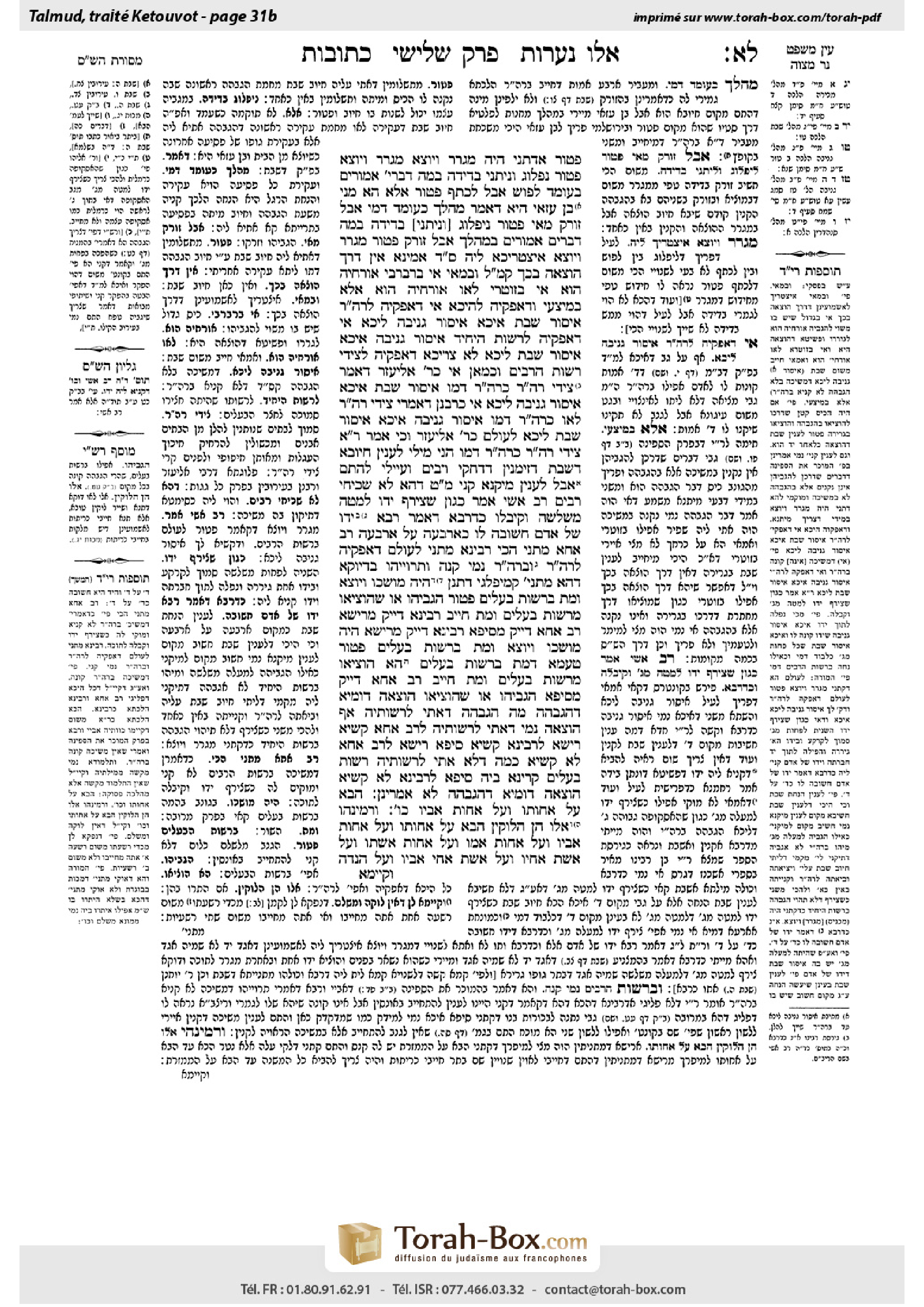
Ketubot 31b: Talmud study for Daf Yomi
Daf Yomi is the daily study of one Talmud folio. Explore 37 tractates with scans, Hebrew text, Sefaria English and AI-generated French translations where annotated.
Passage selection and English or AI-generated French translation are available where the scan has annotations. Daf Study is independent of Torah-Box and Sefaria.
Browse Ketubot · כתובות · All tractatesKetubot 31b text and translations
This page of Ketubot includes the Aramaic text, an English translation and an AI-generated French translation, alongside the scan above.
כתובות ל״א ב · Aramaic and Hebrew text
פָּטוּר. אַדְּתָנֵי: הָיָה מְגָרֵר וְיוֹצֵא מְגָרֵר וְיוֹצֵא פָּטוּר, נִפְלוֹג וְנִיתְנֵי בְּדִידַהּ: בַּמֶּה דְּבָרִים אֲמוּרִים — בְּעוֹמֵד לָפוּשׁ, אֲבָל לְכַתֵּף — פָּטוּר.
אֶלָּא: הָא מַנִּי — בֶּן עַזַּאי הִיא, דְּאָמַר: מְהַלֵּךְ כְּעוֹמֵד דָּמֵי. אֲבָל זוֹרֵק מַאי — פָּטוּר? נִיפְלוֹג [וְנִיתְנֵי] בְּדִידַהּ: בַּמֶּה דְּבָרִים אֲמוּרִים — בִּמְהַלֵּךְ, אֲבָל זוֹרֵק — פָּטוּר!
מְגָרֵר וְיוֹצֵא אִיצְטְרִיכָא לֵיהּ, סָלְקָא דַּעְתָּךְ אָמֵינָא אֵין דֶּרֶךְ הוֹצָאָה בְּכָךְ. קָא מַשְׁמַע לַן.
וּבְמַאי? אִי בְּרַבְרְבֵי — אוֹרְחֵיהּ הוּא. אִי בְּזוּטְרֵי — לָאו אוֹרְחֵיהּ הוּא. אֶלָּא בְּמִיצְעֵי.
וּדְאַפְּקֵיהּ לְהֵיכָא? אִי דְּאַפְּקֵיהּ לִרְשׁוּת הָרַבִּים — אִיסּוּר שַׁבָּת אִיכָּא, אִיסּוּר גְּנֵיבָה לֵיכָּא. אִי דְּאַפְּקֵיהּ לִרְשׁוּת הַיָּחִיד — אִיסּוּר גְּנֵיבָה אִיכָּא, אִיסּוּר שַׁבָּת — לֵיכָּא! לָא צְרִיכָא, דְּאַפְּקֵיהּ לְצִידֵּי רְשׁוּת הָרַבִּים.
וּכְמַאן? אִי כְּרַבִּי אֱלִיעֶזֶר דְּאָמַר צִידֵּי רְשׁוּת הָרַבִּים כִּרְשׁוּת הָרַבִּים דָּמוּ — אִיסּוּר שַׁבָּת אִיכָּא, אִיסּוּר גְּנֵיבָה לֵיכָּא! אִי כְּרַבָּנַן דְּאָמְרִי צִידֵּי רְשׁוּת הָרַבִּים לָאו כִּרְשׁוּת הָרַבִּים דָּמוּ — אִיסּוּר גְּנֵיבָה אִיכָּא, אִיסּוּר שַׁבָּת לֵיכָּא!
לְעוֹלָם כְּרַבִּי אֱלִיעֶזֶר, וְכִי אָמַר רַבִּי אֱלִיעֶזֶר צִידֵּי רְשׁוּת הָרַבִּים כִּרְשׁוּת הָרַבִּים דָּמוּ — הָנֵי מִילֵּי לְעִנְיַן חִיּוּבָא דְשַׁבָּת, דְּזִימְנִין דְּדָחֲקִי רַבִּים וְעָיְילִי לְהָתָם. אֲבָל לְעִנְיַן מִיקְנֵא — קָנֵי. מַאי טַעְמָא — דְּהָא לָא שְׁכִיחִי רַבִּים.
רַב אָשֵׁי אָמַר: כְּגוֹן שֶׁצֵּירַף יָדוֹ לְמַטָּה מִשְּׁלֹשָׁה וְקִיבְּלוֹ. כִּדְרָבָא. דְּאָמַר רָבָא: יָדוֹ שֶׁל אָדָם חֲשׁוּבָה לוֹ כְּאַרְבָּעָה עַל אַרְבָּעָה. רַב אַחָא מַתְנִי הָכִי.
רָבִינָא מַתְנֵי: לְעוֹלָם דְּאַפְּקֵיהּ לִרְשׁוּת הָרַבִּים, וּבִרְשׁוּת הָרַבִּים נָמֵי קָנָה, וְתַרְוַיְיהוּ בְּדִיּוּקָא דְּהָא מַתְנִיתִין קָמִיפַּלְגִי. דִּתְנַן: הָיָה מוֹשְׁכוֹ וְיוֹצֵא וּמֵת בִּרְשׁוּת בְּעָלִים — פָּטוּר. הִגְבִּיהוֹ אוֹ שֶׁהוֹצִיאוֹ מֵרְשׁוּת בְּעָלִים וּמֵת — חַיָּיב.
רָבִינָא דָּיֵיק מֵרֵישָׁא, רַב אַחָא דָּיֵיק מִסֵּיפָא. רָבִינָא דָּיֵיק מֵרֵישָׁא: הָיָה מוֹשְׁכוֹ וְיוֹצֵא וּמֵת בִּרְשׁוּת בְּעָלִים — פָּטוּר. טַעְמָא דְּמֵת בִּרְשׁוּת בְּעָלִים, הָא הוֹצִיאוֹ מֵרְשׁוּת בְּעָלִים וָמֵת — חַיָּיב. רַב אַחָא דָּיֵיק מִסֵּיפָא: הִגְבִּיהוֹ אוֹ שֶׁהוֹצִיאוֹ. הוֹצָאָה דּוּמְיָא דְּהַגְבָּהָה: מָה הַגְבָּהָה — דְּאָתֵי לִרְשׁוּתֵיהּ, אַף הוֹצָאָה נָמֵי — דְּאָתֵי לִרְשׁוּתֵיהּ.
לְרַב אַחָא קַשְׁיָא רֵישָׁא, לְרָבִינָא קַשְׁיָא סֵיפָא! רֵישָׁא לְרַב אַחָא לָא קַשְׁיָא: כַּמָּה דְּלָא אָתֵי לִרְשׁוּתֵיהּ, רְשׁוּת בְּעָלִים קָרֵינָא בֵּיהּ. סֵיפָא לְרָבִינָא לָא קַשְׁיָא: הוֹצָאָה דּוּמְיָא דְּהַגְבָּהָה לָא אָמְרִינַן.
הַבָּא עַל אֲחוֹתוֹ וְעַל אֲחוֹת אָבִיו כּוּ׳. וּרְמִינְהוּ, אֵלּוּ הֵן הַלּוֹקִין: הַבָּא עַל אֲחוֹתוֹ, וְעַל אֲחוֹת אָבִיו, וְעַל אֲחוֹת אִמּוֹ, וְעַל אֲחוֹת אִשְׁתּוֹ, וְעַל אֵשֶׁת אָחִיו, וְעַל אֵשֶׁת אֲחִי אָבִיו, וְעַל הַנִּדָּה.
Ketubot 31b · English translation
He would be exempt. If that is the case, rather than teaching: If he was dragging and exiting, dragging and exiting, he is exempt, let the tanna distinguish and teach the distinction within the case of carrying itself, as follows: In what case are these matters stated? It is in a case where he stopped to rest; however, if he stopped to adjust the burden on his shoulder, he is exempt.
Rather, the Gemara explains why one is liable in the case where he carries the purse. In accordance with whose opinion was this halakha taught? It is in accordance with the opinion of ben Azzai, who said: The legal status of one who walks is like that of one who stops, as each step constitutes a pause between the actions of lifting and placement. Therefore, the initial lifting is not part of the prohibited labor of carrying out. The Gemara infers: But if one throws the object into another domain, what is the halakha? He would be exempt from payment, as the lifting is the start of the prohibited labor of carrying out. If so, let the tanna distinguish and teach the distinction within the case itself, without resorting to the case of dragging and exiting, as follows: In what case are these matters stated? It is in the case of one who walks, so that there is separation between lifting and carrying out, and therefore the theft and the desecration of Shabbat are not simultaneous. However, one who throws is exempt from payment, as liability for carrying out and for theft are incurred simultaneously.
The Gemara answers: According to the opinion of ben Azzai, that would in fact be a more appropriate distinction; however, the case of one who was dragging and exiting was necessary for the tanna to teach because it includes a novel element, as it might enter your mind to say that this is not a typical manner of carrying out, and one is not liable to be executed for performing a prohibited labor in an atypical manner. Therefore, it teaches us that this too is a manner of carrying out.
And the Gemara asks: In what case is this so? If it is in the case of large purses, obviously dragging is its typical manner, and there is nothing novel in this. If it is in the case of small purses, dragging is certainly not its typical manner, and one would certainly not be liable. Rather, it must be referring to intermediate-sized purses. Although they are not always carried out in this manner, since they are sometimes dragged, the novelty is that he is liable for desecrating Shabbat and exempt from the payment.
The Gemara continues: And in this case, to where did he carry out the pouch? If he carried it out from the owner’s private domain to the public domain, there is violation of the prohibition of Shabbat; however, there is no violation of the prohibition against theft, as one does not acquire an item by pulling it into the public domain. If he carried it out from the owner’s private domain to his own private domain, there is violation of the prohibition against theft; however, there is no violation of the prohibition of Shabbat. The Gemara answers: This ruling is necessary only in a case where he carried it out to the sides of the public domain. This is referring to the area in the public domain adjacent to the houses located on its sides, demarcated from the thoroughfare by small pegs and not by a full-fledged partition.
The Gemara asks: And in accordance with whose opinion is this taught? If it is in accordance with the opinion of Rabbi Eliezer, who said: The legal status of the sides of the public domain is like that of the public domain, there is violation of the prohibition of Shabbat; however, there is no violation of the prohibition against theft. If it is in accordance with the opinion of the Rabbis, who said: The legal status of the sides of the public domain is not like that of the public domain, there is violation of the prohibition against theft; however, there is no violation of the prohibition of Shabbat.
The Gemara answers: Actually, it is in accordance with the opinion of Rabbi Eliezer, and when Rabbi Eliezer said: The legal status of the sides of the public domain is like that of the public domain, that applies only with regard to the liability for performing prohibited labor on Shabbat, as occasionally the multitudes crowd and enter there. However, with regard to the matter of acquiring an object, one acquires it by dragging it there. What is the reason for this halakha? It is due to the fact that the public is not typically found there, and acquisition can be effected in a place where the multitudes are not typically found.
Rav Ashi said: Actually, one is exempt when one dragged the object into the public domain in a case where he joined his hand to his other hand at a height below three handbreadths off the ground and received the purse by passing it from one hand into the other as soon as he brought it into the public domain. This is in accordance with the opinion of Rava, as Rava said: A person’s hand is considered like four by four handbreadths for him. Therefore, an object placed in one’s hand is considered placed with regard to Shabbat, and since his hand is his personal domain he has also acquired the stolen item. Rav Aḥa taught the entire discussion this way, as above.
Ravina taught otherwise: Actually, it is a case where one carried out the object to the public domain, and in the public domain he also acquires the stolen object by removing it from the owner’s domain, even if he does not transfer it to his own domain. The Gemara comments: And the two of them, Rav Aḥa and Ravina disagree with regard to the inference of this mishna, as we learned in a mishna (Bava Kamma 79a) with regard to one who stole an animal: If he was pulling the animal and exiting, and it died in the domain of the owner, the thief is exempt from payment because he did not yet acquire the animal and therefore did not assume liability for its death through circumstances beyond his control. If he lifted it or took it out of the owner’s domain, thereby acquiring the animal, and it died, the thief is liable to pay its value because it died in his possession.
Ravina inferred his conclusion from the first clause of the mishna, and Rav Aḥa inferred his conclusion from the latter clause. Ravina inferred his conclusion from the first clause: If he was pulling the animal and exiting, and it died in the domain of the owner, the thief is exempt from payment. The reason that the thief is exempt is that the animal died in the owner’s domain; by inference, if he took it out of the owner’s domain and it died, he is liable because the thief acquires the item by its very removal from the owner’s property, even to the public domain. Rav Aḥa inferred his conclusion from the latter clause of the mishna: If he lifted it or took it out of the owner’s domain, he is liable. Based on the juxtaposition of the two, taking the animal out is similar to lifting it: Just as lifting is an act of acquisition through which the animal comes into his domain, so too, taking it out is referring to a case where it comes into his domain.
The Gemara observes: For Rav Aḥa the first clause of the mishna is difficult, while for Ravina the latter clause is difficult. The Gemara answers: The first clause is not difficult for Rav Aḥa, as he could explain it as follows: As long as the animal has not come into one’s domain, even if it has left the owner’s property, we continue to call it the owner’s domain. Similarly, the latter clause is not difficult for Ravina, as in his opinion we do not say: Taking the animal out is similar to lifting it. Therefore, the mishna’s ruling is that the thief acquires the animal merely through its removal from the owner’s property.
§ The mishna continues: Similarly, one who has forced relations with his sister, i.e., he rapes her, or with his father’s sister, or with his mother’s sister, or with his wife’s sister, or with his brother’s wife, or with his father’s brother’s wife after they divorced, or with a menstruating woman, there is a fine paid. And the Gemara raised a contradiction from the following mishna (Makkot 13a): And these people are flogged: One who has relations with his sister, or with his father’s sister, or with his mother’s sister, or with his wife’s sister, or with his brother’s wife, or with his father’s brother’s wife, or with a menstruating woman. Anyone who intentionally has relations with any of these women is punished with lashes.
Ketubot 31b · Traduction française (IA)
Il serait exempt. Si tel est le cas, au lieu d’enseigner : « S’il tirait l’objet en sortant, tirait l’objet en sortant, il est exempt », que le tanna distingue et expose la distinction dans le cas même du portage, comme suit : Dans quel cas ces propos ont-ils été énoncés ? Lorsqu’il s’est arrêté pour se reposer. En revanche, s’il s’est arrêté pour ajuster le fardeau sur son épaule, il est exempt.
La Guemara explique plutôt pourquoi il est passible dans le cas où il porte la bourse. Selon l’opinion de qui cette halakha a-t-elle été enseignée ? Selon l’opinion de ben Azzai, qui a dit : Le statut de celui qui marche est comme celui de celui qui s’arrête, car chaque pas constitue une pause entre les actions de soulever et de déposer. Par conséquent, le soulèvement initial ne fait pas partie du travail interdit consistant à faire sortir un objet. La Guemara en déduit : Mais si quelqu’un jette l’objet dans un autre domaine, quelle est la halakha ? Il serait exempt de paiement, car le soulèvement marque le début du travail interdit consistant à faire sortir un objet. Si tel est le cas, que le tanna distingue et expose la distinction dans le cas même, sans recourir au cas de celui qui tire l’objet en sortant, comme suit : Dans quel cas ces propos ont-ils été énoncés ? Lorsqu’il marche, de sorte qu’il y a une séparation entre le soulèvement et le fait de faire sortir l’objet, et que le vol et la profanation du Chabbat ne sont donc pas simultanés. En revanche, celui qui jette l’objet est exempt de paiement, car la responsabilité pour l’avoir fait sortir et celle pour le vol sont engagées simultanément.
La Guemara répond : Selon l’opinion de ben Azzai, cette distinction serait effectivement plus appropriée. Toutefois, le cas de celui qui tirait l’objet en sortant était nécessaire au tanna, car il comporte un élément nouveau : on aurait pu penser que ce n’est pas une manière habituelle de faire sortir un objet et que l’on n’est pas passible de la peine de mort pour avoir accompli un travail interdit d’une manière inhabituelle. C’est pourquoi le tanna nous enseigne que cela aussi constitue une manière de faire sortir un objet.
Et la Guemara demande : Dans quel cas cela s’applique-t-il ? S’il s’agit de grandes bourses, il est évident qu’on les fait habituellement sortir en les traînant, et il n’y a là rien de nouveau. S’il s’agit de petites bourses, les traîner n’est certainement pas une manière habituelle de les faire sortir, et il ne serait assurément pas passible. Il faut donc plutôt parler de bourses de taille moyenne. Bien qu’on ne les fasse pas toujours sortir de cette manière, puisqu’on les traîne parfois, l’élément nouveau est qu’il est passible pour la profanation du Chabbat et exempt de paiement.
La Guemara poursuit : Dans ce cas, où a-t-il fait sortir la bourse ? S’il l’a fait sortir du domaine privé du propriétaire vers le domaine public, il y a transgression de l’interdit du Chabbat, mais pas de l’interdit du vol, car on n’acquiert pas un objet en le tirant jusque dans le domaine public. S’il l’a fait sortir du domaine privé du propriétaire vers son propre domaine privé, il y a transgression de l’interdit du vol, mais pas de l’interdit du Chabbat. La Guemara répond : Cette décision n’est nécessaire que dans le cas où il l’a fait sortir vers les côtés du domaine public. Il s’agit de la zone du domaine public qui borde les maisons situées de part et d’autre, délimitée par de petits piquets et non par une véritable cloison.
La Guemara demande : Et selon l’opinion de qui cela a-t-il été enseigné ? Si c’est selon l’opinion de Rabbi Eliezer, qui a dit : Le statut des côtés du domaine public est comme celui du domaine public, il y a transgression de l’interdit du Chabbat, mais pas de l’interdit du vol. Si c’est selon l’opinion des Sages, qui ont dit : Le statut des côtés du domaine public n’est pas comme celui du domaine public, il y a transgression de l’interdit du vol, mais pas de l’interdit du Chabbat.
La Guemara répond : En réalité, c’est selon l’opinion de Rabbi Eliezer. Et lorsque Rabbi Eliezer a dit que le statut des côtés du domaine public est comme celui du domaine public, cela ne concerne que la responsabilité pour l’accomplissement d’un travail interdit le Chabbat, car il arrive que les foules s’y pressent et y pénètrent. Toutefois, s’agissant de l’acquisition d’un objet, on l’acquiert en le tirant jusque-là. Quelle est la raison de cette halakha ? C’est que le public ne se trouve généralement pas à cet endroit, et l’acquisition peut se faire dans un lieu où les foules ne se trouvent généralement pas.
Rav Ashi a dit : En réalité, on est exempt lorsqu’on a tiré l’objet jusque dans le domaine public, dans un cas où l’on a joint sa main à l’autre à une hauteur inférieure à trois téfaḥim du sol, puis reçu la bourse en la faisant passer d’une main à l’autre dès qu’on l’a fait entrer dans le domaine public. Cela est conforme à l’opinion de Rava, car Rava a dit : La main d’une personne est considérée pour elle comme un espace de quatre téfaḥim sur quatre. Par conséquent, un objet placé dans sa main est considéré comme déposé au regard du Chabbat ; et puisque sa main constitue son domaine personnel, il a également acquis l’objet volé. Rav Aḥa a enseigné toute cette discussion de cette manière, comme précédemment.
Ravina a enseigné autrement : En réalité, il s’agit d’un cas où l’on a fait sortir l’objet dans le domaine public et où, là aussi, on acquiert l’objet volé en le retirant du domaine du propriétaire, même sans le faire passer dans son propre domaine. La Guemara fait remarquer : Rav Aḥa et Ravina sont en désaccord sur la déduction à tirer de cette Michna, comme nous l’avons appris dans une Michna (Bava Kamma 79a) au sujet de celui qui a volé un animal : S’il tirait l’animal en sortant et que celui-ci mourait dans le domaine du propriétaire, le voleur est exempt de paiement, car il n’avait pas encore acquis l’animal et n’était donc pas devenu responsable de sa mort due à des circonstances indépendantes de sa volonté. S’il l’a soulevé ou l’a fait sortir du domaine du propriétaire, acquérant ainsi l’animal, et que celui-ci mourait, le voleur est tenu d’en payer la valeur, car l’animal est mort alors qu’il était en sa possession.
Ravina a tiré sa conclusion de la première partie de la Michna, et Rav Aḥa de la dernière partie. Ravina a tiré sa conclusion de la première partie : S’il tirait l’animal en sortant et que celui-ci mourait dans le domaine du propriétaire, le voleur est exempt de paiement. La raison de cette exemption est que l’animal est mort dans le domaine du propriétaire ; on en déduit que s’il l’a fait sortir du domaine du propriétaire et que l’animal mourait, il est passible, car le voleur acquiert l’objet du seul fait qu’il le retire du bien du propriétaire, même en le faisant entrer dans le domaine public. Rav Aḥa a tiré sa conclusion de la dernière partie de la Michna : S’il l’a soulevé ou l’a fait sortir du domaine du propriétaire, il est passible. D’après le rapprochement des deux propositions, le fait de faire sortir l’animal est comparable à son soulèvement : de même que le soulèvement est un acte d’acquisition par lequel l’animal entre dans son domaine, de même, le fait de le faire sortir désigne un cas où l’animal entre dans son domaine.
La Guemara fait remarquer : Pour Rav Aḥa, la première partie de la Michna pose une difficulté, tandis que pour Ravina, c’est la dernière partie qui pose une difficulté. La Guemara répond : La première partie ne pose pas de difficulté à Rav Aḥa, car il peut l’expliquer ainsi : Tant que l’animal n’est pas entré dans le domaine de quelqu’un, même s’il a quitté le bien du propriétaire, nous continuons à considérer qu’il se trouve dans le domaine du propriétaire. De même, la dernière partie ne pose pas de difficulté à Ravina, car, selon lui, nous ne disons pas que le fait de faire sortir l’animal est comparable à son soulèvement. La décision de la Michna est donc que le voleur acquiert l’animal du seul fait qu’il le retire du bien du propriétaire.
§ La Michna poursuit : De même, celui qui a violé sa sœur, ou la sœur de son père, ou la sœur de sa mère, ou la sœur de sa femme, ou la femme de son frère, ou la femme du frère de son père après leur divorce, ou une femme menstruée, doit payer une amende. La Guemara soulève une contradiction à partir de la Michna suivante (Makkot 13a) : Voici ceux qui sont flagellés : celui qui a des relations avec sa sœur, ou avec la sœur de son père, ou avec la sœur de sa mère, ou avec la sœur de sa femme, ou avec la femme de son frère, ou avec la femme du frère de son père, ou avec une femme menstruée. Quiconque a intentionnellement des relations avec l’une de ces femmes est puni de flagellation.
Traduction française générée par IA à partir de l’édition anglaise de Sefaria. Vérifie toujours un passage avec le texte source.
Text from Sefaria: William Davidson Edition - Vocalized Aramaic (CC BY NC); William Davidson Edition - English (CC BY NC).