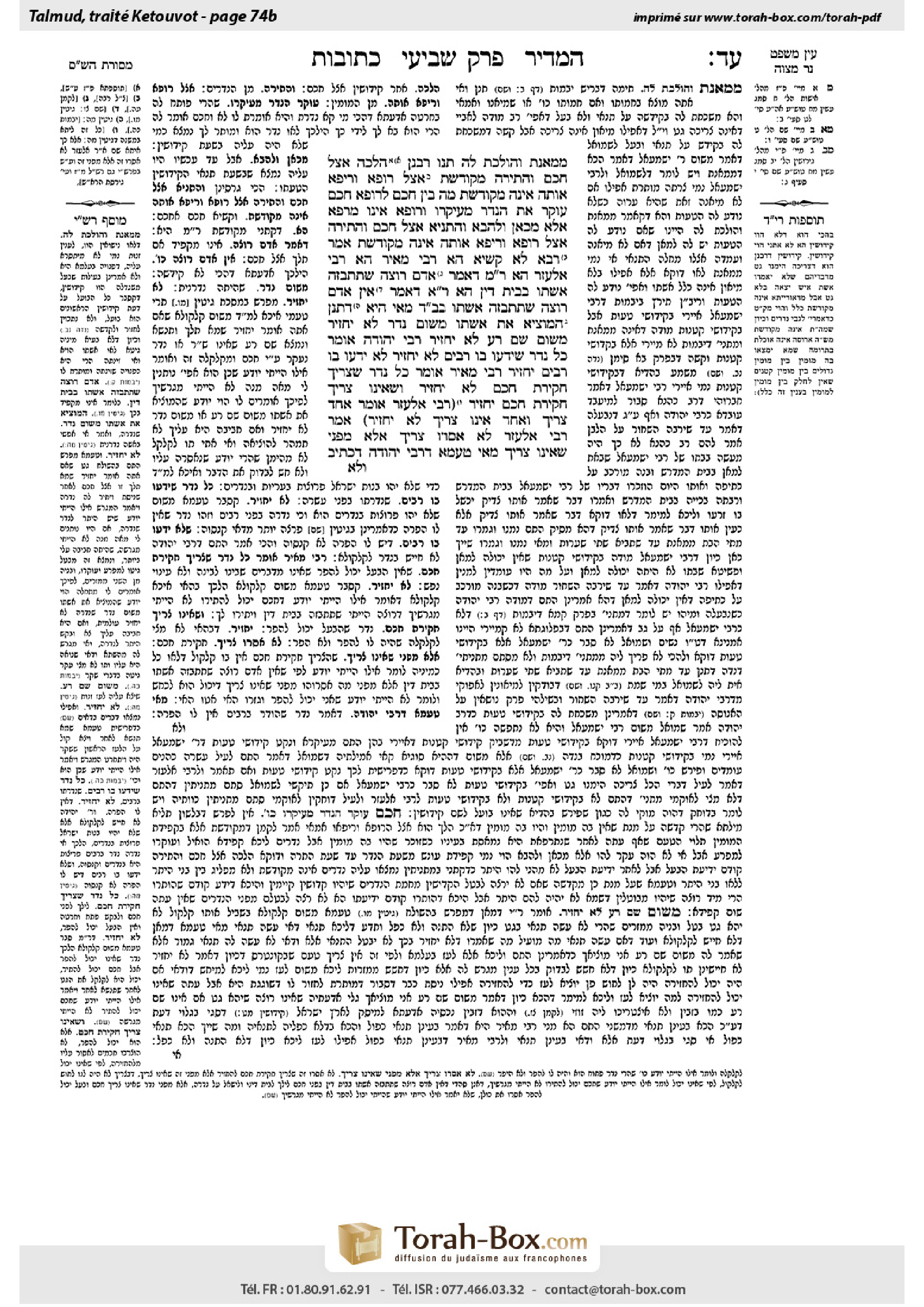
Ketubot 74b: Talmud study for Daf Yomi
Daf Yomi is the daily study of one Talmud folio. Explore 37 tractates with scans, Hebrew text, Sefaria English and AI-generated French translations where annotated.
Passage selection and English or AI-generated French translation are available where the scan has annotations. Daf Study is independent of Torah-Box and Sefaria.
Browse Ketubot · כתובות · All tractatesKetubot 74b text and translations
This page of Ketubot includes the Aramaic text, an English translation and an AI-generated French translation, alongside the scan above.
כתובות ע״ד ב · Aramaic and Hebrew text
מְמָאֶנֶת וְהוֹלֶכֶת לָהּ.
תָּנוּ רַבָּנַן: הָלְכָה אֵצֶל חָכָם וְהִתִּירָהּ — מְקוּדֶּשֶׁת. אֵצֶל רוֹפֵא וְרִיפֵּא אוֹתָהּ — אֵינָהּ מְקוּדֶּשֶׁת. מָה בֵּין חָכָם לְרוֹפֵא? חָכָם עוֹקֵר אֶת הַנֶּדֶר מֵעִיקָּרוֹ, וְרוֹפֵא אֵינוֹ מְרַפֵּא אֶלָּא מִכָּאן וּלְהַבָּא.
וְהָתַנְיָא: אֵצֶל חָכָם וְהִתִּירָהּ, אֵצֶל רוֹפֵא וְרִיפֵּא אוֹתָהּ — אֵינָהּ מְקוּדֶּשֶׁת! אָמַר רָבָא: לָא קַשְׁיָא, הָא — רַבִּי מֵאִיר, הָא — רַבִּי אֶלְעָזָר. הָא רַבִּי מֵאִיר, דְּאָמַר: אָדָם רוֹצֶה שֶׁתִּתְבַּזֶּה אִשְׁתּוֹ בְּבֵית דִּין. הָא רַבִּי אֶלְעָזָר, דְּאָמַר: אֵין אָדָם רוֹצֶה שֶׁתִּתְבַּזֶּה אִשְׁתּוֹ בְּבֵית דִּין.
מַאי הִיא? דִּתְנַן: הַמּוֹצִיא אֶת אִשְׁתּוֹ מִשּׁוּם נֶדֶר — לֹא יַחְזִיר. מִשּׁוּם שֵׁם רָע — לֹא יַחְזִיר.
רַבִּי יְהוּדָה אוֹמֵר: כׇּל נֶדֶר שֶׁיָּדְעוּ בּוֹ רַבִּים — לֹא יַחֲזִיר. לֹא יָדְעוּ בּוֹ רַבִּים — יַחֲזִיר. רַבִּי מֵאִיר אוֹמֵר: כׇּל נֶדֶר שֶׁצָּרִיךְ חֲקִירַת חָכָם — לֹא יַחֲזִיר. וְשֶׁאֵינוֹ צָרִיךְ חֲקִירַת חָכָם — יַחֲזִיר.
רַבִּי אֶלְעָזָר אוֹמֵר: אֶחָד צָרִיךְ וְאֶחָד אֵינוֹ צָרִיךְ — לֹא יַחֲזִיר. אָמַר רַבִּי אֶלְעָזָר: לֹא אָסְרוּ צָרִיךְ אֶלָּא מִפְּנֵי שֶׁאֵינוֹ צָרִיךְ. מַאי טַעְמָא דְּרַבִּי יְהוּדָה? דִּכְתִיב:
Ketubot 74b · English translation
she may refuse her husband and go on her way. According to this opinion, the marriage did not take effect at all, despite the fact that they engaged in sexual intercourse, because the betrothal involved an error.
§ The Sages taught: If a man betroths a woman on condition that there are no vows incumbent upon her to fulfill, but there are vows incumbent upon her, and she goes to a halakhic authority and he dissolves her vows, she is betrothed. However, if he betroths her on condition that she has no blemishes, but she does have blemishes, and she goes to a doctor and he heals her blemishes, she is not betrothed. The Gemara inquires: What is the difference between a halakhic authority and a doctor? The Gemara explains: When a halakhic authority dissolves a vow, he uproots the vow retroactively. It is as if she had never vowed at all, and therefore she was in fact not bound by vows at the time of their betrothal. But a doctor only heals from here onward. Since she had blemishes at the time of betrothal, she is in breach of his condition.
The Gemara raises a difficulty: But isn’t it taught in a different baraita that if she goes to a halakhic authority and he dissolves her vows, or to a doctor and he heals her blemishes, she is not betrothed? Rava said: This is not difficult, for this baraita follows the opinion of Rabbi Meir, and that one follows Rabbi Elazar. The Gemara elaborates: This baraita, which states that if her vows were dissolved by a halakhic authority she is betrothed, is in accordance with Rabbi Meir, who said that a man is willing for his wife to be degraded by going to court to have her vow dissolved. That baraita follows the opinion of Rabbi Elazar, who said that a man is not willing for his wife to be degraded in court. Consequently, even if she went to a halakhic authority and he dissolved her vows, such a solution is unacceptable to her husband, as he did not want her to go to court. Therefore, the betrothal is invalid even after the dissolution of the vow.
The Gemara poses a question: What is this fundamental dispute between Rabbi Meir and Rabbi Elazar? The Gemara answers: As we learned in a mishna (Gittin 45b): If a man who divorces his wife due to a vow that she took subsequently regrets his decision and wants to take her back, he may not remarry her. Similarly, if he divorces her due to a bad reputation she has acquired, he may not remarry her. This is because if he were allowed to take her back if the vow is dissolved by a halakhic authority or after discovering that the rumors about her were false, he might say that had he known this he never would have divorced her. Such a statement would retroactively cast doubt on the validity of the bill of divorce and could potentially cause her children from a second marriage to have the status of mamzerim. He is therefore informed that if he divorces her due to a vow or a bad reputation he can never remarry her.
Rabbi Yehuda says: With regard to any vow that is known by many people and therefore cannot be nullified, he may not remarry her. If it is not known by many people, but rather is a private matter between them, he may remarry her. Rabbi Meir says: Any vow that requires investigation by a halakhic authority, that is, the husband cannot nullify it himself and she needs a halakhic authority to analyze the vow carefully to find an opening that will permit its dissolution, he may not remarry her, for he can claim that had he known the vow could be dissolved he would never have divorced her, thereby undermining the bill of divorce. And with regard to a vow that does not require the investigation by a halakhic authority, which he knows he can nullify himself, he may remarry her. There is no concern that he might impair the bill of divorce, as he knew he could dissolve the vow and yet he chose to divorce her regardless.
Rabbi Elazar says: Both in the case of a vow that requires investigation by a halakhic authority and one that does not require it, he may not remarry her. Rabbi Elazar said in explanation of his view: They prohibited remarrying a woman who was bound by a vow that requires investigation by a halakhic authority only due to a vow that does not require such investigation. The Gemara explains the respective opinions: What is the reason for Rabbi Yehuda’s statement? As it is written:
Ketubot 74b · Traduction française (IA)
elle peut refuser son mari et s’en aller. Selon cette opinion, le mariage n’a pas pris effet du tout, bien qu’ils aient eu des relations sexuelles, car les kiddouchin reposaient sur une erreur.
§ Les Sages ont enseigné : Si un homme fiance une femme à condition qu’elle ne soit tenue par aucun vœu, mais qu’elle soit effectivement tenue par des vœux, et qu’elle se rende auprès d’une autorité halakhique qui les délie, elle est fiancée. En revanche, s’il la fiance à condition qu’elle n’ait aucun défaut, mais qu’elle en ait, et qu’elle se rende chez un médecin qui les soigne, elle n’est pas fiancée. La Guemara demande : Quelle est la différence entre une autorité halakhique et un médecin ? La Guemara explique : Lorsqu’une autorité halakhique délie un vœu, elle l’annule rétroactivement. C’est comme si elle n’avait jamais fait de vœu ; elle n’était donc, en réalité, tenue par aucun vœu au moment de leurs kiddouchin. Mais un médecin ne soigne les défauts qu’à partir de ce moment. Puisqu’elle avait des défauts au moment des kiddouchin, elle ne remplissait pas la condition qu’il avait posée.
La Guemara soulève une difficulté : Mais n’enseigne-t-on pas dans une autre baraïta que si elle se rend auprès d’une autorité halakhique qui délie ses vœux, ou chez un médecin qui soigne ses défauts, elle n’est pas fiancée ? Rava a dit : Il n’y a pas de difficulté, car cette baraïta suit l’opinion de Rabbi Meïr, tandis que l’autre suit celle de Rabbi Elazar. La Guemara développe : Cette baraïta, qui affirme que si ses vœux ont été déliés par une autorité halakhique, elle est fiancée, est conforme à l’opinion de Rabbi Meïr, qui dit qu’un homme accepte que sa femme soit humiliée en se présentant devant un tribunal pour faire délier son vœu. L’autre baraïta suit l’opinion de Rabbi Elazar, qui dit qu’un homme n’accepte pas que sa femme soit humiliée devant un tribunal. Par conséquent, même si elle s’est rendue auprès d’une autorité halakhique qui a délié ses vœux, cette solution est inacceptable pour son mari, puisqu’il ne voulait pas qu’elle aille au tribunal. Les kiddouchin sont donc invalides même après la levée du vœu.
La Guemara pose une question : En quoi consiste ce désaccord fondamental entre Rabbi Meïr et Rabbi Elazar ? La Guemara répond : Comme nous l’avons appris dans une Michna (Gittin 45b) : Si un homme qui a divorcé de sa femme à cause d’un vœu qu’elle avait fait regrette ensuite sa décision et veut la reprendre, il ne peut pas la réépouser. De même, s’il a divorcé d’elle à cause de la mauvaise réputation qu’elle a acquise, il ne peut pas la réépouser. En effet, s’il était autorisé à la reprendre lorsque le vœu est délié par une autorité halakhique, ou après avoir découvert que les rumeurs à son sujet étaient fausses, il pourrait dire que, s’il l’avait su, il ne l’aurait jamais répudiée. Une telle déclaration remettrait rétroactivement en question la validité de l’acte de divorce et pourrait faire que ses enfants issus d’un second mariage soient considérés comme des mamzerim. On lui fait donc savoir que s’il divorce de sa femme à cause d’un vœu ou d’une mauvaise réputation, il ne pourra jamais la réépouser.
Rabbi Yehouda dit : Pour tout vœu connu de nombreuses personnes et qui ne peut donc pas être annulé, il ne peut pas la réépouser. S’il n’est pas connu de nombreuses personnes, mais qu’il s’agit d’une affaire privée entre eux, il peut la réépouser. Rabbi Meïr dit : Pour tout vœu qui nécessite l’examen d’une autorité halakhique, c’est-à-dire que le mari ne peut pas l’annuler lui-même et qu’elle a besoin d’une autorité halakhique pour examiner attentivement le vœu et trouver une ouverture permettant de le délier, il ne peut pas la réépouser, car il pourrait prétendre que, s’il avait su que le vœu pouvait être délié, il ne l’aurait jamais répudiée, ce qui remettrait en cause l’acte de divorce. Quant à un vœu qui ne nécessite pas l’examen d’une autorité halakhique, qu’il sait pouvoir annuler lui-même, il peut la réépouser. Il n’y a pas lieu de craindre qu’il remette en cause l’acte de divorce, puisqu’il savait qu’il pouvait annuler le vœu et qu’il a néanmoins choisi de la répudier.
Rabbi Elazar dit : Qu’il s’agisse d’un vœu qui nécessite l’examen d’une autorité halakhique ou d’un vœu qui ne le nécessite pas, il ne peut pas la réépouser. Rabbi Elazar a expliqué son opinion : On a interdit de réépouser une femme tenue par un vœu qui nécessite l’examen d’une autorité halakhique uniquement à cause d’un vœu qui ne nécessite pas un tel examen. La Guemara explique les opinions respectives : Quelle est la raison de la déclaration de Rabbi Yehouda ? Comme il est écrit :
Traduction française générée par IA à partir de l’édition anglaise de Sefaria. Vérifie toujours un passage avec le texte source.
Text from Sefaria: William Davidson Edition - Vocalized Aramaic (CC BY NC); William Davidson Edition - English (CC BY NC).