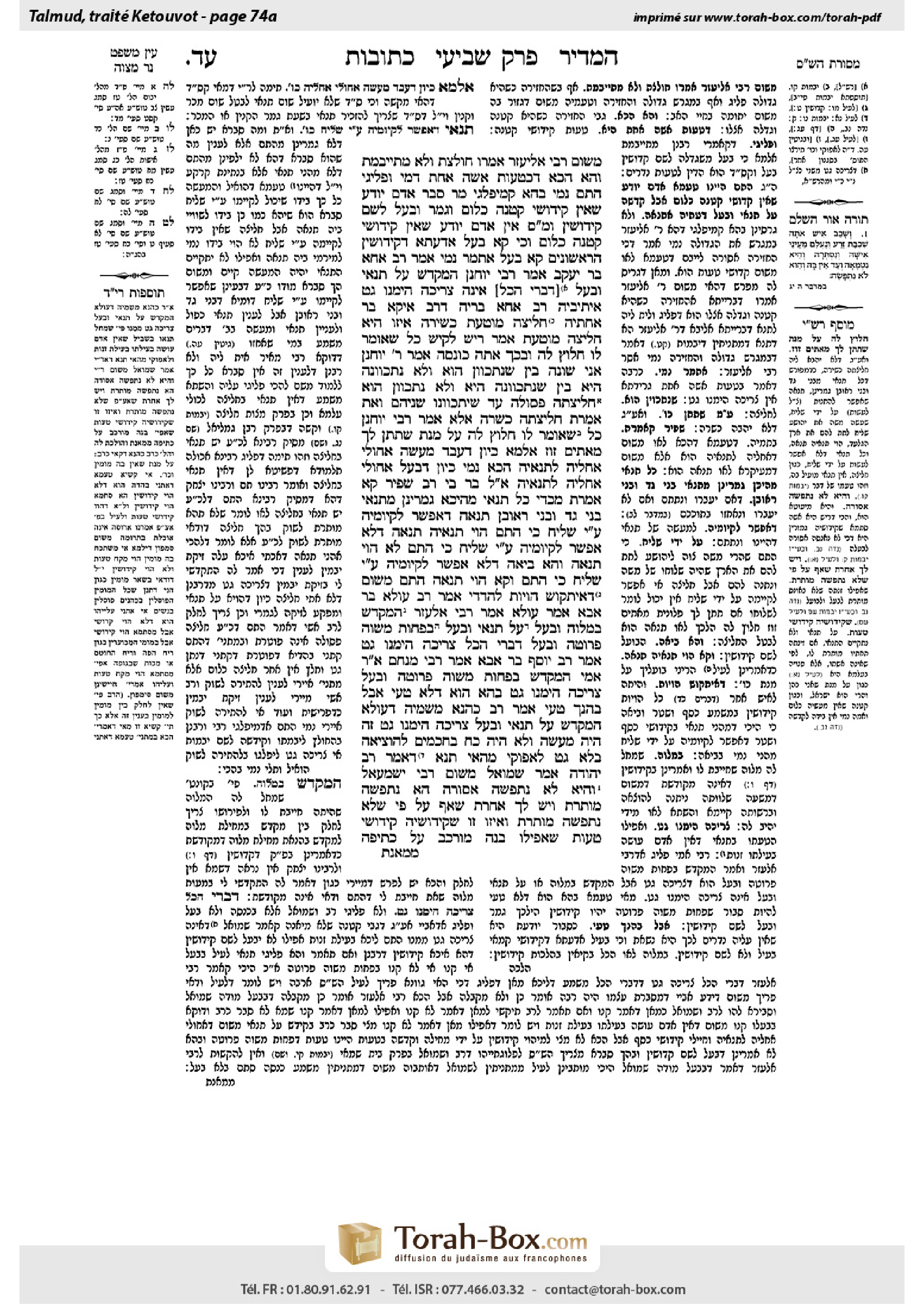
Ketubot 74a: Talmud study for Daf Yomi
Daf Yomi is the daily study of one Talmud folio. Explore 37 tractates with scans, Hebrew text, Sefaria English and AI-generated French translations where annotated.
Passage selection and English or AI-generated French translation are available where the scan has annotations. Daf Study is independent of Torah-Box and Sefaria.
Browse Ketubot · כתובות · All tractatesKetubot 74a text and translations
This page of Ketubot includes the Aramaic text, an English translation and an AI-generated French translation, alongside the scan above.
כתובות ע״ד א · Aramaic and Hebrew text
מִשּׁוּם רַבִּי אֱלִיעֶזֶר אָמְרוּ: חוֹלֶצֶת וְלֹא מִתְיַיבֶּמֶת. וְהָא הָכָא, דִּכְטָעוּת אִשָּׁה אַחַת דָּמֵי, וּפְלִיגִי!
הָתָם נָמֵי בְּהָא קָמִיפַּלְגִי, מָר סָבַר: אָדָם יוֹדֵעַ שֶׁאֵין קִידּוּשֵׁי קְטַנָּה כְּלוּם, וְגָמַר וּבָעַל לְשֵׁם קִידּוּשִׁין, וּמַר סָבַר: אֵין אָדָם יוֹדֵעַ שֶׁאֵין קִידּוּשֵׁי קְטַנָּה כְּלוּם, וְכִי קָא בָעַל — אַדַּעְתָּא דְּקִידּוּשִׁין הָרִאשׁוֹנִים קָא בָעַל.
אִתְּמַר נָמֵי, אָמַר רַב אַחָא בַּר יַעֲקֹב אָמַר רַבִּי יוֹחָנָן: הַמְקַדֵּשׁ עַל תְּנַאי וּבָעַל — [דִּבְרֵי הַכֹּל] אֵינָהּ צְרִיכָה הֵימֶנּוּ גֵּט. אֵיתִיבֵיהּ רַב אַחָא בְּרֵיהּ דְּרַב אִיקָא בַּר אֲחָתֵיהּ: חֲלִיצָה מוּטְעֵת כְּשֵׁירָה. אֵיזוֹ הִיא חֲלִיצָה מוּטְעֵת? אָמַר רֵישׁ לָקִישׁ: כֹּל שֶׁאוֹמֵר לוֹ ״חֲלוֹץ לָהּ, וּבְכָךְ אַתָּה כּוֹנְסָהּ״.
אָמַר רַבִּי יוֹחָנָן, אֲנִי שׁוֹנֶה: בֵּין שֶׁנִּתְכַּוֵּון הוּא וְלֹא נִתְכַּוְּונָה הִיא, בֵּין שֶׁנִּתְכַּוְּונָה הִיא וְלֹא נִתְכַּוֵּון הוּא חֲלִיצָתָהּ פְּסוּלָה, עַד שֶׁיִּתְכַּוְּונוּ שְׁנֵיהֶם. וְאַתְּ אָמְרַתְּ חֲלִיצָתָהּ כְּשֵׁרָה? אֶלָּא אָמַר רַבִּי יוֹחָנָן: כֹּל שֶׁאוֹמֵר לוֹ ״חֲלוֹץ לָהּ עַל מְנָת שֶׁתִּתֵּן לְךָ מָאתַיִם זוּז״.
אַלְמָא כֵּיוָן דַּעֲבַד מַעֲשֶׂה — אַחוֹלֵי אַחֲלֵיהּ לִתְנָאֵיהּ. הָכָא נָמֵי, כֵּיוָן דִּבְעַל — אַחוֹלֵי אַחֲלֵיהּ לִתְנָאֵיהּ!
אֲמַר לֵיהּ בַּר בֵּי רַב: שַׁפִּיר קָא אָמְרַתְּ? מִכְּדֵי כֹּל תְּנַאי מֵהֵיכָא גָּמְרִינַן — מִתְּנַאי בְּנֵי גָד וּבְנֵי רְאוּבֵן,
תְּנָאָה דְּאֶפְשָׁר לְקַיּוֹמֵיהּ עַל יְדֵי שָׁלִיחַ, כִּי הָתָם — הָוֵי תְּנָאֵיהּ תְּנָאָה. דְּלָא אֶפְשָׁר לְקַיּוֹמֵיהּ עַל יְדֵי שָׁלִיחַ, כִּי הָתָם — לָא הָוֵי תְּנָאָה.
וְהָא בִּיאָה, דְּלָא אֶפְשָׁר לְקַיּוֹמַיהּ עַל יְדֵי שָׁלִיחַ כִּי הָתָם, וְקָא הָוֵי תְּנָאָה!
הָתָם, מִשּׁוּם דְּאִיתַּקּוּשׁ הֲוָיוֹת לַהֲדָדֵי.
אָמַר רַב עוּלָּא בַּר אַבָּא אָמַר עוּלָּא אָמַר רַבִּי אֶלְעָזָר: הַמְקַדֵּשׁ בְּמִלְוָה וּבָעַל, עַל תְּנַאי וּבָעַל, בְּפָחוֹת מִשָּׁוֶה פְּרוּטָה וּבָעַל — דִּבְרֵי הַכֹּל צְרִיכָה הֵימֶנּוּ גֵּט.
אָמַר רַב יוֹסֵף בַּר אַבָּא אָמַר רַבִּי מְנַחֵם אָמַר רַבִּי אַמֵּי: הַמְקַדֵּשׁ בְּפָחוֹת מִשָּׁוֶה פְּרוּטָה וּבָעַל, צְרִיכָה הֵימֶנּוּ גֵּט. בְּהָא הוּא דְּלָא טָעֵי, אֲבָל בְּהָנָךְ טָעֵי.
אָמַר רַב כָּהֲנָא מִשְּׁמֵיהּ דְּעוּלָּא: הַמְקַדֵּשׁ עַל תְּנַאי וּבָעַל — צְרִיכָה הֵימֶנּוּ גֵּט. זֶה הָיָה מַעֲשֶׂה, וְלֹא הָיָה כֹּחַ בַּחֲכָמִים לְהוֹצִיאָהּ בְּלֹא גֵּט.
לְאַפּוֹקֵי מֵהַאי תַּנָּא. דְּאָמַר רַב יְהוּדָה אָמַר שְׁמוּאֵל מִשּׁוּם רַבִּי יִשְׁמָעֵאל: ״וְהִיא לֹא נִתְפָּשָׂה״ — אֲסוּרָה. הָא נִתְפָּשָׂה — מוּתֶּרֶת. וְיֵשׁ לְךָ אַחֶרֶת שֶׁאַף עַל פִּי שֶׁלֹּא נִתְפָּשָׂה, מוּתֶּרֶת. וְאֵיזוֹ זוֹ? שֶׁקִּידּוּשֶׁיהָ קִידּוּשֵׁי טָעוּת, שֶׁאֲפִילּוּ בְּנָהּ מוּרְכָּב עַל כְּתֵיפָהּ,
Ketubot 74a · English translation
In the name of Rabbi Eliezer they said that even in this case she performs ḥalitza, but she may not enter into levirate marriage. This dispute seems to hinge on whether, when he engaged in sexual intercourse with her as an adult, he did so for the purpose of betrothal, or whether he relied upon the invalid betrothal performed when she was a minor. But here, this should be considered similar to an error concerning one woman, and yet they disagree.
The Gemara refutes this claim: This is not the nature of the disagreement. Rather, there too they disagree over a possible halakhic error: One Sage, the first tanna, holds that a person knows that the betrothal of a minor girl is nothing, and consequently, after she reaches adulthood, he decides to engage in sexual intercourse for the purpose of betrothal. Therefore, if the husband dies she may enter into levirate marriage. And one Sage, Rabbi Eliezer, holds that a person does not know that the betrothal of a minor girl is nothing, and therefore when he engages in sexual intercourse with her after she reaches adulthood, he does so on the basis of the initial betrothal, which is not effective according to Torah law, and therefore she cannot enter into levirate marriage.
It was also stated in accordance with Rabba’s opinion, that there is no dispute with regard to an error concerning one woman: Rav Aḥa bar Ya’akov said that Rabbi Yoḥanan said: One who betrothed a woman conditionally and engaged in sexual intercourse without specifying that he is voiding the condition, all agree that she does not require a bill of divorce from him. Rav Aḥa, son of Rav Ika, son of Rav Aḥa bar Ya’akov’s sister, raised an objection to his opinion from a baraita that states: A mistaken ḥalitza is valid. The amora’im asked: What is meant by the term: A mistaken ḥalitza? Reish Lakish said: Any situation when someone says to a man whose married brother died childless [yavam] not well versed in halakha: Perform ḥalitza with her and by doing so you will thereby marry her. Although he did not intend to release their bond with this ḥalitza, it is nevertheless effective.
Rabbi Yoḥanan said: I teach with regard to the halakhot of ḥalitza: Whether he intended to release her through ḥalitza and she did not intend it, or whether she intended this outcome and he did not intend it, her ḥalitza is invalid; it will always be invalid until they both intend the appropriate outcome. And you say that in that case, when he intended to marry her and not to release her, that her ḥalitza is valid? Rather, Rabbi Yoḥanan said that in fact, in such a case, the ḥalitza would be invalid, and the term: A mistaken ḥalitza, concerns any situation where someone says to the yavam: Perform ḥalitza with her on condition that she gives you two hundred dinars as payment, and afterward she refuses to give him the money.
The Gemara returns to our issue: Apparently, it can be seen from here that since he performed an action, the halakha views this as though he explicitly waived his condition, for although he stipulated a condition, once he actually performs ḥalitza the condition is ignored. If so, here too, with regard to a conditional betrothal, since he engaged in sexual intercourse, he has waived his condition, which contradicts Rav Aḥa bar Ya’akov’s view.
He said to him: Student of the academy, have you spoken well? The reason why the ḥalitza is valid is not because he waived his condition, but rather because the condition was invalid to begin with. After all, from where do we learn through tradition all the laws of conditions? From the conditions made with the descendants of Gad and the descendants of Reuben. Moses made a condition with the tribes of Gad and Reuben: If they would go with the rest of the nation to fight in the battles for the land of Canaan on the western side of the Jordan, they would receive their inheritance on the eastern side, as they requested (see Numbers, chapter 32).
The Gemara derives the halakhot of contractual conditions from that incident, and these include the rule that a condition that can be fulfilled by means of an agent, as was done there, when Moses transferred responsibility for implementing the condition to Joshua and the Elders, and such a condition is a valid condition. Whereas a condition that cannot be fulfilled by means of an agent as was done there is not a valid condition. Accordingly, since ḥalitza cannot be performed by means of an agent, the condition is of no effect and the ḥalitza is valid. There is therefore no proof from here that a husband who performs an action waives his condition.
The Gemara raises a difficulty: But sexual intercourse is something that cannot be fulfilled by means of an agent as was done there, in the case of the descendants of Gad and the descendants of Reuben, and yet it is considered a valid condition. If a man says that he is engaging in intercourse with a woman for the purpose of betrothal on condition that a certain stipulation be fulfilled, if that condition is broken the betrothal is invalid.
The Gemara answers: There, in the case of betrothal, there is a special reason for this law, because the different ways of becoming betrothed are juxtaposed to each other. The Torah describes betrothal with the term becoming, as in the expression: “And she becomes another man’s wife” (Deuteronomy 24:2). Betrothal can be performed through the transference of money or an item of value, through a document, or through sexual intercourse. All three forms are juxtaposed with one another. Conditions can be stipulated for betrothal performed via transference of money or through a document, since these methods of betrothal can be fulfilled through an agent. Therefore, a condition may also be stipulated for betrothal through sexual intercourse, although that cannot be fulfilled through an agent.
Rav Ulla bar Abba said that Ulla said that Rabbi Elazar said: In the case of one who betroths a woman with a loan by forgiving a debt she owes him, which does not effect betrothal, and subsequently engages in sexual intercourse with her; or one who betroths a woman conditionally and the condition was not fulfilled, and he subsequently engages in sexual intercourse with her; or one who betroths a woman with an item worth less than the value of a peruta, and he subsequently engages in sexual intercourse with her, in all of these cases, all agree that she requires a bill of divorce from him. Although the initial betrothal was invalid, they are betrothed due to the subsequent sexual intercourse.
Rav Yosef bar Abba said that Rabbi Menaḥem said that Rabbi Ami said: In the case of one who betroths a woman with an item worth less than the value of a peruta and subsequently engages in sexual intercourse with her, she requires a bill of divorce from him. This is because it is in this matter that he does not err. He knows that betrothal must be performed with an item worth at least a peruta, and he therefore must have engaged in intercourse with her for the purpose of betrothal. But with regard to those other cases, i.e., a loan or a condition, he does err. He engages in intercourse based upon his initial betrothal, and therefore she does not require a bill of divorce.
Rav Kahana said in the name of Ulla: In the case of one who betroths a woman conditionally and the condition was not fulfilled, and he subsequently engages in sexual intercourse with her, she requires a bill of divorce from him, in accordance with Rabbi Elazar. The Gemara relates: This was an incident that actually occurred. A man betrothed a woman conditionally and then engaged in sexual intercourse with her without specification, and the Sages did not have the power to allow her to leave her husband without a bill of divorce, since they could not definitively rule that the betrothal was invalid. Therefore, they forced him to give her a bill of divorce.
The Gemara comments: This statement comes to exclude the opinion of this tanna, as Rav Yehuda said that Shmuel said in the name of Rabbi Yishmael: The verse states with regard to a woman suspected by her husband of having been unfaithful [sota]: “And she was not seized” (Numbers 5:13), i.e., she was not raped. That is, she is forbidden to her husband since she willingly committed adultery with another man. Consequently, a woman who in fact was seized is permitted to her husband. And you have another woman who, although she was not seized but rather engaged in sexual intercourse willingly, is nevertheless permitted to her husband and is not considered a sota. And who is this? This is referring to one whose betrothal was a mistaken betrothal, as even if her son from this marriage is riding on her shoulders,
Ketubot 74a · Traduction française (IA)
Au nom de Rabbi Eliezer, on a dit que même dans ce cas, elle doit accomplir la ḥalitsa, mais qu’elle ne peut pas contracter de mariage léviratique. Ce désaccord semble dépendre de la question de savoir si, lorsqu’il a eu des relations sexuelles avec elle alors qu’elle était majeure, il l’a fait dans l’intention de la fiancer, ou s’il s’est fondé sur les fiançailles invalides contractées lorsqu’elle était mineure. Mais ici, cela devrait être considéré comme une erreur concernant une seule femme, et pourtant ils sont en désaccord.
La Guemara réfute cette affirmation : ce n’est pas là la nature du désaccord. Là aussi, ils sont plutôt en désaccord au sujet d’une éventuelle erreur halakhique. Un Sage, le premier tanna, estime qu’une personne sait que les fiançailles d’une jeune fille mineure ne valent rien et que, par conséquent, après qu’elle a atteint la majorité, il décide d’avoir des relations sexuelles avec elle dans l’intention de la fiancer. Aussi, si son mari meurt, elle peut contracter un mariage léviratique. Un autre Sage, Rabbi Eliezer, estime qu’une personne ne sait pas que les fiançailles d’une jeune fille mineure ne valent rien ; ainsi, lorsqu’il a des relations sexuelles avec elle après qu’elle a atteint la majorité, il le fait en se fondant sur les fiançailles initiales, qui ne sont pas valides selon la Torah. Elle ne peut donc pas contracter de mariage léviratique.
On a également enseigné conformément à l’opinion de Rabba, selon laquelle il n’y a pas de désaccord concernant une erreur portant sur une seule femme. Rav Aḥa bar Ya’akov a dit que Rabbi Yoḥanan a dit : Celui qui a fiancé une femme sous condition et a eu des relations sexuelles avec elle sans préciser qu’il renonçait à la condition, tous reconnaissent qu’elle n’a pas besoin qu’il lui délivre un acte de divorce. Rav Aḥa, fils de Rav Ika, fils de la sœur de Rav Aḥa bar Ya’akov, a soulevé une objection contre son opinion à partir d’une baraïta qui enseigne : Une ḥalitsa accomplie par erreur est valide. Les amoraïm demandèrent : Que signifie l’expression « une ḥalitsa accomplie par erreur » ? Reish Lakish dit : toute situation où quelqu’un dit à un homme dont le frère marié est mort sans enfant [yavam], qui ne connaît pas bien la halakha : « Accomplis la ḥalitsa avec elle, et ainsi tu pourras l’épouser. » Bien qu’il n’ait pas eu l’intention de défaire leur lien par cette ḥalitsa, celle-ci est néanmoins valide.
Rabbi Yoḥanan dit : J’enseigne, au sujet des lois de la ḥalitsa, que, qu’il ait eu l’intention de la libérer par la ḥalitsa et qu’elle n’en ait pas eu l’intention, ou qu’elle ait eu cette intention et que lui ne l’ait pas eue, sa ḥalitsa est invalide ; elle le sera toujours jusqu’à ce que tous deux aient l’intention requise. Et tu dis que, dans ce cas, où il avait l’intention de l’épouser et non de la libérer, sa ḥalitsa est valide ? Rabbi Yoḥanan dit plutôt qu’en fait, dans un tel cas, la ḥalitsa serait invalide, et que l’expression « une ḥalitsa accomplie par erreur » désigne toute situation où quelqu’un dit au yavam : « Accomplis la ḥalitsa avec elle à condition qu’elle te donne deux cents dinars », puis où elle refuse de lui donner l’argent.
La Guemara revient à notre sujet : apparemment, on peut en déduire que, puisqu’il a accompli un acte, la halakha considère qu’il a explicitement renoncé à sa condition ; en effet, bien qu’il ait stipulé une condition, dès lors qu’il accomplit effectivement la ḥalitsa, la condition est écartée. Si tel est le cas, ici aussi, concernant des fiançailles conditionnelles, puisqu’il a eu des relations sexuelles, il a renoncé à sa condition, ce qui contredit l’opinion de Rav Aḥa bar Ya’akov.
Il lui dit : « Étudiant de l’académie, as-tu bien raisonné ? » Si la ḥalitsa est valide, ce n’est pas parce qu’il a renoncé à sa condition, mais parce que cette condition était invalide dès le départ. Après tout, d’où apprenons-nous par tradition toutes les lois relatives aux conditions ? Des conditions imposées aux descendants de Gad et aux descendants de Ruben. Moïse posa une condition aux tribus de Gad et de Ruben : s’ils accompagnaient le reste du peuple pour combattre dans les guerres visant à prendre possession du pays de Canaan, à l’ouest du Jourdain, ils recevraient leur héritage à l’est du Jourdain, comme ils l’avaient demandé (voir Nombres, chapitre 32).
La Guemara déduit de cet épisode les lois relatives aux conditions contractuelles. Celles-ci comprennent la règle suivante : une condition qui peut être réalisée par l’intermédiaire d’un mandataire, comme ce fut le cas là-bas lorsque Moïse confia à Josué et aux Anciens la responsabilité de mettre en œuvre la condition, est une condition valide. En revanche, une condition qui ne peut être réalisée par l’intermédiaire d’un mandataire, comme ce fut le cas là-bas, n’est pas valide. Par conséquent, puisque la ḥalitsa ne peut pas être accomplie par l’intermédiaire d’un mandataire, la condition est sans effet et la ḥalitsa est valide. On ne peut donc pas en déduire qu’un mari qui accomplit un acte renonce à sa condition.
La Guemara soulève une difficulté : mais les relations sexuelles ne peuvent pas être accomplies par l’intermédiaire d’un mandataire, contrairement à ce qui fut le cas dans l’épisode des descendants de Gad et des descendants de Ruben, et pourtant la condition est considérée comme valide. Si un homme dit qu’il a des relations sexuelles avec une femme dans l’intention de la fiancer, à condition qu’une certaine stipulation soit remplie, si cette condition n’est pas respectée, les fiançailles sont invalides.
La Guemara répond : dans le cas des fiançailles, cette loi s’explique par une raison particulière, car les différentes modalités de fiançailles sont mises en parallèle les unes avec les autres. La Torah décrit les fiançailles par le terme « devenir », comme dans l’expression : « Et elle devient la femme d’un autre homme » (Deutéronome 24:2). On peut se fiancer par le transfert d’argent ou d’un objet de valeur, par un document ou par des relations sexuelles. Ces trois formes sont mises en parallèle les unes avec les autres. On peut stipuler des conditions pour des fiançailles réalisées par le transfert d’argent ou par un document, puisque ces modalités peuvent être réalisées par l’intermédiaire d’un mandataire. On peut donc également stipuler une condition pour des fiançailles par des relations sexuelles, bien que celles-ci ne puissent pas être réalisées par l’intermédiaire d’un mandataire.
Rav Ulla bar Abba a dit qu’Ulla a dit que Rabbi Elazar a dit : dans le cas d’un homme qui fiance une femme au moyen d’un prêt, en lui remettant une dette qu’elle lui doit, ce qui ne produit pas de fiançailles, puis a des relations sexuelles avec elle ; ou d’un homme qui fiance une femme sous condition, alors que la condition n’a pas été remplie, puis a des relations sexuelles avec elle ; ou d’un homme qui fiance une femme au moyen d’un objet valant moins qu’une perouta, puis a des relations sexuelles avec elle, tous reconnaissent, dans chacun de ces cas, qu’elle a besoin qu’il lui délivre un acte de divorce. Bien que les fiançailles initiales aient été invalides, ils sont fiancés à la suite des relations sexuelles ultérieures.
Rav Yosef bar Abba a dit que Rabbi Menaḥem a dit que Rabbi Ami a dit : dans le cas d’un homme qui fiance une femme au moyen d’un objet valant moins qu’une perouta, puis a des relations sexuelles avec elle, elle a besoin qu’il lui délivre un acte de divorce. C’est sur ce point qu’il ne se trompe pas. Il sait que les fiançailles doivent être effectuées au moyen d’un objet valant au moins une perouta ; il a donc nécessairement eu des relations sexuelles avec elle dans l’intention de la fiancer. Mais dans les autres cas, c’est-à-dire un prêt ou une condition, il se trompe. Il a des relations sexuelles avec elle en se fondant sur ses fiançailles initiales ; elle n’a donc pas besoin qu’il lui délivre un acte de divorce.
Rav Kahana a dit au nom d’Ulla : dans le cas d’un homme qui fiance une femme sous condition, alors que la condition n’a pas été remplie, puis a des relations sexuelles avec elle, elle a besoin qu’il lui délivre un acte de divorce, conformément à l’opinion de Rabbi Elazar. La Guemara rapporte : un tel incident s’est réellement produit. Un homme avait fiancé une femme sous condition, puis avait eu des relations sexuelles avec elle sans rien préciser. Les Sages n’avaient pas le pouvoir de lui permettre de quitter son mari sans acte de divorce, puisqu’ils ne pouvaient pas trancher avec certitude que les fiançailles étaient invalides. Ils l’obligèrent donc à lui délivrer un acte de divorce.
La Guemara fait remarquer : cette déclaration vise à exclure l’opinion de ce tanna, car Rav Yehuda a dit que Shmuel a dit au nom de Rabbi Yishmael : au sujet d’une femme que son mari soupçonne d’infidélité [sota], le verset dit : « Et elle n’a pas été saisie » (Nombres 5:13), c’est-à-dire qu’elle n’a pas été violée. Autrement dit, elle est interdite à son mari, puisqu’elle a volontairement commis un adultère avec un autre homme. Par conséquent, une femme qui a effectivement été saisie est permise à son mari. Il existe aussi une autre femme qui, bien qu’elle n’ait pas été saisie mais ait eu volontairement des relations sexuelles, est néanmoins permise à son mari et n’est pas considérée comme une sota. Et qui est-ce ? Il s’agit d’une femme dont les fiançailles étaient erronées, même si le fils issu de ce mariage est assis sur ses épaules,
Traduction française générée par IA à partir de l’édition anglaise de Sefaria. Vérifie toujours un passage avec le texte source.
Text from Sefaria: William Davidson Edition - Vocalized Aramaic (CC BY NC); William Davidson Edition - English (CC BY NC).