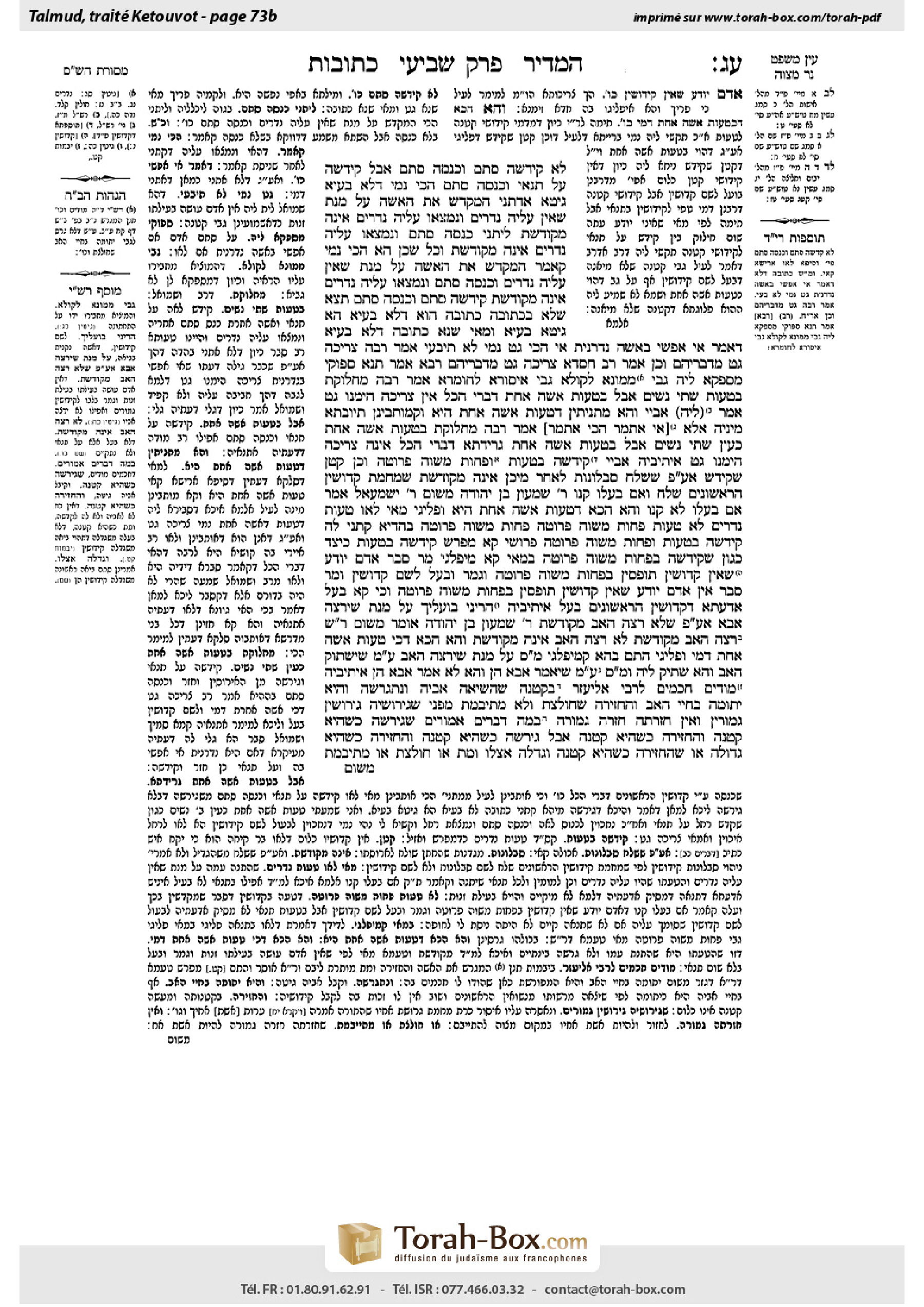
Ketubot 73b: Talmud study for Daf Yomi
Daf Yomi is the daily study of one Talmud folio. Explore 37 tractates with scans, Hebrew text, Sefaria English and AI-generated French translations where annotated.
Passage selection and English or AI-generated French translation are available where the scan has annotations. Daf Study is independent of Torah-Box and Sefaria.
Browse Ketubot · כתובות · All tractatesKetubot 73b text and translations
This page of Ketubot includes the Aramaic text, an English translation and an AI-generated French translation, alongside the scan above.
כתובות ע״ג ב · Aramaic and Hebrew text
לָא, קִידְּשָׁה סְתָם, וּכְנָסָהּ סְתָם.
אֲבָל, קִידְּשָׁה עַל תְּנַאי וּכְנָסָהּ סְתָם — הָכִי נָמֵי דְּלָא בָּעֲיָא גִּיטָּא? אַדְּתָנֵי הַמְקַדֵּשׁ אֶת הָאִשָּׁה עַל מְנָת שֶׁאֵין עָלֶיהָ נְדָרִים וְנִמְצְאוּ עָלֶיהָ נְדָרִים אֵינָהּ מְקוּדֶּשֶׁת, לִיתְנֵי: כְּנָסָהּ סְתָם וְנִמְצְאוּ עָלֶיהָ נְדָרִים — אֵינָהּ מְקוּדֶּשֶׁת, וְכׇל שֶׁכֵּן הָא.
הָכִי נָמֵי קָאָמַר: הַמְקַדֵּשׁ אֶת הָאִשָּׁה עַל מְנָת שֶׁאֵין עָלֶיהָ נְדָרִים וּכְנָסָהּ סְתָם, וְנִמְצְאוּ עָלֶיהָ נְדָרִים — אֵינָהּ מְקוּדֶּשֶׁת. קִידְּשָׁה סְתָם וּכְנָסָהּ סְתָם — תֵּצֵא שֶׁלֹּא בִּכְתוּבָּה.
כְּתוּבָּה הוּא דְּלָא בָּעֲיָא, הָא גִּיטָּא — בָּעֲיָא. וּמַאי שְׁנָא כְּתוּבָּה דְּלָא בָּעֲיָא — דְּאָמַר: אִי אֶפְשִׁי בְּאִשָּׁה נַדְרָנִית, אִי הָכִי גֵּט נָמֵי לָא תִּיבְּעֵי!
אָמַר רַבָּה: צְרִיכָה גֵּט מִדִּבְרֵיהֶם. וְכֵן אָמַר רַב חִסְדָּא: צְרִיכָה גֵּט מִדִּבְרֵיהֶם. רָבָא אָמַר: תַּנָּא סַפּוֹקֵי מְסַפְּקָא לֵיהּ, גַּבֵּי מָמוֹנָא לְקוּלָּא, גַּבֵּי אִיסּוּרָא לְחוּמְרָא.
אָמַר רַבָּה: מַחְלוֹקֶת בְּטָעוּת שְׁתֵּי נָשִׁים. אֲבָל בְּטָעוּת אִשָּׁה אַחַת — דִּבְרֵי הַכֹּל אֵין צְרִיכָה הֵימֶנּוּ גֵּט.
אֲמַר (לֵיהּ) אַבָּיֵי: וְהָא מַתְנִיתִין דְּטָעוּת אִשָּׁה אַחַת הִיא, וְקָמוֹתְבִינַן תְּיוּבְתָּא מִינַּיהּ!
אֶלָּא אִי אִתְּמַר הָכִי אִתְּמַר, אָמַר רַבָּה: מַחְלוֹקֶת בְּטָעוּת אִשָּׁה אַחַת כְּעֵין שְׁתֵּי נָשִׁים. אֲבָל בְּטָעוּת אִשָּׁה אַחַת גְּרֵידְתָּא — דִּבְרֵי הַכֹּל אֵינָהּ צְרִיכָה הֵימֶנּוּ גֵּט.
אֵיתִיבֵיהּ אַבָּיֵי: קִידְּשָׁהּ בְּטָעוּת, וּפָחוֹת מִשָּׁוֶה פְּרוּטָה, וְכֵן קָטָן שֶׁקִּידֵּשׁ, אַף עַל פִּי שֶׁשָּׁלַח סִבְלוֹנוֹת לְאַחַר מִיכֵּן — אֵינָהּ מְקוּדֶּשֶׁת, שֶׁמֵּחֲמַת קִדּוּשִׁין הָרִאשׁוֹנִים שָׁלַח. וְאִם בָּעֲלוּ — קָנוּ. רַבִּי שִׁמְעוֹן בֶּן יְהוּדָה מִשּׁוּם רַבִּי יִשְׁמָעֵאל אָמַר: אִם בָּעֲלוּ לֹא קָנוּ.
וְהָא הָכָא דְּטָעוּת אִשָּׁה אַחַת הִיא, וּפְלִיגִי. מַאי לָאו טָעוּת נְדָרִים?
לָא, טָעוּת פָּחוֹת מִשָּׁוֶה פְּרוּטָה. פָּחוֹת מִשָּׁוֶה פְּרוּטָה בְּהֶדְיָא קָתָנֵי לַהּ: קִידְּשָׁהּ בְּטָעוּת וּפָחוֹת מִשָּׁוֶה פְּרוּטָה! פָּרוֹשֵׁי קָא מְפָרֵשׁ: קִידְּשָׁהּ בְּטָעוּת כֵּיצַד? כְּגוֹן שֶׁקִּידְּשָׁהּ בְּפָחוֹת מִשָּׁוֶה פְּרוּטָה.
בְּמַאי קָא מִיפַּלְגִי? מָר סָבַר: אָדָם יוֹדֵעַ שֶׁאֵין קִדּוּשִׁין תּוֹפְסִין בְּפָחוֹת מִשָּׁוֶה פְּרוּטָה, וְגָמַר וּבָעַל לְשֵׁם קִדּוּשִׁין. וּמַר סָבַר: אֵין אָדָם יוֹדֵעַ שֶׁאֵין קִדּוּשִׁין תּוֹפְסִין בְּפָחוֹת מִשָּׁוֶה פְּרוּטָה, וְכִי קָא בָעַל, אַדַּעְתָּא דְּקִדּוּשִׁין הָרִאשׁוֹנִים בָּעַל.
אֵיתִיבֵיהּ: ״הֲרֵינִי בּוֹעֲלִיךְ עַל מְנָת שֶׁיִּרְצֶה אַבָּא״, אַף עַל פִּי שֶׁלֹּא רָצָה הָאָב — מְקוּדֶּשֶׁת. רַבִּי שִׁמְעוֹן בֶּן יְהוּדָה אוֹמֵר מִשּׁוּם רַבִּי שִׁמְעוֹן: רָצָה הָאָב מְקוּדֶּשֶׁת, לֹא רָצָה הָאָב אֵינָהּ מְקוּדֶּשֶׁת. וְהָא הָכָא, דְּכִי טָעוּת אִשָּׁה אַחַת דָּמֵי, וּפְלִיגִי!
הָתָם בְּהָא קָמִיפַּלְגִי, מָר סָבַר ״עַל מְנָת שֶׁיִּרְצֶה הָאָב״ — עַל מְנָת שֶׁיִּשְׁתּוֹק הָאָב, וְהָא שָׁתֵיק לֵיהּ. וּמָר סָבַר ״עַל מְנָת שֶׁיֹּאמַר אַבָּא ׳הֵן׳״, וְהָא לָא אָמַר אַבָּא ׳הֵן׳.
אֵיתִיבֵיהּ: מוֹדִים חֲכָמִים לְרַבִּי אֱלִיעֶזֶר בִּקְטַנָּה שֶׁהִשִּׂיאָהּ אָבִיהָ, וְנִתְגָּרְשָׁה וְהִיא יְתוֹמָה בְּחַיֵּי הָאָב, וְהֶחְזִירָהּ — שֶׁחוֹלֶצֶת וְלֹא מִתְיַבֶּמֶת,
מִפְּנֵי שֶׁגֵּירוּשֶׁיהָ גֵּירוּשִׁין גְּמוּרִין, וְאֵין חֲזָרָתָהּ חֲזָרָה גְּמוּרָה.
בַּמֶּה דְּבָרִים אֲמוּרִים — שֶׁגֵּירְשָׁהּ כְּשֶׁהִיא קְטַנָּה, וְהֶחְזִירָהּ כְּשֶׁהִיא קְטַנָּה. אֲבָל גֵּירְשָׁהּ כְּשֶׁהִיא קְטַנָּה וְהֶחְזִירָהּ כְּשֶׁהִיא גְּדוֹלָה, אוֹ שֶׁהֶחְזִירָהּ כְּשֶׁהִיא קְטַנָּה וְגָדְלָה אֶצְלוֹ וָמֵת — אוֹ חוֹלֶצֶת אוֹ מִתְיַבֶּמֶת.
Ketubot 73b · English translation
The Gemara rejects the proof: No, the case there is referring to where he betrothed her without specification and then married her without specification.
The Gemara asks: But according to this explanation, if he betrothed her conditionally and then married her without specification, is it indeed the case that she does not require a bill of divorce? If so, instead of teaching in the mishna that if one betroths a woman on condition that there are no vows incumbent upon her to fulfill, and it was subsequently discovered that there are vows that are incumbent upon her, she is not betrothed, let the mishna teach instead a more novel halakha: If he betrothed her with a condition and married her without specification and then it was discovered that vows were incumbent upon her, she is not betrothed. And from this one can derive that all the more so the same halakha would apply in this case, where he betrothed her conditionally but did not repeat the condition when marrying her.
The Gemara answers: That is also what he is saying, and one should understand the mishna this way: One who betroths a woman on condition that there are no vows incumbent upon her to fulfill, and then marries her without specification, and it is then discovered that vows were incumbent upon her, she is not betrothed. If he betrothed her without specification and married her without specification, she requires a bill of divorce but may be divorced without receiving payment of her marriage contract.
The Gemara asks about this halakha according to Shmuel: The mishna says that she does not require or receive payment of her marriage contract, but one can infer that she does require a bill of divorce. And what is different about a marriage contract that she does not require payment? Because he says: I do not want a vowing wife, and therefore the marriage is considered a mistaken transaction. If so, she should also not require a bill of divorce. Since he is clearly particular about this, shouldn’t the betrothal also be considered a mistaken transaction?
Rabba said: She requires a bill of divorce from the words of the Sages, i.e., by rabbinic law. Although by Torah law the betrothal is in fact invalid, the Sages declared that since he did not explicitly stipulate the condition, she requires a bill of divorce. And similarly, Rav Ḥisda said: She requires a bill of divorce from the words of the Sages. Rava said a different explanation: The tanna is uncertain about the status of the betrothal in this case. Concerning monetary matters, one should be lenient. Therefore, she cannot extract money from the husband for the marriage contract based on the principle that in monetary cases the burden of proof rests upon the claimant. But concerning prohibitions such as adultery, one must be stringent, and she therefore requires a bill of divorce.
Rabba said: The dispute between Rav and Shmuel is in the case of an error concerning two women. The same man married one woman on condition that she had no vows incumbent upon her and then married another woman without specification. Rav and Shmuel disagree whether the condition he explicitly stated for the first woman should be seen as proof that he is particular about this with regard to the second one as well, to the point that the betrothal is invalid if the condition was not fulfilled. But in the case of an error concerning one woman, where he betroths her with a condition, marries her without specification, and subsequently discovered that the condition was not fulfilled, all agree, including Rav, that she does not require a bill of divorce from him.
Abaye said to him: But the mishna discusses an error concerning one woman, as a second woman is not mentioned, and we raise an objection from it against Shmuel, implying that Rav and Shmuel have a dispute in this case as well. How, then, can you say that dispute is in the case of an error concerning two women?
Rather, the previous explanation must be retracted and instead the Gemara says: If the above statement of Rabba was said, it was said as follows: Rabba said that the dispute between Rav and Shmuel is with regard to a case of an error concerning one woman similar to an error concerning two women. He betrothed one woman conditionally and then divorced her, and subsequently married her again without specification. In this case, Rav and Shmuel dispute whether the assumption is that he intended to nullify the initial condition with the second betrothal or whether he married her the second time based upon the conditions of the first betrothal. But in the case of a simple error only concerning one woman, where he betroths her with a condition, marries her without specification, and then discovers that the condition was not fulfilled, all agree that she does not require a bill of divorce from him.
Abaye raised an objection to Rabba’s statement from a baraita: In cases where the man betrothed her in error, or he betrothed her with an item worth less than the value of a peruta, and similarly in a case where there was a minor boy who betrothed a woman, even if the man later sent presents [sivlonot] to the bride after he became an adult, she is not betrothed, because he sent them on the basis of the original betrothal. And if the men in any of these cases engaged in sexual intercourse with the woman after betrothal at the appropriate time, they have acquired the women as their wives, since they presumably intended the intercourse to serve as betrothal. Rabbi Shimon ben Yehuda said in the name of Rabbi Yishmael: Even if they engage in sexual intercourse, they have not acquired the women as wives, since they presumably engaged in these relations based upon the earlier betrothal, which was invalid.
Noting that the first case in the baraita is where a man betrothed a woman in error, Abaye asks: But here in this baraita, where the first case is an error concerning one woman, and the first tanna and Rabbi Shimon ben Yehuda disagree; what, is it not that the intention of the phrase: Betrothed her in error, is referring to an error in the condition with regard to vows, where he mistakenly believed she didn’t have any vows incumbent upon her? This would constitute a refutation of Rabba’s statement that all agree that in a case of an error concerning one woman she is not betrothed.
The Gemara responds: No, here it is referring to a halakhic error, that he betrothed a woman with an item worth less than the value of a peruta. The Gemara asks: Concerning the case where the betrothal is with an item worth less than the value of a peruta, the baraita teaches it explicitly as a separate case with the following words: If he betrothed her in error, or if he betrothed her with an item worth less than the value of a peruta. The Gemara answers: It is explaining what it stated earlier: What is the case of one who betrothed her in error? For example, when he betrothed her with an item worth less than the value of a peruta, as he did not engage in sexual intercourse with her based on such a betrothal.
The Gemara asks: With regard to what do they disagree? The Gemara answers: One Sage, the first tanna, holds that a person knows that betrothal does not take effect with an item worth less than the value of a peruta. Consequently, he decides to engage in sexual intercourse for the purpose of betrothal and therefore acquires the woman as his wife through these relations. And one Sage, Rabbi Shimon ben Yehuda, holds that a person does not know that betrothal does not take effect with an item worth less than the value of a peruta, and when he later engages in sexual intercourse, he does so on the basis of the original betrothal, so no new betrothal takes place.
Abaye again raised an objection to Rabba’s statement from a baraita: If a man said to a woman: I am engaging in sexual intercourse with you for the purpose of betrothal on condition that my father will desire our betrothal, and then he married her without specification, although the father did not desire it, she is nevertheless betrothed through this act of intercourse. Rabbi Shimon ben Yehuda says in the name of Rabbi Shimon: If the father desires it, she is betrothed, and if the father does not desire it, she is not betrothed, since he engaged in intercourse with her based on the initial condition. But here it is similar to a mistake concerning one woman, and they disagree whether the betrothal is valid.
The Gemara responds: There, they disagree about this: One Sage, the first tanna, holds that: On condition that my father will desire it, means: On condition that my father is silent. Consequently, if his father does not protest, the betrothal is valid, and he was indeed silent about it. And one Sage, Rabbi Shimon ben Yehuda, holds that it means: On condition that my father says yes, and he did not say yes. Therefore, the dispute is about the significance of the father’s silence in this case.
Abaye again raised an objection to Rabba’s statement from a baraita: The Rabbis concede to Rabbi Eliezer concerning a minor girl who was married off by her father and then divorced while she was still a minor, and is therefore treated by the halakha as an orphan in the lifetime of the father, since the halakha is that the father is no longer able to marry her off to someone else, and while she was still a minor, her former husband remarried her, and he then died without children, that she performs ḥalitza and may not instead enter into levirate marriage.
The baraita continues: This is because her divorce was a full-fledged divorce, since the father has authority to receive her bill of divorce from her husband, and her return to her husband afterward is not a full-fledged return, since she remarries her husband while still a minor, and her father no longer has authority to marry her off, and marriage to a minor girl by her own consent is not considered a full-fledged marriage. She is consequently prohibited from entering into a levirate marriage based on the prohibition against a divorcée marrying her former husband’s brother.
The baraita continues: In what case is this statement said? When he divorced her while she was still a minor girl and then remarried her while she was still a minor girl. But if he divorced her while she was still a minor girl, and then remarried her when she was an adult woman, or if he remarried her while she was still a minor girl and she became an adult woman while married to him, the second marriage is binding, and she has the status of a full-fledged married woman. And therefore, if he died, either she performs ḥalitza or she enters into levirate marriage like any other widow.
Ketubot 73b · Traduction française (IA)
La Guemara rejette la preuve : Non, le cas évoqué là concerne un homme qui l’a fiancée sans préciser de condition, puis l’a épousée sans en préciser.
La Guemara demande : Mais, selon cette explication, s’il l’a fiancée sous condition puis l’a épousée sans préciser de condition, est-il vraiment exact qu’elle n’a pas besoin d’un acte de divorce ? Si tel est le cas, au lieu d’enseigner dans la Michna que, si un homme fiance une femme à condition qu’elle n’ait aucun vœu qu’elle soit tenue d’accomplir et que l’on découvre ensuite qu’elle a de tels vœux, elle n’est pas fiancée, que la Michna enseigne plutôt une halakha plus novatrice : s’il l’a fiancée sous condition, puis l’a épousée sans préciser de condition, et que l’on découvre ensuite qu’elle avait des vœux à accomplir, elle n’est pas fiancée. On pourrait en déduire, à plus forte raison, que la même halakha s’applique dans le cas où il l’a fiancée sous condition, mais n’a pas répété cette condition au moment de l’épouser.
La Guemara répond : C’est également ce qu’il dit, et il faut donc comprendre la Michna ainsi : Celui qui fiance une femme à condition qu’elle n’ait aucun vœu qu’elle soit tenue d’accomplir, puis l’épouse sans préciser de condition, et découvre alors qu’elle avait de tels vœux, ne l’a pas fiancée. S’il l’a fiancée sans préciser de condition et l’a épousée sans préciser de condition, elle a besoin d’un acte de divorce, mais peut être répudiée sans recevoir le paiement de sa ketouba.
La Guemara examine cette halakha selon Shmuel : la Michna dit qu’elle n’a pas besoin de recevoir le paiement de sa ketouba, mais on peut en déduire qu’elle a besoin d’un acte de divorce. Pourquoi le paiement de la ketouba ne lui revient-il pas ? Parce qu’il dit : « Je ne veux pas d’une épouse qui a des vœux », et le mariage est donc considéré comme une transaction conclue par erreur. Si tel est le cas, elle ne devrait pas non plus avoir besoin d’un acte de divorce. Puisqu’il tient manifestement à cela, les fiançailles ne devraient-elles pas, elles aussi, être considérées comme une transaction conclue par erreur ?
Rabba a dit : Elle a besoin d’un acte de divorce en vertu des paroles des Sages, c’est-à-dire selon le droit rabbinique. Bien que, selon la Torah, les fiançailles soient en réalité invalides, les Sages ont décrété que, puisqu’il n’avait pas explicitement stipulé la condition, elle avait besoin d’un acte de divorce. De même, Rav Ḥisda a dit : Elle a besoin d’un acte de divorce en vertu des paroles des Sages. Rava a donné une autre explication : le tanna est incertain quant au statut des fiançailles dans ce cas. Pour les questions pécuniaires, il faut se montrer indulgent. Elle ne peut donc pas obtenir de son mari le paiement de sa ketouba, conformément au principe selon lequel, dans les affaires pécuniaires, la charge de la preuve incombe au demandeur. Mais, pour les interdictions, comme celle de l’adultère, il faut se montrer strict ; elle a donc besoin d’un acte de divorce.
Rabba a dit : La controverse entre Rav et Shmuel porte sur le cas d’une erreur impliquant deux femmes. Un même homme a épousé une femme à condition qu’elle n’ait aucun vœu à accomplir, puis en a épousé une autre sans préciser de condition. Rav et Shmuel sont en désaccord sur la question de savoir si la condition qu’il a explicitement formulée pour la première femme prouve qu’il tient également à cette condition pour la seconde, au point que les fiançailles sont invalides si elle n’est pas remplie. Mais, dans le cas d’une erreur impliquant une seule femme — il la fiance sous condition, l’épouse sans préciser de condition, puis découvre que la condition n’a pas été remplie — tous sont d’accord, y compris Rav, qu’elle n’a pas besoin d’un acte de divorce de sa part.
Abaye lui dit : Mais la Michna traite d’une erreur impliquant une seule femme, puisqu’elle ne mentionne pas de seconde femme, et nous soulevons contre Shmuel une objection tirée de cette Michna, ce qui implique que Rav et Shmuel sont également en désaccord dans ce cas. Comment peux-tu donc dire que leur controverse porte sur une erreur impliquant deux femmes ?
Il faut plutôt revenir sur l’explication précédente. La Guemara dit alors : Si la déclaration susmentionnée de Rabba a été formulée, c’est en ces termes : Rabba a dit que la controverse entre Rav et Shmuel porte sur un cas d’erreur impliquant une seule femme, analogue à un cas d’erreur impliquant deux femmes. Il a fiancé une femme sous condition, puis a divorcé d’elle et, par la suite, l’a épousée de nouveau sans préciser de condition. Dans ce cas, Rav et Shmuel sont en désaccord sur la question de savoir s’il faut supposer qu’il a voulu annuler la condition initiale lors des secondes fiançailles, ou s’il l’a épousée une seconde fois en se fondant sur les conditions des premières fiançailles. Mais, dans le cas d’une simple erreur impliquant une seule femme — il la fiance sous condition, l’épouse sans préciser de condition, puis découvre que la condition n’a pas été remplie — tous sont d’accord qu’elle n’a pas besoin d’un acte de divorce de sa part.
Abaye soulève une objection contre la déclaration de Rabba à partir d’une baraïta : Dans les cas où un homme l’a fiancée par erreur ou l’a fiancée avec un objet d’une valeur inférieure à une perouta, et de même dans le cas où un garçon mineur a fiancé une femme, même si l’homme a ensuite envoyé des présents [sivlonot] à la fiancée après être devenu majeur, elle n’est pas fiancée, car il les a envoyés sur la base des fiançailles initiales. Si, dans l’un de ces cas, les hommes ont eu des relations sexuelles avec la femme après les fiançailles, au moment approprié, ils l’ont acquise comme épouse, car ils ont vraisemblablement voulu que ces relations tiennent lieu de fiançailles. Rabbi Shimon ben Yehuda a dit au nom de Rabbi Yishmael : Même s’ils ont des relations sexuelles avec elles, ils ne les ont pas acquises comme épouses, car ils ont vraisemblablement eu ces relations en se fondant sur les fiançailles antérieures, qui étaient invalides.
Remarquant que le premier cas de la baraïta est celui d’un homme qui a fiancé une femme par erreur, Abaye demande : Mais ici, dans cette baraïta, le premier cas concerne une erreur impliquant une seule femme, et le premier tanna et Rabbi Shimon ben Yehuda sont en désaccord. N’est-ce pas que l’expression « l’a fiancée par erreur » désigne une erreur concernant la condition relative aux vœux, c’est-à-dire qu’il croyait à tort qu’elle n’avait aucun vœu à accomplir ? Cela réfuterait la déclaration de Rabba selon laquelle tous sont d’accord que, dans le cas d’une erreur impliquant une seule femme, elle n’est pas fiancée.
La Guemara répond : Non, il s’agit ici d’une erreur halakhique : il l’a fiancée avec un objet d’une valeur inférieure à une perouta. La Guemara demande : Le cas où il l’a fiancée avec un objet d’une valeur inférieure à une perouta, la baraïta l’enseigne explicitement comme un cas distinct, en ces termes : « S’il l’a fiancée par erreur, ou s’il l’a fiancée avec un objet d’une valeur inférieure à une perouta. » La Guemara répond : Cela explique ce qui a été dit précédemment : Quel est le cas de celui qui l’a fiancée par erreur ? Par exemple, lorsqu’il l’a fiancée avec un objet d’une valeur inférieure à une perouta, car il n’a pas eu de relations sexuelles avec elle en se fondant sur de telles fiançailles.
La Guemara demande : Sur quoi porte leur désaccord ? La Guemara répond : Un Sage, le premier tanna, estime qu’une personne sait que des fiançailles ne prennent pas effet avec un objet d’une valeur inférieure à une perouta. Par conséquent, il décide d’avoir des relations sexuelles dans l’intention de la fiancer et l’acquiert donc comme épouse par ces relations. Un autre Sage, Rabbi Shimon ben Yehuda, estime qu’une personne ne sait pas que des fiançailles ne prennent pas effet avec un objet d’une valeur inférieure à une perouta ; lorsqu’il a ensuite des relations sexuelles avec elle, il le fait en se fondant sur les fiançailles initiales, de sorte qu’aucune nouvelle fiançailles n’a lieu.
Abaye soulève de nouveau une objection contre la déclaration de Rabba à partir d’une baraïta : Si un homme dit à une femme : « J’ai des relations sexuelles avec toi en vue de te fiancer, à condition que mon père désire nos fiançailles », puis l’épouse sans préciser de condition, bien que son père ne les ait pas désirées, elle est néanmoins fiancée par cet acte. Rabbi Shimon ben Yehuda dit au nom de Rabbi Shimon : Si le père le désire, elle est fiancée, et s’il ne le désire pas, elle n’est pas fiancée, car il a eu des relations avec elle en se fondant sur la condition initiale. Mais ici, le cas est analogue à une erreur impliquant une seule femme, et ils sont en désaccord sur la validité des fiançailles.
La Guemara répond : Là, leur désaccord porte sur le sens de cette condition : un Sage, le premier tanna, estime que « à condition que mon père le désire » signifie « à condition que mon père garde le silence ». Par conséquent, si son père ne s’y oppose pas, les fiançailles sont valides, et il est effectivement resté silencieux à ce sujet. Un autre Sage, Rabbi Shimon ben Yehuda, estime que cela signifie « à condition que mon père dise oui », et il n’a pas dit oui. Leur désaccord porte donc sur la signification du silence du père dans ce cas.
Abaye soulève de nouveau une objection contre la déclaration de Rabba à partir d’une baraïta : Les Sages reconnaissent l’opinion de Rabbi Eliezer au sujet d’une jeune fille mineure que son père a mariée, puis qui a été divorcée alors qu’elle était encore mineure et qui est donc considérée par la halakha comme orpheline du vivant de son père, puisque, selon la halakha, son père ne peut plus la marier à quelqu’un d’autre. Alors qu’elle était encore mineure, son ancien mari l’a épousée de nouveau, puis il est mort sans enfants : elle doit accomplir la ḥalitsa et ne peut pas contracter de mariage lévirat.
La baraïta poursuit : La raison en est que son divorce était un divorce pleinement valide, puisque son père a le pouvoir de recevoir de son mari l’acte de divorce qui lui est destiné, tandis que son retour auprès de son mari par la suite n’est pas un retour pleinement valide, puisqu’elle épouse de nouveau son mari alors qu’elle est encore mineure, et que son père n’a plus le pouvoir de la marier ; le mariage d’une jeune fille mineure par son propre consentement n’est pas considéré comme un mariage pleinement valide. Il lui est donc interdit de contracter un mariage lévirat, en vertu de l’interdiction faite à une femme divorcée d’épouser le frère de son ancien mari.
La baraïta poursuit : Dans quel cas cette déclaration a-t-elle été formulée ? Lorsqu’il l’a divorcée alors qu’elle était encore mineure, puis l’a épousée de nouveau alors qu’elle était encore mineure. Mais s’il l’a divorcée alors qu’elle était encore mineure, puis l’a épousée de nouveau une fois qu’elle était devenue majeure, ou s’il l’a épousée de nouveau alors qu’elle était encore mineure et qu’elle est devenue majeure pendant leur mariage, le second mariage est valide et elle a le statut d’une femme pleinement mariée. Par conséquent, s’il meurt, elle accomplit la ḥalitsa ou contracte un mariage lévirat, comme toute autre veuve.
Traduction française générée par IA à partir de l’édition anglaise de Sefaria. Vérifie toujours un passage avec le texte source.
Text from Sefaria: William Davidson Edition - Vocalized Aramaic (CC BY NC); William Davidson Edition - English (CC BY NC).