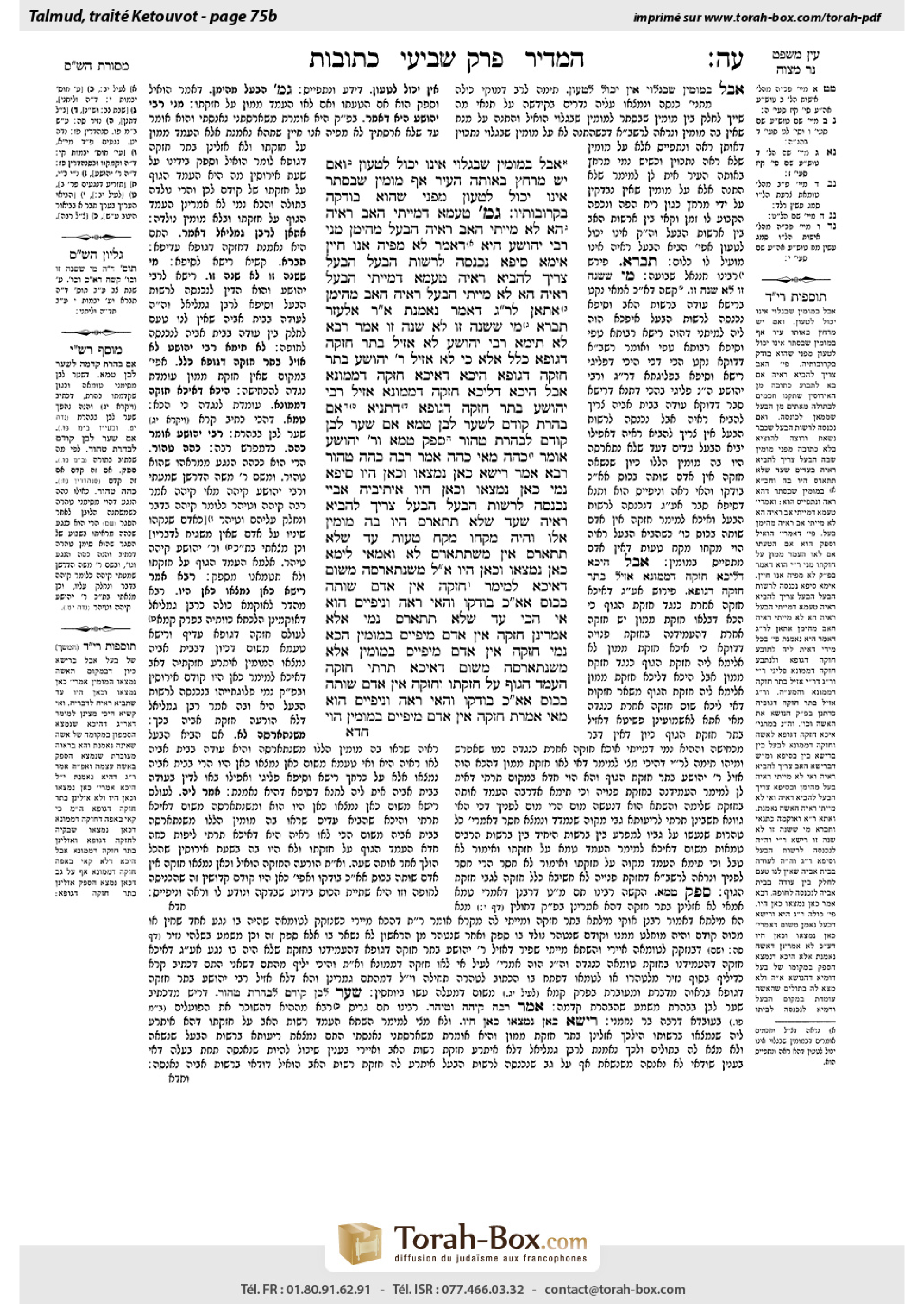
Ketubot 75b: Talmud study for Daf Yomi
Daf Yomi is the daily study of one Talmud folio. Explore 37 tractates with scans, Hebrew text, Sefaria English and AI-generated French translations where annotated.
Passage selection and English or AI-generated French translation are available where the scan has annotations. Daf Study is independent of Torah-Box and Sefaria.
Browse Ketubot · כתובות · All tractatesKetubot 75b text and translations
This page of Ketubot includes the Aramaic text, an English translation and an AI-generated French translation, alongside the scan above.
כתובות ע״ה ב · Aramaic and Hebrew text
אֲבָל בְּמוּמִין שֶׁבַּגָּלוּי אֵינוֹ יָכוֹל לִטְעוֹן. וְאִם יֵשׁ מֶרְחָץ בְּאוֹתָהּ הָעִיר — אַף מוּמִין שֶׁבַּסֵּתֶר אֵינוֹ יָכוֹל לִטְעוֹן, מִפְּנֵי שֶׁהוּא בּוֹדְקָהּ בִּקְרוֹבוֹתָיו.
גְּמָ׳ טַעְמָא דְּמַיְיתֵי הָאָב רְאָיָה, הָא לָא מַיְיתֵי הָאָב רְאָיָה — (הַ)בַּעַל מְהֵימַן. מַנִּי? רַבִּי יְהוֹשֻׁעַ הִיא, דְּאָמַר: לָא מִפִּיהָ אָנוּ חַיִּין.
אֵימָא סֵיפָא: נִכְנְסָה לִרְשׁוּת הַבַּעַל — הַבַּעַל צָרִיךְ לְהָבִיא רְאָיָה. טַעְמָא דְּמַיְיתֵי הַבַּעַל רְאָיָה, הָא לָא מַיְיתֵי הַבַּעַל רְאָיָה — (הָ)אָב מְהֵימַן. אֲתָאן לְרַבָּן גַּמְלִיאֵל דְּאָמַר נֶאֱמֶנֶת! אָמַר רַבִּי אֶלְעָזָר: תַּבְרַהּ, מִי שֶׁשָּׁנָה זוֹ לֹא שָׁנָה זוֹ.
אָמַר רָבָא: לָא תֵּימָא רַבִּי יְהוֹשֻׁעַ לָא אָזֵיל בָּתַר חֲזָקָה דְגוּפָא כְּלָל, אֶלָּא: כִּי לָא אָזֵיל רַבִּי יְהוֹשֻׁעַ בָּתַר חֲזָקָה דְגוּפָא, הֵיכָא דְּאִיכָּא חֲזָקָה דְמָמוֹנָא.
אֲבָל הֵיכָא דְּלֵיכָּא חֲזָקָה דְמָמוֹנָא — אָזֵיל רַבִּי יְהוֹשֻׁעַ בָּתַר חֲזָקָה דְגוּפָא. דְּתַנְיָא: אִם בַּהֶרֶת קוֹדֵם לְשֵׂעָר לָבָן — טָמֵא, אִם שֵׂעָר לָבָן קוֹדֵם לַבַּהֶרֶת — טָהוֹר, סָפֵק — טָמֵא. וְרַבִּי יְהוֹשֻׁעַ אוֹמֵר: כֵּהָה. מַאי ״כֵּהָה״? אָמַר רַבָּה: ״כֵּהָה״ — טָהוֹר.
רָבָא אָמַר: רֵישָׁא, כָּאן נִמְצְאוּ וְכָאן הָיוּ. סֵיפָא נָמֵי, כָּאן נִמְצְאוּ וְכָאן הָיוּ.
אֵיתִיבֵיהּ אַבָּיֵי: נִכְנְסָה לִרְשׁוּת הַבַּעַל — הַבַּעַל צָרִיךְ לְהָבִיא רְאָיָה שֶׁעַד שֶׁלֹּא תִּתְאָרֵס הָיוּ בָּהּ מוּמִין אֵלּוּ, וְהָיָה מִקָּחוֹ מִקָּח טָעוּת. עַד שֶׁלֹּא תִּתְאָרֵס — אִין, מִשֶּׁתִּתְאָרֵס — לָא, וְאַמַּאי? לֵימָא: כָּאן נִמְצְאוּ וְכָאן הָיוּ!
אֲמַר לֵיהּ: מִשֶּׁנִּתְאָרְסָה. מִשּׁוּם דְּאִיכָּא לְמֵימַר: חֲזָקָה אֵין אָדָם שׁוֹתֶה בְּכוֹס אֶלָּא אִם כֵּן בּוֹדְקוֹ. וְהַאי רָאָה וְנִיפַּיַּיס הוּא.
אִי הָכִי, עַד שֶׁלֹּא תִּתְאָרֵס נָמֵי! אֶלָּא אָמְרִינַן: חֲזָקָה אֵין אָדָם מִיפַּיֵּיס בְּמוּמִין. הָכָא נָמֵי, חֲזָקָה אֵין אָדָם מִיפַּיֵּיס בְּמוּמִין!
אֶלָּא: מִשֶּׁנִּתְאָרְסָה, מִשּׁוּם דְּאִיכָּא תַּרְתֵּי: חֲזָקָה הַעֲמֵד הַגּוּף עַל חֶזְקָתוֹ, וַחֲזָקָה אֵין אָדָם שׁוֹתֶה בְּכוֹס אֶלָּא אִם כֵּן בּוֹדְקוֹ, וְהַאי רָאָה וְנִיפַּיַּיס הוּא. מַאי אָמְרַתְּ? חֲזָקָה אֵין אָדָם מִיפַּיֵּיס בְּמוּמִין — הָוֵי
Ketubot 75b · English translation
But with regard to visible blemishes, he cannot claim that the betrothal was in error, as he presumably saw and accepted them before the betrothal. And if there is a bathhouse in the city, where all the women go to bathe, even with regard to hidden blemishes he cannot make this claim, because he examines her through the agency of his female relatives. He would have asked one of his relatives to look over the woman he is about to marry.
GEMARA: The mishna states that if the woman had blemishes while she was in her father’s house, the father must bring proof that they developed after the betrothal. The Gemara infers: The reason the father’s claim is accepted is due to the fact that the father brings proof, but if the father does not bring proof then the husband is deemed credible when he claims the betrothal was a mistaken transaction because the blemishes predated it. The Gemara asks: In accordance with whose opinion is this mishna? It is the opinion of Rabbi Yehoshua, who said in a mishna (12a) with regard to a case when the wife claims that she was raped after her betrothal while her husband says it happened beforehand, that we don’t live from, i.e., we don’t rely on the words of her mouth, but rather she must substantiate her claim.
The Gemara continues: Now say the latter clause of the mishna: If she had entered the husband’s domain, the husband must bring proof. Again the Gemara infers: The reason his claim is accepted is due to the fact that the husband brings proof, but if the husband does not bring proof then the father is deemed credible. We arrive at the opinion of Rabban Gamliel, who said that the woman is deemed credible when she says that the incident occurred after the betrothal. Consequently, the first and last clauses of the mishna appear to contradict one another. Rabbi Elazar said: This mishna is disjointed, and does not follow a single opinion; the tanna who taught this halakha did not teach that halakha.
Rava said: Do not say that Rabbi Yehoshua does not follow the presumptive status of the body at all, that is, it should not be assumed that Rabbi Yehoshua fundamentally rejects the idea that one’s body is presumed to remain in its initial, intact state until proven otherwise. Rather, say that Rabbi Yehoshua does not follow the presumptive status of the body only when there is an opposing claim of monetary possession. An example of this is the case in the mishna where the woman seeks to extract money from her husband for payment of her marriage contract by claiming that she was raped after the betrothal. Since acceptance of her claim would mean her husband has to pay, Rabbi Yehoshua maintains that the presumptive status of her body alone is not sufficient.
But when there is no possession of money, as in the mishna, Rabbi Yehoshua does in fact follow the presumptive status of the body. As it is taught in a baraita with regard to the halakhot of leprosy: If the bright white leprous spot preceded the white hair then the one afflicted is ritually impure; if the white hair preceded the bright white spot he is pure. If it is uncertain which came first, he is impure. And Rabbi Yehoshua says: Dull. They asked: What is the meaning of dull? Rabba said that dull means it is ritually pure, as though the plague was of a dull shade, which is not impure. This shows that in an uncertain case where there is no issue of monetary possession, Rabbi Yehoshua accepts the presumptive status of the body, and therefore, the one afflicted is ritually pure.
Rava said a different answer to the contradiction in the mishna: In the first clause of the mishna, where the blemishes were discovered while she was still in her father’s house, the assumption is that since they were discovered here, they were also created here. In other words, since the blemishes were found while she was still in her father’s house, there is a presumption that they were also present at the earlier stage, prior to the betrothal. Consequently, the burden of proof is on the father who claims the blemishes developed at a later stage. In the latter clause of the mishna as well, since the blemishes were discovered when she was in the husband’s house, it is assumed that since they were discovered here, in the husband’s domain, they were also created here, after the marriage.
Abaye raised an objection to Rava’s opinion from the mishna: If she had entered the husband’s domain when the blemishes were discovered, the husband must bring proof that she had these blemishes before she was betrothed, and therefore his transaction of betrothal was a mistaken transaction. The Gemara infers: If he brought proof that these blemishes were there before she was betrothed then yes, his claim is accepted, but if he proved that the blemishes were present from a point in time after she was betrothed, even if she was still in her father’s house, his claim is not accepted. But why? Even if his proof concerns the period after the betrothal, let us say that since they were discovered here, they were also created here, and she presumably had these blemishes before the betrothal.
Rava said to him: With regard to a case where the blemishes were found to have been present from a point in time after she was betrothed, there is a reason why one does not assume that they were there beforehand: Because it can be said that there is a presumption that a person does not drink from a cup unless he first examines it. In other words, one does not betroth a woman unless he first investigates her to determine if she is acceptable to him. And consequently this man has undoubtedly seen her blemishes and been appeased about them. Therefore, in the event that the blemishes did exist at the time of betrothal, it can be assumed that the husband knew about them and accepted the situation.
The Gemara raises a difficulty: If that is so, then even if he brought proof that the blemishes existed before she was betrothed, we should also rely on the above presumption and say that he must have been aware of them and betrothed her regardless. But this is not the halakha. Rather, it must be that we say there is an opposing presumption that a person does not become appeased with regard to blemishes. Therefore, it must be proven that he saw these blemishes and did not object. Here too, we should say there is a presumption that a person does not become appeased with regard to blemishes.
Rather, the mishna must be explained differently: If he brought proof that she had these blemishes from a point in time after she was betrothed, his claim of a mistaken betrothal is not accepted because there are two presumptions opposing it. There is a presumption of: Establish the state of the woman’s body according to its presumptive, unblemished status and consequently assume that the blemishes were not present at the time of betrothal, and additionally there is the presumption that a person does not drink from a cup unless he first examines it, and this man has undoubtedly seen her blemishes and been appeased. What do you say in opposition to this argument, that there is a presumption that a man does not become appeased with regard to blemishes? Even so, it is
Ketubot 75b · Traduction française (IA)
Mais, en ce qui concerne les défauts visibles, il ne peut pas prétendre que les kidouchin ont été conclus par erreur, puisqu’il les a vraisemblablement vus et acceptés avant les kidouchin. Et s’il y a un bain public dans la ville, où toutes les femmes vont se baigner, il ne peut pas non plus invoquer cet argument au sujet des défauts cachés, car il l’examine par l’intermédiaire de ses parentes. Il aurait demandé à l’une de ses parentes d’examiner la femme qu’il s’apprêtait à épouser.
GUEMARA : La Michna enseigne que si la femme présentait des défauts alors qu’elle se trouvait dans la maison de son père, le père doit apporter la preuve qu’ils sont apparus après les kidouchin. La Guemara en déduit que la prétention du père n’est acceptée que parce qu’il apporte une preuve ; mais s’il n’en apporte pas, le mari est considéré comme crédible lorsqu’il affirme que les kidouchin constituaient une transaction conclue par erreur, puisque les défauts les précédaient. La Guemara demande : Selon l’opinion de qui cette Michna est-elle formulée ? Selon celle de Rabbi Yehoshua, qui a dit dans une Michna (12a), à propos du cas où l’épouse affirme avoir été violée après ses kidouchin tandis que son mari soutient que cela s’est produit auparavant, qu’on ne vit pas de la parole de sa bouche, c’est-à-dire qu’on ne se fie pas à ses propos, mais qu’elle doit étayer sa prétention.
La Guemara poursuit : Considérons maintenant la dernière partie de la Michna : si elle est entrée dans le domaine du mari, c’est au mari d’apporter la preuve. Là encore, la Guemara en déduit que sa prétention n’est acceptée que parce que le mari apporte une preuve ; mais s’il n’en apporte pas, le père est considéré comme crédible. Nous aboutissons alors à l’opinion de Rabban Gamliel, qui a dit que la femme est considérée comme crédible lorsqu’elle affirme que l’incident s’est produit après les kidouchin. Par conséquent, la première et la dernière partie de la Michna semblent se contredire. Rabbi Elazar a dit : Cette Michna est décousue et ne suit pas une seule opinion ; le tanna qui a enseigné cette halakha n’a pas enseigné cette autre halakha.
Rava a dit : Ne dis pas que Rabbi Yehoshua ne tient jamais compte de la présomption relative à l’état du corps, c’est-à-dire qu’il ne faut pas supposer que Rabbi Yehoshua rejette fondamentalement l’idée que le corps d’une personne est présumé demeurer dans son état initial, intact, jusqu’à preuve du contraire. Dis plutôt que Rabbi Yehoshua ne tient pas compte de cette présomption uniquement lorsqu’une prétention opposée porte sur la possession d’argent. C’est le cas dans la Michna, où la femme cherche à obtenir de son mari le paiement de sa ketouba en affirmant avoir été violée après les kidouchin. Puisque l’acceptation de sa prétention obligerait son mari à payer, Rabbi Yehoshua estime que la présomption relative à l’état de son corps ne suffit pas à elle seule.
Mais lorsqu’il n’est pas question de possession d’argent, comme dans la Michna, Rabbi Yehoshua tient effectivement compte de la présomption relative à l’état du corps. En effet, il est enseigné dans une baraïta concernant les lois de la lèpre : si la tache lépreuse d’un blanc éclatant a précédé le poil blanc, la personne atteinte est rituellement impure ; si le poil blanc a précédé la tache d’un blanc éclatant, elle est pure. Si l’on ne sait pas lequel des deux est apparu en premier, elle est impure. Rabbi Yehoshua dit : « Terne. » On demanda : Que signifie « terne » ? Rabba dit que « terne » signifie qu’elle est rituellement pure, comme si la plaie était d’une teinte terne, qui n’entraîne pas l’impureté. Cela montre que, dans un cas d’incertitude où la possession d’argent n’est pas en jeu, Rabbi Yehoshua tient compte de la présomption relative à l’état du corps ; la personne atteinte est donc rituellement pure.
Rava a donné une autre réponse à la contradiction dans la Michna : dans la première partie, où les défauts ont été découverts alors qu’elle se trouvait encore dans la maison de son père, on présume que, puisqu’ils ont été découverts ici, ils sont aussi apparus ici. Autrement dit, puisqu’ils ont été constatés alors qu’elle se trouvait encore dans la maison de son père, on présume qu’ils étaient également présents à l’étape antérieure, avant les kidouchin. Par conséquent, la charge de la preuve incombe au père, qui affirme que les défauts sont apparus plus tard. De même, dans la dernière partie de la Michna, puisqu’ils ont été découverts alors qu’elle se trouvait dans la maison de son mari, on présume que, puisqu’ils ont été découverts ici, dans le domaine du mari, ils sont aussi apparus ici, après le mariage.
Abayé a objecté à l’opinion de Rava en s’appuyant sur la Michna : si elle est entrée dans le domaine du mari lorsque les défauts ont été découverts, le mari doit apporter la preuve qu’elle présentait ces défauts avant ses kidouchin et que, par conséquent, la transaction des kidouchin a été conclue par erreur. La Guemara en déduit que s’il apporte la preuve que ces défauts étaient présents avant ses kidouchin, sa prétention est effectivement acceptée ; mais s’il prouve que les défauts étaient présents à partir d’un moment postérieur aux kidouchin, même si elle se trouvait encore dans la maison de son père, sa prétention n’est pas acceptée. Mais pourquoi ? Même si sa preuve concerne la période postérieure aux kidouchin, ne devrait-on pas dire que, puisqu’ils ont été découverts ici, ils sont aussi apparus ici, et qu’elle présentait donc vraisemblablement ces défauts avant les kidouchin ?
Rava lui répondit : Dans le cas où il est établi que les défauts étaient présents à partir d’un moment postérieur à ses kidouchin, il y a une raison de ne pas présumer qu’ils étaient déjà là auparavant : on peut dire qu’il existe une présomption selon laquelle une personne ne boit pas dans une coupe sans l’avoir d’abord examinée. Autrement dit, on ne donne pas les kidouchin à une femme sans l’avoir d’abord examinée pour déterminer si elle nous convient. Par conséquent, cet homme a certainement vu ses défauts et s’en est accommodé. Ainsi, si les défauts existaient au moment des kidouchin, on peut supposer que le mari en avait connaissance et qu’il a accepté la situation.
La Guemara soulève une difficulté : si tel est le cas, même s’il apporte la preuve que les défauts existaient avant ses kidouchin, ne devrait-on pas également s’appuyer sur la présomption susmentionnée et dire qu’il les connaissait forcément et qu’il lui a néanmoins donné les kidouchin ? Or, telle n’est pas la halakha. Il faut plutôt dire qu’il existe une présomption opposée : une personne ne s’accommode pas des défauts. Il faut donc prouver qu’il a vu ces défauts et qu’il ne s’y est pas opposé. Ici aussi, ne devrait-on pas dire qu’il existe une présomption selon laquelle une personne ne s’accommode pas des défauts ?
Il faut plutôt expliquer la Michna autrement : s’il apporte la preuve qu’elle présentait ces défauts à partir d’un moment postérieur à ses kidouchin, sa prétention selon laquelle les kidouchin ont été conclus par erreur n’est pas acceptée, car deux présomptions s’y opposent. Il y a la présomption suivante : on maintient l’état du corps de la femme conformément à sa présomption d’absence de défauts et l’on suppose, par conséquent, que les défauts n’étaient pas présents au moment des kidouchin. S’y ajoute la présomption selon laquelle une personne ne boit pas dans une coupe sans l’avoir d’abord examinée ; cet homme a donc certainement vu ses défauts et s’en est accommodé. Que direz-vous pour contester cet argument ? Il existe une présomption selon laquelle un homme ne s’accommode pas des défauts. Malgré cela, elle est
Traduction française générée par IA à partir de l’édition anglaise de Sefaria. Vérifie toujours un passage avec le texte source.
Text from Sefaria: William Davidson Edition - Vocalized Aramaic (CC BY NC); William Davidson Edition - English (CC BY NC).