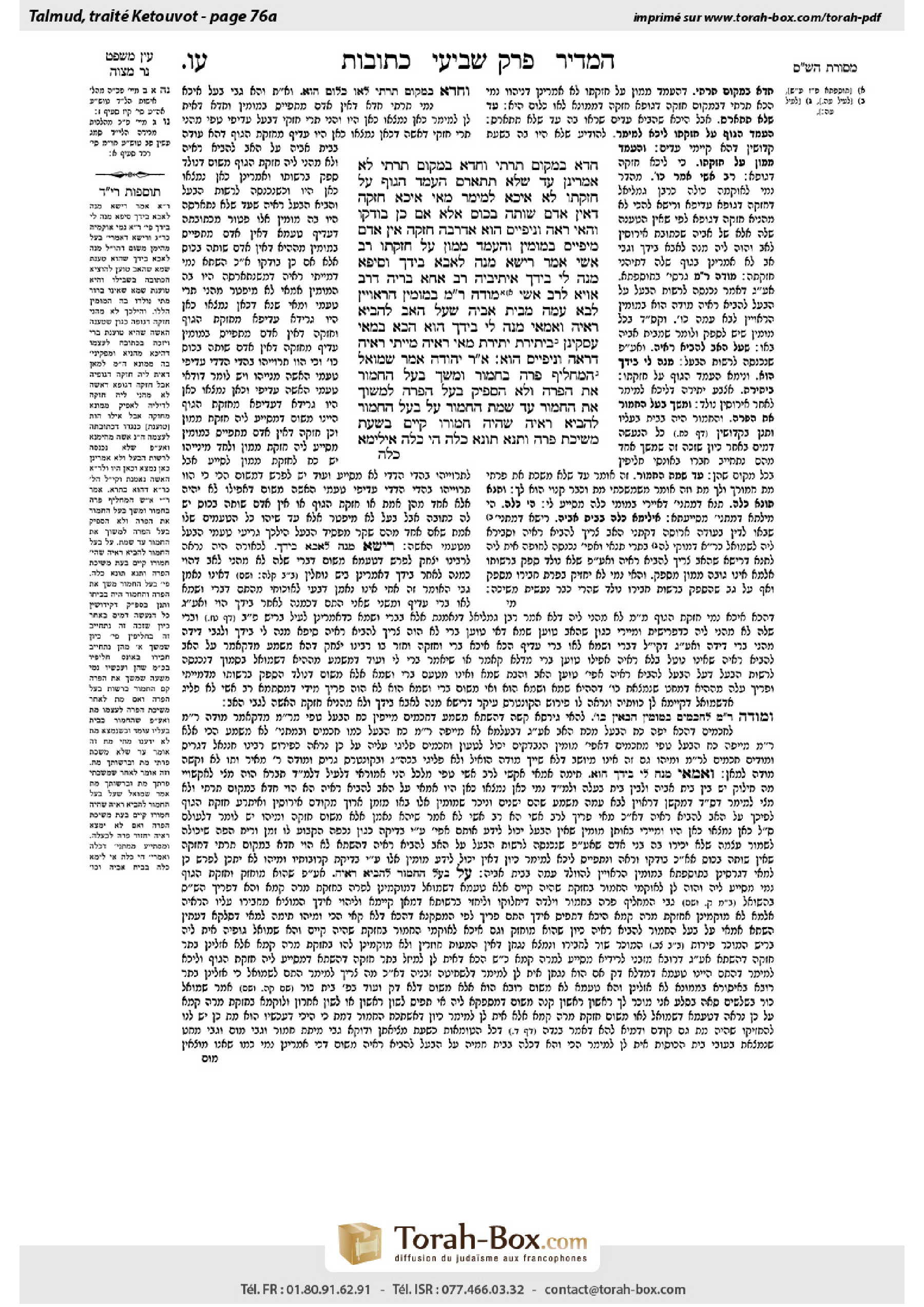
Ketubot 76a: Talmud study for Daf Yomi
Daf Yomi is the daily study of one Talmud folio. Explore 37 tractates with scans, Hebrew text, Sefaria English and AI-generated French translations where annotated.
Passage selection and English or AI-generated French translation are available where the scan has annotations. Daf Study is independent of Torah-Box and Sefaria.
Browse Ketubot · כתובות · All tractatesKetubot 76a text and translations
This page of Ketubot includes the Aramaic text, an English translation and an AI-generated French translation, alongside the scan above.
כתובות ע״ו א · Aramaic and Hebrew text
חֲדָא בִּמְקוֹם תַּרְתֵּי, וַחֲדָא בִּמְקוֹם תַּרְתֵּי לָא אָמְרִינַן. עַד שֶׁלֹּא תִּתְאָרֵס — הַעֲמֵד הַגּוּף עַל חֶזְקָתוֹ לָא אִיכָּא לְמֵימַר. מַאי אִיכָּא? חֲזָקָה דְּאֵין אָדָם שׁוֹתֶה בְּכוֹס אֶלָּא אִם כֵּן בּוֹדְקוֹ, וְהַאי רָאָה וְנִיפַּיַּיס הוּא — אַדְּרַבָּה: חֲזָקָה אֵין אָדָם מִיפַּיֵּיס בְּמוּמִין, וְהַעֲמֵד מָמוֹן עַל חֶזְקָתוֹ.
רַב אָשֵׁי אָמַר: רֵישָׁא ״מָנֶה לְאַבָּא בְּיָדְךָ״, וְסֵיפָא ״מָנֶה לִי בְּיָדְךָ״.
אֵיתִיבֵיהּ רַב אַחָא בְּרֵיהּ דְּרַב אַוְיָא לְרַב אָשֵׁי: מוֹדֶה רַבִּי מֵאִיר בְּמוּמִין הָרְאוּיִין לָבֹא עִמָּהּ מִבֵּית אָבִיהָ, שֶׁעַל הָאָב לְהָבִיא רְאָיָה. וְאַמַּאי? ״מָנֶה לִי בְּיָדְךָ״ הוּא!
הָכָא בְּמַאי עָסְקִינַן — בִּיתֶירֶת. יְתֶירֶת, מַאי רְאָיָה מַיְיתֵי? רְאָיָה דְּרָאָה וְנִיפַּיַּיס הוּא.
אָמַר רַב יְהוּדָה אָמַר שְׁמוּאֵל: הַמַּחֲלִיף פָּרָה בַּחֲמוֹר, וּמָשַׁךְ בַּעַל הַחֲמוֹר אֶת הַפָּרָה, וְלֹא הִסְפִּיק בַּעַל הַפָּרָה לִמְשׁוֹךְ אֶת הַחֲמוֹר עַד שֶׁמֵּת הַחֲמוֹר — עַל בַּעַל הַחֲמוֹר לְהָבִיא רְאָיָה שֶׁהָיָה חֲמוֹרוֹ קַיָּים בִּשְׁעַת מְשִׁיכַת פָּרָה.
וְתַנָּא תּוּנָא כַּלָּה. הֵי כַּלָּה? אִילֵּימָא
Ketubot 76a · English translation
one presumption opposed by two others. And we do not say that one presumption is decisive when it is opposed by two. However, if the husband brings proof that that she was blemished before she was betrothed, we cannot say: Establish the state of the woman’s body according to its presumptive status, since it has been established that the blemishes existed prior to the betrothal. What claim is there in the woman’s favor? Only the presumption that a person does not drink from a cup unless he first examines it, and this man has undoubtedly seen her blemishes and been appeased. The Gemara responds: On the contrary, there is a presumption that a person does not become appeased with regard to blemishes, and therefore the money is established according to its presumptive status and we do not obligate the husband to pay for the marriage contract.
Rav Ashi said that the contradiction between the first and last clauses of the mishna can be resolved in the following manner: The first clause is similar to a claim made by one who says: My father has one hundred dinars in your possession. When the blemishes were discovered he had not yet married her, and therefore the payment for the marriage contract would go to the woman’s father, and not to her. And the latter clause is referring to a married woman who claims the marriage contract for herself, and it is therefore as though she says: I have one hundred dinars in your possession. The presumptive status of her body enables her to claim money only for herself, not on behalf of someone else, including her father.
Rav Aḥa, son of Rav Avya, raised an objection to Rav Ashi’s opinion from a baraita: Rabbi Meir concedes with regard to blemishes that naturally come with her from her father’s house, and which did not develop after the marriage, that the father must bring proof that she did not have them before the betrothal, even if she was already married when they were discovered. But why does Rabbi Meir agree in that case? It is similar to the case where someone says: I have one hundred dinars in your possession, along with the presumptive status of her body; therefore, the burden of proof should be upon the husband.
The Gemara answers: With what are we dealing here? With a case of a woman who has an additional toe. She was obviously born with that blemish. The Gemara is puzzled by this response: If the baraita is speaking about an additional toe, what proof could the father possibly bring to argue that the toe grew after the marriage? The Gemara answers: He can provide proof that the husband saw the extra toe before the betrothal and he became appeased about it.
§ Rav Yehuda said that Shmuel said: With regard to one who exchanges a cow for a donkey, where the two animals involved in this transaction are not in the same location, one of the parties acquires one of the animals by means of pulling it, which transfers the other animal to the other party through acquisition by means of the exchange. And in this case the owner of the donkey pulled the cow, but before the owner of the cow could pull the donkey in turn, the donkey died. The owner of the cow claimed that the donkey died before the other one pulled the cow, which means the exchange transaction never took effect. In that case, the owner of the donkey must bring proof that his donkey was alive at the time when the cow was pulled. If he is unable to bring proof to this effect, the owner of the cow retains his animal.
Rav Yehuda adds: And the tanna of the mishna also taught along similar lines with regard to a bride. Shmuel learned this halakha concerning an acquisition by means of barter from the case of a bride. The Gemara inquires: Which halakha involving a bride serves as the basis for the halakha that Shmuel taught? If we say
Ketubot 76a · Traduction française (IA)
une présomption s’oppose à deux autres. Nous ne disons pas qu’une présomption l’emporte lorsqu’elle est opposée à deux présomptions. Toutefois, si le mari apporte la preuve qu’elle avait des défauts avant les fiançailles, nous ne pouvons pas dire : « Maintenons l’état du corps de la femme selon sa présomption », puisqu’il a été établi que les défauts existaient avant les fiançailles. Quel argument joue en faveur de la femme ? Seulement la présomption qu’une personne ne boit pas dans une coupe sans l’avoir d’abord examinée ; cet homme a donc certainement vu ses défauts et s’en est accommodé. La Guemara répond : Au contraire, il existe une présomption selon laquelle une personne ne s’accommode pas de défauts ; l’argent est donc maintenu selon sa présomption, et nous n’obligeons pas le mari à payer la ketouba.
Rav Ashi dit que la contradiction entre la première et la dernière clauses de la Michna peut être résolue de la manière suivante : la première clause ressemble à la revendication de quelqu’un qui dit : « Mon père a cent dinars en ta possession. » Lorsque les défauts furent découverts, il ne l’avait pas encore épousée ; le paiement de la ketouba devait donc revenir au père de la femme, et non à elle. La dernière clause, elle, concerne une femme mariée qui réclame sa ketouba pour elle-même ; c’est donc comme si elle disait : « J’ai cent dinars en ta possession. » La présomption relative à son corps lui permet de réclamer de l’argent pour elle-même seulement, et non au nom d’une autre personne, y compris son père.
Rav Aḥa, fils de Rav Avya, soulève une objection contre l’opinion de Rav Ashi à partir d’une baraïta : Rabbi Meïr concède, au sujet des défauts qu’elle a naturellement depuis la maison de son père et qui ne sont pas apparus après le mariage, que le père doit apporter la preuve qu’elle ne les avait pas avant les fiançailles, même si elle était déjà mariée lorsqu’ils furent découverts. Mais pourquoi Rabbi Meïr est-il d’accord dans ce cas ? Cela ressemble au cas de quelqu’un qui dit : « J’ai cent dinars en ta possession », et il y a en outre la présomption relative à son corps ; la charge de la preuve devrait donc incomber au mari.
La Guemara répond : De quoi s’agit-il ici ? D’une femme qui a un orteil supplémentaire. Elle est manifestement née avec ce défaut. La Guemara s’étonne de cette réponse : si la baraïta parle d’un orteil supplémentaire, quelle preuve le père pourrait-il bien apporter pour soutenir que l’orteil a poussé après le mariage ? La Guemara répond : Il peut apporter la preuve que le mari avait vu l’orteil supplémentaire avant les fiançailles et qu’il s’en était accommodé.
§ Rav Yehouda dit au nom de Shmouel : Lorsqu’une personne échange une vache contre un âne et que les deux animaux concernés par la transaction ne se trouvent pas au même endroit, l’une des parties acquiert l’un des animaux en le tirant, ce qui transfère l’autre animal à l’autre partie par acquisition au moyen de l’échange. Dans ce cas, le propriétaire de l’âne a tiré la vache, mais, avant que le propriétaire de la vache puisse à son tour tirer l’âne, celui-ci est mort. Le propriétaire de la vache soutient que l’âne est mort avant que l’autre partie ne tire la vache, ce qui signifie que l’échange n’a jamais pris effet. Dans ce cas, le propriétaire de l’âne doit apporter la preuve que son âne était vivant au moment où la vache a été tirée. S’il ne peut fournir cette preuve, le propriétaire de la vache garde son animal.
Rav Yehouda ajoute : Le tanna de la Michna a également enseigné quelque chose de semblable au sujet d’une fiancée. Shmouel a déduit cette halakha concernant une acquisition par échange du cas d’une fiancée. La Guemara demande : Quelle halakha concernant une fiancée sert de fondement à celle qu’a enseignée Shmouel ? Si nous disons
Traduction française générée par IA à partir de l’édition anglaise de Sefaria. Vérifie toujours un passage avec le texte source.
Text from Sefaria: William Davidson Edition - Vocalized Aramaic (CC BY NC); William Davidson Edition - English (CC BY NC).