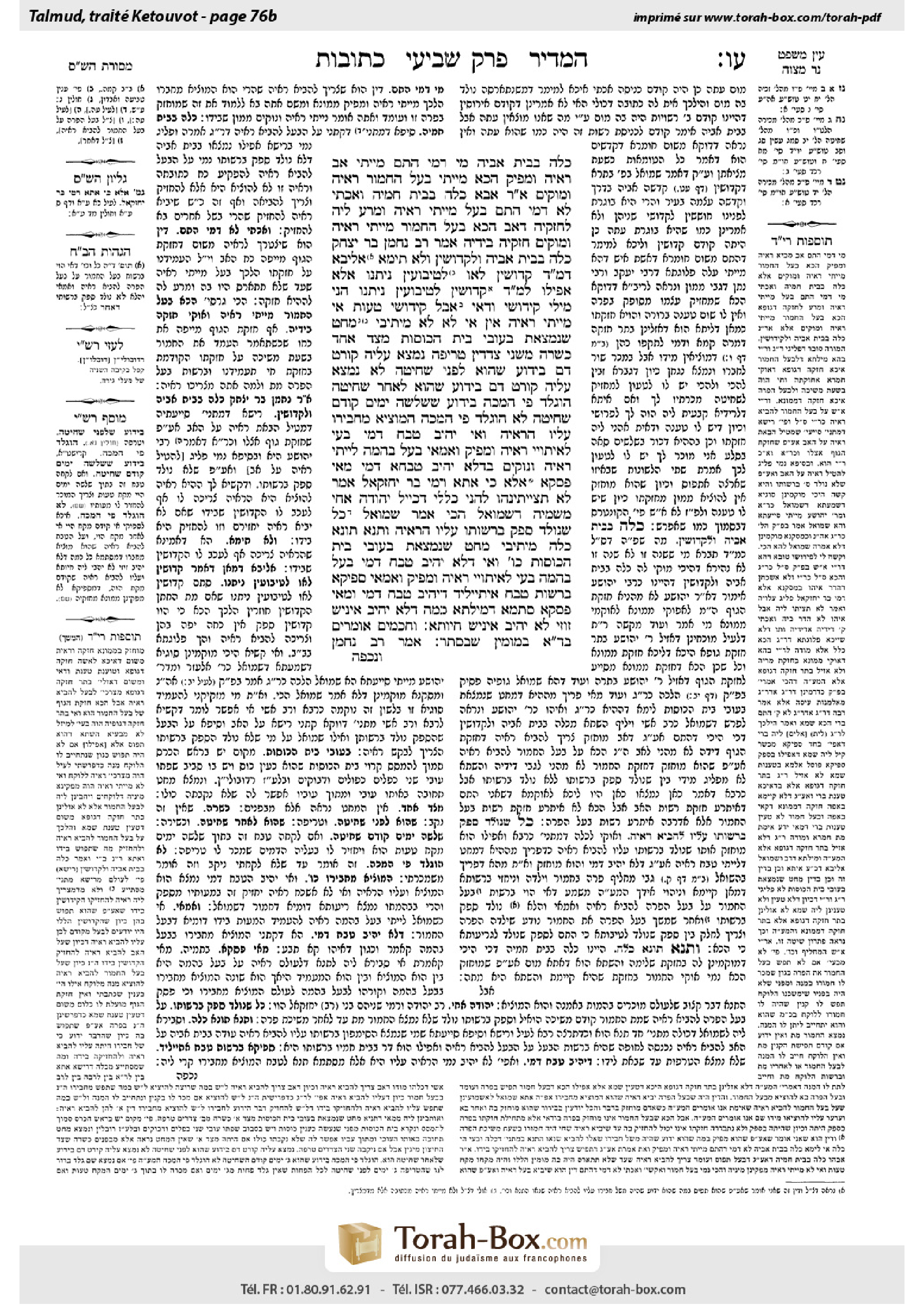
Ketubot 76b: Talmud study for Daf Yomi
Daf Yomi is the daily study of one Talmud folio. Explore 37 tractates with scans, Hebrew text, Sefaria English and AI-generated French translations where annotated.
Passage selection and English or AI-generated French translation are available where the scan has annotations. Daf Study is independent of Torah-Box and Sefaria.
Browse Ketubot · כתובות · All tractatesKetubot 76b text and translations
This page of Ketubot includes the Aramaic text, an English translation and an AI-generated French translation, alongside the scan above.
כתובות ע״ו ב · Aramaic and Hebrew text
כַּלָּה בְּבֵית אָבִיהָ, מִי דָּמֵי? הָתָם — מַיְיתֵי אָב רְאָיָה וּמַפֵּיק, הָכָא — מַיְיתֵי בַּעַל הַחֲמוֹר רְאָיָה וּמוֹקֵים.
אָמַר רַבִּי אַבָּא: כַּלָּה בְּבֵית חָמִיהָ. וְאַכַּתִּי לָא דָּמֵי: הָתָם — בַּעַל מַיְיתֵי רְאָיָה וּמַרַע לֵיהּ לַחֲזָקֵיהּ דְּאָב, הָכָא — בַּעַל הַחֲמוֹר מַיְיתֵי רְאָיָה וּמוֹקֵים חֲזָקֵיהּ בִּידֵיהּ.
אָמַר רַב נַחְמָן בַּר יִצְחָק: כַּלָּה בְּבֵית אָבִיהָ, וּלְקִידּוּשִׁין.
וְלָא תֵּימָא אַלִּיבָּא דְּמַאן דְּאָמַר קִדּוּשִׁין לָאו לְטִיבּוּעִין נִיתְּנוּ. אֶלָּא אֲפִילּוּ לְמַאן דְּאָמַר קִדּוּשִׁין לְטִיבּוּעִין נִיתְּנוּ — הָנֵי מִילֵּי קִידּוּשֵׁי וַדַּאי, אֲבָל קִידּוּשֵׁי טָעוּת, אִי מַיְיתֵי רְאָיָה — אִין, אִי לָא — לָא.
מֵיתִיבִי: מַחַט שֶׁנִּמְצֵאת בְּעוֹבִי בֵּית הַכּוֹסוֹת, מִצַּד אֶחָד — כְּשֵׁרָה. מִשְּׁנֵי צְדָדִין — טְרֵיפָה. נִמְצָא עָלֶיהָ קוֹרֶט דָּם — בְּיָדוּעַ שֶׁהוּא לִפְנֵי שְׁחִיטָה, לֹא נִמְצָא עָלֶיהָ קוֹרֶט דָּם — בְּיָדוּעַ שֶׁהוּא לְאַחַר שְׁחִיטָה.
הוּגְלַד פִּי הַמַּכָּה — בְּיָדוּעַ שֶׁשְּׁלֹשָׁה יָמִים קוֹדֶם שְׁחִיטָה. לֹא הוּגְלַד פִּי הַמַּכָּה — הַמּוֹצִיא מֵחֲבֵירוֹ עָלָיו הָרְאָיָה. וְאִי יְהַיב טַבָּח דְּמֵי — בָּעֵי לְאֵיתוֹיֵי רְאָיָה וּמַפֵּיק.
וְאַמַּאי? בַּעַל בְּהֵמָה לַיְיתֵי רְאָיָה וְנוֹקֵים?
בִּדְלָא יְהַיב טַבָּחָא דָּמֵי. מַאי פַּסְקָא?
אֶלָּא, כִּי אֲתָא רָמֵי בַּר יְחֶזְקֵאל, אָמַר: לָא תְּצִייתִינְהוּ לְהָנֵי כְּלָלֵי דְּכָיֵיל יְהוּדָה אַחִי מִשְּׁמֵיהּ דִּשְׁמוּאֵל. הָכִי אָמַר שְׁמוּאֵל: כֹּל שֶׁנּוֹלַד סָפֵק בִּרְשׁוּתוֹ עָלָיו הָרְאָיָה. וְתַנָּא תּוּנָא כַּלָּה.
מֵיתִיבִי: מַחַט שֶׁנִּמְצֵאת בְּעוֹבִי בֵּית הַכּוֹסוֹת כּוּ׳, וְאִי דְּלָא יְהַיב טַבָּח דָּמֵי — בַּעַל בְּהֵמָה בָּעֵי לְאֵיתוֹיֵי רְאָיָה וּמַפֵּיק, וְאַמַּאי? סְפֵיקָא בִּרְשׁוּת טַבָּח אִיתְיְילִיד!
דִּיהַיב טַבָּח דְּמֵי. וּמַאי פַּסְקָא? סְתָמָא דְמִילְּתָא, כַּמָּה דְּלָא יָהֵיב אִינִישׁ זוּזֵי — לָא יָהֵיב אִינִישׁ חֵיוְתָא.
וַחֲכָמִים אוֹמְרִים: בַּמֶּה דְּבָרִים אֲמוּרִים — בְּמוּמִין שֶׁבַּסֵּתֶר. אָמַר רַב נַחְמָן:
Ketubot 76b · English translation
that his proof is from the halakha with regard to a bride who is still in her father’s house, when the burden of proof is upon the father, is it comparable? There, the father brings proof and takes money away from the husband, whereas here, the owner of the donkey brings proof and maintains possession of the cow. Consequently, perhaps this case is different, and he should not be obliged to provide proof.
Rabbi Abba said: The proof is from the case of a bride in her father-in-law’s house, that is, one who has entered her husband’s domain. The Gemara raises a difficulty: And yet the cases are still not comparable: There, the husband brings proof and undermines the presumption that was in favor of the father, i.e., the presumptive status of the daughter’s body, whereas here, the owner of the donkey brings proof and thereby maintains the presumptive status of the donkey’s body and consequently maintains the cow in his possession. Perhaps, therefore, he should not have to bring proof.
Rav Naḥman bar Yitzḥak said: Shmuel’s proof is from the halakha of a bride in her father’s house, but with regard to the money used for betrothal, not for the marriage contract. The father must bring proof in order to retain the betrothal money.
Rav Naḥman bar Yitzḥak explains: And do not say that this is only according to the one who says in general that betrothal money was not given with the understanding that it is to be lost, that is, the money was handed over only for the purpose of betrothal and it must be returned if the betrothal is canceled. Rather, say that this is even according to the one who says that in the case of betrothal money that was given to be lost, this applies only to a betrothal whose status is certain. According to this opinion, if a husband later divorces his wife or dies she does not have to restore the betrothal money. But with regard to a mistaken betrothal, if the father brings proof then yes, he may keep the money; if he does not bring proof he may not retain ownership of the betrothal money. This supports Shmuel’s opinion that in an uncertain case the one in possession of the money must bring proof in order to retain his ownership.
The Gemara raises an objection to Shmuel’s opinion with regard to presumptions from a baraita about a different issue: In a case of a needle that is found in the thick wall of a slaughtered animal’s second stomach, if it has pierced the stomach from only one side, the animal is kosher. If the stomach is pierced from both sides, meaning that the needle pierced a hole completely through the wall of the stomach, it has the status of an animal with a condition that will cause it to die within twelve months [tereifa], and one is consequently prohibited to eat from it. Furthermore, if a drop of congealed blood is found on top of the needle, it is certain that the perforation was created before the slaughtering of the animal, and it is therefore a tereifa. If no drop of blood is found on it, it is certain that it occurred after the slaughtering, which means the animal is kosher.
If a scab appeared over the wound on that spot, it is certain that the incident happened three days before the slaughtering. The significance of this fact is that if the animal was sold to a butcher after this point in time, the butcher can claim that the transaction was performed in error, as he did not intend to purchase a tereifa animal. If a scab did not appear over the wound, and the seller claims that the animal was injured while in the possession of the butcher who purchased the animal, while the butcher claims that it was wounded when he bought it, the burden of proof rests upon the claimant. And therefore, if the butcher had already given the money, he needs to bring proof and then he can take his money back from the seller.
The Gemara returns to Shmuel’s opinion: But why should this be the halakha? Let the owner of the animal, i.e., the seller, bring proof and establish the validity of the sale, just as the owner of the donkey must provide proof in order to maintain possession of the cow. Why is the burden of proof upon the butcher?
The Gemara answers: This baraita is referring to a case where the butcher had not yet given the money, but was going to pay at a later time. Therefore, the seller is the one claiming money from the butcher, and he must offer proof in order for the transaction to be upheld. The Gemara poses a question: Why was it stated without qualification? The wording of the baraita implies that either side must bring proof. This baraita appears to refute the opinion of Shmuel.
Rather, when Rami bar Yeḥezkel came, he said: Pay no attention to those rules formulated by my brother Yehuda in the name of Shmuel. In actuality, this is what Shmuel said: In whosesoever’s domain the uncertainty came into being, the burden of proof rests upon him. In the case of the exchange of the cow for the donkey, it is the owner of the cow who must provide proof. And the tanna of the mishna also taught along similar lines with regard to a bride. If the bride was in her father’s domain he must provide proof; if she was living with her husband the burden of proof is upon him.
The Gemara raises an objection: A needle that is found in the thick wall of an animal’s second stomach…the burden of proof rests upon the claimant. And if the butcher had not already given the money, the owner of the animal needs to bring proof, and only then can he take his money. The Gemara asks: But why? The uncertainty was formed in the butcher’s possession. According to Rami Bar Yeḥezkel’s opinion, it should be the butcher’s responsibility to provide proof.
The Gemara answers: This baraita is referring to a case where the butcher had already given the money. Since the butcher is the one demanding money from the seller, he must provide proof. The Gemara poses a question: But why was it stated without qualification? How is it known that the tanna was referring to this particular case? The Gemara answers: The ordinary situation is that as long as a person has not given money, the other person will not give him the animal. It can therefore be assumed that the butcher paid for the animal before he was allowed to slaughter it, which means it is he who is claiming the return of the money.
§ The mishna teaches: And the Rabbis say: In what case is this statement said? With regard to hidden blemishes. But he cannot claim to have been unaware of visible blemishes. Rav Naḥman said:
Ketubot 76b · Traduction française (IA)
Que sa preuve soit tirée de la halakha concernant une fiancée qui se trouve encore dans la maison de son père, où la charge de la preuve incombe au père, est-ce comparable ? Là, le père apporte une preuve et reprend de l’argent au mari, tandis qu’ici, le propriétaire de l’âne apporte une preuve et conserve la vache en sa possession. Ce cas est donc peut-être différent, et il ne devrait pas être tenu d’apporter une preuve.
Rabbi Abba dit : La preuve est tirée du cas d’une fiancée dans la maison de son beau-père, c’est-à-dire d’une femme qui est entrée dans le domaine de son mari. La Guemara soulève une difficulté : pourtant, les cas ne sont toujours pas comparables. Là, le mari apporte une preuve et renverse la présomption en faveur du père, à savoir la présomption concernant l’état du corps de la fille, tandis qu’ici, le propriétaire de l’âne apporte une preuve et maintient ainsi la présomption concernant l’état du corps de l’âne, conservant par conséquent la vache en sa possession. Peut-être ne devrait-il donc pas avoir à apporter de preuve.
Rav Naḥman bar Yitzḥak dit : La preuve de Shmuel est tirée de la halakha concernant une fiancée dans la maison de son père, mais elle porte sur l’argent des fiançailles, et non sur la ketouba. Le père doit apporter une preuve pour conserver l’argent des fiançailles.
Rav Naḥman bar Yitzḥak explique : Ne dis pas que cela ne vaut que selon celui qui affirme, de manière générale, que l’argent des fiançailles n’a pas été donné en sachant qu’il serait perdu, c’est-à-dire que cet argent n’a été remis qu’en vue des fiançailles et qu’il doit être rendu si celles-ci sont annulées. Dis plutôt que cela vaut même selon celui qui affirme que, dans le cas de l’argent des fiançailles donné pour être perdu, cela ne s’applique qu’à des fiançailles dont le statut est certain. Selon cet avis, si un mari divorce ensuite de sa femme ou meurt, celle-ci n’a pas à restituer l’argent des fiançailles. Mais, dans le cas de fiançailles conclues par erreur, si le père apporte une preuve, alors il peut garder l’argent ; s’il n’apporte pas de preuve, il ne peut pas en conserver la propriété. Cela appuie l’avis de Shmuel selon lequel, dans un cas incertain, celui qui détient l’argent doit apporter une preuve pour en conserver la propriété.
La Guemara soulève une objection à l’avis de Shmuel concernant les présomptions, à partir d’une baraïta portant sur une autre question : si une aiguille est trouvée dans la paroi épaisse du deuxième estomac d’un animal abattu et qu’elle n’a perforé l’estomac que d’un côté, l’animal est casher. Si l’estomac est perforé des deux côtés, c’est-à-dire si l’aiguille a traversé toute son épaisseur, l’animal a le statut de tereifa, c’est-à-dire d’un animal atteint d’une affection qui le fera mourir dans les douze mois [tereifa] ; il est donc interdit d’en manger. En outre, si une goutte de sang coagulé est trouvée sur l’aiguille, il est certain que la perforation s’est produite avant l’abattage de l’animal, qui est donc tereifa. Si aucune goutte de sang n’est trouvée dessus, il est certain que la perforation s’est produite après l’abattage, ce qui signifie que l’animal est casher.
Si une croûte s’est formée sur la blessure à cet endroit, il est certain que l’incident s’est produit trois jours avant l’abattage. Cela importe car, si l’animal a été vendu à un boucher après ce moment, celui-ci peut prétendre que la transaction a été conclue par erreur, puisqu’il n’avait pas l’intention d’acheter un animal tereifa. Si aucune croûte ne s’est formée sur la blessure et que le vendeur affirme que l’animal a été blessé alors qu’il était en possession du boucher qui l’a acheté, tandis que le boucher soutient qu’il était blessé au moment de l’achat, la charge de la preuve incombe à celui qui réclame. Par conséquent, si le boucher a déjà payé, il doit apporter une preuve, après quoi il pourra reprendre son argent au vendeur.
La Guemara revient à l’avis de Shmuel : mais pourquoi telle devrait-elle être la halakha ? Que le propriétaire de l’animal, c’est-à-dire le vendeur, apporte une preuve et établisse la validité de la vente, tout comme le propriétaire de l’âne doit apporter une preuve pour conserver la vache en sa possession. Pourquoi la charge de la preuve incombe-t-elle au boucher ?
La Guemara répond : cette baraïta parle d’un cas où le boucher n’a pas encore payé, mais doit le faire plus tard. Le vendeur est donc celui qui réclame de l’argent au boucher, et il doit apporter une preuve pour que la transaction soit maintenue. La Guemara demande : pourquoi cela a-t-il été énoncé sans précision ? La formulation de la baraïta implique que l’une ou l’autre partie doit apporter une preuve. Cette baraïta semble réfuter l’avis de Shmuel.
Mais lorsque Rami bar Yeḥezkel arriva, il dit : Ne prêtez pas attention aux règles formulées par mon frère Yehuda au nom de Shmuel. En réalité, voici ce que Shmuel a dit : la charge de la preuve incombe à celui dans le domaine de qui l’incertitude est apparue. Dans le cas de l’échange de la vache contre l’âne, c’est le propriétaire de la vache qui doit apporter une preuve. Le tanna de la Michna a également enseigné dans le même sens au sujet d’une fiancée : si elle se trouvait dans le domaine de son père, celui-ci doit apporter une preuve ; si elle vivait avec son mari, la charge de la preuve incombe à celui-ci.
La Guemara soulève une objection : une aiguille trouvée dans la paroi épaisse du deuxième estomac d’un animal… la charge de la preuve incombe à celui qui réclame. Et si le boucher n’a pas encore payé, le propriétaire de l’animal doit apporter une preuve, et ce n’est qu’alors qu’il peut recevoir son argent. La Guemara demande : mais pourquoi ? L’incertitude est apparue dans le domaine du boucher. Selon l’avis de Rami bar Yeḥezkel, ce devrait être au boucher d’apporter une preuve.
La Guemara répond : cette baraïta parle d’un cas où le boucher a déjà payé. Puisque c’est lui qui réclame de l’argent au vendeur, il doit apporter une preuve. La Guemara demande : mais pourquoi cela a-t-il été énoncé sans précision ? Comment sait-on que le tanna parlait de ce cas particulier ? La Guemara répond : en général, tant qu’une personne n’a pas payé, l’autre ne lui remet pas l’animal. On peut donc supposer que le boucher a payé l’animal avant d’être autorisé à l’abattre, ce qui signifie que c’est lui qui réclame le remboursement de l’argent.
§ La Michna enseigne : Et les Sages disent : Dans quel cas cette déclaration a-t-elle été faite ? À propos de défauts cachés. Mais il ne peut pas prétendre qu’il ignorait les défauts visibles. Rav Naḥman dit :
Traduction française générée par IA à partir de l’édition anglaise de Sefaria. Vérifie toujours un passage avec le texte source.
Text from Sefaria: William Davidson Edition - Vocalized Aramaic (CC BY NC); William Davidson Edition - English (CC BY NC).