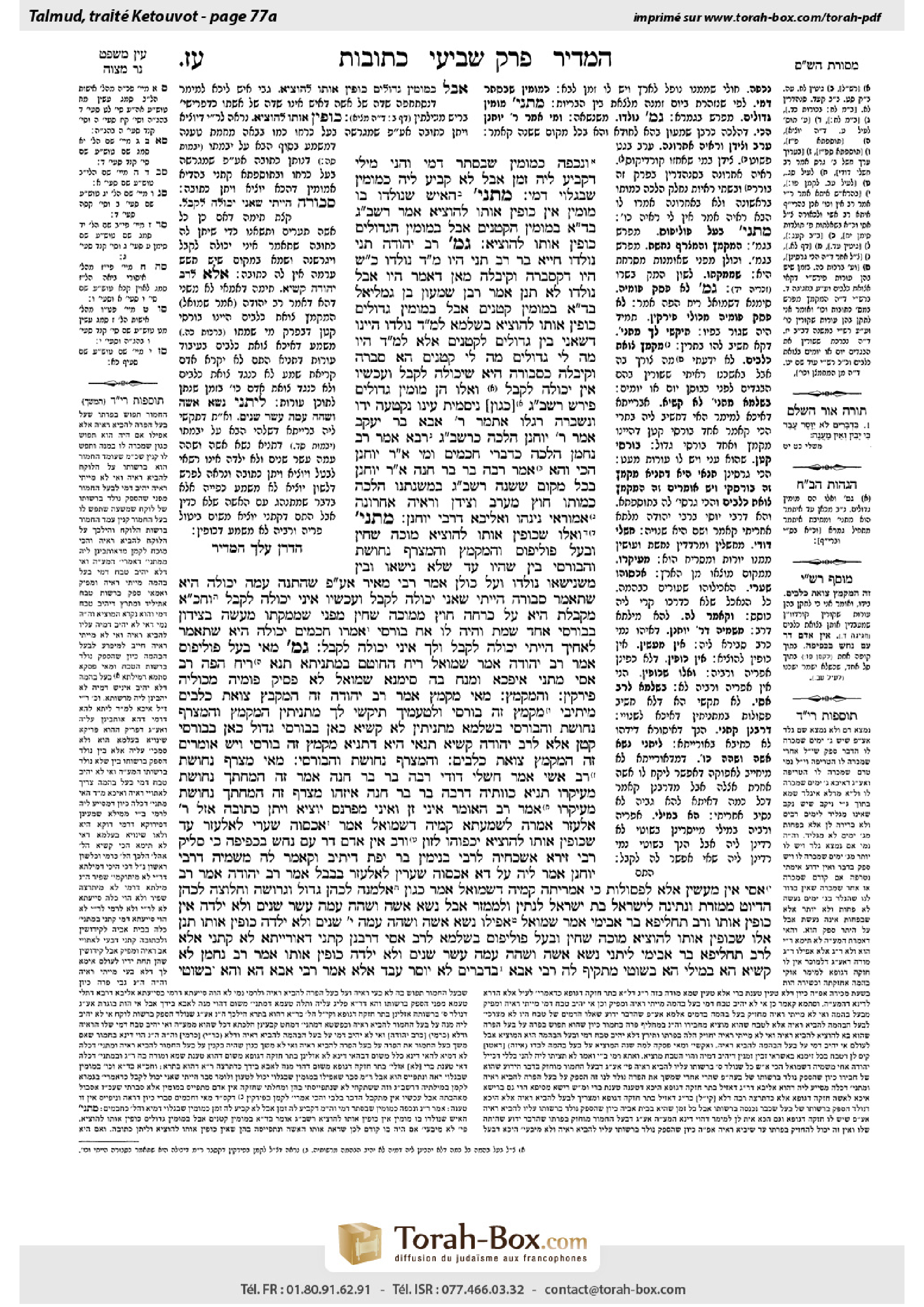
Ketubot 77a: Talmud study for Daf Yomi
Daf Yomi is the daily study of one Talmud folio. Explore 37 tractates with scans, Hebrew text, Sefaria English and AI-generated French translations where annotated.
Passage selection and English or AI-generated French translation are available where the scan has annotations. Daf Study is independent of Torah-Box and Sefaria.
Browse Ketubot · כתובות · All tractatesKetubot 77a text and translations
This page of Ketubot includes the Aramaic text, an English translation and an AI-generated French translation, alongside the scan above.
כתובות ע״ז א · Aramaic and Hebrew text
וְנִכְפֶּה — כְּמוּמִין שֶׁבַּסֵּתֶר דָּמֵי. וְהָנֵי מִילֵּי דִּקְבִיעַ לֵיהּ זְמַן, אֲבָל לָא קְבִיעַ לֵיהּ — כְּמוּמִין שֶׁבַּגָּלוּי דָּמֵי.
מַתְנִי׳ הָאִישׁ שֶׁנּוֹלְדוּ בּוֹ מוּמִין — אֵין כּוֹפִין אוֹתוֹ לְהוֹצִיא. אָמַר רַבָּן שִׁמְעוֹן בֶּן גַּמְלִיאֵל: בַּמֶּה דְּבָרִים אֲמוּרִים — בְּמוּמִין הַקְּטַנִּים, אֲבָל בְּמוּמִין הַגְּדוֹלִים — כּוֹפִין אוֹתוֹ לְהוֹצִיא.
גְּמָ׳ רַב יְהוּדָה תָּנֵי נוֹלְדוּ. חִיָּיא בַּר רַב תָּנֵי הָיוּ. מַאן דְּאָמַר נוֹלְדוּ, כׇּל שֶׁכֵּן הָיוּ — (דְּקָסָבְרָה) [דְּהָא סְבַרָה] וְקַבִּילָה. מַאן דְּאָמַר הָיוּ, אֲבָל נוֹלְדוּ — לֹא.
תְּנַן, אָמַר רַבָּן שִׁמְעוֹן בֶּן גַּמְלִיאֵל: בַּמֶּה דְּבָרִים אֲמוּרִים — בְּמוּמִין קְטַנִּים, אֲבָל בְּמוּמִין גְּדוֹלִים — כּוֹפִין אוֹתוֹ לְהוֹצִיא. בִּשְׁלָמָא לְמַאן דְּאָמַר ״נוֹלְדוּ״, הַיְינוּ דְּשָׁאנֵי בֵּין גְּדוֹלִים לִקְטַנִּים. אֶלָּא לְמַאן דְּאָמַר ״הָיוּ״ — מָה לִי גְּדוֹלִים מָה לִי קְטַנִּים? הָא סְבַרָה וְקַבִּילָה!
כִּסְבוּרָה הִיא שֶׁיְּכוֹלָה לְקַבֵּל, וְעַכְשָׁיו אֵין יְכוֹלָה לְקַבֵּל. וְאֵלּוּ הֵן מוּמִין גְּדוֹלִים? פֵּירֵשׁ רַבָּן שִׁמְעוֹן בֶּן גַּמְלִיאֵל: [כְּגוֹן] נִיסְמֵית עֵינוֹ, נִקְטְעָה יָדוֹ, וְנִשְׁבְּרָה רַגְלוֹ.
אִתְּמַר, רַבִּי אַבָּא בַּר יַעֲקֹב אָמַר רַבִּי יוֹחָנָן: הֲלָכָה כְּרַבָּן שִׁמְעוֹן בֶּן גַּמְלִיאֵל. רָבָא אָמַר רַב נַחְמָן: הֲלָכָה כְּדִבְרֵי חֲכָמִים.
וּמִי אָמַר רַבִּי יוֹחָנָן הָכִי? וְהָא אָמַר רַבָּה בַּר בַּר חָנָה אָמַר רַבִּי יוֹחָנָן: בְּכׇל מָקוֹם שֶׁשָּׁנָה רַבָּן שִׁמְעוֹן בֶּן גַּמְלִיאֵל בְּמִשְׁנָתֵנוּ — הֲלָכָה כְּמוֹתוֹ, חוּץ מֵעָרֵב, וְצַיְדָן, וּרְאָיָה אַחֲרוֹנָה. אָמוֹרָאֵי נִינְהוּ וְאַלִּיבָּא דְּרַבִּי יוֹחָנָן.
מַתְנִי׳ וְאֵלּוּ שֶׁכּוֹפִין אוֹתוֹ לְהוֹצִיא: מוּכֵּה שְׁחִין, וּבַעַל פּוֹלִיפּוּס, וְהַמְקַמֵּץ, וְהַמְצָרֵף נְחוֹשֶׁת, וְהַבּוּרְסִי. בֵּין שֶׁהָיוּ עַד שֶׁלֹּא נִישְּׂאוּ, וּבֵין מִשֶּׁנִּישְּׂאוּ נוֹלְדוּ. וְעַל כּוּלָּן אָמַר רַבִּי מֵאִיר: אַף עַל פִּי שֶׁהִתְנָה עִמָּהּ, יְכוֹלָה הִיא שֶׁתֹּאמַר: ״סְבוּרָה הָיִיתִי שֶׁאֲנִי יְכוֹלָה לְקַבֵּל, וְעַכְשָׁיו אֵינִי יְכוֹלָה לְקַבֵּל״.
וַחֲכָמִים אוֹמְרִים: מְקַבֶּלֶת הִיא עַל כׇּרְחָהּ, חוּץ מִמּוּכֵּה שְׁחִין, מִפְּנֵי שֶׁמְּמִקָּתוֹ. מַעֲשֶׂה בְּצַיְדוֹן בְּבוּרְסִי אֶחָד שֶׁמֵּת, וְהָיָה לוֹ אָח בּוּרְסִי. אָמְרוּ חֲכָמִים: יְכוֹלָה הִיא שֶׁתֹּאמַר ״לְאָחִיךָ הָיִיתִי יְכוֹלָה לְקַבֵּל, וּלְךָ אֵינִי יְכוֹלָה לְקַבֵּל״.
גְּמָ׳ מַאי ״בַּעַל פּוֹלִיפּוּס״? אָמַר רַב יְהוּדָה אָמַר שְׁמוּאֵל: רֵיחַ הַחוֹטֶם. בְּמַתְנִיתָא תָּנָא: רֵיחַ הַפֶּה. רַב אַסִּי מַתְנִי אִיפְּכָא. וּמַנַּח בַּהּ סִימָנָא: שְׁמוּאֵל לָא פָּסֵיק פּוּמֵּיהּ מִכּוּלֵּיהּ פִּירְקִין.
וְהַמְקַמֵּץ. מַאי ״מְקַמֵּץ״? אָמַר רַב יְהוּדָה: זֶה הַמְקַבֵּץ צוֹאַת כְּלָבִים. מֵיתִיבִי: ״מְקַמֵּץ״ זֶה בּוּרְסִי! וּלְטַעְמָיךְ תִּיקְשֵׁי לָךְ מַתְנִיתִין: ״הַמְקַמֵּץ וְהַמְצָרֵף נְחוֹשֶׁת וְהַבּוּרְסִי״!
בִּשְׁלָמָא מַתְנִיתִין לָא קַשְׁיָא: כָּאן בְּבוּרְסִי גָּדוֹל, כָּאן בְּבוּרְסִי קָטָן. אֶלָּא לְרַב יְהוּדָה קַשְׁיָא! תַּנָּאֵי הִיא, דְּתַנְיָא: ״מְקַמֵּץ״ זֶה בּוּרְסִי, וְיֵשׁ אוֹמְרִים: זֶה הַמְקַמֵּץ צוֹאַת כְּלָבִים.
וְהַמְצָרֵף נְחוֹשֶׁת וְהַבּוּרְסִי. מַאי ״מְצָרֵף נְחוֹשֶׁת״? רַב אָשֵׁי אָמַר: חָשְׁלֵי דּוּדֵי. רַבָּה בַּר בַּר חָנָה אָמַר: זֶה הַמְחַתֵּךְ נְחוֹשֶׁת מֵעִיקָּרוֹ. תַּנְיָא כְּווֹתֵיהּ דְּרַבָּה בַּר בַּר חָנָה: אֵיזֶהוּ ״מְצָרֵף״? זֶה הַמְחַתֵּךְ נְחוֹשֶׁת מֵעִיקָּרוֹ.
אָמַר רַב: הָאוֹמֵר ״אֵינִי זָן וְאֵינִי מְפַרְנֵס״ — יוֹצִיא וְיִתֵּן כְּתוּבָּה. אֲזַל רַבִּי אֶלְעָזָר אַמְרַהּ לִשְׁמַעְתָּא קַמֵּיהּ דִּשְׁמוּאֵל. אָמַר: אַכְּסוּהּ שְׂעָרֵי לְאֶלְעָזָר. עַד שֶׁכּוֹפִין אוֹתוֹ לְהוֹצִיא — יִכְפּוּהוּ לָזוּן.
וְרַב: אֵין אָדָם דָּר עִם נָחָשׁ בִּכְפִיפָה. כִּי סְלֵיק רַבִּי זֵירָא, אַשְׁכְּחֵיהּ לְרַבִּי בִּנְיָמִין בַּר יֶפֶת דְּיָתֵיב וְקָאָמַר לַהּ, מִשְּׁמֵיהּ דְּרַבִּי יוֹחָנָן. אֲמַר לֵיהּ: עַל דָּא אַכְּסוּהּ שְׂעָרִין לְאֶלְעָזָר בְּבָבֶל.
אָמַר רַב יְהוּדָה אָמַר רַב אַסִּי: אֵין מְעַשִּׂין אֶלָּא לִפְסוּלוֹת. כִּי אַמְרִיתַהּ קַמֵּיהּ דִּשְׁמוּאֵל, אֲמַר: כְּגוֹן אַלְמָנָה לְכֹהֵן גָּדוֹל, וּגְרוּשָׁה וַחֲלוּצָה לְכֹהֵן הֶדְיוֹט, מַמְזֶרֶת וּנְתִינָה לְיִשְׂרָאֵל, בַּת יִשְׂרָאֵל לְנָתִין וּלְמַמְזֵר. אֲבָל נָשָׂא אִשָּׁה וְשָׁהָה עִמָּהּ עֶשֶׂר שָׁנִים וְלֹא יָלְדָה — אֵין כּוֹפִין אוֹתוֹ.
וְרַב תַּחְלִיפָא בַּר אֲבִימִי אָמַר שְׁמוּאֵל: אֲפִילּוּ נָשָׂא אִשָּׁה וְשָׁהָה עִמָּהּ עֶשֶׂר שָׁנִים וְלֹא יָלְדָה — כּוֹפִין אוֹתוֹ. תְּנַן, אֵלּוּ שֶׁכּוֹפִין אוֹתוֹ לְהוֹצִיא: מוּכֵּה שְׁחִין וּבַעַל פּוֹלִיפּוּס. בִּשְׁלָמָא לְרַב אַסִּי: דְּרַבָּנַן קָתָנֵי, דְּאוֹרָיְיתָא לָא קָתָנֵי. אֶלָּא לְרַב תַּחְלִיפָא בַּר אֲבִימִי, לִיתְנֵי נָשָׂא אִשָּׁה וְשָׁהָה עִמָּהּ עֶשֶׂר שָׁנִים וְלֹא יָלְדָה — כּוֹפִין אוֹתוֹ.
אָמַר רַב נַחְמָן, לָא קַשְׁיָא: הָא בְּמִילֵּי, הָא בְּשׁוֹטֵי. מַתְקֵיף לַהּ רַבִּי אַבָּא: ״בִּדְבָרִים לֹא יִוָּסֶר עָבֶד״! אֶלָּא אָמַר רַבִּי אַבָּא: הָא וְהָא בְּשׁוֹטֵי,
Ketubot 77a · English translation
And an epileptic is considered like a hidden blemish, for it is possible that nobody is aware of her ailment. The Gemara comments: And this applies only if the sickness comes at regular intervals, as the woman and her family can conceal her illness. But if the attacks do not appear at regular intervals and can occur at any time, this is considered like a visible blemish, as it is impossible that her condition is unknown to others.
MISHNA: In the case of a man who developed blemishes after marriage, the court does not force him to divorce his wife. Rabban Shimon ben Gamliel said: In what case is this statement said? It is said with regard to minor blemishes. However, with regard to major blemishes, which will be defined later in the Gemara, the court does force him to divorce her.
GEMARA: Rav Yehuda teaches the mishna in accordance with the version quoted above: The man developed blemishes after marrying his wife. Conversely, Ḥiyya bar Rav teaches: The man had blemishes prior to the marriage. The Gemara clarifies the difference between the two opinions: The one who says that the man who developed blemishes after marriage does not have to divorce his wife says that the same halakha applies all the more so to one who had blemishes beforehand, as she was aware of them and accepted them. However, the one who says that the mishna is referring to one who had blemishes prior to his marriage would say that only in that case he is not compelled to divorce her, but if they developed after the marriage this is not the halakha, as she did not marry him under such conditions.
We learned in the mishna: Rabban Shimon ben Gamliel said: In what case is this statement said? This is said with regard to minor blemishes, but with regard to major blemishes the court forces him to divorce her. The Gemara poses a question: Granted, according to the one who says that the correct version is: Developed blemishes, this is the reason that there is a difference between major and minor blemishes, as only major blemishes are grounds for divorce. But according to the one who says that the correct version is: Had blemishes, what difference is it to me whether they were major blemishes, and what difference is it to me whether they were minor ones? Either way, she was aware of them and accepted them.
The Gemara answers: In the case of major blemishes she can claim that she initially thought that she could accept a husband with such blemishes, but now that she is married she realizes that she cannot accept such an arrangement. The Gemara inquires: And what are these major blemishes of a husband that Rabban Shimon ben Gamliel considers grounds for divorce? Rabban Shimon ben Gamliel explained: For example, if his eye was blinded, or his hand cut off, or his leg broken.
It was stated: Rabbi Abba bar Yaakov said that Rabbi Yoḥanan said: The halakha is in accordance with the opinion of Rabban Shimon ben Gamliel. Rava said that Rav Naḥman said: The halakha is in accordance with the statement of the Rabbis that there is no difference between minor and major blemishes.
The Gemara poses a question: And did Rabbi Yoḥanan actually say so, that the halakha follows Rabban Shimon ben Gamliel? But Rabba bar bar Ḥanna said that Rabbi Yoḥanan said: Wherever Rabban Shimon ben Gamliel taught in our Mishna, the halakha is in accordance with him, apart from three cases: The halakha of a guarantor (Bava Batra 173b); the halakha he stated with regard to the divorce case in Sidon (Gittin 74a); and the latter of his disputes with the Rabbis with regard to the halakhot of evidence (Sanhedrin 31a). Since Rabbi Yoḥanan issued a statement that the halakha is in accordance with Rabban Shimon ben Gamliel in all but three exceptional cases, why would it be necessary for him to issue a special ruling in the present discussion? The Gemara answers: They are amora’im, and they disagree with regard to the opinion of Rabbi Yoḥanan. Rabbi Abba bar Yaakov maintains that Rabbi Yoḥanan did not issue a general directive, but rather provided a separate ruling for each case.
MISHNA: And these are the defects for which the court forces him to divorce her: One afflicted with boils; or one who has a polyp; or one who works as a gatherer, or one who works as a melder of copper, or one who works as a tanner of hides, all of whose work involves handling foul-smelling materials. Whether he had these defects before they got married, or whether they developed after they got married, the court forces them to divorce. And with regard to all of these, Rabbi Meir said: Even though he stipulated with her ahead of time that he suffers from this particular ailment or this is his line of work, she can nevertheless demand a divorce and say: I thought I could accept this issue but now I realize I cannot accept it.
And the Rabbis say: If she initially agreed she must accept it against her will, apart from a situation in which her husband is afflicted with boils. In that case the Rabbis concede that he must divorce her, because the disease consumes his flesh when they engage in marital relations. The mishna relates an additional account: An incident occurred in Sidon involving a certain tanner who died childless, and he had a brother who was also a tanner. This brother was required to enter into levirate marriage with the widow. The Sages said: She can say: I could accept living with a tanner for your brother but I cannot accept it for you, and therefore he must perform ḥalitza with her.
GEMARA: The Gemara inquires about several unclear terms which appear in the mishna: What is one who has a polyp? Rav Yehuda said that Shmuel said: This is one who has a foul odor of the nose. It was taught in a baraita: A polyp is a foul odor of the mouth. Rav Asi teaches the reverse, that Shmuel is the one who said a polyp is odor of the mouth. And he provided a mnemonic device for his opinion: Shmuel did not close his mouth from our entire chapter, meaning that he studied it and commented on it extensively. This statement was formulated in a way that contains a hint that Shmuel’s opinion involves the mouth.
The mishna taught, in the list of defects for which the husband is forced to divorce his wife: Or one who works as a gatherer. The Gemara asks: What is the meaning of a gatherer? Rav Yehuda said: This is referring to one who gathers dog excrement for use in tanning. The Gemara raises an objection from a baraita: A gatherer, this is a tanner. The Gemara responds: And according to your reasoning, the mishna itself should present a difficulty for you, as it states: One who works as a gatherer, or one who works as a melder of copper, or one who works as a tanner of hides, which indicates that the mishna holds that the gatherer and the tanner are not the same.
The Gemara explains: Granted, the mishna is not difficult, as one can say that here, where the tanner is listed separately from the one who gathers, it is referring to a large-scale tanner, and there, when the baraita states that a gatherer is a tanner, it is speaking of a small-scale tanner. But according to Rav Yehuda it is difficult. The Gemara answers: It is a dispute between tanna’im, as it is taught in a baraita: A gatherer, this is a tanner, and some say: This is one who gathers dog excrement. Rav Yehuda follows this latter opinion.
The mishna teaches: And a coppersmith and a tanner. The Gemara poses a question: What is the meaning of a coppersmith? Rav Ashi said: A kettle smith, that is, one who beats copper in order to make kettles; his handling of copper leaves him with a bad odor. Rabba bar bar Ḥanna said: This is one who hews copper from its source in the ground. The Gemara comments: It is taught in a baraita in accordance with the opinion of Rabba bar bar Ḥanna: Who is a coppersmith? This is one who hews copper from its source.
§ As the mishna discusses situations in which the court forces the husband to divorce his wife, the Gemara mentions a similar case. Rav said: A husband who says: I will not sustain my wife and I will not provide a livelihood for her, must divorce her and give her the payment of her marriage contract. Rabbi Elazar went and recited this halakha before Shmuel. Shmuel said: Feed [akhsuha] barley, animal fodder, to Elazar. In other words, he has spoken nonsense, as rather than forcing him to divorce her, it would be better for them to force him to sustain his wife.
The Gemara asks: And how does Rav respond to this argument? He bases his ruling on the principle that a person does not reside in a basket, i.e., in close quarters, with a snake. In other words, a woman cannot share her life with a man who provides for her needs only when compelled to do so by the court. The Gemara relates: When Rabbi Zeira ascended to Eretz Yisrael, he found Rabbi Binyamin bar Yefet sitting and reciting this halakha of Rav’s in the name of Rabbi Yoḥanan. He said to him: On account of this matter they fed Elazar with barley in Babylonia.
§ The Gemara continues to discuss cases in which a husband is compelled to divorce his wife. Rav Yehuda said that Rav Asi said: The court forces men to divorce their wives only if they were married to women unfit to marry them. When I recited this halakha before Shmuel, he said: This applies to cases such as, for example, a widow married to a High Priest, a divorcée or a yevama who underwent ḥalitza [ḥalutza] married to a common priest, a daughter born from an incestuous or adulterous relationship [mamzeret], or a Gibeonite woman married to an Israelite, or a daughter of an Israelite married to a Gibeonite or to a mamzer. In all of these cases the marriage is prohibited by Torah law. But if someone married a woman and stayed with her for ten years and she did not give birth, although he is guilty of neglecting the mitzva to be fruitful and multiply, the court does not force him to divorce her.
And Rav Taḥalifa bar Avimi said that Shmuel said: Even in the case of someone who married a woman and stayed with her for ten years and she did not give birth, the court forces him to divorce her, as he is in violation of a positive mitzva. The Gemara poses a question: We learned in the mishna: And these are the defects for which the court forces him to divorce his wife: One afflicted with boils or one who has a polyp. Granted, according to Rav Asi, only cases in which the court compels a divorce by rabbinic law are taught in the mishna, but those that are by Torah law, such as a widow married to a High Priest, are not taught. However, according to Rav Taḥalifa bar Avimi, let the mishna also teach that if he married a woman and stayed with her for ten years and she did not give birth, the court forces him to divorce her, as this is also a rabbinic enactment.
Rav Naḥman said: This is not difficult, as in this case the mishna discusses someone who is forced to divorce his wife by verbal means alone, but in that case it is referring to compelling him by beating him with rods. Although the court does compel a man to divorce his wife if she has not had children, the court does so only by speaking with him. Rabbi Abba strongly objects to this: Can there be a halakha of coercion by verbal means alone? But the verse states: “A servant will not be corrected by words” (Proverbs 29:19). Rather, Rabbi Abba said: Both this and that are referring to coercion by beating him with rods,
Ketubot 77a · Traduction française (IA)
Une femme épileptique est considérée comme présentant un défaut caché, car il est possible que personne ne soit au courant de son mal. La Guemara précise que cela ne s’applique que si les crises surviennent à intervalles réguliers, car la femme et sa famille peuvent dissimuler sa maladie. Mais si les crises ne surviennent pas à intervalles réguliers et peuvent se produire à tout moment, il s’agit d’un défaut visible, car il est impossible que son état demeure inconnu des autres.
MICHNA : Dans le cas d’un homme qui a développé des défauts après son mariage, le tribunal ne le contraint pas à divorcer de sa femme. Rabban Shimon ben Gamliel a dit : Dans quel cas cette déclaration s’applique-t-elle ? Elle concerne les défauts mineurs. En revanche, pour les défauts majeurs, qui seront définis plus loin dans la Guemara, le tribunal le contraint à divorcer d’elle.
GUEMARA : Rav Yehuda enseigne la Michna selon la version citée plus haut : l’homme a développé des défauts après avoir épousé sa femme. À l’inverse, Ḥiyya bar Rav enseigne que l’homme présentait des défauts avant le mariage. La Guemara précise la différence entre ces deux opinions : celui qui dit que l’homme ayant développé des défauts après le mariage n’a pas à divorcer de sa femme dira, à plus forte raison, que la même halakha s’applique à celui qui présentait des défauts auparavant, puisqu’elle en avait connaissance et les avait acceptés. En revanche, celui qui dit que la Michna se rapporte à un homme qui présentait des défauts avant son mariage dirait que c’est uniquement dans ce cas qu’il n’est pas contraint de divorcer d’elle ; mais si les défauts sont apparus après le mariage, la halakha ne s’applique pas ainsi, puisqu’elle ne l’a pas épousé dans ces conditions.
Nous avons appris dans la Michna : Rabban Shimon ben Gamliel a dit : Dans quel cas cette déclaration s’applique-t-elle ? Elle concerne les défauts mineurs, mais pour les défauts majeurs, le tribunal le contraint à divorcer d’elle. La Guemara pose une question : Certes, selon celui qui dit que la version correcte est « a développé des défauts », voilà pourquoi il y a une différence entre les défauts majeurs et mineurs : seuls les défauts majeurs justifient le divorce. Mais selon celui qui dit que la version correcte est « présentait des défauts », quelle différence cela fait-il qu’il s’agisse de défauts majeurs ou mineurs ? Dans les deux cas, elle en avait connaissance et les avait acceptés.
La Guemara répond : Dans le cas de défauts majeurs, elle peut prétendre qu’au départ, elle pensait pouvoir accepter un mari présentant de tels défauts, mais qu’à présent qu’elle est mariée, elle comprend qu’elle ne peut pas accepter une telle situation. La Guemara demande : Quels sont ces défauts majeurs du mari que Rabban Shimon ben Gamliel considère comme justifiant le divorce ? Rabban Shimon ben Gamliel a expliqué : Par exemple, si son œil a été crevé, si sa main a été coupée ou si sa jambe a été fracturée.
Il a été rapporté que Rabbi Abba bar Yaakov a dit au nom de Rabbi Yoḥanan : La halakha est conforme à l’opinion de Rabban Shimon ben Gamliel. Rava a dit au nom de Rav Naḥman : La halakha est conforme à l’avis des Rabbins, selon lequel il n’y a pas de différence entre les défauts mineurs et majeurs.
La Guemara pose une question : Rabbi Yoḥanan a-t-il réellement dit que la halakha suit Rabban Shimon ben Gamliel ? Or Rabba bar bar Ḥanna a dit au nom de Rabbi Yoḥanan : Partout où Rabban Shimon ben Gamliel enseigne dans notre Michna, la halakha est conforme à son opinion, à l’exception de trois cas : la halakha concernant un garant (Bava Batra 173b) ; celle qu’il a énoncée au sujet du cas de divorce à Sidon (Gittin 74a) ; et la dernière de ses controverses avec les Rabbins au sujet des halakhot de la preuve (Sanhedrin 31a). Puisque Rabbi Yoḥanan a déclaré que la halakha suit Rabban Shimon ben Gamliel dans tous les cas sauf ces trois exceptions, pourquoi aurait-il été nécessaire de rendre une décision particulière dans le débat présent ? La Guemara répond : Ce sont des amoraïm, et ils sont en désaccord sur l’opinion de Rabbi Yoḥanan. Rabbi Abba bar Yaakov soutient que Rabbi Yoḥanan n’a pas donné de directive générale, mais a plutôt rendu une décision distincte pour chaque cas.
MICHNA : Voici les défauts pour lesquels le tribunal contraint le mari à divorcer de sa femme : être atteint de furoncles ; avoir un polype ; ou exercer le métier de ramasseur, de fondeur de cuivre ou de tanneur de peaux, métiers qui impliquent tous de manipuler des matières malodorantes. Qu’il ait présenté ces défauts avant leur mariage ou qu’ils soient apparus après, le tribunal les contraint à divorcer. Au sujet de tous ces cas, Rabbi Meir a dit : Même s’il lui a stipulé au préalable qu’il souffrait de cette maladie particulière ou que tel était son métier, elle peut néanmoins demander le divorce et dire : « Je pensais pouvoir accepter cela, mais à présent je comprends que je ne peux pas l’accepter. »
Et les Rabbins disent : Si elle a donné son accord au départ, elle doit l’accepter contre son gré, sauf dans le cas où son mari est atteint de furoncles. Dans ce cas, les Rabbins reconnaissent qu’il doit divorcer d’elle, car la maladie dévore sa chair lorsqu’ils ont des relations conjugales. La Michna rapporte un autre récit : Un tanneur de Sidon mourut sans enfant ; il avait un frère qui était lui aussi tanneur. Ce frère devait contracter un mariage léviratique avec la veuve. Les Sages dirent : Elle peut dire : « Je pouvais accepter de vivre avec un tanneur pour ton frère, mais je ne peux pas l’accepter pour toi » ; il doit donc accomplir la ḥalitza avec elle.
GUEMARA : La Guemara s’enquiert de plusieurs termes obscurs qui apparaissent dans la Michna : qu’est-ce qu’une personne qui a un polype ? Rav Yehuda a dit au nom de Shmuel : C’est quelqu’un qui a une mauvaise odeur provenant du nez. Il a été enseigné dans une baraïta : Un polype, c’est une mauvaise odeur de la bouche. Rav Asi enseigne l’inverse : c’est Shmuel qui a dit qu’un polype est une mauvaise odeur de la bouche. Il a proposé un moyen mnémotechnique pour retenir son opinion : Shmuel n’a pas fermé la bouche pendant tout notre chapitre, c’est-à-dire qu’il l’a étudié et abondamment commenté. Cette formule contient une allusion à l’opinion de Shmuel, qui concerne la bouche.
La Michna a enseigné, dans la liste des défauts pour lesquels le mari est contraint de divorcer de sa femme : exercer le métier de ramasseur. La Guemara demande : Que signifie « ramasseur » ? Rav Yehuda a dit : Il s’agit de quelqu’un qui ramasse des excréments de chien pour le tannage. La Guemara soulève une objection à partir d’une baraïta : « Un ramasseur, c’est un tanneur. » La Guemara répond : Selon votre raisonnement, la Michna elle-même devrait vous poser problème, car elle dit : « Celui qui exerce le métier de ramasseur, ou de fondeur de cuivre, ou de tanneur de peaux », ce qui indique que, selon la Michna, le ramasseur et le tanneur ne sont pas la même personne.
La Guemara explique : Certes, la Michna ne présente pas de difficulté, car on peut dire qu’ici, où le tanneur est mentionné séparément de celui qui ramasse, il s’agit d’un tanneur à grande échelle, tandis que là, lorsque la baraïta dit qu’un ramasseur est un tanneur, elle parle d’un tanneur à petite échelle. Mais l’opinion de Rav Yehuda pose difficulté. La Guemara répond : Il s’agit d’un désaccord entre des tanaïm, car il est enseigné dans une baraïta : « Un ramasseur, c’est un tanneur » ; et certains disent : « C’est quelqu’un qui ramasse des excréments de chien. » Rav Yehuda suit cette dernière opinion.
La Michna enseigne : un forgeron de cuivre et un tanneur. La Guemara pose une question : Que signifie « forgeron de cuivre » ? Rav Ashi a dit : Un fabricant de chaudrons, c’est-à-dire quelqu’un qui martèle le cuivre pour fabriquer des chaudrons ; le fait de manipuler le cuivre lui laisse une mauvaise odeur. Rabba bar bar Ḥanna a dit : Il s’agit de quelqu’un qui extrait le cuivre de sa source dans le sol. La Guemara fait remarquer qu’une baraïta est enseignée conformément à l’opinion de Rabba bar bar Ḥanna : « Qui est un forgeron de cuivre ? C’est quelqu’un qui extrait le cuivre de sa source. »
§ Puisque la Michna traite de situations où le tribunal contraint le mari à divorcer de sa femme, la Guemara mentionne un cas similaire. Rav a dit : Un mari qui déclare : « Je ne subviendrai pas aux besoins de ma femme et je ne pourvoirai pas à son entretien » doit divorcer d’elle et lui verser la somme prévue par sa ketouba. Rabbi Elazar alla réciter cette halakha devant Shmuel. Shmuel dit : « Nourrissez [akhsuha] Elazar d’orge », du fourrage pour animaux. Autrement dit, il a proféré des sottises, car au lieu de le contraindre à divorcer d’elle, il serait préférable de le contraindre à subvenir aux besoins de sa femme.
La Guemara demande : Et comment Rav répond-il à cet argument ? Il fonde sa décision sur le principe qu’une personne ne peut pas vivre dans un panier, c’est-à-dire dans un espace confiné, avec un serpent. Autrement dit, une femme ne peut pas partager sa vie avec un homme qui ne subvient à ses besoins que lorsque le tribunal l’y contraint. La Guemara rapporte : Lorsque Rabbi Zeira monta en Eretz Yisrael, il trouva Rabbi Binyamin bar Yefet assis et récitant cette halakha de Rav au nom de Rabbi Yoḥanan. Il lui dit : « C’est à cause de cette affaire qu’ils ont nourri Elazar d’orge en Babylonie. »
§ La Guemara poursuit l’examen des cas où un mari est contraint de divorcer de sa femme. Rav Yehuda a dit au nom de Rav Asi : Le tribunal ne contraint les hommes à divorcer de leurs femmes que lorsqu’ils ont épousé des femmes qu’ils n’avaient pas le droit d’épouser. Lorsque j’ai récité cette halakha devant Shmuel, il a dit : Cela s’applique à des cas tels que celui d’une veuve mariée à un Grand Prêtre, d’une divorcée ou d’une yevama ayant subi la ḥalitza [ḥalutza] et mariée à un prêtre ordinaire, d’une fille née d’une relation incestueuse ou adultère [mamzeret], d’une femme guivéonite mariée à un Israélite, ou d’une fille d’Israélite mariée à un Guivéonite ou à un mamzer. Dans tous ces cas, le mariage est interdit par la Torah. Mais si quelqu’un a épousé une femme et a vécu avec elle pendant dix ans sans qu’elle ait d’enfant, bien qu’il soit coupable de négliger la mitsva de procréer, le tribunal ne le contraint pas à divorcer d’elle.
Et Rav Taḥalifa bar Avimi a dit au nom de Shmuel : Même dans le cas de quelqu’un qui a épousé une femme et a vécu avec elle pendant dix ans sans qu’elle ait d’enfant, le tribunal le contraint à divorcer d’elle, car il transgresse une mitsva positive. La Guemara pose une question : Nous avons appris dans la Michna : « Voici les défauts pour lesquels le tribunal contraint le mari à divorcer de sa femme : être atteint de furoncles ou avoir un polype. » Certes, selon Rav Asi, seuls les cas où le tribunal impose le divorce en vertu de la loi rabbinique sont enseignés dans la Michna, tandis que ceux relevant de la Torah écrite, comme celui d’une veuve mariée à un Grand Prêtre, ne le sont pas. Cependant, selon Rav Taḥalifa bar Avimi, que la Michna enseigne aussi le cas où il a épousé une femme et a vécu avec elle pendant dix ans sans qu’elle ait d’enfant, et où le tribunal le contraint à divorcer d’elle, puisque cela relève également d’une institution rabbinique.
Rav Naḥman a dit : Il n’y a pas de difficulté, car dans ce cas, la Michna parle de quelqu’un que l’on contraint à divorcer de sa femme uniquement par des paroles, tandis que dans cet autre cas, il s’agit de le contraindre en le frappant à coups de bâton. Bien que le tribunal contraigne un homme à divorcer de sa femme si elle n’a pas eu d’enfants, il ne le fait qu’en lui parlant. Rabbi Abba objecte vivement : Peut-il exister une halakha de contrainte par les seules paroles ? Pourtant, le verset dit : « Un serviteur ne se laisse pas corriger par des paroles » (Proverbes 29:19). Rabbi Abba a plutôt dit : Dans les deux cas, il s’agit de le contraindre en le frappant à coups de bâton,
Traduction française générée par IA à partir de l’édition anglaise de Sefaria. Vérifie toujours un passage avec le texte source.
Text from Sefaria: William Davidson Edition - Vocalized Aramaic (CC BY NC); William Davidson Edition - English (CC BY NC).