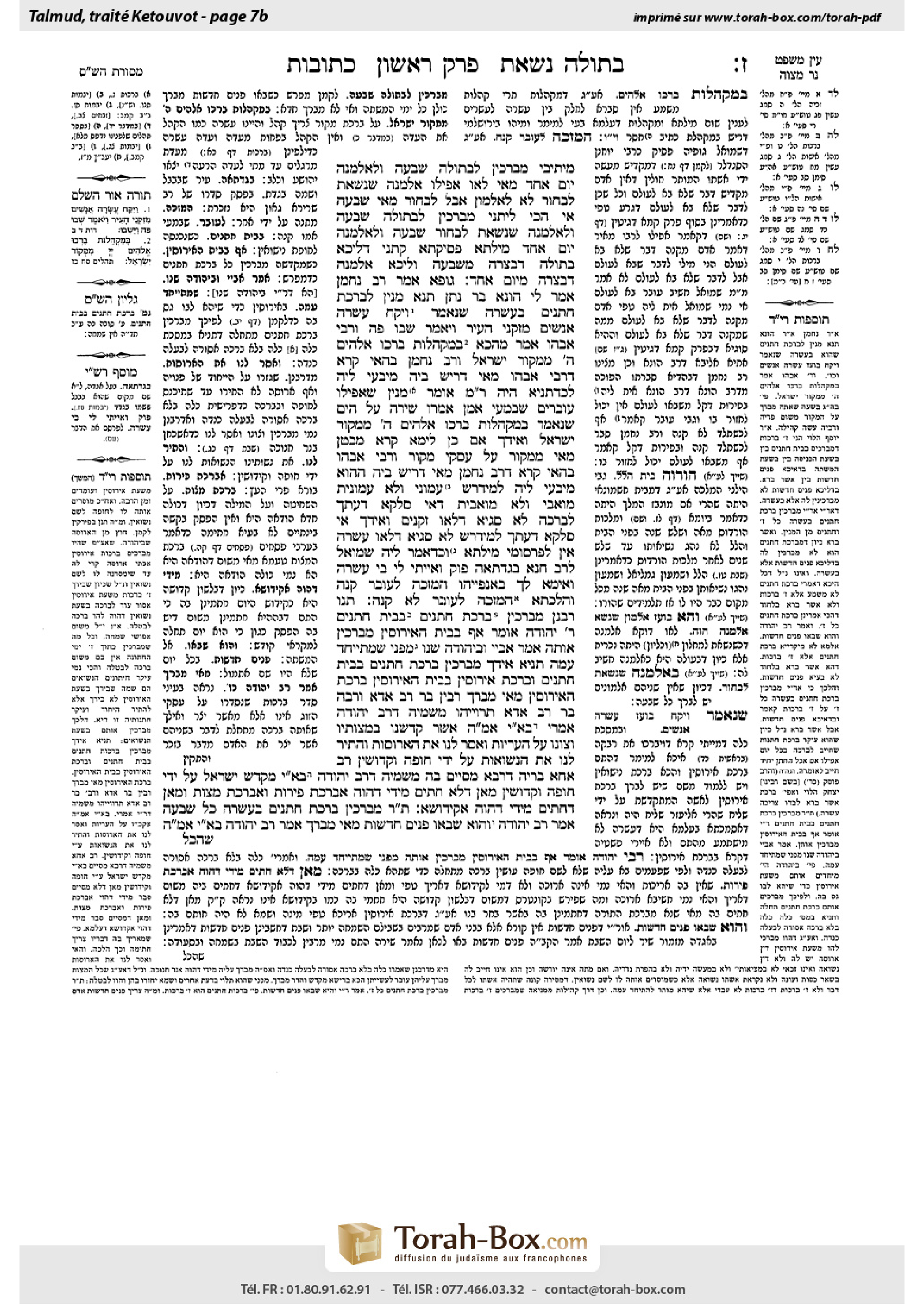
Ketubot 7b: Talmud study for Daf Yomi
Daf Yomi is the daily study of one Talmud folio. Explore 37 tractates with scans, Hebrew text, Sefaria English and AI-generated French translations where annotated.
Passage selection and English or AI-generated French translation are available where the scan has annotations. Daf Study is independent of Torah-Box and Sefaria.
Browse Ketubot · כתובות · All tractatesKetubot 7b text and translations
This page of Ketubot includes the Aramaic text, an English translation and an AI-generated French translation, alongside the scan above.
כתובות ז׳ ב · Aramaic and Hebrew text
מֵיתִיבִי: מְבָרְכִין לִבְתוּלָה שִׁבְעָה וּלְאַלְמָנָה יוֹם אֶחָד. מַאי לָאו, אֲפִילּוּ אַלְמָנָה שֶׁנִּשֵּׂאת לְבָחוּר! לֹא, לְאַלְמוֹן. אֲבָל לְבָחוּר מַאי, שִׁבְעָה? אִי הָכִי לִיתְנֵי: מְבָרְכִין לִבְתוּלָה שִׁבְעָה, וּלְאַלְמָנָה שֶׁנִּשֵּׂאת לְבָחוּר שִׁבְעָה, וּלְאַלְמָנָה יוֹם אֶחָד?
מִילְּתָא פְּסִיקְתָּא קָתָנֵי, דְּלֵיכָּא בְּתוּלָה דְּבָצְרָה מִשִּׁבְעָה, וְלֵיכָּא אַלְמָנָה דְּבָצְרָה מִיּוֹם אֶחָד.
גּוּפָא, אָמַר רַב נַחְמָן: אָמַר לִי הוּנָא בַּר נָתָן, תָּנָא: מִנַּיִן לְבִרְכַּת חֲתָנִים בַּעֲשָׂרָה — שֶׁנֶּאֱמַר: ״וַיִּקַּח עֲשָׂרָה אֲנָשִׁים מִזִּקְנֵי הָעִיר וַיֹּאמֶר שְׁבוּ פֹה״. וְרַבִּי אֲבָהוּ אָמַר, מֵהָכָא: ״בְּמַקְהֵלוֹת בָּרְכוּ אֱלֹהִים ה׳ מִמְּקוֹר יִשְׂרָאֵל״.
וְרַב נַחְמָן, בְּהַאי קְרָא דְּרַבִּי אֲבָהוּ מַאי דָּרֵישׁ בֵּיהּ? מִיבְּעֵי לֵיהּ לְכִדְתַנְיָא, הָיָה רַבִּי מֵאִיר אוֹמֵר: מִנַּיִן שֶׁאֲפִילּוּ עוּבָּרִים שֶׁבִּמְעֵי אִמָּן אָמְרוּ שִׁירָה עַל הַיָּם — שֶׁנֶּאֱמַר: ״בְּמַקְהֵלוֹת בָּרְכוּ אֱלֹהִים ה׳ מִמְּקוֹר יִשְׂרָאֵל״. וְאִידַּךְ? אִם כֵּן, לֵימָא קְרָא ״מִבֶּטֶן״. מַאי ״מִמְּקוֹר״ — עַל עִסְקֵי מְקוֹר.
וְרַבִּי אֲבָהוּ, בְּהַאי קְרָא דְּרַב נַחְמָן מַאי דָּרֵישׁ בֵּיהּ? הָהוּא מִיבְּעֵי לֵיהּ לְמִידְרַשׁ: עַמּוֹנִי וְלֹא עַמּוֹנִית, מוֹאָבִי וְלֹא מוֹאָבִית. דְּאִי סָלְקָא דַעְתָּךְ לִבְרָכָה, לָא סַגִּיא דְּלָאו זְקֵנִים.
וְאִידַּךְ: אִי סָלְקָא דַּעְתָּךְ לְמִידְרַשׁ, לָא סַגִּיא דְּלָאו עֲשָׂרָה! אִין — לְפַרְסוֹמֵי מִילְּתָא, וּכְדַאֲמַר לֵיהּ שְׁמוּאֵל לְרַב חָנָא בַּגְדָּתָאָה: פּוֹק וְאַיְיתִי לִי בֵּי עַשְׂרָה, וְאֵימָא לָךְ בְּאַנְפַּיְיהוּ: הַמְזַכֶּה לְעוּבָּר קָנָה. וְהִלְכְתָא — הַמְזַכֶּה לְעוּבָּר לֹא קָנָה.
תָּנוּ רַבָּנַן: מְבָרְכִין בִּרְכַּת חֲתָנִים בְּבֵית חֲתָנִים. רַבִּי יְהוּדָה אוֹמֵר: אַף בְּבֵית הָאֵרוּסִין מְבָרְכִין אוֹתָהּ.
אָמַר אַבָּיֵי: וּבִיהוּדָה שָׁנוּ, מִפְּנֵי שֶׁמִּתְיַיחֵד עִמָּהּ.
תַּנְיָא אִידַּךְ: מְבָרְכִין בִּרְכַּת חֲתָנִים בְּבֵית חֲתָנִים, וּבִרְכַּת אֵרוּסִין בְּבֵית הָאֵרוּסִין. בִּרְכַּת הָאֵרוּסִין מַאי מְבָרֵךְ? רָבִין בַּר רַב אַדָּא וְרַבָּה בַּר רַב אַדָּא, תַּרְוַיְיהוּ מִשְּׁמֵיהּ דְּרַב יְהוּדָה אָמְרִי: ״בָּרוּךְ אַתָּה ה׳ אֱלֹהֵינוּ מֶלֶךְ הָעוֹלָם, אֲשֶׁר קִדְּשָׁנוּ בְּמִצְוֹתָיו, וְצִוָּנוּ עַל הָעֲרָיוֹת, וְאָסַר לָנוּ אֶת הָאֲרוּסוֹת, וְהִתִּיר לָנוּ אֶת הַנְּשׂוּאוֹת עַל יְדֵי חוּפָּה וְקִדּוּשִׁין״. רַב אַחָא בְּרֵיהּ דְּרָבָא מְסַיֵּים בַּהּ מִשְּׁמֵיהּ דְּרַב יְהוּדָה: ״בָּרוּךְ אַתָּה ה׳, מְקַדֵּשׁ יִשְׂרָאֵל עַל יְדֵי חוּפָּה וְקִדּוּשִׁין״.
מַאן דְּלָא חָתֵים, מִידֵּי דְּהָוֵה אַבִּרְכַּת פֵּרוֹת וְאַבִּרְכַּת מִצְוֹת. וּמַאן דְּחָתֵים, מִידֵּי דְּהָוֵה אַקִּידּוּשָׁא.
תָּנוּ רַבָּנַן: מְבָרְכִין בִּרְכַּת חֲתָנִים בַּעֲשָׂרָה כׇּל שִׁבְעָה. אָמַר רַב יְהוּדָה: וְהוּא שֶׁבָּאוּ פָּנִים חֲדָשׁוֹת.
מַאי מְבָרֵךְ? אָמַר רַב יְהוּדָה: ״בָּרוּךְ אַתָּה ה׳ אֱלֹהֵינוּ מֶלֶךְ הָעוֹלָם,
Ketubot 7b · English translation
The Gemara raises an objection from a baraita: One recites a benediction for a virgin who marries for seven days and for a widow who marries for one day. What, is it not even in the case of a widow who is married to a bachelor, that one recites the benediction for one day? The Gemara answers: No, it is only in the case of a widow who is married to a widower that the benediction is recited for one day. The Gemara asks: However, one may then infer that in the case of a widow who is married to a bachelor, what is the halakha? The blessing is recited seven days? If so, let the tanna teach the baraita: One recites a benediction for a virgin who marries for seven days, and for a widow who marries a bachelor seven days, and for a widow marrying a widower for one day. Why was the middle case omitted?
Although the tanna could have included that case in the baraita, he taught categorical matters. He preferred to avoid entering into detail, as there is no virgin for whom the benediction is recited fewer than seven days, and there is no widow for whom the benediction is recited for less than one day. However, there are circumstances where even for a widow the benediction is recited for more than one day.
§ Apropos the source for the benediction of the grooms, the Gemara discusses the matter itself. Rav Naḥman said: Huna bar Natan said to me that it was taught: From where is it derived that the benediction of the grooms is recited in a quorum of ten men? It is as it is stated: “And he took ten men of the Elders of the city and said: Sit you here, and they sat” (Ruth 4:2). And Rabbi Abbahu said that the source is from here: “In assemblies [mak’helot], bless God, the Lord, from the source of Israel” (Psalms 68:27). This verse indicates that a congregation [kahal], which contains at least ten men, blesses God when reciting a benediction related to the source of Israel, i.e., conjugal relations, which will lead to the birth of Jewish children.
And what does Rav Naḥman derive from this verse from which Rabbi Abbahu derived that halakha? He requires the verse to derive that which is taught in a baraita: Rabbi Meir would say: From where is it derived that even fetuses in their mother’s womb recited the song at the Red Sea? It is as it is stated in the chapter of Psalms that describes the exodus from Egypt: “In assemblies, bless God, the Lord, from the source of Israel.” Even those fetuses that were still in the source, i.e., the womb, joined the assemblies in blessing God. And the other Sage, Rabbi Abbahu says: If that is the meaning, let the verse say: From the belly of Israel. What is the meaning of the term “source”? Clearly, it is referring to matters related to the source of Israel, i.e., the benediction of the grooms, which must be recited in a congregation, a quorum of ten.
And what does Rabbi Abbahu derive from this verse from which Rav Naḥman derived his halakha? He requires the verse stating that Boaz assembled ten men in order to teach that the Torah prohibition with regard to marrying members of the nations of Ammon and Moab is limited to a male Ammonite and not a female Ammonite, and to a male Moabite and not a female Moabite, as, if it would enter your mind that Boaz gathered the men only to recite a benediction, would it not have been sufficient if they were not Elders? From the fact that he convened a quorum of Elders, apparently it was to engage in halakhic discourse and to issue a halakhic ruling.
And the other Sage, Rav Naḥman, would reject that proof. If it would enter your mind that he gathered the men in order to teach a halakha, would it not have been sufficient if they were not ten? The Gemara answers: Yes, in fact a quorum of ten is not necessary to issue a halakhic ruling. Nevertheless, Boaz convened ten Elders to publicize the matter, as Shmuel said to Rav Ḥana of Baghdad: Go and bring me an assembly of ten men and I will say to you before them a halakha that I seek to disseminate: With regard to one who transfers ownership of an object to a fetus, the fetus acquires it, although it has not yet entered the world. Boaz too assembled ten Elders to publicize the matter. Apropos the halakha that Shmuel publicized, the Gemara rules: And the halakha is: With regard to one who transfers ownership of an object to a fetus, the fetus does not acquire it.
The Sages taught in a baraita: One recites the benediction of the grooms in the house of the grooms, when the bride enters into the wedding canopy. Rabbi Yehuda said: One recites it even in the house of the betrothal, at the time of the betrothal.
Abaye said: And the Sages taught the statement of Rabbi Yehuda in Judea because there the custom was that the groom be secluded with his betrothed, leading to the concern lest he engage in conjugal relations with her. Therefore, the blessing is recited already at that stage.
It is taught in another baraita: One recites the benediction of the grooms in the house of the grooms, and the benediction of the betrothal in the house of the betrothal. With regard to the benediction of the betrothal, what formula does one recite? Ravin bar Rav Adda and Rabba bar Rav Adda both said in the name of Rav Yehuda: Blessed are You, Lord our God, King of the universe, Who sanctified us through His mitzvot, and commanded us concerning the forbidden relatives, and prohibited to us those women who are betrothed, and permitted to us those women who are married by means of the wedding canopy and betrothal. Rav Aḥa, son of Rava, concludes the blessing in the name of Rav Yehuda: Blessed are You, Lord, Who sanctifies Israel by means of the wedding canopy and betrothal.
One who does not conclude the benediction of the betrothal in accordance with the opinion of Rav Aḥa, but instead recites it without a concluding blessing, deems the formula of this blessing just as the formula is in the blessing recited over fruits and the blessing recited over mitzvot, in which the words: Blessed are You, Lord, appear only at the beginning of the blessing. And one who concludes the benediction of the betrothal in accordance with the opinion of Rav Aḥa, deems the formula of this blessing just as the formula is in the blessing of kiddush, in which the words: Blessed are You, Lord, appears both at the beginning and the conclusion of the blessing.
§ The Sages taught: One recites the benediction of the grooms in a quorum of ten men all seven days of the wedding celebration. Rav Yehuda said: And that is the case only when new faces who did not previously participate in the festivities came to join the celebration.
The Gemara asks: What blessings does one recite? Rav Yehuda said that these are the seven blessings: Blessed are You, Lord our God, King of the universe,
Ketubot 7b · Traduction française (IA)
La Guemara soulève une objection à partir d’une baraïta : On récite la bénédiction pour une vierge qui se marie pendant sept jours, et pour une veuve qui se marie pendant un jour. Cela signifie-t-il que, même dans le cas d’une veuve qui épouse un célibataire, on récite la bénédiction pendant un jour ? La Guemara répond : Non, c’est seulement dans le cas d’une veuve qui épouse un veuf que l’on récite la bénédiction pendant un jour. La Guemara demande : Mais peut-on alors en déduire que, dans le cas d’une veuve qui épouse un célibataire, la halakha est que la bénédiction est récitée pendant sept jours ? Si tel est le cas, que le tanna enseigne dans la baraïta : On récite la bénédiction pour une vierge qui se marie pendant sept jours, pour une veuve qui épouse un célibataire pendant sept jours, et pour une veuve qui épouse un veuf pendant un jour. Pourquoi le cas intermédiaire a-t-il été omis ?
Bien que le tanna aurait pu inclure ce cas dans la baraïta, il a enseigné des règles catégoriques. Il a préféré éviter d’entrer dans les détails, car il n’y a aucune vierge pour laquelle la bénédiction est récitée moins de sept jours, ni aucune veuve pour laquelle elle est récitée moins d’un jour. Cependant, il existe des circonstances dans lesquelles la bénédiction est récitée pendant plus d’un jour, même pour une veuve.
§ À propos de la source de la bénédiction des mariés, la Guemara examine la question elle-même. Rav Naḥman a dit : Huna bar Natan m’a dit qu’il avait été enseigné : D’où déduit-on que la bénédiction des mariés est récitée en présence d’un quorum de dix hommes ? Du verset : « Il prit dix hommes parmi les anciens de la ville et dit : “Asseyez-vous ici” ; et ils s’assirent » (Ruth 4:2). Rabbi Abbahu a dit que la source se trouve ici : « Dans les assemblées [mak’helot], bénissez Dieu, le Seigneur, depuis la source d’Israël » (Psaumes 68:27). Ce verset indique qu’une assemblée [kahal], qui compte au moins dix hommes, bénit Dieu lorsqu’elle récite une bénédiction liée à la source d’Israël, c’est-à-dire aux relations conjugales, qui conduiront à la naissance d’enfants juifs.
Et que déduit Rav Naḥman de ce verset dont Rabbi Abbahu a tiré cette halakha ? Il en a besoin pour déduire ce qui est enseigné dans une baraïta : Rabbi Meïr disait : D’où déduit-on que même les fœtus dans le ventre de leur mère ont chanté le cantique à la mer Rouge ? Du verset figurant dans le chapitre des Psaumes qui décrit la sortie d’Égypte : « Dans les assemblées, bénissez Dieu, le Seigneur, depuis la source d’Israël. » Même les fœtus qui se trouvaient encore dans la source, c’est-à-dire dans le ventre maternel, se sont joints aux assemblées pour bénir Dieu. Et l’autre Sage, Rabbi Abbahu, dit : Si tel était le sens, que le verset dise : « Depuis le ventre d’Israël ». Que signifie alors le terme « source » ? Il fait clairement référence à des questions liées à la source d’Israël, c’est-à-dire à la bénédiction des mariés, qui doit être récitée en assemblée, devant un quorum de dix.
Et que déduit Rabbi Abbahu de ce verset dont Rav Naḥman a tiré sa halakha ? Il a besoin du verset indiquant que Boaz a rassemblé dix hommes pour enseigner que l’interdiction de la Torah concernant le mariage avec les membres des nations d’Ammon et de Moav ne s’applique qu’aux hommes ammonites et non aux femmes ammonites, et aux hommes moabites et non aux femmes moabites. Car si l’on pouvait penser que Boaz avait rassemblé ces hommes uniquement pour réciter une bénédiction, n’aurait-il pas suffi qu’ils ne soient pas des anciens ? Le fait qu’il ait convoqué un quorum d’anciens indique que c’était pour discuter de halakha et rendre une décision halakhique.
Et l’autre Sage, Rav Naḥman, rejetterait cette preuve. Si l’on pouvait penser qu’il avait rassemblé ces hommes pour enseigner une halakha, n’aurait-il pas suffi qu’ils ne soient pas dix ? La Guemara répond : En effet, un quorum de dix n’est pas nécessaire pour rendre une décision halakhique. Néanmoins, Boaz a convoqué dix anciens pour rendre la chose publique, comme Shmuel a dit à Rav Ḥana de Bagdad : « Va et réunis pour moi une assemblée de dix hommes, et je leur enseignerai devant eux une halakha que je souhaite diffuser : celui qui transfère la propriété d’un objet à un fœtus, le fœtus l’acquiert, bien qu’il ne soit pas encore venu au monde. » Boaz a lui aussi rassemblé dix anciens pour rendre la chose publique. À propos de la halakha que Shmuel a diffusée, la Guemara statue : Et la halakha est la suivante : celui qui transfère la propriété d’un objet à un fœtus, le fœtus ne l’acquiert pas.
Les Sages ont enseigné dans une baraïta : On récite la bénédiction des mariés dans la maison des mariés, lorsque la mariée entre sous la houppa. Rabbi Yehuda a dit : On la récite même dans la maison où ont lieu les fiançailles, au moment des fiançailles.
Abaye a dit : Les Sages ont enseigné la déclaration de Rabbi Yehuda en Judée, car là-bas, la coutume voulait que le marié s’isole avec sa fiancée, ce qui faisait craindre qu’il n’ait des relations conjugales avec elle. C’est pourquoi la bénédiction est récitée dès cette étape.
Il est enseigné dans une autre baraïta : On récite la bénédiction des mariés dans la maison des mariés, et la bénédiction des fiançailles dans la maison des fiançailles. Quelle formule récite-t-on pour la bénédiction des fiançailles ? Ravin bar Rav Adda et Rabba bar Rav Adda ont tous deux dit au nom de Rav Yehuda : « Béni sois-Tu, Seigneur notre Dieu, Roi de l’univers, qui nous as sanctifiés par Tes mitsvot et nous as ordonné au sujet des unions interdites, qui nous as interdit les femmes fiancées et nous as permis les femmes mariées au moyen de la houppa et des fiançailles. » Rav Aḥa, fils de Rava, conclut la bénédiction au nom de Rav Yehuda : « Béni sois-Tu, Seigneur, qui sanctifies Israël au moyen de la houppa et des fiançailles. »
Celui qui ne conclut pas la bénédiction des fiançailles conformément à l’opinion de Rav Aḥa, mais la récite sans formule de conclusion, considère que cette bénédiction suit le modèle de la bénédiction récitée sur les fruits et de celle récitée sur les mitsvot, dans lesquelles les mots « Béni sois-Tu, Seigneur » ne figurent qu’au début. Celui qui conclut la bénédiction des fiançailles conformément à l’opinion de Rav Aḥa considère qu’elle suit le modèle de la bénédiction du kiddouch, dans laquelle les mots « Béni sois-Tu, Seigneur » figurent au début comme à la conclusion.
§ Les Sages ont enseigné : On récite la bénédiction des mariés en présence d’un quorum de dix hommes pendant les sept jours de la célébration du mariage. Rav Yehuda a dit : Cela ne s’applique que lorsque de nouveaux visages, qui n’avaient pas participé auparavant aux festivités, se joignent à la célébration.
La Guemara demande : Quelles bénédictions récite-t-on ? Rav Yehuda a dit qu’il s’agit des sept bénédictions : « Béni sois-Tu, Seigneur notre Dieu, Roi de l’univers, »
Traduction française générée par IA à partir de l’édition anglaise de Sefaria. Vérifie toujours un passage avec le texte source.
Text from Sefaria: William Davidson Edition - Vocalized Aramaic (CC BY NC); William Davidson Edition - English (CC BY NC).