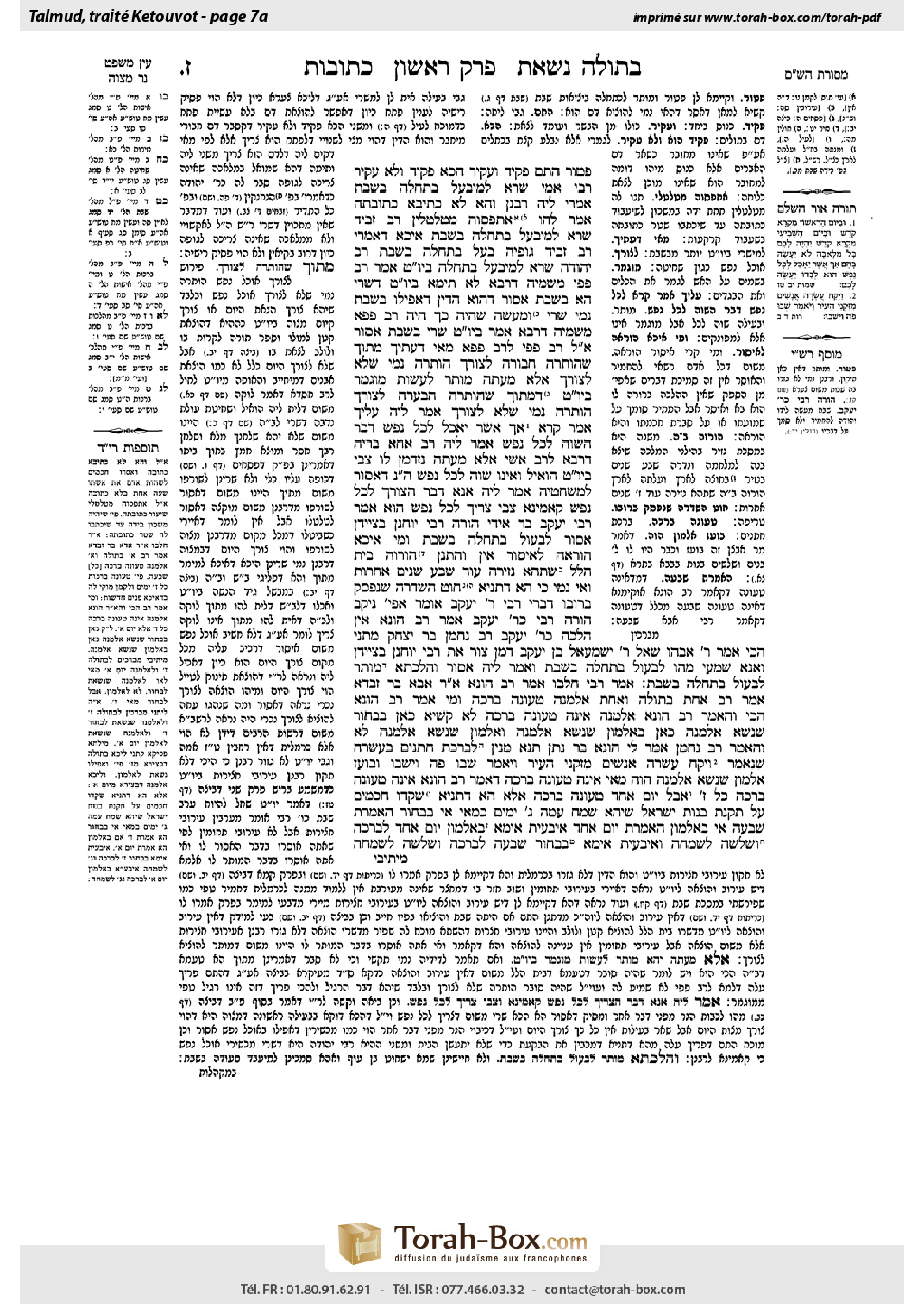
Ketubot 7a: Talmud study for Daf Yomi
Daf Yomi is the daily study of one Talmud folio. Explore 37 tractates with scans, Hebrew text, Sefaria English and AI-generated French translations where annotated.
Passage selection and English or AI-generated French translation are available where the scan has annotations. Daf Study is independent of Torah-Box and Sefaria.
Browse Ketubot · כתובות · All tractatesKetubot 7a text and translations
This page of Ketubot includes the Aramaic text, an English translation and an AI-generated French translation, alongside the scan above.
כתובות ז׳ א · Aramaic and Hebrew text
פָּטוּר. הָתָם, פְּקִיד וַעֲקִיר. הָכָא, פְּקִיד וְלָא עֲקִיר.
רַבִּי אַמֵּי שְׁרָא לְמִיבְעַל בַּתְּחִלָּה בְּשַׁבָּת. אָמְרִי לֵיהּ רַבָּנַן: וְהָא לָא כְּתִיבָא כְּתוּבָּתָהּ! אֲמַר לְהוּ: אַתְפְּסוּהָ מִטַּלְטְלִין.
רַב זְבִיד שְׁרָא לְמִיבְעַל בַּתְּחִלָּה בְּשַׁבָּת. אִיכָּא דְּאָמְרִי: רַב זְבִיד גּוּפֵיהּ בְּעַל בַּתְּחִלָּה בְּשַׁבָּת.
רַב יְהוּדָה שְׁרָא לְמִיבְעַל בַּתְּחִלָּה בְּיוֹם טוֹב. אָמַר רַב פַּפִּי מִשְּׁמֵיהּ דְּרָבָא: לָא תֵּימָא בְּיוֹם טוֹב דִּשְׁרֵי, הָא בְּשַׁבָּת אֲסִיר, דְּהוּא הַדִּין דַּאֲפִילּוּ בְּשַׁבָּת נָמֵי שְׁרֵי, וּמַעֲשֶׂה שֶׁהָיָה כָּךְ הָיָה.
רַב פָּפָּא מִשְּׁמֵיהּ דְּרָבָא אָמַר: בְּיוֹם טוֹב שְׁרֵי, בְּשַׁבָּת אֲסִיר. אֲמַר לֵיהּ רַב פַּפִּי לְרַב פָּפָּא: מַאי דַּעְתָּיךְ — מִתּוֹךְ שֶׁהוּתְּרָה חַבּוּרָה לְצוֹרֶךְ, הוּתְּרָה נָמֵי שֶׁלֹּא לְצוֹרֶךְ? אֶלָּא מֵעַתָּה, מוּתָּר לַעֲשׂוֹת מוּגְמָר בְּיוֹם טוֹב, דְּמִתּוֹךְ שֶׁהוּתְּרָה הַבְעָרָה לְצוֹרֶךְ, הוּתְּרָה נָמֵי שֶׁלֹּא לְצוֹרֶךְ!
אֲמַר לֵיהּ, עָלֶיךָ אָמַר קְרָא: ״אַךְ אֲשֶׁר יֵאָכֵל לְכׇל נֶפֶשׁ״ — דָּבָר הַשָּׁוֶה לְכׇל נֶפֶשׁ.
אֲמַר לֵיהּ רַב אַחָא בְּרֵיהּ דְּרָבָא לְרַב אָשֵׁי: אֶלָּא מֵעַתָּה, נִזְדַּמֵּן לוֹ צְבִי בְּיוֹם טוֹב, הוֹאִיל וְאֵינוֹ שָׁוֶה לְכׇל נֶפֶשׁ, הָכִי נָמֵי דַּאֲסִיר לְמִשְׁחֲטֵיהּ? אֲמַר לֵיהּ: אֲנָא דְּבַר (הַ)צוֹרֶךְ לְכׇל נֶפֶשׁ קָאָמֵינָא, צְבִי צָרִיךְ לְכׇל נֶפֶשׁ הוּא.
אָמַר רַבִּי יַעֲקֹב בַּר אִידִי, הוֹרָה רַבִּי יוֹחָנָן בְּצַיְידָן: אָסוּר לִבְעוֹל בַּתְּחִלָּה בַּשַּׁבָּת. וּמִי אִיכָּא הוֹרָאָה לְאִיסּוּר?
אִין, וְהָתְנַן: הוֹרוּהָ בֵּית הִלֵּל שֶׁתְּהֵא נְזִירָה עוֹד שֶׁבַע שָׁנִים אֲחֵרוֹת.
וְאִי נָמֵי, כִּי הָא דְּתַנְיָא: חוּט הַשִּׁדְרָה שֶׁנִּפְסַק בְּרוּבּוֹ, דִּבְרֵי רַבִּי. רַבִּי יַעֲקֹב אוֹמֵר: אֲפִילּוּ נִיקַּב. הוֹרָה רַבִּי כְּרַבִּי יַעֲקֹב. אָמַר רַב הוּנָא: אֵין הֲלָכָה כְּרַבִּי יַעֲקֹב.
רַב נַחְמָן בַּר יִצְחָק מַתְנֵי הָכִי: אָמַר רַבִּי אֲבָהוּ, שָׁאַל רַבִּי יִשְׁמָעֵאל בֶּן יַעֲקֹב דְּמִן צוּר אֶת רַבִּי יוֹחָנָן בְּצַיְידָן, וַאֲנָא שְׁמַעִי: מַהוּ לִבְעוֹל בַּתְּחִלָּה בַּשַּׁבָּת, וַאֲמַר לֵיהּ: אָסוּר. וְהִלְכְתָא: מוּתָּר לִבְעוֹל בַּתְּחִלָּה בַּשַּׁבָּת.
אָמַר רַבִּי חֶלְבּוֹ אָמַר רַב הוּנָא אָמַר רַבִּי אַבָּא בַּר זַבְדָּא אָמַר רַב: אַחַת בְּתוּלָה וְאַחַת אַלְמָנָה טְעוּנָה בְּרָכָה. וּמִי אָמַר רַב הוּנָא הָכִי? וְהָאָמַר רַב הוּנָא: אַלְמָנָה אֵינָהּ טְעוּנָה בְּרָכָה! לָא קַשְׁיָא: כָּאן בְּבָחוּר שֶׁנָּשָׂא אַלְמָנָה, כָּאן בְּאַלְמוֹן שֶׁנָּשָׂא אַלְמָנָה.
וְאַלְמוֹן שֶׁנָּשָׂא אַלְמָנָה לָא? וְהָאָמַר רַב נַחְמָן, אָמַר לִי הוּנָא בַּר נָתָן, תָּנָא: מִנַּיִן לְבִרְכַּת חֲתָנִים בַּעֲשָׂרָה — שֶׁנֶּאֱמַר: ״וַיִּקַּח עֲשָׂרָה אֲנָשִׁים מִזִּקְנֵי הָעִיר וַיֹּאמֶר שְׁבוּ פֹה וַיֵּשֵׁבוּ״. וּבוֹעַז אַלְמוֹן שֶׁנָּשָׂא אַלְמָנָה הֲוָה.
מַאי ״אֵינָהּ טְעוּנָה בְּרָכָה״ דְּאָמַר רַב הוּנָא — אֵינָהּ טְעוּנָה בְּרָכָה כׇּל שִׁבְעָה, אֲבָל יוֹם אֶחָד טְעוּנָה בְּרָכָה.
אֶלָּא הָא דְּתַנְיָא: שָׁקְדוּ חֲכָמִים עַל תַּקָּנַת בְּנוֹת יִשְׂרָאֵל שֶׁיְּהֵא שָׂמֵחַ עִמָּהּ שְׁלֹשָׁה יָמִים. בְּמַאי: אִי בְּבָחוּר, הָאָמְרַתְּ שִׁבְעָה! אִי בְּאַלְמוֹן, הָאָמְרַתְּ יוֹם אֶחָד?
אִיבָּעֵית אֵימָא: בְּאַלְמוֹן — יוֹם אֶחָד לִבְרָכָה, וּשְׁלֹשָׁה לְשִׂמְחָה. וְאִיבָּעֵית אֵימָא: בְּבָחוּר — שִׁבְעָה לִבְרָכָה, וּשְׁלֹשָׁה לְשִׂמְחָה.
Ketubot 7a · English translation
he is exempt. In this case, exempt means permitted ab initio. Ostensibly, intercourse with a virgin is comparable to creating an opening in an abscess. Why then, would intercourse with a virgin be forbidden on Shabbat? The Gemara rejects the proof: There, the pus in the abscess is pooled in one place and completely removed from the vessels in the flesh. In creating the opening, he creates nothing enduring. Here, however, in the case of the ruptured hymen, even according to the opinion that the blood is pooled, it is not completely removed from the blood vessels in the flesh. Through intercourse, the blood is removed from its place, which constitutes an aspect of a prohibited labor.
The Gemara relates: Rav Ami permitted one to engage in intercourse with his virgin wife for the first time on Shabbat. The Sages said to him: But her marriage contract is not yet written. Engaging in conjugal relations with one’s wife without a marriage contract is considered an act of promiscuity. He said to them: Have her seize a portion of her husband’s movable property equivalent to the value of her marriage contract, and that will serve as a deposit until he writes the marriage contract. He may then engage in sexual relations with her.
The Gemara relates: Rav Zevid permitted one to engage in intercourse with his virgin wife for the first time on Shabbat. There are those who say: Rav Zevid himself engaged in intercourse with his virgin wife for the first time on Shabbat.
It was further related: Rav Yehuda permitted one to engage in intercourse with his virgin wife for the first time on a Festival. Rav Pappi said in the name of Rava: Do not infer and say: It is on a Festival that it is permitted, but on Shabbat it is prohibited, similar to actions involving food preparation, which are permitted on Festivals and prohibited on Shabbat, as the same is true that even on Shabbat it is permitted. And the reason Rav Yehuda issued his ruling with regard to a Festival is due to the fact that the incident that took place, took place in this way.
Rav Pappa said in the name of Rava: According to Rav Yehuda, on a Festival it is permitted, on Shabbat it is prohibited. Rav Pappi said to Rav Pappa: What is your thinking? Is it: Since causing a wound was permitted on a Festival when performed for the purpose of food preparation, it was also permitted when not performed for the purpose of food preparation? If that is so, it would be permitted to prepare incense [mugmar] on a Festival due to the following reason: Since kindling a fire was permitted on a Festival when performed for the purpose of food preparation, it was also permitted when not performed for the purpose of food preparation.
Rav Pappa said to him: It is about your assertion that the verse states with regard to a Festival: “Save that which every person must eat, that alone may be done by you” (Exodus 12:16), indicating a matter that is equal for every person. Incense is burned only by those who are particularly delicate. It is not equally utilized by everyone, and therefore it is not permitted. Intercourse, on the other hand, is universally practiced.
Rav Aḥa, son of Rava, said to Rav Ashi: If that is so, if a deer happened to come into his possession on a Festival, since it is not a food that is equal for every person, would the ruling also be that it is prohibited to slaughter it? Rav Ashi said to him: I said a matter that is a need for every person, and deer meat is a matter that although difficult to acquire, is a need for every person. Incense, even when available, is not universally utilized.
Rabbi Ya’akov bar Idi said: Rabbi Yoḥanan issued a ruling in the city of Tzaidan: It is prohibited to engage in intercourse with one’s virgin wife for the first time on Shabbat. The Gemara asks: And is there a ruling issued to prohibit an action? Typically, that language is utilized in reference to a firmly established ruling. A stringent ruling can be issued even based on uncertainty. In contrast, a lenient ruling can be issued only if the matter is clearly established by means of tradition or the reasoning of the Sage issuing the ruling.
The Gemara answers: Yes, that language is used with regard to a stringent ruling, as didn’t we learn the following in a mishna (Nazir 19b): When Queen Helene’s son went to war, she took a vow to be a nazirite for seven years, and she fulfilled that vow for the duration of her stay in the Diaspora? When she immigrated to Eretz Yisrael, Beit Hillel issued a ruling that she shall be a nazirite for seven additional years. Apparently, rulings are issued to prohibit an action as well.
And alternatively, this is similar to that which is taught in a baraita: If a majority of the spinal cord of an animal is severed, the animal is a tereifa; this is the statement of Rabbi Yehuda HaNasi. Rabbi Ya’akov says: Even if the spinal cord is perforated but otherwise intact, the animal is a tereifa. The baraita continues: Rabbi Yehuda HaNasi issued a ruling in accordance with the opinion of Rabbi Ya’akov. Here too, the term: Issue a ruling, is employed with regard to a stringent ruling. Rav Huna said: Despite the fact that Rabbi Yehuda HaNasi ruled in accordance with his opinion, the halakha is not in accordance with the opinion of Rabbi Ya’akov, but rather it is in accordance with the opinion of Rabbi Yehuda HaNasi. This is one version of this discussion.
Rav Naḥman bar Yitzḥak taught this alternative version of the ruling of Rabbi Yoḥanan. Rav Abbahu said: Rabbi Yishmael ben Ya’akov, who is from Tyre, asked Rabbi Yoḥanan in Tzaidan, and I heard the exchange: What is the halakha with regard to engaging in intercourse with one’s virgin wife for the first time on Shabbat? And he said to him: It is prohibited. The Gemara concludes: And the halakha is that it is permitted to engage in intercourse with one’s virgin wife for the first time on Shabbat, and one need not be concerned lest he cause a wound, create an opening, or initiate bleeding.
§ Rabbi Ḥelbo said that Rav Huna said that Rabbi Abba bar Rav Zavda said that Rav said: Both a virgin and a widow who marry require that the benediction of the grooms be recited. The Gemara asks: Did Rav Huna say that? But didn’t Rav Huna say: A widow does not require that a benediction be recited? The Gemara answers: This is not difficult. Here, where Rav Huna said that a widow requires a benediction, it is with regard to a bachelor who married a widow. There, where Rav Huna said she does not require a benediction, it is with regard to a widower who married a widow.
The Gemara asks: And does a widower who married a widow not require a benediction to be recited? But didn’t Rav Naḥman say: Huna bar Natan said to me that it was taught: From where is it derived that the benediction of the grooms is recited in a quorum of ten men? It is as it is stated with regard to Boaz, who married Ruth: “And he took ten men of the Elders of the city and said: Sit you here, and they sat” (Ruth 4:2). And when Boaz married Ruth, he was a widower marrying a widow. As that is the primary source for the obligation to recite the benediction, apparently the benediction is recited even in that case.
The Gemara answers: What is the meaning of: Does not require a benediction, that Rav Huna stated? It means that she does not require a benediction all seven days of the wedding celebration, but everyone agrees that for one day, she requires that a benediction be recited.
The Gemara asks: However, that which is taught in a baraita, that the Sages were assiduous in seeing to the well-being of Jewish women, ensuring that the groom will rejoice with her three days, and that is why they established that a widow is married on Thursday, with regard to what circumstance is the baraita speaking? If it is with regard to a bachelor who marries a widow, didn’t you say he celebrates seven days; why then did the Sages see to a mere three-day celebration? If it is with regard to a widower who marries a widow, didn’t you say he celebrates for one day? Why then did the Sages see to a three-day celebration?
The Gemara answers that this can be resolved in several manners. If you wish, say: In the case of a widower marrying a widow, there is one day for benediction and three days for celebration. The wedding is scheduled on Thursday to facilitate a three-day celebration. And if you wish, say instead: In the case of a bachelor marrying a widow, there are seven days for benediction and there are three days for celebration, during which he must refrain from going to work.
Ketubot 7a · Traduction française (IA)
Il est exempt. Dans ce cas, « exempt » signifie que l’acte est permis a priori. À première vue, avoir des rapports avec une vierge est comparable à ouvrir un abcès. Pourquoi, dès lors, cela serait-il interdit le Chabbat ? La Guemara rejette cette preuve : dans le cas de l’abcès, le pus est rassemblé en un seul endroit et entièrement détaché des vaisseaux de la chair. En créant l’ouverture, l’homme ne crée rien de durable. Ici, en revanche, dans le cas de la rupture de l’hymen, même selon l’opinion selon laquelle le sang est rassemblé, il n’est pas entièrement détaché des vaisseaux sanguins de la chair. Par les rapports sexuels, le sang est extrait de son emplacement, ce qui constitue un aspect d’un travail interdit.
La Guemara rapporte : Rav Ami autorisa un homme à avoir pour la première fois des rapports avec son épouse vierge le Chabbat. Les Sages lui dirent : « Mais son contrat de mariage n’a pas encore été rédigé. » Avoir des relations conjugales avec son épouse sans contrat de mariage est considéré comme un acte de promiscuité. Il leur répondit : « Qu’elle prenne des biens mobiliers de son mari d’une valeur équivalente à celle de son contrat de mariage ; ils serviront de garantie jusqu’à ce qu’il rédige le contrat. » Il pourra alors avoir des rapports sexuels avec elle.
La Guemara rapporte : Rav Zevid autorisa un homme à avoir pour la première fois des rapports avec son épouse vierge le Chabbat. Certains disent que Rav Zevid lui-même eut pour la première fois des rapports avec son épouse vierge le Chabbat.
Il fut également rapporté que Rav Yehouda autorisa un homme à avoir pour la première fois des rapports avec son épouse vierge un jour de fête. Rav Pappi dit au nom de Rava : « N’en déduis pas que c’est permis un jour de fête, mais interdit le Chabbat, comme les travaux de préparation des aliments, qui sont permis les jours de fête et interdits le Chabbat. En effet, c’est également permis le Chabbat. » Rav Yehouda rendit sa décision au sujet d’un jour de fête parce que l’incident qui s’est produit s’est déroulé ainsi.
Rav Pappa dit au nom de Rava : « Selon Rav Yehouda, c’est permis un jour de fête et interdit le Chabbat. » Rav Pappi dit à Rav Pappa : « Quel est ton raisonnement ? Penses-tu que, puisque le fait de provoquer une blessure a été permis un jour de fête lorsqu’il était effectué pour la préparation des aliments, il l’a également été lorsqu’il n’était pas effectué à cette fin ? Si tel était le cas, il serait permis de préparer de l’encens [mugmar] un jour de fête, pour la raison suivante : puisque l’allumage d’un feu a été permis un jour de fête lorsqu’il était effectué pour la préparation des aliments, il l’aurait également été lorsqu’il n’était pas effectué à cette fin. »
Rav Pappa lui dit : « C’est à propos de ton raisonnement que le verset dit au sujet d’un jour de fête : “Mais ce que chacun doit manger, cela seul pourra être fait par vous” (Exode 12:16), ce qui indique qu’il s’agit d’une chose qui répond à un besoin commun à tous. Seules les personnes particulièrement délicates brûlent de l’encens. Ce n’est pas une chose dont tous font usage ; elle n’est donc pas permise. Les rapports sexuels, en revanche, sont pratiqués par tous. »
Rav Aḥa, fils de Rava, dit à Rav Ashi : « Si tel est le cas, si un cerf lui tombe entre les mains un jour de fête, puisque ce n’est pas un aliment dont tout le monde fait usage, serait-il également interdit de l’abattre ? » Rav Ashi lui dit : « J’ai parlé d’une chose dont tout le monde a besoin. La viande de cerf, bien que difficile à obtenir, est une chose dont tout le monde a besoin. L’encens, même lorsqu’il est disponible, n’est pas utilisé par tous. »
Rabbi Ya’akov bar Idi dit : Rabbi Yoḥanan rendit une décision dans la ville de Tzaidan : il est interdit d’avoir pour la première fois des rapports avec son épouse vierge le Chabbat. La Guemara demande : Peut-on rendre une décision pour interdire une action ? Cette expression est généralement employée pour une décision solidement établie. Une décision rigoureuse peut être rendue même sur la base d’un doute. À l’inverse, une décision indulgente ne peut être rendue que si la question est clairement établie par la tradition ou par le raisonnement du Sage qui rend la décision.
La Guemara répond : Oui, cette expression est employée à propos d’une décision rigoureuse. N’avons-nous pas appris dans une Michna (Nazir 19b) : Lorsque le fils de la reine Helene partit à la guerre, elle fit vœu d’être naziréenne pendant sept ans et observa ce vœu durant tout son séjour en Diaspora. Lorsqu’elle monta en Eretz Yisrael, Beit Hillel rendit la décision qu’elle devait être naziréenne sept années supplémentaires. Il apparaît donc que des décisions sont également rendues pour interdire une action.
Autre possibilité : cela ressemble à ce qui est enseigné dans une baraïta : si la majeure partie de la moelle épinière d’un animal est sectionnée, l’animal est une tereifa ; telle est la déclaration de Rabbi Yehouda HaNassi. Rabbi Ya’akov dit : même si la moelle épinière est perforée, mais intacte par ailleurs, l’animal est une tereifa. La baraïta poursuit : Rabbi Yehouda HaNassi rendit une décision conformément à l’opinion de Rabbi Ya’akov. Ici aussi, l’expression « rendre une décision » est employée à propos d’une décision rigoureuse. Rav Houna dit : bien que Rabbi Yehouda HaNassi ait rendu une décision conformément à son opinion, la halakha n’est pas conforme à l’opinion de Rabbi Ya’akov, mais à celle de Rabbi Yehouda HaNassi. Telle est l’une des versions de cette discussion.
Rav Naḥman bar Yitzḥak enseigna cette autre version de la décision de Rabbi Yoḥanan. Rav Abbahou dit : « Rabbi Yishmael ben Ya’akov, qui est de Tyr, interrogea Rabbi Yoḥanan à Tzaidan, et j’entendis leur échange : “Quelle est la halakha concernant le fait d’avoir pour la première fois des rapports avec son épouse vierge le Chabbat ?” Il lui répondit : “C’est interdit.” » La Guemara conclut : la halakha est qu’il est permis d’avoir pour la première fois des rapports avec son épouse vierge le Chabbat, et il n’est pas nécessaire de craindre qu’il provoque une blessure, crée une ouverture ou déclenche un saignement.
§ Rabbi Ḥelbo dit que Rav Houna dit que Rabbi Abba bar Rav Zavda dit que Rav dit : « Tant une vierge qu’une veuve qui se marient nécessitent la récitation de la bénédiction des mariés. » La Guemara demande : Rav Houna a-t-il dit cela ? Rav Houna n’a-t-il pas dit qu’une veuve n’a pas besoin qu’une bénédiction soit récitée ? La Guemara répond : Il n’y a pas de contradiction. Ici, lorsque Rav Houna dit qu’une veuve nécessite une bénédiction, il s’agit d’un célibataire qui épouse une veuve. Là, lorsqu’il dit qu’elle n’en a pas besoin, il s’agit d’un veuf qui épouse une veuve.
La Guemara demande : Un veuf qui épouse une veuve n’a-t-il donc pas besoin qu’une bénédiction soit récitée ? Rav Naḥman n’a-t-il pas dit : « Houna bar Natan m’a dit qu’il a été enseigné : D’où sait-on que la bénédiction des mariés est récitée en présence d’un quorum de dix hommes ? C’est ce qui est énoncé au sujet de Boaz, qui épousa Ruth : “Il prit dix hommes parmi les Anciens de la ville et leur dit : Asseyez-vous ici. Et ils s’assirent” (Ruth 4:2). » Or, lorsque Boaz épousa Ruth, il était veuf et épousait une veuve. Puisque c’est la source principale de l’obligation de réciter la bénédiction, il apparaît que celle-ci est récitée même dans ce cas.
La Guemara répond : Que signifie l’expression « n’a pas besoin d’une bénédiction » employée par Rav Houna ? Cela signifie qu’elle n’a pas besoin que la bénédiction soit récitée pendant les sept jours de la célébration du mariage, mais tous conviennent qu’elle doit être récitée pendant un jour.
La Guemara demande : Mais dans la baraïta, selon laquelle les Sages se sont particulièrement souciés du bien-être des femmes juives, en veillant à ce que le mari se réjouisse avec elle pendant trois jours, et ont donc institué qu’une veuve se marie le jeudi, de quelle situation est-il question ? S’il s’agit d’un célibataire qui épouse une veuve, n’as-tu pas dit qu’il célèbre pendant sept jours ? Pourquoi, alors, les Sages se sont-ils souciés d’une célébration de seulement trois jours ? S’il s’agit d’un veuf qui épouse une veuve, n’as-tu pas dit qu’il célèbre pendant un jour ? Pourquoi, alors, les Sages se sont-ils souciés d’une célébration de trois jours ?
La Guemara répond que cela peut être résolu de plusieurs façons. Si tu veux, dis : dans le cas d’un veuf qui épouse une veuve, il y a un jour de bénédiction et trois jours de célébration. Le mariage est fixé au jeudi afin de permettre une célébration de trois jours. Ou bien, si tu veux, dis plutôt : dans le cas d’un célibataire qui épouse une veuve, il y a sept jours de bénédiction et trois jours de célébration, pendant lesquels il doit s’abstenir d’aller travailler.
Traduction française générée par IA à partir de l’édition anglaise de Sefaria. Vérifie toujours un passage avec le texte source.
Text from Sefaria: William Davidson Edition - Vocalized Aramaic (CC BY NC); William Davidson Edition - English (CC BY NC).