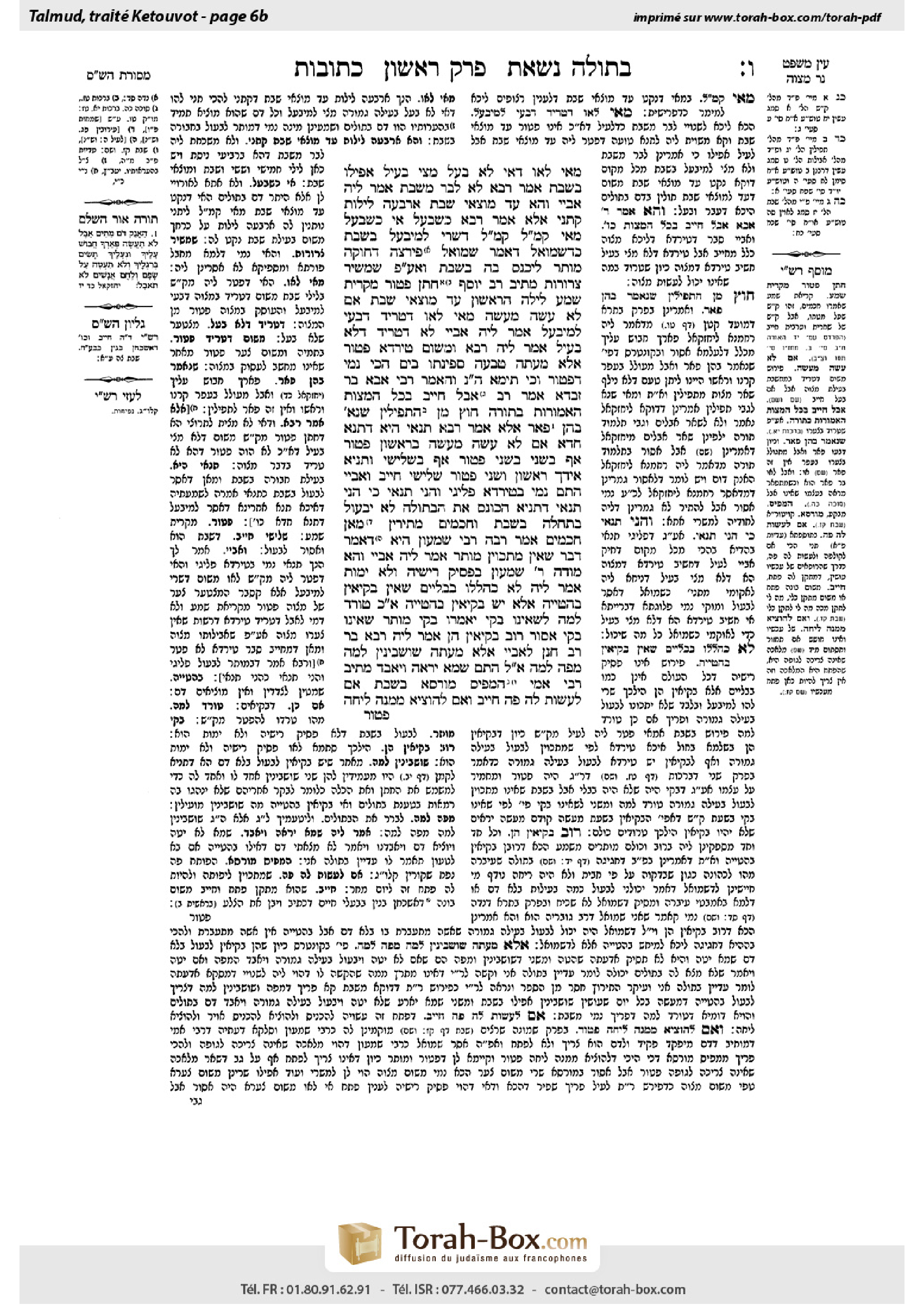
Ketubot 6b: Talmud study for Daf Yomi
Daf Yomi is the daily study of one Talmud folio. Explore 37 tractates with scans, Hebrew text, Sefaria English and AI-generated French translations where annotated.
Passage selection and English or AI-generated French translation are available where the scan has annotations. Daf Study is independent of Torah-Box and Sefaria.
Browse Ketubot · כתובות · All tractatesKetubot 6b text and translations
This page of Ketubot includes the Aramaic text, an English translation and an AI-generated French translation, alongside the scan above.
כתובות ו׳ ב · Aramaic and Hebrew text
מַאי לָאו: דְּאִי לֹא בָּעַל, מָצֵי בָּעֵיל אֲפִילּוּ בְּשַׁבָּת. אָמַר רָבָא: לָא, לְבַר מִשַּׁבָּת. אֲמַר לֵיהּ אַבָּיֵי: וְהָא ״עַד מוֹצָאֵי שַׁבָּת אַרְבָּעָה לֵילוֹת״ קָתָנֵי? אֶלָּא, אָמַר רָבָא: כְּשֶׁבָּעַל.
אִי כְּשֶׁבָּעַל, מַאי קָא מַשְׁמַע לַן? קָא מַשְׁמַע לַן דִּשְׁרֵי לְמִיבְעַל בְּשַׁבָּת, כְּדִשְׁמוּאֵל. דְּאָמַר שְׁמוּאֵל: פִּירְצָה דְּחוּקָה מוּתָּר לִיכָּנֵס בָּהּ בְּשַׁבָּת, וְאַף עַל פִּי שֶׁמַּשִּׁיר צְרוֹרוֹת.
מֵתִיב רַב יוֹסֵף: חָתָן פָּטוּר מִקְּרִיַּת שְׁמַע לַיְלָה הָרִאשׁוֹן עַד מוֹצָאֵי שַׁבָּת אִם לֹא עָשָׂה מַעֲשֶׂה. מַאי לָאו, דִּטְרִיד דְּבָעֵי לְמִיבְעַל! אֲמַר לֵיהּ אַבָּיֵי: לָא, דִּטְרִיד דְּלָא בְּעֵיל.
אֲמַר לֵיהּ רָבָא: וּמִשּׁוּם טִירְדָּא פָּטוּר? אֶלָּא מֵעַתָּה, טָבְעָה סְפִינָתוֹ בַּיָּם, הָכִי נָמֵי דְּפָטוּר?! וְכִי תֵּימָא הָכִי נָמֵי — וְהָאָמַר רַבִּי אַבָּא בַּר זַבְדָּא אָמַר רַב: אָבֵל חַיָּיב בְּכׇל הַמִּצְוֹת הָאֲמוּרוֹת בְּתוֹרָהּ חוּץ מִן הַתְּפִילִּין, שֶׁנֶּאֱמַר בָּהֶן ״פְּאֵר״!
אֶלָּא אָמַר רָבָא: תַּנָּאֵי הִיא. דְּתָנָא חֲדָא: אִם לֹא עָשָׂה מַעֲשֶׂה בָּרִאשׁוֹן — פָּטוּר אַף בַּשֵּׁנִי, בַּשֵּׁנִי — פָּטוּר אַף בַּשְּׁלִישִׁי.
וְתַנְיָא אִידַּךְ: רִאשׁוֹן וְשֵׁנִי — פָּטוּר, שְׁלִישִׁי — חַיָּיב.
וְאַבָּיֵי? הָתָם נָמֵי בְּטִירְדָּא פְּלִיגִי.
וְהָנֵי תַּנָּאֵי כִּי הָנֵי תַּנָּאֵי. דְּתַנְיָא: הַכּוֹנֵס אֶת הַבְּתוּלָה — לֹא יִבְעוֹל בַּתְּחִלָּה בְּשַׁבָּת, וַחֲכָמִים מַתִּירִין.
מַאן חֲכָמִים? אָמַר רַבָּה: רַבִּי שִׁמְעוֹן הִיא, דְּאָמַר: דָּבָר שֶׁאֵין מִתְכַּוֵּין מוּתָּר.
אֲמַר לֵיהּ אַבָּיֵי: וְהָא מוֹדֶה רַבִּי שִׁמְעוֹן בִּ״פְסִיק רֵישֵׁיהּ וְלָא יְמוּת״! אֲמַר לֵיהּ: לֹא כְּהַלָּלוּ בַּבְלִיִּים שֶׁאֵין בְּקִיאִין בְּהַטָּיָיה, אֶלָּא יֵשׁ בְּקִיאִין בְּהַטָּיָיה.
אִם כֵּן, טוֹרֶד לָמָּה? לְשֶׁאֵינוֹ בָּקִי. יֹאמְרוּ: בָּקִי — מוּתָּר, שֶׁאֵינוֹ בָּקִי — אָסוּר! רוֹב בְּקִיאִין הֵן.
אֲמַר לֵיהּ רָבָא בַּר רַב חָנָן לְאַבָּיֵי: אֶלָּא מֵעַתָּה שׁוֹשְׁבִינִין, לָמָּה? מַפָּה לָמָּה? אֲמַר לֵיהּ: הָתָם שֶׁמָּא יִרְאֶה וִיאַבֵּד.
מֵתִיב רַבִּי אַמֵּי: הַמֵּפִיס מוּרְסָא בְּשַׁבָּת, אִם לַעֲשׂוֹת לָהּ פֶּה — חַיָּיב. וְאִם לְהוֹצִיא מִמֶּנָּה לֵיחָה —
Ketubot 6b · English translation
What, is it not referring to a case where if he did not yet engage in full-fledged intercourse, i.e., rupturing the hymen, with his bride, he may engage in full-fledged intercourse with her even on Shabbat? Apparently, it is permitted to engage in intercourse with a virgin on Shabbat. Rava said: No, it is referring to any other day except for Shabbat. Abaye said to him: But isn’t it taught: Until the conclusion of Shabbat, four nights? Four nights from Wednesday until the conclusion of Shabbat includes Shabbat. Rather, Rava said: It is referring to a case where he engaged in full-fledged intercourse with his bride before Shabbat. Therefore, there is no concern lest he cause a wound on Shabbat.
However, if it is referring to a case where he already engaged in intercourse, what is the tanna teaching us when he says that it is permitted to have intercourse with her even on Shabbat? He teaches us that although it might cause bleeding, it is permitted to engage in intercourse on Shabbat, in accordance with the statement of Shmuel, as Shmuel said: It is permitted to enter into a narrow opening in a wall on Shabbat, although doing so causes pebbles to fall from the wall. Here too, although it might cause a wound and bleeding, intercourse is permitted on Shabbat.
Rav Yosef raised an objection from a mishna (Berakhot 16a): A groom is exempt from the mitzva of reciting Shema on the first night of his marriage to a virgin on Wednesday night, until Saturday night, if he has not taken action and consummated the marriage. What, is it not that he is exempt due to the fact that he is preoccupied because he wishes to engage in intercourse with her and is concerned that he will fail to do so properly? Apparently, if he did not yet consummate the marriage, he is exempt from reciting Shema even on Shabbat, indicating that it is permitted to engage in intercourse on Shabbat. Abaye said to him: No. It can be explained that he is exempt from reciting Shema because he is preoccupied due to the fact that he did not yet engage in intercourse with her. No proof may be cited with regard to engaging in intercourse on Shabbat.
Rava said to Abaye: And is one exempt due to preoccupation? If that is so, would one whose ship sunk at sea also be exempt? The Gemara reinforces its question: And if you would say: In fact, that is so, didn’t Rabbi Abba bar Zavda say that Rav said: A mourner is obligated in all the mitzvot in the Torah except for the mitzva to don phylacteries, as the term splendor is stated with regard to phylacteries: “Make no mourning for the dead; bind your splendor upon yourself” (Ezekiel 24:17). Splendor is antithetical to mourning. If a mourner, who is clearly pained and preoccupied, is obligated to recite Shema, then certainly all others who are preoccupied due to events that transpired in the past should be obligated. If the groom is exempt, it must be due to his preoccupation with a mitzva that remains incumbent upon him to perform in the future.
Rather, Rava said: This matter of intercourse with a virgin on Shabbat is subject to a dispute between tanna’im, as one tanna taught: If he did not take action on the first night he is exempt from reciting Shema even on the second. If he failed to consummate the marriage on the second night he is exempt even on the third night, which is Shabbat evening.
And another baraita is taught: On the first and second nights he is exempt; on the third he is obligated to recite Shema. He is obligated on the third night, even if he did not yet consummate the marriage, because the third night is Shabbat, when intercourse with his virgin wife is forbidden. The different rulings in the two baraitot indicate that there is a tannaitic dispute with regard to intercourse with a virgin on Shabbat.
And how does Abaye respond to this proof? He says that there too, it can be explained that it is with regard to preoccupation that the tanna’im disagree. Everyone agrees that it is prohibited to engage in intercourse with a virgin on Shabbat. The dispute is whether or not one’s preoccupation with the fact that he has not yet performed the mitzva of consummating the marriage in the past is considered preoccupation with a mitzva, which would exempt him from reciting Shema?
And the dispute between these tanna’im in the baraitot cited is parallel to the dispute between these tanna’im, as it is taught in another baraita: With regard to one who marries a virgin, he may not engage in intercourse with her for the first time on Shabbat, and the Rabbis permit doing so.
The Gemara asks: Who are the Rabbis that permit doing so? Rabba said: It is the opinion of Rabbi Shimon, who said: An unintentional act is permitted on Shabbat. Since one’s intention is to perform a permitted action, i.e., the consummation of the marriage, and there is no intent to perform a forbidden action, any forbidden action that may ensue is not a source of concern.
Abaye said to Rabba: But doesn’t Rabbi Shimon concede that in the case of: Cut off its head and will it not die, i.e., inevitable consequences, one is not exempted by lack of intent. Since rupture of the hymen and the subsequent bleeding is inevitable, Rabbi Shimon would concede that intercourse with a virgin is forbidden. Rabba said to him: Unlike these Babylonians, who are not experts in diverting during intercourse and are unable to engage in intercourse without rupturing the hymen, there are those who are experts in diverting. Therefore, rupture of the hymen is not an inevitable consequence.
The Gemara asks: If so, and the groom is expert in diverting, why is there preoccupation that renders him exempt from reciting Shema? The Gemara answers: The exemption due to preoccupation is limited to one who is not expert. The Gemara asks: If so, the Sages should say explicitly: One who is expert is permitted to have intercourse with a virgin on Shabbat, and one who is not expert is prohibited from doing so. The Gemara answers: The majority of men are experts in this matter. Therefore, rupture of the hymen is not an inevitable consequence, and intercourse is permitted on Shabbat.
Rava bar Rav Ḥanan said to Abaye: If that is so, and most people are able to engage in intercourse with a virgin without rupturing the hymen, why are groomsmen stationed to ensure that no deceit is employed by the groom with regard to the bride’s virginity? And why is a sheet necessary to determine whether there was blood? The absence of blood proves nothing if intercourse is possible without blood. Abaye said to him: There, the groomsmen and the sheet are necessary lest the groom see blood and seek to destroy it intentionally. Certainly, if he seeks to engage in intercourse and keep the hymen intact he can do so. However, if he engages in full-fledged intercourse and the hymen is ruptured, the Sages sought to ensure that the facts are clear.
Rav Ami raised an objection from a mishna (Eduyyot 2:5): With regard to one who drains an abscess on Shabbat, if his intent is to create a permanent opening so that the abscess will dry, he is liable to receive punishment for performing an action similar to the prohibited labor of building on Shabbat. However, if he created the opening to remove pus,
Ketubot 6b · Traduction française (IA)
Quoi ? Cela ne désigne-t-il pas le cas où il n’a pas encore eu de rapport complet avec sa fiancée, c’est-à-dire qu’il n’a pas encore rompu l’hymen, et où il peut avoir un rapport complet avec elle même le Chabbat ? Il semble donc qu’il soit permis d’avoir un rapport avec une vierge le Chabbat. Rava dit : Non, cela désigne n’importe quel jour autre que le Chabbat. Abaye lui dit : Mais n’est-il pas enseigné : quatre nuits jusqu’à la fin du Chabbat ? Quatre nuits, du mercredi jusqu’à la fin du Chabbat, incluent le Chabbat. Rava dit plutôt : Cela désigne le cas où il a eu un rapport complet avec sa fiancée avant le Chabbat. Il n’y a donc pas à craindre qu’il provoque une blessure le Chabbat.
Toutefois, s’il s’agit d’un cas où il a déjà eu un rapport, que nous enseigne le tanna en disant qu’il est permis d’avoir un rapport avec elle même le Chabbat ? Il nous enseigne que, même si cela risque de provoquer un saignement, il est permis d’avoir un rapport le Chabbat, conformément à l’enseignement de Chmouel. Car Chmouel a dit : Il est permis de pénétrer dans une ouverture étroite d’un mur le Chabbat, bien que cela fasse tomber des cailloux du mur. Ici aussi, même si cela risque de provoquer une blessure et un saignement, le rapport est permis le Chabbat.
Rav Yossef soulève une objection à partir d’une Michna (Berakhot 16a) : Un marié est dispensé de la mitsva de réciter le Chéma la première nuit de son mariage avec une vierge, du mercredi soir au samedi soir, s’il n’a pas encore agi et consommé le mariage. Quoi ? N’est-il pas dispensé parce qu’il est préoccupé, car il souhaite avoir un rapport avec elle et craint de ne pas y parvenir correctement ? Il semble donc que s’il n’a pas encore consommé le mariage, il soit dispensé de réciter le Chéma même le Chabbat, ce qui indique qu’il est permis d’avoir un rapport le Chabbat. Abaye lui dit : Non. On peut expliquer qu’il est dispensé de réciter le Chéma parce qu’il est préoccupé par le fait qu’il n’a pas encore eu de rapport avec elle. On ne peut tirer aucune preuve concernant les rapports le Chabbat.
Rava dit à Abaye : Est-on dispensé parce qu’on est préoccupé ? Si c’était le cas, celui dont le bateau a sombré en mer serait-il lui aussi dispensé ? La Guemara renforce sa question : Et si tu disais : « En effet, c’est le cas », Rabbi Abba bar Zavda n’a-t-il pas dit au nom de Rav : Un endeuillé est tenu d’accomplir toutes les mitsvot de la Torah, à l’exception de la mitsva de porter les téfilines, car le terme « splendeur » est employé à propos des téfilines : « Ne prends pas le deuil des morts ; attache ta splendeur sur toi-même » (Ézéchiel 24,17). La splendeur est incompatible avec le deuil. Si un endeuillé, qui est manifestement affligé et préoccupé, est tenu de réciter le Chéma, alors, à plus forte raison, tous les autres qui sont préoccupés par des événements passés devraient y être tenus. Si le marié est dispensé, cela doit être parce qu’il est préoccupé par une mitsva qu’il lui reste à accomplir à l’avenir.
Rava dit plutôt : La question des rapports avec une vierge le Chabbat fait l’objet d’un désaccord entre tannaïm, car un tanna enseigne : S’il n’a pas agi la première nuit, il est dispensé de réciter le Chéma même la deuxième nuit. S’il n’a pas consommé le mariage la deuxième nuit, il est dispensé même la troisième nuit, qui est le soir du Chabbat.
Et une autre baraïta enseigne : La première et la deuxième nuit, il est dispensé ; la troisième, il est tenu de réciter le Chéma. Il y est tenu la troisième nuit, même s’il n’a pas encore consommé le mariage, car cette troisième nuit est le Chabbat, où les rapports avec son épouse vierge sont interdits. Les décisions divergentes des deux baraïtot indiquent qu’il existe un désaccord entre tannaïm concernant les rapports avec une vierge le Chabbat.
Et comment Abaye répond-il à cette preuve ? Il dit que là aussi, on peut expliquer que le désaccord entre les tannaïm porte sur la préoccupation. Tous conviennent qu’il est interdit d’avoir un rapport avec une vierge le Chabbat. Le désaccord consiste à savoir si le fait d’être préoccupé parce qu’il n’a pas encore accompli la mitsva de consommer le mariage est considéré comme une préoccupation liée à une mitsva, ce qui le dispenserait de réciter le Chéma.
Et le désaccord entre ces tannaïm dans les baraïtot citées correspond à celui entre les tannaïm d’une autre baraïta, qui enseigne : Celui qui épouse une vierge ne peut pas avoir de rapport avec elle pour la première fois le Chabbat, mais les Sages le permettent.
La Guemara demande : Qui sont ces Sages qui le permettent ? Rabba dit : C’est l’opinion de Rabbi Chimon, qui a dit : Un acte involontaire est permis le Chabbat. Puisqu’il a l’intention d’accomplir une action permise, à savoir consommer le mariage, et qu’il n’a pas l’intention d’accomplir une action interdite, toute action interdite qui pourrait en résulter n’est pas un motif de préoccupation.
Abaye dit à Rabba : Mais Rabbi Chimon ne reconnaît-il pas que dans le cas de « Coupe-lui la tête, et ne mourra-t-il pas ? », c’est-à-dire lorsque les conséquences sont inévitables, on ne peut être exempté au motif qu’on n’en avait pas l’intention ? Puisque la rupture de l’hymen et le saignement qui s’ensuit sont inévitables, Rabbi Chimon reconnaîtrait que les rapports avec une vierge sont interdits. Rabba lui dit : Contrairement à ces Babyloniens, qui ne savent pas détourner le rapport et ne peuvent avoir de rapport sans rompre l’hymen, certains savent le détourner. Par conséquent, la rupture de l’hymen n’est pas une conséquence inévitable.
La Guemara demande : Dans ce cas, si le marié sait détourner le rapport, pourquoi est-il préoccupé au point d’être dispensé de réciter le Chéma ? La Guemara répond : La dispense due à la préoccupation ne concerne que celui qui ne sait pas détourner le rapport. La Guemara demande : Dans ce cas, les Sages devraient dire explicitement : Celui qui sait détourner le rapport peut avoir un rapport avec une vierge le Chabbat, et celui qui ne le sait pas ne le peut pas. La Guemara répond : La majorité des hommes savent détourner le rapport. Par conséquent, la rupture de l’hymen n’est pas une conséquence inévitable et les rapports sont permis le Chabbat.
Rava bar Rav Ḥanan dit à Abaye : Dans ce cas, si la plupart des hommes peuvent avoir un rapport avec une vierge sans rompre l’hymen, pourquoi des témoins du marié sont-ils postés pour s’assurer que celui-ci ne trompe personne au sujet de la virginité de la mariée ? Et pourquoi faut-il un drap pour vérifier s’il y a eu du sang ? L’absence de sang ne prouve rien si un rapport est possible sans saignement. Abaye lui dit : Les témoins et le drap sont nécessaires de peur que le marié ne voie du sang et ne cherche intentionnellement à le faire disparaître. Certes, s’il cherche à avoir un rapport tout en préservant l’hymen, il peut le faire. Toutefois, s’il a un rapport complet et que l’hymen est rompu, les Sages ont voulu s’assurer que les faits soient établis.
Rav Ami soulève une objection à partir d’une Michna (Eduyyot 2,5) : Celui qui vide un abcès le Chabbat, si son intention est de créer une ouverture permanente afin que l’abcès sèche, est passible d’une peine pour avoir accompli un acte semblable au travail interdit de construire le Chabbat. Toutefois, s’il a créé l’ouverture afin d’évacuer le pus,
Traduction française générée par IA à partir de l’édition anglaise de Sefaria. Vérifie toujours un passage avec le texte source.
Text from Sefaria: William Davidson Edition - Vocalized Aramaic (CC BY NC); William Davidson Edition - English (CC BY NC).