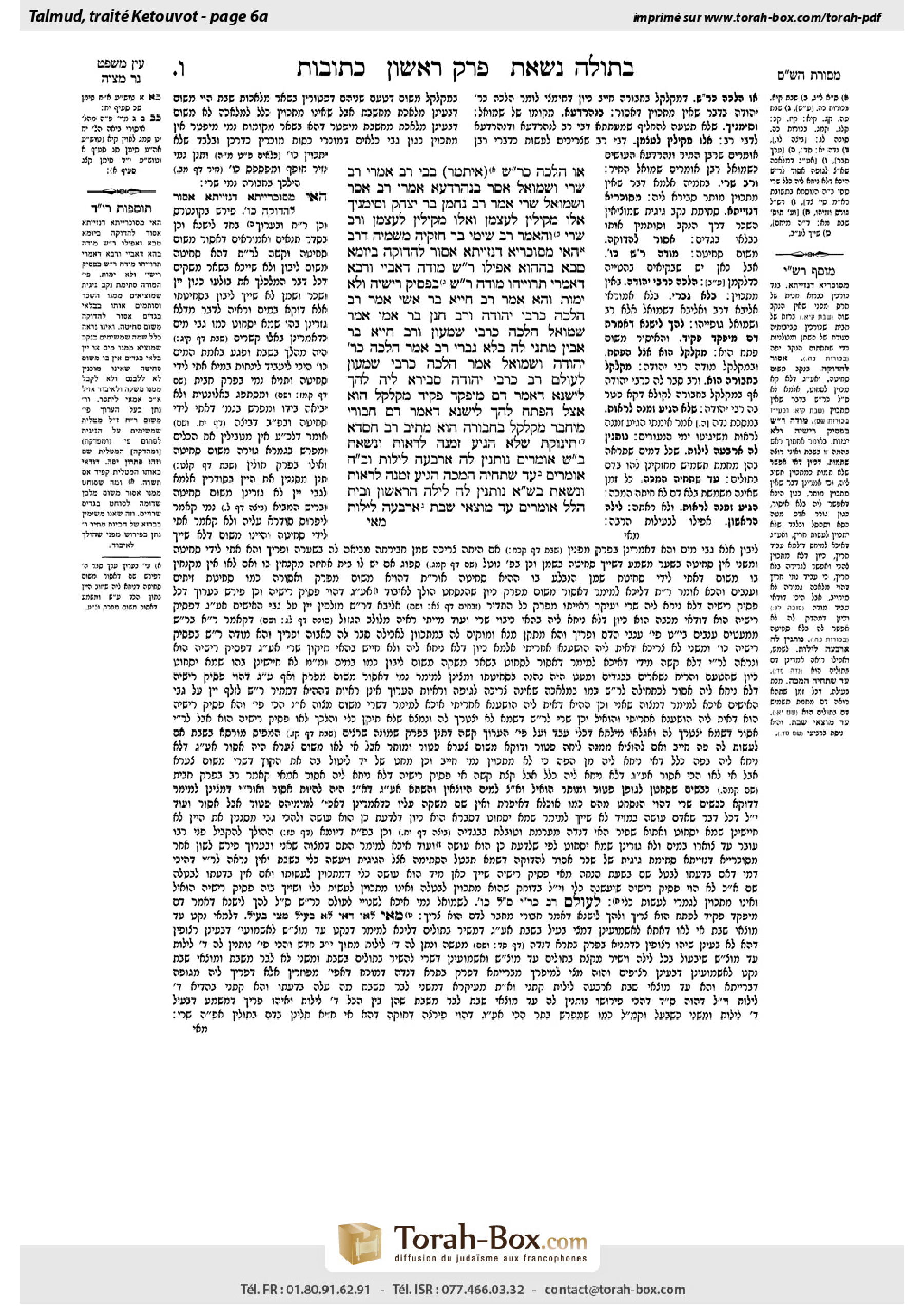
Ketubot 6a: Talmud study for Daf Yomi
Daf Yomi is the daily study of one Talmud folio. Explore 37 tractates with scans, Hebrew text, Sefaria English and AI-generated French translations where annotated.
Passage selection and English or AI-generated French translation are available where the scan has annotations. Daf Study is independent of Torah-Box and Sefaria.
Browse Ketubot · כתובות · All tractatesKetubot 6a text and translations
This page of Ketubot includes the Aramaic text, an English translation and an AI-generated French translation, alongside the scan above.
כתובות ו׳ א · Aramaic and Hebrew text
אוֹ הֲלָכָה כְּרַבִּי שִׁמְעוֹן.
(אִיתְּמַר:) בְּבֵי רַב אָמְרִי: רַב שָׁרֵי וּשְׁמוּאֵל אָסַר. בִּנְהַרְדְּעָא אָמְרִי: רַב אָסַר וּשְׁמוּאֵל שָׁרֵי. אָמַר רַב נַחְמָן בַּר יִצְחָק, וְסִימָנָיךְ: אֵלּוּ מְקִילִּין לְעַצְמָן וְאֵלּוּ מְקִילִּין לְעַצְמָן.
וְרַב שָׁרֵי? וְהָאָמַר רַב שִׁימִי בַּר חִזְקִיָּה מִשְּׁמֵיהּ דְּרַב: הַאי מְסוֹכַרְיָא דְּנַזְיָיתָא — אָסוּר לְהַדּוֹקַהּ בְּיוֹמָא טָבָא!
בְּהָהוּא אֲפִילּוּ רַבִּי שִׁמְעוֹן מוֹדֶה, דְּאַבָּיֵי וְרָבָא דְּאָמְרִי תַּרְוַיְיהוּ: מוֹדֶה רַבִּי שִׁמְעוֹן בִּ״פְסִיק רֵישֵׁיהּ וְלָא יְמוּת״.
וְהָא אָמַר רַב חִיָּיא בַּר אָשֵׁי אָמַר רַב: הֲלָכָה כְּרַבִּי יְהוּדָה. וְרַב חָנָן בַּר אַמֵּי אָמַר שְׁמוּאֵל: הֲלָכָה כְּרַבִּי שִׁמְעוֹן. וְרַב חִיָּיא בַּר אָבִין מַתְנֵי לַהּ בְּלָא גַּבְרֵי, רַב אָמַר: הֲלָכָה כְּרַבִּי יְהוּדָה, וּשְׁמוּאֵל אָמַר: הֲלָכָה כְּרַבִּי שִׁמְעוֹן.
לְעוֹלָם רַב כְּרַבִּי יְהוּדָה סְבִירָא לֵיהּ, לְהַךְ לִישָּׁנָא דְּאָמַר דָּם מִיפְקָד פְּקִיד — מְקַלְקֵל הוּא אֵצֶל הַפֶּתַח. לְהָךְ לִישָּׁנָא דְּאָמַר דָּם חַבּוֹרֵי מִיחַבַּר — מְקַלְקֵל בְּחַבּוּרָה הוּא.
מֵתִיב רַב חִסְדָּא: תִּינוֹקֶת שֶׁלֹּא הִגִּיעַ זְמַנָּהּ לִרְאוֹת וְנִשֵּׂאת, בֵּית שַׁמַּאי אוֹמְרִים: נוֹתְנִין לָהּ אַרְבָּעָה לֵילוֹת, וּבֵית הִלֵּל אוֹמְרִים: עַד שֶׁתִּחְיֶה הַמַּכָּה.
הִגִּיעַ זְמַנָּהּ לִרְאוֹת וְנִשֵּׂאת, בֵּית שַׁמַּאי אוֹמְרִים: נוֹתְנִין לָהּ לַיְלָה הָרִאשׁוֹן. וּבֵית הִלֵּל אוֹמְרִים: עַד מוֹצָאֵי שַׁבָּת, אַרְבָּעָה לֵילוֹת.
Ketubot 6a · English translation
Or, is the halakha in accordance with the opinion of Rabbi Shimon, who ruled that one who is destructive in causing a wound on Shabbat is liable if he did so intentionally?
With regard to the halakha of engaging in intercourse with one’s virgin bride on Shabbat, it was stated that in the school of Rav they say: Rav permitted doing so and Shmuel prohibited doing so. In Neharde’a, where Shmuel lived, they say: Rav prohibited doing so and Shmuel permitted doing so. Rav Naḥman bar Yitzḥak said: And your mnemonic is: These are lenient with regard to themselves, and those are lenient with regard to themselves. Each attributes the lenient ruling to the local halakhic authority, whose ruling is binding in that locale.
The Gemara asks: And did Rav permit engaging in intercourse in those circumstances? But didn’t Rav Shimi bar Ḥizkiyya say in the name of Rav: In the case of this cloth stopper of a barrel [nazyata], it is prohibited to insert it tightly in the spout of the barrel on a Festival, because in the process liquid will be squeezed from the cloth, and squeezing liquids is prohibited on Shabbat and Festivals. Apparently, Rav prohibits even unintentional actions.
The Gemara answers: In the case of the barrel, even Rabbi Shimon concedes, as it is Abaye and Rava who both say: Rabbi Shimon concedes in the case of: Cut off its head and will it not die, i.e., a case that involves inevitable consequences like the decapitation of an animal, that the action is forbidden. Here, the liquid will inevitably be squeezed from the cloth.
The Gemara asks: But didn’t Rav Ḥiyya bar Ashi say that Rav said with regard to unintentional acts: The halakha is in accordance with the opinion of Rabbi Yehuda, and Rav Ḥanan bar Ami said that Shmuel said: The halakha is in accordance with the opinion of Rabbi Shimon. And Rav Ḥiyya bar Avin taught these rulings directly, without citing additional men who transmitted them. Rav said: The halakha is in accordance with the opinion of Rabbi Yehuda, and Shmuel said: The halakha is in accordance with the opinion of Rabbi Shimon. How then did Rav permit intercourse with one’s virgin bride on Shabbat?
The Gemara answers: Actually, Rav holds in accordance with the opinion of Rabbi Yehuda. According to that version that said that the blood is pooled, he is destructive vis-à-vis the opening. According to that version that said that blood is flowing through blood vessels attached to the body, he is destructive in causing the wound, and Rabbi Yehuda concedes that it is permitted.
Rav Ḥisda raised an objection from a mishna (Nidda 64b). With regard to a young girl whose time to see the flow of menstrual blood has not arrived, as she has not yet reached puberty, and she married, Beit Shammai say: One gives her four nights during which she may engage in intercourse, as any blood is attributed to the ruptured hymen. Beit Hillel say: There is no limit. Rather, any blood she sees is attributed to the ruptured hymen until the wound heals.
If, however, her time to see the flow of menstrual blood has arrived, as she has reached the age of puberty, even if she has not yet menstruated, and she married, Beit Shammai say: One gives her the first night, during which the blood is attributed to the wound. Thereafter, the blood is presumed to be menstrual blood, and she is forbidden to her husband. Beit Hillel say: One gives her from Wednesday, the day designated for marriage of a virgin, until the conclusion of Shabbat, four nights. During that period, any blood is attributed to the wound, and she is permitted to her husband.
Ketubot 6a · Traduction française (IA)
Ou bien la halakha suit-elle l’avis de Rabbi Shimon, selon lequel celui qui cause une blessure de manière destructive le Chabbat est passible d’une sanction s’il agit intentionnellement ?
Concernant la halakha relative aux relations avec sa jeune épouse vierge le Chabbat, il a été rapporté qu’à l’école de Rav, on dit que Rav les a permises et que Shmuel les a interdites. À Neharde’a, où vivait Shmuel, on dit que Rav les a interdites et que Shmuel les a permises. Rav Naḥman bar Yitzḥak dit : Et voici un moyen mnémotechnique : ceux-ci se montrent indulgents envers eux-mêmes, et ceux-là se montrent indulgents envers eux-mêmes. Chacun attribue la décision indulgente à l’autorité halakhique locale, dont la décision fait autorité dans cette région.
La Guemara demande : Rav a-t-il vraiment permis d’avoir des relations dans ces circonstances ? Rav Shimi bar Ḥizkiyya n’a-t-il pas dit au nom de Rav : Il est interdit, lors d’un jour de fête, d’enfoncer fermement ce bouchon de tissu [nazyata] dans le goulot d’un tonneau, car du liquide sera alors extrait du tissu, or l’extraction de liquides est interdite le Chabbat et les jours de fête. Il semble donc que Rav interdise même les actes non intentionnels.
La Guemara répond : Dans le cas du tonneau, même Rabbi Shimon reconnaît que c’est interdit, car Abaye et Rava disent tous deux que Rabbi Shimon reconnaît le cas où l’on coupe la tête d’un animal et où il ne peut que mourir, c’est-à-dire un cas où les conséquences sont inévitables. Ici, le liquide sera inévitablement extrait du tissu.
La Guemara demande : Rav Ḥiyya bar Ashi n’a-t-il pas dit que Rav avait déclaré, au sujet des actes non intentionnels, que la halakha suit l’avis de Rabbi Yehuda ? Et Rav Ḥanan bar Ami n’a-t-il pas dit que Shmuel avait déclaré que la halakha suit l’avis de Rabbi Shimon ? Rav Ḥiyya bar Avin a transmis ces décisions directement, sans citer d’autres hommes qui les lui auraient rapportées. Rav a dit que la halakha suit l’avis de Rabbi Yehuda, et Shmuel a dit que la halakha suit l’avis de Rabbi Shimon. Comment Rav a-t-il donc permis d’avoir des relations avec sa jeune épouse vierge le Chabbat ?
La Guemara répond : En réalité, Rav suit l’avis de Rabbi Yehuda. Selon la version qui dit que le sang est accumulé, il agit de manière destructive à l’égard de l’ouverture. Selon la version qui dit que le sang s’écoule de vaisseaux sanguins attachés au corps, il cause la blessure de manière destructive, et Rabbi Yehuda reconnaît que cela est permis.
Rav Ḥisda soulève une objection à partir d’une Michna (Nidda 64b). À propos d’une jeune fille qui n’a pas encore atteint l’âge auquel elle commence à voir s’écouler le sang menstruel et qui s’est mariée, Beit Shammaï disent : On lui accorde quatre nuits pendant lesquelles elle peut avoir des relations, car tout saignement est attribué à la rupture de l’hymen. Beit Hillel disent : Il n’y a pas de limite. Tout saignement qu’elle constate est attribué à la rupture de l’hymen jusqu’à ce que la blessure guérisse.
Toutefois, si elle a atteint l’âge auquel elle peut commencer à voir s’écouler le sang menstruel, même si elle n’a pas encore eu ses règles, et qu’elle s’est mariée, Beit Shammaï disent : On lui accorde la première nuit, durant laquelle le sang est attribué à la blessure. Par la suite, le sang est présumé être du sang menstruel, et elle est interdite à son mari. Beit Hillel disent : On lui accorde la période allant du mercredi, jour fixé pour le mariage d’une vierge, jusqu’à la fin du Chabbat, soit quatre nuits. Pendant cette période, tout saignement est attribué à la blessure, et elle est permise à son mari.
Traduction française générée par IA à partir de l’édition anglaise de Sefaria. Vérifie toujours un passage avec le texte source.
Text from Sefaria: William Davidson Edition - Vocalized Aramaic (CC BY NC); William Davidson Edition - English (CC BY NC).