Ketubot 5b: Talmud study for Daf Yomi
Daf Yomi is the daily study of one Talmud folio. Explore 37 tractates with scans, Hebrew text, Sefaria English and AI-generated French translations where annotated.
Passage selection and English or AI-generated French translation are available where the scan has annotations. Daf Study is independent of Torah-Box and Sefaria.
Browse Ketubot · כתובות · All tractatesKetubot 5b text and translations
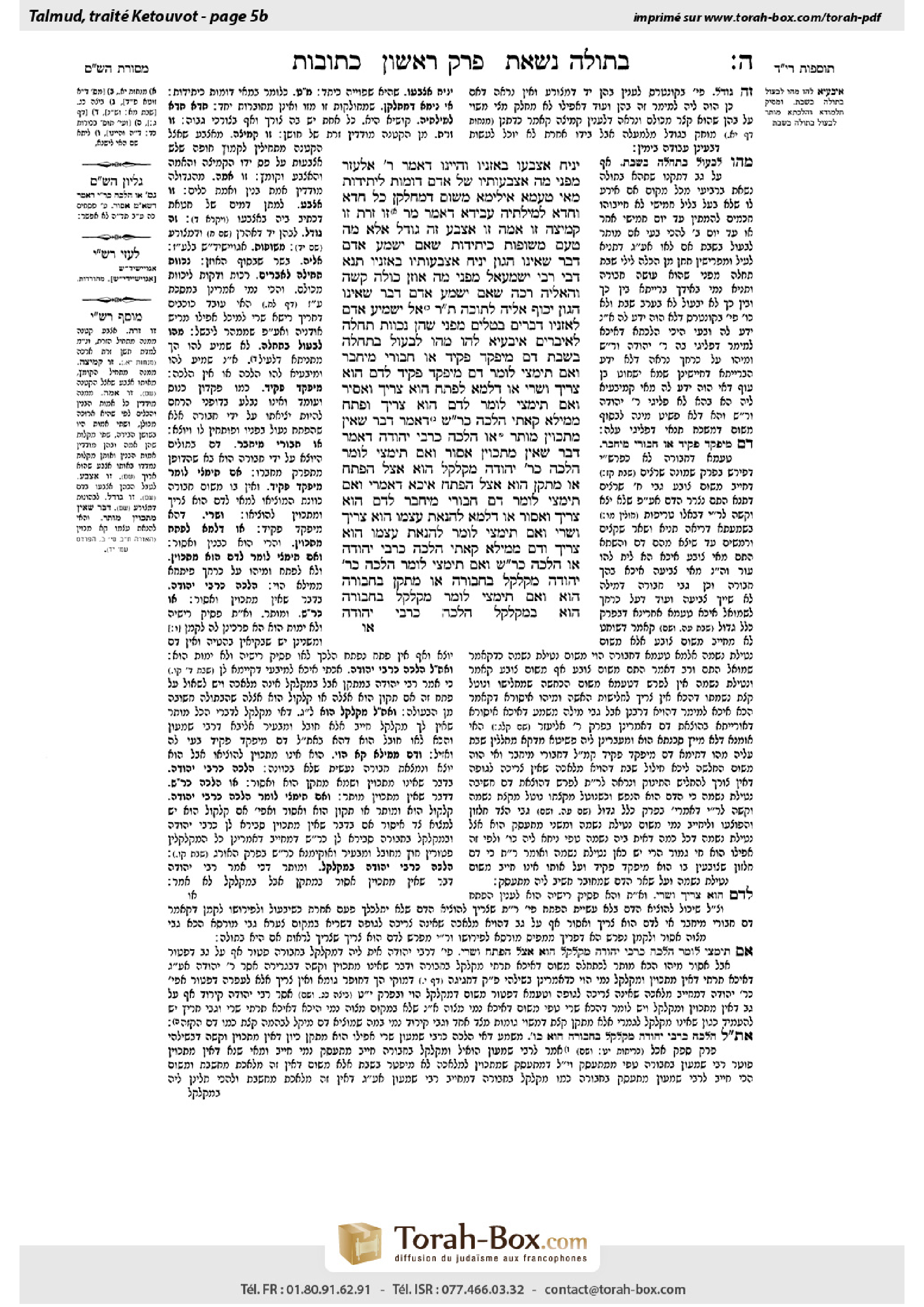
This page of Ketubot includes the Aramaic text, an English translation and an AI-generated French translation, alongside the scan above.
כתובות ה׳ ב · Aramaic and Hebrew text
יַנִּיחַ אֶצְבָּעוֹ בְּאׇזְנָיו. וְהַיְינוּ דְּאָמַר רַבִּי אֶלְעָזָר: מִפְּנֵי מָה אֶצְבְּעוֹתָיו שֶׁל אָדָם דּוֹמוֹת לִיתֵידוֹת? מַאי טַעְמָא? אִילֵּימָא מִשּׁוּם דִּמְחַלְּקָן, כׇּל חֲדָא וַחֲדָא לְמִילְּתַיהּ עֲבִידָא. דְּאָמַר מָר: זוֹ זֶרֶת. זוֹ קְמִיצָה. זוֹ אַמָּה. זוֹ אֶצְבַּע. זֶה גּוּדָל.
אֶלָּא: מַה טַּעַם מְשׁוּפּוֹת כִּיתֵידוֹת — שֶׁאִם יִשְׁמַע אָדָם דָּבָר שֶׁאֵינוֹ הָגוּן, יַנִּיחַ אֶצְבְּעוֹתָיו בְּאׇזְנָיו. תָּנָא דְּבֵי רַבִּי יִשְׁמָעֵאל: מִפְּנֵי מָה אוֹזֶן כּוּלָּהּ קָשָׁה וְהָאַלְיָה רַכָּה? שֶׁאִם יִשְׁמַע אָדָם דָּבָר שֶׁאֵינוֹ הָגוּן, יָכוֹף אַלְיָה לְתוֹכָהּ. תָּנוּ רַבָּנַן: אַל יַשְׁמִיעַ אָדָם לְאׇזְנָיו דְּבָרִים בְּטֵלִים, מִפְּנֵי שֶׁהֵן נִכְווֹת תְּחִלָּה לְאֵיבָרִים.
אִיבַּעְיָא לְהוּ: מַהוּ לִבְעוֹל בַּתְּחִלָּה בְּשַׁבָּת. דָּם מִיפְקָד פְּקִיד, אוֹ חַבּוֹרֵי מִיחַבַּר?
וְאִם תִּימְצֵי לוֹמַר דָּם מִיפְקָד פְּקִיד: לַדָּם הוּא צָרִיךְ, וּשְׁרֵי. אוֹ דִּלְמָא לַפֶּתַח הוּא צָרִיךְ, וַאֲסִיר.
וְאִם תִּימְצֵי לוֹמַר לַדָּם הוּא צָרִיךְ, וּפֶתַח מִמֵּילָא קָאָתֵי — הֲלָכָה כְּרַבִּי שִׁמְעוֹן דְּאָמַר דָּבָר שֶׁאֵין מִתְכַּוֵּין מוּתָּר, אוֹ הֲלָכָה כְּרַבִּי יְהוּדָה דְּאָמַר דָּבָר שֶׁאֵין מִתְכַּוֵּין אָסוּר?
וְאִם תִּימְצֵי לוֹמַר הֲלָכָה כְּרַבִּי יְהוּדָה — מְקַלְקֵל הוּא אֵצֶל הַפֶּתַח, אוֹ מְתַקֵּן הוּא אֵצֶל הַפֶּתַח?
אִיכָּא דְּאָמְרִי: וְאִם תִּימְצֵי לוֹמַר דָּם חַבּוֹרֵי מִיחַבַּר — לַדָּם הוּא צָרִיךְ, וְאָסוּר, אוֹ דִּלְמָא לַהֲנָאַת עַצְמוֹ הוּא צָרִיךְ, וְשָׁרֵי?
וְאִם תִּימְצֵי לוֹמַר לַהֲנָאַת עַצְמוֹ הוּא צָרִיךְ, וְדָם מִמֵּילָא קָאָתֵי — הֲלָכָה כְּרַבִּי יְהוּדָה אוֹ הֲלָכָה כְּרַבִּי שִׁמְעוֹן?
וְאִם תִּימְצֵי לוֹמַר הֲלָכָה כְּרַבִּי יְהוּדָה — מְקַלְקֵל בְּחַבּוּרָה אוֹ מְתַקֵּן בְּחַבּוּרָה הוּא?
וְאִם תִּימְצֵי לוֹמַר מְקַלְקֵל בְּחַבּוּרָה הוּא — בִּמְקַלְקֵל הֲלָכָה כְּרַבִּי יְהוּדָה,
Ketubot 5b · English translation
he should place his finger, which is shaped like a peg, into his ears. And that is what Rabbi Elazar said: Why are the fingers of a person similar to pegs? The Gemara asks: What is the reason that Rabbi Elazar said that fingers are like pegs? If we say that it is due to the fact that they are discrete from each other, each and every finger was designated for its own discrete, sacred matter, as the Master said: This small finger is for measuring a span, the distance between the little finger to the tip of the thumb used in measuring the breastplate of the High Priest; this next finger is used for taking a fistful of the meal-offering; this middle finger is used for measuring a cubit, the distance from the elbow to the tip of the middle finger; this one next to the thumb is the finger used to sprinkle the blood of offerings on the altar; this is the thumb, on which the blood and oil is placed in the purification ritual of a leper.
Rather, the question is: What is the reason that they are pointed like pegs? It is so that if a person hears an inappropriate matter, he will place his fingers in his ears. Similarly, a Sage of the school of Rabbi Yishmael taught: Why is the entire ear hard and the earlobe soft? It is so that if a person hears an inappropriate matter, he will bend his earlobe into his ear to seal it. The Sages taught: A person should not allow his ears to hear idle matters. Because of the fact that ears are very sensitive and are the first of the limbs burned, one should make certain not to expose them to anything problematic.
§ A dilemma was raised before the Sages: What is the halakha with regard to engaging in intercourse with one’s virgin bride for the first time on Shabbat? The dilemma is with regard to the nature of the blood that emerges as a result of the piercing of the hymen. Is it that the blood is pooled, and it is released once the hymen is pierced, so that no prohibition is violated? Or, is the blood flowing through vessels attached to the body, and it emerges as a result of a wound, so that he does violate a prohibition?
And if you say that it is pooled and the intercourse does not cause a wound, there is an additional dilemma: Does the husband require the blood to flow, and that is his objective in performing the act, in which case it is permitted? Or, perhaps he requires the opening caused by the rupture of the hymen, and creating that opening is prohibited on Shabbat.
And if you say that he requires the blood, and the opening comes about incidentally as an unintended consequence, is the halakha in accordance with the opinion of Rabbi Shimon, who said: An unintentional act, i.e., a permitted action from which a forbidden labor inadvertently ensued, is permitted? Or, is the halakha in accordance with the opinion of Rabbi Yehuda, who said: An unintentional act is forbidden?
And even if you say that the halakha is in accordance with the opinion of Rabbi Yehuda in this regard, is this a destructive action vis-à-vis the opening, and is it consequently permitted on Shabbat because only constructive actions are forbidden? Or, perhaps it is a constructive action vis-à-vis the opening.
Some say that the series of dilemmas is as follows: And if you say that the blood is flowing through vessels attached to the body and emerges as a result of a wound, does the husband require the blood, and engaging in intercourse is consequently prohibited, as his intent is to cause the wound? Or, perhaps he requires the act of intercourse solely for his own pleasure, and it is permitted.
And if you say that he requires the act of intercourse solely for his own pleasure, and the blood comes incidentally, as it was not his intent to draw blood, is the halakha in accordance with the opinion of Rabbi Yehuda with regard to an unintentional act, or is it in accordance with the opinion of Rabbi Shimon?
And if you say that the halakha is in accordance with the opinion of Rabbi Yehuda and unintentional acts are forbidden, is one destructive in causing the wound or constructive in causing the wound?
And if you say that he is destructive in causing the wound, in cases involving destructive acts is the halakha in accordance with the opinion of Rabbi Yehuda, who rules that one who performs any destructive act on Shabbat is exempt, even if he did so intentionally?
Ketubot 5b · Traduction française (IA)
Il doit placer dans ses oreilles son doigt, qui a la forme d’un piquet. C’est ce que Rabbi Elazar a dit : « Pourquoi les doigts d’une personne ressemblent-ils à des piquets ? » La Guemara demande : Pour quelle raison Rabbi Elazar a-t-il dit que les doigts ressemblent à des piquets ? Si l’on répond que c’est parce qu’ils sont séparés les uns des autres, chaque doigt a été destiné à une tâche sacrée distincte, comme l’a enseigné le Maître : le petit doigt sert à mesurer un empan, c’est-à-dire la distance entre le petit doigt et le bout du pouce, utilisée pour mesurer le pectoral du Grand Prêtre ; le doigt suivant sert à prélever une poignée de l’offrande végétale ; le majeur sert à mesurer une coudée, c’est-à-dire la distance entre le coude et le bout du majeur ; le doigt voisin du pouce sert à asperger le sang des sacrifices sur l’autel ; et le pouce sert à recevoir le sang et l’huile lors du rituel de purification d’un lépreux.
La question est plutôt : pour quelle raison les doigts sont-ils pointus comme des piquets ? C’est afin que, si une personne entend des propos inconvenants, elle puisse placer ses doigts dans ses oreilles. De même, un Sage de l’école de Rabbi Yishmael a enseigné : « Pourquoi l’oreille est-elle dure dans son ensemble, alors que le lobule est mou ? » C’est afin que, si une personne entend des propos inconvenants, elle puisse rabattre son lobule dans son oreille pour la boucher. Les Sages ont enseigné : une personne ne doit pas laisser ses oreilles entendre des propos futiles. Comme les oreilles sont très sensibles et sont les premières parties du corps à brûler, il faut veiller à ne pas les exposer à quoi que ce soit de problématique.
§ Les Sages ont soulevé une question : quelle est la halakha concernant les premiers rapports d’un homme avec son épouse vierge pendant Chabbat ? La question porte sur la nature du sang qui s’écoule lorsque l’hymen est perforé. Le sang est-il accumulé et libéré une fois l’hymen perforé, de sorte qu’aucune interdiction n’est enfreinte ? Ou bien le sang circule-t-il dans des vaisseaux attachés au corps et s’écoule-t-il à la suite d’une blessure, de sorte qu’il enfreint une interdiction ?
Et si tu dis que le sang est accumulé et que le rapport ne provoque pas de blessure, une autre question se pose : le mari a-t-il besoin que le sang s’écoule, et est-ce là son objectif en accomplissant l’acte, auquel cas cela est permis ? Ou bien a-t-il besoin de l’ouverture créée par la rupture de l’hymen, auquel cas créer cette ouverture est interdit pendant Chabbat.
Et si tu dis qu’il a besoin du sang et que l’ouverture se produit incidemment, comme une conséquence non intentionnelle, la halakha suit-elle l’opinion de Rabbi Shimon, qui a dit qu’un acte non intentionnel — c’est-à-dire une action permise dont découle par inadvertance un travail interdit — est permis ? Ou bien la halakha suit-elle l’opinion de Rabbi Yehuda, qui a dit qu’un acte non intentionnel est interdit ?
Et même si tu dis que, sur ce point, la halakha suit l’opinion de Rabbi Yehuda, s’agit-il d’une action destructrice quant à l’ouverture, et est-elle par conséquent permise pendant Chabbat, puisque seules les actions constructives sont interdites ? Ou bien s’agit-il d’une action constructive quant à l’ouverture ?
Selon certains, la série de questions est la suivante : et si tu dis que le sang circule dans des vaisseaux attachés au corps et s’écoule à la suite d’une blessure, le mari a-t-il besoin du sang, de sorte que le rapport est interdit puisqu’il a l’intention de provoquer la blessure ? Ou bien ne recherche-t-il le rapport que pour son propre plaisir, auquel cas cela est permis ?
Et si tu dis qu’il ne recherche le rapport que pour son propre plaisir et que le sang s’écoule incidemment, puisqu’il n’avait pas l’intention de faire couler le sang, la halakha suit-elle l’opinion de Rabbi Yehuda concernant les actes non intentionnels, ou celle de Rabbi Shimon ?
Et si tu dis que la halakha suit l’opinion de Rabbi Yehuda et que les actes non intentionnels sont interdits, celui qui provoque la blessure agit-il de manière destructrice ou constructive ?
Et si tu dis qu’il agit de manière destructrice en provoquant la blessure, dans les cas d’actes destructeurs la halakha suit-elle l’opinion de Rabbi Yehuda, qui statue que quiconque accomplit un acte destructeur pendant Chabbat est exempt, même s’il l’a fait intentionnellement ?
Traduction française générée par IA à partir de l’édition anglaise de Sefaria. Vérifie toujours un passage avec le texte source.
Text from Sefaria: William Davidson Edition - Vocalized Aramaic (CC BY NC); William Davidson Edition - English (CC BY NC).