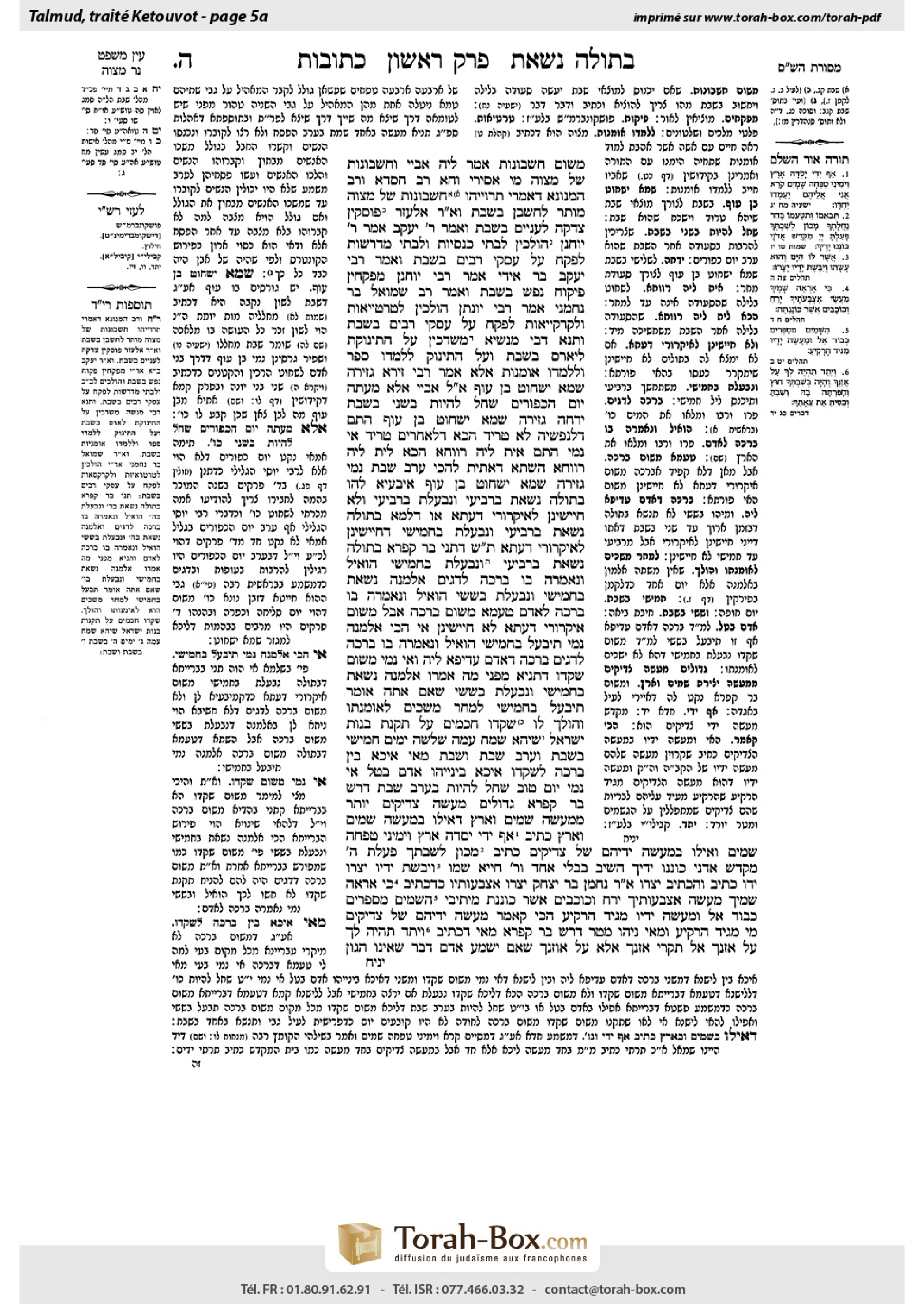
Ketubot 5a: Talmud study for Daf Yomi
Daf Yomi is the daily study of one Talmud folio. Explore 37 tractates with scans, Hebrew text, Sefaria English and AI-generated French translations where annotated.
Passage selection and English or AI-generated French translation are available where the scan has annotations. Daf Study is independent of Torah-Box and Sefaria.
Browse Ketubot · כתובות · All tractatesKetubot 5a text and translations
This page of Ketubot includes the Aramaic text, an English translation and an AI-generated French translation, alongside the scan above.
כתובות ה׳ א · Aramaic and Hebrew text
מִשּׁוּם חֶשְׁבּוֹנוֹת.
אֲמַר לֵיהּ אַבָּיֵי: וְחֶשְׁבּוֹנוֹת שֶׁל מִצְוָה מִי אֲסִירִי? וְהָא רַב חִסְדָּא וְרַב הַמְנוּנָא דְּאָמְרִי תַּרְוַיְיהוּ: חֶשְׁבּוֹנוֹת שֶׁל מִצְוָה מוּתָּר לְחַשְּׁבָן בְּשַׁבָּת! וְאָמַר רַבִּי אֶלְעָזָר: פּוֹסְקִין צְדָקָה לַעֲנִיִּים בְּשַׁבָּת! וְאָמַר רַבִּי יַעֲקֹב אָמַר רַבִּי יוֹחָנָן: הוֹלְכִין לְבָתֵּי כְנֵסִיּוֹת וּלְבָתֵּי מִדְרָשׁוֹת לְפַקֵּחַ עַל עִסְקֵי רַבִּים בְּשַׁבָּת. וְאָמַר רַבִּי יַעֲקֹב בַּר אִידֵּי אָמַר רַבִּי יוֹחָנָן: מְפַקְּחִין פִּיקּוּחַ נֶפֶשׁ בְּשַׁבָּת.
וְאָמַר רַב שְׁמוּאֵל בַּר נַחְמָנִי אָמַר רַבִּי יוֹנָתָן: הוֹלְכִין לְטֵרַטְיָיאוֹת וּלְקִרְקְיָיאוֹת לְפַקֵּחַ עַל עִסְקֵי רַבִּים בְּשַׁבָּת. וְתָנָא דְּבֵי מְנַשְּׁיָא: מְשַׁדְּכִין עַל הַתִּינוֹקֶת לֵיאָרֵס בְּשַׁבָּת, וְעַל הַתִּינוֹק לְלַמְּדוֹ סֵפֶר וּלְלַמְּדוֹ אוּמָּנוּת.
אֶלָּא, אָמַר רַבִּי זֵירָא: גְּזֵירָה שֶׁמָּא יִשְׁחוֹט בֶּן עוֹף. אֲמַר לֵיהּ אַבָּיֵי: אֶלָּא מֵעַתָּה, יוֹם הַכִּפּוּרִים שֶׁחָל לִהְיוֹת בְּשֵׁנִי בְּשַׁבָּת יִדָּחֶה, גְּזֵירָה שֶׁמָּא יִשְׁחוֹט בֶּן עוֹף! הָתָם דִּלְנַפְשֵׁיהּ — לָא טְרִיד, הָכָא דְּלַאֲחֵרִים — טְרִיד. אִי נָמֵי: הָתָם אִית לֵיהּ רַוְוחָא, הָכָא לֵית לֵיהּ רַוְוחָא.
הַשְׁתָּא דְּאָתֵית לְהָכִי, עֶרֶב שַׁבָּת נָמֵי — גְּזֵירָה שֶׁמָּא יִשְׁחוֹט בֶּן עוֹף.
אִיבַּעְיָא לְהוּ: בְּתוּלָה נִשֵּׂאת בָּרְבִיעִי וְנִבְעֶלֶת בָּרְבִיעִי, וְלָא חָיְישִׁינַן לְאִיקָּרוֹרֵי דַעְתָּא, אוֹ דִלְמָא: בְּתוּלָה נִשֵּׂאת בָּרְבִיעִי וְנִבְעֶלֶת בַּחֲמִישִׁי, דְּחָיְישִׁינַן לְאִיקָּרוֹרֵי דַעְתָּא.
תָּא שְׁמַע, דְּתָנֵי בַּר קַפָּרָא: בְּתוּלָה נִשֵּׂאת בָּרְבִיעִי וְנִבְעֶלֶת בַּחֲמִישִׁי, הוֹאִיל וְנֶאֶמְרָה בּוֹ בְּרָכָה לַדָּגִים. אַלְמָנָה נִשֵּׂאת בַּחֲמִישִׁי וְנִבְעֶלֶת בַּשִּׁשִּׁי — הוֹאִיל וְנֶאֶמְרָה בּוֹ בְּרָכָה לָאָדָם. טַעְמָא מִשּׁוּם בְּרָכָה, אֲבָל מִשּׁוּם אִיקָּרוֹרֵי דַעְתָּא — לָא חָיְישִׁינַן.
אִי הָכִי, אַלְמָנָה נָמֵי תִּיבָּעֵל בַּחֲמִישִׁי, הוֹאִיל וְנֶאֶמְרָה בּוֹ בְּרָכָה לַדָּגִים! בְּרָכָה דְאָדָם עֲדִיפָא לֵיהּ.
וְאִי נָמֵי: מִשּׁוּם שָׁקְדוּ. דְּתַנְיָא: מִפְּנֵי מָה אָמְרוּ אַלְמָנָה נִשֵּׂאת בַּחֲמִישִׁי וְנִבְעֶלֶת בַּשִּׁשִּׁי? שֶׁאִם אַתָּה אוֹמֵר תִּיבָּעֵל בַּחֲמִישִׁי, לְמָחָר מַשְׁכִּים לְאוּמָּנֻתוֹ וְהוֹלֵךְ לוֹ. שָׁקְדוּ חֲכָמִים עַל תַּקָּנַת בְּנוֹת יִשְׂרָאֵל, שֶׁיְּהֵא שָׂמֵחַ עִמָּהּ שְׁלֹשָׁה יָמִים: חֲמִישִׁי בְּשַׁבָּת, וְעֶרֶב שַׁבָּת, וְשַׁבָּת.
מַאי אִיכָּא בֵּין ״בְּרָכָה״ לְ״שָׁקְדוּ״? אִיכָּא בֵּינַיְיהוּ אָדָם בָּטֵל. אִי נָמֵי: יוֹם טוֹב שֶׁחָל לִהְיוֹת בְּעֶרֶב שַׁבָּת.
דָּרַשׁ בַּר קַפָּרָא: גְּדוֹלִים מַעֲשֵׂה צַדִּיקִים יוֹתֵר מִמַּעֲשֵׂה שָׁמַיִם וָאָרֶץ, דְּאִילּוּ בְּמַעֲשֵׂה שָׁמַיִם וָאָרֶץ כְּתִיב: ״אַף יָדִי יָסְדָה אֶרֶץ וִימִינִי טִפְּחָה שָׁמָיִם״, וְאִלּוּ בְּמַעֲשֵׂה יְדֵיהֶם שֶׁל צַדִּיקִים כְּתִיב: ״מָכוֹן לְשִׁבְתְּךָ פָּעַלְתָּ ה׳ מִקְּדָשׁ אֲדֹנָי כּוֹנְנוּ יָדֶיךָ״.
הֵשִׁיב בַּבְלִי אֶחָד, וְרַבִּי חִיָּיא שְׁמוֹ: ״וְיַבֶּשֶׁת יָדָיו יָצָרוּ״! ״יָדוֹ״ כְּתִיב. וְהָכְתִיב ״יָצָרוּ״! אָמַר רַב נַחְמָן בַּר יִצְחָק: יָצְרוּ אֶצְבְּעוֹתָיו, כְּדִכְתִיב: ״כִּי אֶרְאֶה שָׁמֶיךָ מַעֲשֵׂה אֶצְבְּעוֹתֶיךָ יָרֵחַ וְכוֹכָבִים אֲשֶׁר כּוֹנָנְתָּ״.
מֵיתִיבִי: ״הַשָּׁמַיִם מְסַפְּרִים כְּבוֹד אֵל וּמַעֲשֵׂה יָדָיו מַגִּיד הָרָקִיעַ״! הָכִי קָאָמַר: מַעֲשֵׂה יְדֵיהֶם שֶׁל צַדִּיקִים מִי מַגִּיד — הָרָקִיעַ, וּמַאי נִיהוּ — מָטָר.
דָּרַשׁ בַּר קַפָּרָא, מַאי דִּכְתִיב: ״וְיָתֵד תִּהְיֶה לְךָ עַל אֲזֵנֶךָ״. אַל תִּקְרֵי ״אֲזֵנֶךָ״, אֶלָּא ״עַל אׇזְנֶךָ״ — שֶׁאִם יִשְׁמַע אָדָם דָּבָר שֶׁאֵינוֹ הָגוּן,
Ketubot 5a · English translation
It is due to calculations performed on Shabbat to prepare for the wedding. He would thereby engage in weekday matters on Shabbat.
Abaye said to him: And are calculations for a mitzva prohibited on Shabbat? But wasn’t it Rav Ḥisda and Rav Hamnuna who both said: With regard to calculations for a mitzva, it is permitted to reckon them on Shabbat? And Rabbi Elazar said: One may allocate charity to the poor on Shabbat. And Rabbi Ya’akov said that Rabbi Yoḥanan said: One goes to synagogues and study halls to supervise matters affecting the multitudes on Shabbat. And Rabbi Ya’akov bar Idi said that Rabbi Yoḥanan said: One supervises matters of saving a life on Shabbat.
And Rabbi Shmuel bar Naḥmani said that Rabbi Yonatan said: One goes to theaters [tartiyyaot] and circuses [karkiyyaot] to supervise matters affecting the multitudes on Shabbat, because the fate of the Jewish people or of individual Jews is often decided there and one’s presence could prevent calamity. And the Sage of the school of Menashya taught: One makes matches [meshadkhin] among the families concerned for a young girl to be betrothed on Shabbat, and similarly one may make arrangements for a young boy to teach him Torah and to teach him a craft. Apparently, calculations for a mitzva may be reckoned on Shabbat, including calculations for a wedding. Therefore, this cannot be the reason for the prohibition against marrying at the conclusion of Shabbat.
Rather, Rabbi Zeira said: It is a decree lest one slaughter a young fowl on Shabbat, due to his preoccupation with the preparations for that night’s wedding feast. Abaye said to him: If that is so, Yom Kippur that occurs on Monday should be postponed when fixing the calendar, due to a decree lest one slaughter a young fowl on Shabbat for the meal on Yom Kippur eve, which is a mitzva. The Gemara distinguishes between the cases. There, with regard to Yom Kippur eve, when one is preparing a meal for himself, he is not preoccupied, and he will not overlook the fact that it is Shabbat. Here, in the case of a wedding, one is preparing a meal for others and is preoccupied. Alternatively, there, on Yom Kippur eve, he has an interval of time during which he can slaughter the bird, as the mitzva is to eat the meal on Yom Kippur eve the next day. Here, he does not have an interval of time, because the wedding and the feast take place at night at the conclusion of Shabbat.
The Gemara says: Now that we have come to this understanding of the prohibition against marrying at the conclusion of Shabbat, the prohibition not to engage in sexual intercourse on Shabbat evening, too, is not due to the intercourse. Rather, it is a decree lest one slaughter a young fowl for the wedding feast.
§ The Gemara raises a dilemma: Is a virgin married on Wednesday and does she engage in intercourse on that Wednesday, and we are not concerned lest his resolve to take his bride to court upon discovering that she was not a virgin cool overnight? Rather, he will certainly go to court the next morning. Or perhaps, a virgin is married on Wednesday but engages in intercourse on Thursday, as we are concerned that his resolve will cool.
Come and hear proof, as bar Kappara taught: A virgin is married on Wednesday and engages in intercourse on Thursday, since the blessing to the fish: Be fruitful and multiply, was stated on the fifth day of Creation. A widow is married on Thursday and engages in intercourse on Friday, since the blessing of procreation was stated to man on the sixth day of Creation. It may be inferred that the reason is due to the blessing, but with regard to the possibility lest his resolve cool, we are not concerned.
The Gemara asks: If so, a widow should also engage in intercourse on Thursday, since the blessing to the fish was stated then. The Gemara answers: Since there is the option to postpone engaging in relations to the day on which the blessing of man was stated, doing so is preferable for him.
Alternatively, that day was established as the day for a widow to engage in sexual relations due to the fact that the Sages were assiduous in seeing to the well-being of Jewish women, as it is taught in a baraita: Why did the Sages say that a widow is married on Thursday and engages in intercourse on Friday? It is because if you say that she should engage in intercourse on Thursday, on the next day the groom will go to ply his craft early and leave his wife alone. When a man marries a widow, there is no observance of the seven days of rejoicing, whose legal status is like that of a Festival, during which he does not go to work. Therefore, the Sages were assiduous in seeing to the well-being of Jewish women and ensured that the groom rejoice with her for three days: Thursday, the day of the wedding; and Shabbat eve, the day when they engage in sexual relations; and Shabbat.
What practical difference is there between the two reasons given to engage in relations on Friday, i.e., the blessing of procreation for man and the fact that the Sages were assiduous? The Gemara answers: There is a practical difference between them in the case of an idle person, who has no job, in which case the reason of blessing applies and the reason that the Sages were assiduous does not, as no matter what he will not go to work early. Alternatively, there is a practical difference in the case of a Festival that occurs on Shabbat eve. There too, the reason of blessing applies but the Sages’ assiduousness does not apply, as one does not work on a Festival.
§ The Gemara cites additional aggadic statements of bar Kappara. Bar Kappara taught: The handiwork of the righteous is greater than the creation of heaven and earth, as with regard to the creation of heaven and earth it is written: “My hand also has laid the foundation of the earth, and My right hand has spanned the heavens” (Isaiah 48:13). There, hand is written in the singular. Whereas with regard to the handiwork of the righteous it is written: “The place which You have made for Yourself to dwell in, Lord, the Sanctuary, Lord, which your hands have established” (Exodus 15:17). The reference is to the Temple, which is the handiwork of man, and hand is written in the plural.
A certain Babylonian, and his name is Rabbi Ḥiyya, responded with a challenge. It is written with regard to creation of the earth: “And His hands formed the dry land” (Psalms 95:5). The Gemara answers: “His hand” is the way it is written. Although the word is vocalized in the plural, it is written in the singular, without the letter yod. But isn’t it written: “Formed,” in the plural? Rav Naḥman bar Yitzḥak said: The plural is referring to His fingers, as it is written: “When I see Your heavens, the work of Your fingers, the moon and stars, which You have established” (Psalms 8:4).
The Gemara raises an objection: “The heavens declare the glory of God, and the firmament proclaims the work of His hands” (Psalms 19:2). The heavens were created by His hands. The Gemara answers that this is what the verse is saying: Who attests to the handiwork of the righteous, that they are performing the will of God? It is the heavens. And what is the avenue through which the heavens do so? It is by means of rain that falls due to the prayers of the righteous.
Bar Kappara taught: What is the meaning of that which is written: And you shall have a peg among your weapons [azenekha]” (Deuteronomy 23:14)? Do not read it as: Your weapons [azenekha]. Rather, read it: On your ear [oznekha], meaning that if a person hears an inappropriate matter,
Ketubot 5a · Traduction française (IA)
C’est à cause des calculs effectués pendant Chabbat pour préparer le mariage. Il s’occuperait ainsi d’affaires profanes pendant Chabbat.
Abayé lui dit : Les calculs liés à une mitsva sont-ils donc interdits pendant Chabbat ? Rav Ḥisda et Rav Hamnuna n’ont-ils pas tous deux dit que, lorsqu’il s’agit de calculs liés à une mitsva, il est permis de les faire pendant Chabbat ? Rabbi Elazar a dit qu’on peut répartir la tsédaka entre les pauvres pendant Chabbat. Rabbi Ya’akov a dit au nom de Rabbi Yoḥanan qu’on se rend dans les synagogues et les maisons d’étude pour superviser les affaires intéressant la collectivité pendant Chabbat. Rabbi Ya’akov bar Idi a dit au nom de Rabbi Yoḥanan qu’on supervise les affaires liées au sauvetage d’une vie pendant Chabbat.
Rabbi Shmuel bar Naḥmani a dit au nom de Rabbi Yonatan qu’on se rend dans les théâtres [tartiyyaot] et les cirques [karkiyyaot] pour superviser les affaires intéressant la collectivité pendant Chabbat, car le sort du peuple juif ou de Juifs pris individuellement s’y décide souvent, et la présence de quelqu’un peut empêcher une catastrophe. Le Sage de l’école de Menashya enseignait qu’on arrange [meshadkhin] entre les familles concernées les fiançailles d’une jeune fille pendant Chabbat ; de même, on peut prendre des dispositions pour un jeune garçon afin de lui enseigner la Torah et un métier. Il apparaît donc que les calculs liés à une mitsva peuvent être faits pendant Chabbat, y compris ceux concernant un mariage. Par conséquent, cela ne peut être la raison de l’interdiction de se marier à la fin de Chabbat.
Rabbi Zeira dit plutôt : C’est un décret, de peur qu’on n’abatte un jeune volatile pendant Chabbat, parce qu’on serait absorbé par les préparatifs du festin de mariage de cette nuit-là. Abayé lui dit : Si tel est le cas, il faudrait repousser Yom Kippour tombant un lundi lors de la fixation du calendrier, par crainte qu’on n’abatte un jeune volatile pendant Chabbat pour le repas de la veille de Yom Kippour, qui constitue une mitsva. La Guemara distingue les cas. Dans le cas de la veille de Yom Kippour, lorsqu’on prépare un repas pour soi-même, on n’est pas absorbé par les préparatifs et on n’oubliera pas que c’est Chabbat. Ici, dans le cas d’un mariage, on prépare un repas pour d’autres et l’on est absorbé par les préparatifs. Autre réponse : dans le cas de la veille de Yom Kippour, on dispose d’un intervalle pendant lequel on peut abattre le volatile, car la mitsva consiste à prendre le repas le lendemain, à la veille de Yom Kippour. Ici, on ne dispose pas d’un tel intervalle, car le mariage et le festin ont lieu la nuit, à la fin de Chabbat.
La Guemara dit : Maintenant que nous avons compris ainsi l’interdiction de se marier à la fin de Chabbat, l’interdiction d’avoir des relations sexuelles le vendredi soir n’est pas non plus due aux relations elles-mêmes. C’est plutôt un décret, de peur qu’on n’abatte un jeune volatile pour le festin de mariage.
§ La Guemara soulève un dilemme : Une vierge se marie-t-elle le mercredi et a-t-elle des relations sexuelles ce même mercredi, sans que l’on craigne que sa résolution de traîner sa nouvelle épouse en justice après avoir découvert qu’elle n’était pas vierge ne se soit émoussée pendant la nuit ? Il ira alors certainement au tribunal le lendemain matin. Ou bien une vierge se marie-t-elle le mercredi, mais n’a-t-elle des relations sexuelles que le jeudi, car on craint que sa résolution ne s’émousse ?
Apporte une preuve, car bar Kappara enseignait : Une vierge se marie le mercredi et a des relations sexuelles le jeudi, puisque la bénédiction adressée aux poissons — « Soyez féconds et multipliez-vous » — fut prononcée le cinquième jour de la Création. Une veuve se marie le jeudi et a des relations sexuelles le vendredi, puisque la bénédiction de procréation fut adressée à l’homme le sixième jour de la Création. On peut en déduire que la raison tient à la bénédiction ; quant à la possibilité que sa résolution s’émousse, nous ne la prenons pas en considération.
La Guemara demande : Dans ce cas, une veuve devrait elle aussi avoir des relations sexuelles le jeudi, puisque la bénédiction adressée aux poissons fut prononcée ce jour-là. La Guemara répond : Puisqu’il est possible de reporter les relations au jour où la bénédiction fut adressée à l’homme, il est préférable pour lui de procéder ainsi.
Autre réponse : ce jour fut fixé pour les relations sexuelles d’une veuve parce que les Sages veillaient avec sollicitude au bien-être des femmes juives, comme l’enseigne une baraïta : Pourquoi les Sages ont-ils dit qu’une veuve se marie le jeudi et a des relations sexuelles le vendredi ? Parce que si elle avait des relations sexuelles le jeudi, le lendemain le marié irait tôt exercer son métier et laisserait sa femme seule. Lorsqu’un homme épouse une veuve, les sept jours de réjouissances ne sont pas observés ; leur statut juridique est celui d’une fête, pendant laquelle il ne va pas travailler. Les Sages veillaient donc avec sollicitude au bien-être des femmes juives et ont fait en sorte que le marié se réjouisse avec elle pendant trois jours : le jeudi, jour du mariage ; le vendredi, jour où ils ont des relations sexuelles ; et Chabbat.
Quelle différence pratique y a-t-il entre les deux raisons invoquées pour avoir des relations le vendredi, à savoir la bénédiction de procréation adressée à l’homme et la sollicitude des Sages ? La Guemara répond : Il y a une différence pratique dans le cas d’un homme désœuvré, qui n’a pas de métier : la raison de la bénédiction s’applique, mais pas celle de la sollicitude des Sages, puisqu’en tout état de cause il n’ira pas travailler tôt. Autre différence pratique : le cas où une fête tombe la veille de Chabbat. Là aussi, la raison de la bénédiction s’applique, mais pas celle de la sollicitude des Sages, car on ne travaille pas pendant une fête.
§ La Guemara rapporte d’autres déclarations aggadiques de bar Kappara. Bar Kappara enseignait : L’œuvre des justes est supérieure à la création du ciel et de la terre, car, au sujet de la création du ciel et de la terre, il est écrit : « Ma main a aussi fondé la terre, et ma droite a déployé les cieux » (Isaïe 48,13). Ici, « main » est au singulier. En revanche, au sujet de l’œuvre des justes, il est écrit : « Le lieu que tu as fait pour y résider, Seigneur, le sanctuaire, Seigneur, que tes mains ont établi » (Exode 15,17). Il s’agit du Temple, qui est l’œuvre de l’homme, et « mains » est au pluriel.
Un certain Babylonien, nommé Rabbi Ḥiyya, objecta : Au sujet de la création de la terre, il est écrit : « Ses mains ont formé la terre ferme » (Psaumes 95,5). La Guemara répond : « Sa main » est la forme écrite du mot. Bien que le mot soit vocalisé au pluriel, il s’écrit au singulier, sans la lettre yod. Mais n’est-il pas écrit « ont formé », au pluriel ? Rav Naḥman bar Yitzḥak dit : Le pluriel désigne ses doigts, comme il est écrit : « Quand je contemple tes cieux, l’œuvre de tes doigts, la lune et les étoiles que tu as établies » (Psaumes 8,4).
La Guemara soulève une objection : « Les cieux racontent la gloire de Dieu, et le firmament proclame l’œuvre de ses mains » (Psaumes 19,2). Les cieux ont été créés par ses mains. La Guemara répond que voici le sens du verset : Qui témoigne de l’œuvre des justes, qui accomplissent la volonté de Dieu ? Ce sont les cieux. Et par quel moyen les cieux le font-ils ? Par la pluie qui tombe grâce aux prières des justes.
Bar Kappara enseignait : Quel est le sens de ce qui est écrit : « Tu auras un piquet parmi tes armes [azenekha] » (Deutéronome 23,14) ? Ne lis pas « tes armes [azenekha] », mais lis « à ton oreille [oznekha] », ce qui signifie que si une personne entend une chose inconvenante,
Traduction française générée par IA à partir de l’édition anglaise de Sefaria. Vérifie toujours un passage avec le texte source.
Text from Sefaria: William Davidson Edition - Vocalized Aramaic (CC BY NC); William Davidson Edition - English (CC BY NC).