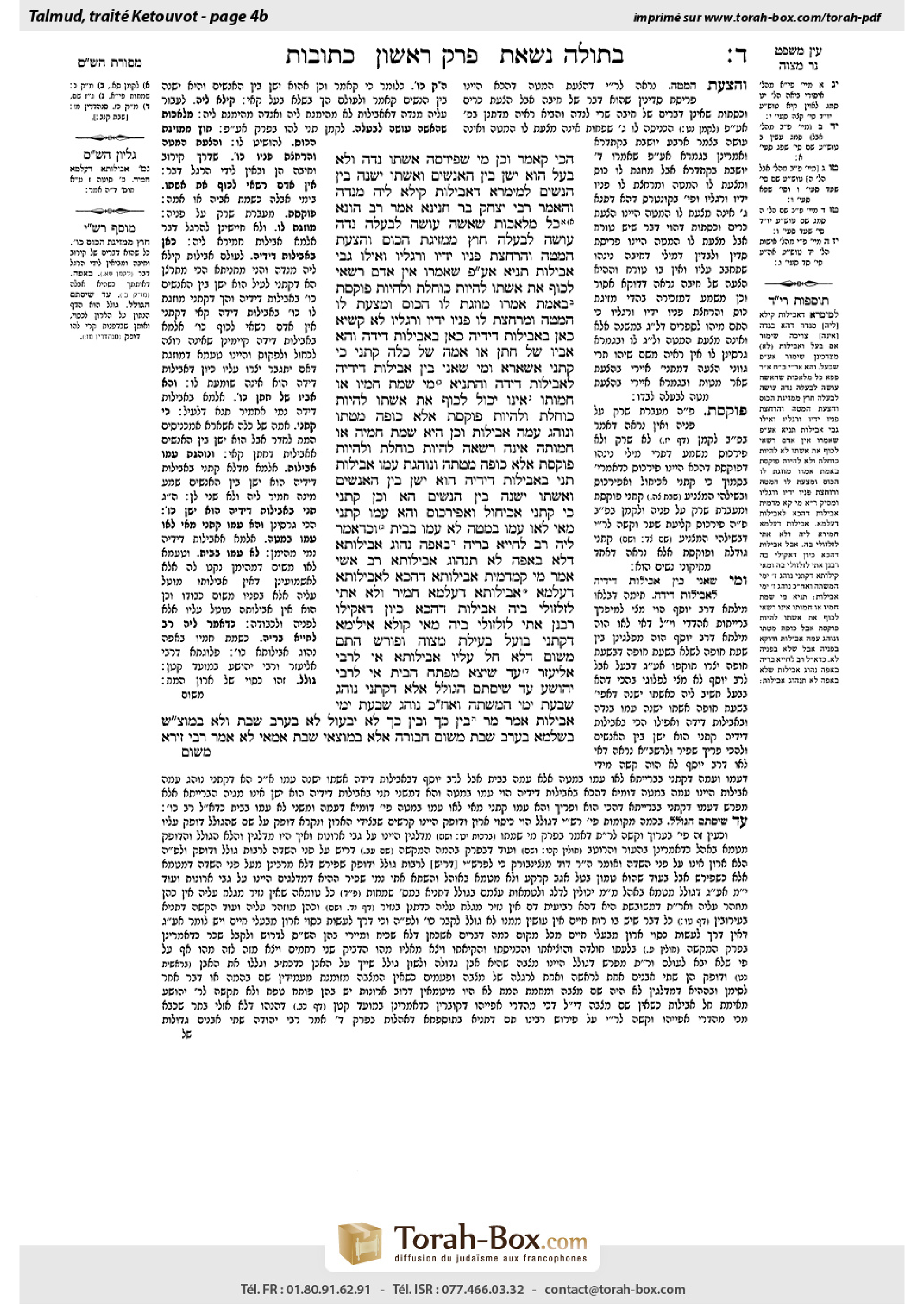
Ketubot 4b: Talmud study for Daf Yomi
Daf Yomi is the daily study of one Talmud folio. Explore 37 tractates with scans, Hebrew text, Sefaria English and AI-generated French translations where annotated.
Passage selection and English or AI-generated French translation are available where the scan has annotations. Daf Study is independent of Torah-Box and Sefaria.
Browse Ketubot · כתובות · All tractatesKetubot 4b text and translations
This page of Ketubot includes the Aramaic text, an English translation and an AI-generated French translation, alongside the scan above.
כתובות ד׳ ב · Aramaic and Hebrew text
הָכִי קָאָמַר: וְכֵן מִי שֶׁפֵּירְסָה אִשְׁתּוֹ נִדָּה וְלֹא בָּעַל — הוּא יָשֵׁן בֵּין הָאֲנָשִׁים, וְאִשְׁתּוֹ יְשֵׁנָה בֵּין הַנָּשִׁים.
לְמֵימְרָא דַּאֲבֵילוּת קָיְלָא לֵיהּ מִנִּדָּה?
וְהָאָמַר רַבִּי יִצְחָק בַּר חֲנִינָא אָמַר רַב הוּנָא: כׇּל מְלָאכוֹת שֶׁאִשָּׁה עוֹשָׂה לְבַעְלָהּ — נִדָּה עוֹשָׂה לְבַעְלָהּ, חוּץ מִמְּזִיגַת הַכּוֹס וְהַצָּעַת הַמִּטָּה, וְהַרְחָצַת פָּנָיו יָדָיו וְרַגְלָיו. וְאִלּוּ גַּבֵּי אֲבֵילוּת תַּנְיָא: אַף עַל פִּי שֶׁאָמְרוּ אֵין אָדָם רַשַּׁאי לָכוֹף אֶת אִשְׁתּוֹ לִהְיוֹת כּוֹחֶלֶת וְלִהְיוֹת פּוֹקֶסֶת, בֶּאֱמֶת אָמְרוּ: מוֹזֶגֶת לוֹ הַכּוֹס, וּמַצַּעַת לוֹ הַמִּטָּה, וּמַרְחֶצֶת לוֹ פָּנָיו יָדָיו וְרַגְלָיו.
לָא קַשְׁיָא: כָּאן — בַּאֲבֵילוּת דִּידֵיהּ, כָּאן — בַּאֲבֵילוּת דִּידַהּ.
וְהָא אָבִיו שֶׁל חָתָן אוֹ אִמָּהּ שֶׁל כַּלָּה קָתָנֵי! כִּי קָתָנֵי, אַשְּׁאָרָא.
וּמִי שָׁאנֵי בֵּין אֲבֵילוּת דִּידֵיהּ לַאֲבֵילוּת דִּידַהּ? וְהָתַנְיָא: מִי שֶׁמֵּת חָמִיו אוֹ חֲמוֹתוֹ — אֵינוֹ יָכוֹל לָכוֹף אֶת אִשְׁתּוֹ לִהְיוֹת כּוֹחֶלֶת וְלִהְיוֹת פּוֹקֶסֶת, אֶלָּא כּוֹפֶה מִטָּתוֹ, וְנוֹהֵג עִמָּהּ אֲבֵילוּת. וְכֵן הִיא שֶׁמֵּת חָמִיהָ אוֹ חֲמוֹתָהּ — אֵינָהּ רַשָּׁאָה לִהְיוֹת כּוֹחֶלֶת וְלִהְיוֹת פּוֹקֶסֶת, אֶלָּא כּוֹפָה מִטָּתָהּ וְנוֹהֶגֶת עִמּוֹ אֲבֵילוּת.
תְּנִי בַּאֲבֵילוּת דִּידֵיהּ: הוּא יָשֵׁן בֵּין הָאֲנָשִׁים וְאִשְׁתּוֹ יְשֵׁנָה בֵּין הַנָּשִׁים. הָא ״וְכֵן״ קָתָנֵי! כִּי קָתָנֵי, אַכִּיחוּל וְאַפִּירְכּוּס. וְהָא ״עִמּוֹ״ קָתָנֵי, מַאי לָאו עִמּוֹ בַּמִּטָּה! לֹא, עִמּוֹ בַּבַּיִת. וּכְדַאֲמַר לֵיהּ רַב לְחִיָּיא בְּרֵיהּ: בְּאַפַּהּ נְהוֹג אֲבִילוּתָא, דְּלָא בְּאַפַּהּ לָא תִּנְהוֹג אֲבִילוּתָא.
רַב אָשֵׁי אָמַר: מִי קָמְדַמֵּית אֲבִילוּתָא דְהָכָא לַאֲבִילוּתָא דְעָלְמָא? אֲבִילוּתָא דְעָלְמָא חֲמִיר, וְלָא אָתֵי לְזַלְזוֹלֵי בֵּיהּ. אֲבֵילוּת דְהָכָא, כֵּיוָן דְּאַקִּילוּ רַבָּנַן, אָתֵי לְזַלְזוֹלֵי בֵּיהּ.
מַאי קוּלָּא? אִילֵּימָא דְּקָתָנֵי בּוֹעֵל בְּעִילַת מִצְוָה וּפוֹרֵשׁ — הָתָם מִשּׁוּם דְּלֹא חָל עָלָיו אֲבִילוּתָא, אִי לְרַבִּי אֱלִיעֶזֶר עַד שֶׁיֵּצֵא מִפֶּתַח הַבַּיִת, אִי לְרַבִּי יְהוֹשֻׁעַ עַד שֶׁיִּסָּתֵם הַגּוֹלֵל.
אֶלָּא דְּקָתָנֵי: נוֹהֵג שִׁבְעַת יְמֵי הַמִּשְׁתֶּה, וְאַחַר כָּךְ נוֹהֵג שִׁבְעַת יְמֵי אֲבֵילוּת.
אָמַר מָר: בֵּין כָּךְ וּבֵין כָּךְ לֹא יִבְעוֹל, לֹא בָּעֶרֶב שַׁבָּת וְלֹא בְּמוֹצָאֵי שַׁבָּת. בִּשְׁלָמָא בְּעֶרֶב שַׁבָּת — מִשּׁוּם חַבּוּרָה. אֶלָּא בְּמוֹצָאֵי שַׁבָּת, אַמַּאי לָא?
אָמַר רַבִּי זֵירָא:
Ketubot 4b · English translation
This is what the tanna is saying: And likewise, with regard to a groom whose wife began to menstruate, and he had not yet engaged in intercourse with her, he sleeps among the men, and his wife sleeps among the women. However, in the case of a mourner, even if they already engaged in sexual relations, he sleeps among the men and she sleeps among the women.
The Gemara asks: Is that to say that the prohibition against relations during mourning is more lenient in his opinion than the prohibition against relations with a menstruating woman? That is apparently the case, as after engaging in the initial intercourse, he may enter into seclusion with his menstruating wife but not with his wife when either of them is in mourning.
The Gemara continues: But didn’t Rav Yitzḥak bar Ḥanina say that Rav Huna said: All tasks that a woman typically performs for her husband, a menstruating woman performs for her husband, except for pouring his drink into the cup; arranging his bed; and washing his face, hands, and feet, as these actions are particularly intimate. Whereas with regard to mourning, it is taught in a baraita: Although they said that a man may not compel his mourning wife, to paint her eyes blue or to rouge [pokeset] her face, in truth they said that she may pour his drink into the cup; arrange his bed; and wash his face, hands, and feet. Apparently, the concern lest they come to engage in relations while in mourning is less pressing than the concern while she is menstruating.
The Gemara answers: This is not difficult. Here, where the Sages required them to sleep apart, it is in a case of the husband’s mourning; there, where the Sages allowed her to pour his drink and perform other intimate activities, it is in a case of the wife’s mourning. The prohibition against relations when one is mourning is not perceived to be as severe as the prohibition against relations with a menstruating woman. However, when his wife is mourning, even were he unable to restrain himself, his wife would not be complicit. Therefore, the Sages did not restrict their interaction.
The Gemara asks: But isn’t it taught in that baraita: The father of the groom and the mother of the bride? This indicates that it makes no difference which of them was in mourning. When the tanna teaches that there is no distinction between which of them was in mourning, it was concerning the rest of the mourning practices cited there, not with regard to prohibiting their seclusion.
The Gemara asks: And do the Sages distinguish between his mourning and her mourning? But isn’t it taught in a baraita: With regard to one whose father-in-law or mother-in-law died, he may not compel his wife to paint her eyes blue or to rouge her face. Rather, he overturns his bed, as was the practice among mourners, and observes the mourning period with her. And likewise, if a wife’s father-in-law or mother-in-law dies, she is not allowed to paint her eyes blue or to rouge her face. Rather, she overturns her bed and observes the mourning period with him. There is no mention in the context of his mourning that he must not be alone with his wife.
The Gemara emends the baraita. Teach with regard to his mourning: He sleeps among the men and his wife sleeps among the women. The Gemara asks: But doesn’t the tanna teach: And likewise? This indicates that there is no difference between the two cases. The Gemara answers: When the tanna teaches that there is no distinction between which of them is mourning, it is with regard to painting and rouge. The Gemara asks: But doesn’t the tanna teach: With him? What, does it not mean with him together in bed, and there is no concern that it will lead to sexual relations? No, it means with him at home, and it is as that which Rav said to Ḥiyya, his son, when his wife’s father died: Before her, observe mourning practices; not before her, do not observe mourning practices. Understood in this context, the term: With him, means in his presence.
Rav Ashi said that the question was based on a mistaken premise: Can you compare the mourning here with mourning in general? Mourning in general is stringent, and one will not come to take it lightly. However, with regard to mourning here, immediately following the wedding, since the Sages were lenient, one will come to take it lightly.
What leniency did the Sages enact in this case? If we say it is that which the tanna teaches: The groom engages in the initial intercourse with the bride to fulfill the mitzva and then he withdraws from his wife, then there, where the corpse is placed into a room in the house, it is due to the fact that mourning has not yet taken effect upon him. Consequently, there is no leniency with regard to mourning practices. If it is according to the opinion of Rabbi Eliezer, mourning does not take effect until the corpse emerges from the entrance of the house for burial. If it is according to the opinion of Rabbi Yehoshua, mourning does not take effect until the covering of the grave is sealed.
Rather, the leniency is that which the tanna teaches: And the groom then observes the seven days of feast following the wedding, and thereafter he observes the seven days of mourning. Since the Sages were lenient and allowed him to observe the wedding feast, despite the fact that he is a mourner, they prohibited his being alone with his wife so he would be less likely to practice additional leniencies in his mourning.
§ The Master said in the baraita: In any event, the groom may not engage in intercourse with his virgin bride, neither on Shabbat evening, nor at the conclusion of Shabbat. Granted, on Shabbat evening he may not engage in intercourse due to the prohibition against inflicting a wound on Shabbat. However, at the conclusion of Shabbat, why may he not engage in intercourse with his virgin bride?
Rabbi Zeira said:
Ketubot 4b · Traduction française (IA)
Voici ce que dit le tanna : De même, lorsqu’une épouse commence à avoir ses règles avant que son marié ait eu des rapports avec elle, il dort parmi les hommes et elle dort parmi les femmes. En revanche, dans le cas d’un endeuillé, même si les époux ont déjà eu des rapports, il dort parmi les hommes et elle dort parmi les femmes.
La Guemara demande : Cela signifie-t-il qu’à son avis, l’interdiction des rapports pendant le deuil est moins stricte que celle des rapports avec une femme menstruée ? C’est apparemment le cas, car après les premiers rapports, il peut s’isoler avec son épouse menstruée, mais pas avec son épouse lorsque l’un des deux est en deuil.
La Guemara poursuit : Mais Rav Yitzḥak bar Ḥanina n’a-t-il pas dit que Rav Huna a dit : Une femme menstruée accomplit pour son mari toutes les tâches qu’une femme accomplit habituellement pour lui, à l’exception de lui verser sa boisson dans une coupe, de préparer son lit et de lui laver le visage, les mains et les pieds, car ces gestes sont particulièrement intimes ? En revanche, au sujet du deuil, une baraïta enseigne : Bien qu’ils aient dit qu’un homme ne peut pas contraindre son épouse en deuil à se farder les yeux de bleu ni à se mettre du rouge aux joues [pokeset], ils ont dit en vérité qu’elle peut lui verser sa boisson dans une coupe, préparer son lit et lui laver le visage, les mains et les pieds. Il semble donc que la crainte qu’ils en viennent à avoir des rapports pendant le deuil soit moins pressante que lorsqu’elle est menstruée.
La Guemara répond : Il n’y a pas de difficulté. Ici, lorsque les Sages leur ont imposé de dormir séparément, il s’agit du deuil du mari ; là, lorsqu’ils lui ont permis de lui verser sa boisson et d’accomplir d’autres gestes intimes, il s’agit du deuil de l’épouse. L’interdiction des rapports pendant le deuil n’est pas considérée comme aussi sévère que celle des rapports avec une femme menstruée. Toutefois, lorsque son épouse est en deuil, même s’il ne parvenait pas à se maîtriser, elle ne serait pas complice. C’est pourquoi les Sages n’ont pas restreint leurs interactions.
La Guemara demande : Mais cette baraïta n’enseigne-t-elle pas : le père du marié et la mère de la mariée ? Cela indique que peu importe lequel des deux est en deuil. Lorsque le tanna enseigne qu’il n’y a pas de distinction selon lequel des deux est en deuil, cela concerne les autres pratiques de deuil mentionnées là, et non l’interdiction de s’isoler.
La Guemara demande : Les Sages font-ils une distinction entre son deuil à lui et son deuil à elle ? Mais une baraïta n’enseigne-t-elle pas : Si le beau-père ou la belle-mère d’un homme meurt, il ne peut pas contraindre son épouse à se farder les yeux de bleu ni à se mettre du rouge aux joues. Il retourne plutôt son lit, comme le font les endeuillés, et observe avec elle la période de deuil. De même, si le beau-père ou la belle-mère d’une femme meurt, elle n’a pas le droit de se farder les yeux de bleu ni de se mettre du rouge aux joues. Elle retourne plutôt son lit et observe avec lui la période de deuil. Il n’est pas dit, dans le contexte de son deuil à lui, qu’il ne doit pas s’isoler avec son épouse.
La Guemara corrige la baraïta : Au sujet du deuil du mari, enseigne : Il dort parmi les hommes et son épouse dort parmi les femmes. La Guemara demande : Mais le tanna n’enseigne-t-il pas : « De même » ? Cela indique qu’il n’y a pas de différence entre les deux cas. La Guemara répond : Lorsque le tanna enseigne qu’il n’y a pas de distinction selon lequel des deux est en deuil, cela concerne le fard et le rouge. La Guemara demande : Mais le tanna n’enseigne-t-il pas : « Avec lui » ? Cela signifie-t-il qu’elle est avec lui dans le même lit, sans qu’on craigne que cela conduise à des rapports ? Non, cela signifie qu’elle est avec lui à la maison, comme lorsque Rav dit à son fils Ḥiyya, après la mort du père de l’épouse de celui-ci : « En sa présence, observe les pratiques de deuil ; en son absence, ne les observe pas. » Dans ce contexte, les mots « avec lui » signifient « en sa présence ».
Rav Ashi dit que la question reposait sur une prémisse erronée : Peut-on comparer le deuil dont il est question ici au deuil en général ? Le deuil en général est strict, et l’on ne risque pas de le prendre à la légère. En revanche, dans le cas du deuil évoqué ici, qui survient immédiatement après le mariage, les Sages ayant fait preuve d’indulgence, on risque de le prendre à la légère.
Quelle indulgence les Sages ont-ils instituée dans ce cas ? Si l’on dit qu’il s’agit de ce que le tanna enseigne : Le marié a d’abord des rapports avec la mariée afin d’accomplir la mitsva, puis se sépare d’elle, alors, dans le cas où le corps est placé dans une pièce de la maison, c’est parce que le deuil n’a pas encore pris effet pour lui. Par conséquent, il n’y a aucune indulgence concernant les pratiques de deuil. Selon l’opinion de Rabbi Eliezer, le deuil ne prend effet qu’au moment où le corps sort par l’entrée de la maison en vue de l’enterrement. Selon l’opinion de Rabbi Yehoshua, le deuil ne prend effet qu’une fois le couvercle de la tombe scellé.
L’indulgence est plutôt celle qu’enseigne le tanna : Le marié observe ensuite les sept jours de réjouissances qui suivent le mariage, puis les sept jours de deuil. Puisque les Sages ont fait preuve d’indulgence en lui permettant de célébrer les réjouissances du mariage bien qu’il soit en deuil, ils lui ont interdit de s’isoler avec son épouse, afin qu’il soit moins enclin à s’autoriser d’autres entorses aux pratiques de deuil.
§ Le Maître a dit dans la baraïta : Quoi qu’il en soit, le marié ne peut pas avoir de rapports avec sa mariée vierge, ni le vendredi soir ni à la fin du Chabbat. Il est compréhensible qu’il ne puisse pas avoir de rapports le vendredi soir, en raison de l’interdiction de provoquer une blessure pendant Chabbat. Mais pourquoi ne peut-il pas avoir de rapports avec sa mariée vierge à la fin du Chabbat ?
Rabbi Zeira a dit :
Traduction française générée par IA à partir de l’édition anglaise de Sefaria. Vérifie toujours un passage avec le texte source.
Text from Sefaria: William Davidson Edition - Vocalized Aramaic (CC BY NC); William Davidson Edition - English (CC BY NC).