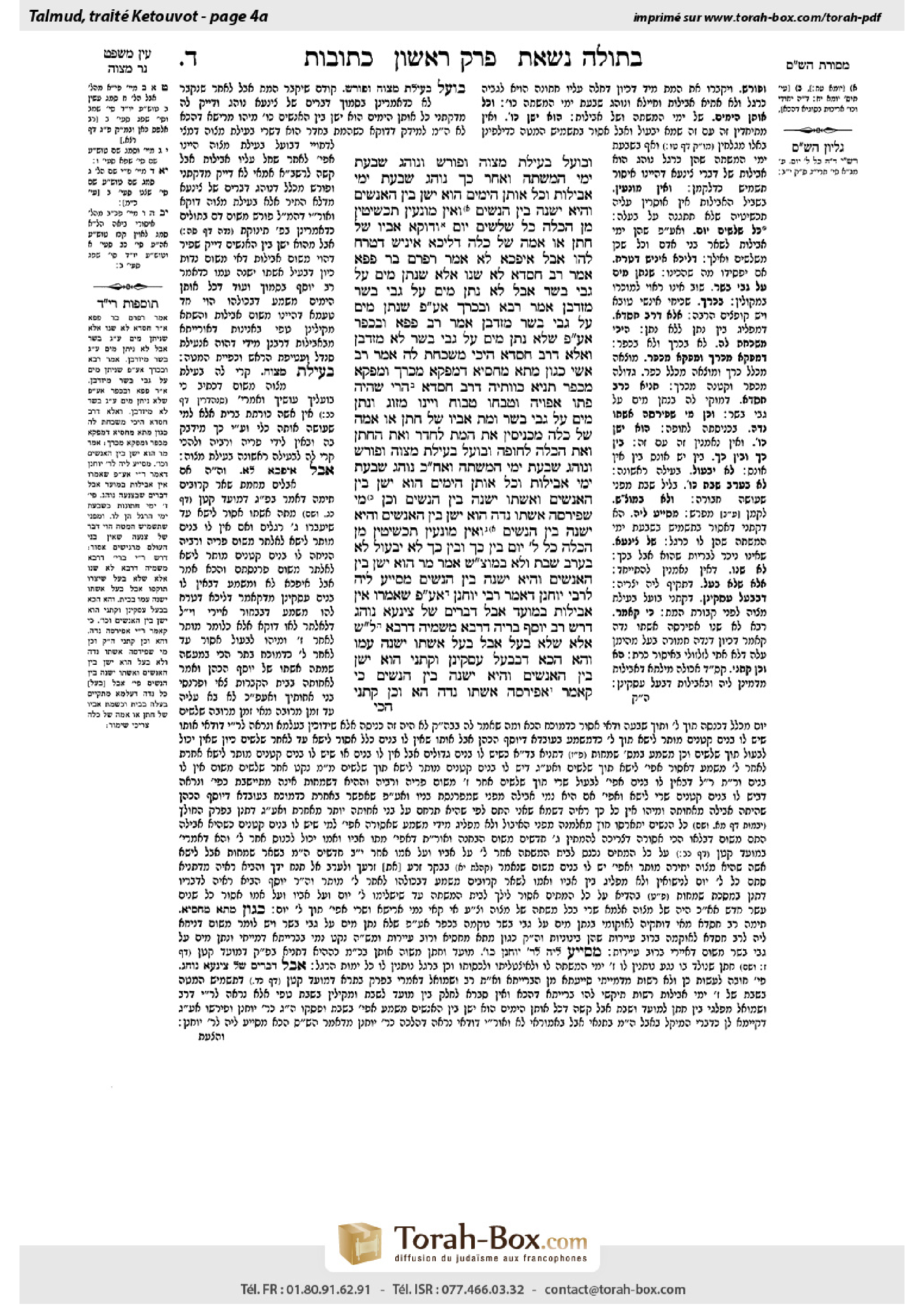
Ketubot 4a: Talmud study for Daf Yomi
Daf Yomi is the daily study of one Talmud folio. Explore 37 tractates with scans, Hebrew text, Sefaria English and AI-generated French translations where annotated.
Passage selection and English or AI-generated French translation are available where the scan has annotations. Daf Study is independent of Torah-Box and Sefaria.
Browse Ketubot · כתובות · All tractatesKetubot 4a text and translations
This page of Ketubot includes the Aramaic text, an English translation and an AI-generated French translation, alongside the scan above.
כתובות ד׳ א · Aramaic and Hebrew text
וּבוֹעֵל בְּעִילַת מִצְוָה וּפוֹרֵשׁ, וְנוֹהֵג שִׁבְעַת יְמֵי הַמִּשְׁתֶּה, וְאַחַר כָּךְ נוֹהֵג שִׁבְעַת יְמֵי אֲבֵילוּת. וְכׇל אוֹתָן הַיָּמִים, הוּא יָשֵׁן בֵּין הָאֲנָשִׁים וְהִיא יְשֵׁנָה בֵּין הַנָּשִׁים. וְאֵין מוֹנְעִין תַּכְשִׁיטִין מִן הַכַּלָּה כׇּל שְׁלֹשִׁים יוֹם.
וְדַוְקָא, אָבִיו שֶׁל חָתָן אוֹ אִמָּהּ שֶׁל כַּלָּה, דְּלֵיכָּא אִינִישׁ דְּטָרַח לְהוּ. אֲבָל אִיפְּכָא — לָא.
אָמַר רַפְרָם בַּר פָּפָּא אָמַר רַב חִסְדָּא: לֹא שָׁנוּ אֶלָּא שֶׁנָּתַן מַיִם עַל גַּבֵּי בָּשָׂר, אֲבָל לֹא נָתַן מַיִם עַל גַּבֵּי בָּשָׂר — מִזְדַּבַּן.
אָמַר רָבָא: וּבִכְרַךְ, אַף עַל פִּי שֶׁנָּתַן מַיִם עַל גַּבֵּי בָּשָׂר — מִזְדַּבַּן. אָמַר רַב פָּפָּא: וּבִכְפָר, אַף עַל פִּי שֶׁלֹּא נָתַן מַיִם עַל גַּבֵּי בָּשָׂר — לָא מִזְדַּבַּן. וְאֶלָּא דְּרַב חִסְדָּא הֵיכִי מַשְׁכַּחַתְּ לַהּ? אָמַר רַב אָשֵׁי: כְּגוֹן מָתָא מַחְסֵיָא, דְּמַפְּקָא מִכְּרַךְ, וּמַפְּקָא מִכְּפַר.
תַּנְיָא כְּווֹתֵיהּ דְּרַב חִסְדָּא: הֲרֵי שֶׁהָיָה פִּתּוֹ אֲפוּיָה וְטִבְחוֹ טָבוּחַ וְיֵינוֹ מָזוּג, וְנָתַן מַיִם עַל גַּבֵּי בָּשָׂר, וּמֵת אָבִיו שֶׁל חָתָן אוֹ אִמָּהּ שֶׁל כַּלָּה — מַכְנִיסִין אֶת הַמֵּת לַחֶדֶר, וְאֶת הֶחָתָן וְאֶת הַכַּלָּה לַחוּפָּה, וּבוֹעֵל בְּעִילַת מִצְוָה וּפוֹרֵשׁ, וְנוֹהֵג שִׁבְעַת יְמֵי הַמִּשְׁתֶּה, וְאַחַר כָּךְ נוֹהֵג שִׁבְעַת יְמֵי אֲבֵילוּת. וְכׇל אוֹתָן הַיָּמִים, הוּא יָשֵׁן בֵּין הָאֲנָשִׁים וְאִשְׁתּוֹ יְשֵׁנָה בֵּין הַנָּשִׁים.
וְכֵן מִי שֶׁפֵּירְסָה אִשְׁתּוֹ נִדָּה — הוּא יָשֵׁן בֵּין הָאֲנָשִׁים וְהִיא יְשֵׁנָה בֵּין הַנָּשִׁים. וְאֵין מוֹנְעִין תַּכְשִׁיטִין מִן הַכַּלָּה כָּל שְׁלֹשִׁים יוֹם. בֵּין כָּךְ וּבֵין כָּךְ לֹא יִבְעוֹל, לֹא בְּעֶרֶב שַׁבָּת וְלֹא בְּמוֹצָאֵי שַׁבָּת.
אָמַר מָר: הוּא יָשֵׁן בֵּין הָאֲנָשִׁים וְהִיא יְשֵׁנָה בֵּין הַנָּשִׁים, מְסַיַּיע לֵיהּ לְרַבִּי יוֹחָנָן. דְּאָמַר רַבִּי יוֹחָנָן: אַף עַל פִּי שֶׁאָמְרוּ אֵין אֲבֵילוּת בַּמּוֹעֵד, אֲבָל דְּבָרִים שֶׁל צִינְעָא — נוֹהֵג.
דָּרֵשׁ רַב יוֹסֵף בְּרֵיהּ דְּרָבָא מִשְּׁמֵיהּ דְּרָבָא: לֹא שָׁנוּ אֶלָּא שֶׁלֹּא בָּעַל, אֲבָל בָּעַל — אִשְׁתּוֹ יְשֵׁנָה עִמּוֹ.
וְהָא הָכָא, דִּבְבָעַל עָסְקִינַן, וְקָתָנֵי: הוּא יָשֵׁן בֵּין הָאֲנָשִׁים וְהִיא יְשֵׁנָה בֵּין הַנָּשִׁים! כִּי קָאָמַר, אַפֵּירְסָה אִשְׁתּוֹ נִדָּה.
הָא ״וְכֵן״ קָתָנֵי!
Ketubot 4a · English translation
And the groom then engages in intercourse with the bride to fulfill the mitzva, and then he withdraws from his wife, and the corpse is buried. And the groom then observes the seven days of the wedding feast, which are a personal festival for him, when the obligation of mourning rites does not take effect, and thereafter he observes the seven days of mourning. And throughout those days of rejoicing and mourning, the groom sleeps among the men, and the bride sleeps among the women, and they are not permitted to enter into seclusion. And in the event of mourning, one does not withhold jewels from the bride for the entire thirty-day period after the wedding, so that she not be undesirable to her husband.
And the wedding takes place and is followed by seven days of feasting and seven days of mourning, specifically if it is the father of the groom or the mother of the bride who died, as in that case there is no other person who would exert themselves for them. They are the ones responsible for the wedding preparations, and therefore the preparations that were completed must be utilized. However, if the opposite takes place, i.e., the mother of the groom or the father of the bride dies, no, the practice is different. The corpse is buried immediately, the seven-day mourning period is observed, and only afterward is the couple married.
Rafram bar Pappa said that Rav Ḥisda said: The Sages taught that they are married immediately only if one already placed water on the meat. In that case, it will be impossible to sell it to others, and if it is not cooked immediately it will spoil and a significant loss will be incurred, potentially resulting in cancellation of the wedding feast. However, if he did not place water on the meat, it can be sold. No significant loss will be incurred, so the mourning period need not be postponed.
Rava said: And in a city, where there are typically many buyers, even if he placed water on the meat it can be sold, and the mourning period need not be postponed. Rav Pappa said: And in a village, even if he did not place water on the meat, it cannot be sold, because no buyers can be found to purchase a quantity of meat that great. Based on the statements of Rava and Rav Pappa, whether or not water was placed on the meat is irrelevant both in a large city and in a village. The Gemara asks: Where do you find a case where the statement of Rav Ḥisda applies? Rav Ashi says: It can be found in a place like his city of Mata Meḥasya, which is removed from the category of a city, as it is too small, and removed from the category of a village, as it is too large.
The following baraita was taught in accordance with the opinion of Rav Ḥisda: If one’s bread was baked, and his animal slaughtered, and his wine diluted, and he placed water on the meat, and the father of the groom or the mother of the bride died, one moves the corpse into a room, and the bride and groom are ushered to the wedding canopy, and they are married. The groom then engages in intercourse with the bride to fulfill the mitzva, and he then withdraws from his wife, and the corpse is buried. And the groom then observes the seven days of the wedding feast, and thereafter observes the seven days of mourning. And throughout those days of feast and mourning, the groom sleeps among the men, and his wife sleeps among the women, and they are not permitted to be alone together.
And likewise, a groom whose wife began to menstruate at the time of the wedding, he sleeps among the men and she sleeps among the women, until she becomes ritually pure. However, the Sages do not withhold jewels from the bride while she is in mourning for the entire thirty-day period after the wedding. In any event, the groom may not engage in intercourse with his virgin bride, neither on Shabbat evening, as he will thereby inflict a wound, nor at the conclusion of Shabbat.
The Gemara proceeds to analyze the baraita. The Master said: He sleeps among the men and she sleeps among the women. This supports the opinion of Rabbi Yoḥanan, as Rabbi Yoḥanan said: Although they stated that there is no mourning observed on a Festival, yet one observes matters of privacy, i.e., mourning practices not apparent to onlookers. Therefore, the groom and the bride may not engage in relations during the seven days of rejoicing, as the legal status of those days is like that of a Festival for them.
Rav Yosef, son of Rava, taught in the name of Rava: They taught the halakha that if the bride began menstruating, the bride and groom may not be alone together, only if he did not engage in intercourse with her. However, if he engaged in intercourse with her, and afterward she begins menstruating, his wife sleeps with him, and there is no concern that this will lead to their engaging in forbidden relations.
The Gemara asks: But here, with regard to mourning, we are dealing with a case where he already engaged in intercourse that was permitted prior to the funeral, and yet the tanna teaches: He sleeps among the men and she sleeps among the women. The Gemara answers: When he states the ruling that if they already engaged in intercourse she sleeps with him, it was concerning only a case where his wife began menstruating, and it is not a case of mourning.
The Gemara asks: But doesn’t it state: And likewise, indicating that the legal status of the mourner and the legal status of the groom whose wife is menstruating are the same?
Ketubot 4a · Traduction française (IA)
Le marié a alors des relations avec la mariée afin d’accomplir la mitsva, puis il s’éloigne de son épouse et le défunt est enterré. Le marié observe ensuite les sept jours des réjouissances nuptiales, qui constituent pour lui une fête personnelle durant laquelle l’obligation d’observer les rites de deuil ne prend pas effet, puis les sept jours de deuil. Pendant toute cette période de réjouissances et de deuil, le marié dort parmi les hommes et la mariée parmi les femmes ; ils n’ont pas le droit de s’isoler ensemble. En cas de deuil, on ne prive pas la mariée de ses bijoux pendant toute la période de trente jours suivant le mariage, afin qu’elle ne devienne pas indésirable aux yeux de son mari.
Le mariage est célébré, puis suivent sept jours de festin et sept jours de deuil, précisément lorsque c’est le père du marié ou la mère de la mariée qui est décédé, car, dans ce cas, personne d’autre ne se dévouerait pour eux. Ce sont eux qui sont chargés des préparatifs du mariage ; les préparatifs déjà achevés doivent donc être utilisés. En revanche, si c’est l’inverse, c’est-à-dire si la mère du marié ou le père de la mariée décède, la pratique est différente. Le défunt est enterré immédiatement, les sept jours de deuil sont observés, et le couple ne se marie qu’ensuite.
Rafram bar Pappa a dit que Rav Ḥisda a dit : Les Sages ont enseigné qu’ils se marient immédiatement uniquement si l’on a déjà versé de l’eau sur la viande. Dans ce cas, il sera impossible de la vendre à d’autres, et si elle n’est pas cuite immédiatement, elle se gâtera, entraînant une perte importante et risquant de provoquer l’annulation du festin de mariage. En revanche, si l’on n’a pas versé d’eau sur la viande, on peut la vendre. Il n’y aura pas de perte importante et il n’est donc pas nécessaire de différer la période de deuil.
Rava a dit : Dans une ville, où il y a généralement de nombreux acheteurs, même si l’on a versé de l’eau sur la viande, on peut la vendre ; il n’est donc pas nécessaire de différer la période de deuil. Rav Pappa a dit : Dans un village, même si l’on n’a pas versé d’eau sur la viande, on ne peut pas la vendre, car on ne trouve pas d’acheteurs pour une si grande quantité de viande. D’après les propos de Rava et de Rav Pappa, que l’on ait ou non versé de l’eau sur la viande n’a aucune importance, aussi bien dans une grande ville que dans un village. La Guemara demande : Où trouve-t-on donc un cas auquel s’applique la déclaration de Rav Ḥisda ? Rav Ashi dit : Dans un lieu comme sa ville, Mata Meḥasya, qui ne relève pas de la catégorie des villes, car elle est trop petite, ni de celle des villages, car elle est trop grande.
La baraïta suivante a été enseignée conformément à l’opinion de Rav Ḥisda : Si le pain de quelqu’un a été cuit, que son animal a été abattu, que son vin a été coupé d’eau, qu’il a versé de l’eau sur la viande, et que le père du marié ou la mère de la mariée décède, on transporte le défunt dans une pièce, puis on conduit la mariée et le marié sous la houppa et ils se marient. Le marié a alors des relations avec la mariée afin d’accomplir la mitsva, puis il s’éloigne de son épouse et le défunt est enterré. Le marié observe ensuite les sept jours des réjouissances nuptiales, puis les sept jours de deuil. Pendant tous ces jours de festin et de deuil, le marié dort parmi les hommes et son épouse parmi les femmes ; ils n’ont pas le droit de rester seuls ensemble.
De même, lorsqu’une mariée commence à avoir ses règles au moment du mariage, le marié dort parmi les hommes et elle parmi les femmes, jusqu’à ce qu’elle devienne rituellement pure. Toutefois, même si elle est en deuil, les Sages ne privent pas la mariée de ses bijoux pendant toute la période de trente jours suivant le mariage. Quoi qu’il en soit, le marié ne peut pas avoir de relations avec sa jeune épouse vierge, ni le vendredi soir, car il lui infligerait alors une blessure, ni à la fin du Chabbat.
La Guemara poursuit l’analyse de la baraïta. Le Maître a dit : « Il dort parmi les hommes et elle dort parmi les femmes. » Cela étaye l’opinion de Rabbi Yoḥanan, car Rabbi Yoḥanan a dit : Bien qu’ils aient déclaré qu’on n’observe pas le deuil pendant une fête, on observe néanmoins les manifestations du deuil qui relèvent de l’intimité, c’est-à-dire les pratiques qui ne sont pas visibles aux yeux des autres. Par conséquent, le marié et la mariée ne peuvent pas avoir de relations pendant les sept jours de réjouissances, car ces jours ont pour eux le statut juridique d’une fête.
Rav Yosef, fils de Rava, a enseigné au nom de Rava : La halakha selon laquelle, si la mariée commence à avoir ses règles, les mariés ne peuvent pas rester seuls ensemble, ne s’applique que s’il n’a pas eu de relations avec elle. En revanche, s’il a eu des relations avec elle et qu’elle commence ensuite à avoir ses règles, son épouse dort avec lui, et l’on ne craint pas que cela les conduise à avoir des relations interdites.
La Guemara demande : Mais ici, en ce qui concerne le deuil, il s’agit d’un cas où il a déjà eu des relations licites avant les funérailles, et pourtant le tanna enseigne : « Il dort parmi les hommes et elle dort parmi les femmes. » La Guemara répond : Lorsqu’il énonce la règle selon laquelle, s’ils ont déjà eu des relations, elle dort avec lui, il s’agit uniquement d’un cas où son épouse a commencé à avoir ses règles, et non d’un cas de deuil.
La Guemara demande : Mais n’est-il pas écrit : « De même », ce qui indique que le statut juridique de la personne en deuil et celui du marié dont l’épouse a ses règles sont identiques ?
Traduction française générée par IA à partir de l’édition anglaise de Sefaria. Vérifie toujours un passage avec le texte source.
Text from Sefaria: William Davidson Edition - Vocalized Aramaic (CC BY NC); William Davidson Edition - English (CC BY NC).