Ketubot 93a: Talmud study for Daf Yomi
Daf Yomi is the daily study of one Talmud folio. Explore 37 tractates with scans, Hebrew text, Sefaria English and AI-generated French translations where annotated.
Passage selection and English or AI-generated French translation are available where the scan has annotations. Daf Study is independent of Torah-Box and Sefaria.
Browse Ketubot · כתובות · All tractatesKetubot 93a text and translations
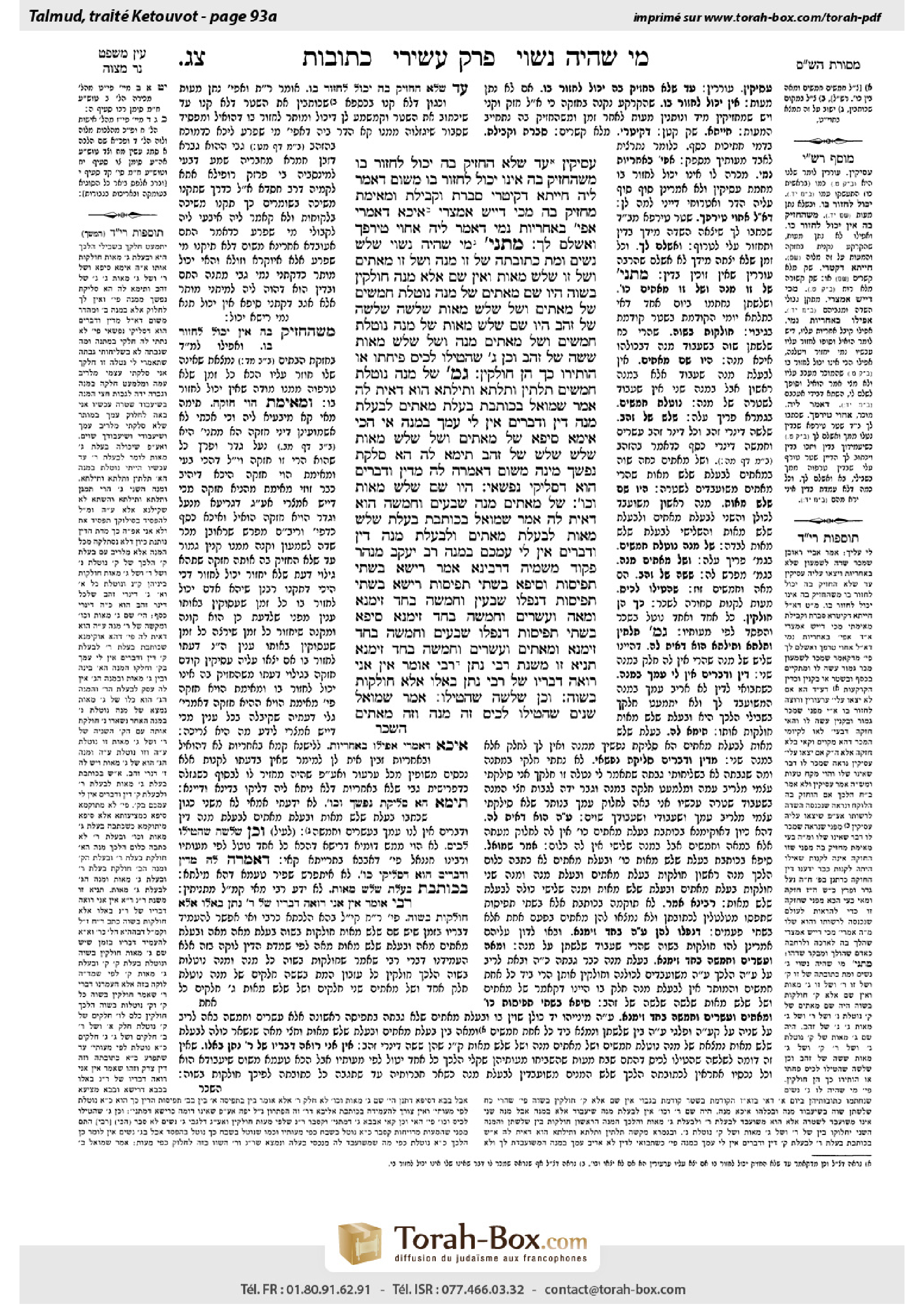
This page of Ketubot includes the Aramaic text, an English translation and an AI-generated French translation, alongside the scan above.
כתובות צ״ג א · Aramaic and Hebrew text
עֲסִיקִין, עַד שֶׁלֹּא הֶחְזִיק בָּהּ — יָכוֹל לַחֲזוֹר בּוֹ, מִשֶּׁהֶחְזִיק בָּהּ — אֵינוֹ יָכוֹל לַחֲזוֹר בּוֹ. מִשּׁוּם דְּאָמַר לֵיהּ: חַיְיתָא דְּקִיטְרֵי סְבַרְתְּ וְקַבֵּילְתְּ. וּמֵאֵימַת מַחְזֵיק בַּהּ? מִכִּי דָיֵישׁ אַמִּצְרֵי.
אִיכָּא דְּאָמְרִי אֲפִילּוּ בְּאַחְרָיוּת נָמֵי. דְּאָמַר לֵיהּ: אַחְוִי טִירְפָךְ וַאֲשַׁלֵּם לָךְ.
מַתְנִי׳ מִי שֶׁהָיָה נָשׂוּי שָׁלֹשׁ נָשִׁים, וָמֵת, כְּתוּבָּתָהּ שֶׁל זוֹ מָנֶה, וְשֶׁל זוֹ מָאתַיִם, וְשֶׁל זוֹ שְׁלֹשׁ מֵאוֹת, וְאֵין שָׁם אֶלָּא מָנֶה — חוֹלְקִין בְּשָׁוֶה.
הָיוּ שָׁם מָאתַיִם, שֶׁל מָנֶה נוֹטֶלֶת חֲמִשִּׁים, שֶׁל מָאתַיִם וְשֶׁל שְׁלֹשׁ מֵאוֹת שְׁלֹשָׁה שְׁלֹשָׁה שֶׁל זָהָב. הָיוּ שָׁם שְׁלֹשׁ מֵאוֹת — שֶׁל מָנֶה נוֹטֶלֶת חֲמִשִּׁים, וְשֶׁל מָאתַיִם מָנֶה, וְשֶׁל שְׁלֹשׁ מֵאוֹת שִׁשָּׁה שֶׁל זָהָב.
וְכֵן שְׁלֹשָׁה שֶׁהִטִּילוּ לַכִּיס, פִּיחֲתוּ אוֹ הוֹתִירוּ — כָּךְ הֵן חוֹלְקִין.
גְּמָ׳ שֶׁל מָנֶה נוֹטֶלֶת חֲמִשִּׁים? תְּלָתִין וּתְלָתָא וְתִילְתָּא הוּא דְּאִית לַהּ!
אָמַר שְׁמוּאֵל: בְּכוֹתֶבֶת בַּעֲלַת מָאתַיִם לְבַעֲלַת מָנֶה ״דִּין וּדְבָרִים אֵין לִי עִמָּךְ בְּמָנֶה״.
אִי הָכִי, אֵימָא סֵיפָא: שֶׁל מָאתַיִם וְשֶׁל שְׁלֹשׁ מֵאוֹת שָׁלֹשׁ שָׁלֹשׁ שֶׁל זָהָב. תֵּימָא לַהּ: הָא סַלֵּקְתְּ נַפְשִׁךְ מִינַּהּ!
מִשּׁוּם דְּאָמְרָה לַהּ: מִדִּין וּדְבָרִים הוּא דְּסַלִּיקִי נַפְשַׁאי.
הָיוּ שָׁם שְׁלֹשׁ מֵאוֹת וְכוּ׳.
שֶׁל מָאתַיִם מָנֶה? שִׁבְעִים וַחֲמִשָּׁה הוּא דְּאִית לַהּ!
אָמַר שְׁמוּאֵל: בְּכוֹתֶבֶת בַּעֲלַת שְׁלֹשׁ מֵאוֹת לְבַעֲלַת מָאתַיִם וּלְבַעֲלַת מָנֶה ״דִּין וּדְבָרִים אֵין לִי עִמָּכֶם בְּמָנֶה״.
רַב יַעֲקֹב מִנְּהַר פְּקוֹד מִשְּׁמֵיהּ דְּרָבִינָא אָמַר: רֵישָׁא בִּשְׁתֵּי תְפִיסוֹת, וְסֵיפָא בִּשְׁתֵּי תְפִיסוֹת.
רֵישָׁא בִּשְׁתֵּי תְפִיסוֹת — דְּנָפְלוּ שִׁבְעִין וַחֲמִשָּׁה בְּחַד זִימְנָא, וּמֵאָה וְעֶשְׂרִים וַחֲמִשָּׁה בְּחַד זִימְנָא.
סֵיפָא בִּשְׁתֵּי תְפִיסוֹת — דְּנָפְלוּ שִׁבְעִים וַחֲמִשָּׁה בְּחַד זִימְנָא, וּמָאתַיִם וְעֶשְׂרִים וַחֲמִשָּׁה בְּחַד זִימְנָא.
תַּנְיָא: זוֹ מִשְׁנַת רַבִּי נָתָן. רַבִּי אוֹמֵר: אֵין אֲנִי רוֹאֶה דְּבָרָיו שֶׁל רַבִּי נָתָן בְּאֵלּוּ, אֶלָּא חוֹלְקוֹת בְּשָׁוֶה.
וְכֵן שְׁלֹשָׁה שֶׁהֵטִילוּ. אָמַר שְׁמוּאֵל: שְׁנַיִם שֶׁהִטִּילוּ לְכִיס, זֶה מָנֶה וְזֶה מָאתַיִם —
Ketubot 93a · English translation
disputants i.e., individuals who dispute Reuven’s ownership of the field, as long as Shimon has not yet taken possession of it, he can renege on the deal. However, once he has taken possession, Shimon cannot renege on the deal, because at that point the seller, Reuven, can say to him: You agreed to a sack [ḥaita] of knots and you received it, i.e., since you purchased the field with no guarantee, you understood that it was a risky investment. The Gemara asks: And from when is Shimon considered to have taken possession of the property? The Gemara answers: It is from when he walks the boundaries of the land to inspect it.
There are those who say that even if Reuven sold him the field with a guarantee, Shimon may not demand a refund immediately when he discovers that there are disputants, as Reuven can say to Shimon: Show me your document of authorization to repossess property from me, and I will pay you.
MISHNA: In the case of one who was married to three women and died and the marriage contract of this wife was for one hundred dinars and the marriage contract of this second wife was for two hundred dinars, and the marriage contract of this third wife was for three hundred, and all three contracts were issued on the same date so that none of the wives has precedence over any of the others, and the total value of the estate is only one hundred dinars, the wives divide the estate equally.
If there were two hundred dinars in the estate, the one whose marriage contract was for one hundred dinars takes fifty dinars, while those whose contracts were for two hundred and three hundred dinars take three dinars of gold each, which are the equivalent of seventy-five silver dinars. If there were three hundred dinars in the estate, the one whose marriage contract was for one hundred dinars takes fifty dinars, the one whose contract was for two hundred dinars takes one hundred dinars, and the one whose contract was for three hundred dinars takes six dinars of gold, the equivalent of one hundred and fifty silver dinars.
Similarly, three individuals who deposited money into a purse, i.e., invested different amounts of money into a joint business venture: If they incurred a loss or earned a profit, and now choose to dissolve the partnership, they divide the assets in this manner, i.e., based upon the amount that each of them initially invested in the partnership.
GEMARA: The Gemara asks about the halakha in the case where the estate has two hundred dinars, in which case the wife whose marriage contract was for one hundred dinars receives fifty dinars. Why should the wife whose marriage contract was for one hundred take fifty? She should have the right to collect only thirty-three and one-third dinars. Since her claim is only for the first hundred dinars, and all three women have an equal right to this first hundred, it stands to reason that it should be divided equally between the three of them.
Shmuel said: This is a case where the wife whose contract was for two hundred writes a document to the wife whose contract was for one hundred dinars: I do not have any legal dealings or involvement with you with regard to the first hundred dinars. Since she relinquished her share in the first hundred dinars, only two claimants remain, the one whose contract was for one hundred and the one whose contract was for three hundred, and they divide it equally between them.
The Gemara asks: If that is so, say the latter clause of that very same statement in the mishna, where it states that the wife whose contract was for two hundred and the one whose contract was for three hundred take three dinars of gold each. This is difficult, because the wife whose contract was for three hundred should be able to say to the wife whose contract was for two hundred: You have removed yourself from the first hundred dinars, and so you have a claim only against the remaining hundred. It should follow that the wife whose contract was for three hundred should take one hundred in total, fifty from the first hundred and fifty from the second hundred, and the one whose contract was for two hundred should receive only fifty, which is half of the second hundred.
The Gemara answers: This is not so, because the wife whose contract was for two hundred can say to the wife whose contract was for three hundred: I have removed myself only from legal dealings or involvement, i.e., I have not completely relinquished my rights to the first hundred; I only agreed not to become involved in litigation with the wife whose marriage contract was for one hundred dinars. However, I maintain my rights to the first hundred dinars with regard to my involvement with you. Consequently, both women have equal rights to the remaining one hundred and fifty dinars, and they divide it equally between them.
The mishna teaches that if there were three hundred dinars in the estate, the money is divided so that the wife whose marriage contract was for one hundred receives fifty dinars, the wife whose contract was for two hundred receives one hundred, and the one whose contract was for three hundred receives one hundred and fifty dinars.
The Gemara asks: Why does the one whose contract was for two hundred receive one hundred dinars? She should have the right to receive only seventy-five. As Shmuel explained above, since she agreed not to litigate with the wife whose contract was for one hundred with regard to the first hundred, it turns out that she has a claim only for one hundred and fifty of the remaining sum, since she clearly has no rights at all to the third hundred; therefore, she should receive half of what she is suing for, which is seventy-five dinars.
The Gemara answers that Shmuel said: The case is where the one whose contract was for three hundred writes a document to the one whose contract was for two hundred and to the one whose contract was for one hundred dinars: I have no legal dealings or involvement with you with regard to the first hundred dinars. Due to this agreement, the first hundred is divided between the wife whose contract was for one hundred and the wife whose contract was for two hundred, with each receiving fifty. The second hundred is divided between the wife whose contract was for two hundred and the wife whose contract was for three hundred. As a result of this, the wife whose contract was for two hundred ends up with a full hundred. The third hundred goes exclusively to the wife whose contract was for three hundred, bringing her total to one hundred and fifty dinars.
Rav Ya’akov of Nehar Pekod said in the name of Ravina: The mishna is not referring to cases where one of the women waived her rights, but rather to cases in which they did not receive the inheritance all at once, but in installments; each time an installment became available, the women repossessed a portion of the estate. The first clause is referring to a case where there were two seizures of property, and the latter clause is similarly referring to a case where there were two seizures of property.
The Gemara explains: The first clause of the mishna, where two hundred dinars were available, is referring to a case where there were two seizures of property, as seventy-five dinars became available at one time and one hundred and twenty-five dinars at another time. When the first installment became available, each of the women had an equal claim to the money and they divided it equally, each receiving twenty-five dinars. When the second installment became available, the woman whose contract was for one hundred dinars had a claim to seventy-five dinars, and received one-third of that amount, bringing her total to fifty. The other women also received an equal share of those seventy-five dinars, and divided equally the remaining fifty dinars, bringing their totals to seventy-five dinars apiece.
The latter clause, where three hundred dinars were available, is also referring to a case where there were two seizures of property, as seventy-five dinars became available to them at one time and two hundred and twenty-five dinars at another time.
It is taught in a baraita: This is the teaching of Rabbi Natan. Rabbi Yehuda HaNasi says: I do not agree with Rabbi Natan’s statement with regard to these women; rather, they divide the estate equally.
It was taught in the mishna: Similarly, three individuals who deposited money into a purse, i.e., invested different amounts in a joint business venture, divide the assets in a similar manner. Shmuel said: In a case of two individuals who deposited money into a purse, where this individual invested one hundred dinars and that individual invested two hundred,
Ketubot 93a · Traduction française (IA)
…des contestataires, c’est-à-dire des personnes qui contestent la propriété du champ de Reuven. Tant que Shimon n’en a pas encore pris possession, il peut revenir sur l’accord. Mais une fois qu’il en a pris possession, il ne peut plus revenir sur l’accord, car le vendeur, Reuven, peut alors lui dire : « Tu as accepté un sac [ḥaita] de nœuds et tu l’as reçu », c’est-à-dire que, puisqu’il a acheté le champ sans garantie, il savait qu’il s’agissait d’un investissement risqué. La Guemara demande : À partir de quand Shimon est-il considéré comme ayant pris possession du bien ? La Guemara répond : à partir du moment où il parcourt les limites du terrain pour l’inspecter.
Selon certains, même si Reuven lui a vendu le champ avec une garantie, Shimon ne peut pas exiger immédiatement un remboursement lorsqu’il découvre l’existence de contestataires, car Reuven peut lui dire : « Montre-moi le document qui m’autorise à reprendre un bien auprès de toi, et je te paierai. »
MICHNA : Dans le cas d’un homme qui était marié à trois femmes et qui est mort, le contrat de mariage de la première femme s’élevait à cent dinars, celui de la deuxième à deux cents dinars et celui de la troisième à trois cents dinars. Les trois contrats ayant été établis à la même date, aucune des femmes n’a priorité sur les autres. Si la valeur totale de la succession n’est que de cent dinars, les femmes se la partagent à parts égales.
Si la succession contient deux cents dinars, celle dont le contrat de mariage s’élevait à cent dinars reçoit cinquante dinars, tandis que celles dont les contrats s’élevaient à deux cents et trois cents dinars reçoivent chacune trois dinars d’or, l’équivalent de soixante-quinze dinars d’argent. Si la succession contient trois cents dinars, celle dont le contrat de mariage s’élevait à cent dinars reçoit cinquante dinars, celle dont le contrat s’élevait à deux cents dinars en reçoit cent, et celle dont le contrat s’élevait à trois cents dinars reçoit six dinars d’or, l’équivalent de cent cinquante dinars d’argent.
De même, dans le cas de trois personnes qui ont déposé de l’argent dans une bourse, c’est-à-dire qui ont investi des sommes différentes dans une entreprise commune : si elles ont subi une perte ou réalisé un bénéfice et décident alors de dissoudre leur association, elles se partagent les biens de cette manière, c’est-à-dire en fonction de la somme que chacune avait initialement investie dans l’association.
GUEMARA : La Guemara interroge sur la halakha dans le cas où la succession contient deux cents dinars et où la femme dont le contrat de mariage s’élevait à cent dinars reçoit cinquante dinars. Pourquoi reçoit-elle cinquante dinars ? Elle ne devrait avoir le droit de recouvrer que trente-trois dinars et un tiers. Puisqu’elle ne réclame que sur les premiers cent dinars et que les trois femmes ont des droits égaux sur ces premiers cent dinars, il semble logique que cette somme soit partagée à parts égales entre elles.
Shmuel a dit : Il s’agit d’un cas où la femme dont le contrat s’élevait à deux cents dinars rédige un document en faveur de celle dont le contrat s’élevait à cent dinars, disant : « Je n’ai aucune affaire ni aucun lien juridique avec toi au sujet des premiers cent dinars. » Puisqu’elle a renoncé à sa part des premiers cent dinars, il ne reste que deux créancières : celle dont le contrat s’élevait à cent dinars et celle dont le contrat s’élevait à trois cents dinars. Elles se partagent cette somme à parts égales.
La Guemara demande : Dans ce cas, examinons la dernière clause de cette même déclaration de la Michna, qui indique que la femme dont le contrat s’élevait à deux cents dinars et celle dont le contrat s’élevait à trois cents dinars reçoivent chacune trois dinars d’or. Cela pose difficulté, car celle dont le contrat s’élevait à trois cents dinars devrait pouvoir dire à celle dont le contrat s’élevait à deux cents dinars : « Tu t’es retirée des premiers cent dinars ; tu n’as donc de droits que sur les cent dinars restants. » Il s’ensuivrait que celle dont le contrat s’élevait à trois cents dinars devrait recevoir cent dinars au total, cinquante sur les premiers cent et cinquante sur les seconds cent, tandis que celle dont le contrat s’élevait à deux cents dinars ne devrait recevoir que cinquante dinars, soit la moitié des seconds cent.
La Guemara répond : Il n’en est pas ainsi, car celle dont le contrat s’élevait à deux cents dinars peut dire à celle dont le contrat s’élevait à trois cents dinars : « Je me suis retirée uniquement de toute affaire ou de tout lien juridique avec toi ; autrement dit, je n’ai pas entièrement renoncé à mes droits sur les premiers cent dinars. J’ai seulement accepté de ne pas entrer en litige avec celle dont le contrat de mariage s’élevait à cent dinars. Toutefois, je conserve mes droits sur les premiers cent dinars dans mes rapports avec toi. » Par conséquent, les deux femmes ont des droits égaux sur les cent cinquante dinars restants et se les partagent à parts égales.
La Michna enseigne que si la succession contient trois cents dinars, l’argent est réparti de sorte que celle dont le contrat de mariage s’élevait à cent dinars reçoit cinquante dinars, celle dont le contrat s’élevait à deux cents dinars en reçoit cent, et celle dont le contrat s’élevait à trois cents dinars en reçoit cent cinquante.
La Guemara demande : Pourquoi celle dont le contrat s’élevait à deux cents dinars reçoit-elle cent dinars ? Elle ne devrait avoir le droit d’en recevoir que soixante-quinze. En effet, comme Shmuel l’a expliqué plus haut, puisqu’elle a accepté de ne pas entrer en litige avec celle dont le contrat s’élevait à cent dinars au sujet des premiers cent dinars, il s’avère qu’elle ne peut réclamer que cent cinquante dinars sur la somme restante, puisqu’elle n’a manifestement aucun droit sur les troisièmes cent dinars. Elle devrait donc recevoir la moitié de la somme qu’elle réclame, soit soixante-quinze dinars.
La Guemara répond que Shmuel a dit : Il s’agit d’un cas où celle dont le contrat s’élevait à trois cents dinars rédige un document en faveur de celle dont le contrat s’élevait à deux cents dinars et de celle dont le contrat s’élevait à cent dinars, disant : « Je n’ai aucune affaire ni aucun lien juridique avec vous au sujet des premiers cent dinars. » En vertu de cet accord, les premiers cent dinars sont partagés entre celle dont le contrat s’élevait à cent dinars et celle dont le contrat s’élevait à deux cents dinars, qui reçoivent chacune cinquante dinars. Les deuxièmes cent dinars sont partagés entre celle dont le contrat s’élevait à deux cents dinars et celle dont le contrat s’élevait à trois cents dinars. Ainsi, celle dont le contrat s’élevait à deux cents dinars reçoit au total cent dinars. Les troisièmes cent dinars reviennent exclusivement à celle dont le contrat s’élevait à trois cents dinars, ce qui porte son total à cent cinquante dinars.
Rav Ya’akov de Nehar Pekod a dit au nom de Ravina : La Michna ne traite pas de cas où l’une des femmes a renoncé à ses droits, mais de cas où elles n’ont pas reçu l’héritage en une seule fois, mais par versements ; chaque fois qu’un versement devenait disponible, les femmes recouvraient une partie de la succession. La première clause traite d’un cas où il y a eu deux saisies de biens, et la dernière clause traite pareillement d’un cas où il y a eu deux saisies de biens.
La Guemara explique : La première clause de la Michna, où deux cents dinars étaient disponibles, traite d’un cas où il y a eu deux saisies de biens : soixante-quinze dinars sont devenus disponibles à un moment et cent vingt-cinq dinars à un autre. Lorsque le premier versement est devenu disponible, chacune des femmes avait un droit égal sur l’argent et elles se le sont partagé à parts égales, recevant chacune vingt-cinq dinars. Lorsque le deuxième versement est devenu disponible, celle dont le contrat s’élevait à cent dinars avait droit à soixante-quinze dinars et en a reçu un tiers, ce qui a porté son total à cinquante dinars. Les autres femmes ont également reçu une part égale de ces soixante-quinze dinars et se sont partagé à parts égales les cinquante dinars restants, ce qui a porté leur total à soixante-quinze dinars chacune.
La dernière clause, où trois cents dinars étaient disponibles, traite également d’un cas où il y a eu deux saisies de biens : soixante-quinze dinars sont devenus disponibles à un moment et deux cent vingt-cinq dinars à un autre.
Il est enseigné dans une baraïta : Telle est l’opinion de Rabbi Natan. Rabbi Yehuda HaNasi dit : « Je ne suis pas d’accord avec la déclaration de Rabbi Natan au sujet de ces femmes ; elles se partagent plutôt la succession à parts égales. »
Il a été enseigné dans la Michna que trois personnes qui ont déposé de l’argent dans une bourse, c’est-à-dire qui ont investi des sommes différentes dans une entreprise commune, se partagent les biens de manière similaire. Shmuel a dit : Dans le cas de deux personnes qui ont déposé de l’argent dans une bourse, lorsque l’une a investi cent dinars et l’autre deux cents,
Traduction française générée par IA à partir de l’édition anglaise de Sefaria. Vérifie toujours un passage avec le texte source.
Text from Sefaria: William Davidson Edition - Vocalized Aramaic (CC BY NC); William Davidson Edition - English (CC BY NC).