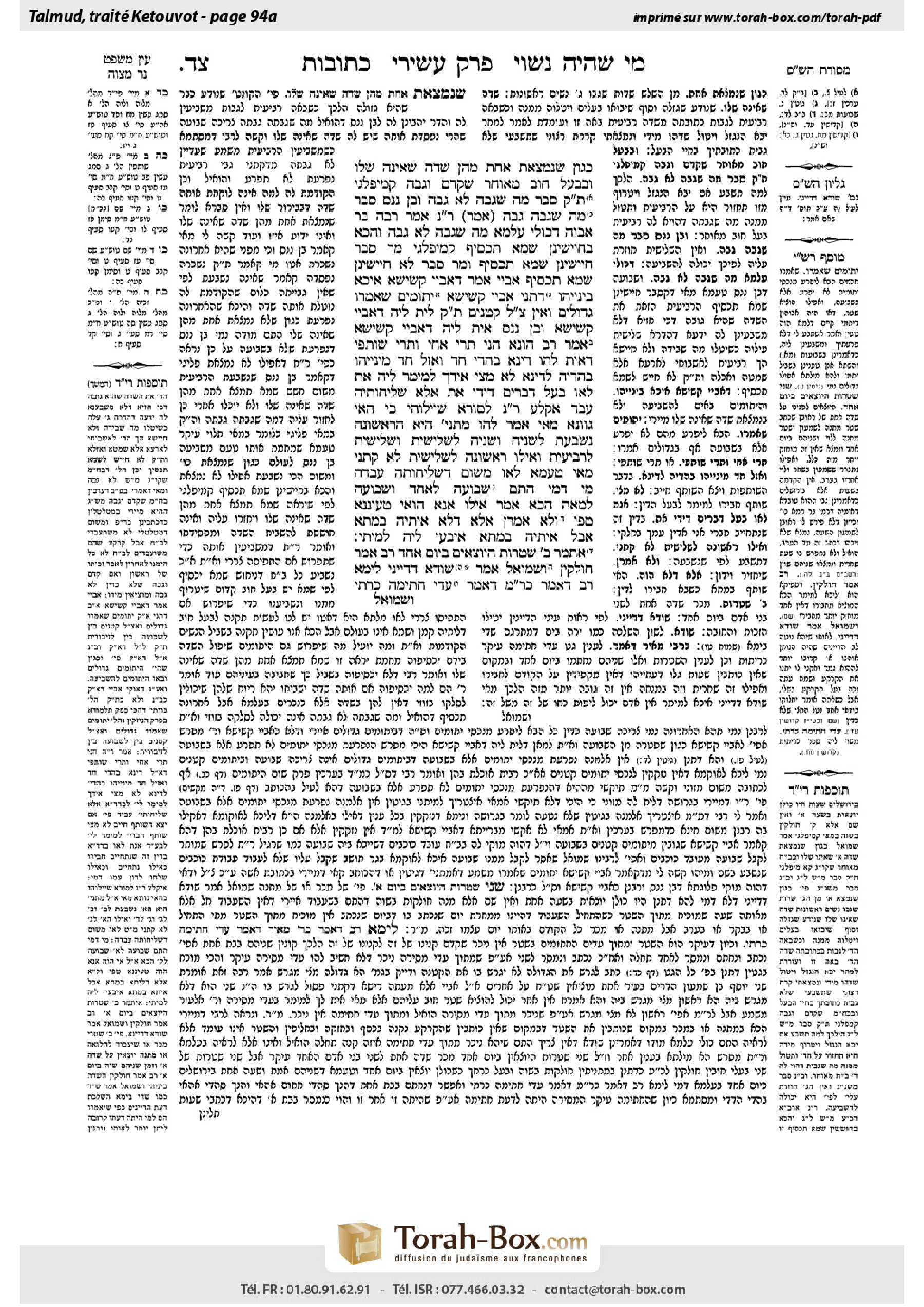
Ketubot 94a: Talmud study for Daf Yomi
Daf Yomi is the daily study of one Talmud folio. Explore 37 tractates with scans, Hebrew text, Sefaria English and AI-generated French translations where annotated.
Passage selection and English or AI-generated French translation are available where the scan has annotations. Daf Study is independent of Torah-Box and Sefaria.
Browse Ketubot · כתובות · All tractatesKetubot 94a text and translations
This page of Ketubot includes the Aramaic text, an English translation and an AI-generated French translation, alongside the scan above.
כתובות צ״ד א · Aramaic and Hebrew text
כְּגוֹן שֶׁנִּמְצֵאת אַחַת מֵהֶן שָׂדֶה שֶׁאֵינָהּ שֶׁלּוֹ. וּבְבַעַל חוֹב מְאוּחָר שֶׁקָּדַם וְגָבָה קָמִיפַּלְגִי.
תַּנָּא קַמָּא סָבַר: מַה שֶּׁגָּבָה לֹא גָּבָה.
וּבֶן נַנָּס סָבַר: מַה שֶּׁגָּבָה גָּבָה.
(אָמַר) רַב נַחְמָן אָמַר רַבָּה בַּר אֲבוּהּ: דְּכוּלֵּי עָלְמָא — מַה שֶּׁגָּבָה לֹא גָּבָה. וְהָכָא בְּחָיְישִׁינַן שֶׁמָּא תַּכְסִיף קָמִיפַּלְגִי,
מָר סָבַר: חָיְישִׁינַן שֶׁמָּא תַּכְסִיף. וּמַר סָבַר: לָא חָיְישִׁינַן שֶׁמָּא תַּכְסִיף.
אַבָּיֵי אָמַר: דְּאַבָּיֵי קַשִּׁישָׁא אִיכָּא בֵּינַיְיהוּ. דְּתָנֵי אַבָּיֵי קַשִּׁישָׁא: יְתוֹמִים שֶׁאָמְרוּ — גְּדוֹלִים. וְאֵין צָרִיךְ לוֹמַר קְטַנִּים.
תַּנָּא קַמָּא לֵית לֵיהּ דְּאַבָּיֵי קַשִּׁישָׁא. וּבֶן נַנָּס אִית לֵיהּ דְּאַבָּיֵי קַשִּׁישָׁא.
אָמַר רַב הוּנָא: הָנֵי תְּרֵי אַחֵי וּתְרֵי שׁוּתָּפֵי דְּאִית לְהוּ דִּינָא בַּהֲדֵי חַד, וַאֲזַל חַד מִינַּיְיהוּ בַּהֲדֵיהּ לְדִינָא — לָא מָצֵי אִידַּךְ לְמֵימַר לֵיהּ: אַתְּ לָאו בַּעַל דְּבָרִים דִּידִי אַתְּ. אֶלָּא שְׁלִיחוּתֵיהּ עֲבַד.
אִקְּלַע רַב נַחְמָן לְסוּרָא. שַׁיְילוּהִי: כִּי הַאי גַוְונָא מַאי?
אֲמַר לְהוּ, מַתְנִיתִין הִיא: הָרִאשׁוֹנָה נִשְׁבַּעַת לַשְּׁנִיָּה, וּשְׁנִיָּה לַשְּׁלִישִׁית, וּשְׁלִישִׁית לָרְבִיעִית. וְאִילּוּ רִאשׁוֹנָה לַשְּׁלִישִׁית לָא קָתָנֵי, מַאי טַעְמָא, לָאו מִשּׁוּם דִּשְׁלִיחוּתַהּ עָבְדָה?
מִי דָּמֵי? הָתָם שְׁבוּעָה לְאֶחָד וּשְׁבוּעָה לְמֵאָה, הָכָא אָמַר: אִילּוּ אֲנָא הֲוַאי, טָעֵינְנָא טְפֵי.
וְלָא אֲמַרַן אֶלָּא דְּלָא אִיתֵיהּ בְּמָתָא, אֲבָל אִיתֵיהּ בְּמָתָא — אִיבְּעִי לֵיהּ לְמֵיתֵי.
אִתְּמַר: שְׁנֵי שְׁטָרוֹת הַיּוֹצְאִים בְּיוֹם אֶחָד, רַב אָמַר: חוֹלְקִין, וּשְׁמוּאֵל אָמַר: שׁוּדָא דְּדַיָּינֵי.
לֵימָא רַב דְּאָמַר כְּרַבִּי מֵאִיר, דְּאָמַר: עֵדֵי חֲתִימָה כָּרְתִי.
Ketubot 94a · English translation
The case is where it is discovered that one of the fields in the estate is not his field, e.g., the husband had stolen it from someone else. Consequently, it is likely that the field will be repossessed, and if it is used to pay the marriage contract of one of the first three wives, that wife stands to lose out. And they disagree with regard to a creditor whose promissory note was dated later than that of another creditor, and yet he collected his debt before the other creditor, leaving nothing for the other creditor to collect. This is parallel to the case of the wives if the fourth wife collects her marriage contract and then one of the earlier wives loses the field she has been paid.
The first tanna holds that what the creditor has collected, he has not fully collected, i.e., he will have to give up the property he collected so that the creditor with the earlier promissory note can collect his debt. Similarly, if the property given to one of the first three wives is repossessed and there is nothing left for her to collect, the fourth wife will have to relinquish the property that she had been paid to accommodate the wife who preceded her.
And ben Nanas holds that what the creditor has collected, he has collected, i.e., it is not taken from him in order to pay the earlier creditor. Consequently, according to the first tanna, there is no need for the fourth wife to take an oath before she collects the property, because whatever she collects can be taken from her in order to pay the other wives. According to ben Nanas, since the property the fourth wife collects cannot be taken from her, she must take an oath that she is collecting this property legally in order to ensure that none of the other wives will lose out because of what she collects.
Rav Naḥman said that Rabba bar Avuh said: Everyone agrees that what the later creditor has collected, he has not collected, i.e., it may be repossessed by the earlier creditor. Rather, they disagree here as to whether we are concerned that perhaps she will deplete the field and cause its value to depreciate.
One Sage, ben Nanas, holds that we are concerned that perhaps she will deplete the field. If she is not required to take the oath, she will understand that her hold on the land is uncertain, as it is possible that one of the other wives will repossess it. Consequently, she will try to reap the maximum benefit from the field in the short term without investing in the field for the long term, and thereby depleting the field. The Sages therefore imposed an oath upon the fourth wife. And one Sage, the first tanna, holds that we are not concerned that perhaps she will deplete the field and we can assume that it will retain its original value. Therefore, there is no reason to impose an oath upon the fourth wife.
Abaye said: There is a practical difference between them, the first tanna and ben Nanas, with regard to the ruling of Abaye the Elder, as Abaye the Elder taught: The orphans with regard to whom the Sages said that one cannot collect property from them without taking an oath include adult orphans, and, needless to say, orphans who are minors. Even adult orphans are not necessarily aware of the business affairs of their parents, and one can easily press claims against the estate that take advantage of their ignorance. Therefore, anyone who wishes to collect money from the estate is required to take an oath.
The first tanna does not accept the ruling of Abaye the Elder and therefore holds that the fourth wife does not have to take an oath when collecting her marriage contract. And ben Nanas accepts the ruling of Abaye the Elder and therefore holds that the fourth wife must take an oath before collecting part of the estate.
§ Rav Huna said: In a case of two brothers or two partners who have legal proceedings against another individual, and one of them went to attend to the legal proceedings against him and lost, the other brother or partner cannot say to the litigant: I am not legally answerable to you, i.e., I am not bound by the verdict because I was not represented in the legal proceedings. Rather, the brother or partner who appeared in court is considered to have acted as his agent.
The Gemara relates that Rav Naḥman once happened to come to Sura. They asked him: What is the halakha in a case like this one presented by Rav Huna, where only one of the two brothers or partners attends the court proceedings?
He said to them: It is taught in a mishna: The woman he married first takes an oath to the woman he married second, the second to the third, and the third to the fourth. But it does not teach that the first wife takes an oath to the third or the fourth. What is the reason? Is it not due to the fact that when the second wife requires the first to take an oath, she is acting as the third wife’s agent as well, since they both share the same concern regarding the first wife?
The Gemara responds: Is it comparable? There, in the case of the mishna, an oath to one is equal to an oath to one hundred, and there is no need for the first wife to take multiple oaths about the same matter. Here, however, in the case of the brothers or business partners, the second brother or partner can say: Had I been there, I would have presented a more convincing claim.
The Gemara notes: We said that this doubt is taken into account only if the second brother or partner is not in town when the legal proceedings take place. However, if he is in town, he should come to court to participate in the legal proceedings, and if he fails to do so, it is clear that he is content to allow his brother or partner to represent him in court.
§ It was stated that in a case of two deeds that are issued, i.e., dated, on the same day, e.g., where an individual gave or sold the same item to two different people, Rav said: They divide it between them, as it is impossible to determine who it belongs to, and Shmuel said: The item is awarded according to the discretion [shuda] of the judges.
The Gemara asks: Shall we say that Rav said his ruling in accordance with the opinion of Rabbi Meir, who said that signatory witnesses on the document effect the transaction? Here, since the seller or the giver of the field did not ask the signatory witnesses to note the exact time, it implies that he wished to give it to two people, but did not want to reveal that he was giving it to both of them.
Ketubot 94a · Traduction française (IA)
Le cas est celui où l’on découvre que l’un des champs de la succession n’appartient pas au mari, par exemple parce qu’il l’avait volé à quelqu’un d’autre. Il est donc probable que le champ sera repris. Si l’on s’en sert pour payer la ketouba de l’une des trois premières épouses, celle-ci risque d’y perdre. Leur désaccord porte sur le cas d’un créancier dont le billet de dette est daté après celui d’un autre créancier, mais qui a néanmoins recouvré sa créance avant l’autre, ne laissant rien à ce dernier à recouvrer. Cela correspond au cas des épouses : la quatrième épouse recouvre sa ketouba, puis l’une des premières perd le champ qui lui a été attribué en paiement.
Selon le premier tanna, ce que le créancier a recouvré, il ne l’a pas recouvré définitivement : il devra restituer les biens obtenus afin que le créancier dont le billet de dette est antérieur puisse recouvrer sa créance. De même, si le bien attribué à l’une des trois premières épouses est repris et qu’il ne lui reste rien à recouvrer, la quatrième épouse devra abandonner le bien qu’elle avait reçu en paiement, au profit de l’épouse qui l’a précédée.
Ben Nanas, lui, estime que ce que le créancier a recouvré, il l’a recouvré définitivement : on ne le lui reprend pas pour payer le créancier antérieur. Par conséquent, selon le premier tanna, la quatrième épouse n’a pas besoin de prêter serment avant de recouvrer le bien, car tout ce qu’elle recouvre peut lui être repris afin de payer les autres épouses. Selon ben Nanas, puisque le bien recouvré par la quatrième épouse ne peut pas lui être repris, elle doit prêter serment qu’elle le recouvre légalement, afin qu’aucune des autres épouses ne pâtisse de ce qu’elle recouvre.
Rav Naḥman dit au nom de Rabba bar Avuh : Tous sont d’accord pour dire que ce que le créancier postérieur a recouvré, il ne l’a pas recouvré définitivement, c’est-à-dire que le créancier antérieur peut le reprendre. Leur désaccord porte plutôt sur la question de savoir si l’on craint qu’elle ne détériore le champ et n’en fasse baisser la valeur.
Un Sage, ben Nanas, estime que l’on craint qu’elle ne détériore le champ. Si elle n’est pas tenue de prêter serment, elle comprendra que son droit sur le champ est incertain, puisqu’il est possible que l’une des autres épouses le reprenne. Elle cherchera donc à tirer le plus grand profit possible du champ à court terme, sans y investir à long terme, et le détériorera ainsi. Les Sages ont donc imposé un serment à la quatrième épouse. Un autre Sage, le premier tanna, estime que l’on ne craint pas qu’elle détériore le champ et que l’on peut supposer qu’il conservera sa valeur initiale. Il n’y a donc aucune raison d’imposer un serment à la quatrième épouse.
Abaye dit : Il existe une différence pratique entre les positions du premier tanna et de ben Nanas concernant la décision d’Abaye l’Ancien, car Abaye l’Ancien enseignait : Les orphelins au sujet desquels les Sages ont dit qu’on ne peut recouvrer de biens auprès d’eux sans prêter serment comprennent les orphelins adultes, et à plus forte raison les orphelins mineurs. Même les orphelins adultes ne connaissent pas nécessairement les affaires de leurs parents, et il est facile de présenter à la succession des réclamations qui exploitent leur ignorance. Par conséquent, quiconque souhaite recouvrer de l’argent sur la succession doit prêter serment.
Le premier tanna n’accepte pas la décision d’Abaye l’Ancien et estime donc que la quatrième épouse n’a pas à prêter serment lorsqu’elle recouvre sa ketouba. Ben Nanas, lui, accepte la décision d’Abaye l’Ancien et estime donc que la quatrième épouse doit prêter serment avant de recouvrer une partie de la succession.
§ Rav Huna dit : Dans le cas de deux frères ou de deux associés qui ont un litige avec une autre personne, si l’un d’eux se rend au tribunal pour suivre la procédure et perd, l’autre frère ou associé ne peut pas dire au plaideur : « Je ne suis pas juridiquement tenu envers toi », c’est-à-dire que le jugement ne me lie pas parce que je n’étais pas représenté dans la procédure. Au contraire, le frère ou l’associé qui s’est présenté au tribunal est considéré comme ayant agi en qualité de mandataire de l’autre.
La Guemara rapporte que Rav Naḥman vint un jour à Sura. On lui demanda : Quelle est la halakha dans un cas comme celui présenté par Rav Huna, où un seul des deux frères ou associés assiste à la procédure judiciaire ?
Il leur dit : Il est enseigné dans une Michna : La femme qu’il a épousée en premier prête serment à celle qu’il a épousée en second, la deuxième à la troisième, et la troisième à la quatrième. Mais il n’est pas enseigné que la première épouse prête serment à la troisième ou à la quatrième. Pourquoi ? N’est-ce pas parce que, lorsque la deuxième épouse demande à la première de prêter serment, elle agit également comme mandataire de la troisième épouse, puisqu’elles sont toutes deux concernées par la première épouse ?
La Guemara répond : Ces cas sont-ils comparables ? Dans le cas de la Michna, un serment prêté à une personne équivaut à un serment prêté à cent personnes ; la première épouse n’a donc pas à prêter plusieurs serments sur la même question. Ici, en revanche, dans le cas des frères ou des associés, le deuxième frère ou associé peut dire : « Si j’avais été présent, j’aurais présenté un argument plus convaincant. »
La Guemara précise : Nous avons dit que ce doute n’est pris en considération que si le deuxième frère ou associé ne se trouve pas en ville au moment de la procédure. En revanche, s’il est en ville, il doit se présenter au tribunal pour y participer ; s’il ne le fait pas, il est clair qu’il consent à ce que son frère ou associé le représente au tribunal.
§ Il a été enseigné que, dans le cas de deux actes établis, c’est-à-dire datés, le même jour — par exemple, lorsqu’une personne a donné ou vendu le même bien à deux personnes différentes —, Rav dit : Ils se le partagent, car il est impossible de déterminer à qui il appartient ; et Chmouel dit : Le bien est attribué selon l’appréciation [shuda] des juges.
La Guemara demande : Faut-il dire que Rav a formulé sa décision conformément à l’opinion de Rabbi Meïr, selon laquelle ce sont les témoins signataires de l’acte qui rendent la transaction effective ? Ici, puisque le vendeur ou le donateur du champ n’a pas demandé aux témoins signataires d’inscrire l’heure exacte, cela laisse entendre qu’il voulait le donner à deux personnes, mais ne voulait pas révéler qu’il le donnait aux deux.
Traduction française générée par IA à partir de l’édition anglaise de Sefaria. Vérifie toujours un passage avec le texte source.
Text from Sefaria: William Davidson Edition - Vocalized Aramaic (CC BY NC); William Davidson Edition - English (CC BY NC).