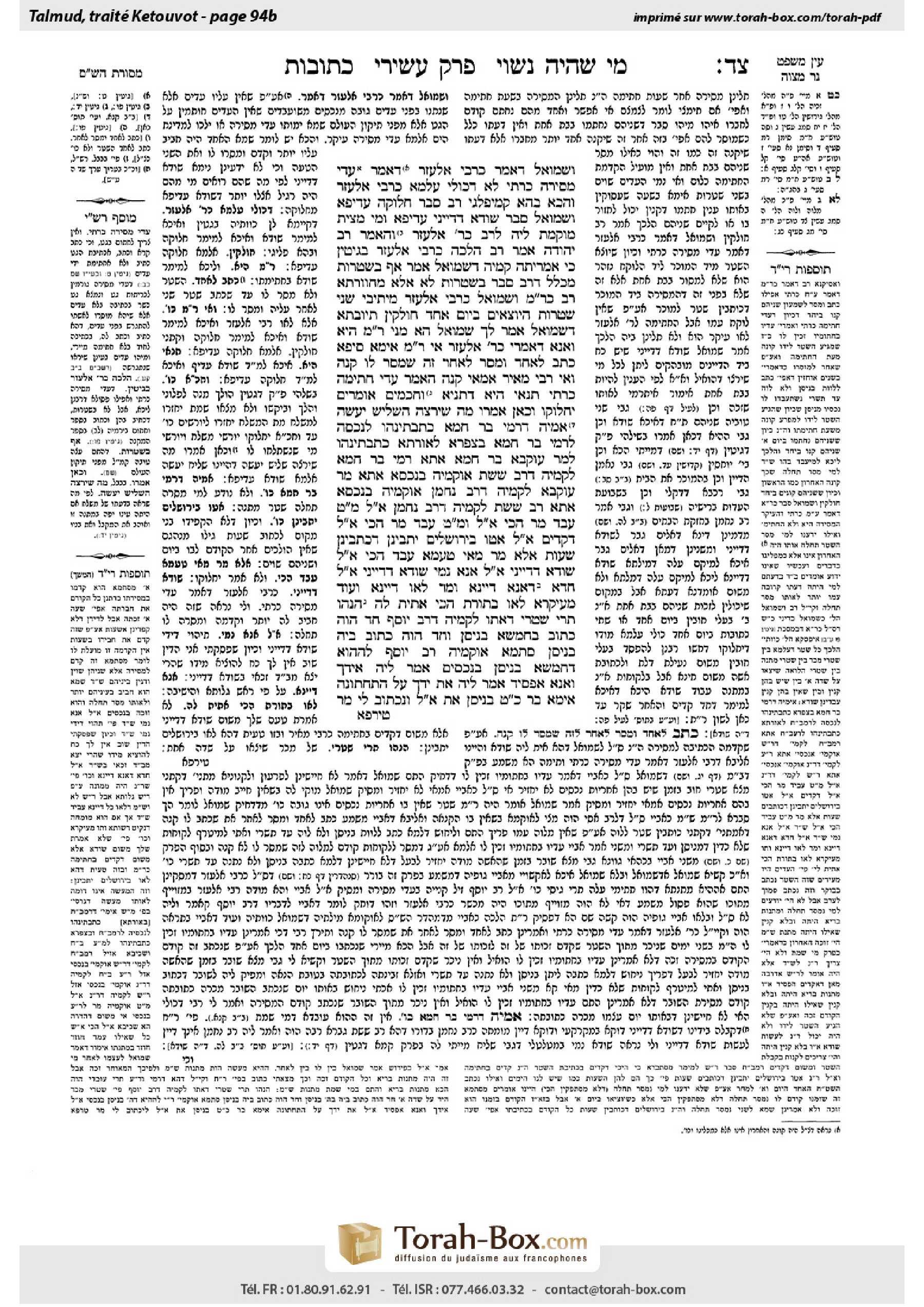
Ketubot 94b: Talmud study for Daf Yomi
Daf Yomi is the daily study of one Talmud folio. Explore 37 tractates with scans, Hebrew text, Sefaria English and AI-generated French translations where annotated.
Passage selection and English or AI-generated French translation are available where the scan has annotations. Daf Study is independent of Torah-Box and Sefaria.
Browse Ketubot · כתובות · All tractatesKetubot 94b text and translations
This page of Ketubot includes the Aramaic text, an English translation and an AI-generated French translation, alongside the scan above.
כתובות צ״ד ב · Aramaic and Hebrew text
וּשְׁמוּאֵל דְּאָמַר כְּרַבִּי אֶלְעָזָר, דְּאָמַר: עֵדֵי מְסִירָה כָּרְתִי.
לָא, דְּכוּלֵּי עָלְמָא כְּרַבִּי אֶלְעָזָר, וְהָכָא בְּהָא קָמִיפַּלְגִי, רַב סָבַר: חֲלוּקָּה עֲדִיפָא. וּשְׁמוּאֵל סָבַר: שׁוּדָא דְּדַיָּינֵי עֲדִיפָא.
וּמִי מָצֵית מוֹקְמַתְּ לֵיהּ לְרַב כְּרַבִּי אֶלְעָזָר? וְהָאָמַר רַב יְהוּדָה אָמַר רַב: הֲלָכָה כְּרַבִּי אֶלְעָזָר בְּגִיטִּין. כִּי אַמְרִיתַהּ קַמֵּיהּ דִּשְׁמוּאֵל, אָמַר: אַף בִּשְׁטָרוֹת. מִכְּלָל דְּרַב סָבַר בִּשְׁטָרוֹת לָא! אֶלָּא: מְחַוַּורְתָּא רַב כְּרַבִּי מֵאִיר, וּשְׁמוּאֵל כְּרַבִּי אֶלְעָזָר.
מֵיתִיבִי: שְׁנֵי שְׁטָרוֹת הַיּוֹצְאִים בְּיוֹם אֶחָד חוֹלְקִין, תְּיוּבְתָּא דִשְׁמוּאֵל. אָמַר לָךְ שְׁמוּאֵל: הָא מַנִּי — רַבִּי מֵאִיר הִיא, וַאֲנָא דַּאֲמַרִי כְּרַבִּי אֶלְעָזָר.
אִי רַבִּי מֵאִיר, אֵימָא סֵיפָא: כָּתַב לְאֶחָד וּמָסַר לְאַחֵר — זֶה שֶׁמָּסַר לוֹ קָנָה. וְאִי רַבִּי מֵאִיר, אַמַּאי קָנָה? הָאָמַר עֵדֵי חֲתִימָה כָּרְתִי!
תַּנָּאֵי הִיא. דְּתַנְיָא, וַחֲכָמִים אוֹמְרִים: יַחְלוֹקוּ, וְכָאן אָמְרוּ: מַה שֶּׁיִּרְצֶה הַשָּׁלִישׁ, יַעֲשֶׂה.
אִמֵּיהּ דְּרָמֵי בַּר חָמָא כְּתַבְתִּינְהוּ לְנִכְסַהּ לְרָמִי בַּר חָמָא בְּצַפְרָא, לְאוּרְתָּא כְּתַבְתִּינְהוּ לְמָר עוּקְבָא בַּר חָמָא.
אֲתָא רָמֵי בַּר חָמָא לְקַמֵּיהּ דְּרַב שֵׁשֶׁת, אוֹקְמֵיהּ בְּנִכְסֵי. אֲתָא מָר עוּקְבָא לְקַמֵּיהּ דְּרַב נַחְמָן, אוֹקְמֵיהּ בְּנִכְסֵי. אֲתָא רַב שֵׁשֶׁת לְקַמֵּיהּ דְּרַב נַחְמָן, אֲמַר לֵיהּ: מַאי טַעְמָא עֲבַד מָר הָכִי? אֲמַר לֵיהּ: וּמַאי טַעְמָא עֲבַד מָר הָכִי?
אֲמַר לֵיהּ: דִּקְדֵים. אֲמַר לֵיהּ: אַטּוּ בִּירוּשָׁלַיִם יָתְבִינַן דְּכָתְבִינַן שָׁעוֹת? אֶלָּא מָר מַאי טַעְמָא עֲבַד הָכִי? אֲמַר לֵיהּ: שׁוּדָא דְּדַיָּינֵי.
אֲמַר לֵיהּ: אֲנָא נָמֵי שׁוּדָא דְּדַיָּינֵי, אֲמַר לֵיהּ: חֲדָא, דַּאֲנָא דַּיָּינָא וּמָר לָאו דַּיָּינָא. וְעוֹד, מֵעִיקָּרָא לָאו בְּתוֹרַת הָכִי אֲתֵית לַהּ.
הָנְהוּ תְּרֵי שְׁטָרֵי דַּאֲתוֹ לְקַמֵּיהּ דְּרַב יוֹסֵף. חַד הֲוָה כָּתוּב בְּחַמְשָׁא בְּנִיסָן, וְחַד הֲוָה כָּתוּב בֵּיהּ בְּנִיסָן סְתָמָא. אוֹקְמֵיהּ רַב יוֹסֵף לְהָהוּא דְּחַמְשָׁא בְּנִיסָן בִּנְכָסִים.
אֲמַר לֵיהּ אִידַּךְ: וַאֲנָא אַפְסֵיד? אֲמַר לֵיהּ: אַתְּ יָדְךָ עַל הַתַּחְתּוֹנָה, אֵימָא בַּר עֶשְׂרִים וְתִשְׁעָה בְּנִיסָן אַתְּ.
אֲמַר לֵיהּ: וְנִכְתּוֹב לִי מָר
Ketubot 94b · English translation
And Shmuel said his ruling in accordance with the opinion of Rabbi Elazar, who said that witnesses of the transmission effect the transaction, i.e., the act of transferring the legal document to the beneficiary causes the transaction to take effect. Therefore, the fact that the two documents bear the same date is of no consequence because the documents were presumably not given to their beneficiaries simultaneously, and the property belongs exclusively to the individual who received his document first. Consequently, there is no reason to divide the property.
The Gemara responds: No, it is possible to say that everyone holds in accordance with the opinion of Rabbi Elazar, and here they disagree about the following: Rav holds that in a case of a doubt that cannot be resolved with regard to monetary law, division is preferable, and Shmuel holds that leaving the decision to the discretion of the judges is preferable.
The Gemara asks: Can you really establish that the opinion of Rav is in accordance with the opinion of Rabbi Elazar? Didn’t Rav Yehuda say that Rav said: The halakha is in accordance with the opinion of Rabbi Elazar with regard to bills of divorce? And Rav Yehuda related further: When I said this halakha in the presence of Shmuel, he said: The halakha is in accordance with the opinion of Rabbi Elazar even with regard to other legal documents as well. By inference, it is apparent that Rav holds that with regard to other legal documents, no, the halakha is not in accordance with Rabbi Elazar. Rather, it is clear that Rav holds in accordance with the opinion of Rabbi Meir, and Shmuel holds in accordance with the opinion of Rabbi Elazar.
The Gemara raises an objection from a baraita: In the case of two deeds that are issued dated the same day, the recipients of the deeds divide the property equally. Is this not a conclusive refutation of the opinion of Shmuel? The Gemara answers that Shmuel could have said to you: In accordance with whose opinion is this baraita? It is in accordance with the opinion of Rabbi Meir, and I said my opinion in accordance with the opinion of Rabbi Elazar.
The Gemara continues to ask: If this baraita is in accordance with the opinion of Rabbi Meir, say the latter clause of that same baraita: If he wrote a deed to one individual and then transmitted it to another individual, the one to whom the deed was transmitted has acquired the property. If the baraita is following the opinion of Rabbi Meir, why did the latter individual acquire the property? Didn’t Rabbi Meir say that the signatory witnesses on the document effect the transaction and not the witnesses to its transmission?
The Gemara responds: The baraita cited above is entirely in accordance with the opinion of Rabbi Elazar. However, there is a dispute between tanna’im with regard to money whose ownership is uncertain, as it is taught in a baraita: In a case where an individual sent a sum of money to another via a messenger, and by the time the messenger arrived, the intended recipient had died, and in the meantime, the individual who had sent the money also died, the tanna’im disagree about what to do with the money. The Rabbis say: The heirs of the sender and the heirs of the intended recipient should divide the money. And here, in Babylonia, they said: The third party, i.e., the messenger, can do as he pleases with the money, a ruling that is comparable to the solution of leaving the decision to the discretion of the judges.
The Gemara relates that the mother of Rami bar Ḥama wrote a deed in the morning transferring ownership of her property to Rami bar Ḥama, and in the evening she wrote another deed transferring her property to another of her sons, Mar Ukva bar Ḥama.
Rami bar Ḥama came before Rav Sheshet and the latter established his right to the property. Mar Ukva, his brother, came before Rav Naḥman and the latter established his right to the property. Rav Sheshet came before Rav Naḥman and said to him: What is the reason that the Master did this, i.e., why did you issue this ruling? Rav Naḥman said to him: And what is the reason that the Master did this, i.e., why did you rule as you did?
Rav Sheshet said to him: Because Rami bar Ḥama’s deed preceded that of Mar Ukva. Rav Naḥman said to Rav Sheshet: Is that to say that we are sitting in Jerusalem, that we write the hours on our legal documents? The halakha is that in any place where the hours are not recorded on legal documents, it does not matter when during the day a document was written. Rav Sheshet asked Rav Naḥman: But what is the reason that the Master did this, ruling as you did? Rav Naḥman said to him: It was the discretion of the judges, i.e., I ruled this way since it seemed to me that this is the way the mother wanted it.
Rav Sheshet said to Rav Naḥman: I also applied the principle of the discretion of the judges and ruled as I did. Rav Naḥman said to him: One response to your point is that I am a judge, and the Master is not a judge, as Rav Sheshet did not serve in the official capacity of a judge. Furthermore, at the outset, you did not arrive at your conclusion for this reason, but due to your own theory with regard to the dating of the documents, which proved to be incorrect.
The Gemara relates another incident in which an individual wrote two deeds about the same piece of property: There were these two deeds that came before Rav Yosef. In one deed, it was written that the owner of the field sold it to a particular individual on the fifth of Nisan, and in the other one it was written that he sold the same property to someone else in Nisan, without specifying on which day in Nisan the sale took place. Rav Yosef established that the one whose deed said the fifth of Nisan had the right to the property.
The other claimant said to Rav Yosef: Should I lose? After all, it is possible that my deed was written prior to the other deed. Rav Yosef said to him: You are at a disadvantage, because there is no specific date in your deed, allowing one to say that your deed is from the twenty-ninth of Nisan. Since you have no way to prove otherwise, the property is awarded to the one who has a more specific date recorded in his deed.
The man said to him: Let the Master write me
Ketubot 94b · Traduction française (IA)
Et Chmouel a énoncé sa décision conformément à l’opinion de Rabbi Elazar, selon laquelle ce sont les témoins de la remise qui font prendre effet à la transaction, c’est-à-dire que la remise du document juridique au bénéficiaire est l’acte qui fait prendre effet à la transaction. Par conséquent, le fait que les deux documents portent la même date est sans importance, car ils n’ont vraisemblablement pas été remis à leurs bénéficiaires simultanément, et le bien appartient exclusivement à celui qui a reçu son document le premier. Il n’y a donc aucune raison de partager le bien.
La Guemara répond : Non, il est possible de dire que tous sont d’accord avec l’opinion de Rabbi Elazar et qu’ici, leur désaccord porte sur le point suivant : Rav estime que, lorsqu’un doute en matière pécuniaire ne peut être résolu, il est préférable de partager, tandis que Chmouel estime qu’il vaut mieux laisser la décision à l’appréciation des juges.
La Guemara demande : Peut-on vraiment établir que l’opinion de Rav est conforme à celle de Rabbi Elazar ? Rav Yehouda n’a-t-il pas dit que Rav a dit : « La halakha est conforme à l’opinion de Rabbi Elazar concernant les actes de divorce » ? Rav Yehouda a également rapporté : « Lorsque j’ai énoncé cette halakha en présence de Chmouel, il m’a dit : “La halakha est conforme à l’opinion de Rabbi Elazar même pour les autres documents juridiques.” » Il en ressort que, selon Rav, pour les autres documents juridiques, la halakha n’est pas conforme à l’opinion de Rabbi Elazar. Il est donc clair que Rav suit l’opinion de Rabbi Meïr, tandis que Chmouel suit celle de Rabbi Elazar.
La Guemara soulève une objection à partir d’une baraïta : Dans le cas de deux actes délivrés à la même date, leurs bénéficiaires se partagent le bien à parts égales. N’est-ce pas là une réfutation décisive de l’opinion de Chmouel ? La Guemara répond que Chmouel aurait pu vous dire : « De quelle opinion cette baraïta relève-t-elle ? De celle de Rabbi Meïr. Quant à moi, j’ai énoncé mon opinion conformément à celle de Rabbi Elazar. »
La Guemara poursuit son objection : Si cette baraïta relève de l’opinion de Rabbi Meïr, examinons sa dernière clause : S’il a rédigé un acte pour une personne, puis l’a remis à une autre, celle à qui l’acte a été remis acquiert le bien. Si la baraïta suit l’opinion de Rabbi Meïr, pourquoi la seconde personne acquiert-elle le bien ? Rabbi Meïr n’a-t-il pas dit que ce sont les témoins signataires du document qui font prendre effet à la transaction, et non les témoins de sa remise ?
La Guemara répond : La baraïta citée précédemment relève entièrement de l’opinion de Rabbi Elazar. Cependant, les tannaïm divergent au sujet d’une somme d’argent dont la propriété est incertaine, comme l’enseigne une baraïta : Dans le cas où une personne a envoyé une somme d’argent à une autre par l’intermédiaire d’un messager, que le destinataire prévu est mort au moment où le messager est arrivé et que, entre-temps, l’expéditeur est lui aussi mort, les tannaïm divergent sur la manière de traiter cet argent. Les Sages disent : Les héritiers de l’expéditeur et ceux du destinataire prévu doivent se partager l’argent. Et ici, en Babylonie, ils disent : Le tiers, c’est-à-dire le messager, peut disposer de l’argent comme il l’entend, décision comparable au fait de laisser la décision à l’appréciation des juges.
La Guemara rapporte que la mère de Rami bar Ḥama rédigea le matin un acte transférant la propriété de ses biens à Rami bar Ḥama, puis, le soir, elle rédigea un autre acte transférant ses biens à un autre de ses fils, Mar Ukva bar Ḥama.
Rami bar Ḥama se présenta devant Rav Chéchet, qui lui reconnut le droit aux biens. Mar Ukva, son frère, se présenta devant Rav Naḥman, qui lui reconnut le droit aux biens. Rav Chéchet se présenta devant Rav Naḥman et lui dit : « Pour quelle raison le Maître a-t-il agi ainsi ? », c’est-à-dire : pourquoi avez-vous rendu cette décision ? Rav Naḥman lui dit : « Et pour quelle raison le Maître a-t-il agi ainsi ? », c’est-à-dire : pourquoi avez-vous statué comme vous l’avez fait ?
Rav Chéchet lui dit : « Parce que l’acte de Rami bar Ḥama précédait celui de Mar Ukva. » Rav Naḥman dit à Rav Chéchet : « Croirait-on que nous siégeons à Jérusalem, où l’on inscrit les heures sur les documents juridiques ? » La halakha est que, partout où les heures ne sont pas inscrites sur les documents juridiques, le moment de la journée où un document a été rédigé n’a pas d’importance. Rav Chéchet demanda à Rav Naḥman : « Mais pour quelle raison le Maître a-t-il agi ainsi, en statuant comme vous l’avez fait ? » Rav Naḥman lui dit : « C’était à l’appréciation des juges », autrement dit, j’ai statué ainsi parce qu’il m’a semblé que c’était ce que souhaitait la mère.
Rav Chéchet dit à Rav Naḥman : « Moi aussi, j’ai appliqué le principe de l’appréciation des juges et j’ai statué comme je l’ai fait. » Rav Naḥman lui dit : « Une réponse à votre argument est que moi, je suis juge, alors que le Maître ne l’est pas », car Rav Chéchet n’exerçait pas officiellement la fonction de juge. De plus, au départ, vous n’êtes pas parvenu à votre conclusion pour cette raison, mais en vous fondant sur votre propre théorie concernant la datation des documents, qui s’est révélée erronée.
La Guemara rapporte un autre incident où une personne rédigea deux actes concernant le même bien : deux actes furent présentés à Rav Yossef. Dans l’un, il était écrit que le propriétaire du champ l’avait vendu à une personne donnée le cinq Nissan ; dans l’autre, il était écrit qu’il avait vendu le même bien à une autre personne au mois de Nissan, sans préciser quel jour du mois avait eu lieu la vente. Rav Yossef reconnut le droit au bien à celui dont l’acte indiquait le cinq Nissan.
L’autre prétendant dit à Rav Yossef : « Devrais-je donc perdre ? Après tout, il est possible que mon acte ait été rédigé avant l’autre. » Rav Yossef lui dit : « Vous êtes désavantagé, car votre acte ne porte pas de date précise, ce qui permet de dire qu’il date du vingt-neuf Nissan. Puisque vous n’avez aucun moyen de prouver le contraire, le bien est attribué à celui dont l’acte porte la date la plus précise. »
L’homme lui dit : « Que le Maître m’en rédige un. »
Traduction française générée par IA à partir de l’édition anglaise de Sefaria. Vérifie toujours un passage avec le texte source.
Text from Sefaria: William Davidson Edition - Vocalized Aramaic (CC BY NC); William Davidson Edition - English (CC BY NC).