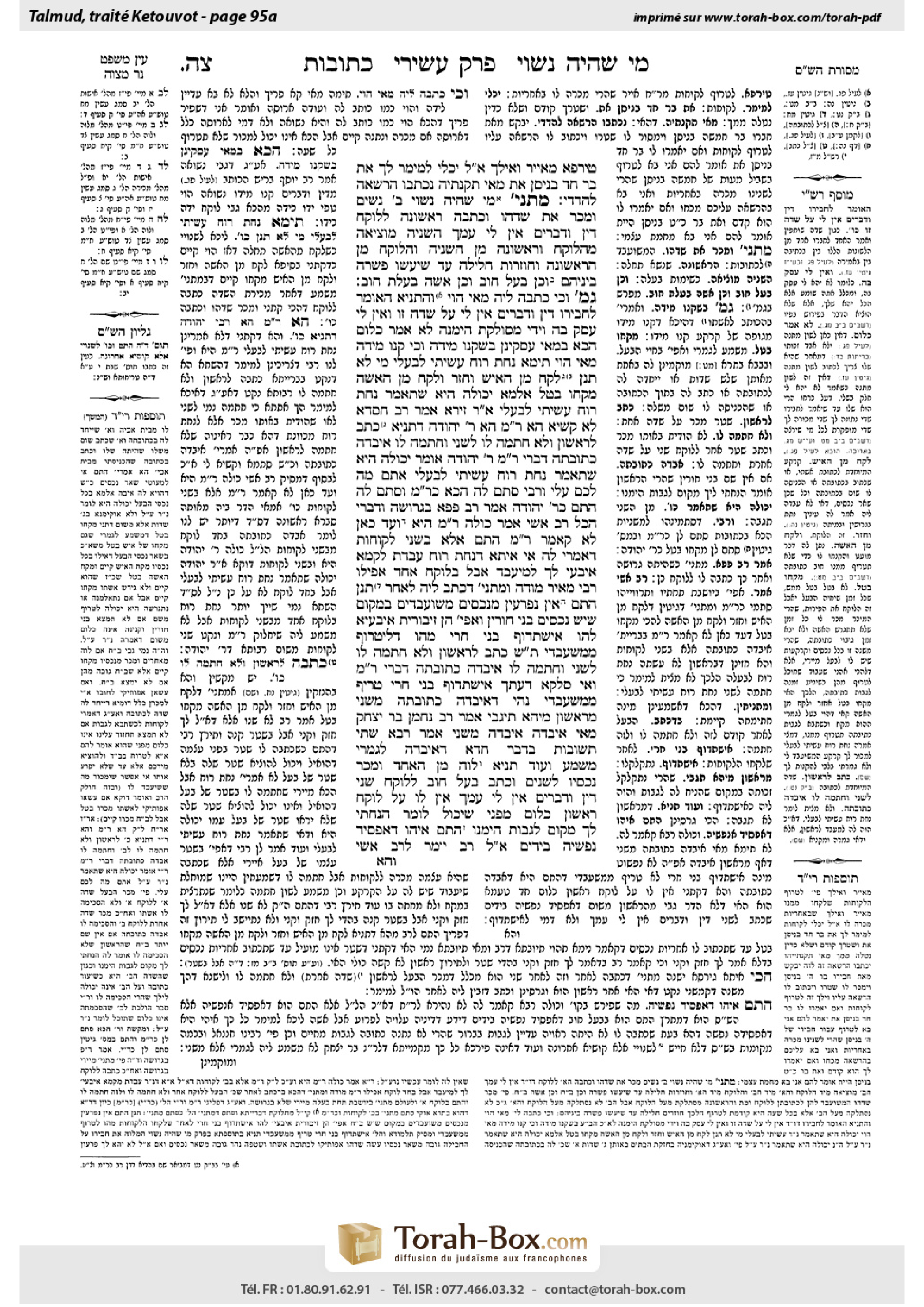
Ketubot 95a: Talmud study for Daf Yomi
Daf Yomi is the daily study of one Talmud folio. Explore 37 tractates with scans, Hebrew text, Sefaria English and AI-generated French translations where annotated.
Passage selection and English or AI-generated French translation are available where the scan has annotations. Daf Study is independent of Torah-Box and Sefaria.
Browse Ketubot · כתובות · All tractatesKetubot 95a text and translations
This page of Ketubot includes the Aramaic text, an English translation and an AI-generated French translation, alongside the scan above.
כתובות צ״ה א · Aramaic and Hebrew text
טִירְפָא מֵאִיָּיר וְאֵילָךְ. אֲמַר לֵיהּ: יָכְלִי לְמֵימַר לָךְ: אַתְּ בַּר חַד בְּנִיסָן אַתְּ.
מַאי תַּקַּנְתֵּיהּ? נִכְתְּבוּ הַרְשָׁאָה לַהֲדָדֵי.
מַתְנִי׳ מִי שֶׁהָיָה נָשׂוּי שְׁתֵּי נָשִׁים וּמָכַר אֶת שָׂדֵהוּ, וְכָתְבָה רִאשׁוֹנָה לַלּוֹקֵחַ ״דִּין וּדְבָרִים אֵין לִי עִמָּךְ״ — הַשְּׁנִיָּה מוֹצִיאָה מֵהַלּוֹקֵחַ, וְרִאשׁוֹנָה מִן הַשְּׁנִיָּה, וְהַלּוֹקֵחַ מִן הָרִאשׁוֹנָה. וְחוֹזְרוֹת חֲלִילָה, עַד שֶׁיַּעֲשׂוּ פְּשָׁרָה בֵּינֵיהֶם. וְכֵן בַּעַל חוֹב, וְכֵן אִשָּׁה בַּעֲלַת חוֹב.
גְּמָ׳ וְכִי כָּתְבָה לֵיהּ מַאי הָוֵי? וְהָתַנְיָא: הָאוֹמֵר לַחֲבֵירוֹ ״דִּין וּדְבָרִים אֵין לִי עַל שָׂדֶה זוֹ״, וְ״אֵין לִי עֵסֶק בָּהּ״, וְ״יָדַי מְסוּלָּקֹת הֵימֶנָּה״ — לֹא אָמַר כְּלוּם. הָכָא בְּמַאי עָסְקִינַן — בְּשֶׁקָּנוּ מִיָּדָהּ.
וְכִי קָנוּ מִיָּדָהּ מַאי הָוֵי? תֵּימָא: נַחַת רוּחַ עָשִׂיתִי לְבַעְלִי. מִי לָא תְּנַן: לָקַח מִן הָאִישׁ וְחָזַר וְלָקַח מִן הָאִשָּׁה — מִקָּחוֹ בָּטֵל. אַלְמָא: יְכוֹלָה הִיא שֶׁתֹּאמַר נַחַת רוּחַ עָשִׂיתִי לְבַעְלִי.
אָמַר רַבִּי זֵירָא אָמַר רַב חִסְדָּא, לָא קַשְׁיָא: הָא רַבִּי מֵאִיר, הָא רַבִּי יְהוּדָה.
דְּתַנְיָא: כָּתַב לָרִאשׁוֹן וְלֹא חָתְמָה לוֹ, לַשֵּׁנִי וְחָתְמָה לוֹ — אִיבְּדָה כְּתוּבָּתָהּ, דִּבְרֵי רַבִּי מֵאִיר.
רַבִּי יְהוּדָה אוֹמֵר, יְכוֹלָה הִיא שֶׁתֹּאמַר: ״נַחַת רוּחַ עָשִׂיתִי לְבַעְלִי, אַתֶּם מַה לָּכֶם עָלַי״?
וְרַבִּי, סָתֵם לַהּ הָכָא כְּרַבִּי מֵאִיר וְסָתֵם לַהּ הָתָם כְּרַבִּי יְהוּדָה?!
אָמַר רַב פָּפָּא: בִּגְרוּשָׁה, וְדִבְרֵי הַכֹּל.
רַב אָשֵׁי אָמַר: כּוּלַּהּ רַבִּי מֵאִיר הִיא, וְעַד כָּאן לָא קָאָמַר רַבִּי מֵאִיר הָתָם, אֶלָּא בִּשְׁנֵי לָקוֹחוֹת, דְּאָמְרִי לַהּ: אִי אִיתָא דְּנַחַת רוּחַ עֲבַדְתְּ — לְקַמָּא אִיבְּעִי לָךְ לְמִיעְבַּד. אֲבָל בְּלוֹקֵחַ אֶחָד, אֲפִילּוּ רַבִּי מֵאִיר מוֹדֶה. וּמַתְנִיתִין דִּכְתַב לֵיהּ לְאַחֵר.
תְּנַן הָתָם: אֵין נִפְרָעִין מִנְּכָסִים מְשׁוּעְבָּדִים בִּמְקוֹם שֶׁיֵּשׁ נְכָסִים בְּנֵי חוֹרִין, וַאֲפִילּוּ הֵן זִיבּוּרִית. אִיבַּעְיָא לְהוּ: אִישְׁתְּדוּף בְּנֵי חָרֵי, מַהוּ דְּלִיטְרוֹף מִמְּשַׁעְבְּדִי?
תָּא שְׁמַע: כָּתַב לָרִאשׁוֹן וְלֹא חָתְמָה לוֹ, לַשֵּׁנִי וְחָתְמָה לוֹ — אִיבְּדָה כְּתוּבָּתָהּ, דִּבְרֵי רַבִּי מֵאִיר.
וְאִי סָלְקָא דַּעְתָּךְ אִישְׁתְּדוּף בְּנֵי חָרֵי טָרֵיף מִמְּשַׁעְבְּדִי, נְהִי דְּאִיבְּדָה כְּתוּבָּתָהּ מִשֵּׁנִי — מֵרִאשׁוֹן מִיהָא תִּיגְבֵּי.
אָמַר רַב נַחְמָן בַּר יִצְחָק: מַאי ״אִיבְּדָה״ — אִיבְּדָה מִשֵּׁנִי.
אָמַר רָבָא: שְׁתֵּי תְּשׁוּבוֹת בַּדָּבָר, חֲדָא: דְּ״אִיבְּדָה״ לִגְמָרֵי מַשְׁמַע. וְעוֹד, תַּנְיָא: לָוָה מִן הָאֶחָד וּמָכַר נְכָסָיו לִשְׁנַיִם, וְכָתַב בַּעַל חוֹב לְלוֹקֵחַ שֵׁנִי: ״דִּין וּדְבָרִים אֵין לִי עִמָּךְ״ — אֵין לוֹ עַל לוֹקֵחַ רִאשׁוֹן כְּלוּם. מִפְּנֵי שֶׁיָּכוֹל לוֹמַר: הִנַּחְתִּי לְךָ מָקוֹם לִגְבּוֹת הֵימֶנּוּ.
הָתָם אִיהוּ דְּאַפְסֵיד נַפְשֵׁיהּ בְּיָדַיִם.
אֲמַר לֵיהּ רַב יֵימַר לְרַב אָשֵׁי:
Ketubot 95a · English translation
a document of authorization to repossess liened property of the seller from anyone who purchased property from him from the first of the month of Iyyar and on. Rav Yosef said to him: A purchaser can say to you: Your deed is from the first of Nisan, so that the field that you purchased is rightfully yours and it is the other man, whose deed was dated on the fifth of Nisan, who took it illegally. Therefore, you should take possession of that field rather than repossessing other property.
The Gemara asks: If so, what is his remedy? The Gemara answers: Let the deed holders write a document of authorization to each other. If the individual whose deed was written on the fifth of Nisan authorizes the other individual to repossess property on his behalf, then he will be able to repossess property sold after the end of Nisan, because regardless of when his deed was written and whose deed was written first, he now has the right to repossess liened property.
MISHNA: In a case of one who was married to two women and sold his field, and the wife whom he married first wrote to the purchaser: I do not have any legal dealings or involvement with you, then the second wife, who did not relinquish her claim to repossess this property, may appropriate the field from the purchaser as payment of her marriage contract. This is because the property was liened for the payment of her marriage contract before it was sold to this purchaser. Then, the first wife can appropriate the field from the second as payment for her marriage contract, since her marriage contract predates that of the second wife. The purchaser can then appropriate the field from the first wife, due to the fact that she relinquished her rights vis-à-vis the purchaser. They continue to do so according to this cycle [ḥalila] until they agree on a compromise between them. And so too, with regard to a creditor, and so too, with regard to a female creditor.
GEMARA: The Gemara asks: And if the first wife wrote this to him, what of it? Isn’t it taught in a baraita: One who says to another, e.g., if a field is jointly owned and one partner says to the other: I have no legal dealings or involvement with regard to this field, or: I have no connection to it, or: I have withdrawn from it, has said nothing, as such declarations have no legal validity. The Gemara answers: With what are we dealing here? It is a case where he acquired it from her possession by performing an act of acquisition in order to validate her relinquishing the field, in which case her statement is legally valid.
The Gemara asks: And if they acquired it from her, what of it? Let the woman say afterward: I did it only to please my husband, as I saw that he wished to sell the field and I did not want to quarrel with him, but I did not mean it seriously. Didn’t we learn in a mishna (Gittin 55b): If one purchased property from a man, even if he later went back and purchased rights to that property from the man’s wife, the transaction is nullified? Apparently, the wife can say: I did it only to please my husband but did not mean it, and that claim is accepted.
Rabbi Zeira said that Rav Ḥisda said: This is not difficult: This mishna here is in accordance with the opinion of Rabbi Meir, and that mishna in tractate Gittin is in accordance with the opinion of Rabbi Yehuda.
As it is taught in a baraita: In a case where a husband wrote a bill of sale to one purchaser, but his wife did not sign it for him because she did not agree to the sale, and later he sold a different property to a second purchaser, and this time his wife signed the bill of sale for him, the halakha is that she has lost the settlement promised to her in her marriage contract in the event that the husband is left without property from which she can collect; this is the statement of Rabbi Meir. According to Rabbi Meir, not only is the wife unable to sue the second purchaser after she signed his deed, but she cannot sue the first buyer either since he can say to her: When I purchased the field, I left you a field from which you could have collected, and you brought this loss upon yourself.
Rabbi Yehuda says that she can say: I did it only to please my husband but did not mean to ratify the second sale either; and you, what claim do you have against me?
The Gemara asks: Is it possible that Rabbi Yehuda HaNasi, the redactor of the Mishna, presented the unattributed mishna here in accordance with the opinion of Rabbi Meir and presented the unattributed mishna there in accordance with the opinion of Rabbi Yehuda? Such a dichotomy is unlikely.
Rav Pappa offered another answer to the question and said: The mishna here is referring to a divorcée who wrote a note to the purchaser relinquishing her rights to the field after her divorce, and everyone agrees that her statement is binding, as she cannot claim to have acted in order to please her husband.
Rav Ashi said: It is all in accordance with the opinion of Rabbi Meir, and Rabbi Meir states his opinion there only in a case where the husband sold property to two different purchasers, as they can say to her: If it is true that you acted only in order to please your husband, you should have done so with regard to the first purchaser and not just the second. However, in a case where there is only one purchaser, even Rabbi Meir concedes that she can claim to have acted only out of the desire to please her husband. And the mishna here is referring to a case where the husband previously wrote a bill of sale to another purchaser and the wife did not ratify the sale, and the second time he sold a property she did ratify the sale. Consequently, even Rabbi Meir concedes that the woman cannot claim that she acted only in order to please her husband.
§ We learned in a mishna elsewhere (Gittin 48b): One does not collect a debt from liened property that has been sold to a third party where there is unsold property available, even if the unsold property is of inferior quality. A dilemma was raised before the Sages: If the unsold property became blighted and is no longer of sufficient value to pay off the debt, what is the halakha? Would the creditor be allowed to repossess liened property that has been sold to a third party?
Come and hear a solution to this dilemma based upon the following baraita: In a case where a husband wrote a bill of sale to one purchaser, but his wife did not sign it for him, and later he sold a different property to a second purchaser and his wife signed the bill of sale for him, the halakha is that she has lost the settlement specified in her marriage contract in the event that the husband is left without property from which she can collect; this is the statement of Rabbi Meir.
Now, if it should enter your mind that in a case where the unsold property became blighted the creditor would be able to repossess liened property, then even though she lost her ability to collect her marriage contract from the second purchaser, she should at least be able to collect from the first purchaser, because she never relinquished her right to the property he purchased. Although there was unsold property left at the time that the first purchase was made, that property is inaccessible to her because she relinquished her right to it. Consequently, her inability to repossess property from the first purchaser indicates that it is not possible to repossess liened property in the event that unsold property is blighted.
Rav Naḥman bar Yitzḥak said: It is possible to explain that what Rabbi Meir meant when he said: She has lost her marriage contract, is that she has lost her rights from the second purchaser alone, but not from the first.
Rava said: There are two responses with which your statement can be rejected. One is that the expression: She has lost, indicates that she has lost her rights entirely, even with regard to the first purchaser. And furthermore, it is explicitly taught in a baraita: If an individual borrowed from one creditor and sold his property to two purchasers and the creditor wrote a note to the second purchaser saying: I do not have any legal dealings or involvement with you, he has no claims toward the first purchaser either. This is because the first purchaser is able to say to the creditor: I left you a place from where to collect your debt, since when I purchased the land, unsold property still remained in the debtor’s possession, and therefore you have no claims against me.
The Gemara rejects the attempt to solve the dilemma with regard to collecting from liened property when the unsold property was blighted: There, in the case of a woman or man who wrote to the second purchaser: I do not have any legal dealings or involvement with you, it is he who causes a loss to himself by his own direct action of signing away his rights. It cannot be proven what the halakha would be in the case of a blighted field, where the reason he cannot make use of the field is not due to his own action.
Rav Yeimar said to Rav Ashi:
Ketubot 95a · Traduction française (IA)
un acte d’autorisation permettant de reprendre un bien grevé du vendeur auprès de toute personne qui lui a acheté un bien à partir du premier jour du mois d’Iyyar. Rav Yosef lui dit : Un acquéreur peut te répondre : « Ton acte est daté du premier Nissan ; le champ que tu as acheté t’appartient donc légitimement, et c’est l’autre homme, dont l’acte est daté du cinq Nissan, qui l’a pris illégalement. » Tu devrais donc prendre possession de ce champ plutôt que de reprendre un autre bien.
La Guemara demande : Si tel est le cas, quel recours a-t-il ? La Guemara répond : Que les détenteurs des actes rédigent chacun un acte d’autorisation en faveur de l’autre. Si celui dont l’acte est daté du cinq Nissan autorise l’autre à reprendre des biens en son nom, celui-ci pourra reprendre les biens vendus après la fin du mois de Nissan, car, quelle que soit la date de son acte et quel que soit celui dont l’acte a été rédigé en premier, il a désormais le droit de reprendre des biens grevés.
Michna : Dans le cas d’un homme marié à deux femmes qui a vendu son champ, si la femme qu’il a épousée en premier écrit à l’acquéreur : « Je n’ai aucun recours juridique ni aucun lien avec vous », la seconde épouse, qui n’a pas renoncé à son droit de reprendre ce bien, peut reprendre le champ à l’acquéreur en paiement de sa ketouba. En effet, le bien était grevé en garantie du paiement de sa ketouba avant d’être vendu à cet acquéreur. La première épouse peut ensuite reprendre le champ à la seconde en paiement de sa ketouba, puisque la sienne est antérieure à celle de la seconde épouse. L’acquéreur peut alors reprendre le champ à la première épouse, car elle a renoncé à ses droits à son égard. Elles poursuivent ce cycle [ḥalila] jusqu’à ce qu’elles trouvent un compromis. Il en va de même pour un créancier, et aussi pour une créancière.
Guemara : La Guemara demande : Et si la première épouse lui a écrit cela, qu’est-ce que cela change ? N’est-il pas enseigné dans une baraïta : Celui qui dit à un autre — par exemple, lorsque deux personnes possèdent un champ en copropriété et que l’une dit à l’autre : « Je n’ai aucun recours juridique ni aucun lien avec ce champ », ou : « Je n’ai aucun lien avec lui », ou : « J’y renonce » — n’a rien dit, car de telles déclarations n’ont aucune valeur juridique. La Guemara répond : De quoi s’agit-il ici ? D’un cas où l’autre a acquis le champ d’elle au moyen d’un acte d’acquisition, afin de rendre sa renonciation au champ valide ; dans ce cas, sa déclaration est juridiquement valable.
La Guemara demande : Et si l’on a procédé à un acte d’acquisition auprès d’elle, qu’est-ce que cela change ? La femme pourrait ensuite dire : « Je l’ai fait uniquement pour faire plaisir à mon mari : j’ai vu qu’il souhaitait vendre le champ et je ne voulais pas me quereller avec lui, mais je ne le pensais pas sérieusement. » N’avons-nous pas appris dans une michna (Gittin 55b) : Si quelqu’un a acheté un bien à un homme, même s’il achète ensuite à l’épouse de cet homme des droits sur ce bien, la transaction est annulée ? Il semble donc que l’épouse puisse dire : « Je l’ai fait uniquement pour faire plaisir à mon mari, sans le penser sérieusement », et que cet argument soit accepté.
Rabbi Zeira a dit au nom de Rav Ḥisda : Il n’y a pas de difficulté : cette michna-ci suit l’opinion de Rabbi Meïr, tandis que cette michna-là, dans le traité Gittin, suit celle de Rabbi Yehouda.
Comme il est enseigné dans une baraïta : Dans le cas où un mari a rédigé un acte de vente en faveur d’un acquéreur, mais que son épouse ne l’a pas signé parce qu’elle n’était pas d’accord avec la vente, puis où il a vendu un autre bien à un second acquéreur et où son épouse a cette fois signé l’acte de vente, la halakha est qu’elle a perdu le droit au paiement prévu par sa ketouba dans l’éventualité où son mari se retrouverait sans bien sur lequel elle puisse exercer son recours. Telle est l’opinion de Rabbi Meïr. Selon Rabbi Meïr, non seulement l’épouse ne peut pas poursuivre le second acquéreur après avoir signé son acte, mais elle ne peut pas non plus poursuivre le premier acquéreur, car celui-ci peut lui dire : « Lorsque j’ai acheté le champ, je t’ai laissé un champ sur lequel tu aurais pu exercer ton recours ; c’est toi qui as provoqué cette perte. »
Rabbi Yehouda dit qu’elle peut répondre : « Je l’ai fait uniquement pour faire plaisir à mon mari, mais je n’avais pas non plus l’intention de ratifier la seconde vente ; et toi, quel recours as-tu contre moi ? »
La Guemara demande : Est-il possible que Rabbi Yehouda HaNassi, le rédacteur de la Michna, ait présenté ici une michna anonyme selon l’opinion de Rabbi Meïr et, là-bas, une michna anonyme selon celle de Rabbi Yehouda ? Une telle divergence paraît improbable.
Rav Pappa proposa une autre réponse à la question et dit : Cette michna-ci concerne une femme divorcée qui, après son divorce, a écrit à l’acquéreur un document par lequel elle renonçait à ses droits sur le champ. Tous conviennent que sa déclaration l’engage, puisqu’elle ne peut pas prétendre avoir agi pour faire plaisir à son mari.
Rav Ashi dit : Tout cela suit l’opinion de Rabbi Meïr, et Rabbi Meïr n’exprime là-bas son opinion que dans un cas où le mari a vendu des biens à deux acquéreurs différents, car ceux-ci peuvent lui dire : « S’il est vrai que tu n’as agi que pour faire plaisir à ton mari, tu aurais dû le faire à l’égard du premier acquéreur, et pas seulement du second. » Cependant, lorsqu’il n’y a qu’un seul acquéreur, même Rabbi Meïr reconnaît qu’elle peut prétendre avoir agi uniquement pour faire plaisir à son mari. Or, la michna-ci concerne un cas où le mari avait auparavant rédigé un acte de vente en faveur d’un autre acquéreur sans que son épouse ratifie la vente, puis où, lors de la vente suivante, elle l’a ratifiée. Par conséquent, même Rabbi Meïr reconnaît que la femme ne peut pas prétendre avoir agi uniquement pour faire plaisir à son mari.
§ Nous avons appris dans une michna ailleurs (Gittin 48b) : On ne recouvre pas une dette sur des biens grevés qui ont été vendus à un tiers lorsqu’il existe des biens invendus, même si ceux-ci sont de qualité inférieure. Les Sages ont soulevé un dilemme : Si les biens invendus se sont détériorés et n’ont plus une valeur suffisante pour rembourser la dette, quelle est la halakha ? Le créancier peut-il alors reprendre des biens grevés vendus à un tiers ?
Viens et entends une solution à ce dilemme, fondée sur la baraïta suivante : Dans le cas où un mari a rédigé un acte de vente en faveur d’un acquéreur sans que son épouse le signe, puis où il a vendu un autre bien à un second acquéreur et où son épouse a signé l’acte de vente, la halakha est qu’elle a perdu le droit au paiement prévu par sa ketouba dans l’éventualité où son mari se retrouverait sans bien sur lequel elle puisse exercer son recours. Telle est l’opinion de Rabbi Meïr.
Or, s’il fallait conclure que, lorsque les biens invendus se sont détériorés, le créancier peut reprendre des biens grevés, alors, bien qu’elle ait perdu le droit de recouvrer sa ketouba auprès du second acquéreur, elle devrait au moins pouvoir la recouvrer auprès du premier, puisqu’elle n’a jamais renoncé à son droit sur le bien que celui-ci a acheté. Certes, il restait des biens invendus au moment du premier achat, mais elle ne peut pas les saisir parce qu’elle a renoncé à ses droits sur eux. Par conséquent, le fait qu’elle ne puisse pas reprendre un bien au premier acquéreur indique qu’il n’est pas possible de reprendre des biens grevés lorsque les biens invendus se sont détériorés.
Rav Naḥman bar Yitzḥak dit : On peut expliquer que, lorsque Rabbi Meïr a dit : « Elle a perdu sa ketouba », il voulait dire qu’elle a perdu ses droits uniquement à l’égard du second acquéreur, mais pas du premier.
Rava dit : Il y a deux réponses permettant de réfuter ton propos. Premièrement, l’expression « elle a perdu » indique qu’elle a entièrement perdu ses droits, y compris à l’égard du premier acquéreur. De plus, il est explicitement enseigné dans une baraïta : Si un homme a emprunté auprès d’un créancier, puis a vendu ses biens à deux acquéreurs, et que le créancier a écrit au second acquéreur : « Je n’ai aucun recours juridique ni aucun lien avec vous », il n’a pas non plus de recours contre le premier acquéreur. En effet, le premier acquéreur peut dire au créancier : « Je t’ai laissé un bien sur lequel recouvrer ta dette, puisque, lorsque j’ai acheté le terrain, il restait des biens invendus en possession du débiteur ; tu n’as donc aucun recours contre moi. »
La Guemara rejette la tentative de résoudre le dilemme concernant le recouvrement sur des biens grevés lorsque les biens invendus se sont détériorés : Dans le cas d’une femme ou d’un homme qui a écrit au second acquéreur : « Je n’ai aucun recours juridique ni aucun lien avec vous », c’est lui-même qui provoque sa propre perte en renonçant directement à ses droits par sa signature. On ne peut donc pas en déduire quelle serait la halakha dans le cas de biens détériorés, où l’impossibilité d’y recourir n’est pas due à sa propre action.
Rav Yeimar dit à Rav Ashi :
Traduction française générée par IA à partir de l’édition anglaise de Sefaria. Vérifie toujours un passage avec le texte source.
Text from Sefaria: William Davidson Edition - Vocalized Aramaic (CC BY NC); William Davidson Edition - English (CC BY NC).