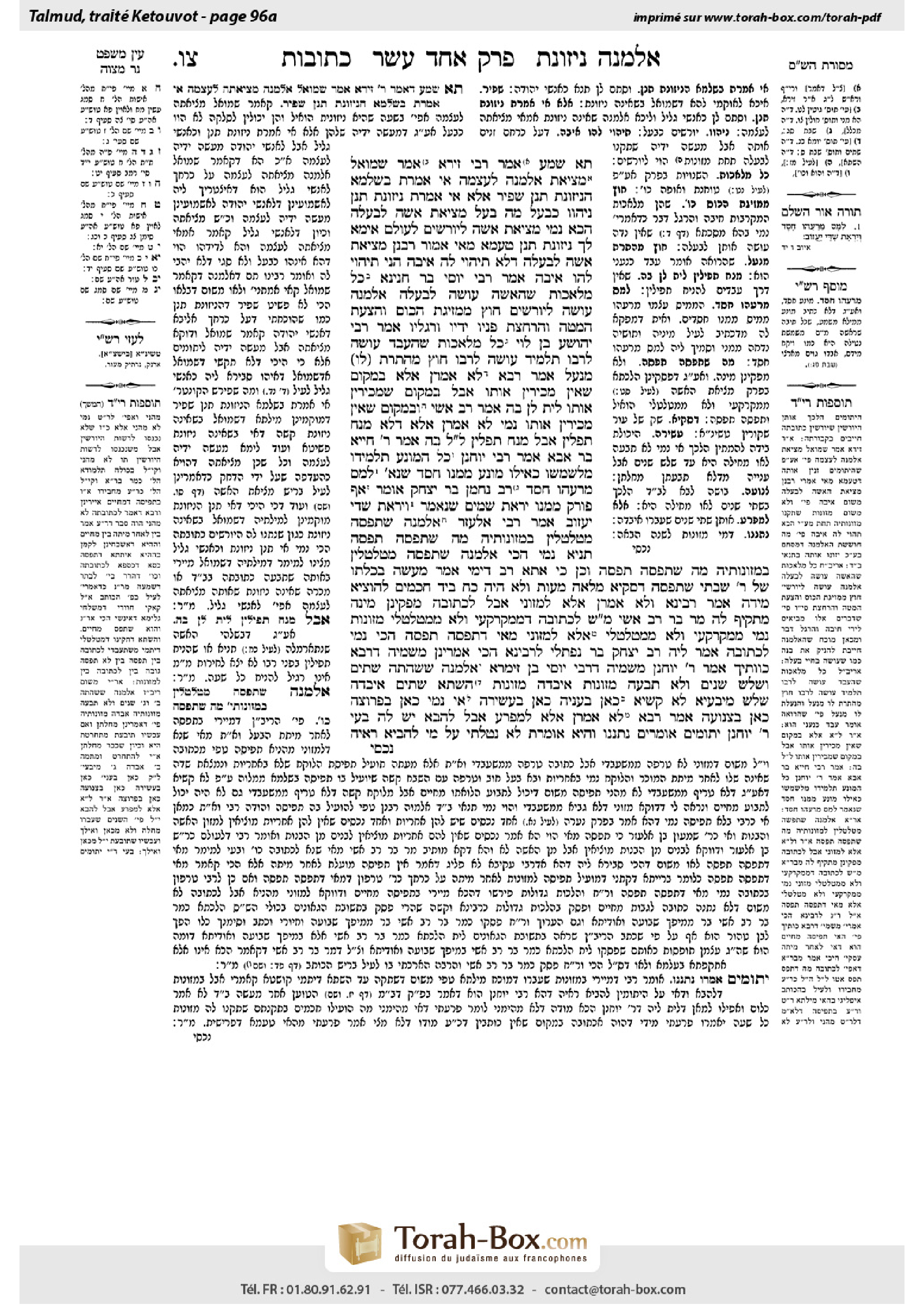
Ketubot 96a: Talmud study for Daf Yomi
Daf Yomi is the daily study of one Talmud folio. Explore 37 tractates with scans, Hebrew text, Sefaria English and AI-generated French translations where annotated.
Passage selection and English or AI-generated French translation are available where the scan has annotations. Daf Study is independent of Torah-Box and Sefaria.
Browse Ketubot · כתובות · All tractatesKetubot 96a text and translations
This page of Ketubot includes the Aramaic text, an English translation and an AI-generated French translation, alongside the scan above.
כתובות צ״ו א · Aramaic and Hebrew text
תָּא שְׁמַע, אָמַר רַבִּי זֵירָא אָמַר שְׁמוּאֵל: מְצִיאַת אַלְמָנָה לְעַצְמָהּ. אִי אָמְרַתְּ בִּשְׁלָמָא ״הַנִּיזּוֹנֶת״ תְּנַן — שַׁפִּיר. אֶלָּא אִי אָמְרַתְּ ״נִיזּוֹנֶת״ תְּנַן, נִיהְווֹ כְּבַעַל: מָה בַּעַל מְצִיאַת אִשָּׁה לְבַעְלָהּ, הָכָא נָמֵי מְצִיאַת אִשָּׁה לַיּוֹרְשִׁים!
לְעוֹלָם אֵימָא לָךְ: ״נִיזּוֹנֶת״ תְּנַן: טַעְמָא מַאי אֲמוּר רַבָּנַן מְצִיאַת אִשָּׁה לְבַעְלָהּ — דְּלָא תֶּיהְוֵי לַהּ אֵיבָה. הָנֵי — תֶּיהְוֵי לְהוּ אֵיבָה.
אָמַר רַבִּי יוֹסֵי בַּר חֲנִינָא: כׇּל מְלָאכוֹת שֶׁהָאִשָּׁה עוֹשָׂה לְבַעְלָהּ, אַלְמָנָה עוֹשָׂה לַיּוֹרְשִׁים, חוּץ מִמְּזִיגַת הַכּוֹס וְהַצָּעַת הַמִּטָּה וְהַרְחָצַת פָּנָיו יָדָיו וְרַגְלָיו.
אָמַר רַבִּי יְהוֹשֻׁעַ בֶּן לֵוִי: כׇּל מְלָאכוֹת שֶׁהָעֶבֶד עוֹשֶׂה לְרַבּוֹ — תַּלְמִיד עוֹשֶׂה לְרַבּוֹ, חוּץ מֵהַתָּרַת (לוֹ) מִנְעָל.
אָמַר רָבָא: לָא אֲמַרַן אֶלָּא בִּמְקוֹם שֶׁאֵין מַכִּירִין אוֹתוֹ, אֲבָל בִּמְקוֹם שֶׁמַּכִּירִין אוֹתוֹ לֵית לַן בַּהּ. אָמַר רַב אָשֵׁי: וּבִמְקוֹם שֶׁאֵין מַכִּירִין אוֹתוֹ נָמֵי, לָא אֲמַרַן אֶלָּא דְּלָא מַנַּח תְּפִלִּין, אֲבָל מַנַּח תְּפִלִּין — לֵית לַן בַּהּ.
אָמַר רַבִּי חִיָּיא בַּר אַבָּא אָמַר רַבִּי יוֹחָנָן: כׇּל הַמּוֹנֵעַ תַּלְמִידוֹ מִלְּשַׁמְּשׁוֹ — כְּאִילּוּ מוֹנֵעַ מִמֶּנּוּ חֶסֶד, שֶׁנֶּאֱמַר: ״לַמָּס מֵרֵעֵהוּ חָסֶד״. רַב נַחְמָן בַּר יִצְחָק אוֹמֵר: אַף פּוֹרֵק מִמֶּנּוּ יִרְאַת שָׁמַיִם, שֶׁנֶּאֱמַר: ״וְיִרְאַת שַׁדַּי יַעֲזוֹב״.
אָמַר רַבִּי אֶלְעָזָר: אַלְמָנָה שֶׁתָּפְסָה מִטַּלְטְלִין בִּמְזוֹנוֹתֶיהָ — מַה שֶּׁתָּפְסָה תָּפְסָה. תַּנְיָא נָמֵי הָכִי: אַלְמָנָה שֶׁתָּפְסָה מִטַּלְטְלִין בִּמְזוֹנוֹתֶיהָ — מַה שֶּׁתָּפְסָה תָּפְסָה.
וְכֵן כִּי אֲתָא רַב דִּימִי, אָמַר: מַעֲשֶׂה בְּכַלָּתוֹ שֶׁל רַבִּי שַׁבְּתַי שֶׁתָּפְסָה דִּסַקַּיָּא מְלֵאָה מָעוֹת, וְלֹא הָיָה כֹּחַ בְּיַד חֲכָמִים לְהוֹצִיא מִיָּדָהּ.
אָמַר רָבִינָא: וְלָא אֲמַרַן אֶלָּא לִמְזוֹנֵי, אֲבָל לִכְתוּבָּה — מַפְּקִינַן מִינַּהּ.
מַתְקֵיף לַהּ מָר בַּר רַב אָשֵׁי: מַאי שְׁנָא לִכְתוּבָּה, דְּמִמְּקַרְקְעֵי וְלָא מִמִּטַּלְטְלִי? מְזוֹנוֹת נָמֵי מִמְּקַרְקְעֵי וְלָא מִמִּטַּלְטְלִי! אֶלָּא לִמְזוֹנֵי — מַאי דְּתָפְסָה תָּפְסָה, הָכִי נָמֵי לִכְתוּבָּה!
אֲמַר לֵיהּ רַב יִצְחָק בַּר נַפְתָּלִי לְרָבִינָא: הָכִי אָמְרִינַן מִשְּׁמֵיהּ דְּרָבָא כְּווֹתָיךְ.
אָמַר רַבִּי יוֹחָנָן מִשְּׁמֵיהּ דְּרַבִּי יוֹסֵי בֶּן זִימְרָא: אַלְמָנָה שֶׁשָּׁהֲתָה שְׁתַּיִם וְשָׁלֹשׁ שָׁנִים וְלֹא תָּבְעָה מְזוֹנוֹת — אִיבְּדָה מְזוֹנוֹת.
הַשְׁתָּא שְׁתַּיִם — אִיבְּדָה, שָׁלֹשׁ מִיבַּעְיָא?! לָא קַשְׁיָא: כָּאן בַּעֲנִיָּה, כָּאן בַּעֲשִׁירָה.
אִי נָמֵי: כָּאן בִּפְרוּצָה, כָּאן בִּצְנוּעָה.
אָמַר רָבָא: לָא אֲמַרַן אֶלָּא לְמַפְרֵעַ, אֲבָל לְהַבָּא יֵשׁ לָהּ.
בָּעֵי רַבִּי יוֹחָנָן: יְתוֹמִים אוֹמְרִים נָתַנְנוּ, וְהִיא אוֹמֶרֶת לֹא נָטַלְתִּי, עַל מִי לְהָבִיא רְאָיָה?
Ketubot 96a · English translation
The Gemara suggests: Come and hear a proof from that which Rabbi Zeira said that Shmuel said: Any lost article found by the widow she acquires for herself. Granted, if you say that we learned in the mishna: A widow who is sustained, Shmuel’s principle is well understood. Then, according to the mishna, there are cases where a widow is supported by her husband’s heirs and other cases where she is not. Shmuel is referring to a case where the heirs do not sustain her, and therefore any earnings and articles that she may find belong to her. However, if you say that we learned in the mishna: A widow is sustained by the heirs in place of her husband, then let the heirs be like the husband in every sense. Just as in the case of the husband, any lost article found by the wife belongs to the husband, here too, any lost article found by the widowed wife should belong to the heirs.
The Gemara rejects this proof: Actually, I will say to you that we learned in the mishna: A widow is sustained, and this does not contradict Shmuel’s statement. What is the reason that the Sages said that any lost article found by the wife belongs to her husband? It is so that she should not be subject to her husband’s enmity. The Sages were concerned that if the husband saw that his wife had come into possession of money and did not know the source of that money, they would quarrel. However, these heirs, let them have enmity toward the widow.
Rabbi Yosei bar Ḥanina said: All tasks that a wife performs for her husband, a widow performs for the husband’s heirs, except for filling his cup; and making his bed; and washing his face, hands, and feet, which are expressions of affection that a woman performs specifically for her husband.
Rabbi Yehoshua ben Levi said: All tasks that a Canaanite slave performs for his master, a student performs for his teacher, except for untying his shoe, a demeaning act that was typically performed by slaves and would not be appropriate for a student to do.
Rava said: We said this only if the teacher and the student are in a place where people are not familiar with the student and he could be mistaken for a slave. However, in a place where people are familiar with the student, we have no problem with it as everyone knows that he is not a slave. Rav Ashi said: And in a place where people are not familiar with the student, we said this halakha only if he is not donning phylacteries, but if he is donning phylacteries, we have no problem with it. A slave does not don phylacteries, and since this student is donning phylacteries, even if he unties his teacher’s shoes he will not be mistaken for a slave.
Rabbi Ḥiyya bar Abba said that Rabbi Yoḥanan said: Anyone who prevents his student from serving him, it is as if he withheld from him kindness, as it is stated: “To him that is ready to faint [lamas], from his friend kindness is due” (Job 6:14). Rabbi Yoḥanan interprets this to mean that one who prevents [memis] another from performing acts on his behalf, prevents him from performing the mitzva of kindness. Rav Naḥman bar Yitzḥak says: He even removes from the student the fear of Heaven, as it is stated in the continuation of the verse: “Even to one who forsakes the fear of the Almighty.”
Rabbi Elazar said: In the case of a widow who seized movable property for her sustenance, that which she seized, she seized and it remains in her possession. That halakha is also taught in a baraita: A widow who seized movable property to provide for her sustenance, that which she seized, she seized.
And likewise, when Rav Dimi came from Eretz Yisrael he said: There was an incident involving Rabbi Shabbtai’s daughter-in-law, who seized a saddlebag [diskayya] full of coins for her sustenance, and the Sages did not have the authority to remove it from her possession.
Ravina said: We said the halakha that we do not remove from her possession that which she seized only in a case where she seized the assets for her sustenance. However, if she seized the assets as payment of her marriage contract, we remove it from her.
Mar bar Rav Ashi objects to this: What is different about seizing assets as payment of her marriage contract, that they are removed from her possession? If it is that a marriage contract is paid only from real estate and not from movable property, there is a rabbinic enactment that sustenance is also paid only from real estate and not from movable property. Rather, just as you say that if she seizes assets for her sustenance, that which she seized, she seized, so too, her seizure is effective if she does so as payment of her marriage contract.
Rav Yitzḥak bar Naftali said to Ravina: We say this halakha in the name of Rava, in accordance with your teaching that if she seized movable property as payment of her marriage contract, it is removed from her possession.
Rabbi Yoḥanan said in the name of Rabbi Yosei ben Zimra: A widow who waited two or three years after her husband’s death and did not demand sustenance from the heirs has forfeited the right to receive sustenance from them. Since she did not demand her sustenance, it is assumed that she must have forgone this right.
The Gemara discusses the language of Rabbi Yosei ben Zimra’s statement: Now that it was stated that after two years she forfeited her rights to receive sustenance, is it necessary to state that she also forfeited her rights after three years? The Gemara answers: This is not difficult. Here, the first statement is referring to a poor woman for which two years is a long time. If she does not demand sustenance for two years, it is clear that she has forgiven the heirs this obligation. There, the second statement is referring to a rich woman who can support herself for two years. It is only clear after three years that she forgave the obligation.
Alternatively, here it is referring to an unabashed woman, who is not ashamed to demand her rights from the heirs. If she does not demand sustenance within two years, it is assumed that she has forgone this right. There, it is referring to a modest woman, who is embarrassed to demand sustenance from the heirs and who waits until the third year to claim this right.
Rava said: We said this halakha only retroactively; the widow cannot demand to be reimbursed for the past years in which she paid for her own sustenance. However, from here onward, once she demands sustenance she has the right to receive it from the heirs.
Rabbi Yoḥanan raises a dilemma: If the orphans say: We gave her sustenance, and she says: I took none, upon whom is it incumbent to bring proof to support his argument?
Ketubot 96a · Traduction française (IA)
La Guemara propose : « Viens et écoute » une preuve de ce que Rabbi Zeira a dit au nom de Shmuel : tout objet perdu que trouve une veuve lui appartient. Certes, si l’on dit que nous avons appris dans la Michna : « Une veuve qui est entretenue », le principe de Shmuel se comprend bien. En effet, selon la Michna, il existe des cas où une veuve est entretenue par les héritiers de son mari et d’autres où elle ne l’est pas. Shmuel parle d’un cas où les héritiers ne l’entretiennent pas ; par conséquent, ses gains et les objets qu’elle trouve lui appartiennent. Mais si l’on dit que nous avons appris dans la Michna : « Une veuve est entretenue par les héritiers à la place de son mari », alors les héritiers devraient être assimilés au mari à tous égards. De même que, dans le cas du mari, tout objet perdu que trouve sa femme appartient au mari, de même, ici, tout objet perdu que trouve la veuve devrait appartenir aux héritiers.
La Guemara rejette cette preuve : En réalité, je te dirai que nous avons appris dans la Michna : « Une veuve est entretenue », et cela ne contredit pas la déclaration de Shmuel. Pourquoi les Sages ont-ils dit que tout objet perdu que trouve une femme appartient à son mari ? Afin qu’elle ne soit pas exposée à l’hostilité de son mari. Les Sages craignaient que, si le mari voyait que sa femme avait reçu de l’argent sans en connaître la provenance, ils ne se disputent. Mais ces héritiers, qu’ils soient hostiles à la veuve !
Rabbi Yosei bar Ḥanina a dit : La veuve accomplit pour les héritiers de son mari toutes les tâches qu’une femme accomplit pour son mari, à l’exception de lui remplir sa coupe, de faire son lit et de lui laver le visage, les mains et les pieds, gestes d’affection qu’une femme accomplit spécifiquement pour son mari.
Rabbi Yehoshua ben Levi a dit : L’élève accomplit pour son maître toutes les tâches qu’un esclave cananéen accomplit pour son maître, à l’exception de lui délacer sa chaussure, acte dégradant habituellement accompli par les esclaves et qui ne conviendrait pas à un élève.
Rava a dit : Nous n’avons énoncé cette règle que si le maître et l’élève se trouvent dans un endroit où les gens ne connaissent pas l’élève et pourraient le prendre pour un esclave. Mais dans un endroit où les gens le connaissent, cela ne pose aucun problème, puisque tous savent qu’il n’est pas un esclave. Rav Ashi a dit : Et dans un endroit où les gens ne connaissent pas l’élève, nous n’avons énoncé cette halakha que s’il ne porte pas les téfilines. Mais s’il les porte, cela ne pose aucun problème. Un esclave ne porte pas les téfilines ; puisque cet élève les porte, même s’il délace les chaussures de son maître, on ne le prendra pas pour un esclave.
Rabbi Ḥiyya bar Abba a dit au nom de Rabbi Yoḥanan : Quiconque empêche son élève de le servir, c’est comme s’il le privait de bonté, ainsi qu’il est dit : « À celui qui défaille [lamas], son ami doit la bonté » (Job 6,14). Rabbi Yoḥanan comprend ainsi ce verset : celui qui empêche [memis] autrui d’accomplir des actes en sa faveur l’empêche d’accomplir la mitsva de bonté. Rav Naḥman bar Yitzḥak dit : Il le prive même de la crainte du Ciel, ainsi qu’il est dit dans la suite du verset : « même envers celui qui abandonne la crainte du Tout-Puissant ».
Rabbi Elazar a dit : Dans le cas d’une veuve qui s’est emparée de biens mobiliers pour assurer sa subsistance, ce dont elle s’est emparée, elle le garde et le conserve en sa possession. Cette halakha est également enseignée dans une baraïta : Une veuve qui s’est emparée de biens mobiliers pour assurer sa subsistance, ce dont elle s’est emparée, elle le garde.
De même, lorsque Rav Dimi vint d’Eretz Israël, il dit : Il y eut un incident concernant la belle-fille de Rabbi Shabbtai, qui s’empara d’une sacoche [diskayya] pleine de pièces pour assurer sa subsistance, et les Sages n’eurent pas le pouvoir de la lui retirer.
Ravina a dit : Nous n’avons énoncé la halakha selon laquelle on ne lui retire pas ce dont elle s’est emparée que dans le cas où elle s’est emparée des biens pour assurer sa subsistance. Mais si elle s’en est emparée en paiement de sa ketouba, on le lui retire.
Mar bar Rav Ashi objecte : En quoi le fait de s’emparer de biens en paiement de sa ketouba diffère-t-il, pour qu’on les lui retire ? Si c’est parce qu’une ketouba n’est payée qu’au moyen de biens immobiliers, et non de biens mobiliers, il existe aussi un décret rabbinique selon lequel la subsistance n’est payée qu’au moyen de biens immobiliers, et non de biens mobiliers. Au contraire, de même que tu dis que, si elle s’empare de biens pour assurer sa subsistance, ce dont elle s’est emparée, elle le garde, de même, sa prise est valable si elle agit en paiement de sa ketouba.
Rav Yitzḥak bar Naftali dit à Ravina : Nous énonçons cette halakha au nom de Rava, conformément à ton enseignement selon lequel, si elle s’est emparée de biens mobiliers en paiement de sa ketouba, on les lui retire.
Rabbi Yoḥanan a dit au nom de Rabbi Yosei ben Zimra : Une veuve qui a attendu deux ou trois ans après la mort de son mari sans réclamer aux héritiers de quoi assurer sa subsistance a perdu le droit de recevoir d’eux cette subsistance. Puisqu’elle ne l’a pas réclamée, on suppose qu’elle a renoncé à ce droit.
La Guemara examine la formulation de la déclaration de Rabbi Yosei ben Zimra : Dès lors qu’il a été dit qu’après deux ans elle a perdu le droit de recevoir sa subsistance, est-il nécessaire de préciser qu’elle l’a également perdu après trois ans ? La Guemara répond : Il n’y a pas de difficulté. Ici, la première déclaration concerne une femme pauvre, pour qui deux ans constituent une longue période. Si elle ne réclame pas sa subsistance pendant deux ans, il est clair qu’elle a libéré les héritiers de cette obligation. Là, la seconde déclaration concerne une femme riche, qui peut subvenir à ses besoins pendant deux ans. Ce n’est qu’après trois ans qu’il est clair qu’elle a renoncé à cette obligation.
Autre possibilité : ici, il s’agit d’une femme sans gêne, qui n’a pas honte de réclamer ses droits aux héritiers. Si elle ne réclame pas sa subsistance dans les deux ans, on suppose qu’elle a renoncé à ce droit. Là, il s’agit d’une femme pudique, qui est gênée de réclamer sa subsistance aux héritiers et attend la troisième année pour faire valoir ce droit.
Rava a dit : Nous n’avons énoncé cette halakha que pour le passé : la veuve ne peut pas demander à être remboursée des années antérieures pendant lesquelles elle a payé elle-même sa subsistance. Mais à partir de maintenant, dès qu’elle réclame sa subsistance, elle a le droit de la recevoir des héritiers.
Rabbi Yoḥanan soulève un dilemme : Si les orphelins disent : « Nous lui avons fourni sa subsistance », et qu’elle dit : « Je n’ai rien reçu », à qui incombe-t-il d’apporter une preuve à l’appui de son affirmation ?
Traduction française générée par IA à partir de l’édition anglaise de Sefaria. Vérifie toujours un passage avec le texte source.
Text from Sefaria: William Davidson Edition - Vocalized Aramaic (CC BY NC); William Davidson Edition - English (CC BY NC).