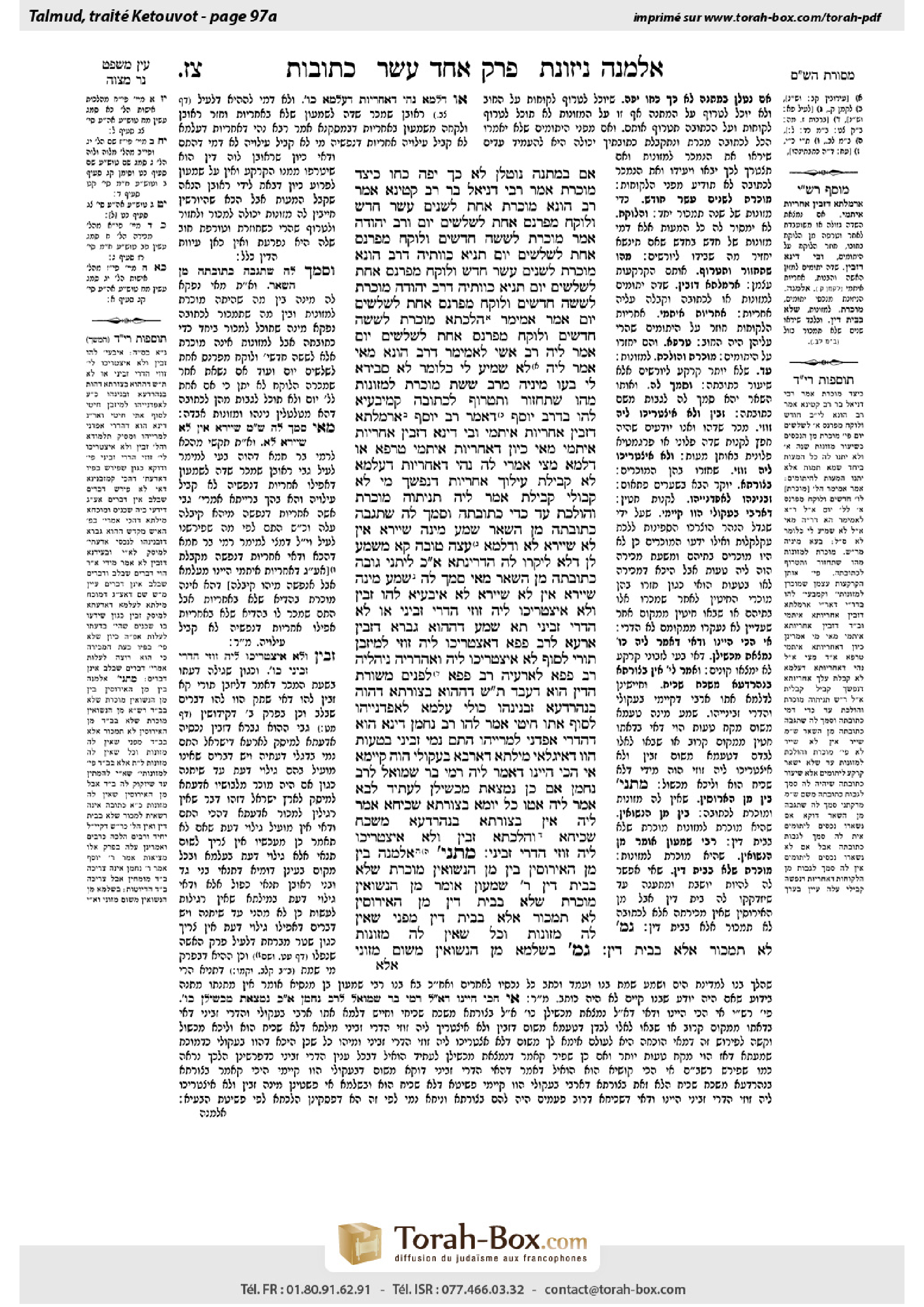
Ketubot 97a: Talmud study for Daf Yomi
Daf Yomi is the daily study of one Talmud folio. Explore 37 tractates with scans, Hebrew text, Sefaria English and AI-generated French translations where annotated.
Passage selection and English or AI-generated French translation are available where the scan has annotations. Daf Study is independent of Torah-Box and Sefaria.
Browse Ketubot · כתובות · All tractatesKetubot 97a text and translations
This page of Ketubot includes the Aramaic text, an English translation and an AI-generated French translation, alongside the scan above.
כתובות צ״ז א · Aramaic and Hebrew text
אִם בְּמַתָּנָה נוֹטְלָן לֹא כָּךְ יָפֶה כֹּחוֹ.
כֵּיצַד מוֹכֶרֶת? אָמַר רַבִּי דָּנִיאֵל בַּר רַב קַטִּינָא אָמַר רַב הוּנָא: מוֹכֶרֶת אַחַת לִשְׁנֵים עָשָׂר חֹדֶשׁ, וְלוֹקֵחַ מְפַרְנֵס אַחַת לִשְׁלשִׁים יוֹם. וְרַב יְהוּדָה אָמַר: מוֹכֶרֶת לְשִׁשָּׁה חֳדָשִׁים, וְלוֹקֵחַ מְפַרְנֵס אַחַת לִשְׁלשִׁים יוֹם.
תַּנְיָא כְּווֹתֵיהּ דְּרַב הוּנָא: מוֹכֶרֶת לִשְׁנֵים עָשָׂר חֹדֶשׁ, וְלוֹקֵחַ מְפַרְנֵס אַחַת לִשְׁלשִׁים יוֹם. תַּנְיָא כְּווֹתֵיהּ דְּרַב יְהוּדָה: מוֹכֶרֶת לְשִׁשָּׁה חֳדָשִׁים, וְלוֹקֵחַ מְפַרְנֵס אַחַת לִשְׁלשִׁים יוֹם.
אָמַר אַמֵּימָר, הִלְכְתָא: מוֹכֶרֶת לְשִׁשָּׁה חֳדָשִׁים וְלוֹקֵחַ מְפַרְנֵס אַחַת לִשְׁלשִׁים יוֹם. אֲמַר לֵיהּ רַב אָשֵׁי לְאַמֵּימָר: דְּרַב הוּנָא מַאי? אֲמַר לֵיהּ: לָא שְׁמִיעַ לִי, כְּלוֹמַר: לָא סְבִירָא לִי.
בְּעוֹ מִינֵּיהּ מֵרַב שֵׁשֶׁת: מוֹכֶרֶת לִמְזוֹנוֹת, מַהוּ שֶׁתַּחֲזוֹר וְתִטְרוֹף לִכְתוּבָּה?
קָמִיבַּעְיָא לְהוּ בִּדְרַב יוֹסֵף. דְּאָמַר רַב יוֹסֵף: אַרְמַלְתָּא דְּזַבֵּין — אַחְרָיוּת אַיַּתְמֵי, וּבֵי דִינָא דְּזַבֵּין — אַחְרָיוּת אַיַּתְמֵי. מַאי?
כֵּיוָן דְּאַחְרָיוּת אַיַּתְמֵי, טָרְפָא, אוֹ דִלְמָא מָצֵי אָמְרִי לַהּ: נְהִי דְּאַחְרָיוּת דְּעָלְמָא לָא קַבֵּילְתְּ עִילָּוָךְ, אַחְרָיוּת דְּנַפְשָׁךְ מִי לָא קַבּוֹלֵי קַבֵּילְתְּ?
אֲמַר לֵיהּ, תְּנֵיתוּהָ: מוֹכֶרֶת וְהוֹלֶכֶת עַד כְּדֵי כְתוּבָּתָהּ, וְסֶמֶךְ לָהּ שֶׁתִּגְבֶּה כְּתוּבָּתָהּ מִן הַשְּׁאָר. שְׁמַע מִינַּהּ: שַׁיַּירָא — אִין, לָא שַׁיַּירָא — לָא.
וְדִלְמָא עֵצָה טוֹבָה קָא מַשְׁמַע לַן, דְּלָא לִיקְרוֹ לַהּ הַדְרָנִיתָא. אִם כֵּן, לִיתְנֵי: ״גּוֹבָה כְּתוּבָּתָהּ מִן הַשְּׁאָר״, מַאי ״סֶמֶךְ לָהּ״? שְׁמַע מִינַּהּ: שַׁיַּירָא — אִין, לָא שַׁיַּירָא — לָא.
אִיבַּעְיָא לְהוּ: זַבֵּין וְלָא אִיצְטְרִיכוּ לֵיהּ זוּזֵי, הָדְרִי זְבִינֵי, אוֹ לָא הָדְרִי זְבִינֵי?
תָּא שְׁמַע: דְּהָהוּא גַּבְרָא דְּזַבֵּין אַרְעָא לְרַב פָּפָּא, דְּאִצְטְרִיכוּ לֵיהּ זוּזֵי לְמִיזְבַּן תּוֹרֵי. לְסוֹף לָא אִיצְטְרִיכוּ לֵיהּ, וְאַהְדְּרַיהּ נִיהֲלֵיהּ רַב פָּפָּא לְאַרְעֵיהּ. רַב פָּפָּא לִפְנִים מִשּׁוּרַת הַדִּין הוּא דַּעֲבַד.
תָּא שְׁמַע: דְּהָהוּא בִּצּוּרְתָּא דַּהֲוָת בִּנְהַרְדְּעָא, זַבְּנִינְהוּ כּוּלֵּי עָלְמָא לְאַפַּדְנַיְיהוּ, לְסוֹף אֲתוֹ חִיטֵּי. אֲמַר לְהוּ רַב נַחְמָן: דִּינָא הוּא דְּהָדְרִי אַפַּדְנֵי לְמָרַיְיהוּ.
הָתָם נָמֵי: זְבִינֵי בְּטָעוּת הֲווֹ, דְּאִיגַּלַּאי מִילְּתָא דְּאַרְבָּא בְּעִקּוּלֵי הֲוָה קָיְימָא.
אִי הָכִי, הַיְינוּ דַּאֲמַר לֵיהּ רָמֵי בַּר שְׁמוּאֵל לְרַב נַחְמָן: אִם כֵּן נִמְצֵאתָ מַכְשִׁילָן לֶעָתִיד לָבֹא! אֲמַר לֵיהּ: אַטּוּ כׇּל יוֹמָא בִּצּוּרְתָּא שְׁכִיחָא? אֲמַר לֵיהּ: אִין, בִּצּוּרְתָּא בִּנְהַרְדְּעָא מִשְׁכָּח שְׁכִיחָא.
וְהִלְכְתָא: זַבֵּין וְלָא אִיצְטְרִיכוּ לֵיהּ זוּזֵי — הָדְרִי זְבִינֵי.
מַתְנִי׳ אַלְמָנָה, בֵּין מִן הָאֵירוּסִין בֵּין מִן הַנִּשּׂוּאִין — מוֹכֶרֶת שֶׁלֹּא בְּבֵית דִּין.
רַבִּי שִׁמְעוֹן אוֹמֵר: מִן הַנִּשּׂוּאִין מוֹכֶרֶת שֶׁלֹּא בְּבֵית דִּין, מִן הָאֵירוּסִין לֹא תִּמְכּוֹר אֶלָּא בְּבֵית דִּין, מִפְּנֵי שֶׁאֵין לָהּ מְזוֹנוֹת. וְכֹל שֶׁאֵין לָהּ מְזוֹנוֹת — לֹא תִּמְכּוֹר אֶלָּא בְּבֵית דִּין.
גְּמָ׳ בִּשְׁלָמָא מִן הַנִּשּׂוּאִין — מִשּׁוּם מְזוֹנֵי,
Ketubot 97a · English translation
If he takes it as a gift, his power as a creditor is not enhanced in this manner. He is not served well because he would not be able to seize property sold to a third party in order to receive his gift. So too, the widow can sell property and then decide later for what purpose she sold it.
§ The Gemara asks: How does a widow sell property to earn money for her support? Rabbi Daniel bar Rav Ketina said that Rav Huna said: She sells her late husband’s property once every twelve months and the buyer who purchased the property from her provides her with money once every thirty days. And Rav Yehuda said: She sells once every six months and the buyer provides her with money once every thirty days.
The Gemara notes: It is taught in a baraita in accordance with the opinion of Rav Huna: She sells once every twelve months, and the buyer provides her with support once every thirty days. So too, it is taught in a baraita in accordance with the opinion of Rav Yehuda: She sells once every six months, and the buyer provides her with money once every thirty days.
Ameimar said: The halakha is that she sells once every six months and the buyer provides her with money once every thirty days, in accordance with the opinion of Rav Yehuda. Rav Ashi said to Ameimar: What do you have to say about the opinion of Rav Huna? He said to him: I did not hear about this statement; that is to say, I do not hold in accordance with it.
§ The students raised a dilemma to Rav Sheshet: If a woman sells property for her sustenance, what is the halakha? Can she return and seize those very properties that she had sold, as payment for her marriage contract?
The Gemara explains: They raised this dilemma in reference to a halakha established by Rav Yosef, as Rav Yosef said: In the case of a widow who sold liened property to a third party, the property guarantee rests upon the orphans. If the property was seized from the purchasers in payment of a previous debt, then the purchasers are reimbursed by the orphans. And so too, in the case of a court that sold property belonging to the deceased, the property guarantee rests upon the orphans. It is in light of this halakha that the dilemma was raised to Rav Sheshet: What is the halakha in this case?
Is the halakha that since the property guarantee rests on the orphans, she is able to seize the property? Or perhaps the buyers are able to say to her: Granted, you did not accept upon yourself a property guarantee for everyone, and it is the heirs and not you who have to reimburse us if our property is seized; however, did you not accept a guarantee about your own actions, that you as the seller will not return and seize the property from us?
Rav Sheshet said to the one who raised the dilemma: You learned in a baraita: A widow sells the deceased’s property for her sustenance, and she continues to do so until there is nothing left except the value of her marriage contract, and she relies upon the fact that she will collect payment of her marriage contract from the remainder of the property. Learn from this that if she left property equal in value to her marriage contract, then yes, she can sell it as payment of her marriage contract; but if she did not leave property, then no, she cannot collect her marriage contract. If she could simply seize the land from the buyers, she would not need to set aside part of her husband’s property to use as payment for her marriage contract. She could sell all the land for sustenance and afterward return and seize the property from the purchasers.
The Gemara rejects this proof: But perhaps the baraita teaches us good advice, so that they will not call her a retractor and say that she is an untrustworthy individual who goes back on agreements into which she entered. However, legally, she is able to seize the property from the buyers. The Gemara answers: If that is so, and the baraita intended only to give advice, let it simply teach: She collects payment of her marriage contract from the remainder. What is the purpose of the added emphasis of: She relies? Learn from this that the baraita is worded in a precise manner and teaches that if she left property, yes, she can collect payment of her marriage contract. If she did not leave over, no, she cannot collect payment of her marriage contract.
§ A dilemma was raised before the scholars: If someone sold properties because he needed money for a certain purpose and in the end he did not need the money for that purpose, is this considered a sale conducted in error, so that the seller can renege on the deal and the sale is reversed? Or, is the sale not reversed and what is done is done?
The Gemara suggests: Come and hear a proof: There was a certain man who sold land to Rav Pappa because he needed money to buy oxen. In the end, he did not need the money and regretted having sold the land, and Rav Pappa returned his land to him. The Gemara rejects this: This is not a proof, as Rav Pappa acted in a manner that was beyond the letter of the law.
Come and hear another proof: There was a certain drought in Neharde’a during which everyone sold his mansion [appadna] in order to buy wheat. In the end, wheat arrived, driving down the price, rendering their sale unnecessary. Rav Naḥman said to them: The halakha is that the mansions are returned to their previous owners. It is evident that he holds that a sale that was prompted by the need for money is voided if it becomes clear that the seller no longer needs the money.
The Gemara answers: There too, the sale was conducted in error, as it became known that the ship with the wheat was already in the bays of the river at the time when the mansions were sold. Had they known that the ship was so close, they would not have sold their property. This is a case of an error at the time of the sale, which is different from a case where the circumstances changed after the sale.
The Gemara offers proof that the error was already present at the time of the transaction: If so, this is what Rami bar Shmuel said to Rav Naḥman when he questioned his ruling: If this is so, and the mansions need to be restored to their previous owners, you find yourself obstructing them for the future. As a result of this ruling, people will not want to buy land because they will worry that the seller will change his mind. Rav Naḥman said to him: Is that to say that it is so common, that there is a drought every day? I said that the properties are returned only in these specific circumstances. He said to him: Yes, in Neharde’a drought is a frequent occurrence.
The Gemara concludes: And the halakha is that if one sold properties for a certain purpose and in the end did not need the money for that reason, the sale is reversed.
MISHNA: A widow, whether widowed from betrothal or from marriage, sells her husband’s property when not in court.
Rabbi Shimon says: A widow from marriage sells when not in court, but a widow from betrothal may sell only in court, because she does not receive sustenance from her husband’s property. She receives only her marriage contract, and anyone who does not receive sustenance may sell only in court.
GEMARA: The Gemara elaborates: Granted, a widow from marriage may sell when not in court due to the fact that her sustenance is a pressing concern, so one does not make her wait until she finds a court that will oversee her sale.
Ketubot 97a · Traduction française (IA)
S’il accepte cela comme un don, son statut de créancier n’est pas renforcé de cette manière. Il n’y trouve pas son compte, car il ne pourrait pas saisir un bien vendu à un tiers afin de recevoir son don. De même, la veuve peut vendre un bien, puis décider ultérieurement dans quel but elle l’a vendu.
§ La Guemara demande : Comment une veuve vend-elle des biens pour obtenir de quoi assurer son entretien ? Rabbi Daniel bar Rav Ketina a dit que Rav Huna a dit : Elle vend les biens de son défunt mari une fois tous les douze mois, et l’acheteur qui les lui a achetés lui verse de l’argent tous les trente jours. Rav Yehuda a dit : Elle vend une fois tous les six mois, et l’acheteur lui verse de l’argent tous les trente jours.
La Guemara relève : Une baraïta est enseignée conformément à l’avis de Rav Huna : Elle vend une fois tous les douze mois, et l’acheteur lui verse de quoi assurer son entretien tous les trente jours. De même, une baraïta est enseignée conformément à l’avis de Rav Yehuda : Elle vend une fois tous les six mois, et l’acheteur lui verse de l’argent tous les trente jours.
Ameimar a dit : La halakha est qu’elle vend une fois tous les six mois et que l’acheteur lui verse de l’argent tous les trente jours, conformément à l’avis de Rav Yehuda. Rav Ashi a dit à Ameimar : Que réponds-tu à l’avis de Rav Huna ? Il lui a dit : Je n’ai pas entendu cet enseignement, c’est-à-dire que je ne le suis pas.
§ Les étudiants posèrent à Rav Sheshet la question suivante : Si une femme vend des biens pour assurer son entretien, quelle est la halakha ? Peut-elle revenir saisir ces mêmes biens qu’elle a vendus, en paiement de sa ketouba ?
La Guemara explique : Ils posèrent cette question à propos d’une halakha établie par Rav Yosef. En effet, Rav Yosef a dit : Dans le cas d’une veuve qui a vendu à un tiers des biens grevés d’une créance, la garantie du bien incombe aux orphelins. Si le bien est saisi au profit d’un créancier antérieur, les acheteurs sont alors indemnisés par les orphelins. De même, lorsqu’un tribunal a vendu des biens appartenant au défunt, la garantie du bien incombe aux orphelins. C’est à la lumière de cette halakha que la question fut posée à Rav Sheshet : quelle est la halakha dans ce cas ?
La halakha est-elle que, puisque la garantie du bien incombe aux orphelins, elle peut saisir le bien ? Ou peut-être les acheteurs peuvent-ils lui dire : Certes, tu ne t’es pas engagée à garantir le bien à tous égards, et ce sont les héritiers, non toi, qui doivent nous indemniser si notre bien est saisi ; mais ne t’es-tu pas engagée à répondre de tes propres actes, en tant que vendeuse, à ne pas revenir ensuite saisir le bien que tu nous as vendu ?
Rav Sheshet dit à celui qui avait posé la question : Tu as appris dans une baraïta : Une veuve vend les biens du défunt pour assurer son entretien, et elle continue ainsi jusqu’à ce qu’il ne reste plus rien, à l’exception d’une somme équivalente à sa ketouba ; elle compte alors percevoir le paiement de sa ketouba sur le reliquat des biens. Déduis-en que si elle a laissé des biens d’une valeur équivalente à sa ketouba, alors oui, elle peut les vendre en paiement de sa ketouba ; mais si elle n’a laissé aucun bien, alors non, elle ne peut pas recouvrer sa ketouba. Si elle pouvait simplement saisir les terres auprès des acheteurs, elle n’aurait pas besoin de réserver une partie des biens de son mari pour le paiement de sa ketouba. Elle pourrait vendre toutes les terres pour assurer son entretien, puis revenir saisir les biens auprès des acheteurs.
La Guemara rejette cette preuve : Mais peut-être la baraïta lui donne-t-elle un bon conseil, afin qu’on ne la traite pas de femme qui se dédit et qu’on ne dise pas qu’elle n’est pas digne de confiance, puisqu’elle revient sur les accords qu’elle a conclus. Pourtant, du point de vue juridique, elle peut saisir les biens auprès des acheteurs. La Guemara répond : Si tel était le cas, et si la baraïta ne faisait que donner un conseil, elle aurait simplement dû enseigner : Elle perçoit le paiement de sa ketouba sur le reliquat. À quoi sert l’accent mis sur le fait qu’elle compte sur cela ? Déduis-en que la formulation de la baraïta est précise et enseigne que si elle a laissé des biens, alors oui, elle peut percevoir le paiement de sa ketouba ; si elle n’en a pas laissé, alors non, elle ne peut pas percevoir le paiement de sa ketouba.
§ Une question fut soulevée devant les Sages : Si quelqu’un a vendu des biens parce qu’il avait besoin d’argent pour un certain usage, mais qu’au bout du compte il n’a pas eu besoin de cet argent pour cet usage, s’agit-il d’une vente conclue par erreur, de sorte que le vendeur peut se rétracter et que la vente est annulée ? Ou bien la vente n’est-elle pas annulée, et ce qui est fait est fait ?
La Guemara propose : Viens et écoute une preuve. Un homme vendit un terrain à Rav Pappa parce qu’il avait besoin d’argent pour acheter des bœufs. Finalement, il n’eut pas besoin de cet argent et regretta d’avoir vendu le terrain ; Rav Pappa lui rendit alors son terrain. La Guemara rejette cette preuve : ce n’est pas une preuve, car Rav Pappa a agi au-delà de la lettre de la loi.
Viens et écoute une autre preuve. Il y eut une sécheresse à Nehardea, durant laquelle chacun vendit son manoir [appadna] afin d’acheter du blé. Finalement, du blé arriva, faisant baisser les prix et rendant leurs ventes inutiles. Rav Naḥman leur dit : La halakha est que les manoirs sont rendus à leurs propriétaires précédents. Il apparaît qu’il estime qu’une vente motivée par un besoin d’argent est annulée s’il s’avère que le vendeur n’a plus besoin de cet argent.
La Guemara répond : Là aussi, la vente avait été conclue par erreur, car on apprit que le bateau chargé de blé se trouvait déjà dans les anses du fleuve au moment où les manoirs furent vendus. S’ils avaient su que le bateau était si proche, ils n’auraient pas vendu leurs biens. C’est un cas d’erreur au moment de la vente, qui diffère d’un cas où les circonstances changent après la vente.
La Guemara apporte la preuve que l’erreur existait déjà au moment de la transaction. Si tel est le cas, voici ce que Rami bar Shmuel dit à Rav Naḥman lorsqu’il contesta sa décision : Si c’est ainsi, et que les manoirs doivent être rendus à leurs propriétaires précédents, tu les empêches de vendre à l’avenir. À la suite de cette décision, les gens ne voudront plus acheter de terres, car ils craindront que le vendeur ne change d’avis. Rav Naḥman lui dit : Est-ce donc si fréquent, au point qu’il y ait une sécheresse chaque jour ? J’ai dit que les biens ne sont rendus que dans ces circonstances particulières. Il lui répondit : Oui, à Nehardea, les sécheresses sont fréquentes.
La Guemara conclut : Et la halakha est que si quelqu’un a vendu des biens dans un but précis, mais qu’au bout du compte il n’a pas eu besoin de l’argent pour ce motif, la vente est annulée.
MICHNA : Une veuve, qu’elle soit devenue veuve après les fiançailles ou après le mariage, vend les biens de son mari hors du tribunal.
Rabbi Shimon dit : Une veuve devenue veuve après le mariage vend hors du tribunal, mais une veuve devenue veuve après les fiançailles ne peut vendre qu’au tribunal, car elle ne reçoit pas d’entretien sur les biens de son mari. Elle ne reçoit que sa ketouba, et quiconque ne reçoit pas d’entretien ne peut vendre qu’au tribunal.
GUEMARA : La Guemara développe : Il est évident qu’une veuve devenue veuve après le mariage peut vendre hors du tribunal, car son entretien est une nécessité urgente ; on ne la fait donc pas attendre qu’elle trouve un tribunal qui supervisera sa vente.
Traduction française générée par IA à partir de l’édition anglaise de Sefaria. Vérifie toujours un passage avec le texte source.
Text from Sefaria: William Davidson Edition - Vocalized Aramaic (CC BY NC); William Davidson Edition - English (CC BY NC).