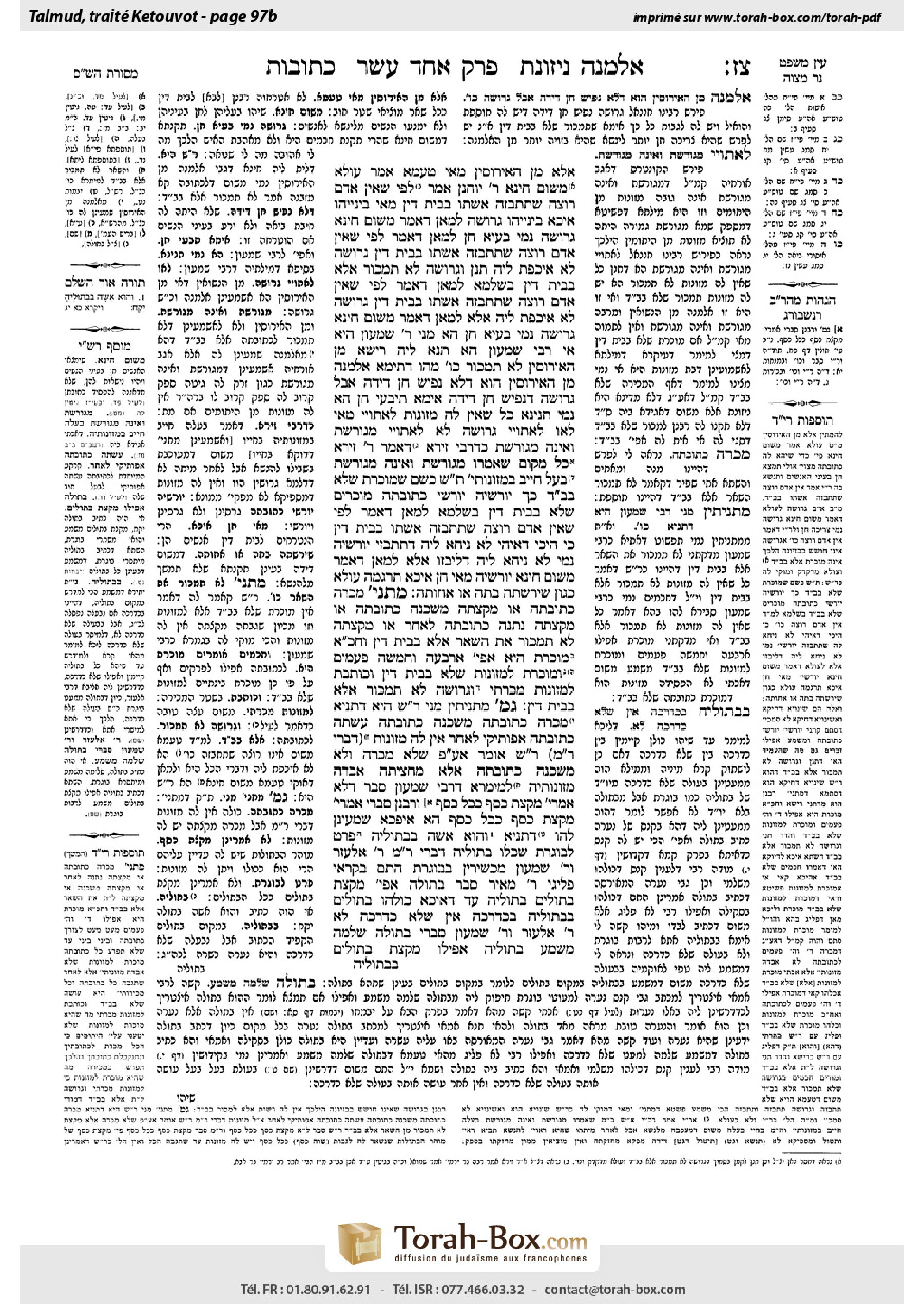
Ketubot 97b: Talmud study for Daf Yomi
Daf Yomi is the daily study of one Talmud folio. Explore 37 tractates with scans, Hebrew text, Sefaria English and AI-generated French translations where annotated.
Passage selection and English or AI-generated French translation are available where the scan has annotations. Daf Study is independent of Torah-Box and Sefaria.
Browse Ketubot · כתובות · All tractatesKetubot 97b text and translations
This page of Ketubot includes the Aramaic text, an English translation and an AI-generated French translation, alongside the scan above.
כתובות צ״ז ב · Aramaic and Hebrew text
אֶלָּא מִן הָאֵירוּסִין מַאי טַעְמָא? אָמַר עוּלָּא: מִשּׁוּם חִינָּא. רַבִּי יוֹחָנָן אָמַר: לְפִי שֶׁאֵין אָדָם רוֹצֶה שֶׁתִּתְבַּזֶּה אִשְׁתּוֹ בְּבֵית דִּין.
מַאי בֵּינַיְיהוּ? אִיכָּא בֵּינַיְיהוּ גְּרוּשָׁה. לְמַאן דְּאָמַר מִשּׁוּם חִינָּא — גְּרוּשָׁה נָמֵי בָּעֲיָא חֵן, לְמַאן דְּאָמַר לְפִי שֶׁאֵין אָדָם רוֹצֶה שֶׁתִּתְבַּזֶּה אִשְׁתּוֹ בְּבֵית דִּין — גְּרוּשָׁה לָא אִיכְפַּת לֵיהּ.
תְּנַן: וּגְרוּשָׁה לֹא תִּמְכּוֹר אֶלָּא בְּבֵית דִּין. בִּשְׁלָמָא לְמַאן דְּאָמַר לְפִי שֶׁאֵין אָדָם רוֹצֶה שֶׁתִּתְבַּזֶּה אִשְׁתּוֹ בְּבֵית דִּין — גְּרוּשָׁה לָא אִיכְפַּת לֵיהּ. אֶלָּא לְמַאן דְּאָמַר מִשּׁוּם חִינָּא, גְּרוּשָׁה נָמֵי בָּעֲיָא חֵן!
הָא מַנִּי — רַבִּי שִׁמְעוֹן הִיא.
אִי רַבִּי שִׁמְעוֹן, הָא תְּנָא לֵיהּ רֵישָׁא: מִן הָאֵירוּסִין לֹא תִּמְכּוֹר כּוּ׳?
מַהוּ דְּתֵימָא: אַלְמָנָה מִן הָאֵירוּסִין הוּא דְּלָא נְפִישׁ חֵן דִּידַהּ, אֲבָל גְּרוּשָׁה דִּנְפִישׁ חֵן דִּידַהּ, אֵימָא תִּיבְּעֵי חֵן.
הָא נָמֵי תְּנֵינָא: ״כֹּל שֶׁאֵין לָהּ מְזוֹנוֹת״. לְאֵתוֹיֵי מַאי? לָאו לְאֵתוֹיֵי גְּרוּשָׁה?
לָא, לְאֵתוֹיֵי ״מְגוֹרֶשֶׁת וְאֵינָהּ מְגוֹרֶשֶׁת״ — כִּדְרַבִּי זֵירָא. דְּאָמַר רַבִּי זֵירָא: כׇּל מָקוֹם שֶׁאָמְרוּ מְגוֹרֶשֶׁת וְאֵינָהּ מְגוֹרֶשֶׁת — בַּעַל חַיָּיב בִּמְזוֹנוֹתֶיהָ.
תָּא שְׁמַע: כְּשֵׁם שֶׁמּוֹכֶרֶת שֶׁלֹּא בְּבֵית דִּין, כָּךְ יוֹרְשֶׁיהָ יוֹרְשֵׁי כְתוּבָּתָהּ מוֹכְרִים שֶׁלֹּא בְּבֵית דִּין. בִּשְׁלָמָא לְמַאן דְּאָמַר לְפִי שֶׁאֵין אָדָם רוֹצֶה שֶׁתִּתְבַּזֶּה אִשְׁתּוֹ בְּבֵית דִּין, כִּי הֵיכִי דְּאִיהִי לָא נִיחָא לֵיהּ דְּתִתְבַּזֵּי — יוֹרְשֶׁיהָ נָמֵי לָא נִיחָא לֵיהּ דְּלִיבַּזּוּ, אֶלָּא לְמַאן דְּאָמַר מִשּׁוּם חִינָּא, יוֹרְשֶׁיהָ מַאי חֵן אִיכָּא? תַּרְגְּמַהּ עוּלָּא: כְּגוֹן שֶׁיְּרָשַׁתָּה בִּתָּהּ אוֹ אֲחוֹתָהּ.
מַתְנִי׳ מָכְרָה כְּתוּבָּתָהּ אוֹ מִקְצָתָהּ, מִשְׁכְּנָה כְּתוּבָּתָהּ אוֹ מִקְצָתָהּ, נָתְנָה כְּתוּבָּתָהּ לְאַחֵר אוֹ מִקְצָתָהּ — לֹא תִּמְכּוֹר אֶת הַשְּׁאָר אֶלָּא בְּבֵית דִּין. וַחֲכָמִים אוֹמְרִים: מוֹכֶרֶת הִיא אֲפִילּוּ אַרְבָּעָה וַחֲמִשָּׁה פְּעָמִים. וּמוֹכֶרֶת לִמְזוֹנוֹת שֶׁלֹּא בְּבֵית דִּין, וְכוֹתֶבֶת ״לִמְזוֹנוֹת מָכַרְתִּי״. וּגְרוּשָׁה לֹא תִּמְכּוֹר אֶלָּא בְּבֵית דִּין.
גְּמָ׳ מַתְנִיתִין מַנִּי? רַבִּי שִׁמְעוֹן הִיא. דְּתַנְיָא: מָכְרָה כְּתוּבָּתָהּ, מִשְׁכְּנָה כְּתוּבָּתָהּ, עָשְׂתָה כְּתוּבָּתָהּ אַפּוֹתֵיקֵי לְאַחֵר — אֵין לָהּ מְזוֹנוֹת, דִּבְרֵי רַבִּי מֵאִיר. רַבִּי שִׁמְעוֹן אוֹמֵר: אַף עַל פִּי שֶׁלֹּא מָכְרָה וְלֹא מִשְׁכְּנָה כְּתוּבָּתָהּ אֶלָּא מַחֲצִיתָהּ — אִבְּדָה מְזוֹנוֹתֶיהָ.
לְמֵימְרָא דְּרַבִּי שִׁמְעוֹן סָבַר דְּלָא אָמְרִינַן מִקְצָת כֶּסֶף כְּכׇל כֶּסֶף, וְרַבָּנַן סָבְרִי אָמְרִינַן מִקְצָת כֶּסֶף כְּכׇל כֶּסֶף?
הָא אִיפְּכָא שָׁמְעִינַן לְהוּ! דְּתַנְיָא: ״וְהוּא אִשָּׁה בִּבְתוּלֶיהָ״ — פְּרָט לְבוֹגֶרֶת שֶׁכָּלוּ בְּתוּלֶיהָ, דִּבְרֵי רַבִּי מֵאִיר. רַבִּי אֶלְעָזָר וְרַבִּי שִׁמְעוֹן מַכְשִׁירִין בְּבוֹגֶרֶת.
הָתָם בִּקְרָאֵי פְּלִיגִי. רַבִּי מֵאִיר סָבַר: ״בְּתוּלָה״ — אֲפִילּוּ מִקְצָת בְּתוּלִים. ״בְּתוּלֶיהָ״ — עַד דְּאִיכָּא כּוּלְּהוּ בְּתוּלִים. ״בִּבְתוּלֶיהָ״, בִּכְדַרְכָּהּ — אִין, שֶׁלֹּא כְּדַרְכָּהּ — לָא.
רַבִּי אֶלְעָזָר וְרַבִּי שִׁמְעוֹן סָבְרִי: ״בְּתוּלָה״ — שְׁלֵמָה מַשְׁמַע, ״בְּתוּלֶיהָ״ — אֲפִילּוּ מִקְצָת בְּתוּלִים.
Ketubot 97b · English translation
However, what is the reason that a widow from betrothal may sell property when not in court? Ulla said: Due to desirability. The Sages enacted several ordinances on behalf of women, so that men will want to marry them. Rabbi Yoḥanan said: Because a man does not want his wife to be disgraced by being involved in court proceedings.
The Gemara asks: What is the practical difference between the two opinions? The Gemara answers: The practical difference between them is in the case of a divorcée. According to the one who says that it is due to desirability, a divorcée also requires desirability. But according to the one who says that it is because a man does not want his wife to be disgraced in court, a man does not care if his ex-wife is disgraced.
We learned in the mishna (97b): And a divorcée may sell only in court. The Gemara asks: Granted, according to the one who says that this is because a man does not want his wife to be disgraced in court, here he does not care if his ex-wife is disgraced. However, according to the one who says that it is due to desirability, a divorcée also requires desirability, so why should she be required to sell in court?
The Gemara answers: In accordance with whose opinion is this continuation of the mishna? It is according to the opinion of Rabbi Shimon in the mishna, who explains that anyone who is selling property to receive payment of her marriage contract and not for sustenance is required to sell only in court, and a divorcée does not receive sustenance.
The Gemara asks: If this is according to the opinion of Rabbi Shimon, then wasn’t it already taught in the first clause that a widow from betrothal sells only in court because she does not receive sustenance? Since the same reasoning applies to a divorcée, why would the mishna have to teach the halakha again in this case?
The Gemara answers: It was necessary, lest you say: In the case of a widow from betrothal, she is not in great need of her desirability, as she has not been tarnished through sexual relations and men will not hold back from marrying her, and therefore she can go to the court to manage her affairs; however, a divorcée, who is in great need of her desirability and needs assistance in getting remarried, say that she requires desirability so that she will not be disgraced and she is allowed to take care of her affairs out of court. Lest you make this argument, the halakha was clearly stated in the mishna.
The Gemara asks: Didn’t we already learn this halakha, as it also says in the mishna the following generalization: And anyone who does not receive sustenance may sell only in court? This halakha was intended to add what? Was it not meant to add the case of a divorcée and teach that she can sell only in court, in which case the concluding remark of the mishna about the divorcée is superfluous?
The Gemara rejects this: No, it is to include a woman about whom there is uncertainty whether she is divorced or whether she is not divorced, and it is in accordance with the opinion of Rabbi Zeira, as Rabbi Zeira said: Wherever it was said: A woman that there is uncertainty whether she is divorced or whether she is not divorced, her husband is obligated to provide her sustenance until the divorce is final, and a woman in this situation may sell out of court as well.
The Gemara suggests: Come and hear proof: Just as the widow sells when not in court, so too, her heirs, those who inherit her marriage contract, sell when not in court. Granted, according to the one who says that the reason why she may sell out of court is because a man does not want his wife to be disgraced by having to appear in court, it is possible to say that just as he is not amenable to the idea that she will be disgraced, he also is not amenable to the idea that her heirs will be disgraced. However, according to the one who says that she sells out of court due to desirability, what desirability do her heirs need to have? Ulla interpreted it: This could take place, for example, when her daughter or her sister inherited from her, and they too need desirability.
MISHNA: If a woman sold all or part of her marriage contract, or if she mortgaged all or part of her marriage contract, or if she gave away as a gift all or part of her marriage contract to another, then she sells the remainder only in court. And the Rabbis say: She sells even four or five times, and she is not obligated to sell everything at one time. And despite selling several times, she sells for her sustenance even when not in court, and she writes in the bill of sale: I sold this for my sustenance. And a divorcée, who does not receive sustenance, sells only in court.
GEMARA: The Gemara asks: Whose opinion is expressed in the mishna? The Gemara answers: It is in accordance with the opinion of Rabbi Shimon, as it is taught in a baraita: If she sold all of her marriage contract, or mortgaged her marriage contract, or if she made her marriage contract designated repayment to another, she does not receive sustenance any longer; this is the statement of Rabbi Meir. Rabbi Shimon says: Although she has not sold or mortgaged her entire marriage contract, but only half of it, she has lost her right to sustenance. Therefore, she can only sell the rest of her marriage contract in court.
The Gemara asks: Is this to say that Rabbi Shimon holds that we do not say that part of the money has a status like the entire sum of money? Since she no longer has a claim to the entire sum of her marriage contract, it is as though she no longer has a marriage contract and loses her right to sustenance, and the Rabbis hold that we do say part of the money is like the entire money.
Didn’t we hear them say the opposite? As it is taught in a baraita concerning the verse that speaks about the High Priest (Leviticus 21:13): “And he shall take a wife in her virginity,” to exclude a grown woman whose sign of virginity has diminished because when a girl goes through puberty her hymen wears away; this is the statement of Rabbi Meir. Rabbi Elazar and Rabbi Shimon declare as fit even a grown woman for the High Priest. This implies that they are of the opinion that the absence of a part is not considered the absence of the whole, and although part of her sign of virginity has been diminished, it is still present.
The Gemara answers: There they disagree with regard to the interpretation of the verses. Rabbi Meir holds that were it stated in the verse a virgin, this general term would have indicated that as long as she is a virgin, even if she has only part of her sign of virginity, she could marry the High Priest. However, since the verse states: “Her virginity,” it means to say until there is a sign of virginity in its entirety. The addition of the prefix “in” to the phrase “in her virginity” teaches that if she engaged in sexual intercourse in the typical manner, i.e., in the place where her sign of virginity lies, then yes, it is considered that she has engaged in sexual intercourse and is no longer considered a virgin. But if she engaged in sexual intercourse in an atypical manner, i.e., anal intercourse, then she is not considered to have engaged in sexual intercourse.
By contrast, Rabbi Elazar and Rabbi Shimon hold that the word virgin implies a complete virgin, whose sign of virginity is completely intact. Therefore, when the verse says: “Her virginity,” it indicates that even if she has only part of her sign of virginity, in this regard she is still considered a virgin.
Ketubot 97b · Traduction française (IA)
Toutefois, pourquoi une veuve dont les fiançailles n’ont pas été suivies du mariage peut-elle vendre des biens hors du tribunal ? Oulla a dit : En raison de l’attrait qu’elle exerce. Les Sages ont institué plusieurs ordonnances en faveur des femmes, afin que les hommes souhaitent les épouser. Rabbi Yoḥanan a dit : Parce qu’un homme ne veut pas que sa femme soit humiliée en ayant à comparaître devant le tribunal.
La Guemara demande : Quelle est la différence pratique entre ces deux opinions ? La Guemara répond : La différence pratique concerne le cas d’une femme divorcée. Selon celui qui dit que c’est en raison de l’attrait qu’elle exerce, une femme divorcée a elle aussi besoin de préserver cet attrait. Mais selon celui qui dit que c’est parce qu’un homme ne veut pas que sa femme soit humiliée au tribunal, un homme ne se soucie pas que son ex-femme soit humiliée.
Nous avons appris dans la Michna (97b) : Une femme divorcée ne peut vendre qu’au tribunal. Cela se comprend selon celui qui dit que c’est parce qu’un homme ne veut pas que sa femme soit humiliée au tribunal : ici, il ne se soucie pas que son ex-femme soit humiliée. Cependant, selon celui qui dit que c’est en raison de l’attrait qu’elle exerce, une femme divorcée a elle aussi besoin de préserver cet attrait ; pourquoi devrait-elle donc être tenue de vendre au tribunal ?
La Guemara répond : De quelle opinion relève cette suite de la Michna ? De celle de Rabbi Chimon dans la Michna, qui explique que toute femme qui vend des biens pour percevoir le paiement de sa ketouba, et non pour assurer sa subsistance, doit vendre uniquement au tribunal ; or, une femme divorcée ne reçoit pas de subsistance.
La Guemara demande : Si cela relève de l’opinion de Rabbi Chimon, n’a-t-on pas déjà enseigné dans la première partie que la veuve dont les fiançailles n’ont pas été suivies du mariage ne vend qu’au tribunal, parce qu’elle ne reçoit pas de subsistance ? Puisque le même raisonnement s’applique à une femme divorcée, pourquoi la Michna devrait-elle enseigner de nouveau la halakha dans ce cas ?
La Guemara répond : C’était nécessaire, de peur que tu ne dises : Dans le cas d’une veuve dont les fiançailles n’ont pas été suivies du mariage, elle n’a pas grand besoin de préserver son attrait, car elle n’a pas été déshonorée par des relations sexuelles et les hommes ne s’abstiendront pas de l’épouser ; elle peut donc se rendre au tribunal pour régler ses affaires. En revanche, pour une femme divorcée, qui a grand besoin de préserver son attrait et a besoin d’aide pour se remarier, on pourrait dire qu’elle a besoin de préserver son attrait afin de ne pas être humiliée et qu’elle est autorisée à régler ses affaires hors du tribunal. Pour éviter que tu ne tiennes ce raisonnement, la halakha est explicitement énoncée dans la Michna.
La Guemara demande : N’avons-nous pas déjà appris cette halakha, puisque la Michna énonce aussi la règle générale suivante : Toute femme qui ne reçoit pas de subsistance ne peut vendre qu’au tribunal ? Quel cas cette halakha visait-elle à ajouter ? N’était-ce pas celui d’une femme divorcée, afin d’enseigner qu’elle ne peut vendre qu’au tribunal, auquel cas la remarque finale de la Michna au sujet de la femme divorcée est superflue ?
La Guemara rejette cette interprétation : Non, cela inclut une femme dont on ne sait pas avec certitude si elle est divorcée ou non, et cela est conforme à l’opinion de Rabbi Zeira. En effet, Rabbi Zeira a dit : Chaque fois qu’il est dit qu’il existe un doute quant à savoir si une femme est divorcée ou non, son mari est tenu de subvenir à ses besoins jusqu’à ce que le divorce soit définitif ; une femme dans cette situation peut donc, elle aussi, vendre hors du tribunal.
La Guemara propose : Viens et écoute une preuve : De même que la veuve vend hors du tribunal, ses héritiers, ceux qui héritent de sa ketouba, vendent eux aussi hors du tribunal. Cela se comprend selon celui qui dit que la raison pour laquelle elle peut vendre hors du tribunal est qu’un homme ne veut pas que sa femme soit humiliée en ayant à comparaître au tribunal ; on peut dire que, de même qu’il ne veut pas qu’elle soit humiliée, il ne veut pas non plus que ses héritiers soient humiliés. Cependant, selon celui qui dit qu’elle vend hors du tribunal en raison de l’attrait qu’elle exerce, de quel attrait ses héritiers ont-ils besoin ? Oulla l’a interprété ainsi : Cela peut se produire, par exemple, lorsque sa fille ou sa sœur a hérité d’elle ; elles aussi ont besoin de préserver leur attrait.
MICHNA : Si une femme a vendu tout ou partie de sa ketouba, ou si elle a hypothéqué tout ou partie de sa ketouba, ou si elle a fait don à quelqu’un de tout ou partie de sa ketouba, elle ne peut vendre le reste qu’au tribunal. Et les Rabbins disent : Elle peut vendre même quatre ou cinq fois, et elle n’est pas tenue de tout vendre en une seule fois. Malgré ces ventes répétées, elle peut vendre pour assurer sa subsistance même hors du tribunal, et elle inscrit dans l’acte de vente : « J’ai vendu ceci pour assurer ma subsistance. » Une femme divorcée, qui ne reçoit pas de subsistance, ne peut vendre qu’au tribunal.
GUEMARA : La Guemara demande : De quelle opinion relève la Michna ? La Guemara répond : Elle est conforme à l’opinion de Rabbi Chimon, comme il est enseigné dans une baraïta : Si elle a vendu toute sa ketouba, ou l’a hypothéquée, ou a cédé à quelqu’un le droit au remboursement de sa ketouba, elle ne reçoit plus de subsistance ; telle est la déclaration de Rabbi Meïr. Rabbi Chimon dit : Bien qu’elle n’ait vendu ni hypothéqué la totalité de sa ketouba, mais seulement la moitié, elle a perdu son droit à la subsistance. Par conséquent, elle ne peut vendre le reste de sa ketouba qu’au tribunal.
La Guemara demande : Faut-il en conclure que, selon Rabbi Chimon, on ne dit pas qu’une partie de la somme a le statut de la somme entière ? Puisqu’elle n’a plus de créance portant sur la totalité de sa ketouba, c’est comme si elle n’avait plus de ketouba et elle perd son droit à la subsistance ; les Rabbins, eux, considèrent qu’une partie de la somme équivaut à la somme entière.
N’avons-nous pas entendu dire le contraire ? Car une baraïta enseigne, au sujet du verset relatif au grand prêtre (Lévitique 21,13) : « Il prendra une femme dans sa virginité », ce qui exclut une femme adulte dont le signe de virginité a diminué, car lorsque la jeune fille atteint la puberté, son hymen s’use ; telle est la déclaration de Rabbi Meïr. Rabbi Elazar et Rabbi Chimon déclarent même apte au grand prêtre une femme adulte. Cela implique qu’ils considèrent que l’absence d’une partie n’est pas assimilée à l’absence du tout : bien qu’une partie de son signe de virginité ait diminué, celui-ci est toujours présent.
La Guemara répond : Là, ils sont en désaccord sur l’interprétation des versets. Rabbi Meïr considère que si le verset disait « une vierge », ce terme général indiquerait que, tant qu’elle est vierge, même si elle ne possède qu’une partie de son signe de virginité, elle pourrait épouser le grand prêtre. Cependant, puisque le verset dit « sa virginité », cela signifie que le signe de virginité doit être présent dans son intégralité. L’ajout de la préposition « dans » dans l’expression « dans sa virginité » enseigne que si elle a eu des relations sexuelles de la manière habituelle, c’est-à-dire à l’endroit où se trouve son signe de virginité, alors oui, on considère qu’elle a eu des relations sexuelles et elle n’est plus considérée comme vierge. Mais si elle a eu des relations sexuelles de manière inhabituelle, c’est-à-dire par voie anale, on ne considère pas qu’elle a eu des relations sexuelles.
À l’inverse, Rabbi Elazar et Rabbi Chimon considèrent que le mot « vierge » désigne une vierge dont le signe de virginité est entièrement intact. Par conséquent, lorsque le verset dit « sa virginité », cela indique que même si elle ne possède qu’une partie de son signe de virginité, à cet égard elle est toujours considérée comme vierge.
Traduction française générée par IA à partir de l’édition anglaise de Sefaria. Vérifie toujours un passage avec le texte source.
Text from Sefaria: William Davidson Edition - Vocalized Aramaic (CC BY NC); William Davidson Edition - English (CC BY NC).